- Market Value (2025): USD 2.4 Bn
- Estimated Value (2026): USD 2.7 Bn
- Forecast Value (2036): USD 7.4 Bn
- CAGR (2026-2036): 10.6%
What is the Electronic Data Capture Systems Market forecast to be worth by 2036?
USD 2.7 billion to USD 7.4 billion by 2036 at a 10.6% CAGR.
- The electronic data capture systems market reached USD 2.4 billion in 2025.
- Demand is projected to increase from USD 2.7 billion in 2026 to USD 7.4 billion by 2036.
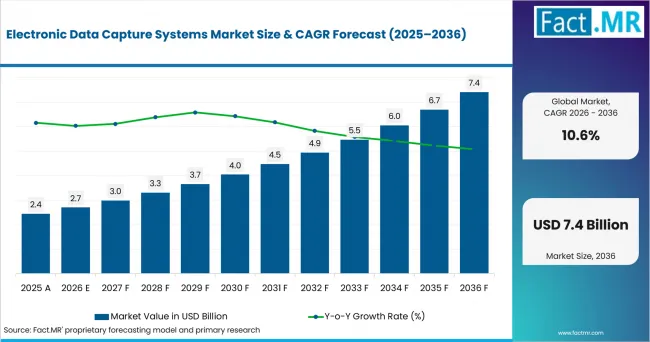
Electronic Data Capture Systems Market Value Analysis | Source: Fact.MR
What are the defining numbers behind Electronic Data Capture Systems Market growth?
An absolute opportunity of USD 4.7 billion is expected between 2026 and 2036.
- Demand Drivers in the Market
- Clinical trials generate participant and laboratory data across multiple sites, making centralized data collection essential. Electronic data capture systems allow investigators to enter information into standardized electronic case report forms while sponsors review study progress without waiting for paper records to be transferred.
- Regulatory expectations are strengthening demand for validated electronic systems. FDA guidance requires electronic records and signatures used in clinical investigations to be trustworthy and reliable, with controls covering access, audit trails and data retention. These requirements make compliant EDC platforms part of the core trial infrastructure.
- Data-quality requirements support wider use of automated checks. EDC systems can identify missing fields or inconsistent values during entry, allowing sites to resolve queries before database lock. Published research also finds that EDC can reduce data errors and improve access to trial information compared with paper-based collection.
- Sponsors are connecting EDC platforms with electronic health records and other clinical systems to reduce duplicate entry. The FDA has supported standards-based transfer of clinical research data from EHR systems into EDC platforms, which can reduce manual transcription and reconciliation work.
- Revised Good Clinical Practice requirements place greater emphasis on computerized-system controls and data governance. ICH E6(R3) requires access to clinical-trial systems to be restricted to authorized users, strengthening demand for platforms with role-based permissions and traceable record changes.
- Key Segments Analyzed
- Cloud-based EDC Platforms account for 42.0% of the Solution Type segment in 2026, supported by centralized access across distributed trial sites.
- Clinical Trial Data Management holds 44.0% of the Clinical Application segment in 2026 because EDC systems form the primary repository for structured study data.
- Pharmaceutical Companies represent 46.0% of the End-use Industry segment in 2026 due to their extensive clinical development portfolios.
- Clinical Research Organizations account for 43.0% of the User Category segment in 2026 as they operate EDC systems across multiple sponsor studies.
- SaaS Deployment holds 41.0% of the Deployment Model segment in 2026, reflecting demand for study-specific configuration without dedicated local infrastructure.
How does the Electronic Data Capture Systems Market break down by segment?
The market is segmented by Solution Type, Clinical Application, End-use Industry, User Category and Deployment Model.
Why does Cloud-based EDC Platform lead Solution Type?
Cloud-based EDC Platforms are projected to account for a 42.0% share in 2026.
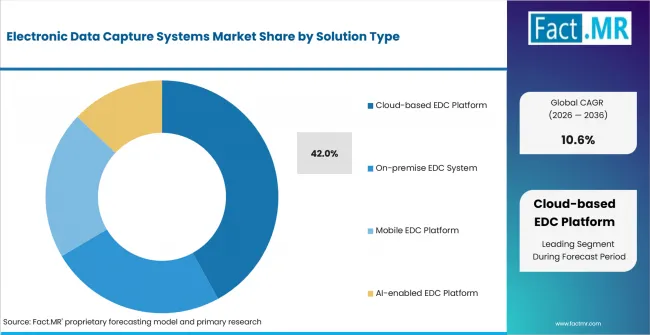
Electronic Data Capture Systems Market Analysis By Solution Type | Source: Fact.MR
Cloud platforms lead because clinical trials often involve sites operating across several countries. A centralized platform allows authorized users to enter and review data through a common system while sponsors manage study configuration and queries remotely.
Cloud delivery also supports controlled updates across all sites. EMA guidance requires computerized systems used in clinical trials to maintain data integrity throughout the electronic-data lifecycle, which favours platforms with centralized validation and audit controls.
Why does Clinical Trial Data Management lead Clinical Application?
Clinical Trial Data Management is projected to account for a 44.0% share in 2026.
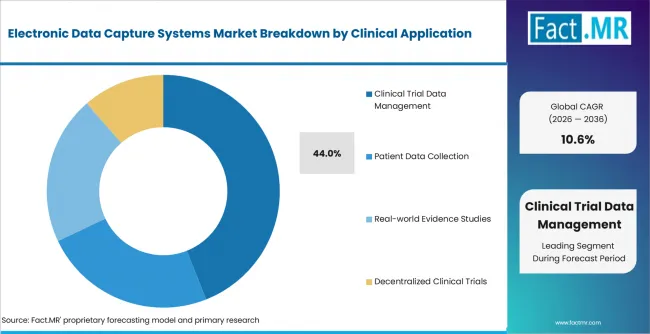
Electronic Data Capture Systems Market Analysis By Clinical Application | Source: Fact.MR
Clinical Trial Data Management leads because EDC systems are built around the capture and validation of protocol-defined study information. Data managers use these platforms to review entries and issue queries before preparing the database for statistical analysis.
Electronic systems can apply logic checks at the point of entry and report information in real time. This helps trial teams identify discrepancies earlier and reduces the delay associated with reviewing paper case report forms.
Why do Pharmaceutical Companies lead End-use Industry?
Pharmaceutical Companies are projected to account for a 46.0% share in 2026.
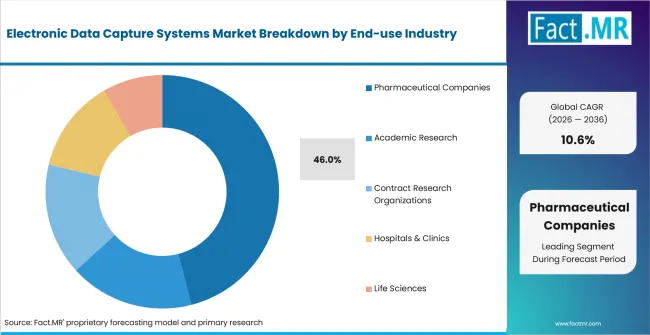
Electronic Data Capture Systems Market Analysis By End Use Industry | Source: Fact.MR
Pharmaceutical companies lead because EDC systems are used across drug-development programmes from early studies through post-market research. Sponsors require structured clinical datasets to assess safety and efficacy and support regulatory submissions.
Clinical data submitted to regulators must meet high standards for reliability and integrity. The FDA states that computerized clinical-trial systems create and maintain data that form the basis of decisions on medical products, making EDC quality central to pharmaceutical development.
Why do Clinical Research Organizations lead User Category?
Clinical Research Organizations are projected to account for a 43.0% share in 2026.
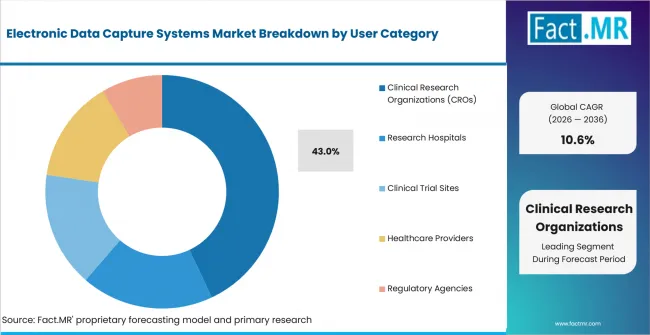
Electronic Data Capture Systems Market Analysis By User Category | Source: Fact.MR
CROs lead because they manage clinical data operations for several pharmaceutical and biotechnology sponsors. A configurable EDC platform allows them to build electronic case report forms and manage queries across different protocols without creating a separate technology environment for each client.
CROs must also demonstrate oversight of electronic systems and protect participant information. FDA guidance specifically applies electronic-record requirements to sponsors, investigators and CROs involved in clinical research.
Why does SaaS Deployment lead Deployment Model?
SaaS Deployment is projected to account for a 41.0% share in 2026.
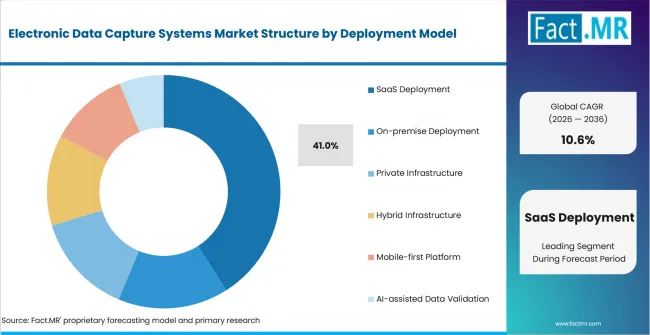
Electronic Data Capture Systems Market Analysis By Deployment Model | Source: Fact.MR
SaaS deployment leads because sponsors can provision an EDC environment for the duration of a study without purchasing permanent server infrastructure. Capacity and user access can be adjusted as sites are activated or closed.
The model also supports standardized software versions across participating centres. This reduces the risk that sites use different configurations and allows security or validation updates to be managed centrally.
What is accelerating Electronic Data Capture Systems Market adoption, and what is holding it back?
Drivers Impact Analysis
| Driver | (~) % Impact on CAGR | Geographic Relevance | Impact Timeline |
|---|---|---|---|
| Adoption and integration | +1.6% | Global | Short term (≤ 2 years) |
| Regulatory and compliance support | +1.4% | USA, Germany and UK | Short term (≤ 2 years) |
| Channel and access expansion | +1.1% | Global | Medium term (2–4 years) |
| Clear specification and documentation | +0.9% | USA, UK and Canada | Medium term (2–4 years) |
| Cost and efficiency gains | +0.6% | Global | Long term (≥ 4 years) |
Source: Fact.MR analysis. Updated Aug 7, 2026
Opportunity Impact Analysis
| Opportunity | (~) % Impact on CAGR | Geographic Relevance | Impact Timeline |
|---|---|---|---|
| Emerging application expansion | +1.0% | Global | Medium term (2–4 years) |
| Premium and specialist positioning | +0.8% | USA, UK and Germany | Medium term (2–4 years) |
| Channel and partner expansion | +0.7% | Global | Long term (≥ 4 years) |
| Standards and compliance alignment | +0.5% | USA, Canada and Singapore | Long term (≥ 4 years) |
Source: Fact.MR analysis. Updated Aug 7, 2026
Restraints Impact Analysis
| Restraint | (~) % Impact on CAGR | Geographic Relevance | Impact Timeline |
|---|---|---|---|
| Cost and complexity | -1.1% | Global | Short term (≤ 2 years) |
| Specification and compliance checks | -0.9% | USA, UK and Germany | Short term (≤ 2 years) |
| Substitution by lower-cost alternatives | -0.7% | Import-dependent markets | Medium term (2–4 years) |
| Supply chain and pricing pressure | -0.5% | Global | Long term (≥ 4 years) |
Source: Fact.MR analysis. Updated Aug 7, 2026
Which countries are scaling the Electronic Data Capture Systems Market fastest?
- USA: ClinicalTrials.gov listed more than 593,000 registered studies in July 2026, including over 167,000 studies conducted only in the USA. The scale of clinical research supports demand for EDC platforms that standardize case-report forms and manage data across sponsors and research sites.
- Germany: All new EU clinical-trial applications must be managed through the Clinical Trials Information System, while ongoing trials were required to transition to the current EU regulatory framework by January 2025. This reinforces demand for validated electronic systems and consistent data governance.
- Japan: PMDA accepts electronic study data and uses accumulated datasets in regulatory reviews. This creates demand for EDC systems capable of producing standardized and submission-ready clinical records.
- UK: Revised UK clinical-trial regulations came into force in April 2026, with updated requirements for sponsors and investigators. Regulatory change supports investment in systems that can maintain reliable trial data and adapt to revised reporting processes.
- Canada: Growth is supported by multinational study activity and the need to maintain electronic records across sponsors and sites. EDC platforms help Canadian trial teams manage data validation and remote oversight within international research programmes.
- Australia: Australia’s established clinical-research environment supports cloud EDC adoption across pharmaceutical trials and academic studies. Platforms that can support distributed sites and standardized data exchange are likely to gain greater use.
- Singapore: Singapore’s role as a regional clinical-trial hub supports demand for EDC systems used across multicountry Asia-Pacific studies. Secure cloud deployment is particularly relevant for sponsors coordinating data from geographically distributed sites.
Electronic Data Capture Systems Market Value Analysis | Source: Fact.MR
| Country | CAGR, 2026–2036 |
|---|---|
| USA | 11.8% |
| Germany | 11.3% |
| Japan | 10.9% |
| UK | 10.4% |
| Canada | 9.9% |
| Australia | 9.4% |
| Singapore | 8.9% |
Source: Fact.MR analysis. Updated Aug 7, 2026
What is driving USA’s growth through 2036?
The USA is forecast to expand at an 11.8% CAGR from 2026 to 2036.
Growth is supported by FDA requirements for electronic clinical records to remain trustworthy and reliable. The agency’s current guidance applies to sponsors and clinical investigators, as well as CROs, and addresses system validation, access controls and audit trails. This creates sustained demand for EDC platforms that can withstand regulatory inspection and preserve a traceable history of every data change.
What is driving Germany’s growth through 2036?
Germany is forecast to expand at an 11.3% CAGR from 2026 to 2036.
Germany operates within the EU Clinical Trials Regulation, under which sponsors submit and manage clinical trial applications through the Clinical Trials Information System. The regulation became fully applicable in January 2025, increasing the need for clinical data systems that can support standardized records and coordinated multinational trial operations.
What is driving Japan’s growth through 2036?
Japan is forecast to expand at a 10.9% CAGR from 2026 to 2036.
PMDA requires electronic study data for applicable regulatory submissions and provides detailed validation rules for submitted datasets. Sponsors conducting trials in Japan therefore need EDC systems capable of producing consistent source records and standardized data that can flow into regulatory submission packages.
What is driving the UK’s growth through 2036?
The UK is forecast to expand at a 10.4% CAGR from 2026 to 2036.
The amended UK Clinical Trials Regulations took effect in April 2026, updating the responsibilities of sponsors and investigators. The regulatory transition is encouraging trial operators to review data-governance processes and adopt platforms that can document oversight while supporting faster study setup and reporting.
What is driving Canada’s growth through 2036?
Canada is forecast to expand at a 9.9% CAGR from 2026 to 2036.
Health Canada’s updated Good Clinical Practice guidance applies to sponsors and qualified investigators, as well as service providers involved in drug trials. The framework reinforces accountability for trial records and system oversight, supporting EDC platforms with role-based access and controlled query management.
What is driving Australia’s growth through 2036?
Australia is forecast to expand at a 9.4% CAGR from 2026 to 2036.
Australia is developing national operating procedures for clinical trials that explicitly cover EDC systems and validated databases. The country is also promoting registry-based trials, broadening demand for platforms that can combine conventional study capture with structured clinical registry data.
What is driving Singapore’s growth through 2036?
Singapore is forecast to expand at an 8.9% CAGR from 2026 to 2036.
The Health Sciences Authority conducts Good Clinical Practice inspections covering trial documents, facilities and records at sponsor or CRO locations. Singapore has also introduced training on the revised ICH E6(R3) framework, encouraging trial operators to adopt EDC systems that support stronger data governance and inspection readiness.
Who leads the Electronic Data Capture Systems Market?
Veeva Systems is positioned as a leading provider through its clinical data platform and integration with wider life-sciences applications. Oracle and Medidata compete through established enterprise clinical-trial environments, while OpenClinica and Castor focus more closely on configurable EDC and research data capture.
Clario and Dassault Systèmes participate through broader clinical technology portfolios. Anju Software provides specialist clinical data-management applications, while IBM contributes enterprise data and cloud capabilities. Fortrea operates primarily as a CRO and service provider, giving it a different competitive role from dedicated EDC software vendors.
Competition depends on study-build speed and data validation capabilities. Sponsors also assess interoperability with randomization systems and electronic patient-reported outcome tools, along with the ability to export submission-ready datasets. FDA guidance makes trustworthy electronic records a regulatory expectation, while EU trial administration is increasingly organized through CTIS.
Cloud vendors benefit from the ability to configure studies across multiple countries without separate local installations. Specialist platforms can compete through shorter implementation cycles and support for academic or investigator-led trials.
Which companies are the key providers?
Key companies include Veeva Systems Inc.; Oracle Corporation; Medidata Solutions, Inc.; OpenClinica, LLC; Castor EDC B.V.; Clario; Dassault Systèmes SE; IBM Corporation; Anju Software, Inc.; and Fortrea Holdings Inc.
- Veeva Systems Inc.
- Oracle Corporation
- Medidata Solutions, Inc.
- OpenClinica, LLC
- Castor EDC B.V.
- Clario
- Dassault Systèmes SE
- IBM Corporation
- Anju Software, Inc.
- Fortrea Holdings Inc.
Bibliography
- Australian Government, Department of Health, Disability and Ageing. (2025). A Guide for Registry-Based Trials.
- Australian Government, Department of Health, Disability and Ageing. (2026). Draft National Standard Operating Procedures for Clinical Trials in Australia.
- European Medicines Agency. (2025). Clinical Trials Regulation Becomes Fully Applicable.
- European Medicines Agency. (2026). Clinical Trials Regulation and Clinical Trials Information System.
- Health Canada. (2026). Guidance for Clinical Trials in Human Participants under Part C, Division 5 of the Food and Drug Regulations.
- Health Sciences Authority, Singapore. (2026). Good Clinical Practice Inspections.
- Health Sciences Authority, Singapore. (2026). ICH E6(R3) Guideline for Good Clinical Practice.
- Medicines and Healthcare products Regulatory Agency. (2026). Clinical Trials for Medicines: Roles and Responsibilities.
- Pharmaceuticals and Medical Devices Agency. (2024). Frequently Asked Questions on Electronic Study Data Submission.
- U.S. Food and Drug Administration. (2024). Electronic Systems, Electronic Records, and Electronic Signatures in Clinical Investigations: Questions and Answers.
- U.S. Food and Drug Administration. (2018). Part 11, Electronic Records; Electronic Signatures: Scope and Application.
This Report Answers
- The report examines demand for electronic data capture systems across solution types and clinical applications.
- Segment analysis identifies the leading categories and their shares within the 2026 market.
- Country analysis compares growth across seven major clinical research markets.
- Competitive analysis assesses enterprise clinical platforms and specialist EDC providers.
- Application analysis reviews EDC use across conventional trials, decentralized studies and real-world evidence programmes.
What does the Electronic Data Capture Systems Market cover?
The market covers software used to collect, validate and manage structured data generated during clinical studies. These systems replace or supplement paper case report forms and provide a central environment for investigators, sponsors and data managers.
The assessment includes cloud, on-premise and mobile EDC systems used in pharmaceutical research, academic studies and decentralized trials. It also covers automated data validation and integration with related clinical systems.
What is included in the scope?
The scope includes EDC platforms used to design electronic case report forms, capture participant data and manage data queries. It covers systems used by pharmaceutical companies, CROs, hospitals and clinical trial sites.
The analysis also includes SaaS, private and hybrid deployments, along with mobile-first systems used for remote data collection. Demand is assessed across North America, Latin America, Europe, East Asia, South Asia and Pacific, and the Middle East and Africa.
What is excluded from the scope?
The scope excludes general hospital information systems and electronic health records that are not used for protocol-defined clinical data capture. Clinical trial management systems are excluded when they only manage study planning, budgeting or site operations without an EDC function.
Paper-only case report forms and standalone statistical analysis software also fall outside the market. eCOA, randomization and trial-supply platforms are included only when integrated into an EDC workflow.
How Was the Analysis Built?
The analysis draws on more than 120 sources, over 35 company portfolios and more than 20 industry interviews across at least 25 countries.
- Primary Research: Discussions with pharmaceutical sponsors, CROs and clinical data managers examine study-build requirements, validation practices and purchasing priorities.
- Desk Research: The review covers regulatory guidance, clinical-trial activity, company platforms and electronic data standards.
- Market Sizing and Forecasting: Estimates combine clinical-trial volumes, EDC adoption, study-level pricing and country growth.
- Data Validation and Update Cycle: Findings are checked against regulatory developments and company activity. Updates account for platform launches and changes in clinical-trial design.
Segmentation
What is the report’s scope and coverage?
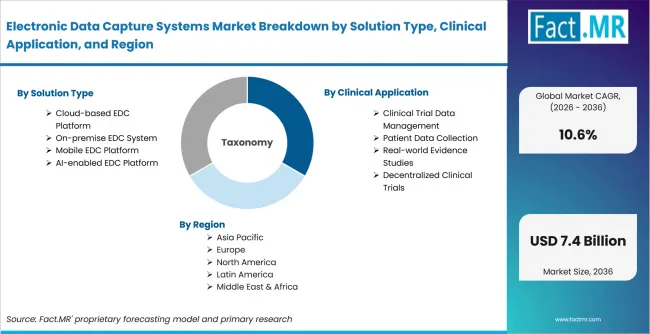
Electronic Data Capture Systems Market Breakdown By Solution Type, Clinical Application, And Region | Source: Fact.MR
| Attribute | Details |
|---|---|
| Quantitative Units | USD billion |
| Market Definition | Electronic systems used to capture and manage structured clinical research data |
| Segments Covered | Solution Type; Clinical Application; End-use Industry; User Category; Deployment Model |
| Regions Covered | North America; Latin America; Europe; East Asia; South Asia and Pacific; Middle East and Africa |
| Countries Covered | USA; Germany; Japan; UK; Canada; Australia; Singapore |
| Key Companies Profiled | Veeva Systems Inc.; Oracle Corporation; Medidata Solutions, Inc.; OpenClinica, LLC; Castor EDC B.V.; and others |
| Forecast Period | 2026 to 2036 |
| Approach | Hybrid top-down and bottom-up assessment using trial activity, solution adoption, segment shares, country growth and company portfolios |
Source: Fact.MR analysis. Updated Aug 7, 2026
How is the market segmented?
-
By Solution Type
- Cloud-based EDC Platform
- Multi-tenant Cloud EDC
- Private Cloud EDC
- On-premise EDC System
- Enterprise EDC Server
- Local Data Repository
- Mobile EDC Platform
- Android Data Capture
- iOS Data Capture
- AI-enabled EDC Platform
- Intelligent Data Validation
- Automated Query Management
- Cloud-based EDC Platform
-
By Clinical Application
- Clinical Trial Data Management
- Phase III Clinical Trials
- Phase IV Clinical Studies
- Patient Data Collection
- ePRO Integration
- Randomization & Trial Supply
- Real-world Evidence Studies
- Observational Studies
- Post-market Surveillance
- Decentralized Clinical Trials
- Remote Patient Monitoring
- Hybrid Clinical Trials
- Clinical Trial Data Management
-
By End-use Industry
- Pharmaceutical Companies
- Biotechnology Companies
- Medical Device Companies
- Academic Research
- Contract Research Organizations
- Government Research Institutes
- Hospitals & Clinics
- Clinical Research Centers
- Public Health Organizations
- Life Sciences
- Precision Medicine
- Genomics Research
- Pharmaceutical Companies
-
By User Category
- Clinical Research Organizations (CROs)
- Sponsors
- Site Management Organizations
- Research Hospitals
- Clinical Trial Sites
- Regulatory Authorities
- Healthcare Providers
- Data Managers
- Investigators
- Regulatory Agencies
- Ethics Committees
- Data Safety Monitoring Boards
- Clinical Research Organizations (CROs)
-
By Deployment Model
- SaaS Deployment
- Public Cloud
- Hybrid Cloud
- On-premise Deployment
- Private Infrastructure
- Hybrid Infrastructure
- Mobile-first Platform
- Offline Synchronization
- Secure Mobile Access
- AI-assisted Data Validation
- Predictive Analytics Engine
- Risk-based Monitoring Engine
- SaaS Deployment
-
By Region
- North America
- Latin America
- Western Europe
- Eastern Europe
- East Asia
- South Asia and Pacific
- Middle East & Africa
Frequently Asked Questions
Which Solution Type leads the market?
Which Clinical Application leads the market?
Which End-use Industry leads the market?
Which User Category leads the market?
Which Deployment Model leads the market?
Which country records the highest listed CAGR?
What is the primary driver in this market?
What is the main restraint?
Which companies are included in the market assessment?
Who worked on this report


Preview the report firsthand - request a free sample
Free SampleGet the brochure for pricing and purchase details
Download PDF