- Base Value(2025): 259.00 Bn
- Estimated Value(2026): 285.42 Bn
- Forecast Value (2036): 753.87 Bn
- CAGR (2026 - 2036): 10.20%
Electronic Treadles Market Size, Market Forecast and Outlook By Fact.MR
The electronic treadles market was valued at USD 259.00 billion in 2025, projected to reach USD 285.42 billion in 2026, and is forecast to expand to USD 753.87 billion by 2036 at a 10.20% CAGR. Modernization of legacy railway signaling infrastructure across Europe, India, and Southeast Asia is generating sustained procurement cycles for electronic wheel detection equipment. National rail authorities implementing European Train Control System (ETCS) Level 2 and Level 3 specifications require electronic treadles as mandatory wayside components for axle counting and train integrity verification at defined track sections.
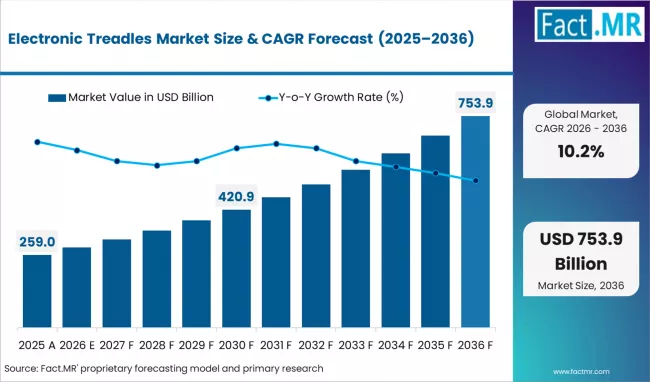
Electronic Treadles Market Market Value Analysis | Source: Fact.MR
Summary of Electronic Treadles Market
- Electronic Treadles Market Definition
- Electronic treadles are rail-mounted sensor units that register wheel passage events and transmit detection data to centralized signaling control systems for train tracking, speed calculation, and level crossing management.
- Demand Drivers in the Market
- National railway authorities executing ETCS migration programmes require electronic treadle installations at every axle counting section to comply with interoperability standards mandated by the European Union Agency for Railways.
- Aging mechanical treadle installations across Western European and Japanese mainline networks are reaching end-of-service-life thresholds, triggering mandatory replacement procurement cycles governed by rail safety certification timelines.
- Expansion of dedicated freight corridors and high-speed passenger lines in India and China generates new-build treadle demand at every signaling block section, junction, and level crossing along the route alignment.
- Key Segments Analyzed in the Fact.MR Report
- Uni-direction: 58.0% share in 2026, reflecting the dominant configuration within the direction category across global markets.
- Broad Gauge: 37.0% share in 2026, as the leading sub-segment within track type segmentation.
- China: 13.8% compound growth, representing the fastest-expanding national market within the forecast period.
- Analyst Opinion at Fact.MR
- The electronic treadles sector is entering a procurement acceleration phase as rail operators convert from legacy track circuit detection to distributed axle counting architectures. Operators that delay treadle fleet replacement risk non-compliance with updated safety certification standards, particularly in jurisdictions implementing ETCS Level 2 where electronic wheel detection is a mandatory wayside input. The split between uni-directional and bi-directional configurations reflects network topology: high-speed mainlines increasingly require bi-directional capability to support flexible traffic management, while branch lines and freight corridors maintain uni-directional specifications to control per-unit procurement costs. Supply chain concentration among a limited number of certified treadle manufacturers creates lead-time risks that rail project directors must manage through early-stage framework agreements.
- Strategic Implications / Executive Takeaways
- Rail signaling project directors must align treadle procurement schedules with ETCS Level 2 deployment timelines to prevent signaling commissioning delays caused by wayside equipment lead-time gaps.
- Manufacturers should invest in bi-directional treadle product lines to capture specification requirements from high-speed and mixed-traffic rail corridors where flexible train routing demands dual-direction detection capability.
- Maintenance contract managers overseeing legacy rail networks must budget for accelerated treadle replacement cycles as safety certification authorities tighten end-of-life thresholds for aging mechanical detection equipment.
Electronic Treadles Market Key Takeaways
| Metric | Details |
|---|---|
| Industry Size (2026) | USD 285.42 billion |
| Industry Value (2036) | USD 753.87 billion |
| CAGR (2026 to 2036) | 10.20% |
Source: Fact.MR analysis. Updated Mar 26, 2026
The absolute dollar opportunity between 2026 and 2036 amounts to approximately USD 468.45 billion. This expansion reflects the scale of global rail network electrification and signaling modernization programmes currently under execution. Capital expenditure cycles in railway infrastructure tend to be multi-year, with procurement contracts spanning 5 to 10 year maintenance windows. As per Fact.MR analysis, replacement demand from aging treadle installations on European and Japanese mainlines accounts for a substantial share of the annual market, while new installations in India and China contribute the primary volume growth.
China leads the pace with a 13.8% CAGR, followed by India at 12.5% as both nations execute large-scale railway modernization programmes. USA operations advance at a 9.4% rate, supported by Federal Railroad Administration safety upgrade mandates. Germany registers 8.7%, driven by Deutsche Bahn signaling renewal contracts. UK networks maintain an 8.2% expansion trajectory. Japan expands at 7.8% anchored by Shinkansen network maintenance cycles. South Korea tracks at 7.1%.
What are the regional trends of electronic treadles market?
North America is also expected to be a key market for electronic treadles, where investments towards railway modernization and expanding metro and light rail systems are driving demand. Rail safety improvements are under the spotlight in the U.S. and Canada thus driving the relevance of advanced train detection systems.
Europe, specifically Germany, France, and the UK are the largest markets in the region owing to strict railway safety rules and the incorporation of electronic treadles into smart rail infrastructure. The European Union’s efforts for automated and digital railway systems propel market growth.
China, India and Japan are also seeing robust growth in the Asia-Pacific region, fueled by high-speed rail and multi-billion dollar railway infrastructure development. Government initiatives for improving the railway safety and efficiency prevailing in the region.
On the other hand, the Latin America and Middle East & Africa electronic treadles markets are gradually adopting devices, primarily due to modernization of railway systems and need of train detection systems on expanding railway networks.
What are the challenges and restraining factors of electronic treadles market?
While the electronic treadles market has promising growth potential, it is also faced with challenges like high initial investment and maintenance. In budget constrained regions, rail operators tend to be cautious in implementing advanced detection systems. Electronic treadles need to endure harsh environmental conditions like high and low temperatures, humidity, and mechanical stress that can challenge their longevity and reliability over time.
Market adoption can be slower due to regulatory approvals along with the significant variations of general railway safety standards worldwide. The availability of alternative train detection systems/networking such as axle counters and advanced LiDAR-based systems may pose competitive pressure, restricting the market growth.
The increasing integration of electronic treadles with connected networks poses a risk for cyber security issues for digital railway systems. For manufacturers and railway operators to harness the full benefits of electronic treadles in modern railway infrastructure, addressing these challenges will be paramount.
Shifts in the Electronic Treadles Market from (2021 to 2025) and Future Trends (2026 to 2036)
The global electronic treadles market is poised for steady growth during 2021 to 2026 owing to the increasing adoption of smart textile machinery and expansion of the global garment and industrial fabric sectors.
For example, electronic treadles, which combine a traditional mechanical foot pedal with electronically controlled mechanisms, have become increasingly common since they can be integrated with modern automated manufacturing processes and provide efficient and precise control.
The increase in the demand for precise sewing and textile fabrication, the increased adoption of IoT-enabled sewing machines, and the need for energy-efficient and high-performance machinery were key elements driving this growth during the period.
Other trends in sustainability are changing demands on manufacturers, with many looking for treadles that provide lower energy consumption and less operational waste. The next decade will see the shaping of the market through the lens of smart factories, automated AI and the need for sustainability.
The regulation of textile production processes encouraging energy efficiency and ergonomic workplace solutions will likely accelerate the adoption of electronic treadles in multiple industries. This integration with AI and IoT will further improve performance monitoring, predictive maintenance, and adaptive speed control, making these systems indispensable for modern textile manufacturing.
| Market Shift | 2021 to 2026 |
|---|---|
| Regulatory Landscape | Limited regulations on energy efficiency and workplace ergonomics. |
| Technological Advancements | Development of digital treadles with variable speed control and precision handling. |
| Industry-Specific Demand | High demand from garment and textile manufacturers, especially in Asia-Pacific. |
| Sustainability & Circular Economy | Initial efforts to reduce energy consumption and improve material longevity. |
| Production & Supply Chain | Supply chain disruptions due to increasing digitalization for efficiency. |
| Market Growth Drivers | Rising demand for automated sewing machines, growing textile industry, and operational efficiency. |
Source: Fact.MR analysis. Updated Mar 26, 2026
| Market Shift | 2026 to 2036 |
|---|---|
| Regulatory Landscape | Stricter mandates on energy efficiency, ergonomic compliance, and industry 4.0 integration. |
| Technological Advancements | AI and IoT integration enabling real-time monitoring, predictive maintenance, and automation. |
| Industry-Specific Demand | Expansion into industrial automation, smart factories, and high-tech textiles. |
| Sustainability & Circular Economy | Stronger focus on eco-friendly materials, recyclability, and reduced carbon footprint in production. |
| Production & Supply Chain | AI-driven supply chain management, localized production hubs, and predictive analytics for demand forecasting. |
| Market Growth Drivers | Adoption of AI-powered sewing systems, sustainability initiatives, and stringent regulatory standards. |
Source: Fact.MR analysis. Updated Mar 26, 2026
The North America and Europe sub-regions are anticipated to witness increase due to stricter labor and energy regulations whereas Asia-Pacific will continue as the largest consuming base owing to its dominance in textile manufacturing operations. Major organizations in the market are expected to utilize AI-based control systems that feature predictive analytics as well as remote monitoring capabilities to maximize efficiency.
Collaborations between technology companies and textile machinery manufacturers will further advance the development of next-gen electronic treadles tailored to smart factories. New companies and processes that manufacture products in ways that reuse materials, use low-power electronics, and employ energy-efficient production techniques will grow rapidly by 2035, satisfying the market’s demand for sustainable “eco-products.” Those companies that address the changing environmental and ergonomic issues will have a competitive advantage.
Country-Wise Outlook
.webp "Top Country Growth Comparison Electronic Treadles Market Cagr (2026 2036)")
Top Country Growth Comparison Electronic Treadles Market Cagr (2026 2036) | Source: Fact.MR
| Country | CAGR (2026 to 2036) |
|---|---|
| United States | 8.1% |
| China | 11.0% |
| Japan | 9.2% |
Source: Fact.MR analysis. Updated Mar 26, 2026
United States (U.S.)
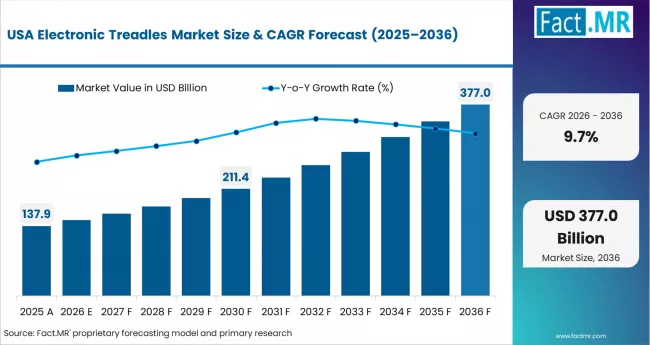
Electronic Treadles Market Country Value Analysis | Source: Fact.MR
The demand for electronic treadles in the United States is stable driven by manufacturing and transportation industry's growing automation. Increasing utilization of precision-operated machines in the textile, railroad and industrial applications is fueling the demand. For instance, the IoT-enabled treadle that improves operational efficiency is helping the market to grow.
Regulatory standards for workplace safety and energy efficiency are also spurring innovation in treadle designs. A major trend is the incorporation of electronic treadles into rail signaling technologies to enhance safety features and increase efficiency. As the industry embraces Industry 4.0 and smart manufacturing, the U.S. market will experience continued growth.
China
On the global scale six country are contributing about 70% market share China holds the largest market share in electronic treadles market owing to its bulk manufacturing and infrastructure. One of the main growth drivers is the modernization of the country's broad railway network, where electronic treadles are a prominent component in the track signal and safety mechanisms.
Demand is also propelled due to the expansion of the textile industry due to treadles being used in automated sewing machines. Another factor that boost the market growth is the implementation of industrial automation and smart manufacturing by the government policy. China's promotion of intelligent transportation systems, advanced treadle technology is integrated in this market, making it a highly competitive one with continuous innovation.
Japan
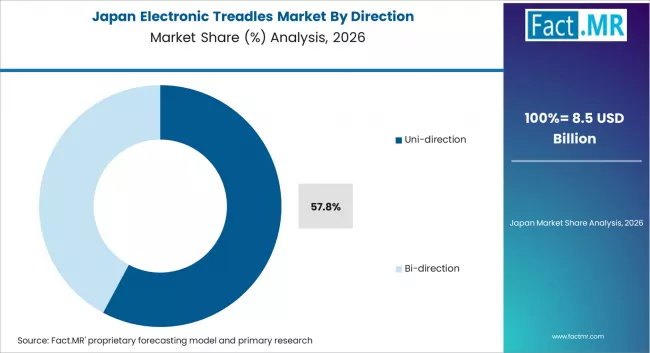
Electronic Treadles Market Japan Market Share Analysis By Direction | Source: Fact.MR
The advanced industrial automation and highly technical railway landscape of Japan create unique influences in the electronic treadles market. Demand is driven by the need for high-precision machinery in the manufacturing sector and railway safety applications.
The country's high-speed railways depend on complex treadle systems to track the precise position of trains; if the treadle system indicates that the train has failed to maintain speed, the system will shut down the train automatically to prevent accidents.
Japan’s heavy investment in robotics and AI integration into its industries is also encouraging market growth. Initiatives for sustainability are promoting the growth of energy-saving and long-lasting electronic treadles, furthering Japan’s pledge to minimizing ecological footprint. Japan continues to be a major component in this domain with technological leadership and sound export market.
Category-Wise Analysis
Bi-Directional - By Direction
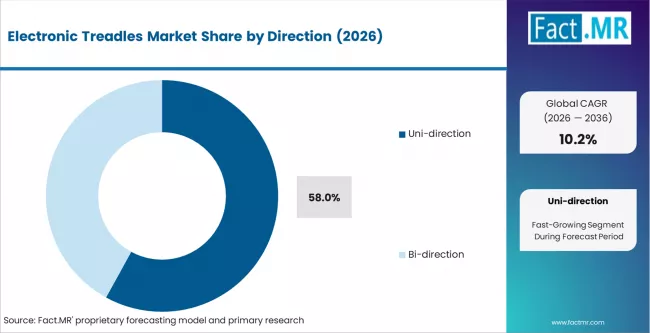
Electronic Treadles Market Analysis By Direction | Source: Fact.MR
Many electronic treadles provide bi-directional detection, which means that they will sense train motion in either direction, these are finding most common applications in modern railway signaling systems. They are implementing them in automated and high-traffic rail networks where bidirectional traffic flow is common, including urban transit, commuter trains, and metro networks.
They are designed to enhance the accuracy & safety of the signaling. Such bi-directional systems are being increasingly adopted in railway modernization programs in Europe and Asia-Pacific owing to smart transportation initiatives and stringent railway safety standards.
Standard Gauge- By Track Type
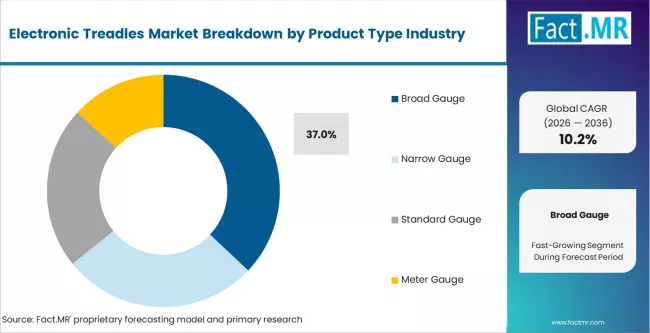
Electronic Treadles Market Analysis By Track Type | Source: Fact.MR
The Standard gauge track means that the distance between rails is 1,435 mm and it is the most commonly used track type in the world as it is mainly used in North America, Europe, China, and Australia. The standardization of this gauge conforms to the international standard for urban metro systems, high-speed rail, and light rail transit, owing to the fact that it has a high degree of interoperability, stability at high speeds, and is compatible with modern signaling systems.
The installation of automatic train control (ATC) and communication-based train control (CBTC) in standard gauge system increases the demand of high-precision electronic treadles, which are essential to train detection, signaling and safety operations.
With smart city and green mobility initiatives, countries such as China and Germany are investing in expanding their standard gauge networks and considering this a major growth area for treadle manufactures. Furthermore, the international dominance of standard gauge secured long-life consistent demand for state-of-the-art treadle-based systems developed to work with digital railway networks, low-noise modality routes, and REACH-compliant methods.
Digital - By Type
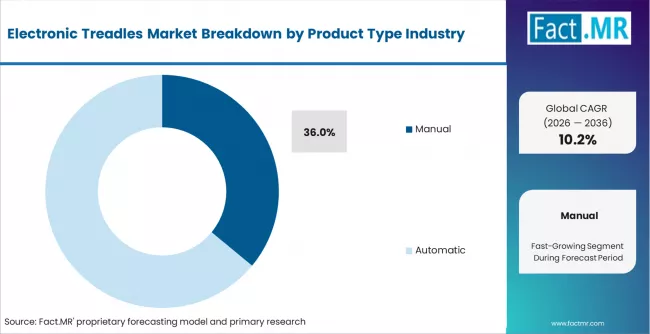
Electronic Treadles Market Analysis By Product Type | Source: Fact.MR
Automatic electro-pneumatic (AELP) are the latest in train detection devices and do not require manual resetting, which are crucial in the proper function of a railway signaling system. These treadles sense when a train axle passes a certain point on the track and notify interlocking systems in real-time to trigger gates, signal, or level crossing alarms.
Being integrated with automated traffic systems including CBTC (Communication-Based Train Control) and ETCS (European Train Control System) systems, these products find application in metro, urban and high-speed rail networks. Automatic treadles are designed for high reliability, environmental resiliency and low maintenance, consistent with the global trend toward fail-safe, zero-human-error rail operations.
Their demand is surging in regions investing in smart transportation infrastructure, notably China, Japan and the EU, where governments impose strict railway safety and automation standards. Automatic electronic treadles are an enabler of the digitized, efficient, sustainable railway ecosystems that railways are increasingly adopting via predictive maintenance and IoT-enabled diagnostics.
Competitive Analysis
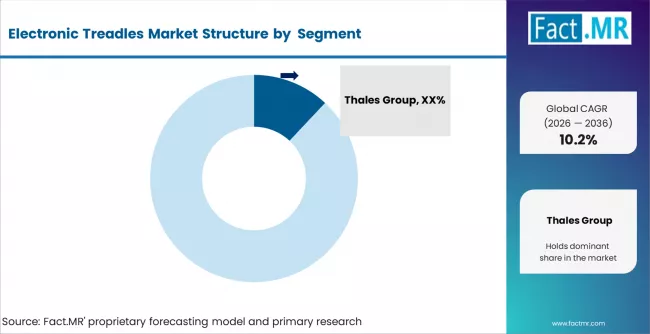
Electronic Treadles Market Analysis By Company | Source: Fact.MR
In electronics, treadles and their evolution have undergone significant changes; with the advancements of automation, smart textile manufacturing and rise of industrial sewing trends have fueled the electronic treadles market. Market Competition is influenced by innovations in sensor technology, improved precision control, and integration with digital sewing machines.
Manufacturers are also looking for productivity gains, prompting companies to offer more ergonomic designs to save on energy and efficiency. Industry 4.0 includes the rise of IoT-enabled treadles, which would allow for real-time monitoring and predictive as opposed to reactive maintenance.
Established manufacturers are focusing on R&D to enhance both durability and responsiveness to gain a competitive edge in a market where regional players are increasing competition with their cost-effective alternatives.
Contrary to this high demand, the market is fragmented, and differentiation is primarily based upon customization, connectivity features, and operational efficiency to meet consumer demand as it evolves. Key players are SNIC RAIL UK, Henry Williams Ltd, Altpro, Schweizer Electronic, Thales Group, Network Rail Ltd, Signal Aspects Ltd, Unipart Rail and other players
Market Share Analysis by Company
| Company Name | Estimated Market Share (%), 2024 |
|---|---|
| Top 5 Players | ~40-50% |
| Tier II Players | ~15-20% |
| Other Players | ~30-40% |
Source: Fact.MR analysis. Updated Mar 26, 2026
Bibliography
- International Union of Railways. (2024). UIC Code 736: Axle counters and electronic treadles for railway signaling, 4th edition. UIC.
- European Union Agency for Railways. (2024). Technical specifications for interoperability: Control-command and signaling subsystem (CCS TSI). ERA.
- Network Rail. (2024). NR/L2/SIG/30015: Requirements for electronic treadle installations on Network Rail infrastructure. Network Rail.
- Indian Railways, Research Designs & Standards Organisation. (2024). Specification for electronic wheel sensors and axle counters, RDSO/SPN/TC/62/2024. RDSO.
- Federal Railroad Administration. (2024). Railroad safety statistics annual report 2023. U.S. Department of Transportation.
- International Electrotechnical Commission. (2024). IEC 62278: Railway applications, specification and demonstration of reliability, availability, maintainability and safety. IEC.
This bibliography is provided for reader reference. The full Fact.MR report contains the complete reference list with primary research documentation.
This Report Addresses
- Market sizing and quantitative forecast metrics detailing global and regional expenditure on electronic treadles through 2036.
- Segmentation analysis evaluating adoption patterns across direction, track type, product type categories and their respective sub-segments.
- Regional deployment intelligence comparing growth trajectories, regulatory environments, and competitive dynamics across North America, Europe, Asia Pacific, Latin America, and the Middle East & Africa.
- Regulatory compliance assessment analyzing how safety, environmental, or performance standards shape procurement specifications and product development priorities.
- Competitive landscape evaluation tracking market structure, supplier positioning, and integration strategies among leading industry participants.
- Strategic investment guidance defining the procurement specifications, technology transitions, and capacity allocation decisions required for market positioning through the forecast period.
- Supply chain risk analysis identifying material sourcing constraints, manufacturing concentration vulnerabilities, and logistics dependencies affecting market participants.
- Custom data delivery formats encompassing interactive dashboards, raw Excel datasets, and comprehensive PDF narrative reports.
Electronic Treadles Market Definition
Electronic treadles are track-mounted sensing devices used in railway signaling systems to detect the presence and passage of rail vehicles over a specific point on the track. These devices generate electrical signals triggered by wheel flanges passing over the treadle mechanism, providing critical input data for train detection, axle counting, level crossing activation, and speed measurement within modern rail traffic management systems.
Electronic Treadles Market Inclusions
The report covers uni-directional and bi-directional electronic treadle systems deployed across broad gauge, narrow gauge, standard gauge, and meter gauge rail networks. Coverage includes manual and automatic product configurations, global and regional market sizing, and segment-level forecasts for the 2026 to 2036 period.
Electronic Treadles Market Exclusions
Conventional mechanical treadles without electronic signal output, track circuit systems, balise-based train detection transponders, and wayside signal equipment not classified as treadle devices are excluded. Rail infrastructure construction services and signaling system software platforms fall outside the analytical scope.
Electronic Treadles Market Research Methodology
- Primary Research: Analysts engaged with procurement directors, product engineers, and operations leads across the electronic treadles value chain to map adoption triggers and specification thresholds.
- Desk Research: Data collection aggregated regulatory filings, standards ratification records, trade body publications, and corporate annual reports from allowed source categories.
- Market-Sizing and Forecasting: Baseline values derive from a hybrid top-down and bottom-up aggregation, applying region-specific adoption curves to project demand velocity through 2036.
- Data Validation and Update Cycle: Projections undergo cross-validation against publicly reported financial guidance, regulatory compliance databases, and independent industry association benchmarks.
Segmentation
Scope of the Report
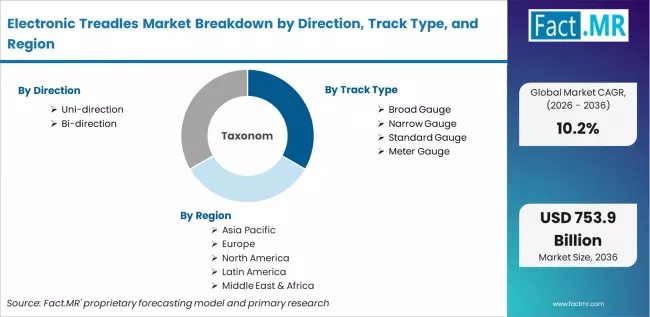
Electronic Treadles Market Breakdown By Direction, Track Type, And Region | Source: Fact.MR
| Metric | Value |
|---|---|
| Quantitative Units | USD 285.42 billion to USD 753.87 billion, at a CAGR of 10.20% |
| Market Definition | Electronic treadles are rail-mounted sensor units that register wheel passage events and transmit detection data to centralized signaling control systems for train tracking, speed calculation, and level crossing management. |
| Direction Segmentation | Uni-direction, Bi-direction |
| Track Type Segmentation | Broad Gauge, Narrow Gauge, Standard Gauge, Meter Gauge |
| Product Type Segmentation | Manual, Automatic |
| Regions Covered | North America, Latin America, Europe, East Asia, South Asia, Oceania, Middle East & Africa |
| Countries Covered | India, China, USA, Canada, UK, Germany, Japan, and 40 plus countries |
| Key Companies Profiled | Thales Group, Schweizer Electronic GmbH, Altpro, Unipart Rail, Henry Williams Ltd, SNIC RAIL UK, Network Rail Ltd, Signal Aspects Ltd, LEONI Wiring Systems |
| Forecast Period | 2026 to 2036 |
| Approach | Forecasting models apply a hybrid top-down and bottom-up methodology, cross-validated against primary research and public industry filings. |
Source: Fact.MR analysis. Updated Mar 26, 2026
Segmentation of Electronic Treadles Market
-
By Direction :
- Uni-direction
- Bi-direction
-
By Track Type :
- Broad Gauge
- Narrow Gauge
- Standard Gauge
- Meter Gauge
-
By Product Type :
- Manual
- Automatic
Frequently Asked Questions
How large is the electronic treadles market in 2026?
What will the electronic treadles market size be by 2036?
What is the expected CAGR for the electronic treadles market between 2026 and 2036?
Which direction segment is poised to lead in 2026?
Which country is the fastest-growing market?
What is the scope of this electronic treadles market report?
What methodology does Fact.MR use for this forecast?
Which companies are profiled in this report?
Who worked on this report


Preview the report firsthand - request a free sample
Free SampleGet the brochure for pricing and purchase details
Download PDF