- Market Value (2025): USD 132.9 Bn
- Estimated Value (2026): USD 147.2 Bn
- Forecast Value (2036): USD 410.5 Bn
- CAGR (2026-2036): 10.8%
What is the Automotive Electronic Manufacturing Services Market forecast to be worth by 2036?
USD 147.2 billion in 2026 to USD 410.5 billion by 2036 at 10.8% CAGR.
- The automotive electronic manufacturing services market reached USD 132.9 billion in 2025 as vehicle programs carried higher electronic content.
- Demand is projected to increase from USD 147.2 billion in 2026 to USD 410.5 billion by 2036.
- The market is forecast to record 10.8% CAGR from 2026 to 2036 owing to ECU consolidation, electrified platforms and connected cabin systems.
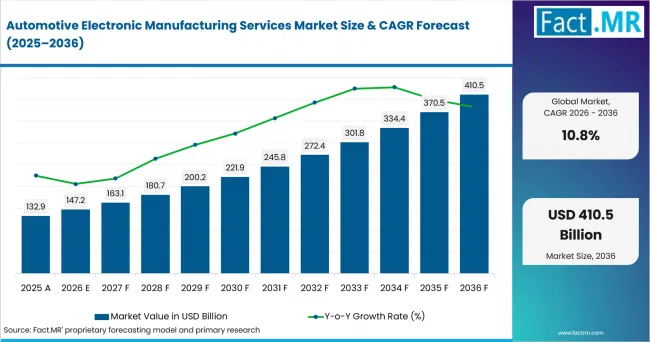
Automotive Electronic Manufacturing Services Market Value Analysis | Source: Fact.MR
What are the defining numbers behind Automotive Electronic Manufacturing Services Market growth?
USD 263.3 billion absolute opportunity by 2036, led by Audio And Infotainment and Electronic Control Unit assemblies alongside Original Equipment Manufacturers.
- Demand Drivers in the Market
- OEM electronics teams need external build support when new model programs carry more controllers, displays and sensor interfaces into the same launch window.
- The International Energy Agency reported in May 2025 that global electric car sales exceeded 17.0 million in 2024 and passed 20.0% sales share.
- Tier 1 suppliers need manufacturing partners that document traceability for ECUs and human-machine-interface components across several vehicle plants.
- Aftermarket channel teams are expected to rely on qualified assemblies where replacement infotainment modules and upgrade components must match vehicle software releases.
- Key Segments Analyzed
- By Application: Audio And Infotainment is expected to hold 23.6% share in 2026 because connected cabin content carries high assembly and testing needs.
- By Product: Electronic Control Unit is projected to account for 39.8% share in 2026 as vehicle functions shift toward software-managed control modules.
- By Sales Channel: Original Equipment Manufacturers are anticipated to capture 68.2% share in 2026 due to platform-level sourcing and launch qualification.
- Analyst Opinion at Fact.MR
- Shambhu Nath Jha, Principal Consultant at Fact.MR, states, “Automotive EMS selection is shifting from board build price to release evidence. Suppliers are expected to win programs when they combine clean electronics assembly with traceable software, component and quality records. The next contest is expected to be fought around qualification speed and warranty protection.”
- Strategic Implications
- OEM procurement teams should qualify EMS partners before final platform freeze so component sourcing and test plans do not delay vehicle launch.
- Tier 1 suppliers should keep design-for-manufacturing reviews close to ECU and display hardware teams to prevent late routing changes.
- Quality leaders should require recall-ready traceability. NHTSA reported on March 3, 2026 that 997 safety recalls were issued for vehicles and vehicle equipment in 2025, while more than 29 million vehicles were recalled.
- Investors should separate EMS providers with automotive release evidence from general electronics assemblers that lack PPAP, warranty and field-failure discipline.
Japan is projected to record 12.0% CAGR through 2036 supported by software-defined vehicle policy and local electronics depth. The USA is expected to post 11.3% CAGR owing to electrified vehicle registrations and SiC semiconductor investment. South Korea is forecast to advance at 9.6% CAGR as exports sustain module volumes. The UK is anticipated to hold 9.2% CAGR with zero-emission registrations lifting electronic content. Germany is estimated to reach 8.5% CAGR through automotive engineering depth and electronics order recovery.
How does the Automotive Electronic Manufacturing Services Market break down by segment?
Audio and Infotainment is expected to lead Application at 23.6% share in 2026. Electronic Control Unit is projected to lead Product at 39.8% share in 2026.
Which application dominates?
Audio and Infotainment is projected to account for 23.6% share in 2026.
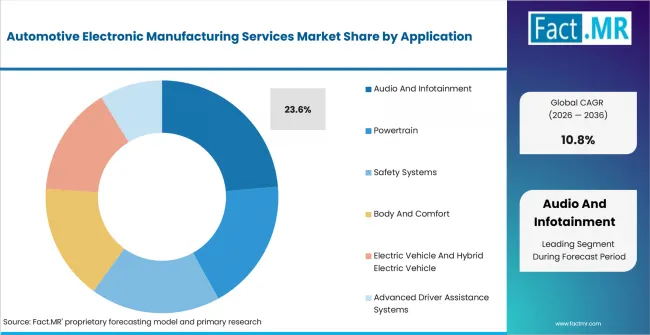
Automotive Electronic Manufacturing Services Market Analysis By Application | Source: Fact.MR
Audio and Infotainment leads because entertainment systems and connectivity solutions require dense boards, display interfaces and wireless modules. Powertrain applications remain relevant where internal combustion modules and electrified powertrain controls run in parallel across model portfolios. The U.S. Department of Energy's Alternative Fuels Data Center lists approximately 5,689,100 electric and 1,765,700 plug-in hybrid light-duty vehicles for the United States in its 2025 registration data, updated in June 2026.
What leads the Product segment?
Electronic Control Unit is expected to hold 39.8% share in 2026.
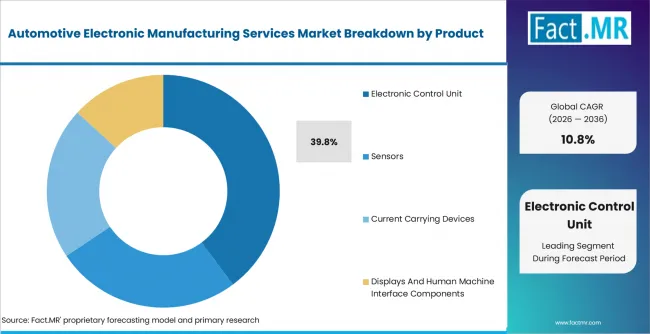
Automotive Electronic Manufacturing Services Market Analysis By Product | Source: Fact.MR
Electronic Control Unit demand is shaped by powertrain control units, body control units and safety control units that manage core vehicle functions. Sensors remain a second product group, led by position, temperature and pressure sensing devices. Displays and Human Machine Interface Components are expected to support cockpit upgrades. EMS providers are expected to win Product work when build controls match automotive-grade validation and software-release records.
How does Sales Channel shape demand?
Original Equipment Manufacturers are anticipated to lead with 68.2% share in 2026.
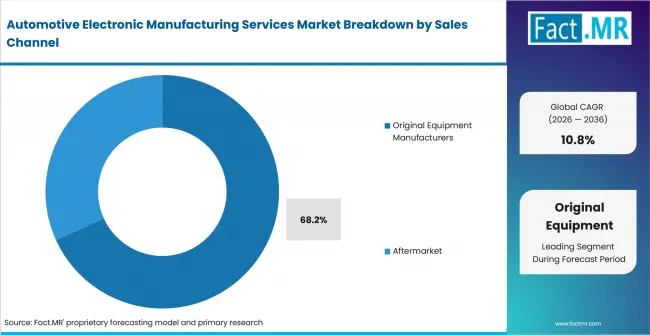
Automotive Electronic Manufacturing Services Market Analysis By Sales Channel | Source: Fact.MR
Original Equipment Manufacturers lead because EMS decisions are tied to platform timing, warranty exposure and validation records. Tier 1 suppliers remain central where complete module programs are outsourced before shipment into vehicle assembly plants. Direct Vehicle Manufacturers require tighter change-control records when software and hardware are released together. Aftermarket demand is smaller but useful for replacement components and upgrade components. The channel mix favors suppliers that serve OEM documentation requirements and keep flexible capacity for service programs.
What is accelerating Automotive Electronic Manufacturing Services Market adoption, and what is holding it back?
Electrified electronic content drives it; qualification and warranty risk restrain it.
Drivers Impact Analysis
| DRIVER | (~) % IMPACT ON CAGR | GEOGRAPHIC RELEVANCE | IMPACT TIMELINE |
|---|---|---|---|
| Electrified platform electronics | +2.6% | USA, Japan, South Korea | Short term (<= 2 years) |
| ECU consolidation | +2.2% | Japan, Germany, USA | Short term (<= 2 years) |
| Infotainment and connectivity upgrades | +1.8% | USA, UK, Japan | Medium term (2-4 years) |
| Safety and ADAS module growth | +1.5% | South Korea, Germany, USA | Medium term (2-4 years) |
| OEM outsourcing discipline | +1.1% | Global vehicle platforms | Long term (>= 4 years) |
Source: Fact.MR analysis. Updated Aug 14, 2026
- Electrified platform electronics: Battery systems and charging systems are expected to raise outsourced assembly value as EV and hybrid platforms carry more power-control electronics. EMS providers gain when they test high-voltage boards and document component traceability.
- ECU consolidation: Zonal and centralized architectures are anticipated to reduce the number of separate modules while raising the value of each qualified assembly. This is expected to favor providers that combine board build, firmware loading and end-of-line testing.
- Infotainment and connectivity upgrades: Cockpit electronics are projected to keep EMS demand visible because displays, antennas and processors must be integrated without delaying vehicle launch. Suppliers with display-bonding and radio-frequency testing remain useful to OEM programs.
- Safety and ADAS module growth: Driver monitoring, active safety and parking assistance are expected to increase testing depth for cameras, sensors and control units. Electronics partners must prove repeatable build quality before the vehicle maker accepts field risk.
- OEM outsourcing discipline: Vehicle manufacturers are forecast to outsource when internal electronics capacity is needed for software integration and architecture control. EMS partners that protect launch schedules are expected to hold more platform-level work.
Opportunity Impact Analysis
| OPPORTUNITY | (~) % IMPACT ON CAGR | GEOGRAPHIC RELEVANCE | IMPACT TIMELINE |
|---|---|---|---|
| Zonal control architectures | +1.5% | Japan and USA | Medium term (2-4 years) |
| Localized power electronics supply | +1.3% | USA, Germany, Japan | Medium term (2-4 years) |
| Cockpit display assemblies | +0.9% | UK, USA, Japan | Medium term (2-4 years) |
| Aftermarket electronic upgrades | +0.7% | Mature vehicle parks | Long term (>= 4 years) |
Source: Fact.MR analysis. Updated Aug 14, 2026
- Zonal control architectures: OEMs are expected to move more functions into larger domain or zonal controllers. EMS providers are expected to benefit when they support complex boards with higher pin counts and stricter thermal control.
- Localized power electronics supply: Regional sourcing is anticipated to create opportunity for EMS plants near EV and semiconductor clusters. The benefit is strongest where OEMs want shorter qualification loops and more visible component supply.
- Cockpit display assemblies: Infotainment displays, instrument clusters and heads up displays are forecast to need more precise assembly and inspection. EMS providers are expected to improve win rates by proving optical, bonding and vibration performance.
- Aftermarket electronic upgrades: Replacement modules are expected to create selective volume after the original vehicle launch. Suppliers need part-number discipline and software compatibility records to serve dealer and service channels.
Restraints Impact Analysis
| RESTRAINT | (~) % IMPACT ON CAGR | GEOGRAPHIC RELEVANCE | IMPACT TIMELINE |
|---|---|---|---|
| Automotive-grade qualification burden | -1.2% | Global | Short term (<= 2 years) |
| Recall and warranty exposure | -0.9% | USA and Europe | Short term (<= 2 years) |
| Semiconductor allocation cycles | -0.8% | Japan, Germany, South Korea | Medium term (2-4 years) |
| Cost pressure in legacy platforms | -0.6% | Global ICE platforms | Long term (>= 4 years) |
Source: Fact.MR analysis. Updated Aug 14, 2026
- Automotive-grade qualification burden: EMS partners must pass production part approval, testing and customer audits before platform release. Smaller assemblers are expected to lose bids when they cannot prove documentation depth.
- Recall and warranty exposure: Vehicle electronics failures are expected to create costly field actions and software repair campaigns. OEMs are expected to favor EMS partners with traceability systems that link components, boards and release records.
- Semiconductor allocation cycles: Automotive chips have longer qualification and supply approval paths than consumer electronics parts. EMS providers are expected to face margin pressure when component substitutions need new customer approval.
- Cost pressure in legacy platforms: Internal combustion platforms still need electronics but often carry tighter cost ceilings. This is expected to limit outsourcing premiums where module complexity remains low.
Which countries are scaling Automotive Electronic Manufacturing Services Market fastest?
- The country comparison spans 3.5 percentage points and forms three practical growth bands across the forecast period.
- Japan remains 0.7 percentage point above the USA through software-defined vehicle policy and domestic electronics capability.
- The USA remains 1.7 percentage points above South Korea owing to EV registrations and SiC supply-chain investment.
- South Korea remains 0.4 percentage point above the UK as export-oriented vehicle production sustains electronics module volume.
- The UK remains 0.7 percentage point above Germany because zero-emission vehicle adoption lifts selective electronics content.
- Germany closes the displayed range while retaining engineering depth in ECUs, automotive chips and control modules.
Comparable CAGRs create different entry conditions due to OEM concentration, semiconductor access and electronics qualification depth. Full report coverage includes North America, Latin America, Europe, East Asia, South Asia and Pacific, Middle East and Africa.
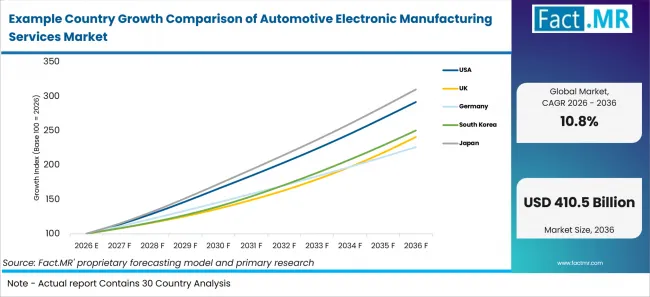
Example Country Growth Comparison Of Automotive Electronic Manufacturing Services Market | Source: Fact.MR
| Country | CAGR (2026-2036) |
|---|---|
| Japan | 12.0% |
| USA | 11.3% |
| South Korea | 9.6% |
| UK | 9.2% |
| Germany | 8.5% |
Source: Fact.MR analysis. Updated Aug 14, 2026
What supports Japan adoption?
12.0% CAGR, supported by software-defined vehicle policy and semiconductor planning.
Japan's growth reflects an automotive base where electronics, software and control architecture are planned together. METI and MLIT updated the Mobility DX Strategy on June 9, 2025 and retained a goal for Japanese software-defined vehicles to account for 30% of global SDV unit sales in both 2030 and 2035. EMS providers are expected to benefit where OEMs need qualified ECU build support without losing control over release records.
How is the USA scaling demand?
11.3% CAGR, driven by electrified vehicle registrations and SiC localization.
The USA automotive electronic manufacturing services market hold 11.3% CAGR through 2036. On July 13, 2026, the U.S. Department of Commerce announced a Direct Funding Agreement with Bosch for up to USD 225 million in CHIPS incentives to support Bosch's USD 2.0 billion investment in a silicon carbide semiconductor facility in Roseville, California.
How is South Korea developing demand?
9.6% CAGR, supported by export volume and eco-friendly vehicle sales.
South Korea’s EMS opportunity is tied to export platforms and high-volume model programs. MOTIR reported in January 2026 that automobile exports reached USD 72.0 billion in 2025 and eco-friendly vehicle sales reached 813,000 units. That base is expected to support outsourced electronics for battery controls, connected cabin modules and ADAS hardware.
What supports UK adoption?
9.2% CAGR, with growth in the licensed zero-emission car stock used as supporting context.
The UK demand base is smaller than the USA and Japan, but zero-emission programs raise electronic content per vehicle. The Department for Transport reported in April 2026 that the UK had 1,737,000 zero-emission cars at the end of 2025, up 35.0% from 2024. EMS demand is expected to be strongest in specialist vehicle programs, cockpit electronics and EV control assemblies.
How does Germany perform?
8.5% CAGR, backed by automotive engineering and electronics order depth.
Germany's growth is shaped by mature OEM engineering and strict supplier qualification. In its February 5, 2026 provisional release, Destatis reported that, in December 2025 versus November 2025 on a seasonally and calendar-adjusted basis, new orders rose 9.8% in electrical equipment and 5.7% in computer, electronic and optical products, while automotive-industry orders fell 6.3%. EMS providers are expected to win work when they support German documentation requirements and absorb timing changes.
Which companies are profiled around the Automotive Electronic Manufacturing Services Market?
Jabil and Flex show the clearest direct relevance, while Sanmina strengthens the wider automotive electronics manufacturing-services landscape.
Jabil supports outsourced manufacturing of vehicle electronic assemblies across ECU, infotainment, sensor and electrified-platform programs. Flex contributes automotive electronics manufacturing aligned with OEM and Tier 1 sourcing requirements. Sanmina adds adjacent electronics assembly, testing and qualification capability. Kimball Electronics / Kimball Solutions and Zollner Elektronik extend the competitive field through automotive-focused electronics manufacturing services, while Universal Scientific Industrial (USI) adds further electronic assembly and manufacturing capacity.
Which companies are profiled in the automotive-electronics manufacturing services market?
Key companies include Jabil Inc.; Flex Ltd.; Sanmina Corporation; Kimball Electronics / Kimball Solutions; Zollner Elektronik AG; and Universal Scientific Industrial (USI).
- Jabil Inc.
- Flex Ltd.
- Sanmina Corporation
- Kimball Electronics / Kimball Solutions
- Zollner Elektronik AG
- Universal Scientific Industrial (USI)
Bibliography
- Department for Transport. (2026, April 29). Vehicle licensing statistics, United Kingdom: 2025. GOV.UK.
- Federal Statistical Office (Destatis). (2026, February 5). New orders in manufacturing in December 2025: +7.8% on the previous month.
- International Energy Agency. (2025, May 14). Global EV Outlook 2025: Expanding sales in diverse markets.
- Ministry of Economy, Trade and Industry. (2025, June 9). Mobility Digital Transformation (DX) Strategy updated.
- Ministry of Trade, Industry and Resources. (2026, January 15). Automobile exports hit record high of $72 billion in 2025.
- National Highway Traffic Safety Administration. (2026, March 3). Consumer alert: Time to check for vehicle safety recalls.
- National Institute of Standards and Technology. (2026, July 13). Department of Commerce announces direct funding agreement with Bosch for a $225 million CHIPS Program award to support domestic production of silicon carbide semiconductors.
- NXP Semiconductors. (2025, March 11). New S32K5 microcontroller family advances zonal SDV architectures and extends the NXP CoreRide platform.
This Report Answers
- The report provides strategic intelligence on the Automotive Electronic Manufacturing Services Market across Application, Product and Sales Channel choices that shape vehicle electronics outsourcing.
- Segment analysis covers Audio And Infotainment and Electronic Control Unit as the share leaders within the 2026 market.
- Country outlook evaluates Japan and the USA alongside South Korea. The UK and Germany complete the growth comparison across the profiled markets.
- Competitive analysis profiles Bosch and Denso alongside Continental and ZF as automotive-electronics ecosystem participants. Infineon, NXP, Astemo and other component or semiconductor providers complete the profiled set; the list is not a pure-play EMS peer group.
- Channel assessment covers Original Equipment Manufacturers and Tier 1 Suppliers. Direct Vehicle Manufacturers and Aftermarket complete the channel view.
What does the Automotive Electronic Manufacturing Services Market cover?
Automotive electronic manufacturing services cover outsourced build, assembly, testing and release support for vehicle electronics where quality records decide platform approval.
The market covers EMS work used in ECUs, sensors, infotainment electronics and EV-related power-control assemblies. It is connected to adjacent automotive electronics programs when OEMs outsource manufacturing but keep platform release control.
Coverage includes semiconductor-heavy modules that rely on automotive semiconductors and automotive power electronics where design changes must be controlled before production release.
Cockpit demand links the market to automotive cockpit electronics, auto infotainment and automotive smart display work that requires display assembly, optical checks and functional testing.
What is included in the scope?
The scope includes Application, Product and Sales Channel. It covers EMS activities linked to design-for-manufacturing input, component sourcing support, PCB assembly, module integration, testing and launch documentation.
ADAS-related coverage includes modules used with automotive radar sensors, automotive pressure sensor and central controller programs where electronics reliability affects vehicle safety claims.
Software-managed vehicle content is included where hardware build and release records support automotive software, vehicle control unit and ADAS controller assembly needs.
What is excluded from the scope?
General consumer electronics EMS, unrelated industrial PCB assembly and standalone semiconductor wafer fabrication remain outside the scope of this market.
The scope excludes software development contracts when no manufacturing or assembly responsibility is included. Vehicle mechanical parts, batteries sold as cells, aftermarket accessories without electronic control functions and general wiring work outside vehicle electronic modules are also excluded. Company revenue is excluded when it cannot be tied to automotive electronic assembly, control modules, sensors, displays or related release work.
How Was the Analysis Built?
The analysis draws on 120+ sources, 35+ company portfolios, 25+ countries, and more than 20 industry interviews.
- Primary Research: Primary research includes discussions with manufacturers, service providers, technology developers, distributors, end users, procurement teams, and subject-matter experts. These conversations examine purchasing priorities, product adoption, operational challenges, approval requirements, competitive positioning, and the factors that influence wider market acceptance.
- Desk Research: Desk research covers government statistics, regulatory publications, company filings, trade data, technical studies, industry associations, standards, public policy, and other authoritative sources. Every source used in the analysis is documented in the bibliography.
- Market Sizing and Forecasting: Market estimates combine historical performance, demand indicators, pricing and volume trends, segment shares, company participation, country-level growth, adoption patterns, investment activity, and barriers to market expansion.
- Data Validation and Update Cycle: Findings are validated by comparing primary interviews with public data, company activity, regulatory changes, trade patterns, and industry developments. Regular updates review new product launches, capacity changes, partnerships, approvals, procurement trends, and shifts in commercial adoption.
Segmentation
What is the report’s scope and coverage?
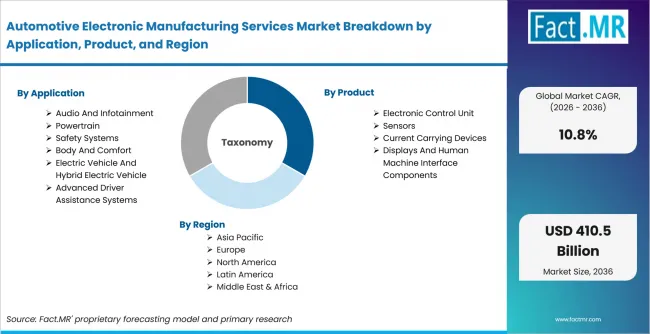
Automotive Electronic Manufacturing Services Market Breakdown By Application, Product, And Region | Source: Fact.MR
| Attribute | Details |
|---|---|
| Quantitative Units | USD billion |
| Market Definition | Outsourced and partner-supported manufacturing of vehicle electronic assemblies used in control, safety, comfort, connectivity, electrified powertrain and cockpit systems |
| Application | Audio And Infotainment; Powertrain; Safety Systems; Body And Comfort; Electric Vehicle And Hybrid Electric Vehicle; Advanced Driver Assistance Systems |
| Product | Electronic Control Unit; Sensors; Current Carrying Devices; Displays And Human Machine Interface Components |
| Sales Channel | Original Equipment Manufacturers; Tier 1 Suppliers; Direct Vehicle Manufacturers; Aftermarket |
| Regions Covered | North America; Latin America; Europe; East Asia; South Asia and Pacific; Middle East and Africa |
| Countries Covered | USA; UK; Germany; South Korea; Japan |
| Key Companies Profiled | Jabil Inc.; Flex Ltd.; Sanmina Corporation; Kimball Electronics / Kimball Solutions; Zollner Elektronik AG; and Universal Scientific Industrial (USI) |
| Forecast Period | 2026 to 2036 |
| Approach | Hybrid top-down and bottom-up approach using vehicle electronics content; ECU and sensor assembly demand; EV and hybrid platform growth; infotainment and connectivity programs; safety electronics adoption; OEM sourcing behavior; aftermarket replacement needs; country adoption patterns and company portfolio review |
Source: Fact.MR analysis. Updated Aug 14, 2026
How is the market segmented?
-
By Application
- Audio And Infotainment
- Entertainment Systems
- Connectivity Solutions
- Powertrain
- Internal Combustion Powertrain
- Electrified Powertrain
- Safety Systems
- Active Safety Systems
- Passive Safety Systems
- Body And Comfort
- Interior Electronics
- Exterior Electronics
- Electric Vehicle And Hybrid Electric Vehicle
- Battery Systems
- Charging Systems
- Advanced Driver Assistance Systems
- Driver Monitoring Systems
- Autonomous Driving Support
- Parking Assistance
- Audio And Infotainment
-
By Product
- Electronic Control Unit
- Powertrain Control Unit
- Body Control Unit
- Safety Control Unit
- Infotainment Control Unit
- Sensors
- Position Sensors
- Temperature Sensors
- Pressure Sensors
- Advanced Sensing Devices
- Current Carrying Devices
- Wiring Harnesses
- Connectors
- Relays And Switches
- Displays And Human Machine Interface Components
- Instrument Clusters
- Infotainment Displays
- Heads Up Displays
- Electronic Control Unit
-
By Sales Channel
- Original Equipment Manufacturers
- Tier 1 Suppliers
- Direct Vehicle Manufacturers
- Aftermarket
- Replacement Components
- Upgrade Components
- Original Equipment Manufacturers
-
By Region
- North America
- Latin America
- Western Europe
- Eastern Europe
- East Asia
- South Asia and Pacific
- Middle East & Africa
Frequently Asked Questions
How big is the automotive electronic manufacturing services market in 2026?
What is the CAGR of the automotive electronic manufacturing services market from 2026 to 2036?
Which application leads the automotive electronic manufacturing services market?
Which product leads the automotive electronic manufacturing services market?
Who are the leading companies in the automotive electronic manufacturing services market?
Who worked on this report


Preview the report firsthand - request a free sample
Free SampleGet the brochure for pricing and purchase details
Download PDF