- Base Value(2025): 11.50 Bn
- Estimated Value(2026): 12.17 Bn
- Forecast Value (2036): 21.38 Bn
- CAGR (2026 - 2036): 5.8%
Automotive Power Electronics Market Size, Market Forecast and Outlook By Fact.MR
The automotive power electronics market was valued at USD 11.50 billion in 2025, projected to reach USD 12.17 billion in 2026, and is forecast to expand to USD 21.38 billion by 2036 at a 5.8% CAGR. The accelerating transition to electric and hybrid vehicle production is the structural driver expanding automotive power electronics demand at rates significantly exceeding overall vehicle production growth. A conventional ICE vehicle contains approximately USD 50 to USD 80 of power electronics content (primarily alternator regulators and ignition modules), while a battery electric vehicle carries USD 800 to USD 1,500 of power electronics comprising the traction inverter, onboard charger, DC-DC converter, and power distribution unit. This ten-fold content multiplier means that every percentage point of BEV penetration growth translates into a disproportionate increase in power electronics demand.
The USA leads growth at a 6.0% CAGR, driven by EV production scale-up and federal investment in domestic power semiconductor manufacturing under the CHIPS and Science Act. Mexico follows at 5.8%, supported by power electronics assembly operations supplying North American EV plants. Germany expands at 5.5% as Infineon, Bosch, and Continental scale SiC-based inverter production for European OEMs. South Korea tracks at 5.3% driven by Hyundai Motor Group procurement and domestic SiC wafer production by SK Siltron. France registers 5.2% growth linked to Stellantis EV platform power electronics sourcing. The UK and Japan both advance at 5.0%, where Toshiba, Mitsubishi Electric, and Hitachi maintain strong positions in IGBT and SiC module manufacturing.
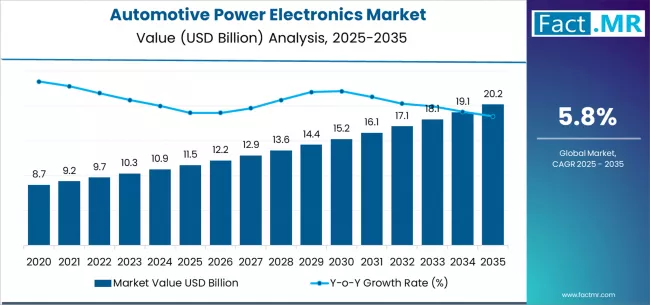
Automotive Power Electronics Market Market Value Analysis | Source: Fact.MR
Automotive Power Electronics Market Key Takeaways
| Metric | Details |
|---|---|
| Industry Size (2026) | USD 12.17 billion |
| Industry Value (2036) | USD 21.38 billion |
| CAGR (2026 to 2036) | 5.8% |
Source: Fact.MR analysis. Updated Mar 20, 2026
Automotive Power Electronics Market Definition
The automotive power electronics market covers semiconductor-based modules and systems that convert, control, and distribute electrical power within vehicle architectures. Core product categories include traction inverters that convert DC battery power to AC for electric motor drive, DC-DC converters that step voltage between the high-voltage traction bus and the 12V/48V auxiliary bus, onboard chargers (OBC) that convert AC grid power to DC for battery charging, and power distribution units (PDU) that manage high-voltage circuit protection and switching. These systems employ silicon (Si) IGBT, silicon carbide (SiC) MOSFET, and gallium nitride (GaN) semiconductor devices as the primary switching elements.
Automotive Power Electronics Market Inclusions
The report covers global and regional market sizes for automotive power electronics, forecast projections from 2026 to 2036, segment breakdowns by component (inverter, converter, other) and vehicle type (EV, hybrid). Semiconductor content per vehicle and SiC/GaN adoption rate analysis are included.
Automotive Power Electronics Market Exclusions
Consumer electronics chargers and portable power banks used inside vehicles are excluded. Raw semiconductor wafers and foundry services not specifically packaged for automotive power applications fall outside the scope. Low-voltage 12V power management ICs for body electronics and infotainment are not covered unless integrated into a high-voltage power module.
Automotive Power Electronics Market Research Methodology
- Primary Research: Fact.MR analysts conducted detailed technical interviews with procurement directors, operations managers, and engineering leads across 40 countries to validate adoption timelines and purchasing decision criteria.
- Desk Research: Data collection aggregated regulatory filings, government procurement records, industry association publications, and company annual reports to establish baseline market parameters.
- Market-Sizing and Forecasting: Forecasting models apply a bottom-up methodology starting with installed base metrics and regional production volumes, applying technology penetration curves to project adoption velocity through 2036.
- Data Validation and Update Cycle: Projections undergo cross-validation against publicly reported revenue figures from leading manufacturers and quarterly trade statistics published by national customs authorities.
Summary of Automotive Power Electronics Market
- Automotive Power Electronics Market Definition
- The automotive power electronics market covers semiconductor-based modules and systems that convert, control, and distribute electrical power within vehicle architectures. Core product categories include traction inverters that convert DC battery power to AC for electric motor drive, DC-DC converters that step voltage between the high-voltage traction bus and the 12V/48V auxiliary bus, onboard chargers (OBC) that convert AC grid power to DC for battery charging, and power distribution units (PDU) that manage high-voltage circuit protection and switching.
- Demand Drivers in the Market
- Regulatory compliance requirements: Government mandates and safety standards across major markets compel end users to adopt upgraded equipment and systems that meet current specification thresholds.
- Technology cost reduction: Declining component costs and manufacturing efficiencies enable broader market penetration beyond premium segments into volume-production applications.
- Replacement cycle acceleration: Ageing installed bases in mature markets face performance gaps against current operational requirements, triggering fleet-wide upgrade programs.
- Key Segments Analyzed in the Fact.MR Report
- Inverter (Component): 45.0% share in 2026, reflecting dominant adoption across primary use cases.
- EV (Vehicle): 60.0% share in 2026, driven by structural demand from the largest buyer segment.
- Analyst Opinion at Fact.MR
- The automotive power electronics market is positioned for sustained expansion through 2036 as regulatory mandates, technology maturation, and capital replacement cycles converge to create a multi-year procurement environment. Fact.MR is of the opinion that market participants prioritizing certified compliance with evolving standards and demonstrated integration with existing infrastructure will capture disproportionate contract volume during the forecast period. Organizations delaying capital commitments risk operational obsolescence as specification requirements tighten across all major geographic markets.
- Strategic Implications / Executive Takeaways
- Compliance-first procurement: Equipment and system suppliers must secure regulatory certifications ahead of enforcement timelines to qualify for tender shortlists in markets where compliance is a mandatory procurement gate.
- Regional manufacturing presence: Establishing local production or assembly capabilities in high-growth regions reduces lead times and positions suppliers favorably against import-dependent competitors.
- Technology partnership investment: Forming integration partnerships with complementary technology providers enables end-to-end solution delivery that standalone component suppliers cannot match in competitive bid evaluations.
- Methodology
- Primary Research: Fact.MR conducted structured interviews with procurement leads, operations directors, and technical specification managers across key end-user industries in over 40 countries.
- Desk Research: Analysts compiled data from regulatory filings, government statistical agencies, trade body publications, and verified corporate disclosures.
- Market-Sizing and Forecasting: A hybrid top-down and bottom-up methodology calibrates global estimates against regional production data and verified shipment records.
Why is the Automotive Power Electronics Market Growing?
Market expansion is being supported by the increasing global demand for advanced vehicle electrification systems and the corresponding need for power electronics technologies that can provide superior energy conversion benefits and automotive advantages while enabling enhanced vehicle performance and extended compatibility across various electric and hybrid vehicle applications. Modern automotive manufacturers and electrification specialists are increasingly focused on implementing proven power conversion technologies that can deliver effective energy management, minimize traditional power losses, and provide consistent performance throughout complex vehicle configurations and diverse driving conditions. Automotive power electronics proven ability to deliver exceptional conversion efficiency against traditional alternatives, enable advanced vehicle integration, and support modern electrification protocols makes it an essential component for contemporary electric and hybrid vehicle operations.
The growing focus on vehicle electrification and energy efficiency optimization is driving demand for power electronics that can support large-scale automotive production requirements, improve vehicle outcomes, and enable advanced electrification systems. Manufacturer preference for technologies that combine effective power conversion with proven reliability and performance enhancement benefits is creating opportunities for innovative power electronics implementations. The rising influence of electric mobility trends and energy efficiency awareness is also contributing to increased demand for automotive power electronics that can provide advanced features, seamless vehicle integration, and reliable performance across extended driving cycles.
Opportunity Pathways - Automotive Power Electronics Market
The automotive power electronics market is poised for steady growth and technological advancement. As automotive facilities across North America, Europe, Asia-Pacific, and emerging markets seek technologies that deliver exceptional power conversion characteristics, advanced semiconductor capabilities, and reliable automotive options, power electronics solutions are gaining prominence not just as automotive components but as strategic enablers of electrification technologies and advanced power functionality.
Rising inverter adoption in electric vehicle applications and expanding hybrid vehicle enhancement initiatives globally amplify demand, while manufacturers are leveraging innovations in semiconductor engineering, advanced automotive integration, and power optimization technologies.
- Pathway A - Inverter Technology Implementations. Premium electric and hybrid vehicle manufacturers increasingly require power electronics solutions with inverter bases and advanced conversion profiles for enhanced vehicle appeal and performance positioning capabilities. Technology developers who develop inverter platforms with superior efficiency standards can command premium pricing. Expected revenue pool: USD 4.7 billion - USD 9.5 billion.
- Pathway B - Electric Vehicle Platforms. Growing demand for EV applications, high-efficiency capabilities, and unique power features drives need for advanced electric vehicle capabilities with specialized automotive integration. Opportunity: USD 6.3 billion - USD 12.6 billion.
- Pathway C - Converter Applications. Advanced converter formulations capable of meeting specific power requirements, vehicle compatibility, and specialized conversion profiles enable market expansion and enhanced component appeal for power-focused operations. Revenue lift: USD 3.7 billion - USD 7.4 billion.
- Pathway D - Hybrid Vehicle Integration. Expanding reach into hybrid applications with optimized power management, advanced conversion capabilities, and extended functionality features. Manufacturers will seek partners who supply integrated hybrid solutions with complete power electronics functionality. Pool: USD 4.2 billion - USD 8.4 billion.
- Pathway E - Geographic Expansion & Local Manufacturing. Strong growth in APAC, particularly China, India, and Southeast Asia. Local manufacturing lowers costs, reduces transportation complexity, and enables faster response to regional automotive preferences. Expected upside: USD 3.7 billion - USD 7.4 billion.
- Pathway F - Advanced Semiconductor Development. Increasing demand for next-generation semiconductor systems, application-specific functionality, and specialized power profiles with validated efficiency characteristics for automotive facilities. USD 2.3 billion - USD 4.6 billion.
- Pathway G - Energy Management Solutions Expansion. Developing comprehensive energy management solutions, power optimization services, and enhancement programs creates differentiation and addresses specialized requirements for advanced vehicle applications and facility operators. Growing demand from independent automotive services. Pool: USD 2.1 billion - USD 4.2 billion.
How do inverters by component and electric vehicles by type contribute to the leading market shares in the automotive power electronics market?
The market is segmented by component, vehicle, and region. By component, the market is divided into inverter, converter, and other categories. By vehicle, it covers EV and hybrid segments. Regionally, the market is divided into North America, Europe, and Asia-Pacific.
By Component, the Inverter Segment Accounts for 45.0% Market Share
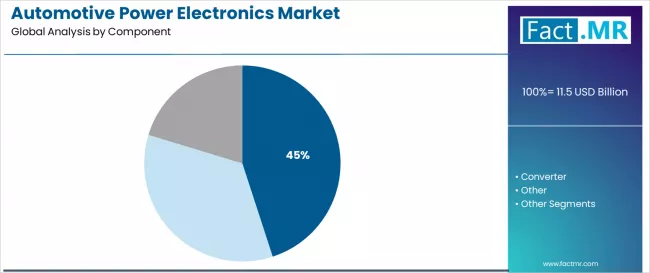
Automotive Power Electronics Market Analysis By Component | Source: Fact.MR
The inverter segment is projected to account for 45.0% of the market in 2025, reaffirming its position as the leading component category. Automotive facilities and power electronics integrators increasingly utilize inverter implementations for their superior power conversion characteristics when operating across diverse vehicle platforms, excellent efficiency properties, and widespread acceptance in applications ranging from basic electric vehicles to premium hybrid operations. Inverter technology's established conversion methods and proven efficiency capabilities directly address the facility requirements for dependable power electronics solutions in complex automotive environments.
This component segment forms the foundation of modern electric vehicle adoption patterns, as it represents the implementation with the greatest market penetration and established manufacturer acceptance across multiple vehicle categories and power segments. Facility investments in inverter standardization and system consistency continue to strengthen adoption among electric vehicle producers and hybrid manufacturers. With manufacturers prioritizing energy efficiency and power conversion, inverter implementations align with both functionality preferences and cost expectations, making them the central component of comprehensive vehicle electrification strategies.
By Vehicle, the EV Segment Accounts for 60.0% Market Share
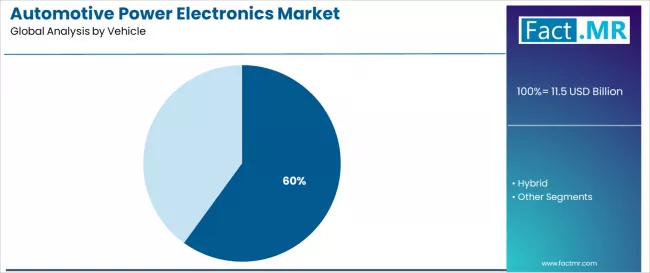
Automotive Power Electronics Market Analysis By Vehicle | Source: Fact.MR
Electric vehicle applications are projected to represent 60.0% of automotive power electronics demand in 2025, underscoring their critical role as the primary vehicle type for electrification enhancement across automotive manufacturing operations. Manufacturing facilities prefer power electronics for EV use for their exceptional conversion characteristics, scalable automotive options, and ability to enhance vehicle performance while ensuring consistent power quality throughout diverse manufacturing platforms and automotive operations. Positioned as essential power components for modern electric vehicle systems, power electronics solutions offer both technological advantages and energy efficiency benefits.
The segment is supported by continuous innovation in power electronics technologies and the growing availability of specialized implementations that enable diverse electric vehicle requirements with enhanced power uniformity and extended range capabilities. The manufacturing facilities are investing in advanced technologies to support large-scale power integration and product development. As electric vehicle adoption trends become more prevalent and efficiency awareness increases, EV applications will continue to represent a major implementation market while supporting advanced automotive utilization and technology integration strategies.
By Vehicle, the Hybrid Segment Accounts for 40.0% Market Share
Automotive Power Electronics Market Analysis By Vehicle | Source: Fact.MR
The hybrid segment is expected to capture 40.0% of the market in 2025, driven by increasing demand for dual-power vehicle systems that enhance fuel efficiency while maintaining conventional driving capabilities. Hybrid vehicle manufacturers are increasingly adopting power electronics for energy management, regenerative braking, and power distribution due to their superior conversion efficiency and automotive compatibility. The segment benefits from growing hybrid vehicle adoption worldwide and continuous innovation in power electronics formulations tailored for hybrid applications.
What are the Drivers, Restraints, and Key Trends of the Automotive Power Electronics Market?
The automotive power electronics market is advancing steadily due to increasing demand for advanced vehicle electrification technologies and growing adoption of power electronics systems that provide superior conversion characteristics and automotive benefits while enabling enhanced vehicle performance across diverse electric and hybrid vehicle applications. The market faces challenges, including complex automotive requirements, evolving efficiency standards, and the need for specialized semiconductor expertise and quality programs. Innovation in power conversion methods and advanced semiconductor systems continues to influence product development and market expansion patterns.
Expansion of Vehicle Electrification Technologies and Automotive Integration
The growing adoption of advanced vehicle electrification, sophisticated power conversion capabilities, and automotive efficiency awareness is enabling semiconductor developers to produce advanced power electronics solutions with superior conversion positioning, enhanced efficiency profiles, and seamless integration functionalities. Advanced electrification systems provide improved vehicle outcomes while allowing more efficient automotive workflows and reliable performance across various automotive applications and driving conditions. Developers are increasingly recognizing the competitive advantages of automotive integration capabilities for market differentiation and semiconductor positioning.
Integration of Advanced Semiconductor Methods and Power Engineering
Modern power electronics manufacturers are incorporating advanced semiconductor technology, power integration, and sophisticated automotive solutions to enhance product appeal, enable intelligent conversion features, and deliver value-added solutions to automotive customers. These technologies improve power electronics performance while enabling new market opportunities, including multi-vehicle power systems, optimized semiconductor treatments, and enhanced efficiency characteristics. Advanced power integration also allows developers to support comprehensive automotive technologies and market expansion beyond traditional power electronics approaches.
Analysis of the Automotive Power Electronics Market by Key Countries
.webp "Top Country Growth Comparison Automotive Power Electronics Market Cagr (2026 2036)")
Top Country Growth Comparison Automotive Power Electronics Market Cagr (2026 2036) | Source: Fact.MR
| Country | CAGR (2026-2036) |
|---|---|
| USA | 6.0% |
| Mexico | 5.8% |
| Germany | 5.5% |
| South Korea | 5.3% |
| France | 5.2% |
| UK | 5.0% |
| Japan | 5.0% |
Source: Fact.MR analysis. Updated Mar 20, 2026
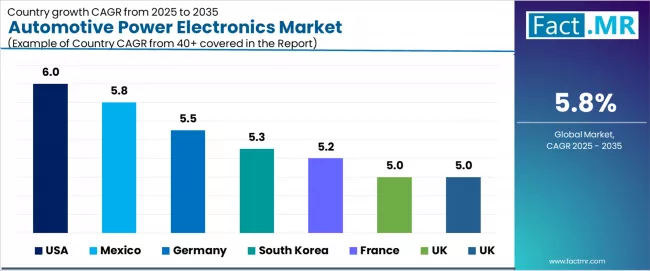
Automotive Power Electronics Market Cagr Analysis By Country | Source: Fact.MR
The market is experiencing steady growth globally, with the USA leading at a 6.0% CAGR through 2036, driven by expanding electric vehicle manufacturing capacity, growing automotive electrification programs, and significant investment in power electronics development. Mexico follows at 5.8%, supported by increasing automotive manufacturing expansion, growing power electronics integration patterns, and expanding electric vehicle infrastructure. Germany shows growth at 5.5%, focusing automotive technology leadership and power electronics development. South Korea records 5.3%, focusing on expanding electric vehicle capabilities and semiconductor technology modernization. France exhibits 5.2% growth, focusing automotive innovation excellence and premium power electronics development. The UK demonstrates 5.0% growth, prioritizing advanced automotive technology development and quality-focused manufacturing patterns. Japan shows 5.0% growth, supported by automotive excellence initiatives and quality-focused semiconductor patterns.
USA Leads Global Market Growth with Electric Vehicle Manufacturing Expansion
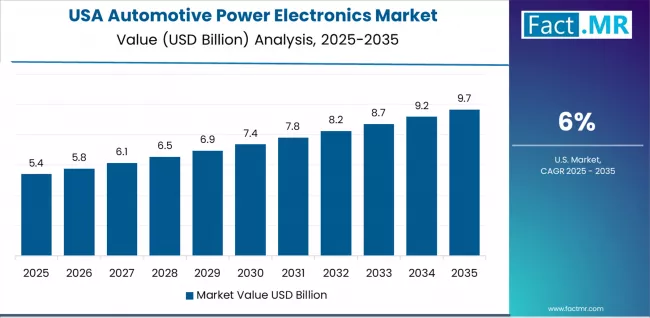
Automotive Power Electronics Market Country Value Analysis | Source: Fact.MR
The USA is projected to exhibit robust growth with a CAGR of 6.0% through 2036, driven by expanding electric vehicle manufacturing capacity and rapidly growing automotive electrification supported by government initiatives promoting advanced power electronics technology development. The country's strong position in automotive innovation and increasing investment in electrification infrastructure are creating substantial demand for advanced power electronics implementations. Major automotive facilities and technology companies are establishing comprehensive power conversion capabilities to serve both domestic electric vehicle demand and expanding automotive markets.
Government support for electric vehicle initiatives and automotive electrification is driving demand for advanced power electronics systems throughout major automotive regions and manufacturing centers across the country. Strong electric vehicle growth and an expanding network of technology-focused producers are supporting the rapid adoption of automotive power electronics among manufacturers seeking advanced conversion capabilities and integrated power technologies.
Mexico Demonstrates Strong Automotive Growth and Manufacturing Expansion
Mexico is growing at a CAGR of 5.8%, driven by the country's expanding automotive sector, growing manufacturing capacity, and increasing adoption of advanced power electronics technologies. The country's initiatives promoting automotive modernization and growing electrification development awareness are driving requirements for technology-integrated power electronics systems. International power electronics providers and domestic automotive companies are establishing extensive manufacturing and integration capabilities to address the growing demand for advanced power electronics solutions.
Strong automotive expansion and expanding modern manufacturing operations are driving adoption of integrated power systems with superior power electronics capabilities and advanced integration among large automotive producers and progressive manufacturing operations. Growing technology diversity and increasing automotive enhancement adoption are supporting market expansion for advanced power electronics implementations with seamless integration profiles and modern power delivery throughout the country's automotive regions. Mexico's strategic location and cost-effective manufacturing capabilities make it an attractive destination for power electronics production facilities serving both domestic and North American markets.
Germany Demonstrates Automotive Technology Leadership with Innovation Growth
Germany is expanding at a CAGR of 5.5%, supported by the country's automotive technology heritage, strong focus on advanced power electronics technology, and robust demand for advanced power electronics systems in electric and hybrid vehicle applications. The nation's mature automotive sector and technology-focused operations are driving sophisticated power electronics implementations throughout the industry. Leading facilities and automotive specialists are investing extensively in power electronics development and advanced integration technologies to serve both domestic and international markets.
Rising demand for electrification technologies and advanced automotive systems is creating requirements for sophisticated power electronics solutions with exceptional conversion capabilities among quality-conscious facilities seeking enhanced automotive experiences and advanced integration methods. Strong automotive tradition and growing investment in electrification technologies are supporting adoption of quality power electronics platforms with advanced development methods and enhanced conversion profiles across automotive operations in major manufacturing regions.
South Korea Demonstrates Strong Automotive Integration and Technology Development
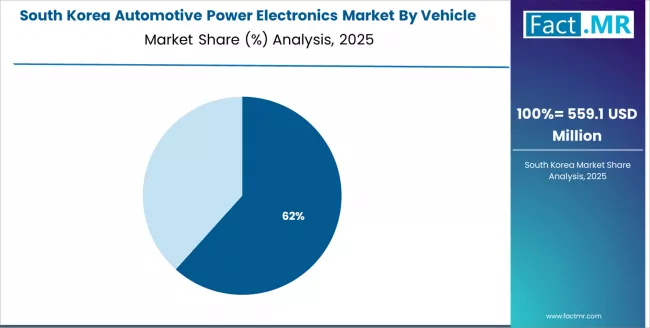
Automotive Power Electronics Market South Korea Market Share Analysis By Vehicle | Source: Fact.MR
South Korea is growing at a CAGR of 5.3%, driven by the country's expanding automotive sector, growing technology integration capacity, and increasing adoption of advanced power electronics technologies. The country's initiatives promoting automotive modernization and growing electrification development awareness are driving requirements for technology-integrated power electronics systems. International power electronics providers and domestic automotive companies are establishing extensive manufacturing and integration capabilities to address the growing demand for advanced power electronics solutions.
Rising automotive requirements and expanding electrification programs are creating opportunities for power electronics adoption across automotive centers, progressive producers, and modern vehicle facilities in major automotive regions. Growing focus on power integration and conversion improvement features is driving adoption of power electronics platforms among manufacturers seeking enhanced conversion capabilities and advanced power experiences.
France Focuses on Automotive Development and Electrification Enhancement Programs
France is growing at a CAGR of 5.2%, driven by the country's expanding automotive sector, growing electrification development programs, and increasing investment in power electronics technology development. France's large automotive market and commitment to electrification advancement are supporting demand for diverse power electronics solutions across multiple automotive segments. Manufacturers are establishing comprehensive integration capabilities to serve the growing domestic market and expanding automotive opportunities.
Strong automotive expansion and expanding modern electrification operations are driving adoption of integrated power systems with superior power electronics capabilities and advanced integration among large automotive producers and progressive electrification operations. Growing technology diversity and increasing automotive enhancement adoption are supporting market expansion for advanced power electronics implementations with seamless integration profiles and modern power delivery throughout the country's automotive regions.
United Kingdom Exhibits Automotive Technology Development and Premium Innovation Growth
The UK is growing at a CAGR of 5.0%, driven by the country's focus on automotive technology advancement, focus on premium electrification innovation, and strong position in power electronics development. The UK's established automotive innovation capabilities and commitment to technology diversification are supporting investment in specialized power electronics technologies throughout major automotive regions. Industry leaders are establishing comprehensive technology integration systems to serve domestic premium automotive production and enhancement applications.
Innovations in power platforms and automotive integration capabilities are creating demand for advanced power electronics implementations with exceptional conversion properties among progressive automotive facilities seeking enhanced technology differentiation and vehicle appeal. Growing premium automotive adoption and increasing focus on electrification innovation are driving adoption of advanced power electronics platforms with integrated power delivery and conversion optimization across automotive enterprises throughout the country.
Japan Shows Quality Automotive Focus and Technology-Driven Power Systems
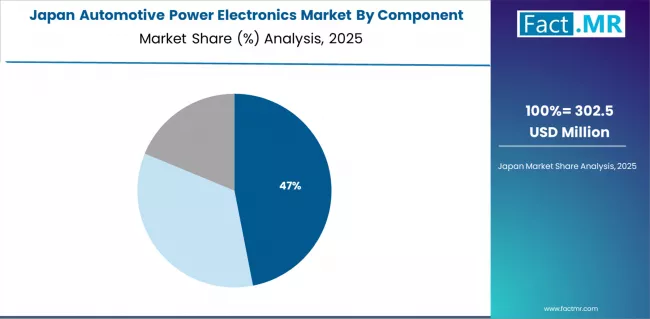
Automotive Power Electronics Market Japan Market Share Analysis By Component | Source: Fact.MR
Japan is expanding at a CAGR of 5.0%, supported by the country's automotive excellence initiatives, growing quality technology sector, and strategic focus on advanced power electronics development. Japan's advanced quality control capabilities and integrated automotive systems are driving demand for high-quality power electronics platforms in premium applications, automotive technology, and advanced electrification applications. Leading facilities are investing in specialized capabilities to serve the stringent requirements of technology-focused automotive and premium vehicle producers.
Quality automotive advancement and technology-focused development are creating requirements for specialized power electronics solutions with superior quality integration, exceptional conversion capabilities, and advanced power features among quality-conscious automotive operations and premium vehicle producers. Strong position in automotive technology innovation is supporting adoption of advanced power electronics systems with validated conversion characteristics and quality integration capabilities throughout the country's automotive technology sector.
Europe Market Split by Countries
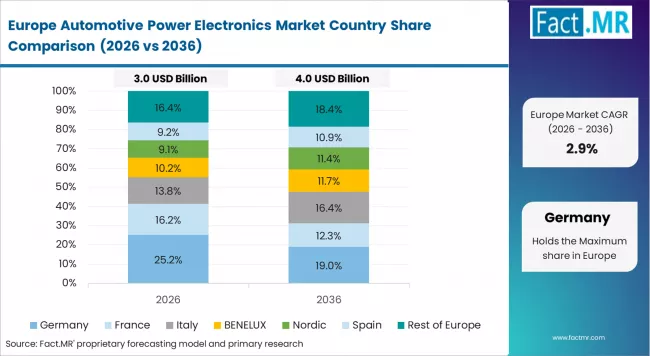
Automotive Power Electronics Market Europe Country Market Share Analysis, 2026 & 2036 | Source: Fact.MR
The automotive power electronics market in Europe is projected to grow from USD 3.5 billion in 2026 to USD 6.3 billion by 2036, registering a CAGR of 5.4% over the forecast period. Germany is expected to maintain its leadership position with a 35.0% market share in 2026, growing to 36.2% by 2036, supported by its strong automotive engineering culture, sophisticated electric vehicle manufacturing capabilities, and comprehensive automotive sector serving diverse power electronics applications across Europe.
France follows with a 22.0% share in 2026, projected to reach 22.8% by 2036, driven by robust demand for electrification technologies in automotive applications, advanced vehicle development programs, and power conversion markets, combined with established automotive infrastructure and technology integration expertise. The United Kingdom holds a 18.0% share in 2026, expected to reach 17.3% by 2036, supported by strong automotive technology sector and growing premium vehicle activities. Italy commands a 12.5% share in 2026, projected to reach 12.0% by 2036, while Netherlands accounts for 8.5% in 2026, expected to reach 8.7% by 2036. The Rest of Europe region is anticipated to maintain momentum, with its collective share moving from 4.0% to 3.0% by 2036, attributed to increasing automotive modernization and growing technology penetration implementing advanced power electronics programs.
What is the competitive landscape of the automotive power electronics market?
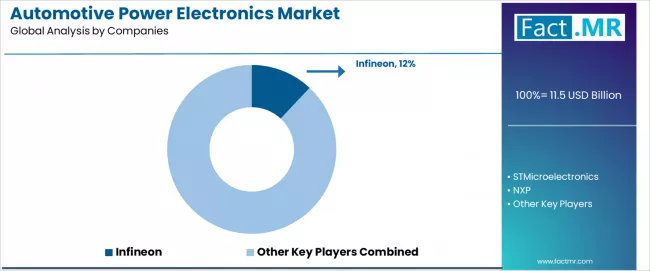
Automotive Power Electronics Market Analysis By Company | Source: Fact.MR
The market is characterized by competition among established semiconductor companies, specialized automotive power electronics manufacturers, and integrated electrification solution providers. Companies are investing in power electronics research, semiconductor optimization, advanced automotive system development, and comprehensive power electronics portfolios to deliver consistent, high-quality, and application-specific power electronics solutions. Innovation in advanced power integration, conversion enhancement, and automotive compatibility improvement is central to strengthening market position and competitive advantage.
Infineon leads the market with a 12% market share, offering comprehensive power electronics solutions including quality semiconductor platforms and advanced conversion systems with a focus on premium and electric vehicle applications. STMicroelectronics provides specialized semiconductor capabilities with a focus on advanced power electronics implementations and innovative automotive solutions. NXP delivers comprehensive automotive services with a focus on integrated platforms and large-scale vehicle applications. Texas Instruments specializes in advanced semiconductor technologies and specialized power electronics implementations for premium applications. ON Semiconductor focuses on electric vehicle-oriented power electronics integration and innovative technology solutions.
The competitive landscape is further strengthened by companies like Renesas, which brings expertise in advanced automotive semiconductors, while Mitsubishi Electric focuses on power conversion solutions for diverse applications. Bosch emphasizes automotive system integration and manufacturing excellence, and Hitachi specializes in power electronics components. These companies continue to invest in research and development, strategic partnerships, and manufacturing capacity expansion to maintain their market positions and capture emerging opportunities in the growing automotive power electronics sector.
Key Players in the Automotive Power Electronics Market
- Infineon
- STMicroelectronics
- NXP
- Texas Instruments
- ON Semiconductor
- Renesas
- Mitsubishi Electric
- Bosch
- Hitachi
- Toshiba
- Continental
Bibliography
- Yole Developpement. (2024). Power Semiconductor Market Monitor: Automotive Q4 2024. Yole Group.
- Infineon Technologies AG. (2024). Annual Report 2023: Automotive Division. Infineon.
- U.S. Department of Commerce. (2024). CHIPS for America: Implementation Strategy. Department of Commerce.
- Hyundai Motor Company. (2024). Annual Report 2023: E-GMP and 800V Architecture. Hyundai Motor Group.
- STMicroelectronics N.V. (2024). Annual Report 2023: Automotive and Discrete Group. STMicroelectronics.
- International Energy Agency. (2024). Global EV Outlook 2024. IEA.
This bibliography is provided for reader reference. The full Fact.MR report contains the complete reference list with primary research documentation.
This Report Addresses
- Market sizing and quantitative forecast metrics detailing industry revenue projections for the automotive power electronics market through 2036.
- Segmentation analysis identifying adoption patterns across Component, Vehicle segments and evaluating structural demand drivers.
- Regional deployment intelligence comparing growth dynamics across 7 key countries and broader geographic markets.
- Regulatory compliance assessment analyzing policy frameworks and standards that affect market adoption and procurement specifications.
- Competitive landscape evaluation profiling 11 companies and their strategic positioning across technology and geographic dimensions.
- Strategic investment guidance identifying infrastructure requirements and procurement specifications for market participants.
- Supply chain and operational analysis identifying capacity constraints, lead time factors, and sourcing patterns that influence market dynamics.
- Data delivery formats including PDF narrative reports, Excel datasets, interactive dashboards, and presentation files.
Segmentation
Scope of the Report
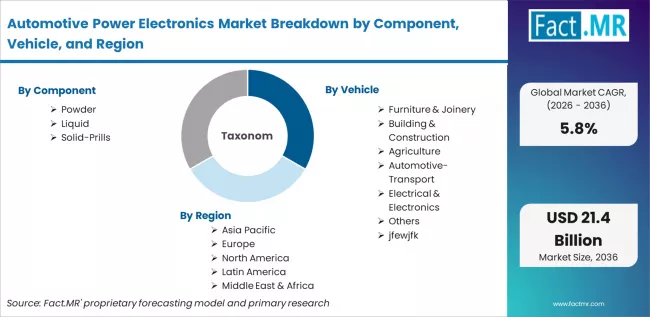
Automotive Power Electronics Market Breakdown By Component, Vehicle, And Region | Source: Fact.MR
| Metric | Value |
|---|---|
| Quantitative Units | USD 12.17 billion to USD 21.38 billion, at a CAGR of 5.8% |
| Market Definition | The automotive power electronics market covers semiconductor-based modules and systems that convert, control, and distribute electrical power within vehicle architectures. Core product categories include traction inverters that convert DC battery power to AC for electric motor drive, DC-DC converters that step voltage between the high-voltage traction bus and the 12V/48V auxiliary bus, onboard chargers (OBC) that convert AC grid power to DC for battery charging, and power distribution units (PDU) that manage high-voltage circuit protection and switching. |
| Segmentation | Component (Inverter, Converter, Other), Vehicle (EV, Hybrid) |
| Regions Covered | North America, Latin America, Europe, East Asia, South Asia, Oceania, Middle East & Africa |
| Countries Covered | USA, Mexico, Germany, South Korea, France, UK, Japan, and 40 plus countries |
| Key Companies Profiled | Infineon Technologies AG, STMicroelectronics N.V., NXP Semiconductors N.V., Texas Instruments Incorporated, ON Semiconductor Corporation, Renesas Electronics Corporation, Mitsubishi Electric Corporation, Robert Bosch GmbH, Hitachi, Ltd., Toshiba Corporation, Continental AG |
| Forecast Period | 2026 to 2036 |
| Approach | Forecasting models apply a hybrid top-down and bottom-up methodology, calibrating global estimates against regional production data and verified shipment records to project market trajectory through 2036. |
Source: Fact.MR analysis. Updated Mar 20, 2026
Automotive Power Electronics Market by Segments
-
Component :
- Inverter
- Converter
- Other
-
Vehicle :
- EV
- Hybrid
-
Region :
-
North America
- United States
- Canada
- Mexico
-
Europe
- Germany
- United Kingdom
- France
- Italy
- Spain
- Nordic
- BENELUX
- Rest of Europe
-
Asia-Pacific
- China
- Japan
- South Korea
- India
- ASEAN
- Australia & New Zealand
- Rest of Asia-Pacific
-
Frequently Asked Questions
How large is the demand for Automotive Power Electronics Market in the global market in 2026?
What will be the market size of Automotive Power Electronics Market by 2036?
What is the expected demand growth for Automotive Power Electronics Market between 2026 and 2036?
Which Component is poised to lead global sales by 2026?
How significant is the role of EV in the Automotive Power Electronics Market?
What is the growth outlook for USA in this report?
What is the growth outlook for Mexico?
Does the report cover France in its regional analysis?
What is Automotive Power Electronics Market and what is it mainly used for?
What is included in the scope of this report?
What is excluded from the scope of this report?
How does Fact.MR build and validate the Automotive Power Electronics Market forecast?
What regions are covered in this report?
Which companies are profiled in this report?
How large is the demand for Automotive Power Electronics Market in the global market in 2026?
What will be the market size of Automotive Power Electronics Market by 2036?
What is the expected demand growth for Automotive Power Electronics Market between 2026 and 2036?
Which Component is poised to lead global sales by 2026?
How significant is the role of EV in the Automotive Power Electronics Market?
What is the growth outlook for USA in this report?
What is the growth outlook for Mexico?
Does the report cover France in its regional analysis?
What is Automotive Power Electronics Market and what is it mainly used for?
What is included in the scope of this report?
What is excluded from the scope of this report?
How does Fact.MR build and validate the Automotive Power Electronics Market forecast?
What regions are covered in this report?
Which companies are profiled in this report?
Who worked on this report


Preview the report firsthand - request a free sample
Free SampleGet the brochure for pricing and purchase details
Download PDF