- Market Value (2025): USD 0.9 Bn
- Estimated Value (2026): USD 1.1 Bn
- Forecast Value (2036): USD 3.8 Bn
- CAGR (2026-2036): 13.6%
What is the encapsulated blemish actives market forecast to be worth by 2036?
USD 1.1 billion in 2026 to USD 3.8 billion by 2036 at a 13.6% CAGR.
- As per Fact.MR analysis, the encapsulated blemish actives market reached USD 0.9 billion in 2025.
- Demand is forecast to increase from USD 1.1 billion in 2026 to USD 3.8 billion by 2036.
- The market is forecast to record a 13.6% CAGR from 2026 to 2036.
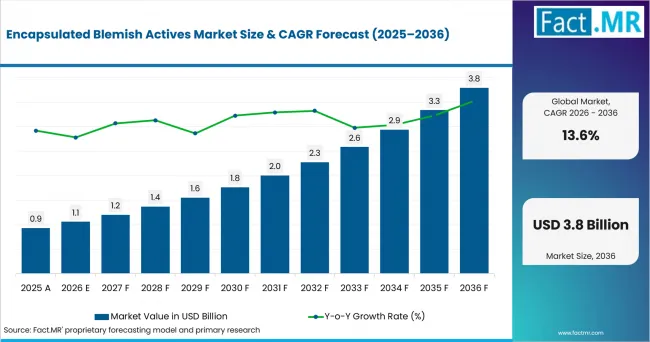
Encapsulated Blemish Actives Market Value Analysis | Source: Fact.MR
What are the main market growth numbers?
USD 2.7 billion absolute opportunity is expected between 2026 and 2036.
- Demand Drivers in the Market
- Blemish care products need systems that protect sensitive ingredients before use. The U.S. Food and Drug Administration reported 1,298,361 unique active cosmetic product listings under MoCRA as of June 30, 2026 [1].
- Product teams need to reduce irritation from retinoids and exfoliating acids. Controlled release limits skin contact and can make daily-use products more comfortable.
- Skin-care brands need shelf-life and release tests to support product claims. The release system is an important part of product development.
- Key Segments Analyzed
- By Active: Salicylic acid is expected to hold a 34.0% share in 2026 because it is widely used in blemish care products. Controlled release can reduce direct skin contact.
- By Carrier: Lipid capsules hold 30.0% share in 2026 because they work with oil-soluble actives and protect sensitive ingredients.
- By Release: Immediate release is expected to hold a 36.0% share in 2026 because many blemish care products release the active soon after use.
- By Product: Serum leads with 33.0% share in 2026 because it can carry more active ingredients and allows different textures and doses.
- Analyst Opinion at Fact.MR
- Principal Consultant Shambhu Nath Jha at Fact.MR states, “Product teams need to check active protection, release, and skin comfort. They also need to check if the system works well in the product. Suppliers that provide steady release can support serums, spot treatments, cleansers, and body care products.”
- Strategic Implications
- Ingredient companies should show how capsules affect shelf life and active release. BASF launched VitaGuard® A on January 23, 2025, using patented solid-lipid encapsulation for retinol.
- Suppliers should explain how their systems work in water-based and oil-based products. Simple mixing steps make it easier to move from lab tests to larger batches.
- Beauty brands should check the active dose, capsule amount, and how often the product is used. They also need to test active release and shelf life.
- Contract manufacturers should check the mixing order and production steps early. Too much mixing, heat, or some surfactants can damage capsules.
France is expected to grow at 14.6% CAGR through 2036 due to its large beauty industry and product rules. Japan follows at 13.2% as skin-care use remains high. The USA is expected to grow at 12.9% as MoCRA rules require clear product records. Germany stands at 12.6%, while the UK records 9.9% as skin-care product safety checks continue.
How does the market break down by segment?
Salicylic acid leads Active at 34.0% share in 2026; Serum leads Product at 33.0% share.
Which Active dominates?
Salicylic acid is forecast to hold 34.0% share in 2026.
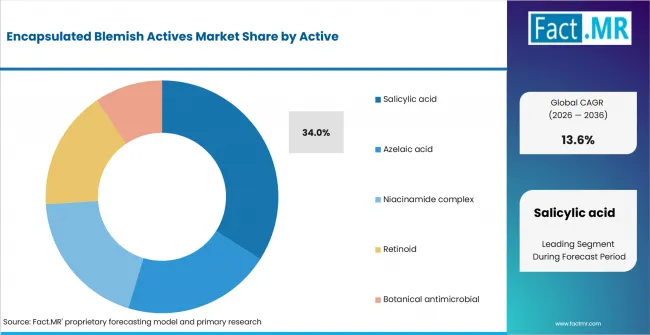
Encapsulated Blemish Actives Market Analysis By Active | Source: Fact.MR
Salicylic acid is expected to lead because it is widely used in blemish care products to clear pores and control skin oil. Capsules protect the active and control its release after use. Azelaic acid and niacinamide are used for other skin needs. Retinoids need careful handling to maintain shelf life and reduce skin irritation.
What leads the Carrier segment?
Lipid capsule is forecast to account for 30.0% share in 2026.
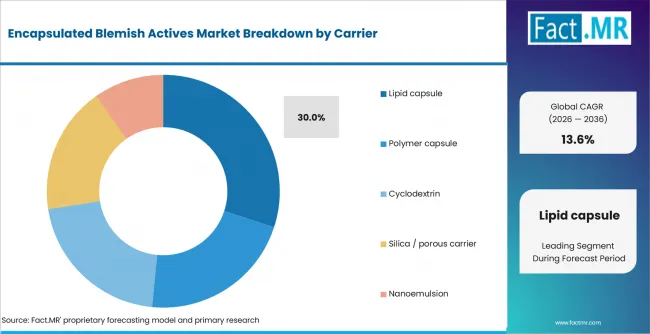
Encapsulated Blemish Actives Market Analysis By Carrier | Source: Fact.MR
Lipid capsules leading this segment because they work well with oil-based actives and protect sensitive ingredients from water. Resin capsules control active release. Cyclodextrins hold selected ingredients inside their structure. Silica and porous systems hold ingredients and release them slowly. Nanoemulsions use small droplets and are suitable for liquid products.
How does Release shape demand?
Fast release is forecast to capture 36.0% share in 2026.
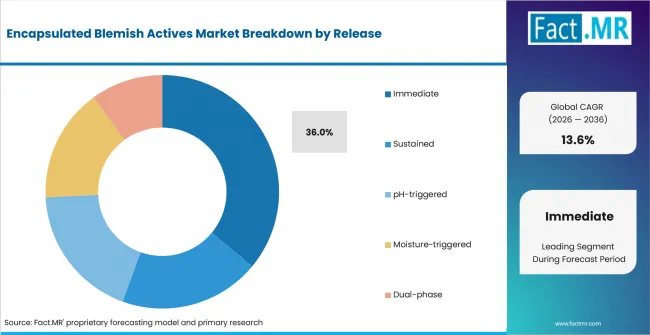
Encapsulated Blemish Actives Market Analysis By Release | Source: Fact.MR
Fast release is expected to lead because spot treatments and serums need to release the active quickly. Slow-release systems keep the active on the skin for longer. Some systems release the active based on skin pH or moisture. Dual-phase systems keep ingredients separate until use.
What supports Serum within Product?
Serum is forecast to represent 33.0% share in 2026.
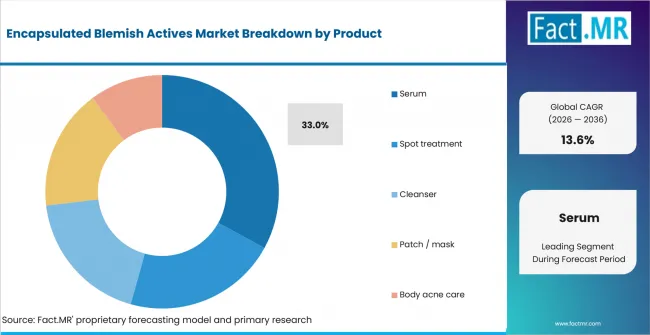
Encapsulated Blemish Actives Market Analysis By Product | Source: Fact.MR
Serums leading this segment because they can contain more active ingredients in a light formula. Spot treatments are used on specific areas, while cleansers stay on the skin for a short time. Patches and masks stay on the skin for a set time. Body acne products use the same actives on other body areas. Shelf life is important for all these products.
What is driving market use, and what is holding it back?
Controlled active release is expected to increase use, while complex product formulas can limit wider use.
Drivers Impact Review
| DRIVER | (~) % IMPACT ON CAGR | GEOGRAPHIC RELEVANCE | IMPACT TIMELINE |
|---|---|---|---|
| Need to protect unstable blemish actives | +1.8% | Global | Short term (<= 2 years) |
| Tolerability focus in daily-use formulas | +1.5% | North America, Europe, East Asia | Medium term (2-4 years) |
| Controlled and triggered release design | +1.2% | Global | Medium term (2-4 years) |
| Expansion across serum and spot formats | +0.9% | North America, Europe, Japan | Long term (>= 4 years) |
Opportunity Impact Review
| OPPORTUNITY | (~) % IMPACT ON CAGR | GEOGRAPHIC RELEVANCE | IMPACT TIMELINE |
|---|---|---|---|
| Carrier platforms for multi-format skin care | +1.3% | Global | Medium term (2-4 years) |
| Enzyme, pH and moisture-triggered release | +1.0% | Europe, Japan, USA | Long term (>= 4 years) |
| Lower-irritation retinoid and acid systems | +0.8% | North America, Europe | Short term (<= 2 years) |
Restraints Impact Review
| RESTRAINT | (~) % IMPACT ON CAGR | GEOGRAPHIC RELEVANCE | IMPACT TIMELINE |
|---|---|---|---|
| Carrier-formula incompatibility | -0.8% | Global | Short term (<= 2 years) |
| Higher validation and stability workload | -0.6% | North America, Europe | Medium term (2-4 years) |
| Release-performance variability after scale-up | -0.4% | Global | Long term (>= 4 years) |
Which countries are growing fastest through 2036?
- The country check spans 4.7 points across the five profiled markets.
- France remains 1.4 points above Japan through its mature beauty products output and input work base.
- Japan remains 0.3 point above the USA through mature skin-care routines and mix depth.
- The USA remains 0.3 point above Germany as MoCRA strengthens product and facility tracking.
- Germany remains 2.7 points above the UK through established chemical and beauty care output skill.
- The UK closes the displayed range as beauty notice rules shape mix and launch planning.
Similar growth rates can create other entry needs across these countries. Beauty rules and output depth vary by market. Consumer routines and product-launch rules differ as well. Full report coverage includes North America; Latin America; Western Europe; Eastern Europe; East Asia; South Asia & Pacific; and Middle East & Africa.
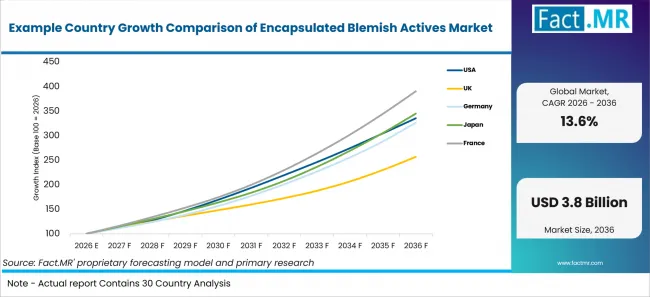
Example Country Growth Comparison Of Encapsulated Blemish Actives Market | Source: Fact.MR
| Country | CAGR (2026-2036) |
|---|---|
| United States | 12.9% |
| United Kingdom | 9.9% |
| Germany | 12.6% |
| Japan | 13.2% |
| France | 14.6% |
What supports USA use?
12.9% CAGR, backed by beauty safety checks and active-led skin care.
U.S. beauty companies need clear records for product results and skin comfort. The FDA launched its real-time beauty adverse-event dashboard on September 12, 2025. More data on skin reactions increases the need for skin comfort testing when active release changes.
What supports the United Kingdom’s growth?
9.9% CAGR, backed by product notice and a mature beauty products base.
UK skin-care brands need to share product and ingredient details with regulators. On July 17, 2026, the Office for Product Safety and Standards reported that the SCPN system had received 861,686 cosmetic notifications since launch as of May 28, 2026 [2].
What is supporting Germany’s use?
12.6% CAGR, backed by household spending and niche-chemical skill.
Germany has high consumer spending and a large beauty industry. Eurostat reported on June 17, 2026, that Germany’s actual individual consumption per person was 20% above the EU average in 2025 [3]. Higher spending can support premium skin-care products with higher costs.
How does Japan perform?
13.2% CAGR, backed by mature skin-care routines and household spending.
Japanese consumers focus on skin-care texture and daily use. The Statistics Bureau of Japan reported on February 6, 2026, that average monthly spending by households with two or more people reached JPY 314,001 in 2025 [4]. Consumer spending can support the use of different skin-care products.
How is France developing demand?
14.6% CAGR, backed by a deep beauty-output and mix base.
France has a large beauty industry for skin-care ingredients and products. DGCCRF reported on February 2, 2026, that it inspected 147 cosmetics businesses while checking product information [5]. These checks require clear product records and careful use of protected active ingredients.
Who leads the Encapsulated Blemish Actives Market?
BASF supplies cosmetic actives and encapsulation systems, including VitaGuard® A for retinol. Evonik offers beauty actives with liposomes and capsules. Croda supplies beauty actives and controlled-release systems. Lubrizol provides skin-care actives, polymers, and formula systems. dsm-firmenich and Givaudan Active Beauty also supply skin-care actives and delivery systems.
Givaudan Active Beauty launched VectorHyal™ in March 2026. The system uses hyaluronic acid to carry water-soluble and oil-soluble actives. Skin enzymes release the actives after use. It also protects sensitive ingredients and works in clear formulas.
BASF and Evonik combine active ingredients with protection and release systems. Croda and Givaudan Active Beauty provide actives and encapsulation systems. Lubrizol supplies actives, polymers, and formula support. dsm-firmenich offers skin-care actives and formula support.
Which companies are the key providers?
Key providers include BASF, Evonik, Croda, Lubrizol, DSM-Firmenich, and Givaudan Active Beauty
- BASF
- Evonik
- Croda
- Lubrizol
- DSM-Firmenich
- Givaudan Active Beauty
Bibliography
- U.S. Food and Drug Administration. (2026, September 9). FDA clarifies it does not provide certificates or other documents to verify compliance for cosmetic product facility registration.
- Office for Product Safety and Standards. (2026, July 17). New data on UK cosmetic product safety notifications.
- Eurostat. (2026, June 17). Household material welfare across the EU in 2025.
- Statistics Bureau of Japan. (2026, February 6). Family Income and Expenditure Survey: 2025 yearly average.
- Direction générale de la concurrence, de la consommation et de la répression des fraudes. (2026, February 2). Cosmétiques : des TPE nouvelles dans le secteur qui méconnaissent trop souvent la réglementation.
- Givaudan. (2026, March 17). Givaudan Active Beauty elevates its delivery systems technology with VectorHyal™.
This Report Answers
- The report explains where encapsulated blemish actives are used across active type, carrier, release profile, and finished-product format.
- Segment analysis identifies the leading subsegments and the formula reasons behind the 2026 shares.
- Country analysis compares the five profiled markets and connects growth to cosmetics production, product-safety oversight, and consumer spending needs.
- Competitive analysis reviews the six profiled companies and focuses on product portfolios, delivery systems, and formula support.
- Application review considers how shelf life, irritation control, carrier fit, and release behavior influence formula choices.
What does the Encapsulated Blemish Actives Market cover?
The market covers encapsulated topical actives intended for blemish-prone skin. It includes systems built around salicylic acid; azelaic acid; niacinamide complexes; retinoids; and botanical antimicrobials. Carrier formats include lipid capsules and polymer capsules. Cyclodextrin systems; porous carriers; and nanoemulsions are also within scope. Upstream formulation inputs are covered in cosmetic chemicals.
What is included in the scope?
The scope includes encapsulated active concentrates used in serum and spot-treatment products.
Cleanser; patch; mask; and body-acne formats are included when the carrier changes active protection or availability. Release designs include immediate and sustained systems. Triggered formats include pH-based and moisture-based approaches. Related carrier use is discussed in encapsulated UV boosters.
What is excluded from the scope?
The scope focuses on topical cosmetic delivery systems for blemish actives.
Oral acne medicines and prescription drug-delivery systems fall outside the assessment. Standalone dermatology devices and conventional blemish products also fall outside the defined boundary. Adjacent finished-product context includes skin care products.
How Was the Analysis Built?
The analysis draws on 120+ sources, 35+ company portfolios, 25+ countries, and more than 20 industry interviews.
- Primary Research: Primary research includes discussions with manufacturers, service providers, technology developers, distributors, end users, and subject-matter experts. These conversations examine purchasing priorities, product adoption, operational challenges, approval requirements, competitive positioning, and the factors that influence wider market acceptance.
- Desk Research: Desk research covers government statistics, regulatory publications, company filings, trade data, technical studies, industry associations, standards, public policy, and other authoritative sources. Every source used in the analysis is documented in the bibliography.
- Market Sizing and Forecasting: Market estimates combine historical performance, demand indicators, pricing and volume trends, segment shares, company participation, country-level growth, adoption patterns, investment activity, and barriers to market expansion.
- Data Validation and Update Cycle: Findings are validated by comparing primary interviews with public data, company activity, regulatory changes, trade patterns, and industry developments. Regular updates review new product launches, capacity changes, partnerships, approvals, and shifts in commercial adoption.
What is the report’s scope and coverage?
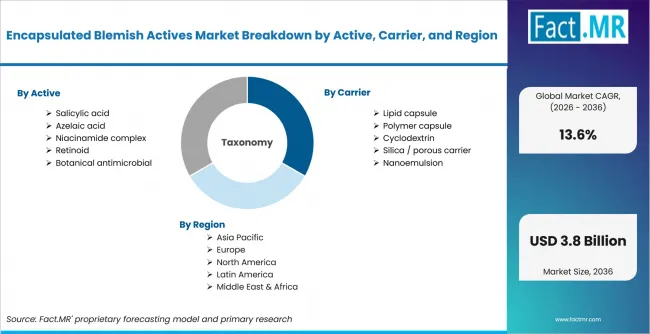
Encapsulated Blemish Actives Market Breakdown By Active, Carrier, And Region | Source: Fact.MR
| Attribute | Details |
|---|---|
| Quantitative Units | USD Billion |
| Market Definition | Encapsulated cosmetic active systems designed for blemish-prone skin, including active ingredients carried in lipid, polymer, cyclodextrin, porous, or nanoemulsion systems for protected, immediate, sustained, or triggered topical delivery. |
| Active | Salicylic acid; Azelaic acid; Niacinamide complex; Retinoid; Botanical antimicrobial |
| Carrier | Lipid capsule; Polymer capsule; Cyclodextrin; Silica / porous carrier; Nanoemulsion |
| Release | Immediate; Sustained; pH-triggered; Moisture-triggered; Dual-phase |
| Product | Serum; Spot treatment; Cleanser; Patch / mask; Body acne care |
| Regions Covered | North America; Latin America; Western Europe; Eastern Europe; East Asia; South Asia & Pacific; Middle East & Africa |
| Countries Covered | United States; United Kingdom; Germany; Japan; France |
| Key Companies Profiled | BASF; Evonik; Croda; Lubrizol; DSM-Firmenich; Givaudan Active Beauty |
| Forecast Period | 2026 to 2036 |
| Approach | Hybrid top-down and bottom-up approach using cosmetic active demand, carrier-system adoption, product-format mix, country growth, supplier portfolio review, and first-party regulatory evidence. |
How is the market segmented?
-
By Active:
- Salicylic acid
- Azelaic acid
- Niacinamide complex
- Retinoid
- Botanical antimicrobial
-
By Carrier:
- Lipid capsule
- Polymer capsule
- Cyclodextrin
- Silica / porous carrier
- Nanoemulsion
-
By Release:
- Immediate
- Sustained
- pH-triggered
- Moisture-triggered
- Dual-phase
-
By Product:
- Serum
- Spot treatment
- Cleanser
- Patch / mask
- Body acne care
-
By Region:
- North America
- Latin America
- Western Europe
- Eastern Europe
- East Asia
- South Asia & Pacific
- Middle East & Africa