- Market Value (2025): USD 1.8 Bn
- Estimated Value (2026): USD 1.9 Bn
- Forecast Value (2036): USD 4.5 Bn
- CAGR (2026-2036): 8.8%
What is the Odor-Control Laundry Boosters Market forecast to be worth by 2036?
USD 1.9 billion in 2026 to USD 4.5 billion by 2036 at an 8.8% CAGR.
- The Odor-Control Laundry Boosters Market reached USD 1.8 billion in 2025.
- Demand is expected to increase from USD 1.9 billion in 2026 to USD 4.5 billion by 2036.
- The market is forecast to record an 8.8% CAGR from 2026 to 2036 as consumers add specialized odor control to routine laundry care.
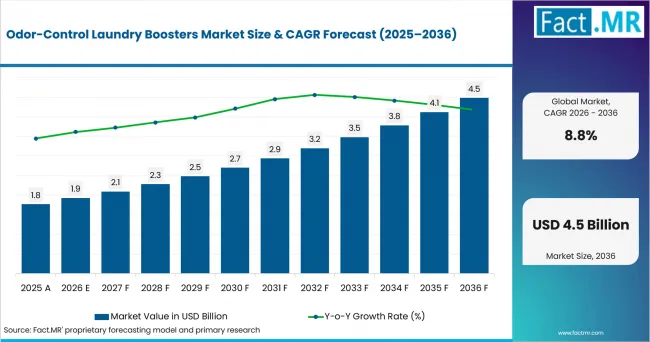
Odor Control Laundry Boosters Market Value Analysis | Source: Fact.MR
What are the defining numbers behind Odor-Control Laundry Boosters Market growth?
An absolute opportunity of USD 2.6 billion is expected between 2026 and 2036.
- Demand Drivers in the Market
- Households dealing with sportswear and everyday sweat often use laundry cleaning products as the base wash step, while odor-control boosters add a separate treatment for retained fabric smell during routine washing.
- Pet owners and households handling damp textiles need products that work at fabric level. Cyclodextrin systems provide one odor-capture route alongside mineral neutralizers and malodor-binding polymers for recurring household use.
- Cold and short wash cycles place more attention on dissolution and residue control. Fragrance booster formats therefore need to disperse cleanly while keeping scent delivery separate from the detergent dose.
- Formulators working across detergent chemistry, including bio-based surfactants for detergents, face closer ingredient review. The U.S. Environmental Protection Agency reported in January 2026 that 1,656 products were Safer Choice-certified in FY2025.
- Key Segments Analyzed
- By Odor Technology: Cyclodextrin is expected to hold 33.0% share in 2026. Its molecular cavity can support capture of odor-causing compounds while fitting consumer laundry formulations.
- By Odor: Body / sweat is expected to hold 29.0% share in 2026 owing to repeated odor exposure in activewear, uniforms, socks, towels, and other frequently washed textiles.
- By Format: Beads are expected to capture 36.0% share in 2026 as in-wash dosing gives consumers a simple way to add fragrance and odor-control support directly to the drum.
- By Use Stage: Main wash is expected to hold 32.0% share in 2026 since it combines booster use with the established detergent step and avoids a separate treatment routine.
- Analyst Opinion at Fact.MR
- Shambhu Nath Jha, Principal Consultant at Fact.MR, states, “Odor-control boosters compete on one practical question: whether the added product solves a fabric-odor problem beyond basic detergent cleaning. Clear dosing and specific claims against sweat, dampness, pet odor, or retained smell are expected to support repeat use.”
- Strategic Implications
- Brand teams should separate odor neutralization from fragrance delivery. Fragrance encapsulation agents can support controlled scent release, while odor-control claims should remain tied to the formulation mechanism and intended wash stage.
- Formulators should test dissolution and residue behavior across cold-water and short-cycle conditions. Enzyme-enhanced laundry chemicals illustrate how wash-temperature performance can become part of formulation design without making the booster routine more complex.
- Retail teams should distinguish odor-led benefits from general softness or scent enhancement. Fabric conditioners occupy a closely adjacent shelf position, so booster packaging needs to explain the extra function in plain language.
- Regulatory teams should align ingredient disclosure and hazard classification with each selling market, especially when a formulation carries antimicrobial or hazardous-mixture needs.
The USA leads at 10.2% CAGR through established laundry-additive use and specialized odor-control routines. The UK follows at 9.9% as fabric-enhancer and separate booster formats remain familiar to consumers. Germany reaches 9.5% through technical laundry-care demand and structured chemical-product requirements. France records 9.2% as mass-retail household-care purchasing supports differentiated freshness products, while Japan posts 7.9% through bead-format innovation, cold-water dissolution, and detailed household laundry routines.
How does the Odor-Control Laundry Boosters Market break down by segment?
Beads lead Format at 36.0% share in 2026; Cyclodextrin leads Odor Technology at 33.0% share.
Which Odor Technology leads?
Cyclodextrin is expected to hold 33.0% share in 2026.
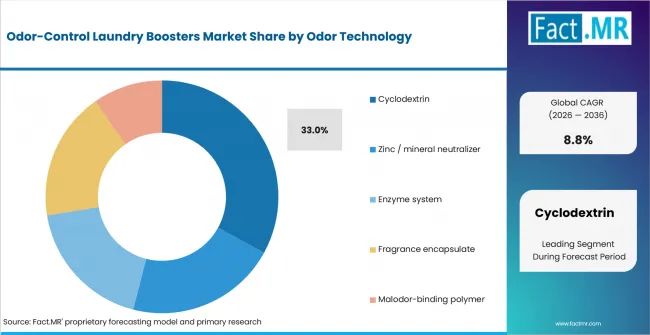
Odor Control Laundry Boosters Market Analysis By Odor Technology | Source: Fact.MR
Cyclodextrin leads because its molecular cavity can host small odor-related molecules in formulated products. Zinc or mineral neutralizers use a different route, while enzymes act on soils that generate smell. Fragrance encapsulates manage scent release, and malodor-binding polymers provide another capture mechanism for persistent fabric odor.
What leads the Odor segment?
Body / sweat leads with 29.0% share in 2026.
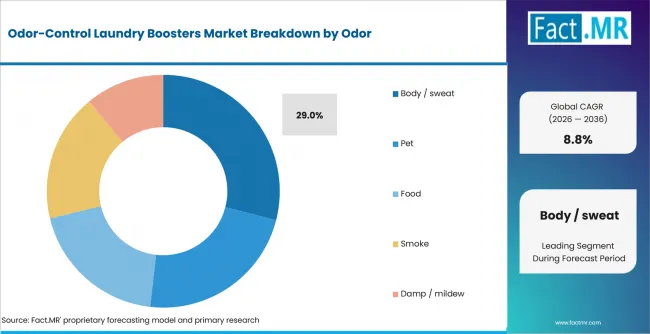
Odor Control Laundry Boosters Market Analysis By Odor | Source: Fact.MR
Body and sweat odor leads because frequently worn textiles can retain smell after repeated use. Pet odor creates another recurring household need. Food, smoke, and damp odors are more situational. Product positioning works best when it identifies the specific fabric-odor problem and gives a clear dosing instruction.
How does Format shape demand?
Beads are expected to capture 36.0% share in 2026.
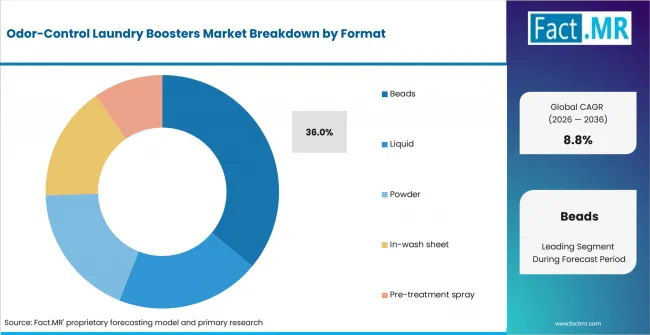
Odor Control Laundry Boosters Market Analysis By Format | Source: Fact.MR
Beads lead because consumers dose them directly into the washer and keep the booster step separate from detergent. Liquids disperse quickly, while powders suit mineral or oxygen systems. Kao announced Humming Flair Aroma Beads in October 2025 and said its Fragrance Pocket Technology helps the beads dissolve in cold water while reducing residue after washing.
What supports Main wash within Use Stage?
Main wash accounts for 32.0% share in 2026.
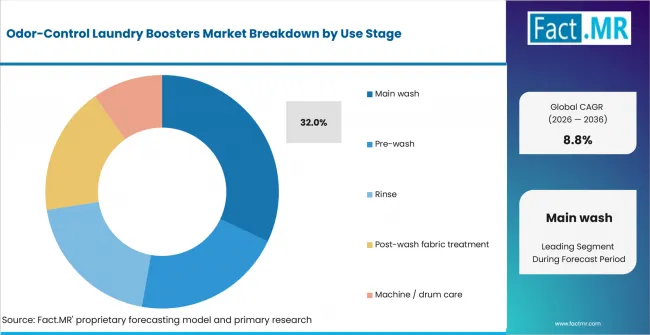
Odor Control Laundry Boosters Market Analysis By Use Stage | Source: Fact.MR
Main-wash use leads because the booster can be added alongside detergent with little change to the routine. Pre-wash targets concentrated odor, while rinse and post-wash products focus on finishing. Broader detergent chemicals remain part of the wash context, while machine-care products address odor sources inside the appliance.
What is accelerating Odor-Control Laundry Boosters Market adoption, and what is holding it back?
Persistent fabric malodor supports adoption; price sensitivity and claim compliance restrain it.
Drivers Impact Analysis
| DRIVER | (~) % IMPACT ON CAGR | GEOGRAPHIC RELEVANCE | IMPACT TIMELINE |
|---|---|---|---|
| Persistent sweat and activewear odor | +1.6% | Global | Short term (<= 2 years) |
| Separate scent and odor-control routines | +1.3% | North America, Europe | Medium term (2-4 years) |
| Bead and liquid format convenience | +1.1% | USA, UK, Japan | Short term (<= 2 years) |
| Pet and damp-textile odor needs | +0.8% | Global | Medium term (2-4 years) |
| Safer chemistry and clearer ingredient screening | +0.6% | USA, Europe | Long term (>= 4 years) |
Source: Fact.MR analysis. Updated Sep 25, 2026
Opportunity Impact Analysis
| OPPORTUNITY | (~) % IMPACT ON CAGR | GEOGRAPHIC RELEVANCE | IMPACT TIMELINE |
|---|---|---|---|
| Cold-water soluble bead systems | +1.1% | USA, Japan, Europe | Short term (<= 2 years) |
| Low-fragrance and fragrance-free odor control | +0.9% | USA, Europe | Medium term (2-4 years) |
| Pet and sports odor specialization | +0.7% | Global | Medium term (2-4 years) |
| Machine and drum odor care extensions | +0.5% | Japan, Europe | Long term (>= 4 years) |
Source: Fact.MR analysis. Updated Sep 25, 2026
Restraints Impact Analysis
| RESTRAINT | (~) % IMPACT ON CAGR | GEOGRAPHIC RELEVANCE | IMPACT TIMELINE |
|---|---|---|---|
| Price pressure in household cleaning | -0.7% | USA, UK, France | Short term (<= 2 years) |
| Hazard and ingredient-label requirements | -0.5% | Europe, USA | Medium term (2-4 years) |
| Residue or dissolution concerns | -0.4% | Global | Short term (<= 2 years) |
| Overlap with detergent and fabric enhancer claims | -0.3% | Global | Long term (>= 4 years) |
Source: Fact.MR analysis. Updated Sep 25, 2026
Which countries are scaling Odor-Control Laundry Boosters Market through 2036?
- The USA records the highest displayed CAGR at 10.2%, placing it 0.3 percentage point above the UK as established laundry-additive use supports specialized odor-control routines.
- The UK reaches 9.9%, staying 0.4 percentage point above Germany as separate fabric-enhancer and scent formats remain familiar within household laundry routines.
- Germany reaches 9.5%, remaining 0.3 percentage point above France as detergent compliance and technical formulation needs influence product design.
- France posts 9.2%, staying 1.3 percentage points above Japan as mass-retail household care provides a broad route to consumers.
- Japan closes the displayed range at 7.9% as cold-water bead design and detailed household laundry routines shape product work.
Comparable CAGRs can create different entry conditions because household-care prices, detergent rules, product formats, and laundry habits vary by country. Full report coverage includes North America, Latin America, Western Europe, Eastern Europe, East Asia, South Asia & Pacific, and Middle East & Africa.
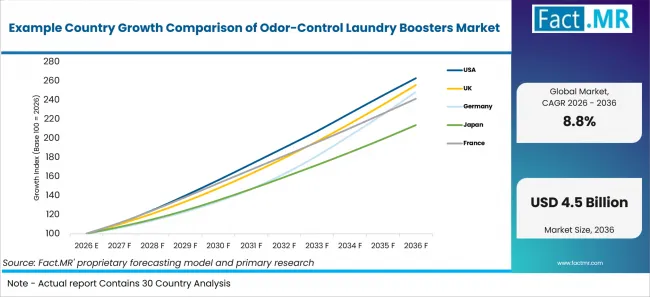
Example Country Growth Comparison Of Odor Control Laundry Boosters Market | Source: Fact.MR
| Country | CAGR (2026-2036) |
|---|---|
| United States | 10.2% |
| United Kingdom | 9.9% |
| Germany | 9.5% |
| France | 9.2% |
| Japan | 7.9% |
Source: Fact.MR analysis. Updated Sep 25, 2026
What supports USA adoption?
10.2% CAGR, supported by established laundry-additive use and household-cleaning price conditions.
The USA has broad familiarity with separate laundry additives, so odor-control boosters can fit an existing wash routine rather than create an entirely new step. The U.S. Bureau of Labor Statistics reported in September 2026 that household cleaning product prices were 2.1% higher year over year in August 2026.
How is the United Kingdom scaling demand?
9.9% CAGR, led by established fabric-enhancer use and measurable household-cleaning activity.
The UK has an established laundry-care shelf where detergent, scent, and softening products already occupy separate roles. The Office for National Statistics reported in September 2026 that the 2025 CPI index for cleaning and maintenance products was 109.9 on a 2015 equal to 100 basis. Familiarity with fabric conditioner products can make a separate booster easier to understand when the odor-control function is explained clearly.
What supports Germany adoption?
9.5% CAGR, backed by technical laundry-care demand and structured chemical-product needs.
Germany combines broad detergent choice with visible chemical-product needs, which places more weight on formulation traceability and clear product instructions. The German Federal Institute for Risk Assessment stated in January 2025 that the UFI requirement applies to household products classified as hazardous and enables notified product formulations to be identified by Germany’s seven Poison Centres. Odor-control boosters so need a clear functional role alongside disciplined labeling and dosing information.
How does France perform?
9.2% CAGR, shaped by mass-retail household-care purchasing and differentiated freshness products.
France provides broad supermarket access to household-care products, which gives beads and liquids a familiar retail setting beside detergent and fabric enhancers. INSEE reported in January 2026 that the December 2025 price index for cleaning and personal care products sold in hypermarkets and supermarkets was 105.26, with 2015 equal to 100. Product differentiation so depends on a clear odor-control purpose and straightforward use instructions within a competitive shelf environment.
How does Japan perform?
7.9% CAGR, driven by detailed laundry routines and continuing bead-format work.
Japan combines detailed household laundry routines with active deodorizing and fragrance product work. The Statistics Bureau reported in February 2026 that two-or-more-person households recorded average monthly consumption expenditure of 314,001 yen in 2025. Booster formats so compete for attention within a carefully managed household basket. Cold-water dissolution and simple dosing remain practical design considerations for in-wash products.
Who leads the Odor-Control Laundry Boosters Market?
Procter & Gamble and Henkel provide direct in-wash scent-booster products through Downy Unstopables and Purex Crystals. Church & Dwight, and Kao also maintain direct scent-booster offerings through Comfort, ARM & HAMMER, and Humming Flair, respectively. Reckitt broadens the competitive set through laundry boosters, sanitizing, and odor-control products.
In April 2026, Henkel refreshed the Purex laundry portfolio and stated that Purex Crystals Scent Boosters carried an updated claim of up to 21 weeks of long-lasting freshness out of storage. Purex Crystals remain a separate in-wash scent-booster format within the wider Purex laundry range.
Procter & Gamble, Henkel, Church & Dwight, and Kao compete directly in laundry fragrance and scent-boosting formats, while Reckitt participates through adjacent laundry booster, odor-control, and sanitizing products. Across these portfolios, product performance, fragrance choice, dissolution and dispersion behavior, dosage convenience, and compatibility with established wash routines provide practical areas of differentiation.
Which companies are the key providers?
Key companies include Procter & Gamble, Henkel, Reckitt, Church & Dwight, and Kao.
- Procter & Gamble
- Henkel
- Reckitt
- Church & Dwight
- Kao
Bibliography
- U.S. Environmental Protection Agency. (2026, February 2). Safer Choice performance measures.
- Procter & Gamble. (2026, July 30). Downy introduces an immersive fragrance experience where consumers can step inside the world behind luxury laundry scent.
- U.S. Bureau of Labor Statistics. (2026, September 11). Table 2. Consumer Price Index for All Urban Consumers (CPI-U): U.S. city average, by detailed expenditure category.
- Office for National Statistics. (2026, September 16). CPI INDEX 05.6.1.1 Cleaning and maintenance products 2015=100.
- German Federal Institute for Risk Assessment. (2025, January 3). UFI code to provide clear identification of detergent and cleaning agent mixtures and save lives.
- Institut national de la statistique et des études économiques. (2026, January 15). En décembre 2025, les prix des produits de grande consommation vendus dans la grande distribution augmentent de 1,4 % sur un an.
- Statistics Bureau of Japan. (2026, February 6). 2025 yearly average [Family Income and Expenditure Survey].
- Henkel. (2026, April 7). Purex® Laundry Brand ushers in a new era of freshness with concentrated liquid formulas and nature-inspired fragrances.
This Report Addresses
- The report explains where odor-control laundry boosters are used across Odor Technology, Odor, Format, and Use Stage. It also covers regional demand and the role of separate booster products within household laundry routines.
- Segment analysis identifies the leading subsegments and explains why cyclodextrin, body and sweat odor, beads, and main-wash use hold prominent positions in the market.
- Country analysis examines the United States, United Kingdom, Germany, France, and Japan. It considers laundry habits, household-care conditions, product familiarity, and regulatory factors that influence booster adoption.
- Competitive analysis reviews Procter & Gamble, Henkel, Reckitt, Church & Dwight, and Kao across scent boosters, odor-control products, sanitizing products, and related laundry-care portfolios.
- Application analysis assesses how odor type, wash stage, dosing convenience, dissolution, fragrance delivery, and residue control influence product selection. It also considers pet odor, sportswear, damp textiles, and machine-care uses.
What does the Odor-Control Laundry Boosters Market cover?
Laundry additives that add a separate odor-control or freshness function before, during, or after the wash cycle.
The market covers separate laundry additives for fabric malodor, including beads, liquids, powders, sheets, and sprays. Included technologies cover cyclodextrin, minerals, enzymes, fragrance encapsulation, and malodor-binding polymers when sold as a distinct laundry-care step.
What is included in the scope?
Odor-control boosters used with household laundry across pre-wash, main-wash, rinse, post-wash, and machine-care routines.
The scope includes cyclodextrin chemistry when it is formulated into a distinct laundry booster for odor management. Fragrance encapsulation is included when it controls scent release inside a separate booster format. Laundry fragrance products enter the scope when they are sold as separate additives with an odor or freshness function.
What is excluded from the scope?
The scope is limited to separate odor-control laundry boosters and closely related additive formats used before, during, or after washing.
Fabric softeners remain part of the adjacent context unless they are sold as a separate odor-control booster or additive. Commercial laundry detergent belongs to the broader wash-care context rather than the household booster boundary. Surfactants are treated as formulation ingredients when they are sold independently from the finished booster product.
How Was the Analysis Built?
The analysis draws on 120+ sources, 35+ company portfolios, 25+ countries, and more than 20 industry interviews.
- Primary Research: Primary research includes discussions with manufacturers, service providers, technology developers, distributors, end users, and subject-matter experts. These conversations examine purchasing priorities, product adoption, operational challenges, approval requirements, competitive positioning, and the factors that influence wider market acceptance.
- Desk Research: Desk research covers government statistics, regulatory publications, company filings, trade data, technical studies, industry associations, standards, public policy, and other authoritative sources. Every source used in the analysis is documented in the bibliography.
- Market Sizing and Forecasting: Market estimates combine historical performance, demand indicators, pricing and volume trends, segment shares, company participation, country-level growth, adoption patterns, investment activity, and barriers to market expansion.
- Data Validation and Update Cycle: Findings are validated by comparing primary interviews with public data, company activity, regulatory changes, trade patterns, and industry developments. Regular updates review new product launches, capacity changes, partnerships, approvals, and shifts in commercial adoption.
Segmentation
What is the report’s scope and coverage?
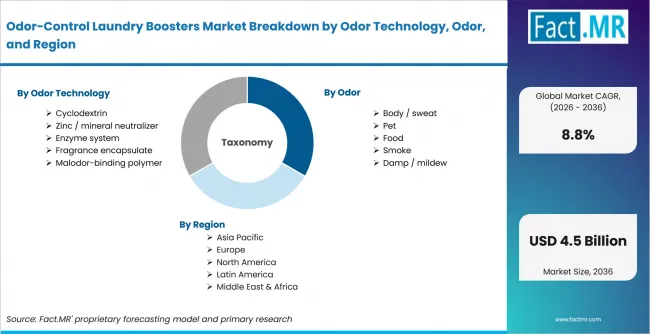
Odor Control Laundry Boosters Market Breakdown By Odor Technology, Odor, And Region | Source: Fact.MR
| Attribute | Details |
|---|---|
| Quantitative Units | USD billion |
| Market Definition | Laundry additives used with or around the wash cycle to neutralize, bind, reduce, or manage persistent fabric malodor and related freshness needs. |
| Odor Technology | Cyclodextrin; Zinc / mineral neutralizer; Enzyme system; Fragrance encapsulate; Malodor-binding polymer |
| Odor | Body / sweat; Pet; Food; Smoke; Damp / mildew |
| Format | Beads; Liquid; Powder; In-wash sheet; Pre-treatment spray |
| Use Stage | Main wash; Pre-wash; Rinse; Post-wash fabric treatment; Machine / drum care |
| Regions Covered | North America; Latin America; Western Europe; Eastern Europe; East Asia; South Asia & Pacific; Middle East & Africa |
| Countries Covered | United States; United Kingdom; Germany; France; Japan |
| Key Companies Profiled | Procter & Gamble; Henkel; Reckitt; Church & Dwight; Kao |
| Forecast Period | 2026 to 2036 |
| Approach | Hybrid top-down and bottom-up assessment using household-care indicators, product portfolios, format participation, country conditions, official statistics, and first-party company developments. |
Source: Fact.MR analysis. Updated Sep 25, 2026
How is the market segmented?
-
By Odor Technology:
- Cyclodextrin
- Zinc / mineral neutralizer
- Enzyme system
- Fragrance encapsulate
- Malodor-binding polymer
-
By Odor:
- Body / sweat
- Pet
- Food
- Smoke
- Damp / mildew
-
By Format:
- Beads
- Liquid
- Powder
- In-wash sheet
- Pre-treatment spray
-
By Use Stage:
- Main wash
- Pre-wash
- Rinse
- Post-wash fabric treatment
- Machine / drum care
-
By Region:
- North America
- Latin America
- Western Europe
- Eastern Europe
- East Asia
- South Asia & Pacific
- Middle East & Africa
Frequently Asked Questions
How big is the Odor-Control Laundry Boosters Market in 2026?
What is the CAGR of the Odor-Control Laundry Boosters Market from 2026 to 2036?
Which odor technology leads the Odor-Control Laundry Boosters Market?
Which format leads the Odor-Control Laundry Boosters Market?
Who are the leading companies in the Odor-Control Laundry Boosters Market?
Who worked on this report


Preview the report firsthand - request a free sample
Free SampleGet the brochure for pricing and purchase details
Download PDF