- Market Value (2025): USD 1.2 Bn
- Estimated Value (2026): USD 1.3 Bn
- Forecast Value (2036): USD 3.8 Bn
- CAGR (2026-2036): 11.2%
What is the clean-label technical consulting market forecast to be worth by 2036?
USD 1.3 billion in 2026 to USD 3.8 billion by 2036 at an 11.2% CAGR.
- The clean-label technical consulting market was valued at USD 1.2 billion in 2025.
- Demand is forecast to increase from USD 1.3 billion in 2026 to USD 3.8 billion by 2036.
- As per Fact.MR analysis, the market is forecast to record an 11.2% CAGR from 2026 to 2036.
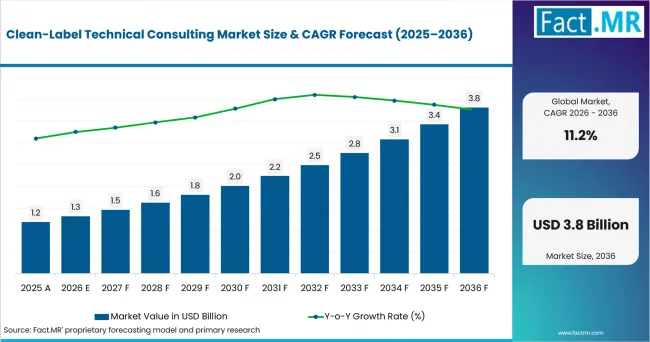
Clean Label Technical Consulting Market Value Analysis | Source: Fact.MR
What are the main market growth numbers?
An absolute opportunity of USD 2.5 billion is expected between 2026 and 2036.
- Demand Drivers in the Market
- Food companies need to test new ingredients when they remove a color or preservative. The same applies when they change sweeteners or ingredients used for texture.
- Food companies need to change recipes when food rules change. In January 2025, the U.S. Food and Drug Administration set January 15, 2027, as the deadline to reformulate foods that use FD&C Red No. 3 [1].
- Bakery companies need to keep products fresh after removing common additives. In April 2025, Corbion introduced Verdad® Essence WH100 to control mold naturally in bakery products.
- Key Segments Analyzed
- By Consulting Workstream: Ingredient replacement is expected to hold a 37.0% share in 2026 because removing an additive often means finding a replacement.
- By Food Category: Baked goods hold 28.0% share in 2026 as ingredient changes can affect mold control and texture.
- By Project Objective: Additive cut accounts for 35.0% share in 2026 as food companies remove additives and change recipes.
- By Engagement: Diagnostic leads with 31.0% share in 2026 since teams first check the role of each ingredient and label rules.
- Analyst Opinion at Fact.MR
- Shambhu Nath Jha, Principal Consultant at Fact.MR, states, “Food companies are expected to choose firms that can test ingredients and product quality. These firms also need to know food rules so recipe changes meet label and market needs.”
- Strategic Implications
- Ingredient suppliers should explain why each replacement works and what changes it may cause. In July 2026, the Office for National Statistics reported that food manufacturing represented 22.9% of UK manufacturers' product sales in 2025 [2].
- Food companies should set the label goal before testing. This makes it clear which recipe changes are needed.
- Labs should check the product, test the new recipe, and then run a pilot test. Each step should be completed before the next one starts.
- Food rule teams should check ingredient names and product claims during recipe changes. This makes sure the final product meets market rules.
The UK is expected to grow at 12.7% CAGR through 2036 as food companies change recipes. The USA follows at 12.1% due to deadlines for ingredient changes. Germany stands at 11.8% as recipe changes continue, followed by France at 11.5%. Japan records 10.0% as food-labeling changes lead to more recipe checks.
How does the market break down by segment?
Input swap leads Support Workstream at 37.0%; Additive cut leads Project Goal at 35.0%.
Which Consulting Workstream dominates?
Input swap is forecast to hold 37.0% share in 2026.
Ingredient replacement leading this segment because clean-label changes often start with removing a color or preservative. Sweeteners may also need replacement. Changing starches or thickeners can affect texture. Food sweeteners are also important when reducing sugar changes texture.
What leads the Food Category segment?
Baked goods is forecast to account for 28.0% share in 2026.
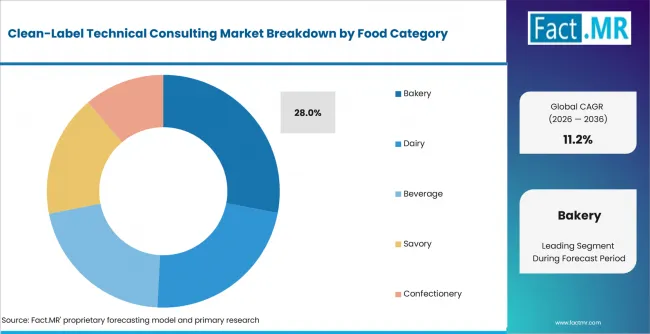
Clean Label Technical Consulting Market Analysis By Food Category | Source: Fact.MR
Baked goods are anticipated to account for a 28.0% share as changes in recipes can impact shelf life and texture. Dairy products may need different stabilizers, while beverages need the right taste. Food emulsifiers are used when recipe changes affect mixing or texture.
How does Project Objective shape demand?
Additive cut is forecast to capture 35.0% share in 2026.
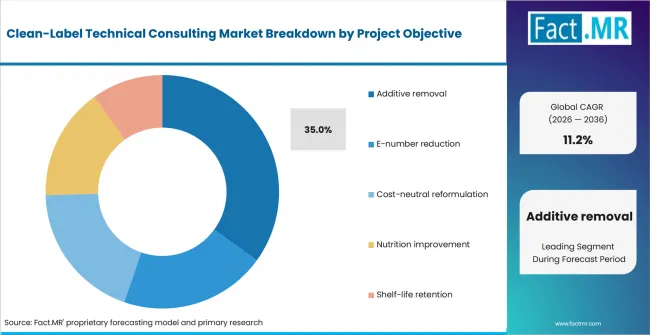
Clean Label Technical Consulting Market Analysis By Project Objective | Source: Fact.MR
Additive cut lead because companies can compare the changed recipe with the original product. E-number removal depends on market rules, while some recipe changes need to keep the same cost. Other changes may reduce sugar or salt. Shelf life also needs to stay the same when an ingredient used for stability is removed. In July 2025, the Max Rubner-Institut proposed an average salt target of 1.2 g per 100 g for bread and rolls [3].
What supports Diagnostic within Engagement?
Review is forecast to represent 31.0% share in 2026.
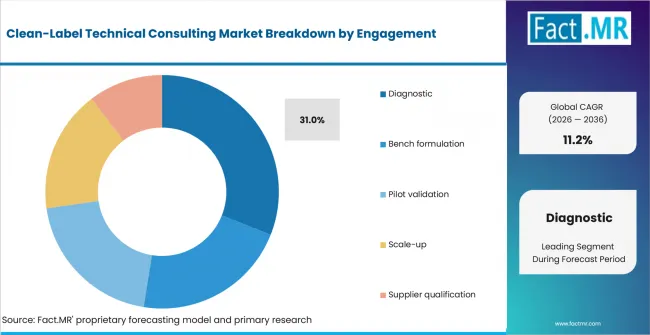
Clean Label Technical Consulting Market Analysis By Engagement | Source: Fact.MR
Review is expected to hold a 31.0% share because consultants first check the role of each ingredient in shelf life, texture, color, and sweetness. They then test replacement ingredients. Pilot tests check the recipe under actual production conditions. Larger tests make sure the recipe gives the same results before final approval.
What is driving market use, and what is holding it back?
Changes in food rules and simple labels increase demand, while product results and higher costs can slow down the growth.
Drivers Impact Analysis
| DRIVER | (~) % IMPACT ON CAGR | GEOGRAPHIC RELEVANCE | IMPACT TIMELINE |
|---|---|---|---|
| Regulatory ingredient and color changes | +1.7% | North America, Europe, Japan | Short term (<= 2 years) |
| Label simplification across established food categories | +1.3% | Global | Medium term (2-4 years) |
| Sugar and sodium reformulation programs | +1.0% | Europe, North America, Japan | Medium term (2-4 years) |
| Need to protect shelf life and sensory performance | +0.8% | Global | Long term (>= 4 years) |
Source: Fact.MR analysis. Updated Oct 5, 2026
Opportunity Impact Analysis
| OPPORTUNITY | (~) % IMPACT ON CAGR | GEOGRAPHIC RELEVANCE | IMPACT TIMELINE |
|---|---|---|---|
| Integrated diagnostic-to-pilot engagements | +1.2% | Global | Short term (<= 2 years) |
| Clean-label preservation for bakery and savory food | +0.9% | North America, Europe | Medium term (2-4 years) |
| Digital formulation support for R&D teams | +0.6% | North America, Europe | Long term (>= 4 years) |
Source: Fact.MR analysis. Updated Oct 5, 2026
Restraints Impact Analysis
| RESTRAINT | (~) % IMPACT ON CAGR | GEOGRAPHIC RELEVANCE | IMPACT TIMELINE |
|---|---|---|---|
| Sensory and shelf-life trade-offs | -0.7% | Global | Short term (<= 2 years) |
| Cost pressure on replacement ingredients | -0.5% | Global | Medium term (2-4 years) |
| Different label rules across jurisdictions | -0.4% | Europe, North America, Japan | Long term (>= 4 years) |
Source: Fact.MR analysis. Updated Oct 5, 2026
Which countries are growing fastest through 2036?
- The displayed country comparison spans 2.7 points across the forecast period.
- The UK is 0.6 point above the USA. Factory work scale and mix change work support demand.
- The USA is 0.3 point above Germany as color-additive changes create deadline-based mix work.
- Germany is 0.3 point above France as national sugar and salt cut targets create product-specific lab briefs.
- France is 1.5 points above Japan as mix and labeling enforcement keeps mix verification active.
Comparable CAGRs can produce different project mixes because rule timing and food-group exposure vary by country. In-house use skill can change the type of external support required. Full report coverage includes North America; Latin America; Western Europe; Eastern Europe; East Asia; South Asia & Pacific; and Middle East & Africa.
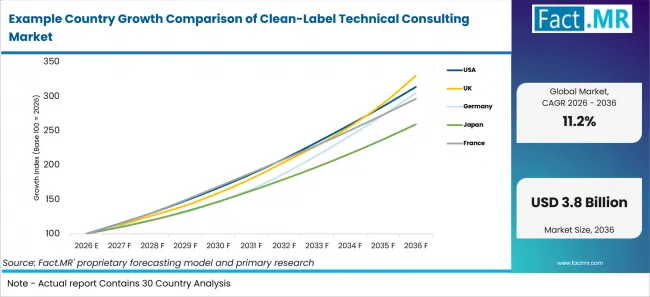
Example Country Growth Comparison Of Clean Label Technical Consulting Market | Source: Fact.MR
| Country | CAGR (2026-2036) |
|---|---|
| United Kingdom | 12.7% |
| United States | 12.1% |
| Germany | 11.8% |
| France | 11.5% |
| Japan | 10.0% |
Source: Fact.MR analysis. Updated Oct 5, 2026
What supports United States adoption?
12.1% CAGR, backed by mix change deadlines and a large food-spending base.
U.S. food companies are changing ingredients for cleaner labels while keeping the same taste and shelf life. In June 2026, the USDA Economic Research Service reported that U.S. food spending reached USD 2.51 trillion in 2025 [4].
How is the United Kingdom scaling demand?
12.7% CAGR, backed by food-factory work scale and label-focused mix change.
UK food companies use outside labs when cleaner labels affect texture and shelf life. Baked goods and prepared foods need testing because ingredient changes can affect the final product. The 12.7% CAGR reflects the need for recipe support in the UK food industry.
What is supporting Germany's adoption?
11.8% CAGR, backed by diet mix change and lab testing needs.
German food companies are changing recipes to reduce sugar and salt while keeping the same taste. They test these changes before full production. The 11.8% CAGR reflects the need to meet nutrition goals while keeping product quality.
How is France developing demand?
11.5% CAGR, backed by a large food-factory work base and mix review.
French food companies review recipes when ingredient labels change while keeping the same product quality. INSEE reported in July 2026 that food, beverage, and tobacco manufacturing output reached EUR 207 billion in 2025 [5]. This creates regular work for taste, texture, shelf life, and label changes.
How does Japan perform?
10.0% CAGR, backed by food-labeling updates and product-specific mix work.
Japanese food companies review recipes when label rules change or new ingredients change the taste. On August 25, 2025, Japan's Consumer Affairs Agency issued the 39th amendment to its notice on the Food Labelling Standards [6].
Who leads the Clean Label Technical Consulting Market?
Kerry Group supports product reformulation through taste, nutrition and application expertise. In March 2026, Kerry reported that its 2025 work included next-generation fermentation-derived Tastesense™ solutions for sugar and salt reduction and an expanded customer innovation-centre network. These capabilities help food makers work on nutrition goals while maintaining taste.
Ingredion combines clean-label ingredient solutions with formulation and texture support. In July 2026, the company presented FUSERA® clean-label solutions at IFT FIRST and gave a first look at Ask Ingredion, an AI-powered assistant within the MyIngredion customer portal. The tool brings together technical expertise, product data and application insights to help R&D teams address formulation challenges.
IFF supports food and beverage reformulation through flavor, taste-modulation and ingredient expertise. Its clean-label portfolio includes flavors, modulators, texturizing ingredients, cultures, enzymes and other ingredient systems. These capabilities can support projects where changes to ingredients affect taste, texture or other product qualities.
Cargill and Tate & Lyle provide ingredient and application expertise for clean-label reformulation. Their capabilities cover areas such as sweetness, texture, mouthfeel and product stability. Corbion adds expertise in shelf-life and bakery formulation, including technical support, sensory testing and preservation solutions. These capabilities help food makers select ingredients and adjust formulations while maintaining the required product performance.
Which companies are the key providers?
Key companies include Kerry Group; Ingredion; IFF; Cargill; Tate & Lyle; and Corbion.
- Kerry Group
- Ingredion
- IFF
- Cargill
- Tate & Lyle
- Corbion
Bibliography
- HM Revenue & Customs. (2026, August 27). Plastic Packaging Tax (PPT) statistics commentary. GOV.UK.
- Ministry of the Environment, Government of Japan. (2026, March 27). Municipal solid waste generation and disposal in FY2024.
- Board of Governors of the Federal Reserve System (US). (2026, February 18). Industrial production: Manufacturing: Nondurable goods: Plastics material and resin (NAICS = 325211). Federal Reserve Bank of St. Louis.
- Office for National Statistics. (2026, July 24). UK manufacturers' sales by product: 2025.
- Statistisches Bundesamt (Destatis). (2026, February 23). Abfallentsorgung 2024: Art und Menge der im Berichtsjahr 2024 gesammelten/zurückgenommenen Verpackungen [Waste disposal 2024: Type and quantity of packaging collected or taken back in 2024].
- Ministères de la Transition écologique, de l’Aménagement du territoire, des Transports, de la Ville et du Logement. (2026, June 18). Plan plastique : 12 leviers pour réduire, réemployer et recycler les emballages plastiques [Plastic plan: 12 levers to reduce, reuse and recycle plastic packaging].
- Loop Industries. (2025, September 15). Loop Industries announces offtake agreement with Taro Plast to supply Loop™ Dimethyl Terephthalate (DMT) made from 100% recycled content.
- Carbios. (2025, November 6). Carbios and Wankai New Materials, a subsidiary of Zhink Group, are committed to the large-scale deployment of Carbios’ PET biorecycling technology in Asia, with the first step being the construction of a PET biorecycling plant in China.
This Report Answers
- The report covers clean-label consulting across ingredient replacement and preservation work. It also covers texture and label review. The focus stays on technical help that links a stated label goal with a formula that can be tested and scaled.
- Segment analysis explains why food manufacturers use outside formula support. It shows where ingredient changes create more lab work and where pilot testing can reduce the risk of a late change.
- Country analysis compares the growth rates with current official evidence. It focuses on the local food base and the type of formula work that can support demand in each country.
- Competitive analysis reviews companies through first-party evidence on clean-label and formula support. It focuses on firms that can help food teams move from an initial brief to tested product work.
- Application analysis examines product performance and shelf life. It also looks at quality and cost because clean-label work often needs all four points to stay aligned through the test process.
What does the Clean-Label Technical Consulting Market cover?
The market covers technical advisory and application work for cleaner food and beverage formulations. It includes ingredient replacement and preservation redesign. Texture work and flavor masking are included when they form part of the reformulation project. Label review and validation complete the technical scope.
Related formulation ecosystems include food flavors and other formulation inputs. These adjacent categories inform technical ingredient choices used in reformulation. The report remains focused on consulting and application-support activity.
What is included in the scope?
The scope includes diagnosis and formula redesign. It covers bench work and pilot validation. Scale-up support and supplier qualification remain part of the assessment when they are tied to clean-label reformulation. Integrated label review is included when it supports the same technical assignment.
The work may draw on specialty food ingredients when formulation performance changes. Consulting remains in scope when these technical choices are evaluated as part of a customer reformulation assignment.
What is excluded from the scope?
The scope excludes standalone ingredient sales and general management consulting. Brand strategy and advertising fall outside the technical boundary. Laboratory testing is excluded when it is unrelated to clean-label reformulation.
Routine regulatory filing, equipment engineering and contract manufacturing are excluded unless directly tied to formula validation or scale-up.
How Was the Analysis Built?
The analysis draws on 120+ sources, 35+ company portfolios, 25+ countries, and more than 20 industry interviews.
- Primary Research: Primary research includes discussions with manufacturers, service providers, technology developers, distributors, end users, and subject-matter experts. These conversations examine purchasing priorities, product adoption, operational challenges, approval requirements, competitive positioning, and the factors that influence wider market acceptance.
- Desk Research: Desk research covers government statistics, regulatory publications, company filings, trade data, technical studies, industry associations, standards, public policy, and other authoritative sources. Every source used in the analysis is documented in the bibliography.
- Market Sizing and Forecasting: Market estimates combine historical performance, demand indicators, pricing and volume trends, segment shares, company participation, country-level growth, adoption patterns, investment activity, and barriers to market expansion.
- Data Validation and Update Cycle: Findings are validated by comparing primary interviews with public data, company activity, regulatory changes, trade patterns, and industry developments. Regular updates review new product launches, capacity changes, partnerships, approvals, and shifts in commercial adoption.
Segmentation
What is the report’s scope and coverage?
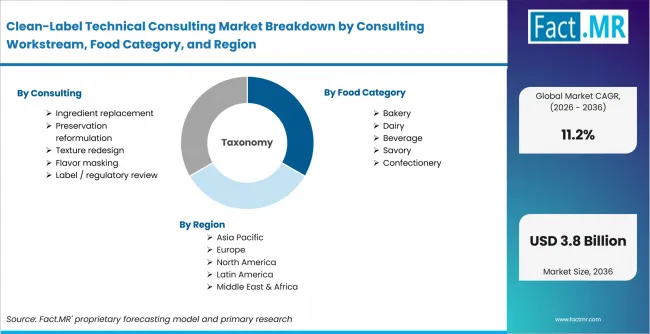
Clean Label Technical Consulting Market Breakdown By Consulting Workstream, Food Category, And Region | Source: Fact.MR
| Attribute | Details |
|---|---|
| Quantitative Units | USD billion |
| Market Definition | Technical consulting and application support used to reformulate food and beverage products for cleaner ingredient declarations while managing functionality, sensory performance, shelf life, cost and regulatory requirements. |
| Consulting Workstream | Ingredient replacement; Preservation reformulation; Texture redesign; Flavor masking; Label / regulatory review |
| Food Category | Bakery; Dairy; Beverage; Savory; Confectionery |
| Project Objective | Additive removal; E-number reduction; Cost-neutral reformulation; Nutrition improvement; Shelf-life retention |
| Engagement | Diagnostic; Bench formulation; Pilot validation; Scale-up; Supplier qualification |
| Regions Covered | North America; Latin America; Western Europe; Eastern Europe; East Asia; South Asia & Pacific; Middle East & Africa |
| Countries Covered | United States; United Kingdom; Germany; Japan; France |
| Key Companies Profiled | Kerry Group; Ingredion; IFF; Cargill; Tate & Lyle; Corbion |
| Forecast Period | 2026 to 2036 |
| Approach | Hybrid top-down and bottom-up assessment using market values, segment shares and country growth rates, supported by first-hand regulatory, statistical and company evidence. |
Source: Fact.MR analysis. Updated Oct 5, 2026
How is the market segmented?
-
By Consulting Workstream:
- Ingredient replacement
- Preservation reformulation
- Texture redesign
- Flavor masking
- Label / regulatory review
-
By Food Category:
- Bakery
- Dairy
- Beverage
- Savory
- Confectionery
-
By Project Objective:
- Additive removal
- E-number reduction
- Cost-neutral reformulation
- Nutrition improvement
- Shelf-life retention
-
By Engagement:
- Diagnostic
- Bench formulation
- Pilot validation
- Scale-up
- Supplier qualification
-
By Region:
- North America
- Latin America
- Western Europe
- Eastern Europe
- East Asia
- South Asia & Pacific
- Middle East & Africa
Frequently Asked Questions
How big is the clean-label technical consulting market in 2026?
What is the CAGR of the clean-label technical consulting market from 2026 to 2036?
Which consulting workstream leads the market?
Which food category leads the market?
Who are the companies profiled in the clean-label technical consulting market?
Who worked on this report


Preview the report firsthand - request a free sample
Free SampleGet the brochure for pricing and purchase details
Download PDF