- Base Value(2025): 167 Mn
- Estimated Value(2026): 173 Mn
- Forecast Value (2036): 254 Mn
- CAGR (2026 - 2036): 3.9%
Europe Tub Grinder Market Forecast and Outlook By Fact.MR
- In 2025, the Europe tub grinder market was valued at USD 167 million.
- Based on Fact.MR analysis, demand for tub grinders in Europe is estimated to grow to USD 173 million in 2026 and USD 254 million by 2036, registering a CAGR of 3.9% during the forecast period.
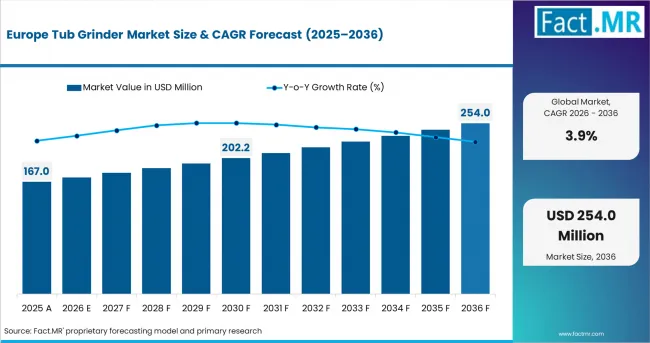
Europe Tub Grinder Market Value Analysis | Source: Fact.MR
| Metric | Value |
|---|---|
| Estimated Value in 2026 | USD 173 million |
| Forecast Value in 2036 | USD 254 million |
| Forecast CAGR (2026 to 2036) | 3.9% |
Source: Fact.MR analysis. Updated Jun 3, 2026
Summary ofEurope Tub Grinder Market
- Demand Drivers
- Waste Management Compliance: Waste management companies and municipal operators are replacing older tub grinders to meet EU Stage V emission standards. This is creating strong short term replacement demand.
- Biomass Energy Demand: Biomass power plants and district heating facilities are increasing wood waste and bio waste processing. This is supporting demand for high capacity tub grinders across Germany, France, and Italy.
- Construction Waste Recycling Rules: Updated European rules are making contractors separate wood waste at job sites. Demolition contractors are using portable tub grinders to reduce wood waste faster.
- Key Segments Analyzed
- • By Type: Wheeled Tub Grinder holds 61.3% share in 2026. Easy movement across construction and waste handling sites supports higher adoption.
- • By Material Processing: Wood Waste leads with 47.8% share in 2026. Strong recycling activity and biomass fuel production are supporting demand.
- • By Power Source: Diesel Engine holds 68.5% share in 2026. Most outdoor waste processing sites still depend on diesel powered equipment.
- • By End User: Waste Management holds 40.0% share in 2026. Municipal waste contracts and recycling targets are supporting equipment demand.
- • By Application: Recycling leads with 41.2% share in 2026. Circular economy programs are increasing material recovery and reuse activities.
- Analyst Opinion at Fact.MR
- Shambhu Nath Jha, Principal Consultant at Fact.MR, opines, 'CXOs in the European tub grinder market will find that regulatory-driven replacement cycles and biomass energy demand are the two structural forces separating growing operators from those managing flat to declining unit volumes through 2036.'
- Strategic Implications
- Tub grinder manufacturers and dealers should focus on Stage V compliant wheeled diesel models in Germany and France. Municipal fleet replacement programs are creating steady short-term demand.
- Companies should develop electric tub grinder models with mobile battery support for urban projects in the United Kingdom and the Netherlands. Low emission rules are limiting diesel equipment use in city areas.
- Expanding aftermarket parts supply and service networks in Italy and Spain can reduce equipment downtime. This also helps improve customer retention in agriculture and landscaping sectors.
The market is projected to generate USD 81 million in incremental revenue through 2036. Growth is stable, not fast. EU recycling upgrades and higher demand for biomass energy feedstock are supporting the market. EU Stage V diesel engine certification costs and import duties on non-EU parts are reducing margins for smaller regional operators.
Germany is projected to record 4.6% CAGR due to equipment renewal programs and recycling compliance targets are supporting market demand. France is forecast to grow at 4.0% CAGR by 2036. Investments in circular economy and recycling infrastructure are driving equipment adoption. The United Kingdom is expected to expand at 3.8% CAGR due to green infrastructure projects and waste regulations are supporting replacement demand. Italy is projected to grow at 3.6% CAGR by 2036. Rising agricultural residue and green waste processing activities are supporting market growth. Spain is forecast to register 3.5% CAGR until 2036. Composting and land clearing investments are contributing to steady demand.
Segmental Analysis
Europe Tub Grinder Market Analysis by Type
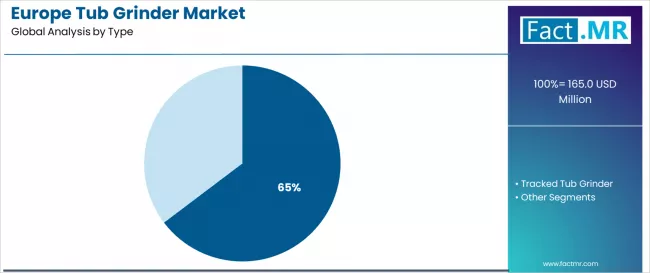
Europe Tub Grinder Market Analysis By Type | Source: Fact.MR
Wheeled Tub Grinders projected to account for 61.3% share lead the market due to easy transportation between municipal waste sites and construction projects. Tracked models are mainly used in rough terrain and forestry applications.
- Mobility Advantage: Wheeled units support faster relocation between multiple processing locations. This improves operating flexibility for waste contractors handling regional projects.
- Forestry Applications: Tracked grinders are preferred in uneven ground conditions and remote land clearing operations. Better surface grip supports stable processing in difficult terrain.
- Doppstadt Expands Waste Shredding Equipment Line: Doppstadt Umwelttechnik GmbH introduced its Core Shredder Line with CoreShred 250, CoreShred 800, and CoreShred 900 twin-shaft shredders. The machines process waste wood, construction waste, tyres, scrap, and green waste. This is relevant to the Europe tub grinder market because recycling contractors often compare shredders and grinders for wood waste reduction and mixed waste handling. [1]
Europe Tub Grinder Market Analysis by Material Processing
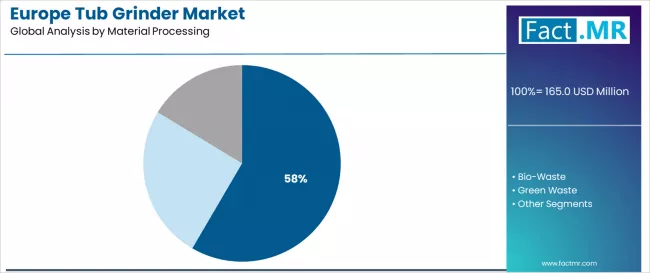
Europe Tub Grinder Market Analysis By Material Processing | Source: Fact.MR
Wood Waste holds the 47.8% share due to strong recycling activity and rising biomass fuel demand. Green waste and bio waste are mainly linked to composting and landscaping operations.
- Wood Recycling Growth: Demolition timber and forestry residues are increasing processing volumes across recycling facilities. Wood waste is the primary feedstock for biomass and mulch production.
- Composting Expansion: Municipal green waste collection programs are supporting grinder demand at composting facilities. Regional organic waste processing capacity is also expanding steadily.
Europe Tub Grinder Market Analysis by Power Source
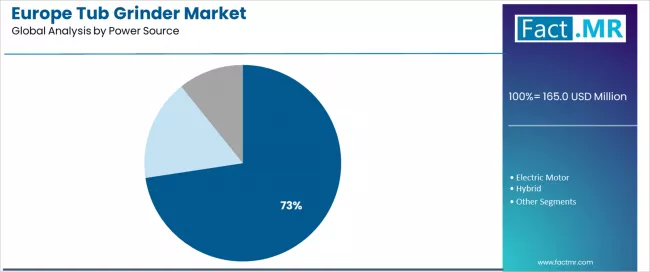
Europe Tub Grinder Market Analysis By Power Source | Source: Fact.MR
Diesel Engine models dominate the market with 68.5% because most grinding activities take place in outdoor and remote locations without stable power supply. Electric models are gaining demand at fixed processing facilities.
- Off Grid Operations: Diesel remains the practical option for mobile and field-based processing. Operators prefer diesel units because they offer higher power and more flexibility.
- Electric Facility Demand: Permanent recycling and biomass sites are using more electric grinders. Low-emission operation is becoming important in urban and regulated industrial locations.
Europe Tub Grinder Market Analysis by End User
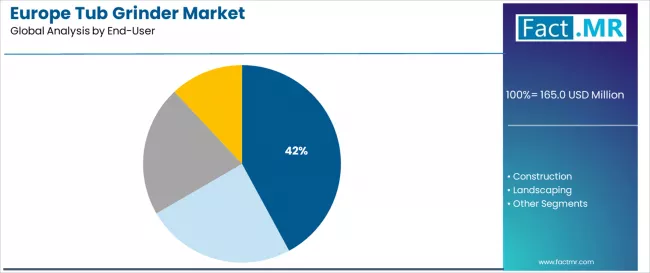
Europe Tub Grinder Market Analysis By End User | Source: Fact.MR
Waste Management remains the leading end user with 40.0% due to municipal contracts and recycling regulations. Construction and agriculture sectors are also increasing equipment usage.
- Municipal Waste Demand: Waste management companies continue investing in high capacity grinding systems. Recycling targets and landfill reduction programs are supporting long term equipment demand.
- Construction Site Processing: Demolition contractors are increasing on site material reduction activities. This reduces transport costs and improves compliance with waste sorting requirements.
- Renewi Acquisition Shows Scale of Recycling Operations: Macquarie Asset Management and BCI completed the acquisition of Renewi to expand recycling and circular economy operations across Europe. Renewi processes more than 10 million tonnes of waste annually through facilities mainly in the Netherlands and Belgium. [2]
Europe Tub Grinder Market Analysis by Application
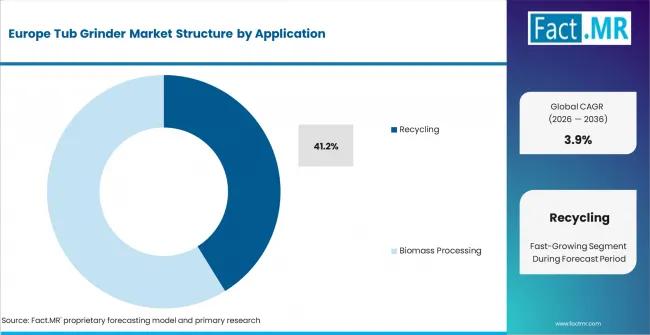
Europe Tub Grinder Market Analysis By Application | Source: Fact.MR
Recycling is the leading application with 41.2% due to strong focus on material recovery and landfill reduction. Biomass processing and composting also represent important growth areas.
- Recycling Priority: Circular economy policies are increasing demand for recyclable material processing. Waste operators are focusing more on resource recovery and secondary material generation.
- Biomass Processing Growth: Demand for consistent biomass fuel preparation is supporting grinder adoption. Energy facilities require uniform feedstock for efficient fuel handling and combustion.
- M&J Recycling Debuts P3000e Pre-Shredder at IFAT: Denmark-based M&J Recycling launched its new P3000e pre-shredder at IFAT Munich, featuring energy-saving eDrive technology and advanced power control for waste recycling operations. The company also unveiled a refreshed brand identity and updated product naming structure. [3]
Driver, Restraints, Opportunities
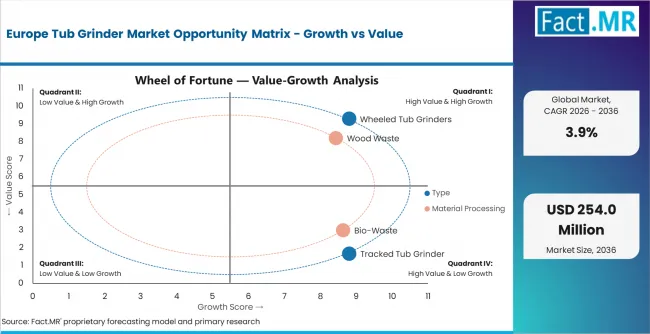
Europe Tub Grinder Market Opportunity Matrix Growth Vs Value | Source: Fact.MR
Fact.MR analysis shows that the Europe tub grinder market is growing steadily. Environmental regulations are pushing waste operators to replace old equipment and invest in better waste processing systems. High equipment costs and limited electric infrastructure at remote sites are slowing adoption among smaller operators.
Recycling and material recovery are changing how tub grinders are used in Europe. More construction and wood waste is now processed on site rather than sent to landfills. This is increasing demand for mobile tub grinders across demolition and municipal waste applications.
- Stage V Emission Compliance: European waste operators are replacing older diesel fleets to meet stricter emission standards. This is creating stable replacement demand across municipal waste and recycling operations.
- Biomass Energy Demand: Rising biomass fuel production and district heating projects are increasing demand for high throughput wood waste processing equipment. Biomass facilities are also expanding feedstock preparation capacity.
- Construction Waste Recycling: Stronger recycling and waste sorting regulations are increasing the use of portable tub grinders at demolition and construction sites. Contractors are processing more material directly at project locations.
Regional Analysis
The Europe tub grinder market is assessed across Western Europe, Eastern Europe, and Northern Europe, covering countries segmented by waste management infrastructure investment, EU recycling compliance status, biomass energy program development, and construction activity levels. The full report offers market attractiveness analysis by region and country.
.webp "Top Country Growth Comparison Europe Tub Grinder Market Cagr (2026 2036)")
Top Country Growth Comparison Europe Tub Grinder Market Cagr (2026 2036) | Source: Fact.MR
| Country | CAGR (2026 to 2036) |
|---|---|
| Germany | 4.6% |
| France | 4.0% |
| UK | 3.8% |
| Italy | 3.6% |
| Spain | 3.5% |
Source: Fact.MR analysis. Updated Jun 3, 2026
Source: Fact.MR analysis, based on proprietary forecasting model and primary research

Europe Tub Grinder Market Cagr Analysis By Country | Source: Fact.MR
Europe Tub Grinder Market Analysis
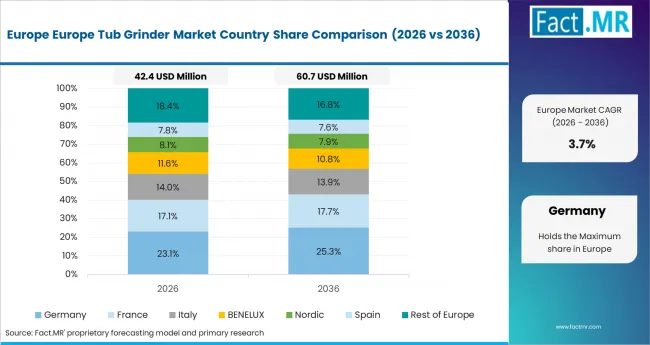
Europe Tub Grinder Market Europe Country Market Share Analysis, 2026 & 2036 | Source: Fact.MR
Europe is the leading revenue generating region in the Europe tub grinder market. Strong waste management infrastructure and high construction waste volumes are supporting steady equipment demand across Germany, France, the United Kingdom, and Italy. Regional recycling targets and biomass processing investments are also increasing the use of mobile and high capacity tub grinders.
- Germany: Germany is projected to grow at 4.6% CAGR through 2036. Strong recycling regulations and municipal waste equipment replacement programs are supporting market expansion. Biomass fuel production and wood waste processing activities are increasing demand for high throughput tub grinders across municipal and industrial sites.
- France: France is forecast to expand at 4.0% CAGR by 2036. Circular economy investments and construction waste recycling targets are increasing demand for mobile grinding equipment in demolition and waste handling projects. Biomass processing infrastructure and wood waste recovery activities are also supporting equipment adoption across regional markets.
- United Kingdom: The United Kingdom market is expected to grow at 3.8% CAGR from 2026 to 2036. Low emission regulations and recycling infrastructure projects are supporting replacement demand for Stage V and electric tub grinders in urban waste management systems. Land clearing and green infrastructure projects are also contributing to steady market growth.
- Italy: Italy is projected to grow at 3.6% CAGR by 2036. Municipal composting projects and agricultural residue processing activities are increasing equipment demand across regional facilities. Biomass preparation and green waste handling operations are also expanding across major farming regions.
- Spain: Spain is expected to grow at 3.5% CAGR from 2026 to 2036. Landscaping and clearing projects are supporting stable demand for tub grinders across urban and agricultural areas. Growth remains moderate due to lower recycling facility density outside large metropolitan regions.
Fact. MR’s analysis of the Europe tub grinder market consists of country-level assessments covering Germany, France, the UK, Italy, and Spain. Readers can find country CAGR benchmarks, compliance program timelines, end-user segment demand breakdowns, and machine type deployment data across all five countries.
Competitive Aligners for Market Players
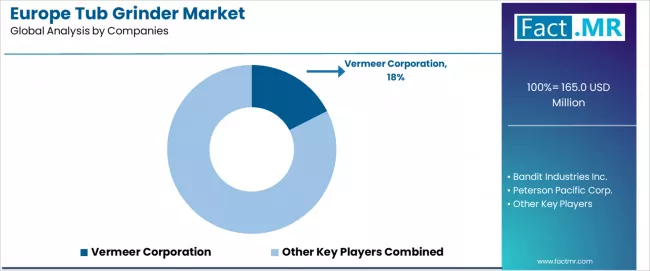
Europe Tub Grinder Market Analysis By Company | Source: Fact.MR
Market players in the Europe tub grinder industry are focusing on product upgrades and stronger service support to improve their market position. Companies are increasing investment in Stage V compliant diesel models because waste operators across Europe are replacing older equipment to meet emission rules. Manufacturers are also expanding electric and hybrid grinder development for urban projects where low emission regulations are becoming stricter.
Dealer and aftermarket networks remain a major competitive factor. Operators prefer suppliers that can provide quick maintenance support and spare part availability because downtime directly affects project schedules and operating costs. Companies with strong regional dealer coverage across Germany, France, and the United Kingdom are gaining higher contract visibility in municipal waste and recycling projects. Mobility and processing efficiency are also shaping competition. Wheeled tub grinders continue to see strong demand because contractors need equipment that can move easily between multiple work sites. Manufacturers are improving grinding throughput and fuel efficiency to help operators manage rising fuel and compliance costs.
Partnerships with recycling contractors and biomass processing facilities are becoming more important. Suppliers are working closely with waste management companies to secure long term equipment supply and service agreements. Rental and leasing programs are also expanding because smaller operators prefer flexible investment models instead of high upfront equipment spending.
Key Players
- Doppstadt Umwelttechnik GmbH
- Komptech GmbH
- Eggersmann Gruppe GmbH & Co. KG
- HAAS Recycling-Systems
- J. Willibald GmbH
Bibliography
- [1] Doppstadt. (2025). Doppstadt launches new product line “Core Line” with top price-performance ratio. Recyclind.
- [2] Macquarie Asset Management. (2025). Macquarie Asset Management and BCI complete acquisition of Renewi. Macquarie Group.
- [3] Recycling Today. (2026). M&J Recycling debuts P3000E pre-shredder at IFAT. Recycling Today.
- [4] Lindner Recyclingtech. (2024). Efficient waste cable recycling. Lindner.
- [5] Derichebourg. (2026). Derichebourg Environnement included in the Government’s new industrial acceleration scheme for two circular economy projects.
This Report Addresses
- Strategic intelligence on Europe tub grinder market demand across machine type, material processed, power source, end user, and application segments covering municipal, construction, and biomass operator programs.
- Market forecast from USD 173 million in 2026 to USD 254 million by 2036 at a CAGR of 3.9% with USD 81 million in absolute opportunity over the forecast period.
- Growth opportunity mapping across Germany Stage V fleet renewal, France circular economy investment program, UK post-Brexit waste infrastructure grants, Italy cohesion fund composting upgrades, and Spain agricultural residue valorization programs.
- Segment analysis by machine type, material processing, power source, end user, and application with European country-level CAGR benchmarks and leading sub-segment share data for 2026.
- Regional outlook covering Western Europe compliance-driven demand, construction waste protocol impact, biomass energy program investment, and municipal contract renewal cycles across all five covered countries.
- Competitive analysis of Vermeer Corporation, Bandit Industries Inc., Peterson Pacific Corp., CW Mill Equipment, and Morbark LLC covering dealer network depth, Stage V product compliance, and biomass and recycling segment positioning.
- Regulatory impact analysis covering EU Stage V non-road machinery emission standards, EU Waste Framework Directive material recovery targets, 2024 C&D Waste Management Protocol obligations, and France AGEC wood recycling mandates.
- Report delivered in PDF, Excel, and presentation formats supported by European waste equipment operator data, EU compliance program investment benchmarks, and primary interviews with fleet operators and municipal waste authority managers.
Europe Tub Grinder Market Definition
The Europe tub grinder market covers industrial rotating-drum grinding machines used to reduce bulk organic waste, wood debris, green waste, and biomass feedstock into smaller output material. Waste management contractors, construction demolition firms, and municipal landscaping authorities deploy these machines to process material that is too large for standard shredders. The primary output includes mulch, compost feedstock, and biomass fuel chips used in European renewable energy programs.
Europe Tub Grinder Market Inclusions
The study covers European market sizing and country-level forecasts from 2026 to 2036 across five segmentation dimensions: machine type, material processed, power source, end user, and application. It includes wheeled and tracked tub grinder unit demand, diesel, electric, and hybrid power configurations, and operator segments spanning waste management, construction, landscaping, and agricultural end users.
Europe Tub Grinder Market Exclusions
The scope excludes horizontal grinders and stationary electric shredding lines not configured as tub grinders. It omits downstream biomass pellet production equipment, mulch retail distribution, and soil amendment manufacturing. Military or government forestry clearing operations outside commercial waste processing contracts fall outside the study boundaries.
Europe Tub Grinder Market Research Methodology
- Primary Research
- Primary research includes interviews with tub grinder fleet operators at European municipal waste authorities, construction waste contractors, and biomass processing facility managers across Germany, France, the UK, and Italy.
- Desk Research
- Desk research draws on EU Construction and Demolition Waste Management Protocol updates from 2024, European Environment Agency recycling performance reports, and company disclosures from Vermeer Corporation, Bandit Industries, and Morbark LLC covering 2024 and 2025.
- Market-Sizing and Forecasting
- Market sizing applies a bottom-up model anchored to tub grinder unit deployment volumes by end user and country. Segment forecasts are built separately for wheeled and tracked machine categories and cross-validated against European biomass and waste processing equipment spending benchmarks.
- Data Validation and Update Cycle
- Data validation uses operator fleet records and machine registration data from European waste equipment associations cross-checked against manufacturer unit shipment disclosures and dealer network reports for 2024 and 2025.
Segmentation
Scope of the Report
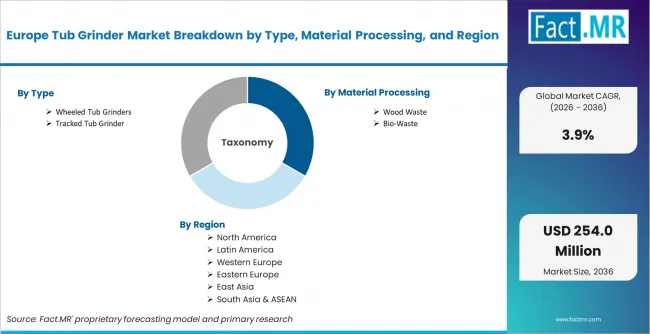
Europe Tub Grinder Market Breakdown By Type, Material Processing, And Region | Source: Fact.MR
| Attribute | Details |
|---|---|
| Quantitative Units | USD 173 million (2026) to USD 254 million (2036), at a CAGR of 3.9% |
| Market Definition | Industrial rotating-drum grinding machines deployed across European waste management, construction, landscaping, and agricultural operations to reduce wood waste, green waste, and biomass feedstock into mulch, compost, and energy-grade chips. |
| Type Segmentation | Wheeled Tub Grinder, Tracked Tub Grinder |
| Material Processing Segmentation | Wood Waste, Bio-Waste, Green Waste |
| Power Source Segmentation | Diesel Engine, Electric Motor, Hybrid |
| End-User Segmentation | Waste Management, Construction, Landscaping, Agriculture |
| Application Segmentation | Recycling, Biomass Processing, Composting, Land Clearing |
| Regions Covered | Western Europe, Eastern Europe, Northern Europe |
| Countries Covered | Germany, France, United Kingdom, Italy, Spain, Nordic Countries, BENELUX, Poland, Hungary, Rest of Europe |
| Key Companies Profiled | Doppstadt Umwelttechnik GmbH, Komptech GmbH, Eggersmann Gruppe GmbH & Co. KG, HAAS Recycling-Systems, J. Willibald GmbH |
| Forecast Period | 2026 to 2036 |
| Approach | Bottom-up model using European tub grinder unit deployment data by operator segment and country, validated against biomass processing equipment spending benchmarks and EU waste compliance program investment timelines from 2024 and 2025 disclosures. |
Source: Fact.MR analysis. Updated Jun 3, 2026
Europe Tub Grinder Market by Segments
-
By Type
- Wheeled Tub Grinder
- Tracked Tub Grinder
-
By Material Processing
- Wood Waste
- Bio-Waste
- Green Waste
-
By Power Source
- Diesel Engine
- Electric Motor
- Hybrid
-
By End-User
- Waste Management
- Construction
- Landscaping
- Agriculture
-
By Application
- Recycling
- Biomass Processing
- Composting
- Land Clearing
-
By Region
- Western Europe
- Germany
- France
- United Kingdom
- Italy
- Spain
- Nordic Countries
- BENELUX
- Rest of Western Europe
- Eastern Europe
- Poland
- Hungary
- Rest of Eastern Europe
- Western Europe
Frequently Asked Questions
How large is the Europe tub grinder market in 2025?
What will the Europe tub grinder market size be in 2026?
What is the projected Europe tub grinder market size by 2036?
What is the expected CAGR for the Europe tub grinder market from 2026 to 2036?
Which machine type is poised to lead the Europe tub grinder market?
Which application segment holds the largest share in the Europe tub grinder market?
Which country shows the fastest growth in the Europe tub grinder market?
Who worked on this report


Preview the report firsthand - request a free sample
Free SampleGet the brochure for pricing and purchase details
Download PDF