- Market Value (2025): USD 85.9 Mn
- Estimated Value (2026): USD 99 Mn
- Forecast Value (2036): USD 410 Mn
- CAGR (2026-2036): 15.3
What is the EUV Pellicle Handlers Market forecast to be worth by 2036?
USD 99 million in 2026 to USD 410 million by 2036 at 15.3% CAGR.
- The EUV pellicle handlers market reached USD 85.9 million in 2025.
- Demand is projected to increase from USD 99 million in 2026 to USD 410 million by 2036.
- The market is forecast to record 15.3% CAGR from 2026 to 2036 owing to higher EUV mask value and stricter pellicle-reticle qualification.
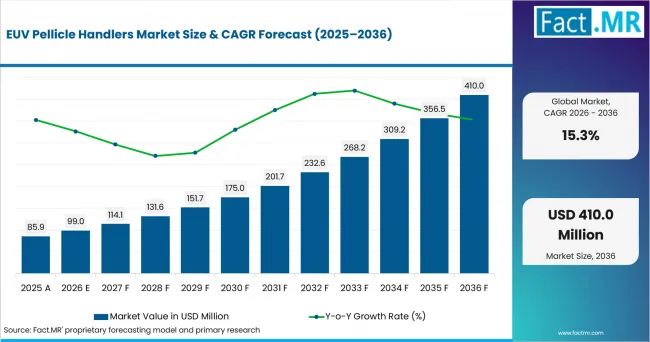
Euv Pellicle Handlers Market Value Analysis | Source: Fact.MR
What are the defining numbers behind EUV Pellicle Handlers Market growth?
USD 311 million absolute opportunity by 2036, led by Mount/demount and CNT-based pellicles alongside Fully robotic systems.
- Demand Drivers in the Market
- Foundry engineering teams require repeatable mount and demount control because pellicle contact points can affect reticle release.
- Mask shops need clean transfer paths supported by sealed carriers and verified particle control during every pellicle movement.
- Automation teams are expected to favor fully robotic recipes as fabs reduce operator handoffs around reticles.
- SEMI reported on April 7, 2026 that worldwide semiconductor equipment billings reached USD 135.1 billion in 2025, up 15.0% year over year.
- Key Segments Analyzed
- By Function: Mount/demount is expected to hold 43.0% share in 2026 because it carries the most direct contact risk for pellicle-reticle assemblies.
- By Pellicle Type: CNT-based is projected to account for 39.0% share in 2026 due to high-power EUV exposure needs.
- By Automation Level: Fully robotic is anticipated to capture 61.0% share in 2026 as fabs reduce manual contact during reticle preparation.
- By End User: Foundries are estimated to represent 54.0% share in 2026 owing to EUV lithography qualification depth.
- Analyst Opinion at Fact.MR
- Shambhu Nath Jha, Principal Consultant at Fact.MR, states, “EUV pellicle handlers operate where mask protection meets scanner uptime. Production approval is expected to depend on particle evidence and repeatable recipes under fab automation rules. Suppliers that combine safe membrane contact, inspection feedback and pod compatibility are expected to move through qualification with fewer rework loops.”
- Strategic Implications
- Mask-shop managers should link inspection logs to handler cycles so incoming defects are separated from handling events.
- Pellicle-material teams should connect handler testing with material targets. Mitsui Chemicals said in April 2026 that its NEDO program targets 95% or higher EUV transmittance and durability equal to at least 10,000 wafers under 1000W EUV output.
- Investors should separate direct pellicle-handler exposure from wider semiconductor robots or generic cleanroom automation revenue.
Taiwan is projected to record 17.19% CAGR through 2036, supported by pilot-line validation. Japan is anticipated to post 16.95% CAGR as high-power pellicle work advances. South Korea is expected to reach 16.86% CAGR due to memory manufacturing. The USA is estimated at 16.73% CAGR as domestic fab projects add reticle-preparation needs. The Netherlands is forecast at 16.57% CAGR owing to EUV tool depth. China is projected at 16.51% CAGR as integrated-circuit output expands.
How does the EUV Pellicle Handlers Market break down by segment?
Mount/demount leads at 43.0%; fully robotic systems lead at 61.0%.
Which function dominates?
Mount/demount is projected to account for 43.0% share in 2026.
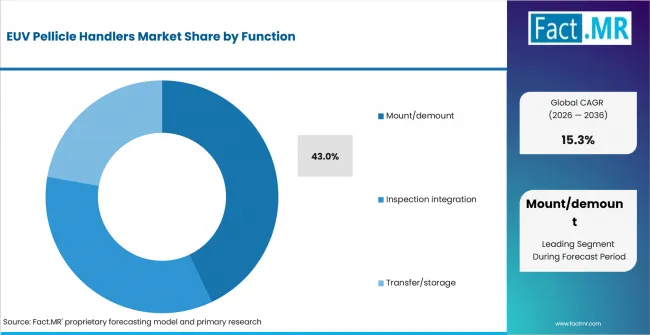
Euv Pellicle Handlers Market Analysis By Function | Source: Fact.MR
Mount/demount is forecast to lead Function with 43.0% share in 2026 because contact control determines whether a pellicle-reticle assembly remains usable after handling. Precise mounting and removal help reduce damage risk, maintain alignment, and support traceable mask workflows across advanced EUV lithography environments.
What leads the Pellicle Type segment?
CNT-based pellicles are expected to hold 39.0% share in 2026.
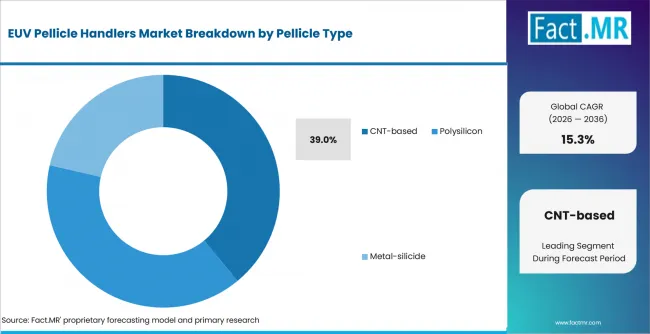
Euv Pellicle Handlers Market Analysis By Pellicle Type | Source: Fact.MR
CNT-based pellicles are projected to lead Pellicle Type with 39.0% share in 2026 because high-power EUV exposure increases the importance of membrane durability and thermal performance. Handler requirements therefore emphasize controlled mounting force, inspection compatibility, and repeatable transfer conditions suited to advanced pellicle materials.
How does Automation Level shape demand?
Fully robotic systems are anticipated to lead with 61.0% share in 2026.
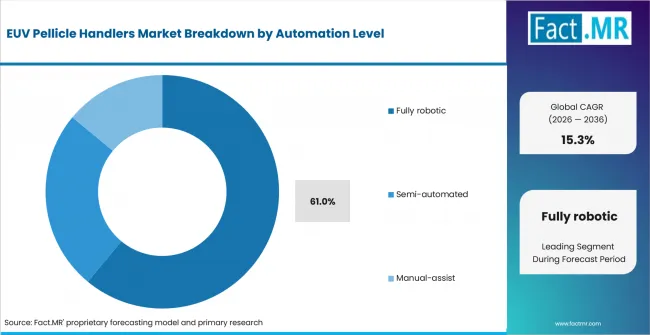
Euv Pellicle Handlers Market Analysis By Automation Level | Source: Fact.MR
Fully robotic systems are anticipated to lead Automation Level with 61.0% share in 2026 because EUV mask logistics require fewer open handling steps and tighter process control. Robotic platforms support repeatable movement, recipe logging, force control, and carrier-state tracking while reducing manual intervention across pellicle handling workflows.
What supports Foundries within End User?
Foundries are estimated to lead with 54.0% share in 2026.
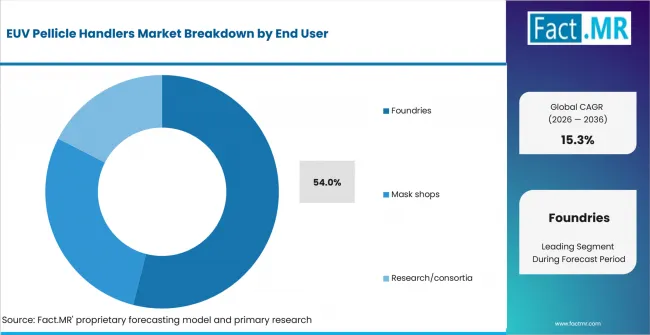
Euv Pellicle Handlers Market Analysis By End User | Source: Fact.MR
Foundries are estimated to lead End User with 54.0% share in 2026 because pellicle movement must align with wafer-start schedules, reticle availability, and scanner release windows. Traceable handling data helps fabs connect mounting activity with inspection results while maintaining repeatable mask logistics across high-volume EUV production.
What is accelerating EUV Pellicle Handlers Market adoption, and what is holding it back?
Mount/demount repeatability drives adoption; particle and membrane-damage risk restrain adoption.
Drivers Impact Analysis
| DRIVER | (~) % IMPACT ON CAGR | GEOGRAPHIC RELEVANCE | IMPACT TIMELINE |
|---|---|---|---|
| Mount/demount repeatability | +3.4% | Taiwan, Japan, South Korea | Short term (<= 2 years) |
| CNT-based pellicle transition | +2.8% | Japan, Taiwan, USA | Short term (<= 2 years) |
| Fully robotic handling | +2.3% | Taiwan, South Korea, Netherlands | Medium term (2-4 years) |
| Inspection integration | +1.7% | Foundries and mask shops | Medium term (2-4 years) |
| Fab qualification discipline | +1.1% | USA, Netherlands, Japan | Long term (>= 4 years) |
Source: Fact.MR analysis. Updated Aug 20, 2026
- Mount/demount repeatability: Pellicle mounting creates reticle-frame contact risk. Fabs require force control and particle evidence before tool release. The driver is expected to carry more weight where masks rotate through several scanner tools.
- CNT-based pellicle transition: CNT structures place more weight on gentle contact and membrane-survival records. Handler vendors are expected to tune mount heads around membrane path and frame stiffness. Qualification gains are likely where material and tool tests happen together.
- Fully robotic handling: Robotic movement reduces open manual contact around EUV masks. Automated carriers are anticipated to gain preference when fabs require recipe logs and repeatable handoffs. The same shift increases the value of traceable mask-handling records during reticle release planning.
- Inspection integration: Inspection-linked handlers separate incoming mask defects from handling events. This helps mask shops assign responsibility when a defect appears after transfer. Demand is projected to improve as customers ask for traceable cleanroom evidence.
- Fab qualification discipline: EUV handler purchases move slowly when each recipe needs approval across mask types. Large fabs are expected to pay for documentation depth before approving fleet use. Smaller sites often wait for a clearer utilization case.
Opportunity Impact Analysis
| OPPORTUNITY | (~) % IMPACT ON CAGR | GEOGRAPHIC RELEVANCE | IMPACT TIMELINE |
|---|---|---|---|
| Closed-loop inspection recipes | +1.5% | Taiwan and South Korea | Medium term (2-4 years) |
| High-power EUV pellicle handling | +1.1% | Japan and USA | Medium term (2-4 years) |
| Carrier and pod compatibility | +0.9% | Netherlands and Taiwan | Long term (>= 4 years) |
| Mask-shop service programs | +0.7% | Japan, South Korea, China | Long term (>= 4 years) |
Source: Fact.MR analysis. Updated Aug 20, 2026
- Closed-loop inspection recipes: Handler data gains value when it links mount events with inspection outcomes. The opportunity is expected to favor systems that capture force, motion and environmental conditions. Clean data reduces disputes between mask shops and fabs.
- High-power EUV pellicle handling: Higher EUV power raises material stress and makes gentle handling more valuable. Suppliers are anticipated to sell more proof packages around membrane survival and repeatable contact. The opportunity remains tied to customer approval cycles.
- Carrier and pod compatibility: EUV handlers must fit sealed reticle-pod workflows so pelliclized masks can move through storage, transfer and lithography-related handling while contamination exposure remains controlled. Vendors are expected to gain share when their tools fit existing carrier routines. Retrofit complexity still slows some installations.
- Mask-shop service programs: Smaller mask shops need repeatable reticle preparation without building full internal engineering teams. Service programs are expected to support adoption where tool utilization starts below foundry levels. Training and recipe support are central to this route.
Restraints Impact Analysis
| RESTRAINT | (~) % IMPACT ON CAGR | GEOGRAPHIC RELEVANCE | IMPACT TIMELINE |
|---|---|---|---|
| Particle risk during mount/demount | -1.5% | Global | Short term (<= 2 years) |
| High qualification cost | -1.1% | Foundries and mask shops | Short term (<= 2 years) |
| Thin-membrane damage risk | -0.8% | CNT-based pellicle programs | Medium term (2-4 years) |
| Export-control and licensing uncertainty | -0.5% | China, USA, Netherlands | Long term (>= 4 years) |
Source: Fact.MR analysis. Updated Aug 20, 2026
- Particle risk during mount/demount: Particles transferred to an EUV mask can delay exposure and inspection release. Tool acceptance therefore needs particle proof across several cycles. This slows conversion from pilot work to full fab use.
- High qualification cost: EUV handler approval needs sample runs and customer-specific documentation. Smaller mask shops are expected to delay purchases when utilization remains uncertain. The restraint is most visible where EUV mask volume is still limited.
- Thin-membrane damage risk: CNT-based pellicles are sensitive to force and frame distortion. This pushes spending toward sensors and recipe validation before production approval. Higher evidence requirements raise the cost of competing in direct handler supply.
- Export-control and licensing uncertainty: Cross-border tool access remains a planning issue for some fabs. Dry etch systems show how semiconductor equipment restrictions can reshape purchasing schedules. Handler vendors must document end use when customers face license review.
Which countries are scaling EUV Pellicle Handlers Market fastest?
- The country comparison spans 0.68 percentage point and forms one tight growth band across EUV lithography clusters.
- Taiwan remains 0.24 percentage point above Japan through foundry scale and pilot-line validation.
- Japan remains 0.09 percentage point above South Korea as equipment depth supports high-power pellicle trials.
- South Korea remains 0.13 percentage point above the USA because memory production keeps EUV mask control close to volume lines.
- The USA remains 0.16 percentage point above the Netherlands as domestic fab investment expands reticle-preparation needs.
- The Netherlands remains 0.06 percentage point above China due to EUV tool depth and specialized machinery exports.
- China closes the displayed range as integrated-circuit output expands under tighter equipment-access rules.
Comparable CAGRs create different entry conditions due to fab scale, mask-shop depth and local engineering support. Taiwan, Japan and South Korea account for 28%, 22% and 19% shares in the named regional split. Full report coverage includes North America, Latin America, Europe, East Asia, South Asia and Pacific, Middle East and Africa.
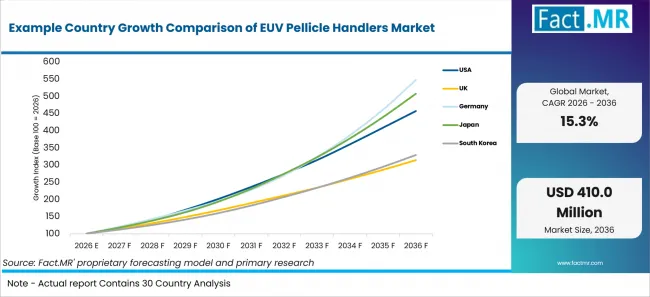
Example Country Growth Comparison Of Euv Pellicle Handlers Market | Source: Fact.MR
| Country | CAGR (2026-2036) |
|---|---|
| Taiwan | 17.19% |
| Japan | 16.95% |
| South Korea | 16.86% |
| USA | 16.73% |
| Netherlands | 16.57% |
| China | 16.51% |
Source: Fact.MR analysis. Updated Aug 20, 2026
What supports Taiwan adoption?
17.19% CAGR through 2036, supported by pilot-line investment and foundry qualification depth.
Taiwanese foundries evaluate handler repeatability before EUV masks enter volume exposure. The country is projected to record 17.19% CAGR through 2036 as mask shops connect pellicle movement with inspection evidence. MOEA said in February 2026 that Taiwan’s first 12-inch advanced semiconductor pilot line represents a NT$3.77 billion investment, giving local equipment and material teams a closer validation base.
How is Japan scaling EUV pellicle handler demand?
16.95% CAGR through 2036, driven by high-power EUV pellicle development and equipment capability.
Japan’s equipment base gives handler suppliers a route to test mount force and membrane survival with local process engineers. Japan is anticipated to post 16.95% CAGR through 2036 as high-power pellicle work raises handling precision requirements. SEAJ’s July 2026 forecast projects Japanese-made semiconductor manufacturing equipment sales of JPY 6.55 trillion in fiscal 2026, up 26.0% year over year.
What supports the South Korea outlook?
16.86% CAGR through 2036, supported by memory production and mask-loop control.
South Korea’s memory fabs need pellicle handling that protects reticles used in repeat high-volume exposure. The market is expected to advance at 16.86% CAGR through 2036 because memory production keeps mask-loop control close to production schedules. MOTIR reported in January 2026 that South Korea’s semiconductor exports reached a record USD 173.4 billion in 2025, up 22.2% year over year.
What is powering USA demand?
16.73% CAGR through 2036, driven by domestic fab investment and reticle-preparation needs.
U.S. fabs are expected to use handler tools where new EUV lines require traceable mask preparation. The USA is estimated to reach 16.73% CAGR through 2036 as domestic investment widens the base for automated pellicle logistics. NIST reported in July 2026 that TSMC announced an incremental USD 100 billion investment, bringing its planned U.S. total to USD 265 billion and adding advanced semiconductor facilities.
What underpins Netherlands growth?
16.57% CAGR through 2036, supported by EUV tool depth and specialized machinery exports.
The Netherlands is tied closely to the EUV scanner ecosystem and specialized machinery supply. It is forecast to record 16.57% CAGR through 2036 as handler compatibility becomes part of the broader EUV tool chain. CBS reported in April 2026 that Dutch goods exports reached EUR 654.8 billion in 2025, while exports to Taiwan increased and trade in specialized machinery strengthened the country’s semiconductor links.
How is China developing demand?
16.51% CAGR through 2036, supported by integrated-circuit output and local process support.
China’s fabs require local process support when imported equipment access becomes harder to plan. China is projected to record 16.51% CAGR through 2036 as fabs add EUV-adjacent mask preparation and inspection capabilities. Official Chinese government data reported integrated-circuit output of 484.3 billion units in 2025, up 10.9% year over year.
Who leads the EUV Pellicle Handlers Market?
FST and Kainova Technology show the direct public product evidence for EUV pellicle mounting and demounting, while Micro Engineering and Lasertec provide additional pellicle-mounting and EUV pellicle-inspection coverage.
FST lists its EPMD as a fully automated EUV Pellicle Mounter/Demounter, with automated mounting and demounting and process-control features. Kainova Technology states that its photomask smart automation equipment is available for both EUV and optical pellicle mounting.
Micro Engineering lists an automatic Pellicle Mounter for semiconductor reticles, although the reviewed product page does not identify the system as EUV-specific. Lasertec released the PELMIS EPM200 in July 2025 for EUV pellicle inspection, including CNT pellicles. Material suppliers and lithography-scanner companies remain adjacent participants unless a current pellicle-handler product is documented.
Which companies are the key providers?
Key companies profiled include FST; Kainova Technology; Micro Engineering, Inc.; and Lasertec Corporation.
- FST
- Kainova Technology
- Micro Engineering, Inc.
- Lasertec Corporation
Bibliography
- ASML Holding N.V. (2026, January 28). ASML reports €32.7 billion total net sales and €9.6 billion net income in 2025.
- Statistics Netherlands. (2026, April 8). Exports to Taiwan up, exports to US and China down.
- Ministry of Economic Affairs. (2026, February 11). MOEA breaks ground on Advanced Semiconductor R&D Center: Taiwan's first 12-inch pilot line to target AI, silicon photonics, and quantum technology.
- Ministry of Trade, Industry and Resources. (2026, January 2). Korea’s annual exports reach new highs in 2025.
- Mitsui Chemicals, Inc. (2026, April 23). Mitsui Chemicals selected for NEDO’s “Development of Manufacturing Technologies for Advanced Semiconductors (Subsidy).”
- U.S. Department of Commerce. (2026, July 16). Trump Administration secures an additional $100 billion U.S. semiconductor manufacturing investment for a total of $265 billion from TSMC.
- SEMI. (2026, April 7). SEMI reports global semiconductor equipment billings reached $135 billion in 2025, up 15% year-on-year.
- Semiconductor Equipment Association of Japan. (2026, July 2). Market Forecast Report: Semiconductor and FPD Manufacturing Equipment Released in July 2026 (Fiscal years 2026 to 2028).
- Lasertec Corporation. (2025, July 11). Lasertec releases PELMIS EPM200 EUV Pellicle Inspection System supporting CNT pellicles.
This Report Answers
- The report provides strategic intelligence on EUV Pellicle Handlers Market demand across Function and Pellicle Type choices that shape EUV mask preparation.
- Segment analysis covers Mount/demount and Fully robotic systems as the share leaders within the 2026 market.
- Country outlook evaluates Taiwan and Japan alongside South Korea, the USA, the Netherlands and China.
- Competitive analysis profiles FST, Kainova Technology, Micro Engineering and Lasertec based on direct or closely aligned pellicle-handling and EUV pellicle-inspection product evidence.
- Automation assessment covers fully robotic and semi-automated handlers. Manual-assist tools remain included where research or small mask-shop workflows require flexibility.
What does the EUV Pellicle Handlers Market cover?
EUV pellicle handlers cover tools that mount and demount pellicles used with EUV reticles.
The same scope includes transfer, inspection and storage tools. The market includes handler platforms tied to EUV pod workflows and clean transfer routines. It also covers reticle movement where particle control is the reason for the purchase.
What is included in the scope?
The scope includes mount/demount tools, inspection-integrated handlers and transfer or storage equipment designed for EUV pellicle workflows.
CNT-based, polysilicon and metal-silicide pellicles are included because each material path changes handling force and storage needs. Fully robotic, semi-automated and manual-assist systems are covered. Relevant upstream material references such as electronic chemicals are included only when they affect pellicle qualification or handler cleanliness.
What is excluded from the scope?
The scope excludes EUV scanners, pellicle membrane manufacturing lines and generic cleanroom robots when they do not perform pellicle handling.
Standard reticle storage without pellicle-specific protection is excluded. General lithography service revenue is excluded unless tied to handler installation or process release. E-Beam Wafer Inspection, SoC test platforms and HBM stack inspection remain outside the market unless their outputs directly support pellicle-handler validation. The market also excludes unrelated physical vapor deposition and dry etch systems when no pellicle-handling workflow is involved.
How Was the Analysis Built?
The analysis draws on 120+ sources, 35+ company portfolios, 25+ countries and more than 20 interviews.
- Primary Research: Primary research includes discussions with equipment manufacturers, mask shops, foundry procurement teams and fab automation specialists. Interviews examine tool acceptance, particle control, pod compatibility and service models.
- Desk Research: Desk research covers official statistics and regulator releases. Company announcements, standards and association data support the public evidence base. Every public source used in the analysis is documented in the bibliography.
- Market Sizing and Forecasting: Market estimates combine historical values with segment shares and country growth. Pellicle qualification and EUV fab activity support the forecast model. Adjacent inspection categories are used only for process-context checks.
- Data Validation and Update Cycle: Findings are validated against official statistics, company activity and export-control changes. Updates review pellicle targets, handler launches and fab investment.
Segmentation
What is the report’s scope and coverage?
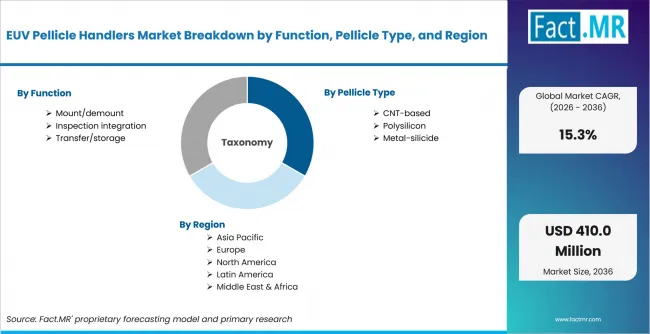
Euv Pellicle Handlers Market Breakdown By Function, Pellicle Type, And Region | Source: Fact.MR
| Attribute | Details |
|---|---|
| Quantitative Units | USD million |
| Market Definition | Equipment used to mount, demount, inspect, transfer and store EUV pellicles and pellicle-reticle assemblies in EUV lithography workflows |
| Function | Mount/demount; Inspection integration; Transfer/storage |
| Pellicle Type | CNT-based; Polysilicon; Metal-silicide |
| Automation Level | Fully robotic; Semi-automated; Manual-assist |
| End User | Foundries; Mask shops; Research/consortia |
| Regions Covered | North America; Latin America; Europe; East Asia; South Asia and Pacific; Middle East and Africa |
| Countries Covered | Taiwan; Japan; South Korea; USA; Netherlands; China |
| Key Companies Profiled | FST; Kainova Technology; Micro Engineering, Inc.; Lasertec Corporation |
| Forecast Period | 2026 to 2036 |
| Approach | Hybrid top-down and bottom-up approach using EUV lithography adoption; pellicle qualification; reticle handling workflows; automation level; mask-shop activity; country growth patterns; company portfolio review |
Source: Fact.MR analysis. Updated Aug 20, 2026
How is the market segmented?
-
By Function:
- Mount/demount
- Inspection integration
- Transfer/storage
-
By Pellicle Type:
- CNT-based
- Polysilicon
- Metal-silicide
-
By Automation Level:
- Fully robotic
- Semi-automated
- Manual-assist
-
By End User:
- Foundries
- Mask shops
- Research/consortia
-
By Region:
- North America
- Latin America
- Europe
- East Asia
- South Asia and Oceania
- Middle East and Africa
Frequently Asked Questions
How big is the EUV pellicle handlers market in 2026?
What is the CAGR of the EUV pellicle handlers market from 2026 to 2036?
Which function leads the EUV pellicle handlers market?
Which pellicle type leads the EUV pellicle handlers market?
Who are the leading companies in the EUV pellicle handlers market?
Who worked on this report


Preview the report firsthand - request a free sample
Free SampleGet the brochure for pricing and purchase details
Download PDF