- Market Value (2025): USD 162.9 Mn
- Estimated Value (2026): USD 195 Mn
- Forecast Value (2036): USD 1180 Mn
- CAGR (2026-2036): 19.7%
What is the Fab DataOps Platforms Market forecast to be worth by 2036?
USD 195 million in 2026 to USD 1,180 million by 2036 at a 19.7% CAGR.
- The Fab DataOps Platforms Market reached USD 162.9 million in 2025.
- Demand is projected to increase from USD 195 million in 2026 to USD 1,180 million by 2036.
- The market is forecast to record 19.7% CAGR from 2026 to 2036 as foundries, IDMs and memory makers standardize fab data pipelines.
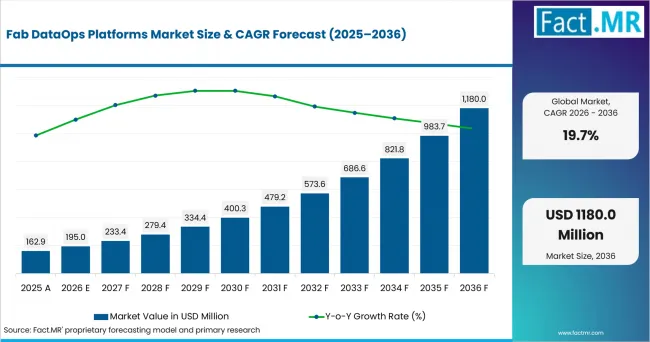
Fab Dataops Platforms Market Value Analysis | Source: Fact.MR
What are the defining numbers behind Fab DataOps Platforms Market growth?
An absolute opportunity of USD 985 million is expected between 2026 and 2036.
- Demand Drivers in the Market
- Foundry data teams need streaming ingestion that keeps sensor context synchronized with lot movement across high-volume lines.
- Factory engineers need governed lineage so model outputs can be traced back to tools, chambers and wafers.
- Yield teams need contextualization layers that reduce manual matching between equipment data, metrology records and MES histories.
- Corporate IT teams need hybrid deployment so sensitive fab data stays controlled while shared analytics scale across sites.
- SIA reported on February 6, 2026 that global semiconductor sales reached USD 791.7 billion in 2025, up 25.6% from 2024.
- Key Segments Analyzed
- By Platform Layer: Data ingestion/streaming is expected to hold 31.0% share in 2026 because it forms the first controlled path from tools and fab systems into analytics.
- By Deployment: Hybrid cloud is projected to account for 48.0% share in 2026 due to split needs for plant control, enterprise analytics and restricted process IP.
- By Data Domain: Equipment/sensor is anticipated to capture 34.0% share in 2026 owing to the volume and frequency of process traces created by fab tools.
- By End User: Foundries are estimated to represent 38.0% share in 2026 as customer programs require fast yield learning across many product families.
- By Scale: Multi-fab enterprise is forecast to hold 41.0% share in 2026 since corporate teams need reusable data models across several fabs.
- Analyst Opinion at Fact.MR
- Shambhu Nath Jha, Principal Consultant at Fact.MR, states, “Fab DataOps is drawing budget because semiconductor manufacturers no longer treat production data as a local engineering file. The next adoption phase is expected to reward platforms that connect lineage, access control and low-latency ingestion without exposing recipe IP. Suppliers that combine equipment standards, semantic models and deployment flexibility should fit the way fabs approve software.”
- Strategic Implications
- Platform vendors should show that tool data keeps equipment context after ingestion, cleansing and feature preparation.
- Fab IT teams should map data ownership before rollout so recipe, metrology and yield groups know which fields can be shared.
- Equipment OEMs should support standard interfaces because SEMI states that modern semiconductor fabs rely on host-to-equipment communication and that custom integrations become complex and costly as suppliers, protocols and software interactions multiply.
- Cloud providers should offer hybrid control patterns that keep regulated or customer-sensitive data under fab governance.
Germany is projected to record 22.0% CAGR through 2036, supported by Dresden fab density and European chip infrastructure. South Korea is anticipated to post 20.1% CAGR as memory fabs add high-frequency data streams around HBM and DRAM production. The USA is forecast to advance at 19.6% CAGR due to CHIPS-funded manufacturing projects and broader fab-modernization activity. Finland is expected to record 19.2% CAGR as microelectronics, photonics and quantum programs create shared data needs. Japan is estimated to reach 17.1% CAGR through Rapidus-linked manufacturing programs. The UK is projected to post 16.7% CAGR as design-led firms connect pilot manufacturing evidence with partner production data.
How does the Fab DataOps Platforms Market break down by segment?
Hybrid cloud is projected to lead Deployment at 48.0% share in 2026; Multi-fab enterprise is projected to lead Scale at 41.0% share.
Which Platform Layer leads?
Data ingestion/streaming is expected to hold 31.0% share in 2026.
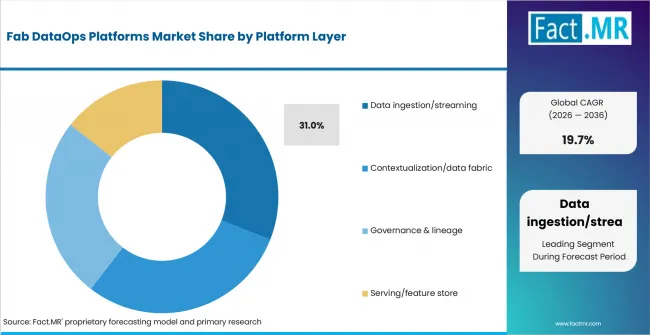
Fab Dataops Platforms Market Analysis By Platform Layer | Source: Fact.MR
Data ingestion/streaming is expected to lead because fabs need reliable capture before analytics becomes useful. Tool events and chamber traces lose value when they arrive late or without process context. Contextualization/data fabric turns raw streams into production entities. Governance, lineage and feature stores gain relevance when fabs reuse model inputs across sites.
What leads the Deployment segment?
Hybrid cloud is projected to account for 48.0% share in 2026.
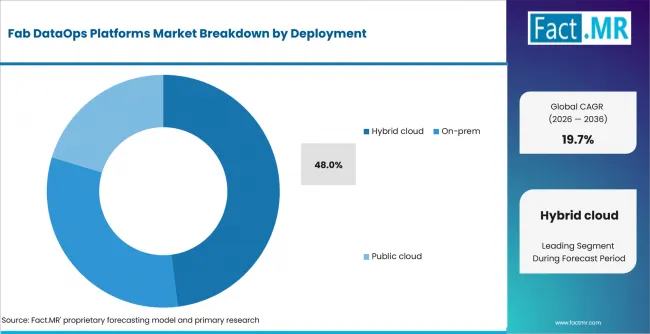
Fab Dataops Platforms Market Analysis By Deployment | Source: Fact.MR
Hybrid cloud is projected to lead because fab operators separate sensitive production systems from enterprise analytics environments. On-premise deployment remains relevant where process IP limits data movement. Public cloud fits fleet-level benchmarking and dashboarding. Siemens stated on March 12, 2025 that AWS IoT SiteWise Edge on Siemens Industrial Edge can ingest data into AWS IoT SiteWise in a matter of minutes, supporting hybrid edge-to-cloud data architectures.
How does Data Domain shape demand?
Equipment/sensor is anticipated to capture 34.0% share in 2026.
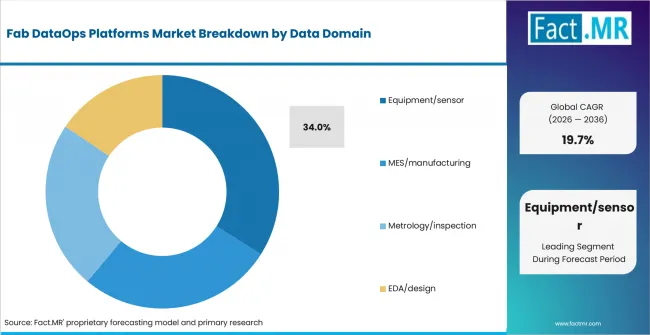
Fab Dataops Platforms Market Analysis By Data Domain | Source: Fact.MR
Equipment/sensor data is anticipated to lead because process tools create high-frequency traces for fault detection and maintenance analytics. MES/manufacturing data connects those traces to lot movement and route context. Metrology and inspection records support yield analysis after process steps. EDA/design data remains selective because it links design intent with fab results.
What supports Foundries within End User?
Foundries are estimated to represent 38.0% share in 2026.
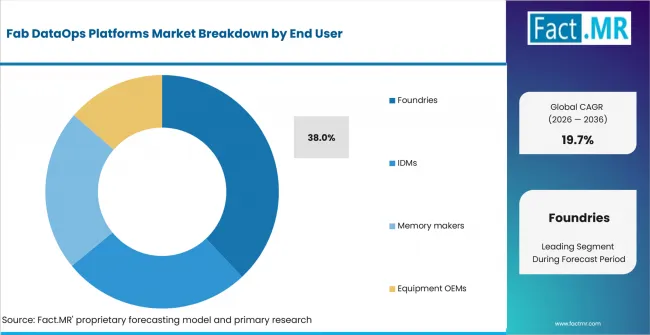
Fab Dataops Platforms Market Analysis By End User | Source: Fact.MR
Foundries are estimated to lead because they handle many customer designs without mixing confidential data. IDMs follow where product and manufacturing teams share common governance. Memory makers need DataOps for HBM and DRAM process learning. Siemens and GlobalFoundries announced on December 11, 2025 a collaboration covering AI-driven semiconductor manufacturing, centralized automation and predictive maintenance.
What supports Multi-fab enterprise scale?
Multi-fab enterprise is forecast to hold 41.0% share in 2026.
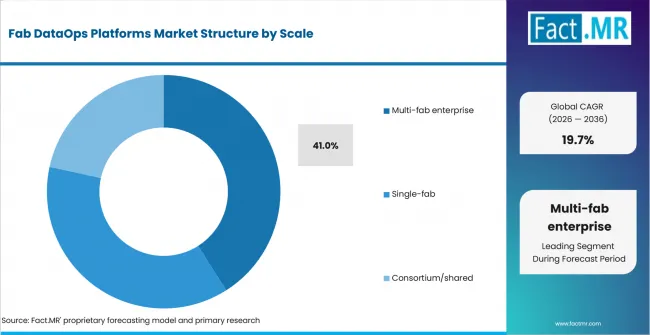
Fab Dataops Platforms Market Analysis By Scale | Source: Fact.MR
Multi-fab enterprise deployments are forecast to lead because the business case improves when data models and access rules are reused across fabs. Single-fab programs remain common during data-quality validation. Consortium models remain selective because participants need strict data partitioning. Platform vendors therefore need repeatable templates that keep local systems in place.
What is accelerating Fab DataOps Platforms Market adoption, and what is holding it back?
Multi-source fab data drives it; qualification risk restrains it.
Drivers Impact Analysis
| DRIVER | (~) % IMPACT ON CAGR | GEOGRAPHIC RELEVANCE | IMPACT TIMELINE |
|---|---|---|---|
| AI-assisted yield learning and digital twins | +2.0% | North America, East Asia, Western Europe | Short term (<= 2 years) |
| Equipment data standardization | +1.6% | Global | Medium term (2-4 years) |
| Hybrid cloud governance | +1.3% | North America, Europe, Japan | Medium term (2-4 years) |
| Multi-fab performance benchmarking | +1.0% | USA, Germany, South Korea | Long term (>= 4 years) |
- AI-assisted yield learning and digital twins: Digital twins need synchronized tool, recipe and metrology records before production use. DataOps platforms are expected to keep model inputs consistent and auditable.
- Equipment data standardization: SEMI standards reduce custom work when process equipment connects with factory systems. DataOps vendors that understand tool communication rules are better placed during qualification.
- Hybrid cloud governance: Fab operators want enterprise analytics without moving every process record outside controlled environments. The model is expected to remain preferred where customer programs restrict data movement.
- Multi-fab performance benchmarking: Corporate manufacturing groups need common definitions for downtime, excursions and recipe-related signals. DataOps platforms are projected to support those comparisons without replacing local systems.
Opportunity Impact Analysis
| OPPORTUNITY | (~) % IMPACT ON CAGR | GEOGRAPHIC RELEVANCE | IMPACT TIMELINE |
|---|---|---|---|
| Fab semantic layers for AI models | +1.4% | Global | Short term (<= 2 years) |
| Secure supplier collaboration | +1.1% | USA, Europe, East Asia | Medium term (2-4 years) |
| Packaging and test data fabric | +0.7% | South Korea, Japan, USA | Long term (>= 4 years) |
- Fab semantic layers for AI models: AI teams need reusable features linked to chambers, lots and process steps. Vendors that reduce manual data wrangling are expected to gain adoption in yield groups.
- Secure supplier collaboration: Materials and equipment suppliers need limited visibility into performance data to support root-cause work. Athinia positions its platform around secure semiconductor data collaboration between ecosystem participants.
- Packaging and test data fabric: Advanced packaging creates datasets outside the front-end fab. Platforms that connect wafer, package and test records are expected to fit HBM and chiplet workflows.
Restraints Impact Analysis
| RESTRAINT | (~) % IMPACT ON CAGR | GEOGRAPHIC RELEVANCE | IMPACT TIMELINE |
|---|---|---|---|
| Process IP and customer confidentiality | -0.8% | Global | Short term (<= 2 years) |
| Legacy MES and tool interface variation | -0.6% | Global | Medium term (2-4 years) |
| Data-quality validation burden | -0.5% | USA, Europe, East Asia | Medium term (2-4 years) |
- Process IP and customer confidentiality: Fabs do not expose recipe-sensitive data without clear controls. Approval slows when a platform cannot show field-level permissions and tenant separation.
- Legacy MES and tool interface variation: Older tools and customized MES instances create adapter work. Platform vendors must budget for site-specific integration even when standards are available.
- Data-quality validation burden: Process engineers need proof that cleaned data still reflects physical wafer history. Weak validation limits use in excursion review and automated recommendations.
Which countries are scaling Fab DataOps Platforms Market fastest?
Germany 22.0%; South Korea 20.1%; USA 19.6%; Finland 19.2%; Japan 17.1%; UK 16.7%.
- The country comparison spans 5.3 percentage points across fab-heavy and design-led semiconductor ecosystems.
- Germany remains 1.9 percentage points above South Korea due to Dresden density and EU chip infrastructure.
- South Korea remains 0.5 percentage point above the USA due to HBM and DRAM data intensity.
- The USA remains 0.4 percentage point above Finland through CHIPS-funded manufacturing projects and broader fab-modernization activity.
- Finland remains 2.1 percentage points above Japan as microelectronics and photonics programs need shared data structures.
- Japan remains 0.4 percentage point above the UK through Rapidus-linked pilot manufacturing.
Comparable CAGRs create different entry conditions due to fab density, public semiconductor funding and data-sharing rules. Full report coverage includes North America, Latin America, Western Europe, Eastern Europe, East Asia, South Asia & Pacific, Middle East & Africa.
Fab Dataops Platforms Market Value Analysis | Source: Fact.MR
| Country | CAGR (2026-2036) |
|---|---|
| Germany | 22.0% |
| South Korea | 20.1% |
| USA | 19.6% |
| Finland | 19.2% |
| Japan | 17.1% |
| UK | 16.7% |
What supports Germany adoption?
22.0% CAGR through 2036, driven by Dresden fab density and shared chip infrastructure.
Germany is forecast to lead the displayed set as fabs and research groups build on a larger domestic chip base. Germany Trade & Invest’s July 2026 semiconductor fact sheet reports around EUR 17 billion in semiconductor-industry revenue in 2025. DataOps suppliers gain a clearer route where equipment support and pilot-line access need common models.
How is South Korea scaling demand?
20.1% CAGR through 2036, supported by HBM production and memory-fab data intensity.
Memory-led production gives South Korea a dense operating base for fab DataOps platforms. SK hynix reported on January 28, 2026 that its 2025 results were driven by high-value products including HBM and that annual revenue reached KRW 97.1467 trillion.
What supports the USA outlook?
19.6% CAGR through 2036, backed by CHIPS-funded manufacturing projects and broader fab-modernization activity.
The USA is expected to scale through new fabs and modernization work. GAO reported on August 6, 2026 that Commerce had funded 49 semiconductor projects across 24 companies as of July 15, 2026. DataOps platforms are expected to connect qualification records with production analytics during ramp.
How is Finland developing demand?
19.2% CAGR through 2036, linked to microelectronics programs and European chip access.
Finland’s opportunity is concentrated in specialized microelectronics, photonics, quantum and ALD ecosystems. Business Finland updated The Chips Campaign in October 2025 with a EUR 40 million funding target. Smaller pilot environments are expected to value reusable data structures that reduce manual joining work.
What underpins Japan’s growth?
17.1% CAGR through 2036, supported by Rapidus and national semiconductor policy.
Japan is moving from policy support toward pilot-line execution for next-generation logic. METI stated on February 27, 2026 that the Government of Japan had invested JPY 100 billion in Rapidus through the Information-technology Promotion Agency, Japan (IPA), giving IPA an 11.5% voting interest. DataOps demand is expected to rise where process development and yield learning need a shared production-data trail.
How is the UK scaling participation?
16.7% CAGR through 2036, driven by design-led firms and semiconductor innovation funding.
The UK outlook is shaped by design-led firms, compound semiconductor clusters and partner-based production routes. DSIT’s Semiconductor Sector Study 2026, published on June 8, 2026, reported that grants and fundraising across the baseline cohort increased 16% to GBP 1.73 billion. DataOps platforms are expected to manage evidence when process learning depends on external foundry or test partners.
Who leads the Fab DataOps Platforms Market?
PDF Solutions is a direct provider through Exensio, Cimetrix and related semiconductor data products. Exensio is positioned around manufacturing analytics, yield learning and semiconductor data workflows. Cimetrix is treated within PDF Solutions because its equipment connectivity products support data collection and control interfaces used by fab systems.
Applied Materials participates through SmartFactory and broader factory automation capabilities. Siemens and GlobalFoundries announced in December 2025 a collaboration to deploy AI-driven manufacturing for semiconductor operations. Athinia fits secure collaborative analytics, and AWS fits infrastructure through manufacturing data services and hybrid cloud tooling.
Which companies are profiled?
Key companies include PDF Solutions, Inc., Applied Materials, Inc. (SmartFactory / AIx), Siemens AG (Opcenter), Athinia (EMD Digital–Palantir partnership), Amazon Web Services, Inc.
- PDF Solutions, Inc.
- Applied Materials, Inc. (SmartFactory / AIx)
- Siemens AG (Opcenter)
- Athinia (EMD Digital–Palantir partnership)
- Amazon Web Services, Inc.
Bibliography
- Semiconductor Industry Association. (2026, February 6). Global annual semiconductor sales increase 25.6% to $791.7 billion in 2025.
- SEMI. (2026, April 7). SEMI reports global semiconductor equipment billings reached $135 billion in 2025, up 15% year-on-year.
- Germany Trade & Invest. (2026, July 10). The semiconductor market in Germany: Issue 2026.
- U.S. Government Accountability Office. (2026, August 6). Semiconductors: Commerce needs plan to meet CHIPS for America R&D requirements (GAO-26-109121).
- Business Finland. (2025, October 20). The Chips Campaign.
- Ministry of Economy, Trade and Industry. (2026, February 27). Press conference by Minister Akazawa (Excerpt).
- Department for Science, Innovation and Technology. (2026, June 8). Semiconductor Sector Study 2026.
- PDF Solutions, Inc. (2025, October 1). PDF Solutions announces next generation of its Exensio® AI/ML solution.
- Siemens AG. (2025, December 11). Siemens and GlobalFoundries collaborate to deploy AI-driven manufacturing to strengthen global semiconductor supply.
- SK hynix Inc. (2026, January 28). SK hynix announces FY25 financial results.
This Report Answers
- The report explains how fab software teams use industrial DataOps frameworks and data catalog tools to connect production records with analytics workloads.
- Segment analysis reviews smart factory software and operational twin dashboards where governed plant data supports yield review.
- Country analysis considers digital twin composer and virtual commissioning links that influence fab adoption routes in the USA, Europe and East Asia.
- Competitive analysis covers platform suppliers that connect model-based manufacturing with application monitoring tools and equipment interfaces.
- Application analysis reviews adjacent semiconductor workflows such as semiconductor diffusion equipment and SoC test platforms where data continuity supports yield learning.
What does the Fab DataOps Platforms Market cover?
The Fab DataOps Platforms Market covers software that improves the collection, structure, governance and reuse of semiconductor manufacturing data. It includes data ingestion, contextualization, lineage, feature serving and controlled sharing functions used by fab operations, process engineering, yield management and equipment-service teams.
The assessment covers hybrid cloud, on-premise and public cloud deployment across equipment, MES, metrology, inspection and design-related data domains. Demand is assessed across foundries, IDMs, memory makers and equipment OEMs, together with single-fab, multi-fab and consortium deployment scales.
What is included in the scope?
The scope includes licensed or subscription software platforms used to build governed data pipelines for semiconductor fabs. It includes standards-based equipment connectivity, manufacturing data models, lineage and analytics-ready feature layers.
Included deployments cover front-end fabs, packaging and test environments when the function is tied to manufacturing data operations. Implementation services are included only when linked to recurring software operation.
What is excluded from the scope?
The scope excludes enterprise data platforms that are not configured for semiconductor fab data or tool connectivity. Raw cloud compute, storage infrastructure and stand-alone equipment hardware are excluded.
EDA design software is excluded unless it connects design data to manufacturing analysis inside a fab DataOps workflow. Consulting work is excluded when it does not create a reusable production data layer.
How Was the Analysis Built?
The analysis draws on 120+ sources, 35+ company portfolios, 25+ countries, and more than 20 industry interviews.
- Primary Research: Primary research includes discussions with manufacturers, service providers, technology developers, distributors, end users, procurement teams, and subject-matter experts. These conversations examine purchasing priorities, product adoption, operational challenges, approval requirements, competitive positioning, and the factors that influence wider market acceptance.
- Desk Research: Desk research covers government statistics, regulatory publications, company filings, trade data, technical studies, industry associations, standards, public policy, and other authoritative sources. Every source used in the analysis is documented in the bibliography.
- Market Sizing and Forecasting: Market estimates combine historical performance, demand indicators, pricing and volume trends, segment shares, company participation, country-level growth, adoption patterns, investment activity, and barriers to market expansion.
- Data Validation and Update Cycle: Findings are validated by comparing primary interviews with public data, company activity, regulatory changes, trade patterns, and industry developments. Regular updates review new product launches, capacity changes, partnerships, approvals, procurement trends, and shifts in commercial adoption.
What is the report’s scope and coverage?
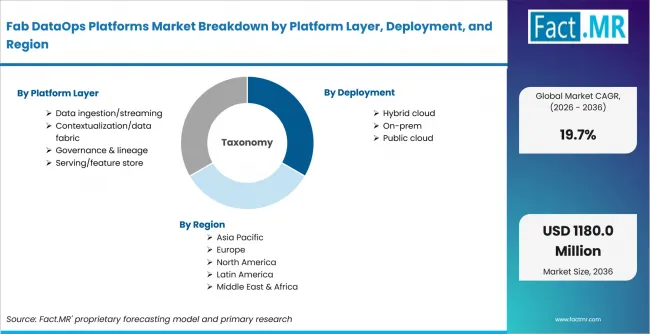
Fab Dataops Platforms Market Breakdown By Platform Layer, Deployment, And Region | Source: Fact.MR
| Attribute | Details |
|---|---|
| Quantitative Units | USD million |
| Market Definition | Software platforms that ingest, contextualize, govern and serve semiconductor fab data for analytics, AI, digital twins, yield learning, equipment monitoring and multi-site manufacturing intelligence. |
| Platform Layer | Data ingestion/streaming; Contextualization/data fabric; Governance & lineage; Serving/feature store |
| Deployment | Hybrid cloud; On-prem; Public cloud |
| Data Domain | Equipment/sensor; MES/manufacturing; Metrology/inspection; EDA/design |
| End User | Foundries; IDMs; Memory makers; Equipment OEMs |
| Scale | Multi-fab enterprise; Single-fab; Consortium/shared |
| Regions Covered | North America; Latin America; Western Europe; Eastern Europe; East Asia; South Asia & Pacific; Middle East & Africa |
| Countries Covered | USA; UK; Germany; Japan; South Korea; Finland |
| Key Companies Profiled | PDF Solutions, Inc., Applied Materials, Inc. (SmartFactory / AIx), Siemens AG (Opcenter), Athinia (EMD Digital–Palantir partnership), Amazon Web Services, Inc. |
| Forecast Period | 2026 to 2036 |
| Approach | Hybrid top-down and bottom-up approach using fab software budgets, equipment connectivity, data-domain intensity, deployment mix, country adoption and provider portfolio review. |
How is the market segmented?
-
By Platform Layer:
- Data ingestion/streaming
- Contextualization/data fabric
- Governance & lineage
- Serving/feature store
-
By Deployment:
- Hybrid cloud
- On-prem
- Public cloud
-
By Data Domain:
- Equipment/sensor
- MES/manufacturing
- Metrology/inspection
- EDA/design
-
By End User:
- Foundries
- IDMs
- Memory makers
- Equipment OEMs
-
By Scale:
- Multi-fab enterprise
- Single-fab
- Consortium/shared
-
By Region:
- North America
- Latin America
- Western Europe
- Eastern Europe
- East Asia
- South Asia & Pacific
- Middle East & Africa