- Market Value (2025): USD 590.7 Mn
- Estimated Value (2026):USD 700 Mn
- Forecast Value (2036):USD 3821.9 Mn
- CAGR (2026-2036):18.5%
What is the industrial DataOps frameworks market forecast to be worth by 2036?
USD 700 million in 2026 to USD 3,821.9 million by 2036, at 18.5% CAGR.
- The industrial DataOps frameworks market crossed a valuation of USD 590.7 million in 2025.
- Demand is expected to increase from USD 700 million in 2026 to USD 3,821.9 million by 2036.
- The market is forecast to record an 18.5% CAGR as plants standardize data from controllers, historians and manufacturing systems.
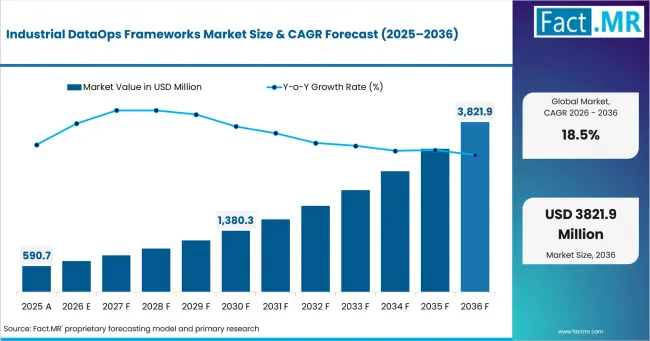
Industrial Dataops Frameworks Market Market Value Analysis | Source: Fact.MR
What are the defining numbers behind industrial DataOps frameworks growth?
USD 3,121.9 million absolute opportunity by 2036, led by India and China.
- Demand Drivers in the Market
- Manufacturers need common data models before plant information can support multi-site analytics.
- Industrial software teams need governed pipelines that reduce one-off integrations between operational systems and cloud tools.
- System integrators need repeatable templates for controllers, historians and Manufacturing Execution Systems.
- Plant operators need contextualized alerts that connect process data with asset and production records.
- Key Segments Analyzed
- By Data Source: Historian Data is expected to hold 31.0% share in 2026 as plants use historians as the main record for operations data.
- By Deployment: Hybrid Cloud is projected to hold 38.0% share in 2026 as buyers keep plant control data close and move governed copies to enterprise tools.
- By Use Case: Data Contextualization is likely to account for 34.0% share in 2026 as buyers need consistent asset meaning before analytics work begins.
- By Connectivity: Open Platform Communications Unified Architecture is estimated to hold 32.0% share in 2026 as factories prioritize interoperable machine data.
- By Buyer Type: Manufacturers are expected to hold 40.0% share in 2026 as plant owners control the budget for operational data projects.
- By Geography: India is projected to record 21.1% CAGR through 2036 as technology-enabled manufacturing programs widen the buyer pool.
- Analyst Opinion at Fact.MR
- Shambhu Nath Jha, Senior Analyst at Fact.MR, states, "I see industrial DataOps as a buying decision about trust more than software volume. Plant teams already have data inside controllers, historians and Manufacturing Execution Systems. The problem is that each plant names assets differently and stores context in separate tools."
- Strategic Implications
- Manufacturers should standardize asset naming before scaling plant-data programs.
- Industrial software providers need connectors and semantic models in the same offer.
- System integrators should package reusable templates for common controller and historian stacks.
- Plant operators need governed data access that does not disturb control-system reliability.
Industrial DataOps frameworks collect plant-floor data and turn it into reusable models for operations teams. International Federation of Robotics data show 542,076 industrial robots installed in 2024. India is projected to record a 21.1% CAGR through 2036 as manufacturing technology programs expand. China is expected to post 20.4% CAGR as robot-heavy factories create larger data volumes. The United States is forecast to advance at 18.9% CAGR as multi-site manufacturers connect plant systems. South Korea is projected to rise at 18.7% CAGR because electronics and automotive plants use dense automation. Germany is forecast at 18.3% CAGR as the Data Act and factory modernization shape requirements. Japan is expected to expand at 17.8% CAGR through 2036 as automation users move more historian data into analytics. The United Kingdom is expected to post 17.2% CAGR through 2036 as manufacturing grants support technology adoption.
How does the industrial DataOps frameworks market break down by segment?
Historian data leads at 31.0%; hybrid cloud leads at 38.0%.
Which data source dominates?
Historian Data holds 31.0% share in 2026.
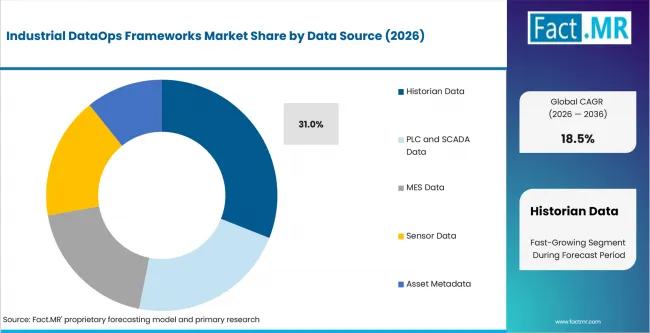
Industrial Dataops Frameworks Market Analysis By Data Source | Source: Fact.MR
Historian Data leads because most factories already use historians as the trusted store for process and time-series records. Buyers then add contextualization layers that map tags to assets, batches and production lines.
Which deployment model dominates?
Hybrid Cloud leads with 38.0% share in 2026.
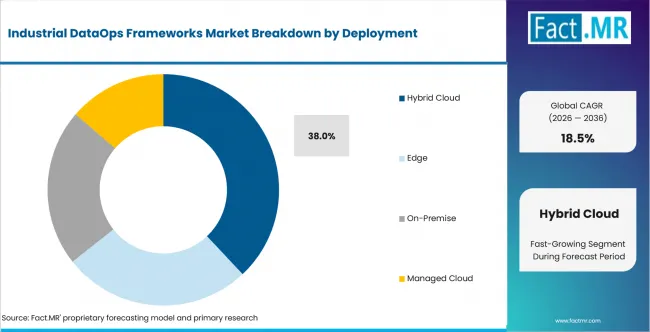
Industrial Dataops Frameworks Market Analysis By Deployment | Source: Fact.MR
Hybrid Cloud leads as manufacturers keep sensitive control data near the plant and deliver approved datasets to enterprise users. This model fits buyers that need cloud analytics without changing plant control networks.
Which use case dominates?
Data Contextualization holds 34.0% share in 2026.
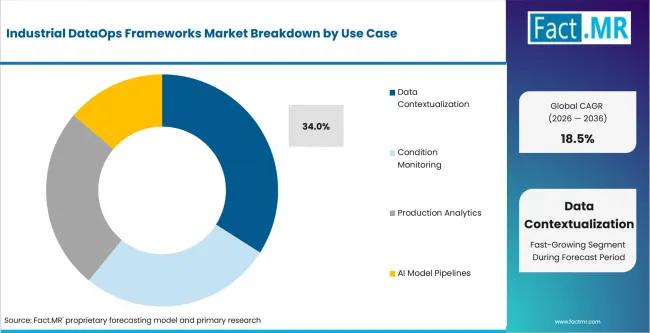
Industrial Dataops Frameworks Market Analysis By Use Case | Source: Fact.MR
Data Contextualization leads because analytics teams cannot use raw tags without asset meaning. Open Platform Communications Unified Architecture criteria now push buyers to evaluate semantics and cloud-model reuse. [4]
Which connectivity route dominates?
Open Platform Communications Unified Architecture accounts for 32.0% share in 2026.
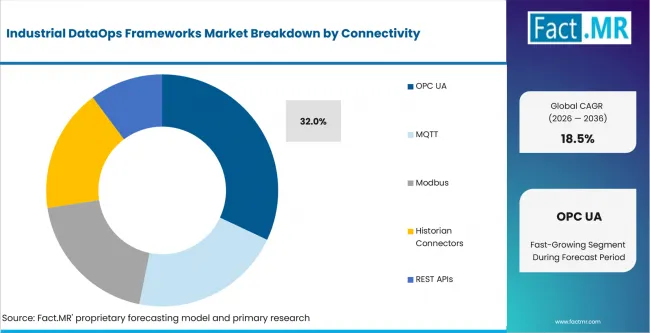
Industrial Dataops Frameworks Market Analysis By Connectivity | Source: Fact.MR
Open Platform Communications Unified Architecture leads because it supports machine-to-enterprise interoperability. The MTConnect Institute describes semantic models for data collected from manufacturing operations. [5]
Which buyer type dominates?
Manufacturers hold 40.0% share in 2026.
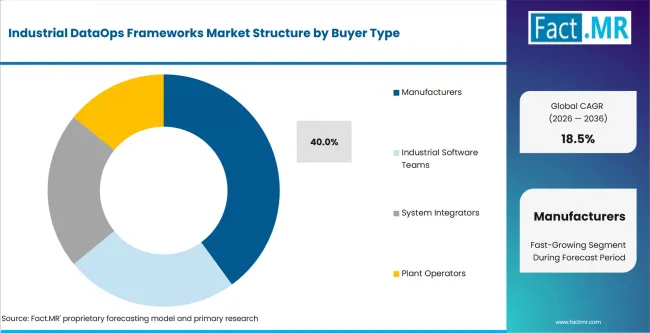
Industrial Dataops Frameworks Market Analysis By Buyer Type | Source: Fact.MR
Manufacturers lead spending because plant owners need data quality before condition monitoring and production analytics produce value. Industrial software teams and system integrators influence selection through architecture standards.
What is accelerating industrial DataOps frameworks adoption, and what is holding it back?
Plant data standardization and hybrid cloud architecture drive it, while legacy tag structures and plant cyber approval restrain it.
Drivers Impact Analysis
| DRIVER | (~) % IMPACT ON CAGR | GEOGRAPHIC RELEVANCE | IMPACT TIMELINE |
|---|---|---|---|
| Plant data standardization | +3.9% | Global industrial sites | Short term |
| Hybrid cloud architecture | +3.2% | United States, Germany, Japan | Medium term |
| AI model pipeline readiness | +2.8% | India, China, United States | Medium term |
| Connected product data rules | +2.1% | European Union and exporters | Short term |
| Integrator template reuse | +1.7% | Global manufacturing clusters | Long term |
Source: Fact.MR analysis. Updated Jul 4, 2026
- Plant data standardization
- Factories are replacing one-off tag extraction with reusable operational models. This supports industrial automation and control systems projects that need consistent plant data before analytics begins.
- The driver is strongest when plants have several historians and separate naming rules. DataOps frameworks reduce manual mapping work and give plant teams one governed route from machine data to business use.
- Hybrid cloud architecture
- Manufacturers often keep control-system data inside plant boundaries. They still need cloud native technologies to distribute approved datasets to enterprise users.
- This creates demand for frameworks that run at the edge and synchronize selected models to cloud applications. The architecture fits buyers that need plant control and enterprise visibility in the same program.
- AI model pipeline readiness
- AI pilots in factories need labeled assets and clean process history. This is why edge analytics adoption depends on better ingestion and context at the source.
- Industrial DataOps becomes the step before model development. Buyers ask whether data is complete, labeled and governed before they fund wider analytics use.
Opportunity Impact Analysis
| OPPORTUNITY | (~) % IMPACT ON CAGR | GEOGRAPHIC RELEVANCE | IMPACT TIMELINE |
|---|---|---|---|
| Historian modernization packages | +3.0% | United States, Europe, Japan | Short term |
| Edge data templates | +2.5% | India, China, South Korea | Medium term |
| Data compliance workflows | +2.2% | European Union and exporters | Medium term |
| AI pipeline accelerators | +1.9% | Global industrial groups | Long term |
| Multi-site plant rollouts | +1.5% | Large manufacturers | Long term |
Source: Fact.MR analysis. Updated Jul 4, 2026
- Historian modernization packages
- Historian projects are shifting from storage upgrades to data usability programs. This creates a direct opening for self-service analytics tools that rely on trusted plant context.
- Suppliers can package connectors, asset models and governance into one upgrade path. The buyer benefit is faster reuse of data that already exists in plant systems.
- Edge data templates
- Edge templates are useful when plants use different controllers and network rules. They support sensor-connected factory systems that need repeatable data flows across production lines.
- The opportunity is strongest for integrators that can build once and reuse across sites. Templates lower project effort without changing the control layer.
- Data compliance workflows
- The European Commission says the Data Act applies from 12 September 2025. [3] This creates a need for clearer access rules around connected product and industrial data.
- Manufacturers that export equipment or operate in Europe need auditable data flows. That requirement can pull digital transformation programs toward governed operational data platforms.
Restraints Impact Analysis
| RESTRAINT | (~) % IMPACT ON CAGR | GEOGRAPHIC RELEVANCE | IMPACT TIMELINE |
|---|---|---|---|
| Legacy tag structures | -2.2% | Global brownfield plants | Short term |
| Plant cyber approval | -1.8% | United States, Europe, Japan | Medium term |
| Asset naming gaps | -1.6% | Multi-site manufacturers | Short term |
| OT data skill shortage | -1.4% | India and smaller plants | Medium term |
| Validation delays | -1.2% | Regulated process sites | Long term |
Source: Fact.MR analysis. Updated Jul 4, 2026
- Legacy tag structures
- Older plants often carry years of tag naming differences. A DataOps project can stall if teams must clean every tag before they deliver a first use case.
- Plant cyber approval
- Cybersecurity review can delay projects that bridge plant systems and enterprise platforms. Buyers therefore prefer frameworks that support digital twin models without exposing control networks.
- The approval process is slower in sites with safety or regulated production risk. Vendors need deployment patterns that separate read access from control access.
- Asset naming gaps
- Plant naming gaps reduce reuse of analytics work across production lines. They also limit model-based manufacturing technologies that depend on consistent asset relationships.
- This restraint is practical rather than theoretical. It affects project speed because engineers must agree on names before software teams can automate data delivery.
Which countries are scaling industrial DataOps frameworks fastest?
India 21.1%, China 20.4%, United States 18.9%, South Korea 18.7%, Germany 18.3%.
Based on regional analysis, the industrial DataOps frameworks market is segmented into North America, Western Europe, East Asia, South Asia, Latin America, and the Middle East & Africa.
| Country | CAGR |
|---|---|
| India | 21.1% |
| China | 20.4% |
| United States | 18.9% |
| South Korea | 18.7% |
| Germany | 18.3% |
| Japan | 17.8% |
| United Kingdom | 17.2% |
Source: Fact.MR analysis. Updated Jul 4, 2026
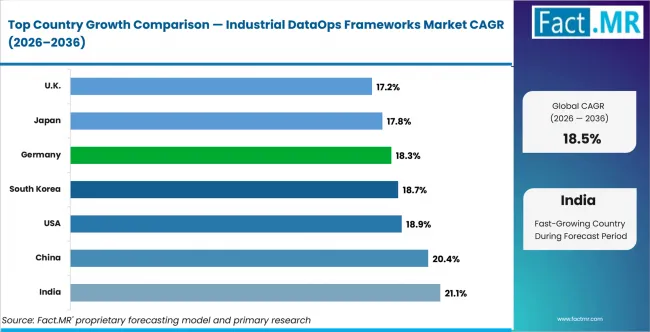
Industrial Dataops Frameworks Market Cagr Analysis By Country | Source: Fact.MR
What is powering India’s lead?
21.1% CAGR, supported by manufacturing technology programs.
India is prioritizing technology-enabled manufacturing at policy level. NITI Aayog warns that delayed frontier technology adoption could create a USD 270.0 billion manufacturing GDP loss by 2035. [7] Industrial DataOps demand grows because manufacturers need reusable data foundations before AI and digital twin programs can scale. Suppliers with low-integration templates gain a stronger route into small and midsize plants.
How is China scaling the market?
20.4% CAGR, driven by automation volume and local factory modernization.
China has the largest robotized factory footprint among the countries assessed. The volume creates large machine-data flows that require contextualization before analytics teams can compare production lines. Local providers gain when they connect plant data to domestic cloud and industrial software ecosystems.
What supports the United States outlook?
18.9% CAGR, supported by multi-site manufacturers and industrial software buying.
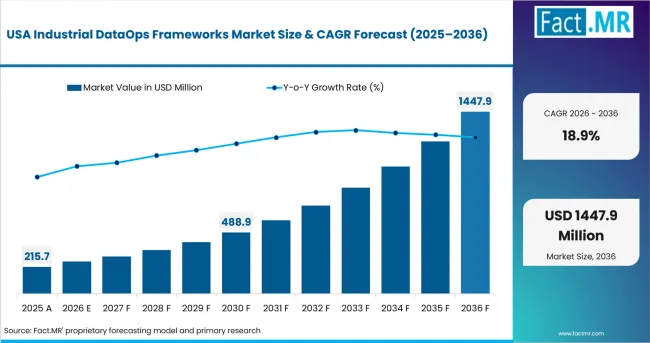
Industrial Dataops Frameworks Market Country Value Analysis | Source: Fact.MR
United States buyers place high weight on cyber review and enterprise architecture before plant data is shared. International Federation of Robotics reports 307 robots per 10,000 manufacturing employees in the United States. [2] This automation density supports DataOps demand in automotive and food plants. Chemicals plants add another use case. Suppliers need security evidence and integration references before large accounts approve wider rollout.
Why is South Korea commercially important?
18.7% CAGR, supported by dense electronics and automotive automation.
South Korea is a high-readiness market because plant data volumes are tied to dense automation. Electronics and automotive plants need clean data from production equipment and inspection systems. Vendors that support semiconductor and electronics workflows are better positioned here.
What underpins Germany’s growth?
18.3% CAGR, backed by industrial standards and EU data rules.
Germany combines factory automation depth with European data governance pressure. The Data Act adds a second requirement because connected product and industrial data access must be managed with clearer rules. Buyers will favor frameworks that support governance and audit trails inside plant-data workflows.
Why does Japan remain a steady DataOps market?
17.8% CAGR, supported by established automation users and conservative validation.
Japan has a deep installed base of automation and process discipline. DataOps demand is tied to factory quality, asset uptime and manufacturing knowledge retention. Providers need stable connectors and clear validation records to win long-running industrial accounts.
How is the United Kingdom building demand?
17.2% CAGR, supported by manufacturing technology support programs.
The United Kingdom is building demand through grant-backed manufacturing technology adoption. United Kingdom Research and Innovation states that Made Smarter Innovation includes a GBP 25.0 million program. [8] This supports projects that connect production systems and analytics in smaller factories. Vendors with implementation partners can use public programs as a route into regional manufacturing clusters.
Who leads the industrial DataOps frameworks landscape?
HighByte, Cognite and Litmus lead through contextualization, industrial data fusion and edge data workflows.
Industrial DataOps frameworks are bought by manufacturers that need reusable plant data. HighByte focuses on industrial DataOps and asset-context modeling. Cognite supports industrial data fusion and AI workflow integration. Litmus connects edge data and cloud workflows for manufacturing environments.
AVEVA brings historian and operations-data depth through the PI portfolio. Seeq strengthens the analytics layer by connecting process data with subject-matter workflows. Siemens uses its industrial software ecosystem to connect engineering, operations and lifecycle data. Rockwell Automation supports plant-data workflows through FactoryTalk DataMosaix.
Providers are likely to win by combining operational technology connectors with governed analytics workflows. The same buyer group is evaluating smart machine systems that need trusted operational data before autonomy features work in production.
Competition through 2036 depends on connector breadth and data-model depth. virtual commissioning programs give vendors a second route into the same plant-data architecture budget.
Which companies are the key players?
HighByte, Cognite, Litmus, AVEVA, Siemens, Rockwell Automation, Seeq
- HighByte
- Cognite
- Litmus
- AVEVA
- Siemens
- Rockwell Automation
- Seeq
Bibliography
- International Federation of Robotics. (2025, September 25). World Robotics 2025 report—Industrial robots—released by IFR: Global robot demand in factories doubles over 10 years.
- International Federation of Robotics. (2026, April 8). Robot density surges in Europe, Asia, and Americas.
- European Commission. (2025, December 15). Data Act explained. Shaping Europe’s Digital Future.
- OPC Foundation. (2026, April). OPC Foundation Cloud Initiative: The industrial cloud interoperability standard. OPC Foundation.
- MTConnect Institute. (2026, January 5). MTConnect Standard: Part 1.0—Fundamentals (Version 2.5.0).
- NITI Aayog. (2025, October 29). Reimagining manufacturing: India’s roadmap to global leadership in advanced manufacturing. Government of India.
- UK Research and Innovation. (2026, March 20). Area of investment and support: Made Smarter Innovation.
- HighByte. (2026). Industrial DataOps software. HighByte.
- Cognite. (2026). Cognite Data Fusion®: Simple access to complex industrial data. Cognite.
- Litmus. (2026). The modern industrial data platform for AI. Litmus.io.
- AVEVA. (2026). AVEVA PI Data Infrastructure. AVEVA.
- Rockwell Automation. (2024, October 29). FactoryTalk DataMosaix from Rockwell Automation offers ease and speed to visualization. Rockwell Automation.
- Siemens. (2026, June 1). Siemens powers the next phase of industrial AI with Intelligence Center X. Siemens.
- Seeq. (2026). Advanced analytics, ML & AI for time series data. Seeq.
This Report Addresses
- Strategic intelligence on industrial DataOps frameworks across data source, deployment and use case.
- Segment analysis covering Historian Data, Hybrid Cloud and Data Contextualization.
- Regional outlook covering India and China. It also covers United States, South Korea and Germany. Japan and United Kingdom are included.
- Competitive analysis covers HighByte and Cognite. It also covers Litmus, AVEVA and Siemens. Rockwell Automation and Seeq are included.
- Service assessment covers data ingestion and contextualization. It also covers governance and pipeline delivery.
- Connectivity assessment covers Open Platform Communications Unified Architecture and Message Queuing Telemetry Transport. Modbus and historian connectors are also covered.
- Primary interviews and provider checks support the forecast. Official source review and automation-intensity validation were also used.
What does the industrial DataOps frameworks market cover?
Software frameworks that contextualize operational data for manufacturing decisions.
The market covers software frameworks that structure data from Programmable Logic Controllers and Supervisory Control and Data Acquisition systems. It also covers historians and Manufacturing Execution Systems. Sensor data and asset metadata are included when they support manufacturing decisions. The scope is limited to data modeling and governed pipeline delivery in industrial operations.
What is included in the scope?
Industrial data contextualization and governed data delivery.
The scope includes frameworks for data ingestion and normalization. It also includes contextualization and pipeline delivery. Deployment covers edge and hybrid cloud environments. On-premise and managed cloud deployments are also included. Connectivity covers Open Platform Communications Unified Architecture and Message Queuing Telemetry Transport. Modbus and historian connectors are included when they feed governed plant data.
What is excluded from the scope?
Generic business intelligence and hardware-only automation systems.
The scope excludes generic enterprise analytics that do not connect operational technology data. It excludes hardware-only industrial automation without data modeling software. It excludes standalone cloud storage and software-only machine learning tools without plant-data ingestion or industrial context.
How was the analysis built?
100+ sources, 40+ company portfolios, 25+ countries, 20+ interviews.
- Primary Research:
- Primary research includes interviews with industrial software buyers and plant automation leaders. It includes input from system integrators and data engineering teams.
- Desk Research:
- Desk research reviews standards sources and official manufacturing technology programs. It covers company product pages and official release activity.
- Market-Sizing and Forecasting:
- Forecasting uses installed industrial automation intensity and industrial software spending. The estimate is reconciled against buyer interviews and company portfolio coverage.
- Data Validation and Update Cycle:
- Forecasts are validated through provider checks and country automation signals. Standards updates and company releases help confirm direction.
Segmentation
What is the report’s scope and coverage?
| Attribute | Details |
|---|---|
| Quantitative Units | USD Million in 2026 to USD Million by 2036 at CAGR |
| Market Definition | Industrial software frameworks that ingest, contextualize, govern and deliver operational data |
| Data Source | PLC and SCADA Data, Historian Data, MES Data, Sensor Data, Asset Metadata |
| Deployment | Edge, Hybrid Cloud, On-Premise, Managed Cloud |
| Use Case | Data Contextualization, Condition Monitoring, Production Analytics, AI Model Pipelines |
| Connectivity | OPC UA, MQTT, Modbus, Historian Connectors, REST APIs |
| Buyer Type | Manufacturers, Industrial Software Teams, System Integrators, Plant Operators |
| Regions Covered | North America, Latin America, Europe, East Asia, South Asia and Pacific, Middle East and Africa |
| Countries Covered | India, China, United States, South Korea, Germany, Japan, United Kingdom |
| Key Companies Profiled | HighByte, Cognite, Litmus, AVEVA, Siemens, Rockwell Automation, Seeq |
| Forecast Period | 2026 to 2036 |
| Approach | Hybrid top-down and bottom-up approach using automation intensity, software deployment evidence and provider validation |
Source: Fact.MR analysis. Updated Jul 4, 2026
How is the market segmented?
-
By Data Source:
- PLC and SCADA Data
- Historian Data
- MES Data
- Sensor Data
- Asset Metadata
-
By Deployment:
- Edge
- Hybrid Cloud
- On-Premise
- Managed Cloud
-
By Use Case:
- Data Contextualization
- Condition Monitoring
- Production Analytics
- AI Model Pipelines
-
By Connectivity:
- OPC UA
- MQTT
- Modbus
- Historian Connectors
- REST APIs
-
By Buyer Type:
- Manufacturers
- Industrial Software Teams
- System Integrators
- Plant Operators
-
By Region
- North America
- United States
- Canada
- Mexico
- Latin America
- Brazil
- Argentina
- Rest of Latin America
- Europe
- Germany
- United Kingdom
- France
- Italy
- Spain
- Rest of Europe
- Asia Pacific
- China
- India
- Japan
- South Korea
- ASEAN
- Middle East & Africa
- GCC Countries
- South Africa
- UAE
- Rest of Middle East & Africa
- North America
Frequently Asked Questions
Which data source leads the Industrial DataOps Frameworks Market?
Which country expands faster in the Industrial DataOps Frameworks Market?
How does China perform in the Industrial DataOps Frameworks Market?
How does Germany perform in the Industrial DataOps Frameworks Market?
What is the primary driver in the Industrial DataOps Frameworks Market?
What is the main restraint in the Industrial DataOps Frameworks Market?
Why is hybrid cloud important in this market?
Who worked on this report


Preview the report firsthand - request a free sample
Free SampleGet the brochure for pricing and purchase details
Download PDF