- Market Value (2025): USD 6365.5 Mn
- Estimated Value (2026): USD 7549.5 Mn
- Forecast Value (2036): USD 41568.5 Mn
- CAGR (2026-2036): 18.60%
What is the Freelance Platforms Market forecast to be worth by 2036?
USD 7,549.5 million in 2026 to USD 41,568.5 million by 2036, at 18.60% CAGR.
- The freelance platforms market crossed a valuation of USD 6,365.5 million in 2025 amid wider use of remote specialist sourcing and project-based work.
- Demand is projected to increase from USD 7,549.5 million in 2026 to USD 41,568.5 million by 2036.
- The market is forecast to record an 18.60% CAGR from 2026 to 2036 supported by more frequent use of structured online contracting.
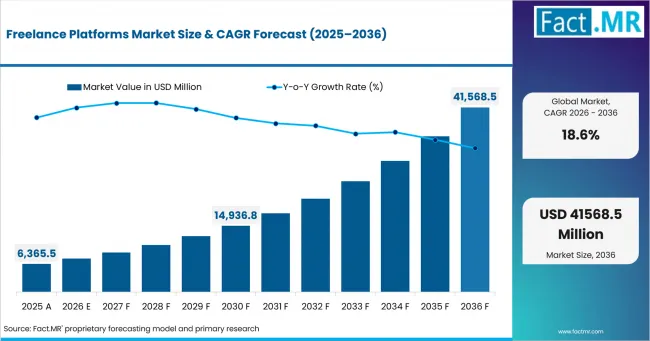
Freelance Platforms Market Market Value Analysis | Source: Fact.MR
What are the defining numbers behind Freelance Platforms Market growth?
USD 34,019.0 million absolute opportunity by 2036, led by platform, freelancer end use and specialist work.
- Demand Drivers in the Market
- Enterprise procurement teams need auditable contractor sourcing supported by identity checks and payment records that fit established vendor governance requirements.
- Hiring managers need shorter specialist search cycles due to scarce technology skills and project deadlines that do not justify permanent hiring rounds.
- Independent professionals need portable work histories reinforced by verified profiles and dispute processes across remote assignments with unfamiliar enterprise accounts.
- Project owners need stronger scoping support because milestone disputes often begin when deliverables and acceptance criteria remain unclear before work starts.
- Key Segments Analyzed
- By Component: Platform is expected to hold 59.7% share in 2026 driven by integrated matching and contracting workflows that keep project activity inside one system.
- By End Use: Freelancer is projected to account for 51.6% share in 2026 supported by recurring profile use and direct access to remote project opportunities.
- By Application: Project Management is anticipated to capture 23.1% share in 2026 attributable to milestone coordination and distributed delivery oversight across complex engagements.
- By Platform Type: Vertical-specific is estimated to represent 33.3% share in 2026 owing to deeper vetting logic and workflow knowledge within defined professional fields.
- By Service Type: Technology is forecast to account for 34.0% share in 2026 shaped by software delivery and automation projects that require scarce specialist capabilities.
- By Skill Level: Specialist is expected to hold 79.0% share in 2026 reinforced by enterprise preference for proven expertise on time-sensitive transformation work.
- Analyst Opinion at Fact.MR
- Shambhu Nath Jha, Senior Analyst at Fact.MR states: “The hard part is proving skills and defining exactly what the client expects before work begins. Demand is projected to favor platforms that shorten screening while keeping responsibility clear across complex external projects. Providers should combine credible vetting with milestone controls and practical compliance support for repeat enterprise work.”
- Strategic Implications
- Platform operators should deepen skill verification and retain structured evidence of completed work across specialist categories that carry higher delivery risk.
- Enterprise procurement teams should define multi-platform sourcing rules that separate open marketplace work from curated specialist and managed project engagements.
- Independent professionals should document measurable outcomes and narrow their service positioning around repeatable problems that enterprise accounts recognize quickly.
- Service partners should connect human expertise with workflow automation while keeping scope approval and delivery accountability visible to enterprise project owners.
Upwork expanded Uma from a work companion into an always-on work agent in July 2025 within a release that contained more than 75 product updates. The company said Uma powered most new client job posts and improved successful matching for high-value projects by 8%, reflecting competition around matching quality and work coordination.
Japan is estimated to record 27.6% CAGR through 2036 driven by clearer freelancer transaction rules and enterprise need for flexible specialist capacity. India is forecast to post 25.1% CAGR through 2036 supported by a broad self-employment base and remote service exports. France is projected to advance at 21.7% CAGR through 2036 owing to business formation and established independent professional structures. China is anticipated to record 17.8% CAGR through 2036 attributable to deep platform participation and broad online service delivery capacity. The United Kingdom is expected to post 17.3% CAGR through 2036 shaped by flexible professional work and enterprise use of external project specialists.
How does the Freelance Platforms Market break down by segment?
Platform accounts for 59.7%; Specialist work accounts for 79.00%.
Which component dominates?
Platform is projected to hold 59.7% share in 2026.
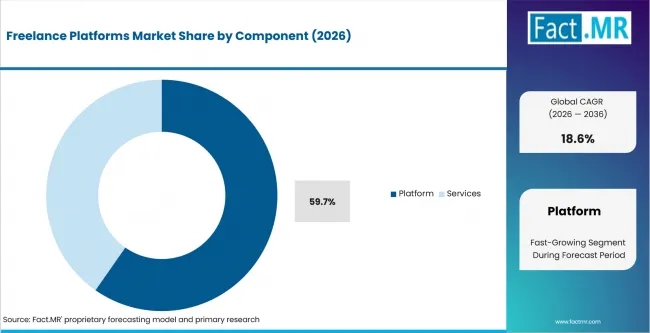
Freelance Platforms Market Analysis By Component | Source: Fact.MR
Platform is projected to hold 59.7% share in 2026 driven by integrated discovery and contracting workflows. Services follow where enterprise accounts need project scoping or compliance support beyond basic marketplace access alone. Project-based and Hybrid models extend platform use toward coordinated delivery for assignments involving linked roles and outputs. The International Labour Organization reported in February 2026 that its updated inventory counted 136 freelance platforms within the online web-based category. That scale gives enterprise accounts wider choice while increasing the value of clear vetting and repeat contracting tools.
What leads the End Use segment?
Freelancer is anticipated to account for 51.6% share in 2026.
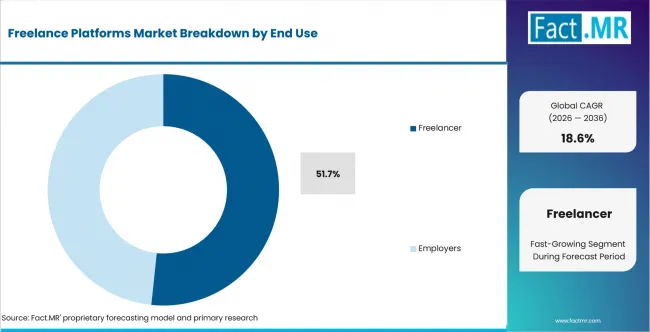
Freelance Platforms Market Analysis By End Use | Source: Fact.MR
Freelancer is anticipated to account for 51.6% share in 2026 supported by repeat profile use and cross-border project access. Employer demand divides between Large Enterprises and Small & Medium Enterprises that use external talent under different procurement controls. Smaller firms usually prioritize faster sourcing when internal teams lack narrow technical or creative skills. Eurostat reported in April 2026 that 2.06 million people aged 20–29 were self-employed across the EU during 2025. That early-career pool broadens the supply of professionals using online profiles to reach work beyond local networks.
How does Application shape demand?
Project Management is estimated to capture 23.12% share in 2026.
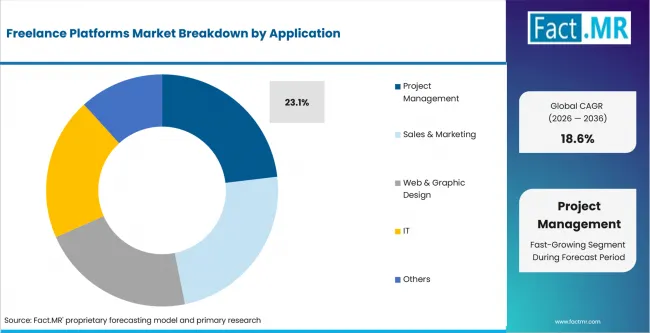
Freelance Platforms Market Analysis By Application | Source: Fact.MR
Project Management is estimated to capture 23.12% share in 2026 attributable to milestone control and distributed delivery coordination. IT work requires technical screening before clients commit to projects involving production systems and business-critical software. Sales & Marketing engagements need campaign context before execution starts across paid media and revenue programs. Fiverr reported in July 2025 that Pro Managed Services had shifted toward higher-value full-scope projects involving new high spenders and repeat clients. That direction favors platforms combining talent access with accountable coordination across linked workstreams and milestone reviews.
What supports Vertical-specific platforms within Platform Type?
Vertical-specific is forecast to represent 33.3% share in 2026.
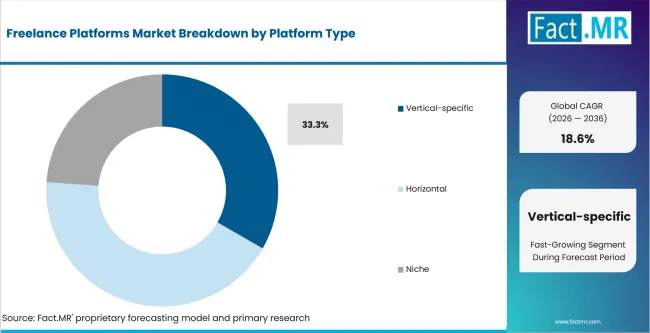
Freelance Platforms Market Analysis By Platform Type | Source: Fact.MR
Vertical-specific is forecast to represent 33.3% share in 2026 owing to profession-specific vetting and service workflows. Horizontal platforms remain relevant for broad category access across common sourcing needs and recurring business assignments. Niche platforms serve narrow skill communities where reputation and specialist context influence selection for technical or regulated assignments. Vertical-specific models also support defined deliverables and review steps that broad marketplaces do not structure consistently. Paro introduced two expert-supervised AI agents in December 2025: Business Tax Minimization and Financial Health Analysis. The release shows how specialist platforms extend beyond matching into guided work systems within defined professional fields.
What leads the Service Type segment?
Technology is expected to account for 34.0% share in 2026.
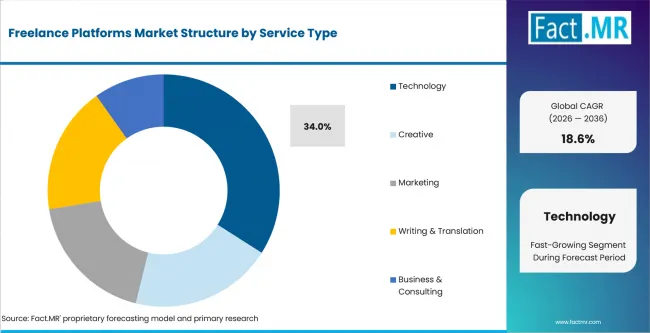
Freelance Platforms Market Analysis By Service Type | Source: Fact.MR
Technology is expected to account for 34.0% share in 2026 shaped by software delivery and automation work requiring scarce expertise. Creative and Marketing services depend on portfolios or channel knowledge before project owners approve customer-facing work. Writing & Translation needs subject expertise while Business & Consulting assignments often require deeper screening for confidential work. Eurostat reported in June 2026 that 10.4 million people worked in ICT specialist occupations across the EU during 2025. That skills base expands the talent pool available to technology-focused platforms serving software delivery and automation projects.
How does Skill Level shape demand?
Specialist is projected to hold 79.0% share in 2026.
Specialist is projected to hold 79.0% share in 2026 reinforced by enterprise need for proven expertise on clearly defined problems. Intermediate talent handles repeat execution work under client oversight while Entry-level work faces intense price competition across standardized tasks. Specialist projects carry higher screening costs and greater delivery risk for teams handling security-sensitive or company-wide change programs. Eurostat reported in June 2025 that 57.5% of EU enterprises recruiting ICT specialists had difficulty filling vacancies during 2023. That hiring difficulty supports specialist platform use when internal search timelines fail to meet urgent project needs.
What is accelerating Freelance Platforms Market adoption, and what is holding it back?
Specialist sourcing drives adoption; classification and trust costs restrain it.
Drivers Impact Analysis
| DRIVER | (~) % IMPACT ON CAGR | GEOGRAPHIC RELEVANCE | IMPACT TIMELINE |
|---|---|---|---|
| Enterprise use of variable specialist teams | +2.8% | North America and Europe | Medium term (2-4 years) |
| AI implementation and workflow redesign | +2.4% | North America and Asia Pacific | Short term (<= 2 years) |
| Cross-border access to specialist capacity | +2.0% | Asia Pacific and Europe | Medium term (2-4 years) |
| Managed compliance and payment infrastructure | +1.5% | Japan and Europe | Medium term (2-4 years) |
| Remote project delivery | +1.2% | Global | Long term (>= 4 years) |
Source: Fact.MR analysis. Updated Jul 7, 2026
- Enterprise use of variable specialist teams: Enterprise accounts separate permanent roles from fixed-term projects that need defined expertise for a limited period. Freelance platforms shorten specialist search cycles and preserve work records across repeat enterprise engagements and changing project teams. Upwork reported in September 2025 that high-value work among large businesses increased 31% during August 2025. Enterprise use is expected to expand where procurement teams preserve control without rebuilding sourcing steps for every project.
- AI implementation and workflow redesign: AI projects create short skill windows because tool choices and implementation patterns change faster than annual workforce planning. Enterprises use external specialists for model integration and process redesign when internal capacity is unavailable. Platforms are projected to gain project volume where skill categories stay current and technical screening is credible. Better matching depends on linking expertise to the actual system and business process before the project scope grows.
- Cross-border access to specialist capacity: Remote delivery lets project owners search beyond local hiring markets for narrow technical and creative skills. Platform records make prior outcomes visible across borders while milestone systems structure payment release for unfamiliar counterparties. Adoption is anticipated to widen where enterprises define language needs and delivery checkpoints before contracting. Providers that reduce payment friction and clarify tax records gain a practical route into repeat cross-border work.
- Managed compliance and payment infrastructure: Freelance engagement now sits closer to formal procurement due to regulators defining clearer transaction and worker-protection expectations. The Japan Fair Trade Commission reported in June 2025 that it issued guidance in 54 freelancer transaction cases during FY2024. Platforms are estimated to gain relevance where contract terms and payment timing remain visible throughout each engagement. Compliance tools become useful when they reduce manual review for procurement and finance teams handling repeat engagements.
- Remote project delivery: Distributed project work is now an established delivery option for software and professional services. Hiring managers compare external experts with internal capacity before starting long recruitment processes for temporary implementation needs. Demand is forecast to continue where platforms keep communication history and deliverable acceptance visible for procurement review. The limit is project suitability where confidential system access or sustained on-site coordination remains necessary for delivery.
Opportunity Impact Analysis
| OPPORTUNITY | (~) % IMPACT ON CAGR | GEOGRAPHIC RELEVANCE | IMPACT TIMELINE |
|---|---|---|---|
| Curated specialist networks for enterprise work | +1.8% | Japan and Europe | Medium term (2-4 years) |
| Vertical finance and consulting platforms | +1.4% | North America and Europe | Medium term (2-4 years) |
| Managed project delivery models | +1.1% | Global enterprise accounts | Short term (<= 2 years) |
| AI-assisted matching and scope development | +0.9% | Global | Short term (<= 2 years) |
Source: Fact.MR analysis. Updated Jul 7, 2026
- Curated specialist networks: Enterprise teams need narrower candidate pools when projects involve architecture decisions or regulated business processes. Pre-screening reduces initial review volume by verifying experience before client searches begin across sensitive or complex assignments. Toptal acquired Graphite in January 2026 and added access to a network of more than 12,000 vetted independent experts. Opportunity is expected to expand where platforms pair verified expertise with account teams that understand project context before introducing candidates.
- Vertical finance and consulting platforms: Finance work creates room for profession-specific workflows around monthly close activity and tax planning. These platforms structure deliverables around recurring finance calendars and controlled document access for sensitive accounting work. The model is projected to gain use where clients want specialist access without searching a broad marketplace. Providers need clear task ownership because finance outputs influence filings and executive decisions involving confidential business records.
- Managed project delivery models: Some enterprise clients want a finished outcome instead of selecting and coordinating each independent professional directly. The model lets a platform assemble multiple roles and track milestones against one project brief from initiation through acceptance. Eurostat reported in May 2025 that 52.9% of EU enterprises with at least 10 employees conducted remote meetings during 2024. Opportunity is anticipated to broaden where platforms coordinate multi-role teams under one delivery structure for remote enterprise projects.
- AI-assisted matching and scope development: Weak project briefs create costly search noise when clients describe goals without defining skills or acceptance criteria. Structured intake converts the initial request into focused questions before a platform returns candidates for human review. The European Commission Joint Research Centre reported in October 2025 that 30% of EU workers used AI for work-related purposes. Adoption is estimated to deepen where platform intake tools clarify skill requirements while hiring managers retain final review.
Restraints Impact Analysis
| RESTRAINT | (~) % IMPACT ON CAGR | GEOGRAPHIC RELEVANCE | IMPACT TIMELINE |
|---|---|---|---|
| Worker classification and employment-status compliance | -1.6% | Europe and Japan | Medium term (2-4 years) |
| Identity and portfolio verification costs | -1.3% | Global | Short term (<= 2 years) |
| Fee pressure and multi-platform participation | -0.9% | Global marketplace accounts | Long term (>= 4 years) |
| Social protection and cross-border coverage gaps | -0.8% | Europe and emerging economies | Medium term (2-4 years) |
Source: Fact.MR analysis. Updated Jul 7, 2026
- Worker classification and employment-status compliance: Freelance platforms operate across jurisdictions that apply different tests to independent work and platform responsibility. The International Labour Conference adopted Convention No. 193 in June 2026 for work mediated by digital platforms. Adoption is expected to slow where enterprise legal teams cannot determine responsibility quickly across cross-border or classification-sensitive engagements. Platforms need contract terms that reflect work control and payment practice instead of using the same language for every engagement.
- Identity and portfolio verification costs: Open marketplaces face fake profiles and unverifiable work claims when account creation is easier than credential review. Stronger checks raise onboarding costs and add friction for legitimate professionals in countries with uneven identity infrastructure. Demand is projected to favor systems that combine identity checks with work-sample evidence for higher-value engagements. The challenge is keeping verification current when freelancer skills change and project needs move into new technical categories.
- Fee pressure and multi-platform participation: Freelancers often maintain profiles across several platforms owing to uneven project flow and different category economics. The behavior weakens exclusivity and raises acquisition costs for platforms competing for the same specialist pool. Revenue is anticipated to face pressure where take rates are visible but differentiated services remain weak. Managed project support and enterprise compliance services provide a clearer defense than transaction fees alone.
- Social protection and cross-border coverage gaps: Platform work does not always provide the same protection structure as standard employment during sickness or periods without work. An International Labour Organization guide published in June 2025 noted that most gig and platform workers do not receive social protection benefits such as health insurance. Participation is forecast to remain selective for professionals whose project income is volatile and whose protection stays tied to standard employment. Platforms face pressure to support clear earnings records and insurance access without misrepresenting employment status.
Which countries are scaling Freelance Platforms Market fastest?
Japan 27.60%; India 25.10%; France 21.70%; China 17.80%; United Kingdom 17.30%.
Freelance Platforms Market is segmented into North America and Europe while coverage also includes East Asia and South Asia & Pacific and Middle East & Africa.
| COUNTRY | CAGR |
|---|---|
| Japan | 27.6% |
| India | 25.1% |
| France | 21.7% |
| China | 17.8% |
| United Kingdom | 17.3% |
Source: Fact.MR analysis. Updated Jul 7, 2026
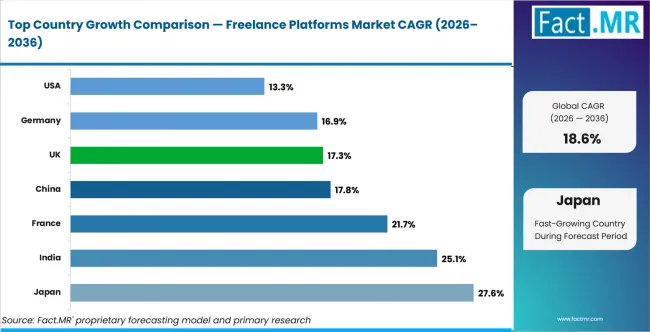
Freelance Platforms Market Cagr Analysis By Country | Source: Fact.MR
What is powering Japan’s growth?
27.6% CAGR, driven by clearer freelancer transaction rules and growing specialist sourcing requirements.
Japan’s formalization of independent professional work is creating a clearer framework for enterprise contracting and platform-based project sourcing. The Japan Fair Trade Commission reported in March 2025 that its FY2024 transaction survey targeted 30,000 ordering enterprises across higher-risk industries. Demand is estimated to expand at 27.6% CAGR through 2036 as enterprises seek specialist capacity with clearer contracting and payment practices. Platforms that support auditable terms and dependable payment workflows can gain stronger acceptance across repeat enterprise engagements.
How is India scaling freelance platform demand?
25.1% CAGR through 2036, supported by a broad self-employment base and exportable remote service capabilities.
India’s broad independent-work base gives freelance platforms access to software and business-service skills that can be delivered remotely across borders. In March 2026, the Press Information Bureau reported that self-employed workers represented 56.2% of total employment during 2025. Demand is forecast to grow at 25.1% CAGR through 2036 as verified skills and smoother cross-border payments expand access to export-oriented projects. Platforms that strengthen worker verification and payment reliability can convert India’s service depth into more repeat international assignments.
What supports the France outlook?
21.7% CAGR, owing to strong business formation and established independent professional structures.
France combines high business creation activity with established independent professional structures that support platform-based sourcing across specialized services. Insee reported in February 2026 that France registered 1,165,800 new businesses during 2025. The market is projected to advance at 21.7% CAGR through 2036 as micro-enterprise activity expands the pool of independent service providers. Platforms that simplify contracts and invoice documentation can fit enterprise procurement processes while clients retain control over profession-specific qualification requirements.
What underpins China’s growth?
17.8% CAGR, attributable to extensive platform participation and established online service delivery capacity.
China’s extensive platform economy gives freelance marketplaces access to a large participant base and established digital service delivery channels. The State Council Information Office reported in June 2025 that 175 million people engaged in platform-based gig work during 2024. Demand is anticipated to advance at 17.8% CAGR through 2036 as local payment systems and clearer service categories widen project access. Platforms that improve project classification and worker matching can strengthen repeat use across domestic assignments and remote service work.
How is the United Kingdom developing freelance platform demand?
17.3% CAGR, shaped by flexible professional work and enterprise demand for project-based specialist sourcing.
United Kingdom enterprises use independent professionals for technology and creative assignments that do not align with permanent recruitment cycles. In June 2026, the Office for National Statistics reported that self-employment jobs rose by 177,000 during the quarter ending March 2026. Demand is expected to expand at 17.3% CAGR through 2036 as businesses increase project-based sourcing across specialized functions. Platforms with structured engagement records and repeat sourcing tools can support procurement teams that manage specialist work across several departments.
Who leads the Freelance Platforms Market?
Upwork and Fiverr span marketplace and managed service models, while Toptal and Paro deepen curated specialist access.
Key industry players such as Upwork combines broad project categories with enterprise account features and AI-assisted hiring tools for organizations that use external specialists repeatedly. Fiverr uses a service catalog model alongside Fiverr Pro for larger client engagements that need curated professional access and account support. Freelancer.com supports project bidding and crowdsourcing contests across an international professional user base spanning many service categories. In December 2025, Freelancer.com announced a partnership with the United Nations Development Programme for a structured crowdsourcing challenge. These providers compete on discovery speed and transaction support while expanding managed service options for enterprise accounts.
Toptal centers its model on screened specialist access while Gigster organizes distributed teams around software delivery. Contently combines an enterprise content platform with a professional talent network and introduced AI Studio in March 2025. Paro focuses on finance and accounting expertise supported by guided work tools for confidential professional tasks. Competition through 2036 is expected to be shaped by verification depth and managed delivery for complex enterprise projects. Enterprise accounts are also likely to compare compliance support before concentrating repeat spend on fewer platforms.
Which companies are the key providers?
Upwork, Fiverr, Freelancer.com, Toptal, Gigster, Contently and Paro.
- Upwork
- Fiverr
- Freelancer.com
- Toptal
- Gigster
- Contently
- Paro
Bibliography
- Contently. (2025, March 18). The Future of Content(ly). Contently.
- Eurostat. (2025, May 14). 53% of EU enterprises held remote meetings in 2024. European Commission.
- Eurostat. (2025, June). ICT specialists - statistics on hard-to-fill vacancies in enterprises. European Commission.
- Eurostat. (2026, April 21). EU sees 2.06 million young entrepreneurs in 2025. European Commission.
- Eurostat. (2026, June). Towards Digital Decade targets for Europe. European Commission.
- European Commission, Joint Research Centre. (2025, October 21). Impact of digitalisation: 30% of EU workers use AI. European Commission.
- Fiverr International Ltd. (2025, July 30). Fiverr Announces Second Quarter 2025 Results. Fiverr International Ltd.
- Freelancer Limited. (2025, December 22). UN Agency Partners with Freelancer to Tackle Global Crisis. Freelancer.
- Institut national de la statistique et des études économiques. (2026, February 6). Business births in 2025. Insee.
- International Labour Organization. (2025, June 16). Exploring the gig economy: Challenges and opportunities. International Labour Organization.
- International Labour Organization. (2026, February 16). Digital labour platforms: Number of platforms and workers. International Labour Organization.
- International Labour Organization. (2026, June 12). Convention concerning decent work in the platform economy, 2026. International Labour Organization.
- Japan Fair Trade Commission. (2025, June 13). Annual Report of the Japan Fair Trade Commission (April 2024–March 2025). Japan Fair Trade Commission.
- Office for National Statistics. (2026, June 18). Labour market overview, UK: June 2026. Office for National Statistics.
- Paro. (2025, December 4). With Launch of AI Agents, Paro Transforms Into Intelligent Work Ecosystem. Paro.
- Press Information Bureau. (2026, March 27). Periodic Labour Force Survey (PLFS) Annual Report, 2025. Government of India.
- State Council Information Office of the People’s Republic of China. (2025, June 3). China’s young kitchen wizards establishing careers as on-demand chefs. State Council Information Office.
- Toptal. (2026, January 7). Toptal Announces the Acquisition of Graphite. Toptal.
- Upwork Inc. (2025, July 23). Upwork Evolves Uma AI into AI Work Agent, Advances Human-AI Collaboration Across Hiring and Work Management. Upwork.
- Upwork Inc. (2025, September 5). Upwork Monthly Hiring Report: AI Amplifies Demand for Human Skills. Upwork.
This Report Addresses
- The report provides strategic intelligence on Freelance Platforms across Component and End Use choices that shape online work sourcing and engagement structures.
- Segment analysis identifies Platform and Specialist work as the leading segments within the 2026 market structure.
- Regional outlook evaluates Japan and India alongside France while China and the United Kingdom complete the country growth comparison.
- Competitive analysis profiles Upwork and Fiverr alongside Freelancer.com and Toptal across marketplace and curated professional service models. Gigster and Contently are followed by Paro within the provider set covering software delivery and specialized professional work.
- Component assessment covers Platform and Services while platform models include Solution-based and Talent-based structures for distinct sourcing and delivery needs. Project-based and Hybrid options complete the platform taxonomy by adding structured delivery paths for coordinated multi-role engagements.
- Use-case assessment covers Sales & Marketing and Web & Graphic Design alongside IT work across common remote professional service engagements. Project Management and other applications complete the application framework by covering coordination-heavy work and broader professional service requirements.
- Platform Type analysis distinguishes Horizontal and Vertical-specific models while Niche platforms serve narrower capability communities and profession-specific workflows.
What does the Freelance Platforms Market cover?
Solution-based, Talent-based, Project-based, and Hybrid platforms used to source and manage independent professional work.
The Freelance Platforms Market covers online systems that connect independent professionals with project owners and enterprise accounts. Coverage includes open marketplace access and curated talent matching alongside project-based and hybrid delivery models.
The market differs from general employment software because revenue comes from external project work and independent professional engagement. Traditional staffing agencies and payroll-only tools stay outside the scope unless they are built into a freelance platform workflow for project sourcing or delivery.
What is included in the scope?
Freelance platform services used for specialist sourcing and project delivery across online work environments.
The scope includes Platform and Services components for Freelancer and Employer end users participating in online professional work sourcing and delivery. Applications cover Sales & Marketing and Web & Graphic Design alongside IT and Project Management work delivered through online platforms. Platform Type coverage spans Horizontal and Vertical-specific models alongside Niche services built around narrower professional communities and work patterns. Service Type coverage includes Technology and Creative work alongside Marketing and Writing & Translation while Business & Consulting remains included for structured enterprise engagements. Adjacent gig economy tech platforms provide broader context for marketplace infrastructure and participant engagement across online work models. AI HR services support comparison with employee-focused matching systems without entering the freelance platform boundary defined in this analysis.
What is excluded from the scope?
Traditional staffing agencies and local task-delivery apps are outside the scope.
The scope excludes ride-hailing and local delivery platforms because their business models depend on location-based task dispatch instead of remote professional work. Payroll-only software and employer-of-record services are excluded unless they sit inside a freelance platform workflow that also handles project sourcing or delivery.
How was the analysis built?
120+ sources, 35+ company portfolios, 25+ countries, 20+ interviews.
- Primary Research: Primary research includes interviews with enterprise procurement teams and hiring managers who use independent professionals. It also includes freelancers and project owners across technology and creative services who use platforms for sourcing and delivery. Finance leaders and platform account teams provide evidence on payment controls and recurring problems during external work programs.
- Desk Research: Desk research reviews official labor statistics and platform-work regulation alongside company product pages and investor materials. Portfolio checks compare marketplace structures and managed service models across active providers serving freelancers and enterprise accounts. Regulatory releases are used to assess payment rules and worker-protection changes across the selected countries.
- Market-Sizing and Forecasting: Forecasting uses freelancer participation and enterprise project demand alongside platform revenue models and service mix. Models also consider specialist skill shortages and remote delivery suitability across services with different screening and coordination needs. Country forecasts reflect remote service capacity and regulatory conditions that influence domestic and cross-border project work.
- Data Validation and Update Cycle: Forecasts are validated through provider checks and client interviews that test assumptions on sourcing frequency and project value. Portfolio mapping confirms active service categories while official releases identify changes in product scope and regulation. Official labor data and regulatory updates are reviewed during each cycle to test whether country conditions have changed.
Segmentation
What is the report’s scope and coverage?
| Attribute | Details |
|---|---|
| Quantitative Units | USD Million in 2026 to USD Million by 2036 |
| Market Definition | Online platforms that connect independent professionals with project owners and enterprise accounts through marketplace access; curated matching and managed delivery models |
| Component | Platform; Services |
| End Use | Freelancer; Large Enterprises; Small & Medium Enterprises |
| Application | Project Management; IT; Sales & Marketing; Web & Graphic Design; Other Applications |
| Platform Type | Horizontal; Vertical-specific; Niche |
| Service Type | Technology; Creative; Marketing; Writing & Translation; Business & Consulting |
| Skill Level | Specialist; Intermediate; Entry-level |
| Regions Covered | North America; Europe; East Asia; South Asia and Pacific; Middle East and Africa |
| Countries Covered | Japan; India; France; China; United Kingdom |
| Key Companies Profiled | Upwork; Fiverr; Freelancer.com; Toptal; Gigster; Contently; Paro |
| Forecast Period | 2026 to 2036 |
| Approach | Hybrid top-down and bottom-up approach using freelancer participation; enterprise project demand; platform revenue models; service mix; specialist skill shortages; remote delivery suitability and provider validation |
Source: Fact.MR analysis. Updated Jul 7, 2026
How is the market segmented?
-
By Component
- Platform
- Services
-
By End Use
- Freelancer
- Large Enterprises
- Small & Medium Enterprises
-
By Application
- Project Management
- IT
- Sales & Marketing
- Web & Graphic Design
- Other Applications
-
By Platform Type
- Horizontal
- Vertical-specific
- Niche
-
By Service Type
- Technology
- Creative
- Marketing
- Writing & Translation
- Business & Consulting
-
By Skill Level
- Specialist
- Intermediate
- Entry-level
-
Region
- North America
- United States
- Canada
- Europe
- France
- United Kingdom
- Germany
- Netherlands
- Spain
- East Asia
- Japan
- China
- South Korea
- South Asia & Pacific
- India
- Singapore
- Australia
- Thailand
- Middle East & Africa
- UAE
- Saudi Arabia
- South Africa
- North America
Frequently Asked Questions
Which Component leads the Freelance Platforms Market?
Which End Use leads the Freelance Platforms Market?
Which Application leads the Freelance Platforms Market?
Which Platform Type leads the Freelance Platforms Market?
Which Service Type leads the Freelance Platforms Market?
Which Skill Level leads the Freelance Platforms Market?
Which country records the highest CAGR in the Freelance Platforms Market?
How does India perform in the Freelance Platforms Market?
How does France perform in the Freelance Platforms Market?
How does China perform in the Freelance Platforms Market?
How does the United Kingdom perform in the Freelance Platforms Market?
What is the primary driver in the Freelance Platforms Market?
What is the main restraint in the Freelance Platforms Market?
Why is Specialist work important?
Why do Freelancers dominate demand?
Who worked on this report


Preview the report firsthand - request a free sample
Free SampleGet the brochure for pricing and purchase details
Download PDF