- Market Value (2025): USD 2.0 Bn
- Estimated Value (2026): USD 2.2 Bn
- Forecast Value (2036): USD 5.7 Bn
- CAGR (2026-2036): 10.1%
What is the Fat-Reduction Protein Lubricants Market forecast to be worth by 2036?
USD 2.2 billion in 2026 to USD 5.7 billion by 2036, at a 10.1% CAGR.
- The Fat-Reduction Protein Lubricants Market crossed a valuation of USD 2.0 billion in 2025.
- Demand is projected to increase from USD 2.2 billion in 2026 to USD 5.7 billion by 2036.
- The market is forecast to grow at a 10.1% CAGR from 2026 to 2036.
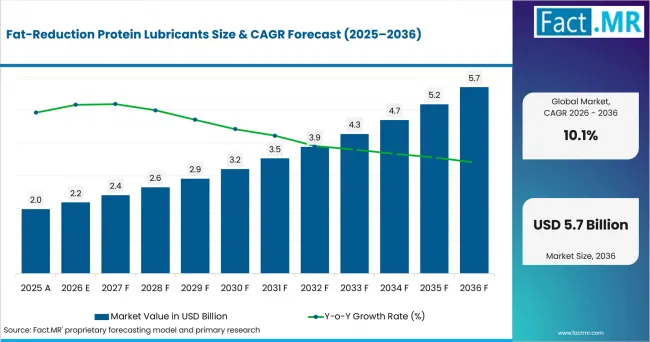
Fat Reduction Protein Lubricants Value Analysis | Source: Fact.MR
What are the defining numbers behind Fat-Reduction Protein Lubricants Market growth?
USD 3.5 billion absolute opportunity by 2036, led by whey proteins, dairy / alternatives, and powder concentrate formats.
- Demand Drivers in the Market
- Dairy developers need proteins that restore creaminess after fat reduction. The system should stay smooth without becoming chalky or too thick.
- Beverage teams need proteins that disperse well and add body. The drink should remain easy to process and stable during storage.
- Sauce and dressing makers need proteins that keep oil and water mixed. Lower-fat products should still coat well and feel familiar in the mouth.
- Bakery teams need proteins that help maintain moisture and soft texture. This becomes important when lower fat changes tenderness during storage.
- Key Segments Analyzed
- By Protein Platform: Whey proteins are expected to hold 34.0% share in 2026.
- By Functional Role: Lubrication / creaminess is projected to hold 31.0% share in 2026.
- By Application: Dairy / alternatives are expected to capture 36.0% share in 2026.
- By Format: Powder concentrate is estimated to represent 29.0% share in 2026.
- Analyst Opinion at Fact.MR
- S.N. Jha, Principal Consultant at Fact.MR, states, “Protein-based fat reduction must meet sensory and nutrition needs. Good systems should keep foods smooth under normal production conditions. Suppliers should pair protein choice with clear tests and use guidance.”
- Strategic Implications
- Dairy brands should test each protein at the planned fat level. They should also use the same shear conditions as commercial production.
- Ingredient makers should show texture results at realistic protein levels. This gives food brands more useful evidence than protein content alone.
- Application teams should check mouthfeel after normal storage. Protein hydration and emulsion behavior can change after the product is made.
- Food makers can qualify more than one protein route where practical. This gives teams more options for meeting the same sensory target.
China is projected to record an 11.6% CAGR through 2036. Japan follows at 10.5%, while the USA and France each reach 10.1%. Germany is expected to post 9.9% over the same period. Each market has a different mix of dairy output, food making, and recipe changes.
How does the Fat-Reduction Protein Lubricants Market break down by segment?
Dairy / alternatives lead Application at 36.0%; whey proteins lead Protein Platform at 34.0%.
Which Protein Platform leads?
Whey proteins are expected to hold 34.0% share in 2026.
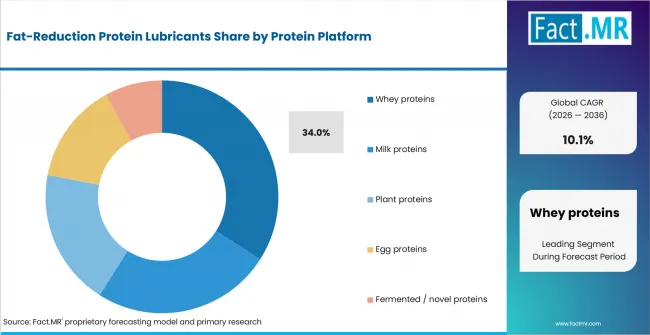
Fat Reduction Protein Lubricants Analysis By Protein Platform | Source: Fact.MR
Whey proteins add protein and useful structure to many foods. Milk proteins fit dairy recipes, while plant and egg proteins serve other needs. Fermented and novel proteins add more choices for product teams. USDA NASS reported 213.524 million pounds of U.S. whey protein isolate production in 2025.
What leads the Functional Role segment?
Lubrication / creaminess is projected to account for 31.0% share in 2026.
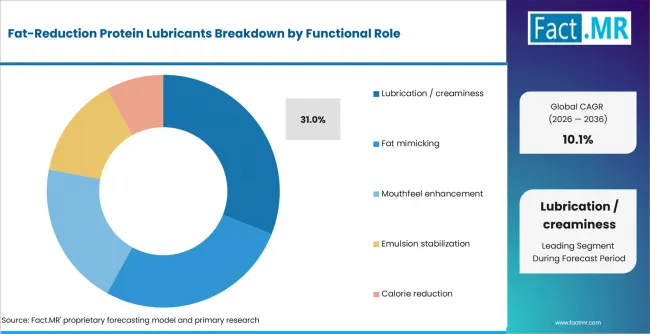
Fat Reduction Protein Lubricants Analysis By Functional Role | Source: Fact.MR
Lubrication and creaminess help replace the sensory role of fat. Fat mimicking and mouthfeel also depend on hydration and other solids. Stable oil-water mixes matter in sauces and dressings. The best protein system must work well in the finished food.
How does Application shape demand?
Dairy / alternatives are anticipated to capture 36.0% share in 2026.
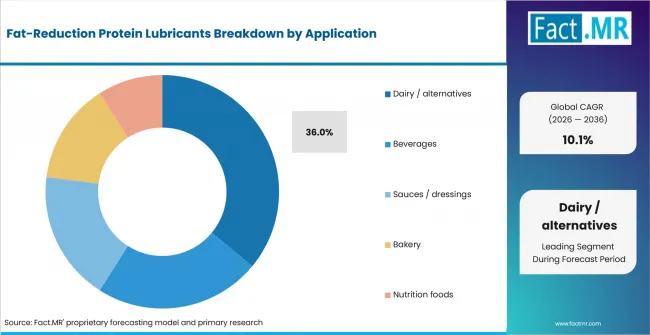
Fat Reduction Protein Lubricants Analysis By Application | Source: Fact.MR
Dairy and alternative-dairy foods make texture changes easy to notice. Consumers expect yoghurt, desserts, and drinks to feel smooth. Beverages also need stability, while sauces need good coating and emulsion control. Bakery products need moisture and tenderness after fat reduction.
What supports Powder Concentrate within Format?
Powder concentrate is estimated to represent 29.0% share in 2026.
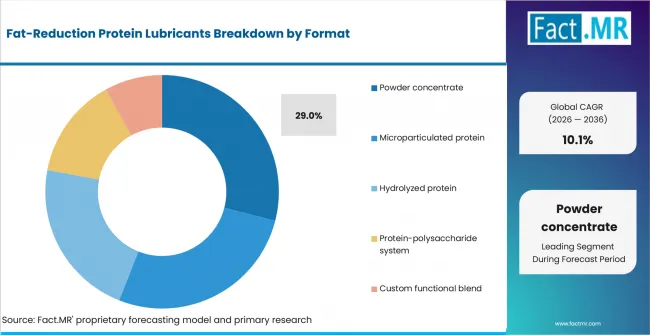
Fat Reduction Protein Lubricants Analysis By Format | Source: Fact.MR
Powder concentrates are practical for storage, dosing, and dry blending. Microparticulated proteins can support a creamy, fat-like feel. Hydrolyzed proteins can help selected recipes mix more easily. Protein-polysaccharide systems and custom blends can combine several texture roles.
What is accelerating Fat-Reduction Protein Lubricants Market adoption, and what is holding it back?
Texture recovery and protein function support adoption, while sensory trade-offs and ingredient costs can limit use.
Drivers Impact Analysis
| DRIVER | (~) % IMPACT ON CAGR | GEOGRAPHIC RELEVANCE | IMPACT TIMELINE |
|---|---|---|---|
| Lower-fat reformulation with retained creaminess | +1.8% | Global | Short term (<= 2 years) |
| Protein enrichment combined with texture function | +1.4% | North America, Europe, East Asia | Medium term (2-4 years) |
| Expansion of dairy and alternative-dairy formats | +1.1% | Global | Medium term (2-4 years) |
| Emulsion and mouthfeel needs in sauces and dressings | +0.8% | North America, Europe | Long term (>= 4 years) |
Opportunity Impact Analysis
| OPPORTUNITY | (~) % IMPACT ON CAGR | GEOGRAPHIC RELEVANCE | IMPACT TIMELINE |
|---|---|---|---|
| Microparticulated proteins for creaminess | +1.2% | North America, Europe, Japan | Medium term (2-4 years) |
| Protein-polysaccharide systems | +0.9% | Global | Medium term (2-4 years) |
| Plant-protein texture systems | +0.7% | China, Europe, North America | Long term (>= 4 years) |
| Custom blends for application-specific reformulation | +0.6% | Global | Short term (<= 2 years) |
Restraints Impact Analysis
| RESTRAINT | (~) % IMPACT ON CAGR | GEOGRAPHIC RELEVANCE | IMPACT TIMELINE |
|---|---|---|---|
| Taste or chalkiness at higher protein use levels | -0.8% | Global | Short term (<= 2 years) |
| Raw-material and food-input cost pressure | -0.6% | Global | Short term (<= 2 years) |
| Process sensitivity across pH and heat conditions | -0.5% | Global | Medium term (2-4 years) |
| Labeling and claim requirements | -0.3% | USA, China, Europe, Japan | Long term (>= 4 years) |
Which countries are scaling the Fat-Reduction Protein Lubricants Market through 2036?
- The country comparison spans 1.7 percentage points and forms three practical growth bands across the forecast period.
- China remains 1.1 percentage points above Japan as dairy output and packaged-food reformulation support protein-based texture work in lower-fat foods.
- Japan remains 0.4 percentage point above the USA as food-processing activity and texture-sensitive reformulation support protein formats designed to keep revised foods smooth and appealing.
- The USA and France both record 10.1% CAGR, with the USA supported by broad food spending and a deep protein-ingredient base, while France benefits from dairy processing and continued milk-based product development.
- France remains 0.2 percentage point above Germany as dairy processing supports continued work with milk and whey proteins in lower-fat formulations.
- Germany closes the displayed range as prepared-food production and protein-rich reformulation create demand for systems that support body, texture, and stable mixes.
Comparable CAGRs can create different entry conditions due to protein supply, dairy and food-processing depth, formulation needs, sensory targets, and local product mix. Full report coverage includes North America, Latin America, Western Europe, Eastern Europe, East Asia, South Asia & Pacific, Middle East & Africa.
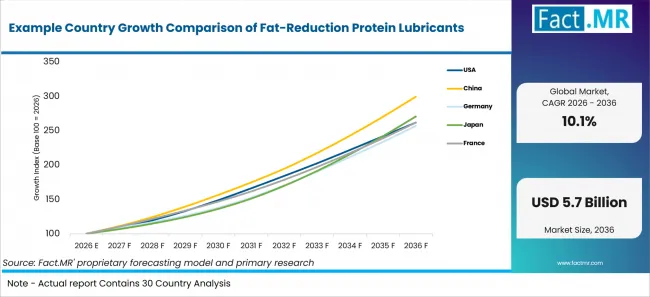
Example Country Growth Comparison Of Fat Reduction Protein Lubricants | Source: Fact.MR
| Country | CAGR (2026-2036) |
|---|---|
| China | 11.6% |
| Japan | 10.5% |
| USA | 10.1% |
| France | 10.1% |
| Germany | 9.9% |
What is powering China’s expansion?
11.6% CAGR, shaped by dairy output and reformulation across packaged foods.
China has a large dairy base for yoghurt, drinks, and desserts. The National Bureau of Statistics reported 40.91 million tonnes of milk output in 2025. This scale supports work with whey, milk, and plant proteins in lower-fat foods.
How is Japan scaling fat-reduction protein lubricant demand?
10.5% CAGR, supported by food processing activity and texture-sensitive reformulation.
Japan has a mature food sector with strong focus on texture. In April 2025, USDA FAS reported that the value of food produced by Japan’s food processing sector totaled USD 174 billion in 2024, up 3.9% from the previous year.
What supports the USA outlook?
10.1% CAGR, reinforced by broad food spending and a deep protein ingredient base.
The USA has a large base for lower-fat food recipe work. USDA ERS reported total U.S. food spending of USD 2.51 trillion in 2025. This market scale supports repeated work with whey and other protein systems for smooth texture.
What underpins France’s growth?
10.1% CAGR, backed by dairy processing and continuing milk-based product development.
France has a large dairy sector where smooth texture remains important. FranceAgriMer reported 2.17 billion litres of cow-milk collection in March 2026. That was 5.3% higher than in March 2025. The dairy base supports work with milk and whey proteins in lower-fat foods.
How is Germany developing demand?
9.9% CAGR, led by prepared-food production and protein-rich reformulation.
Germany has established dairy plants and a large ready-food base. Destatis reported 1.7 million tonnes of ready meals produced in 2024. Their production value reached EUR 5.9 billion. These foods create room for protein systems that support body and stable mixes.
Who leads the Fat-Reduction Protein Lubricants Market?
Kerry, MicroLub, Arla Foods Ingredients, Roquette, Tate & Lyle, and Leprino Nutrition are relevant protein and texture solution suppliers.
Collectively, their portfolios cover dairy and plant proteins, protein hydrolysates, texturants, functional systems, and tailored ingredient solutions. Kerry, for example, supplies dairy- and plant-based protein hydrolysates alongside texture systems, while Arla Foods Ingredients provides whey and milk protein solutions for high-protein applications.
Competitive differentiation is expected to center on smooth texture, processing performance, sensory quality, and formulation support. In June 2025, Roquette expanded its NUTRALYS® portfolio with NUTRALYS® T WHEAT 600L textured wheat protein and NUTRALYS® T PEA 700XC textured pea protein.
Which companies are the key providers?
Companies profiled include Kerry Group; MicroLub; Arla Foods Ingredients; Roquette; Tate & Lyle; and Leprino Nutrition.
- Kerry Group
- MicroLub
- Arla Foods Ingredients
- Roquette
- Tate & Lyle
- Leprino Nutrition
Bibliography
- Arla Foods Ingredients. (2025, November 11). Arla Foods Ingredients showcases innovation expertise with new high-protein concepts.
- Roquette. (2025, June 17). Roquette grows NUTRALYS® plant protein portfolio with addition of new textured wheat and pea proteins.
- Zeballos, E., & Sinclair, W. (2026, June 11). Total U.S. food spending reached $2.51 trillion in 2025. U.S. Department of Agriculture, Economic Research Service.
- U.S. Department of Agriculture, National Agricultural Statistics Service. (2026, April 24). Dairy products 2025 summary.
- U.S. Bureau of Labor Statistics. (2026, January 13). Consumer Price Index-December 2025.
- National Bureau of Statistics of China. (2026, February 28). Statistical communiqué of the People’s Republic of China on the 2025 national economic and social development.
- U.S. Department of Agriculture, Foreign Agricultural Service. (2025, April 1). Japan: Food Processing Ingredients Annual (Report No. JA2025-0014).
- Statistics Bureau of Japan. (2026, January 23). Japan 2025.
- Ministère de l’Agriculture, de l’Agro-alimentaire et de la Souveraineté alimentaire. (2026, March 13). Infographie - Production et consommation de lait et produits laitiers.
- FranceAgriMer. (2026, June 1). Note de conjoncture mensuelle sur la filière lait de vache - Mai 2026.
- Institut national de la statistique et des études économiques. (2026, August 14). Consumer Price Index - Base 2025 - Year-on-year change - All households - Metropolitan France - Food.
- Statistisches Bundesamt (Destatis). (2026, January 14). Produktion von Fertiggerichten binnen fünf Jahren mengenmäßig um 25,6 % gestiegen [Production of ready meals increased by 25.6% in volume within five years].
- Statistisches Bundesamt (Destatis). (2026, May 18). Nach jahrelangem Anstieg: Fleischersatz-Produktion sinkt 2025 um 1,2 % gegenüber dem Vorjahr [After years of increases, production of meat substitutes fell by 1.2% in 2025 compared with the previous year].
- Federal Statistical Office (Destatis). (2026, January 15). Wholesale prices in December 2025: +1.2% on December 2024.
This Report Answers
- The report explains how protein systems can restore creaminess and lubrication. It covers their use when food makers cut fat.
- Segment analysis identifies the leading supplied subsegments. It links each share with a clear processing or sensory reason.
- Country analysis compares the five supplied CAGR outlooks. It also uses official dairy, food, price, and label data.
- Competitive analysis reviews the named providers without company market shares. It focuses on protein function, process fit, and product support.
What does the Fat-Reduction Protein Lubricants Market cover?
The market covers protein ingredients used to restore texture when fat is reduced. These systems can support creaminess, body, lubrication, or stable mixes. They include whey, milk, plant, egg, fermented, and novel proteins with a direct food role.
Applications include dairy and alternatives, beverages, sauces and dressings, bakery, and nutrition foods. Formats include powder concentrate, microparticulated protein, hydrolyzed protein, protein-polysaccharide systems, and custom blends.
What is included in the scope?
Included products are protein ingredients used for fat reduction and texture control. The protein must make a clear contribution to mouthfeel or food performance.
The analysis covers lower-fat dairy, dairy alternatives, drinks, sauces, dressings, bakery, and nutrition foods. It also covers protein-polysaccharide systems and custom blends when protein supports sensory or mixing performance.
What is excluded from the scope?
The scope excludes proteins used only for nutrition fortification. It also excludes stand-alone carbohydrate and lipid systems from the broader fat-replacer category.
General stabilizers, emulsifiers, and hydrocolloids are outside the scope unless protein leads the function. Broader fat-replacer comparisons are used only to explain nearby recipe routes.
How Was the Analysis Built?
The analysis draws on 120+ sources, 35+ company portfolios, 25+ countries, and more than 20 industry interviews.
- Primary Research: Primary research includes discussions with manufacturers, service providers, technology developers, distributors, end users, and subject-matter experts. These conversations examine purchasing priorities, product adoption, operational challenges, approval requirements, competitive positioning, and the factors that influence wider market acceptance.
- Desk Research: Desk research covers government statistics, regulatory publications, company filings, trade data, technical studies, industry associations, standards, public policy, and other authoritative sources. Every source used in the analysis is documented in the bibliography.
- Market Sizing and Forecasting: Market estimates combine historical performance, demand indicators, pricing and volume trends, segment shares, company participation, country-level growth, adoption patterns, investment activity, and barriers to market expansion.
- Data Validation and Update Cycle: Findings are validated by comparing primary interviews with public data, company activity, regulatory changes, trade patterns, and industry developments. Regular updates review new product launches, capacity changes, partnerships, approvals, and shifts in commercial adoption.
What is the report’s scope and coverage?
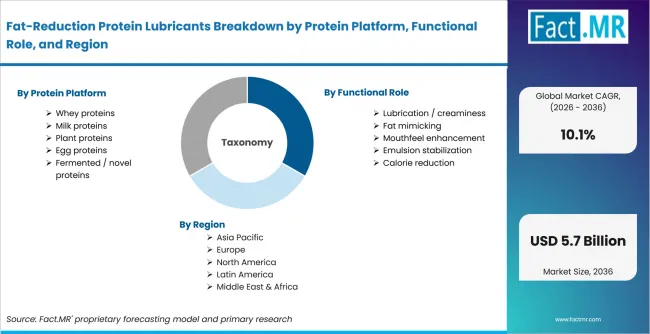
Fat Reduction Protein Lubricants Breakdown By Protein Platform, Functional Role, And Region | Source: Fact.MR
| Attribute | Details |
|---|---|
| Quantitative Units | USD billion |
| Market Definition | Functional protein ingredients and protein-based systems used to replace part of fat’s lubrication, creaminess, mouthfeel or emulsion contribution in food formulations. |
| Protein Platform | Whey proteins; Milk proteins; Plant proteins; Egg proteins; Fermented / novel proteins |
| Functional Role | Lubrication / creaminess; Fat mimicking; Mouthfeel enhancement; Emulsion stabilization; Calorie reduction |
| Application | Dairy / alternatives; Beverages; Sauces / dressings; Bakery; Nutrition foods |
| Format | Powder concentrate; Microparticulated protein; Hydrolyzed protein; Protein-polysaccharide system; Custom functional blend |
| Regions Covered | North America; Latin America; Western Europe; Eastern Europe; East Asia; South Asia & Pacific; Middle East & Africa |
| Countries Covered | United States; China; Germany; Japan; France |
| Key Companies Profiled | Kerry Group; MicroLub; Arla Foods Ingredients; Roquette; Tate & Lyle; Leprino Nutrition |
| Forecast Period | 2026 to 2036 |
| Approach | Hybrid demand-side and supplier-side review using application intensity, protein platform use, formulation needs, official food and dairy statistics, and provider portfolio validation. |
How is the market segmented?
-
By Protein Platform:
- Whey proteins
- Milk proteins
- Plant proteins
- Egg proteins
- Fermented / novel proteins
-
By Functional Role:
- Lubrication / creaminess
- Fat mimicking
- Mouthfeel enhancement
- Emulsion stabilization
- Calorie reduction
-
By Application:
- Dairy / alternatives
- Beverages
- Sauces / dressings
- Bakery
- Nutrition foods
-
By Format:
- Powder concentrate
- Microparticulated protein
- Hydrolyzed protein
- Protein-polysaccharide system
- Custom functional blend
-
By Region:
- North America
- Latin America
- Western Europe
- Eastern Europe
- East Asia
- South Asia & Pacific
- Middle East & Africa