- Market Value (2025): USD 3.3 Bn
- Estimated Value (2026): USD 3.5 Bn
- Forecast Value (2036): USD 6.9 Bn
- CAGR (2026-2036): 7.0%
What is the Protein-Fortified Noodles and Pasta Market forecast to be worth by 2036?
USD 3.5 billion in 2026 to USD 6.9 billion by 2036, at 7.0% CAGR.
- The market reached USD 3.3 billion in 2025 as protein-led meal formats expanded beyond specialist nutrition channels.
- Demand is projected to increase from USD 3.5 billion in 2026 to USD 6.9 billion by 2036.
- The market is forecast to record a 7.0% CAGR from 2026 to 2036 as manufacturers improve protein density without losing familiar pasta and noodle performance.
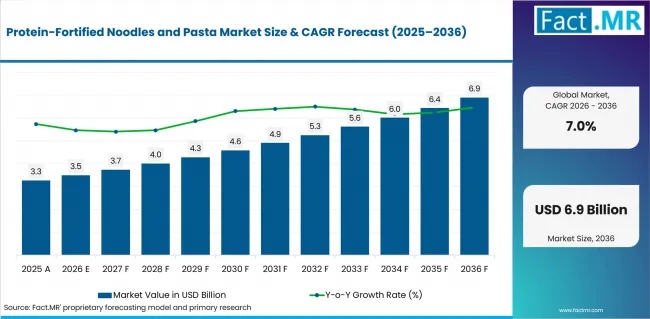
Protein Fortified Noodles And Pasta Market Value Analysis | Source: Fact.MR
What are the defining numbers behind Protein-Fortified Noodles and Pasta Market growth?
USD 3.4 billion in added annual revenue between 2026 and 2036, led by Protein-fortified Pasta, Plant Protein; and Supermarkets & Hypermarkets.
- Demand Drivers in the Market
- Consumers want more protein in familiar dinner formats rather than limiting protein intake to bars, shakes, or sports-nutrition products.
- Manufacturers can raise protein content while preserving established sauces, cooking methods, portion habits; and family meal routines.
- Retailers can merchandise protein-fortified products beside conventional pasta, gluten-free foods, and health-oriented meal solutions; making nutrition and price comparisons visible at shelf.
- Ready-to-cook and one-pot formats extend the category into convenience-led occasions without removing the familiarity of noodles and pasta.
- Key Segments Analyzed
- By Product: Protein-fortified Pasta is projected to hold 43.0% share in 2026 because familiar shapes reduce the behavioral cost of substitution.
- By Protein Source: Plant Protein is anticipated to account for 48.0% share in 2026 as pea, soy, wheat; chickpea; lentil; and fava bean inputs support varied formulations.
- By Distribution Channel: Supermarkets & Hypermarkets are expected to capture 46.0% share in 2026 through side-by-side comparison, promotions, and routine grocery traffic.
- By End User: Retail Consumers are forecast to represent 58.0% share in 2026 as household repeat purchase remains the largest route to scale. Packaging and shelf-life requirements also affect the instant noodles and vegan noodles markets.
- By Claim: High Protein is estimated to hold 51.0% share in 2026 because a clear front-of-pack nutrition message simplifies product comparison.
- Analyst Opinion at Fact.MR
- Shambhu Nath Jha, Sr. Consultant at Fact.MR, states: “Credible revenue capture will come from products that close the gap between nutrition intent and routine meal performance. Protein grams and claim compliance establish eligibility; but taste and price determine trial. Shape; sauce compatibility; cooking tolerance; and retail availability determine repeat purchase. Hybrid formulations and convenient meal formats offer the clearest route from specialist shelves to mass adoption.”
- Strategic Implications
- Brand owners should validate firmness, cooking loss, water uptake; color; and sauce compatibility before scaling a higher-protein formulation.
- Formulators should use hybrid wheat-and-pulse systems where they improve protein density without creating an unfamiliar bite or flavor profile.
- Retail teams should compare protein per serving and price per meal with conventional pasta rather than positioning every product as specialist sports nutrition.
- Manufacturers should review claim thresholds and labeling requirements in each intended market before finalizing pack communication.
How does the Protein-Fortified Noodles and Pasta Market break down by segment?
Protein-fortified Pasta leads Product at 43.0%, Plant Protein leads Protein Source at 48.0%, Supermarkets & Hypermarkets lead Distribution Channel at 46.0%; Retail Consumers lead End User at 58.0%; and High Protein leads Claim at 51.0% in 2026.
Why does Protein-fortified Pasta lead Product?
Protein-fortified Pasta holds 43.0% share in 2026.
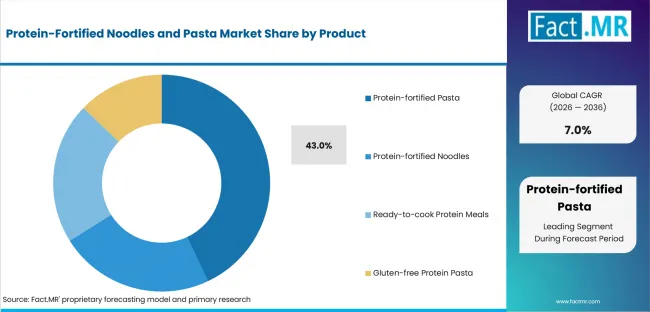
Protein Fortified Noodles And Pasta Market Analysis By Product | Source: Fact.MR
Protein-fortified pasta leads because it adds nutrition to a meal format consumers already understand. Spaghetti, penne, and fusilli fit established sauces; cooking methods; portion habits; and family menus; which lowers the practical cost of trial. Manufacturers can adjust wheat; pea; chickpea; lentil; egg; or dairy protein while preserving a recognizable bite.
What makes Plant Protein the leading Protein Source?
Plant Protein holds 48.0% share in 2026.
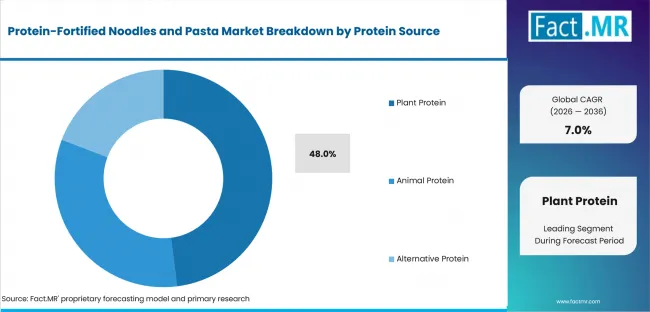
Protein Fortified Noodles And Pasta Market Analysis By Protein Source | Source: Fact.MR
Plant protein provides the widest formulation range across wheat-based and gluten-free products. Pea and wheat proteins can reinforce conventional pasta matrices, while chickpea, lentil; fava bean; soy; and edamame support pulse-forward products with distinct protein and fiber propositions. These inputs also let brands address overlapping high-protein; plant-forward; gluten-free; and clean-label needs.
Why do Supermarkets & Hypermarkets lead Distribution Channel?
Supermarkets & Hypermarkets hold 46.0% share in 2026.
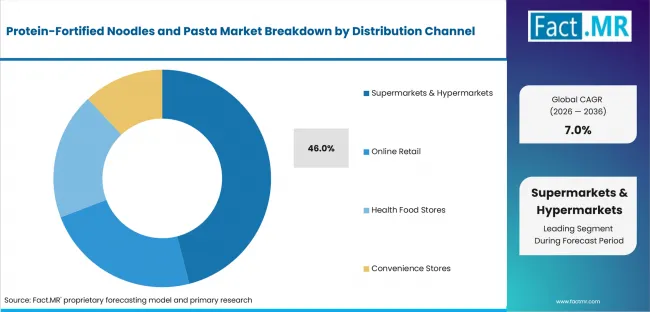
Protein Fortified Noodles And Pasta Market Analysis By Distribution Channel | Source: Fact.MR
Supermarkets and hypermarkets anchor the channel because shoppers can compare protein grams, price per serving, package size; familiar shapes; and cooking instructions beside conventional pasta and gluten-free alternatives. Physical grocery placement supports trial through promotions and repeat purchase through routine shopping trips.
Why do Retail Consumers lead End User?
Retail Consumers hold 58.0% share in 2026.
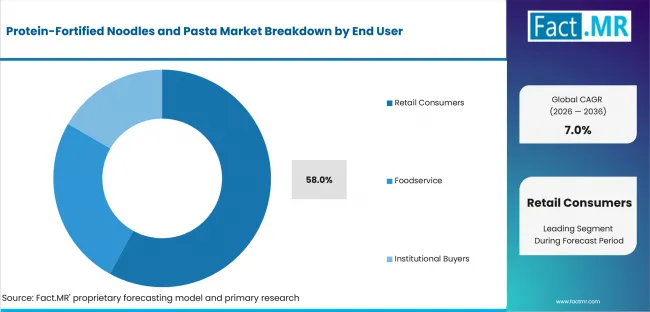
Protein Fortified Noodles And Pasta Market Analysis By End User | Source: Fact.MR
Retail consumers lead because the category scales when a protein-fortified product enters normal pantry rotation. Fitness enthusiasts and health-conscious shoppers create early demand, but broader household revenue depends on products that work for individual meals and family menus without changing preparation habits.
What supports High Protein within Claim?
High Protein holds 51.0% share in 2026.
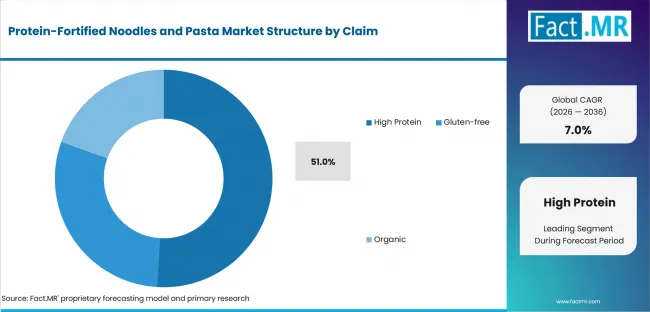
Protein Fortified Noodles And Pasta Market Analysis By Claim | Source: Fact.MR
High Protein leads because it gives shoppers a direct nutrition reason to consider the product and supports simple comparison across brands. Claims tied to 15–20 g or above 20 g of protein serve more specific thresholds, while sports-nutrition positioning remains narrower. Commercial use still depends on meeting the applicable nutrient-content rules in each market. Channel economics connect this demand with the kelp noodles and plant protein ingredients markets.
What is accelerating Protein-Fortified Noodles and Pasta Market adoption, and what is holding it back?
Mainstream protein demand supports adoption, taste and price limit repeat purchase, and hybrid formulations create the clearest route into routine meals.
Drivers Impact Analysis
| DRIVER | QUALITATIVE RELEVANCE | GEOGRAPHIC RELEVANCE | IMPACT TIMELINE |
|---|---|---|---|
| Mainstream protein demand in familiar meal formats | High | USA | Current forecast period |
Source: Fact.MR analysis. Updated Aug 4, 2026
- Mainstream protein demand: Consumers are seeking more protein, but most do not want every eating occasion to resemble a specialist nutrition purchase. The International Food Information Council reported in July 2025 that 35% of Americans had increased protein intake over the prior year and that 56% prioritized protein at dinner. Protein-fortified pasta and noodles translate that intent into a familiar plate.
Opportunity Impact Analysis
| OPPORTUNITY | QUALITATIVE RELEVANCE | GEOGRAPHIC RELEVANCE | IMPACT TIMELINE |
|---|---|---|---|
| Hybrid formulations and convenient meal formats | High | Germany | Current forecast period |
Source: Fact.MR analysis. Updated Aug 4, 2026
- Hybrid formulations: The most credible opportunity is to combine protein density with the sensory cues and convenience of mainstream pasta and noodles. Banza’s April 2026 wheat-and-chickpea launch, Nestlé’s chickpea-flour noodle process, and Chickapea’s one-pot format illustrate three practical routes: hybrid matrices; bitterness control; and meal-level convenience.
Restraints Impact Analysis
| RESTRAINT | QUALITATIVE RELEVANCE | GEOGRAPHIC RELEVANCE | IMPACT TIMELINE |
|---|---|---|---|
| Taste, cooking performance, and price | High | UK | Current forecast period |
Source: Fact.MR analysis. Updated Aug 4, 2026
- Taste and price: The binding restraint appears after nutritional eligibility but before repeat purchase. Taste and price were the two most frequently cited factors in the 2025 protein-source choices reported by the International Food Information Council. High-protein pasta research also shows that added pea, whey, or other proteins can change dough structure and cooking behavior; requiring control of firmness; water uptake; cooking loss; flavor; color; and cost.
Which countries are scaling Protein-Fortified Noodles and Pasta Market fastest?
United Kingdom 7.6%, USA 7.3%, Germany 7.0%; France 6.7%; and Japan 6.4% through 2036.
Regional analysis covers North America, Latin America, Western Europe; Eastern Europe; East Asia; South Asia and Pacific; and the Middle East and Africa.
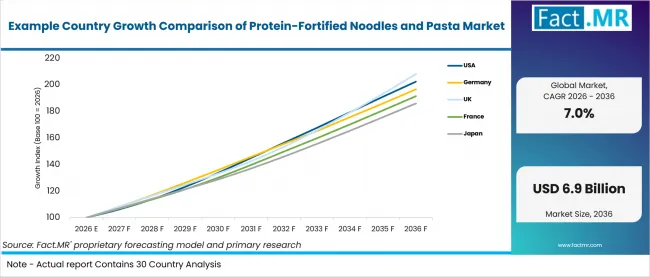
Example Country Growth Comparison Of Protein Fortified Noodles And Pasta Market | Source: Fact.MR
| COUNTRY | CAGR, 2026 to 2036 |
|---|---|
| United Kingdom | 7.6% |
| USA | 7.3% |
| Germany | 7.0% |
| France | 6.7% |
| Japan | 6.4% |
Source: Fact.MR analysis. Updated Aug 4, 2026
What is shaping the United Kingdom's outlook through 2036?
7.6% CAGR through 2036, supported by broad grocery reach and disciplined price architecture.
Large UK grocery chains give the category broad shelf access, but food-store volume volatility keeps shoppers sensitive to price movements and promotional value. Demand is forecast to expand at a 7.6% CAGR from 2026 to 2036 as brands balance protein claims with familiar taste, pack size; and promotional cadence.
What is shaping USA's outlook through 2036?
7.3% CAGR through 2036, driven by protein-seeking households and national grocery distribution.
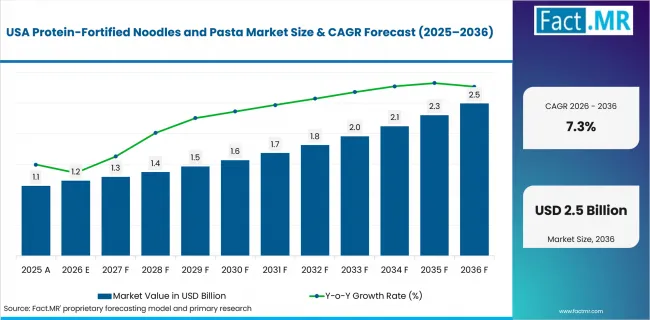
Protein Fortified Noodles And Pasta Market Country Value Analysis | Source: Fact.MR
US households compare protein grams, taste, and price inside routine grocery trips; so familiar shapes and national distribution matter. Manufacturers can use regulated nutrient-content claims to make the benefit visible; but repeat purchase still depends on cooking performance and price per serving. Demand is forecast to rise at 7.3% CAGR through 2036. Ingredient and processing decisions remain relevant to the protein ingredients and sports nutrition ingredient markets.
What is shaping Germany's outlook through 2036?
7.0% CAGR through 2036, supported by plant-forward and whole-grain eating patterns.
German consumers and retailers can connect the category with plant-forward and whole-grain eating patterns, but conventional pasta quality remains the reference point. Sales are projected to expand at a 7.0% CAGR through 2036 as brands improve protein density without compromising bite, cooking tolerance; or ingredient clarity.
What is shaping France's outlook through 2036?
6.7% CAGR through 2036, shaped by legume, whole-grain; and front-of-pack nutrition cues.
French consumers encounter protein pasta within a wider nutrition discussion that includes legumes, whole grains, and Nutri-Score. Demand is forecast to rise at a 6.7% CAGR through 2036; with stronger prospects for products that pair a clear protein message with familiar culinary use and credible ingredient quality.
What is shaping Japan's outlook through 2036?
6.4% CAGR through 2036, supported by localized noodle formats and precise product execution.
Japan offers the strongest commercial fit where protein fortification is adapted to familiar local noodle formats rather than transferred directly from Western pulse-pasta propositions. Sales are projected to expand at a 6.4% CAGR through 2036 as suppliers improve texture, portioning, flavor compatibility; and convenience for domestic retail channels.
Who leads the Protein-Fortified Noodles and Pasta Market?
Barilla Group leads with 16.0% market share, while protein-first specialists and scaled food platforms compete through formulation, retail access; and meal-format innovation.
Barilla Group combines mainstream pasta familiarity with a Protein+ proposition built around durum wheat semolina and pea protein. Banza LLC, Explore Cuisine, The Only Bean; and Chickapea Pasta compete through legume-forward protein credentials and clearer nutrition differentiation. Their commercial challenge is to maintain familiar taste and cooking behavior while supporting a higher-protein message.
Nestlé S.A. and The Hain Celestial Group add broad food-platform and retail infrastructure. Modern Table Meals, Ancient Harvest, and Jovial Foods address complete-protein; specialty; gluten-free; or heritage-grain use cases. Competition through 2036 is expected to focus on claim compliance; sensory quality; convenient formats; and the ability to secure repeat grocery purchase rather than one-time trial.
In April 2026, Banza LLC launched Wheat Protein Pasta and Wheat Protein Mac & Cheese, its first expansion beyond a gluten-free positioning. The semolina-and-chickpea pasta provides 22 g of protein per serving in rotini; penne; and elbows and moved from TikTok Shop into major US grocery chains. Buyer occasions also influence the fortified foods and chickpeas markets.
In February 2026, Chickapea Pasta launched a limited-time three-pack of Creamy Garlic One Pot Pasta Meals at 46 Costco locations in Los Angeles and four in Hawaii. Each serving provides 15 g of protein and 4 g of fiber, is gluten-free; and cooks in less than 12 minutes.
In June 2025, Barilla Group presented its Protein+ proposition as durum wheat semolina pasta fortified with pea protein and offering 20 g of protein per 100 g. The product strategy keeps familiar pasta taste and preparation at the center of the nutrition upgrade.
Which companies are the key providers?
Barilla Group and Banza LLC are leading companies in the market.
- Barilla Group
- Banza LLC
- Modern Table Meals
- Explore Cuisine
- Ancient Harvest
- The Only Bean
- Nestlé S.A.
- The Hain Celestial Group
- Chickapea Pasta
- Jovial Foods
Bibliography
- Electronic Code of Federal Regulations. (2026, July 27). 21 CFR 101.54, Nutrient Content Claims for “Good Source,” “High,” and “More.”
- European Parliament and Council. (2006, December 30). Regulation (EC) No 1924/2006 on Nutrition and Health Claims Made on Foods.
- International Food Information Council. (2025, July 9). IFIC Spotlight Survey: Americans’ Perceptions of Protein.
- Messia, M. C., Cuomo, F., Falasca, L., Trivisonno, M. C., De Arcangelis, E., & Marconi, E. (2021, March 11). Nutritional and Technological Quality of High Protein Pasta.
- German Nutrition Society. (2024, March). Food-Based Dietary Guidelines for Germany.
This Report Addresses
- What is the Protein-Fortified Noodles and Pasta Market worth in 2026, and what value is forecast for 2036?
- Which demand, formulation, purchasing; and operating pressures shape the market?
- Why does Protein-fortified Pasta hold its position within Product?
- How do country growth rates differ across the profiled markets?
- Which companies are profiled, and what determines competitive credibility?
- What scope boundary, evidence base, and methodology support the assessment?
What does the Protein-Fortified Noodles and Pasta Market cover?
Packaged protein-fortified noodles, pasta, ready-to-cook meal kits; and gluten-free protein pasta sold within the defined segmentation universe.
The market covers finished packaged products whose commercial proposition includes added or naturally concentrated protein within noodle or pasta formats. Revenue includes retail products and ready-to-cook protein pasta or noodle meal kits that are sold as part of the Product, Protein Source, Distribution Channel; End User; and Claim framework.
Commercial value comes from the finished protein-fortified format, not from the underlying protein ingredient alone. Products remain in scope when the purchased item is the noodle, pasta; or ready-to-cook meal format rather than a separate powder; sauce; or prepared foodservice meal.
What is included in the scope?
Protein-fortified packaged noodles and pasta across retail, specialty, and convenience-led meal formats.
The scope includes Protein-fortified Pasta, Plant Protein formulations, Supermarkets & Hypermarkets; Retail Consumers; and High Protein claims alongside the approved subsegments. Coverage includes spaghetti; penne; fusilli; pea; soy and wheat protein; modern grocery channels; fitness and health-conscious consumers; families; and the stated protein-claim bands.
What is excluded from the scope?
Conventional non-fortified substitutes, standalone protein ingredients, sauces; and downstream prepared meals are outside the market boundary.
The scope excludes conventional noodles and pasta without a protein-fortified proposition, protein powders sold separately, standalone sauces; restaurant or foodservice meal revenue; and downstream finished meals that are not sold as packaged protein noodle or pasta products. Adjacent food categories are also excluded. Retail execution creates a related demand signal in the plant based protein supplement and fava bean protein for falafel and mezze markets.
How was the analysis built?
- Primary Research
- Structured discussions with manufacturers, protein-ingredient suppliers, distributors; retail category buyers; foodservice and institutional buyers; and food-science specialists examine product scope; pricing; performance; purchase triggers; channel requirements; and adoption frictions.
- Desk Research
- The review covers nutrition-claim regulations, national dietary guidance, public retail and consumption statistics; company filings and product documentation; dated company announcements; and peer-reviewed formulation studies.
- Market-Sizing and Forecasting
- Estimates reconcile product activity, channel presence, company roles; country demand indicators; segment participation; and the stated market values for 2025; 2026; and 2036.
- Data Validation and Update Cycle
- Findings are cross-checked across independent source types and reviewed for consistency with the market definition, segment shares, country CAGRs; company universe; and forecast period.
Segmentation
What is the report’s scope and coverage?
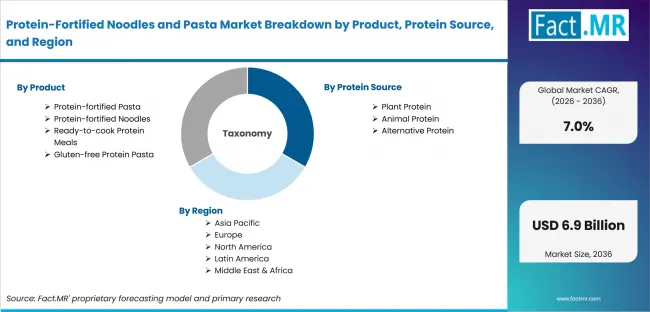
Protein Fortified Noodles And Pasta Market Breakdown By Product, Protein Source, And Region | Source: Fact.MR
| Attribute | Details |
|---|---|
| Quantitative Units | USD Billion in 2026 to USD Billion by 2036 at CAGR |
| Market Definition | Revenue from packaged protein-fortified noodles, pasta, ready-to-cook protein pasta or noodle meal kits; and gluten-free protein pasta sold within the stated segmentation universe. |
| Product | Protein-fortified Pasta; Spaghetti; Penne; Fusilli |
| Protein Source | Plant Protein; Pea Protein; Soy Protein; Wheat Protein |
| Distribution Channel | Supermarkets & Hypermarkets; Hypermarkets; Supermarkets; Modern Grocery Stores |
| End User | Retail Consumers; Fitness Enthusiasts; Health-conscious Consumers; Families |
| Claim | High Protein; 15–20 g Protein; Above 20 g Protein; Sports Nutrition |
| Regions Covered | North America; Latin America; Western Europe; Eastern Europe; East Asia; South Asia and Pacific; Middle East and Africa |
| Countries Covered | USA; Germany; United Kingdom; France; Japan; and more than twenty-five additional countries in the full report |
| Key Companies Profiled | Barilla Group; Banza LLC; Modern Table Meals; Explore Cuisine; Ancient Harvest; The Only Bean; Nestlé S.A.; The Hain Celestial Group; Chickapea Pasta; Jovial Foods |
| Forecast Period | 2026 to 2036 |
| Approach | Hybrid bottom-up and top-down sizing that reconciles company product activity, channel evidence, country demand indicators; segment participation; formulation performance; claim rules; and the defined revenue boundary. |
Source: Fact.MR analysis. Updated Aug 4, 2026
How is the market segmented?
-
By Product
- Protein-fortified Pasta
- Spaghetti
- Penne
- Fusilli
- Protein-fortified Noodles
- Instant Noodles
- Ramen
- Udon
- Ready-to-cook Protein Meals
- Macaroni Meals
- Pasta Meal Kits
- Noodle Meal Kits
- Gluten-free Protein Pasta
- Legume-based Pasta
- Chickpea Pasta
- Lentil Pasta
- Protein-fortified Pasta
-
By Protein Source
- Plant Protein
- Pea Protein
- Soy Protein
- Wheat Protein
- Animal Protein
- Whey Protein
- Egg Protein
- Milk Protein
- Alternative Protein
- Chickpea Protein
- Lentil Protein
- Fava Bean Protein
- Plant Protein
-
By Distribution Channel
- Supermarkets & Hypermarkets
- Hypermarkets
- Supermarkets
- Modern Grocery Stores
- Online Retail
- E-commerce Platforms
- Brand Websites
- Quick Commerce
- Health Food Stores
- Organic Food Stores
- Sports Nutrition Stores
- Specialty Retailers
- Convenience Stores
- Neighborhood Stores
- Mini Markets
- Food Chains
- Supermarkets & Hypermarkets
-
By End User
- Retail Consumers
- Fitness Enthusiasts
- Health-conscious Consumers
- Families
- Foodservice
- Restaurants
- Cafés
- Quick Service Restaurants
- Institutional Buyers
- Schools
- Hospitals
- Corporate Cafeterias
- Retail Consumers
-
By Claim
- High Protein
- 15–20 g Protein
- Above 20 g Protein
- Sports Nutrition
- Gluten-free
- Celiac-friendly
- Rice-based
- Corn-based
- Organic
- USDA Organic
- Non-GMO
- Clean-label
- High Protein
-
By Region
- North America
- Latin America
- Western Europe
- Eastern Europe
- East Asia
- South Asia and Pacific
- Middle East & Africa
Frequently Asked Questions
Which Product leads the Protein-Fortified Noodles and Pasta Market?
Which Protein Source leads the market?
Which Distribution Channel leads the market?
Which End User leads the market?
Which Claim leads the market?
Which country records the highest CAGR in the market?
How does the USA perform in the market?
How does Germany perform in the market?
How does France perform in the market?
How does Japan perform in the market?
What is the primary driver in the market?
What is the main restraint in the market?
Why is Plant Protein important?
Why do Retail Consumers dominate demand?
Who worked on this report


Preview the report firsthand - request a free sample
Free SampleGet the brochure for pricing and purchase details
Download PDF