- Market Value (2025): USD 592.0 Mn
- Estimated Value (2026): USD 540.0 Mn
- Forecast Value (2036): USD 1395.0 Mn
- CAGR (2026-2036): 8.1%
What is the Protein-Fortified Nut and Seed Spreads Market forecast to be worth by 2036?
USD 640.0 million in 2026 to USD 1,395.0 million by 2036 at 8.1% CAGR.
- The protein-fortified nut & seed spreads market reached USD 592.0 million in 2025 as brands tested higher-protein pantry products.
- Demand is projected to increase from USD 640.0 million in 2026 to USD 1,395.0 million by 2036.
- The market is forecast to record 8.1% CAGR from 2026 to 2036 as grocery chains and specialty retailers add spreadable protein formats.
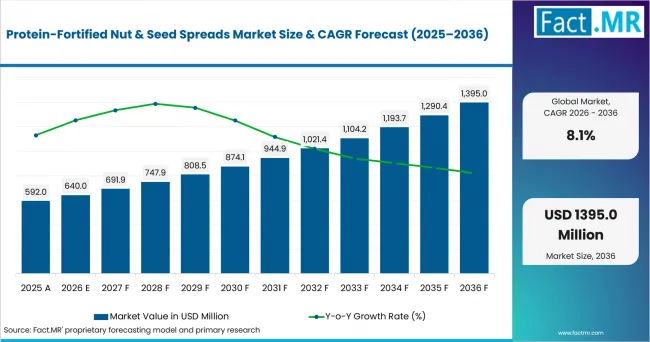
Protein Fortified Nut & Seed Spreads Market Value Analysis | Source: Fact.MR
What are the defining numbers behind Protein-Fortified Nut & Seed Spreads Market growth?
USD 755.0 million absolute opportunity by 2036, led by Peanut, Whey/dairy protein and Grocery & mass distribution.
- Demand Drivers in the Market
- Grocery category teams need protein-rich spreads that fit breakfast and snack occasions without moving shoppers into supplement aisles.
- Sports nutrition retailers benefit from spoonable formats because protein ingredients can move beyond shakes and bars into pantry products.
- High-protein pantry positioning aligns with the USDA and HHS Dietary Guidelines for Americans, 2025–2030. Released in January 2026, the Guidelines recommend prioritizing protein at every meal while emphasizing whole, healthy, nutrient-dense foods.
- Key Segments Analyzed
- By Base: Peanut is expected to hold 38.0% share in 2026 due to familiar taste and broad shelf acceptance.
- By Protein Source: Whey/dairy protein is projected to account for 37.0% share in 2026 owing to clear sports nutrition recognition.
- By Claim: High-protein is anticipated to capture 34.0% share in 2026 since protein grams remain the easiest claim to read quickly.
- By Distribution: Grocery & mass is estimated to represent 39.0% share in 2026 because routine pantry trips remain the main trial route.
- Analyst Opinion at Fact.MR
- Shambhu Nath Jha, Principal Consultant at Fact.MR, states, “Protein-fortified spreads attract attention when the product still behaves like nut butter. The next stage is expected to depend on texture proof across whey, pea and soy systems. Stronger suppliers should combine protein documentation, allergen control and taste work before asking retailers for wider shelf space.”
- Strategic Implications
- Retail category teams should separate everyday protein spreads from dessert-style spreads so the claim stays visible at shelf.
- Brand owners should test peanut and almond bases first, since familiar flavor lowers the risk of premium trial.
- Protein suppliers should document allergen handling carefully. FDA’s January 2025 allergen Q&A guidance covers nine major food allergens. The named allergens include milk and sesame alongside tree nuts, peanuts and soybeans.
- Investors should distinguish branded fortified spreads from commodity peanut butter because claim depth changes margins and promotional spending.
Australia is projected to post 9.8% CAGR through 2036 due to online grocery trial. The United States is expected to record 9.4% CAGR as peanut supply supports mass retail. Canada is forecast to advance at 9.2% CAGR due to packaged pantry buying. The United Kingdom is anticipated to reach 8.9% CAGR as online food and sports nutrition channels support niche discovery. The Netherlands is estimated to record 8.7% CAGR owing to supermarket turnover and online retail reach. Germany is projected to post 7.5% CAGR as healthy-food interest meets price-sensitive grocery behavior.
How does the Protein-Fortified Nut & Seed Spreads Market break down by segment?
Peanut leads at 38.0%; Whey/dairy protein leads at 37.0%.
Which base dominates?
Peanut holds 38.0% share in 2026.
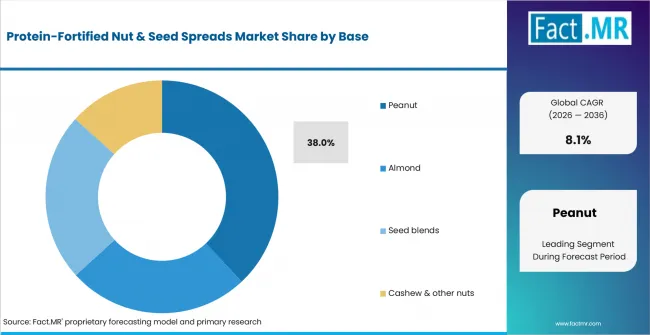
Protein Fortified Nut & Seed Spreads Market Analysis By Base | Source: Fact.MR
Peanut is expected to lead the Base segment because shoppers already read peanut butter as a protein food. Almond follows as a premium base with a milder taste. Comparisons with seed butter are relevant for allergy-aware and plant-forward brands. USDA NASS reported in August 2025 that peanut stocks in commercial storage totaled 1.56 billion pounds on July 31, 2025.
What leads the Protein Source segment?
Whey/dairy protein leads with 37.0% share in 2026.
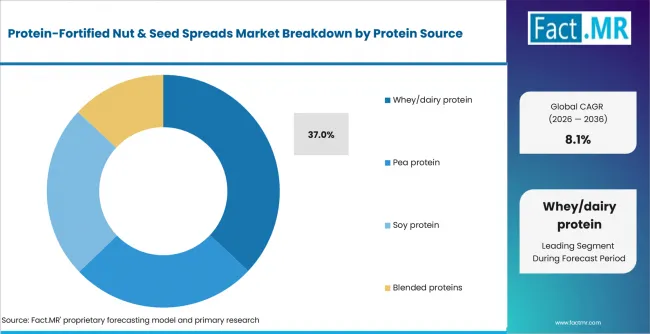
Protein Fortified Nut & Seed Spreads Market Analysis By Protein Source | Source: Fact.MR
Dairy formats using whey protein concentrates are projected to lead Protein Source because sports nutrition shoppers recognize dairy protein quality. Pea protein follows where plant protein ingredients support vegan formulas. Soy protein supports cost control in value formulas. Blended proteins help formulators balance taste and mouthfeel when one protein source thickens the spread too much.
How does Claim shape demand?
High-protein captures 34.0% share in 2026.
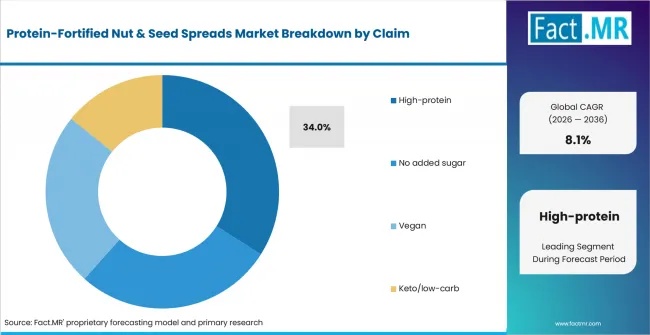
Protein Fortified Nut & Seed Spreads Market Analysis By Claim | Source: Fact.MR
High-protein is anticipated to lead the Claim segment since the claim is direct and easy to compare across jars. No added sugar helps fortified spreads avoid dessert-style comparison. Recipes with protein flavor masking gain relevance when extra protein creates bitterness. Keto/low-carb formats remain more selective because fat profile and sweetness control must work together.
What supports Grocery & mass within Distribution?
Grocery & mass represents 39.0% share in 2026.
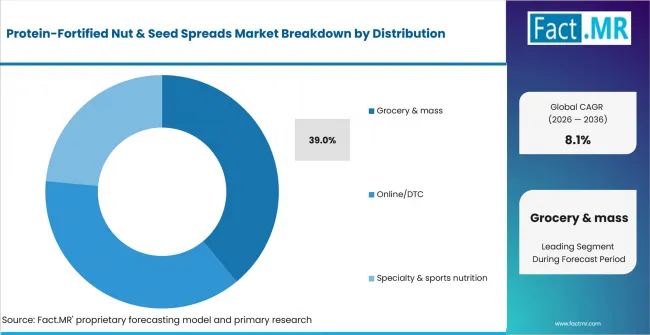
Protein Fortified Nut & Seed Spreads Market Analysis By Distribution | Source: Fact.MR
Grocery & mass is estimated to lead Distribution because shoppers discover spreads during routine pantry trips. Online and DTC channels support flavor testing and subscriptions. Specialty and sports nutrition stores remain useful for higher-protein or vegan formulas. Retailers are expected to favor brands that explain protein grams without pushing jars into a supplement-only shelf.
What is accelerating Protein-Fortified Nut & Seed Spreads Market adoption, and what is holding it back?
Protein-led pantry use drives it; allergen and texture complexity restrains it.
Drivers Impact Analysis
| DRIVER | (~) % IMPACT ON CAGR | GEOGRAPHIC RELEVANCE | IMPACT TIMELINE |
|---|---|---|---|
| Pantry protein reformulation | +2.4% | United States, Canada, Australia | Short term (<= 2 years) |
| Grocery shelf testing | +1.9% | North America and Europe | Short term (<= 2 years) |
| No-added-sugar claims | +1.5% | United Kingdom, Germany, Netherlands | Medium term (2-4 years) |
| Protein source diversification | +1.3% | Global formulation hubs | Medium term (2-4 years) |
| Online trial packs | +1.0% | Australia, United Kingdom, Canada | Long term (>= 4 years) |
Source: Fact.MR analysis. Updated Aug 17, 2026
- Pantry protein reformulation: Familiar nut butter gives brands a simple route into everyday protein use. Peanut and almond bases keep the taste cue clear. The main task is balancing protein grams with spreadability.
- Grocery shelf testing: Retailers are projected to test jars that combine protein, no added sugar and recognizable ingredients. The format is expected to work best beside mainstream spreads, where shoppers already compare texture and price.
- No-added-sugar claims: High-protein positioning works better when sugar levels stay controlled. Brands use this claim to keep the nutrition message credible across the United Kingdom, Germany and Canada.
- Protein source diversification: Whey, pea, soy and blended proteins give formulators several cost and label routes. Blends are anticipated to help where one protein creates grainy texture or flavor drift.
- Online trial packs: DTC brands are expected to use sachets and variety packs to reduce trial risk. Reviews then shape retail listing discussions and repeat-purchase choices.
Opportunity Impact Analysis
| OPPORTUNITY | (~) % IMPACT ON CAGR | GEOGRAPHIC RELEVANCE | IMPACT TIMELINE |
|---|---|---|---|
| Single-serve packets | +1.2% | United States and United Kingdom | Medium term (2-4 years) |
| Whey and pea blends | +1.0% | North America and Europe | Medium term (2-4 years) |
| Sports nutrition retail | +0.8% | United States, Australia, Germany | Long term (>= 4 years) |
| Allergen documentation services | +0.6% | Regulated grocery markets | Long term (>= 4 years) |
Source: Fact.MR analysis. Updated Aug 17, 2026
- Single-serve packets: Portable packs fit gym bags, school lunches and office snacks. The format is expected to work best when the protein claim remains prominent and the serving size is easy to understand.
- Whey and pea blends: Blended proteins are expected to soften flavor problems in heavily fortified spreads. Brands are anticipated to use blends where taste and label targets must work together.
- Sports nutrition retail: Specialty stores are expected to explain protein grams and source differences better than mainstream shelves. Grocery placement remains necessary after plant-based supplements shoppers start comparing spreads with powders and bars.
- Allergen documentation services: Nut, seed, dairy and soy inputs create a demanding label-control environment. Documentation support is expected to gain value as fortified recipes use more protein systems.
Restraints Impact Analysis
| RESTRAINT | (~) % IMPACT ON CAGR | GEOGRAPHIC RELEVANCE | IMPACT TIMELINE |
|---|---|---|---|
| Nut cost variability | -1.1% | United States, Australia, Europe | Short term (<= 2 years) |
| Allergen labelling complexity | -0.9% | North America and Europe | Short term (<= 2 years) |
| Texture and taste tradeoffs | -0.7% | Global formulation hubs | Medium term (2-4 years) |
| Sugar and fat perception | -0.5% | Mass grocery channels | Long term (>= 4 years) |
Source: Fact.MR analysis. Updated Aug 17, 2026
- Nut cost variability: Peanut, almond and cashew inputs expose brands to crop and freight shifts. Brands are expected to protect margins through pack-size control and promotions.
- Allergen labelling complexity: The category carries peanut, tree nut, dairy and soy risks. Retailers are expected to require clear cross-contact controls before accepting more fortified variants.
- Texture and taste tradeoffs: Extra protein is expected to thicken the spread and leave a dry finish. Formulators are expected to reject recipes that meet protein targets but lose spoonability.
- Sugar and fat perception: Nut spreads naturally contain fat, while flavor systems are expected to add sugar in some recipes. Shoppers often question fortified spreads when the label does not explain portion size.
Which countries are scaling Protein-Fortified Nut & Seed Spreads Market fastest?
- The country comparison spans 2.30 percentage points and forms three practical growth bands across the forecast period.
- Australia remains 0.40 percentage point above the United States through online grocery trial and premium health-food retail.
- The United States remains 0.19 percentage point above Canada through peanut supply scale, familiar pantry behavior and mass retail reach.
- Canada remains 0.33 percentage point above the United Kingdom through packaged pantry buying and supermarket recovery.
- The United Kingdom remains 0.15 percentage point above the Netherlands through online food-store activity, specialty nutrition channels and claim-led snacking.
- The Netherlands remains 1.23 percentage points above Germany through supermarket turnover, online retail reach and dense grocery networks.
- Germany closes the displayed range through health-focused food choices, high-protein positioning and disciplined retail pricing.
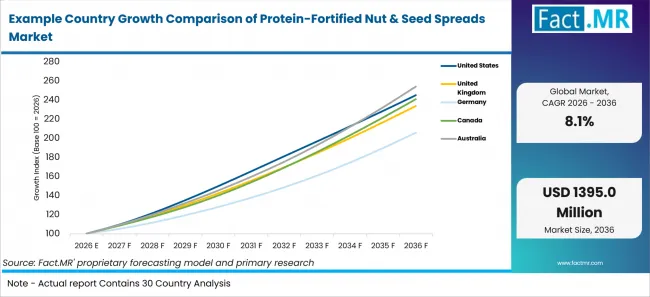
Example Country Growth Comparison Of Protein Fortified Nut & Seed Spreads Market | Source: Fact.MR
Comparable CAGRs can create different entry conditions due to grocery-channel structure, protein-claim acceptance, pricing pressure and online retail reach. Full report coverage includes North America, Europe, South Asia and Pacific, and Oceania.
| Country | CAGR (2026-2036) |
|---|---|
| Australia | 9.8% |
| United States | 9.4% |
| Canada | 9.2% |
| United Kingdom | 8.9% |
| Netherlands | 8.7% |
| Germany | 7.5% |
Source: Fact.MR analysis. Updated Aug 17, 2026
What supports Australia adoption?
9.8% CAGR, supported by online grocery trial and premium health-food retail.
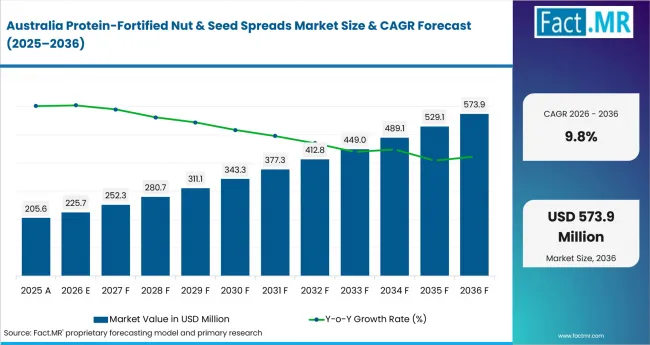
Protein Fortified Nut & Seed Spreads Market Country Value Analysis | Source: Fact.MR
Australia’s growth reflects a market where specialty pantry brands are expected to test premium jars before seeking broader grocery listings. ABS reported in May 2025 that food online sales reached AUD 1,402.1 million in April 2025.
What supports United States adoption?
9.4% CAGR, backed by peanut supply scale and mass retail reach.
The United States has the clearest fit between peanut-based spreads and everyday pantry behavior. Grocery buyers are expected to compare fortified jars with mainstream peanut butter before approving larger facings. Brands that use familiar flavor, smooth texture and simple protein claims are better placed to move from DTC tests into mass retail.
How is Canada scaling demand?
9.2% CAGR, driven by packaged pantry buying and supermarket recovery.
Canada’s growth is tied to value-aware grocery behavior and repeat pantry use. Statistics Canada reported in September 2025 that sales of packaged food dry goods rose 6.1% year over year in June 2025.
How is the United Kingdom developing demand?
8.9% CAGR, supported by online food-store activity and claim-led snacking.
The United Kingdom is expected to benefit from online discovery and specialty nutrition channels. Smaller brands are expected to introduce peanut, almond and plant-protein spreads before negotiating broader supermarket listings. No-added-sugar claims are anticipated to help fortified spreads avoid direct comparison with dessert spreads.
What supports Netherlands growth?
8.7% CAGR, supported by supermarket turnover and online retail reach.
Netherlands growth reflects a dense grocery network and high private-label pressure. CBS reported in November 2025 that retail turnover was 3.8% higher year over year in September 2025. Fortified-spread brands are expected to compete on clear protein value. CBS retail data provide broad grocery and online-channel context but do not measure switching between branded and private-label protein-fortified spreads.
How does Germany perform?
7.5% CAGR, led by health-focused food choice and disciplined retail pricing.
Germany has a useful consumer base for high-protein and plant-forward claims, but premium pricing remains a restraint. BMLEH’s November 2025 Ernährungsreport found that 90% of respondents said it was very important or important that their food is healthy. Retailers are expected to favor formulas that combine nutrition claims with familiar texture and careful allergen
Who leads the Protein-Fortified Nut & Seed Spreads Market?
Hormel Foods Corporation — SKIPPY and Once Again Nut Butter show the clearest branded spread relevance, while Nuts ’N More and American Dream Nut Butter strengthen the protein-forward competitive landscape.
Hormel Foods contributes established peanut-butter scale through SKIPPY, while Once Again Nut Butter adds natural nut-butter positioning. Nuts ’N More and American Dream Nut Butter extend the field toward higher-protein and specialty spread formats. Pintola and MYFITNESS broaden the provider set through nutrition-oriented nut-butter positioning and direct-to-consumer relevance.
Which companies are the key providers?
Key companies include Hormel Foods Corporation — SKIPPY; Once Again Nut Butter; Nuts 'N More; American Dream Nut Butter; Pintola; and MYFITNESS.
- Hormel Foods Corporation — SKIPPY
- Once Again Nut Butter
- Nuts 'N More
- American Dream Nut Butter
- Pintola
- MYFITNESS
Bibliography
- Australian Bureau of Statistics. (2025, May 30). Retail Trade, Australia, April 2025.
- Bundesministerium für Landwirtschaft, Ernährung und Heimat. (2025, November 27). Deutschland, wie es isst – der BMLEH-Ernährungsreport 2025.
- U.S. Food and Drug Administration. (2025, January). Guidance for industry: Questions and answers regarding food allergen labeling (Edition 5).
- Hormel Foods Corporation. (2025, August 13). SKIPPY® Crushin’ It Tour celebrates student hustle with peanut butter on college campuses.
- Statistics Canada. (2025, September 8). Retail Commodity Survey, June 2025.
- U.S. Department of Agriculture, & U.S. Department of Health and Human Services. (2026, January 7). Dietary Guidelines for Americans, 2025–2030.
- U.S. Department of Agriculture, National Agricultural Statistics Service. (2025, August 26). Peanut Stocks and Processing.
This Report Answers
- The report provides strategic intelligence on the Protein-Fortified Nut & Seed Spreads Market across Base and Protein Source choices that shape formulation, texture and retail positioning.
- Segment analysis covers Peanut and Whey/dairy protein as the leading categories, alongside High-protein claims and Grocery & mass distribution.
- Country outlook evaluates Australia and the United States alongside Canada and the United Kingdom. The Netherlands and Germany complete the growth comparison across profiled markets.
- Competitive analysis profiles Hormel Foods Corporation — SKIPPY and Once Again Nut Butter alongside Nuts ’N More and American Dream Nut Butter. Pintola and MYFITNESS complete the provider set.
- Claim and channel assessment covers High-protein, No added sugar, Vegan and Keto/low-carb positioning alongside Grocery & mass, Online/DTC, and Specialty & sports nutrition distribution.
What does the Protein-Fortified Nut & Seed Spreads Market cover?
Protein-fortified nut and seed spreads cover finished products where added protein is central to the claim. The market includes peanut, almond, seed-blend and cashew-based products.
The scope is adjacent to finished spreads when nut and seed bases define the product form. Seed-led formulations are included only where protein fortification changes the claim. Ingredient choices are covered when pea, soy, whey or blended systems shape spread texture.
What is included in the scope?
The scope includes retail-ready and DTC-ready jars, sachets and packets where protein fortification is explicit. Peanut, almond, seed blends and cashew-based spreads are included.
Related formulation intelligence includes source selection where it affects nutrition claims. Vegan claim planning is linked with plant-based protein supplements when shoppers compare spreads with powders and bars.
What is excluded from the scope?
Standard peanut butter without added protein is excluded unless it carries an explicit fortified formulation. Chocolate spreads, jams and dessert toppings are excluded when protein is not central.
Adjacent products such as non-dairy toppings are excluded unless the product is a nut or seed spread. General healthy snacks are excluded when spread format and protein fortification are not both present.
How Was the Analysis Built?
The analysis draws on 120+ sources, 35+ company portfolios, 25+ countries, and more than 20 industry interviews.
- Primary Research: Primary research includes discussions with manufacturers, service providers, technology developers, distributors, end users, procurement teams, and subject-matter experts. These conversations examine purchasing priorities, product adoption, operational challenges, approval requirements, competitive positioning, and the factors that influence wider market acceptance.
- Desk Research: Desk research covers government statistics, regulatory publications, company filings, trade data, technical studies, industry associations, standards, public policy, and other authoritative sources. Every source used in the analysis is documented in the bibliography.
- Market Sizing and Forecasting: Market estimates combine historical performance, demand indicators, pricing and volume trends, segment shares, company participation, country-level growth, adoption patterns, investment activity, and barriers to market expansion.
- Data Validation and Update Cycle: Findings are validated by comparing primary interviews with public data, company activity, regulatory changes, trade patterns, and industry developments. Regular updates review new product launches, capacity changes, partnerships, approvals, procurement trends, and shifts in commercial adoption.
Segmentation
What is the report’s scope and coverage?
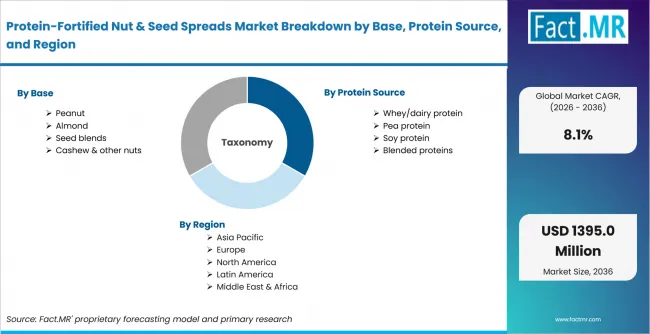
Protein Fortified Nut & Seed Spreads Market Breakdown By Base, Protein Source, And Region | Source: Fact.MR
| Attribute | Details |
|---|---|
| Quantitative Units | USD million |
| Market Definition | Finished nut and seed spreads where added whey, dairy, pea, soy or blended protein is central to the claim and product positioning |
| Base | Peanut; Almond; Seed blends; Cashew and other nuts |
| Protein Source | Whey/dairy protein; Pea protein; Soy protein; Blended proteins |
| Claim | High-protein; No added sugar; Vegan; Keto/low-carb |
| Distribution | Grocery and mass; Online/DTC; Specialty and sports nutrition |
| Regions Covered | North America; Europe; South Asia and Pacific; Oceania |
| Countries Covered | Australia; United States; Canada; United Kingdom; Netherlands; Germany |
| Key Companies Profiled | Hormel Foods Corporation — SKIPPY; Once Again Nut Butter; Nuts 'N More; American Dream Nut Butter; Pintola; and MYFITNESS |
| Forecast Period | 2026 to 2036 |
| Approach | Hybrid top-down and bottom-up approach using spread category behavior; protein-claim adoption; nut and seed base availability; grocery and online channel roles; allergen control; texture requirements; country adoption patterns and company portfolio review |
Source: Fact.MR analysis. Updated Aug 17, 2026
How is the market segmented?
-
By Base:
- Peanut
- Almond
- Seed blends
- Cashew and other nuts
-
By Protein Source:
- Whey/dairy protein
- Pea protein
- Soy protein
- Blended proteins
-
By Claim:
- High-protein
- No added sugar
- Vegan
- Keto/low-carb
-
By Distribution:
- Grocery and mass
- Online/DTC
- Specialty and sports nutrition
-
By Region:
- North America
- Latin America
- Europe
- East Asia
- South Asia and Oceania
- Middle East and Africa
Frequently Asked Questions
How big is the protein-fortified nut & seed spreads market in 2026?
What is the CAGR of the protein-fortified nut & seed spreads market from 2026 to 2036?
Which base leads the protein-fortified nut & seed spreads market?
Which protein source leads the protein-fortified nut & seed spreads market?
Who are the leading companies in the protein-fortified nut & seed spreads market?
Who worked on this report


Preview the report firsthand - request a free sample
Free SampleGet the brochure for pricing and purchase details
Download PDF