- Market Value (2025): USD 3.88 Bn
- Estimated Value (2026): USD 4.29 Bn
- Forecast Value (2036): USD 11.6 Bn
- CAGR (2026-2036): 10.5%
What is the Fingerprint Door Locks Market forecast to be worth by 2036?
USD 4.3 billion in 2026 to USD 11.6 billion by 2036 at a 10.5% CAGR.
- Fingerprint door lock revenue was valued at USD 3.88 billion in 2025.
- The market is expected to reach from USD 4.29 billion in 2026 to USD 11.6 billion by 2036 as buyers increasingly consider biometric entry when replacing door hardware.
- The forecast for 2026 to 2036 indicates a 10.5% CAGR, reflecting demand for fingerprint recognition alongside established access methods.
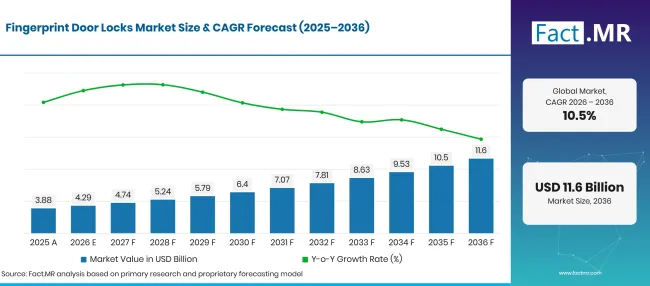
Fingerprint Door Locks Market Forecast Global | Source: Fact.MR
| Year | Basis | Market Value (USD billion) |
|---|---|---|
| 2025 | Actual | 3.88 |
| 2026 | Estimate | 4.29 |
| 2036 | Forecast | 11.6 |
| CAGR 2026 to 2036 | Forecast period | 10.5% |
Source: Fact.MR analysis. Updated Nov 3, 2026
What are the defining numbers behind Fingerprint Door Locks Market growth?
USD 7.3 billion absolute opportunity by 2036; capacitive sensors and offline retail remain central to the 2026 mix.
- Demand Drivers in the Market
- Homeowners seek a door lock that recognizes household members without requiring a carried key. Fingerprint access shortens routine entry while a PIN or mechanical override offers another way inside when a sensor cannot be used.
- Apartment operators value managed access where tenants and building staff need different permissions. The decision depends on straightforward credential removal when occupancy changes, together with dependable local operation during an internet outage.
- Installers increasingly consider the complete lockset rather than the fingerprint reader alone. Door thickness, latch fit, emergency power and warranty service decide whether a fingerprint product is practical for an existing entrance.
- Security teams want product claims they can test. Recognition performance, local credential handling and tamper alarms affect acceptance more directly than a long list of connected features.
- Key Segments Analyzed
- By Product Type: Capacitive recognition accounts for 47.6% of 2026 revenue, reflecting its compact sensor format and familiar use in biometric devices.
- By Application: Residential premises represent 38.4% of 2026 revenue as consumers replace mechanical entrance locks with fingerprint-enabled models.
- By Distribution Channel: Offline stores lead with 57.3% of 2026 revenue because shoppers often want to inspect the lock and confirm installation support.
- By End-User: Individual purchasers capture 54.3% of 2026 sales, while enterprises evaluate permissions and fleet-level maintenance.
- Analyst Opinion at Fact.MR
- Shambhu Nath Jha, Principal Consultant at Fact.MR, states, “A fingerprint lock must work consistently at the entrance, not only during a showroom demonstration. Households need dependable recognition and a backup opening method that is easy to understand. Installers also need a lock that fits the existing door and can be serviced locally.”
- Strategic Implications
- Lock manufacturers can explain fingerprint enrollment, emergency entry and battery replacement in plain language for household users.
- Installers need to confirm door compatibility and account for fitting work before recommending a particular lock body.
- Retailers benefit from giving shoppers a clear comparison of fingerprint capacity, alternative entry methods and after-sales support.
- Property operators can define who may enroll or remove fingerprints and how access rights are managed when users leave.
Germany is forecast to record a 12.1% CAGR through 2036, ahead of Brazil at 11.0%. The USA follows at 10.0%, with the UK at 8.9% and Japan at 7.9%. Housing turnover, installation practices and interest in connected home devices influence demand in each country.
How does the Fingerprint Door Locks Market break down by segment?
Capacitive 47.6%; Residential 38.4%; Offline Stores 57.3%; Individual 54.3% in 2026.
Which Product Type dominates?
Capacitive sensors account for 47.6% of 2026 revenue.
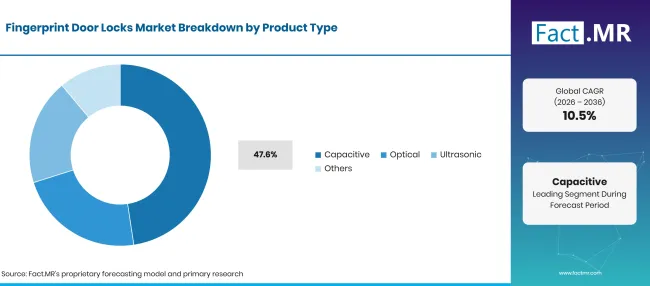
Fingerprint Door Locks Market Breakdown Product Type | Source: Fact.MR
| Product Type | Share (2026) |
|---|---|
| Capacitive (Leading segment) | 47.6% |
| Other segments combined | 52.4% |
| Total | 100.0% |
Source: Fact.MR analysis. Updated Nov 3, 2026
Capacitive sensors allow manufacturers to fit fingerprint recognition into a compact handle or external reader. Optical and ultrasonic systems use different methods to read a finger, creating choices in cost, performance and equipment size. Buyers must also consider enrollment controls, physical lock strength and alternative entry methods. Sensor technology is one part of a complete door-security product, rather than a substitute for sound lock construction.
What leads Application demand?
Residential installations hold 38.4% of 2026 value.
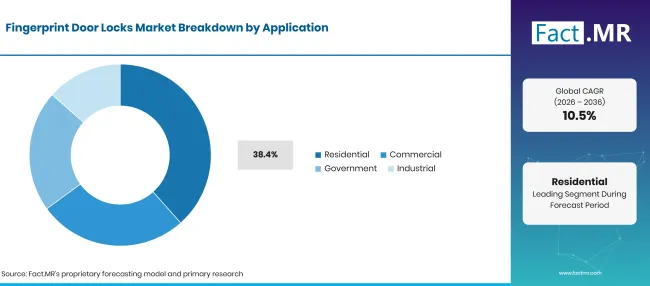
Fingerprint Door Locks Market Breakdown Application | Source: Fact.MR
| Application | Share (2026) |
|---|---|
| Residential (Leading segment) | 38.4% |
| Other segments combined | 61.6% |
| Total | 100.0% |
Source: Fact.MR analysis. Updated Nov 3, 2026
Homeowners often consider fingerprint access during an entrance renovation or when several family members need convenient entry. Rental apartments introduce the added task of removing access rights when occupants change. Commercial buildings may require shared credential management, while industrial and government sites often place greater weight on controlled enrollment and hardware durability.
How do Distribution Channels shape purchases?
Offline Stores represent 57.3% of 2026 sales.
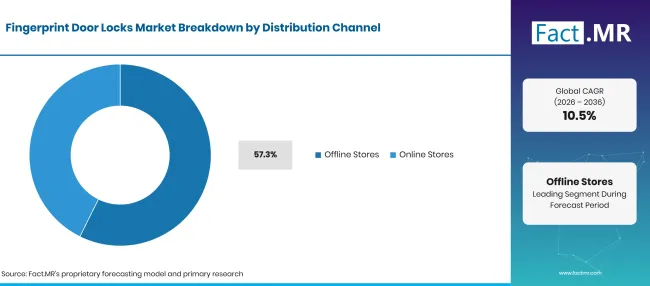
Fingerprint Door Locks Market Breakdown Distribution Channel | Source: Fact.MR
| Distribution Channel | Share (2026) |
|---|---|
| Offline Stores (Leading segment) | 57.3% |
| Other segments combined | 42.7% |
| Total | 100.0% |
Source: Fact.MR analysis. Updated Nov 3, 2026
Hardware stores and locksmiths let customers examine a handle and discuss door measurements before choosing a fingerprint lock. They can also explain battery replacement, emergency keys and warranty support. Online channels make model comparisons easier, particularly for buyers who know the dimensions of their existing lock. Installation advice remains valuable when the product must fit an older or unusual door.
Which End-User group accounts for more sales?
Individual purchasers contribute 54.3% in 2026.
| End-User | Share (2026) |
|---|---|
| Individual (Leading segment) | 54.3% |
| Other segments combined | 45.7% |
| Total | 100.0% |
Source: Fact.MR analysis. Updated Nov 3, 2026
Households usually assess fingerprint locks one entrance at a time, comparing the handle, enrollment steps and backup access. Businesses may need to manage many doors and remove employee permissions across a wider property. That makes consistent hardware, administrator controls and replacement-part availability increasingly important as the number of installations grows.
What is accelerating Fingerprint Door Locks Market adoption, and what is holding it back?
Household entry convenience supports adoption; fitting costs and reliable authentication remain purchase barriers.
Drivers Impact Analysis
| DRIVER | (~) % IMPACT ON CAGR | GEOGRAPHIC RELEVANCE | IMPACT TIMELINE |
|---|---|---|---|
| Household interest in keyless entry | +1.3% | Global | Short term |
| Fingerprints paired with fallback access | +0.9% | Global | Medium term |
| Replacement of entrance hardware | +0.7% | Europe; North America | Medium term |
| Installer and retail demonstrations | +0.5% | Global | Short term |
Source: Fact.MR analysis. Updated Nov 3, 2026
Opportunity Impact Analysis
| OPPORTUNITY | (~) % IMPACT ON CAGR | GEOGRAPHIC RELEVANCE | IMPACT TIMELINE |
|---|---|---|---|
| Compatible add-on fingerprint keypads | +0.7% | Global | Short term |
| Apartment access lifecycle management | +0.5% | Urban markets | Medium term |
| Locally operated fingerprint entry | +0.4% | Global | Medium term |
Source: Fact.MR analysis. Updated Nov 3, 2026
Restraints Impact Analysis
| RESTRAINT | (~) % IMPACT ON CAGR | GEOGRAPHIC RELEVANCE | IMPACT TIMELINE |
|---|---|---|---|
| Door fitting and installation expense | -0.6% | Global | Short term |
| Authentication errors and fallback needs | -0.5% | Global | Medium term |
| Cybersecurity and credential handling | -0.3% | Connected-lock markets | Long term |
Source: Fact.MR analysis. Updated Nov 3, 2026
Which countries are scaling the Fingerprint Door Locks Market through 2036?
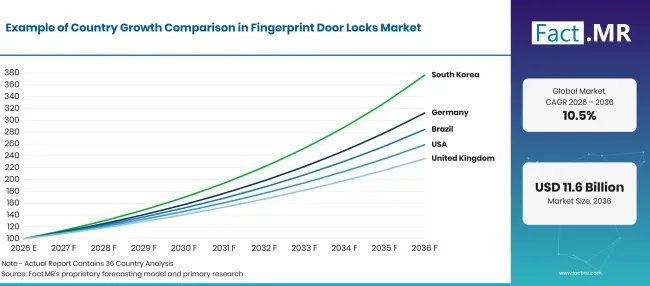
Fingerprint Door Locks Market Growth Index | Source: Fact.MR
| Country | CAGR (2026 to 2036) |
|---|---|
| Germany | 12.1% |
| Brazil | 11.0% |
| USA | 10.0% |
| UK | 8.9% |
| Japan | 7.9% |
Source: Fact.MR analysis. Updated Nov 3, 2026
How is Germany developing fingerprint door lock demand?
12.1% CAGR, retrofit suitability and physical lock quality shape demand.
German fingerprint lock purchases are shaped by existing door hardware and the value placed on dependable mechanical operation. Professional fitting creates an option for households seeking keyless entry without changing the entire door. In a 2026 release, Destatis reported 206,586 dwellings completed in 2025 [1]. Destatis reported an 18.0% decline in completed dwellings for 2025 [2]. Installation charges and enrollment arrangements in rented housing add further purchase considerations.
How is Brazil developing fingerprint door lock demand?
11.0% CAGR, digital familiarity and local retail service support upgrades.
Brazilian household access is becoming more connected, which creates an opening for fingerprint-enabled residential locks. In July 2026, IBGE reported that 95.0% of Brazilian households had internet access in 2025 [3]. The same release recorded 15.4 million connected households with at least one smart device in 2025 [5]. Both trends describe the wider setting for connected home products, although fingerprint authentication can work locally without internet access. IBGE also found that 25.9% of households without internet in 2025 identified access cost as their main obstacle.
How is USA developing fingerprint door lock demand?
10.0% CAGR, single-family replacement and product support shape sales.
US customers compare fingerprint recognition against familiar deadbolts and keypad locks before upgrading an entrance. The U.S. Census Bureau reported in October 2026 that privately owned housing starts were running at an annual rate of 1,221,000 units in September [6]. The same Census release reported a 7.4% year-on-year decline in September starts.
How is UK developing fingerprint door lock demand?
8.9% CAGR, specialist fitting and retail comparisons define replacement demand.
UK fingerprint door lock purchases depend heavily on existing door construction and the availability of a reliable fitting service. The Ministry of Housing reported 208,600 net additional dwellings in England during 2024–25 [4]. The same government release recorded a 6% fall in England’s net additional dwellings.
How is Japan developing fingerprint door lock demand?
7.9% CAGR, compact entrances and dependable local operation influence selection.
Japanese fingerprint door lock selection is shaped by compact residential entrances and careful attention to everyday reliability. Users need a reader positioned where it is easy to reach without interfering with the handle or frame. Apartments add a separate requirement because building managers must be able to remove a former resident’s access.
Who leads the Fingerprint Door Locks Market?
The fingerprint lock market contains traditional access-hardware makers and biometric equipment specialists. ASSA ABLOY sells fingerprint-capable Yale products and accessories, while dormakaba offers door lock products that combine fingerprint entry with other approved methods.
Allegion has fingerprint-enabled Schlage models in parts of Asia even though its US residential catalogue differs. ZKTeco and ADEL have also marketed fingerprint access equipment. Anviz operates in biometric access technology, so its inclusion should be understood through biometric entry solutions rather than a verified current standalone household fingerprint lock range. dependable fitting instructions and clear fingerprint administration are central to supplier comparisons.
Competition depends on the complete entrance solution. Door construction and fitting support can separate a usable product from an attractive catalogue picture. A manufacturer with strong electronic credentials still has to deliver a lock body suited to the installation. For organizational accounts, the quality of credential management can outweigh the visual design.
Which companies are the key providers?
Key companies include ASSA ABLOY AB; dormakaba Holding AG; Allegion plc; ZKTeco Co., Ltd.; ADEL Smart Lock; Anviz Global Inc.
- ASSA ABLOY AB
- dormakaba Holding AG
- Allegion plc
- ZKTeco Co., Ltd.
- ADEL Smart Lock
- Anviz Global Inc.
Bibliography
- [1] Statistisches Bundesamt (Destatis). (2026, May 22). Construction work completed.
- [2] Statistisches Bundesamt (Destatis). (2026, May 22). 18,0 % weniger fertiggestellte Wohnungen im Jahr 2025
- [3] Sousa, M. F., & Brito, R. (2026, July 2). Internet chega a 95% de domicílios do país em 2025. Instituto Brasileiro de Geografia e Estatística
- [4] Ministry of Housing, Communities and Local Government. (2025, November 20). Housing supply: Net additional dwellings, England: 2024 to 2025
- [5] Sousa, M. F., & Brito, R. (2026, July 2). Internet chega a 95% de domicílios do país em 2025. Instituto Brasileiro de Geografia e Estatística
- [6] U.S. Census Bureau. (2026, October 20). Monthly new residential construction, September 2026.
This Report Answers
- The report compares the fingerprint-sensing formats used in entrance locks and explains their practical differences.
- The distribution review explains how fitting advice and product availability influence store and online purchases.
- Country profiles examine the link between installed door stock, replacement activity and biometric entry requirements.
- The competitive discussion distinguishes fingerprint-equipped lock ranges from broader electronic access portfolios.
What does the Fingerprint Door Locks Market cover?
The market covers complete fingerprint-enabled door locks sold for household and organizational entrances. Devices can combine biometric recognition with PIN access, keys or other authorized entry methods. Revenue relates to the door locking product rather than a stand-alone identity verification system.
What is included in the scope?
Capacitive, optical and ultrasonic fingerprint lock designs are included when a fingerprint sensor forms part of an entrance locking solution. Offline and online sales channels are included. The end users consist of individuals and enterprises across the listed applications.
What is excluded from the scope?
Pure software access-management services and fingerprint attendance terminals are outside this market when they are sold without a door-lock product. Mechanical locks lacking fingerprint recognition are also excluded, along with standalone access readers used without an integrated locking device.
How Was the Analysis Built?
The analysis draws on 120+ sources, 35+ company portfolios, 25+ countries, and more than 20 industry interviews.
- Primary Research: Primary research includes discussions with manufacturers, service providers, technology developers, distributors, end users, and subject-matter experts. These conversations examine purchasing priorities, product adoption, operational challenges, approval requirements, competitive positioning, and the factors that influence wider market acceptance.
- Desk Research: Desk research covers government statistics, regulatory publications, company filings, trade data, technical studies, industry associations, standards, public policy, and other authoritative sources. Every source used in the analysis is documented in the bibliography.
- Market Sizing and Forecasting: Market estimates combine historical performance, demand indicators, pricing and volume trends, segment shares, company participation, country-level growth, adoption patterns, investment activity, and barriers to market expansion.
- Data Validation and Update Cycle: Findings are validated by comparing primary interviews with public data, company activity, regulatory changes, trade patterns, and industry developments. Regular updates review new product launches, capacity changes, partnerships, approvals, and shifts in commercial adoption.
Segmentation
What is the report’s scope and coverage?
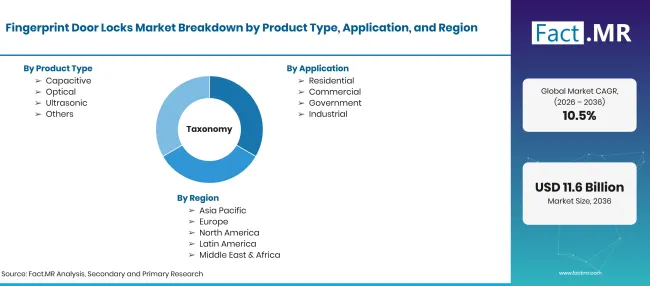
Fingerprint Door Locks Market Taxonomy | Source: Fact.MR
| Attribute | Details |
|---|---|
| Quantitative Units | USD billion |
| Market Definition | Complete door locking devices offering fingerprint recognition as an access method. |
| Product Type | Capacitive; Optical; Ultrasonic; Others |
| Application | Residential; Commercial; Government; Industrial |
| Distribution Channel | Offline Stores; Online Stores |
| End-User | Individual; Enterprises |
| Countries Covered | Germany; Brazil; USA; UK; Japan |
| Companies Profiled | ASSA ABLOY AB; dormakaba Holding AG; Allegion plc; ZKTeco Co., Ltd.; ADEL Smart Lock; Anviz Global Inc. |
| Forecast Period | 2026 to 2036 |
| Approach | Segment and country forecasts alongside product portfolio and official housing and digital-use evidence |
Source: Fact.MR analysis. Updated Nov 3, 2026
How is the market segmented?
-
By Product Type
- Capacitive
- Optical
- Ultrasonic
- Others
-
By Application
- Residential
- Commercial
- Government
- Industrial
-
By Distribution Channel
- Offline Stores
- Online Stores
-
By End-User
- Individual
- Enterprises
-
By Region
- North America
- Latin America
- Western Europe
- Eastern Europe
- East Asia
- South Asia & Pacific
- Middle East & Africa
Frequently Asked Questions
How big is the fingerprint door locks market in 2026?
What is the market CAGR from 2026 to 2036?
Which product type holds the largest share?
Which application leads the market?
Who are the main companies in the fingerprint door locks market?
Who worked on this report


Preview the report firsthand - request a free sample
Free SampleGet the brochure for pricing and purchase details
Download PDF