- Market Value (2025): USD 326.0 Mn
- Estimated Value (2026): USD 342.1 Mn
- Forecast Value (2036): USD 553.0 Mn
- CAGR (2026-2036): 4.9%
What is the Commercial Conveyor Toaster Market forecast to be worth by 2036?
USD 342.1 million in 2026 to USD 553.0 million by 2036 at a 4.9% CAGR.
- Demand for commercial conveyor toasters was worth USD 326.0 million in 2025, with quick-service chains and hotel breakfast lines placing most orders.
- Revenue will move from USD 342.1 million in 2026 to USD 553.0 million by 2036 as operators retire analog units for programmable models.
- A 4.9% CAGR will hold from 2026 to 2036, since chains add toast-based breakfast and sandwich items without adding kitchen staff.
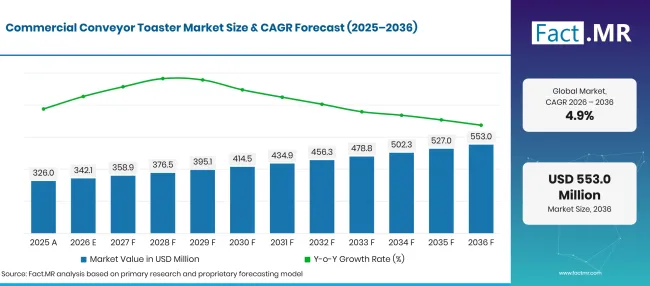
Commercial Conveyor Toaster Market Forecast Global | Source: Fact.MR
| Year | Basis | Market Value (USD million) |
|---|---|---|
| 2025 | Actual | 326.0 |
| 2026 | Estimate | 342.1 |
| 2036 | Forecast | 553.0 |
| CAGR 2026 to 2036 | Forecast period | 4.9% |
Source: Fact.MR analysis. Updated Oct 30, 2026
What are the defining numbers behind Commercial Conveyor Toaster Market growth?
The 2026 to 2036 period adds USD 210.9 million in new value, led by replacement buying in restaurants and hotels.
- Demand Drivers in the Market
- Staffing pressure pushes kitchens toward equipment that runs with little attention. The U.S. Bureau of Labor Statistics counted 12,393.0 thousand employees in food services and drinking places in September 2026 on a preliminary basis [1]. A conveyor toaster lets one worker load bread while the belt sets the timing.
- Eating out keeps taking a bigger slice of the food budget. The USDA Economic Research Service reported that food away from home accounted for 56.3 percent of total U.S. food expenditures in 2025 [2]. Each added breakfast or sandwich order runs through a toasting step before assembly.
- Energy costs shape the choice of replacement units. APW Wyott’s 2026 catalog states that its ECO-4000 Energy Saving Toaster saves approximately 40% more energy than competitive products [3]. Programmable standby modes let kitchens cut heat during slow hours and recover fast for a “toast now” order.
- Menus now carry brioche buns, bagels, English muffins and flatbreads in the same shift. Adjustable belt speed and separate top and bottom heat allow one unit to handle thick and thin products without manual flipping.
- Counter space is tight in compact and kiosk formats. Vertical and front-return designs return product to the operator side, which frees space behind the unit for holding cabinets.
- Key Segments Analyzed
- By Product Type: High-Speed Conveyor Toaster will hold 62.4% share in 2026, as chains need 1,000 or more slices per hour during breakfast rushes.
- By Application: Restaurants will account for 35.2% share in 2026 through daily bun and toast volume in burger, sandwich and breakfast outlets.
- By Distribution Channel: Direct Sales will capture 53.1% share in 2026, given that national chains buy specified models under multi-year supply agreements.
- By Power Source: Electric will command 65.0% share in 2026 since plug-in units need no gas line, flue or hood change.
- Analyst Opinion at Fact.MR
- Shambhu Nath Jha, Principal Consultant at Fact.MR, states, “Toasting is a small step, yet a slow toaster backs up every sandwich and burger station behind it. Chains will keep paying for belt speed, even browning and controls that crew members cannot mis-set. Makers that cut standby energy without slowing recovery will win the replacement cycle through 2036.”
- Strategic Implications
- Equipment makers should publish slices-per-hour ratings for buns, bagels and bread separately, since buyers compare throughput by the product they actually serve.
- Restaurant chains should size toasters to peak-hour order counts, as an oversized unit wastes power for most of the day.
- Dealers and service agents should stock heating elements and belts locally, given that a failed toaster can halt a breakfast menu.
- Hotel and catering buyers should confirm circuit capacity and counter depth before moving from pop-up units to conveyor models.
With a 6.1% CAGR, Germany will head the group as record overnight stays fill hotel breakfast rooms. Brazil follows at 5.6%, where a surge in foreign visitors lifts hotel and snack-bar traffic. The United States will grow at 5.0%, driven by quick-service chains and steady spending on meals away from home. A 4.5% rate in the United Kingdom reflects a broad base of cafés, pubs and hotels that replace equipment on fixed cycles. Japan rounds out the list at 4.0%, with compact kitchens and institutional catering setting the pace.
How does the Commercial Conveyor Toaster Market break down by segment?
High-Speed Conveyor Toaster will lead Product Type at 62.4%; Restaurants will top Application at 35.2%; Direct Sales will head Distribution Channel at 53.1%; Electric will rank first in Power Source at 65.0%.
Which Product Type leads?
High-Speed Conveyor Toaster takes 62.4% of 2026 sales.
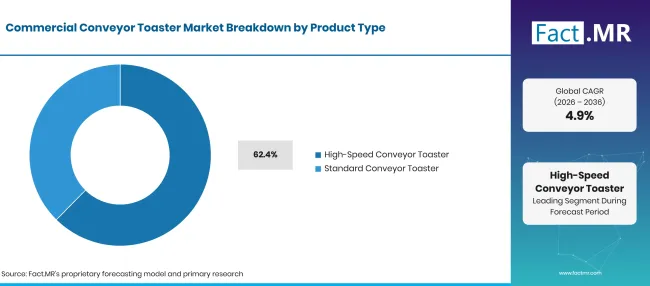
Commercial Conveyor Toaster Market Breakdown Product Type | Source: Fact.MR
| Product Type | Share (2026) |
|---|---|
| High-Speed Conveyor Toaster (Leading segment) | 62.4% |
| Other segments combined | 37.6%* |
| Total | 100.0% |
Source: Fact.MR analysis. Updated Oct 30, 2026
A burger chain at lunch can need a toasted bun every few seconds, and a slow belt stalls the whole line. Wider belts and stronger elements let high-speed units toast three slices side by side. Star Manufacturing’s July 2026 guide rates its Holman DT14 double conveyor at 2,000 slices per hour [4]. Standard conveyor units serve cafés, small hotels and staff canteens with lower peaks. They cost less, draw less current and fit on shorter counters. Many sites pair them with a conveyor pizza oven or a combi unit to cover other menu items.
What supports Restaurants within Application?
Restaurants represent 35.2% of 2026 demand.
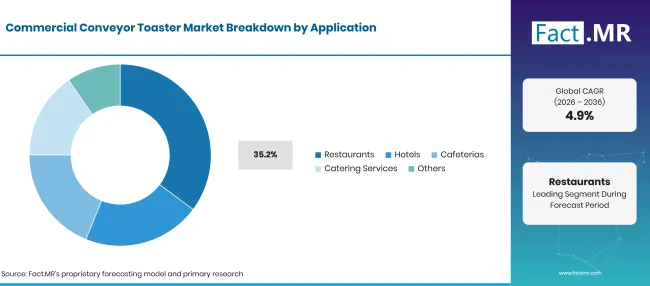
Commercial Conveyor Toaster Market Breakdown Application | Source: Fact.MR
| Application | Share (2026) |
|---|---|
| Restaurants (Leading segment) | 35.2% |
| Other segments combined | 64.8%* |
| Total | 100.0% |
Source: Fact.MR analysis. Updated Oct 30, 2026
Burger, sandwich and breakfast outlets toast bread products on almost every order, so belt toasters run through full service hours. Chains also want each bun to look the same in every store, which favors fixed belt speed and preset heat. Hotels use conveyor units at breakfast buffets where guests toast their own bread. Cafeterias and catering services rely on them for batch service. In Japan, the Ministry of Health, Labour and Welfare counted 94,987 food-service facilities at the end of fiscal 2024, including 50,860 specified facilities [5]. Demand from these sites tracks the wider baked food and cereals category served at breakfast.
How does Distribution Channel shape demand?
Direct Sales carry 53.1% of 2026 revenue.
| Distribution Channel | Share (2026) |
|---|---|
| Direct Sales (Leading segment) | 53.1% |
| Other segments combined | 46.9%* |
| Total | 100.0% |
Source: Fact.MR analysis. Updated Oct 30, 2026
National chains test a toaster in a few stores, approve it, then order it for hundreds of outlets straight from the maker. Such contracts often bundle training, spare parts and service coverage. Independent restaurants and hotels buy through dealers who handle site surveys, delivery and installation. Online retail serves small cafés replacing a single unit. Dealers often quote toasters with other commercial foodservice equipment in one kitchen package.
What role does Power Source play?
Electric units hold 65.0% of 2026 value.
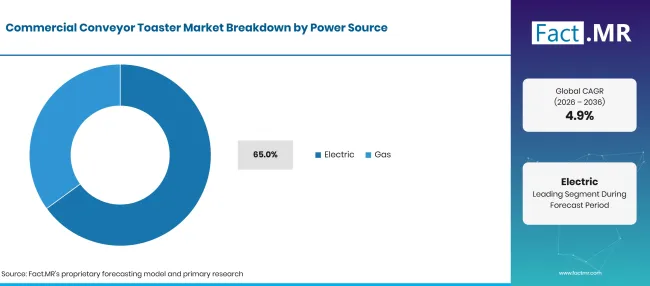
Commercial Conveyor Toaster Market Breakdown Power Source | Source: Fact.MR
| Power Source | Share (2026) |
|---|---|
| Electric (Leading segment) | 65.0% |
| Other segments combined | 35.0%* |
| Total | 100.0% |
Source: Fact.MR analysis. Updated Oct 30, 2026
Most countertop kitchens already have the electrical circuits that a toaster needs, so an electric unit can be plugged in without new gas lines or extra ventilation. Electronic controls also make it easier to program standby heat and belt speed. Gas toasters suit high-volume sites with gas lines in place and lower gas tariffs. Buyers weigh utility prices and service access over a working life of many years. Kitchens that already run combi ovens on electricity often keep the toaster electric as well.
What is accelerating Commercial Conveyor Toaster Market adoption, and what is holding it back?
Thin kitchen crews, more meals eaten outside the home and wider bread menus will keep chains buying belt toasters. Upfront cost, power limits on older circuits and short counters slow purchases in small outlets.
Drivers Impact Analysis
| DRIVER | (~) % IMPACT ON CAGR | GEOGRAPHIC RELEVANCE | IMPACT TIMELINE |
|---|---|---|---|
| Throughput needs in quick-service and breakfast restaurants | +1.6% | North America, Western Europe | Short term (<= 2 years) |
| Labor shortages that favor low-attention equipment | +1.1% | North America, Western Europe, East Asia | Short term (<= 2 years) |
| Replacement of analog units with programmable models | +0.9% | Global | Medium term (2-4 years) |
| Growth in hotel breakfast service and tourism | +0.6% | Western Europe, Latin America, East Asia | Medium term (2-4 years) |
Source: Fact.MR analysis. Updated Oct 30, 2026
Opportunity Impact Analysis
| OPPORTUNITY | (~) % IMPACT ON CAGR | GEOGRAPHIC RELEVANCE | IMPACT TIMELINE |
|---|---|---|---|
| Energy-saving standby modes and rapid recovery | +0.8% | North America, Western Europe, East Asia | Medium term (2-4 years) |
| Multi-product toasters for buns, bagels and flatbreads | +0.6% | Global | Medium term (2-4 years) |
| Compact vertical units for kiosks and small formats | +0.4% | East Asia, South Asia & Pacific | Long term (>= 4 years) |
Source: Fact.MR analysis. Updated Oct 30, 2026
Restraints Impact Analysis
| RESTRAINT | (~) % IMPACT ON CAGR | GEOGRAPHIC RELEVANCE | IMPACT TIMELINE |
|---|---|---|---|
| High purchase price of high-speed units for independents | -0.6% | Global | Short term (<= 2 years) |
| Electrical capacity limits in older buildings | -0.4% | Western Europe, East Asia | Medium term (2-4 years) |
| Counter-space limits in small outlets | -0.2% | Global | Long term (>= 4 years) |
Source: Fact.MR analysis. Updated Oct 30, 2026
Which countries are scaling the Commercial Conveyor Toaster Market through 2036?
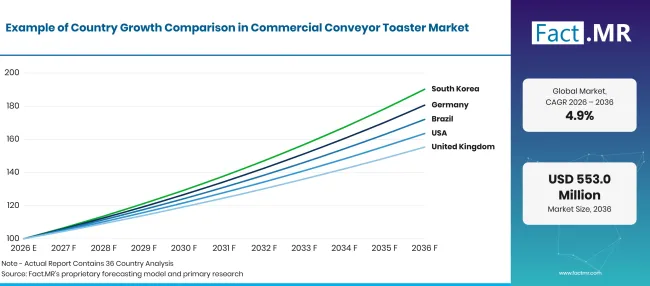
Commercial Conveyor Toaster Market Growth Index | Source: Fact.MR
| Country | CAGR (2026 to 2036) |
|---|---|
| Germany | 6.1% |
| Brazil | 5.6% |
| United States | 5.0% |
| United Kingdom | 4.5% |
| Japan | 4.0% |
Source: Fact.MR analysis. Updated Oct 30, 2026
What supports Germany’s adoption?
6.1% CAGR, driven by record overnight stays and hotel breakfast demand.
Hotel breakfast is the main toasting occasion in Germany. Destatis reported a record 497.5 million overnight stays in 2025, up 0.3% on 2024 [6]. The pace held in 2026, with 282.1 million stays from January to July, 0.9% above the same period a year earlier [7]. Buffet lines need toasters that guests can operate safely and that keep up at peak times.
How is Brazil developing demand?
5.6% CAGR, backed by record foreign arrivals and new hospitality jobs.
Embratur figures showed 8,390,708 international arrivals in Brazil from January to November 2025, up 40.6% on the same period of 2024 [8]. Tourism also recorded a net gain of nearly 91,000 formal jobs through October 2025 [9]. Hotels in São Paulo and Rio de Janeiro and the snack bars serving them add toasting capacity as guest counts rise.
What is supporting the United States’ adoption?
5.0% CAGR, reflecting high spending on meals away from home.
Americans spent about USD 1.41 trillion on food away from home in 2025, according to the USDA Economic Research Service [2]. Burger and breakfast chains toast buns on nearly every order. Most toaster orders come from chain replacement programs, where one approved model goes into hundreds of stores.
How is the United Kingdom scaling demand?
4.5% CAGR, helped by a broad base of cafés, pubs and hotels.
The Office for National Statistics counted 177,000 accommodation and food service businesses in the UK in 2025, 6.5% of all VAT or PAYE registered firms [10]. Many are small sites with limited counter space. Buyers favor compact conveyor units and dealer-installed models with local service.
How does Japan perform?
4.0% CAGR, as compact kitchens and inbound tourism shape purchases.
JNTO estimated 42,683,600 visitor arrivals to Japan in 2025 [11]. Hotel breakfast rooms and station cafés serve toast sets to many of these guests. Kitchens are small, so buyers look for narrow and vertical units that fit beside rice cookers and commercial coffee machines.
Who leads the Commercial Conveyor Toaster Market?
Competition splits into two camps. Toaster specialists such as Star Manufacturing (Holman), Hatco and Antunes win national chain contracts on belt speed, browning consistency and controls. Star’s July 2026 guide lists Holman QCS models from 350 to 1,600 slices per hour plus the DT14 double toaster [4].
Antunes marked its 70th year in 2025 and in November described high-precision toasters built for repeatable buns across global chain locations [12]. Hatco offers Toast-Qwik, Toast King and Intelligent Toast-Qwik conveyor lines with programmable settings. Broadline equipment makers form the second camp. APW Wyott sells X*TREME radiant toasters and the ECO-4000 energy-saving range [3]. Vollrath offers conveyor and vertical contact bun toasters, Prince Castle supplies quick-service kitchens, and BakeMax serves independents through dealers. Service reach, standby energy and approval on chain menus will separate winners through 2036.
Which companies are the key providers?
Key companies include Star Manufacturing International, Inc.; Hatco Corporation; Antunes; APW Wyott; The Vollrath Company, LLC; Prince Castle; and BakeMax.
- Star Manufacturing International, Inc.
- Hatco Corporation
- Antunes
- APW Wyott
- The Vollrath Company, LLC
- Prince Castle
- BakeMax
Bibliography
- [1] U.S. Bureau of Labor Statistics. (2026, October 28). Food Services and Drinking Places: NAICS 722.
- [2] U.S. Department of Agriculture, Economic Research Service. (2026, June 11). Total U.S. food spending reached $2.51 trillion in 2025.
- [3] APW Wyott. (2026, August 1). APW Wyott Product Guide.
- [4] Star Manufacturing International, Inc. (2026, July 20). Star, Holman, Toastmaster Product Guide.
- [5] Ministry of Health, Labour and Welfare, Japan. (2025, October 21). 令和6(2024[Overview of the fiscal 2024 Report on Public Health Administration and Services].
- [6] Statistisches Bundesamt (Destatis). (2026, February 11). Tourismus in Deutschland im Jahr 2025: Erneut Rekordwert bei Gästeübernachtungen [Tourism in Germany in 2025: Another record for overnight stays].
- [7] Statistisches Bundesamt (Destatis). (2026, September 11). Tourismus in Deutschland im Juli 2026: 3,2 % mehr Übernachtungen als im Vorjahresmonat [Tourism in Germany in July 2026: 3.2% more overnight stays than a year earlier].
- [8] Agência Gov, Government of Brazil. (2025, December 11). Brasil renova recorde histórico e recebe mais de 8,3 milhões de turistas internacionais em 2025 [Brazil renews historic record and receives more than 8.3 million international tourists in 2025].
- [9] Agência Gov, Government of Brazil. (2025, December 31). Ações do governo consolidam trajetória de alta do turismo brasileiro [Government actions consolidate the upward path of Brazilian tourism].
- [10] Office for National Statistics. (2025, September 24). UK business; activity, size and location: 2025.
- [11] Japan National Tourism Organization. (2026, January 21). Number of visitor arrivals to Japan: December 2025.
- [12] Antunes. (2025, November 4). Partnering for Growth.
This Report Answers
- How large is toaster revenue by product type, application, channel and power source from 2026 to 2036?
- Which subsegment holds first place in each category, and which kitchen needs keep it there?
- Why do Germany, Brazil, the United States, the United Kingdom and Japan grow at different rates?
- Where do toaster specialists and broadline equipment makers each win business?
- How do labor, energy prices and menu changes affect replacement timing?
What does the Commercial Conveyor Toaster Market cover?
Conveyor toasters move product on a belt or chain past radiant or contact heat, so each item gets the same time and temperature. Units range from compact 350-slice models to double-belt machines for chain kitchens.
Revenue is counted at the factory or first-sale price of new equipment. Demand is tracked across restaurants, hotels, cafeterias and catering services.
What is included in the scope?
Horizontal radiant conveyor toasters, vertical contact bun toasters and double-belt models sold for commercial use are included. Both electric and gas units count, as do models with programmable controls and energy-saving standby.
Toasters bought by chains under supply contracts, by dealers for resale and through online stores are all in scope. Units installed in bakery cafés that toast items from the gluten-free bread and specialty bread range also count.
What is excluded from the scope?
Pop-up toasters and household appliances are left out, even when used in small offices. Toaster ovens, salamanders and contact grills that do not use a conveyor are also excluded.
Spare parts, belts and service contracts sold apart from a new unit do not count toward revenue. Used and refurbished toasters are excluded as well.
How Was the Analysis Built?
The analysis draws on 120+ sources, 35+ company portfolios, 25+ countries, and more than 20 industry interviews.
- Primary Research: Primary research includes discussions with manufacturers, service providers, technology developers, distributors, end users, and subject-matter experts. These conversations examine purchasing priorities, product adoption, operational challenges, approval requirements, competitive positioning, and the factors that influence wider market acceptance.
- Desk Research: Desk research covers government statistics, regulatory publications, company filings, trade data, technical studies, industry associations, standards, public policy, and other authoritative sources. Every source used in the analysis is documented in the bibliography.
- Market Sizing and Forecasting: Market estimates combine historical performance, demand indicators, pricing and volume trends, segment shares, company participation, country-level growth, adoption patterns, investment activity, and barriers to market expansion.
- Data Validation and Update Cycle: Findings are validated by comparing primary interviews with public data, company activity, regulatory changes, trade patterns, and industry developments. Regular updates review new product launches, capacity changes, partnerships, approvals, and shifts in commercial adoption.
Segmentation
What is the report’s scope and coverage?
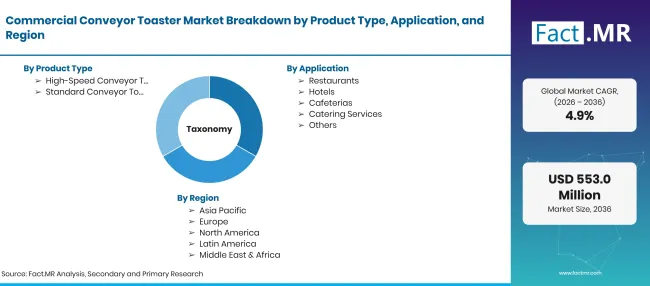
Commercial Conveyor Toaster Market Taxonomy | Source: Fact.MR
| Attribute | Details |
|---|---|
| Quantitative Units | USD million |
| Market Definition | Commercial toasters that carry bread, buns, bagels and similar products through a heated chamber on a moving belt or contact conveyor. The scope covers new units sold to foodservice operators. |
| Product Type | High-Speed Conveyor Toaster; Standard Conveyor Toaster |
| Application | Restaurants; Hotels; Cafeterias; Catering Services; Others |
| Distribution Channel | Direct Sales; Distributors and Dealers; Online Retail |
| Power Source | Electric; Gas |
| Regions Covered | North America; Latin America; Western Europe; Eastern Europe; East Asia; South Asia & Pacific; Middle East & Africa |
| Countries Covered | Germany; Brazil; United States; United Kingdom; Japan |
| Companies Profiled | Star Manufacturing International, Inc.; Hatco Corporation; Antunes; APW Wyott; The Vollrath Company, LLC; Prince Castle; BakeMax |
| Forecast Period | 2026 to 2036 |
| Approach | Hybrid top-down and bottom-up approach using foodservice outlet counts, chain replacement cycles, slices-per-hour capacity by model class and supplier portfolio review. |
Source: Fact.MR analysis. Updated Oct 30, 2026
How is the market segmented?
-
By Product Type
- High-Speed Conveyor Toaster
- Standard Conveyor Toaster
-
By Application
- Restaurants
- Hotels
- Cafeterias
- Catering Services
- Others
-
By Distribution Channel
- Direct Sales
- Distributors and Dealers
- Online Retail
-
By Power Source
- Electric
- Gas
-
By Region
- North America
- Latin America
- Western Europe
- Eastern Europe
- East Asia
- South Asia & Pacific
- Middle East & Africa
Frequently Asked Questions
How big is the commercial conveyor toaster market in 2026?
What is the CAGR of the commercial conveyor toaster market from 2026 to 2036?
Which product type leads the commercial conveyor toaster market?
Which application leads the commercial conveyor toaster market?
Which distribution channel leads the commercial conveyor toaster market?
Which power source leads the commercial conveyor toaster market?
Which country will grow the most in the commercial conveyor toaster market?
Who are the main companies in the commercial conveyor toaster market?
Who worked on this report


Preview the report firsthand - request a free sample
Free SampleGet the brochure for pricing and purchase details
Download PDF