The Flavors & Fragrances Market is analyzed by product, including flavors, sweet flavors, savory flavors and beverage flavors, along with application, form, and region, forecast 2026 to 2036.
By Fact.MR Food & Beverage DeskFact-checked under the Fact.MR editorial processUpdated
15 min read
Flavors and Fragrances Market Analysis and Forecast by Fact.MR
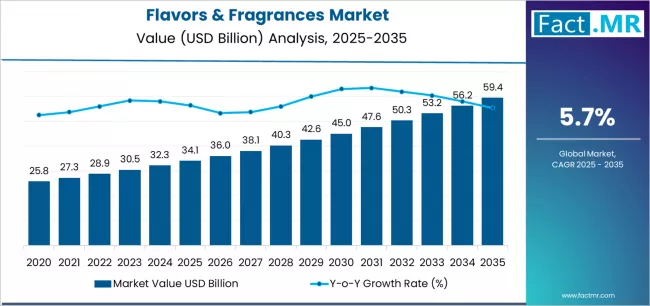
The global market for flavors and fragrances is estimated to be around USD 34.1 billion in 2025 and has been forecast to expand at a CAGR of 5.7% to end up at USD 62.7 billion by 2036. Flavors and fragrances encompass natural and synthetic aromatic compounds used to impart taste and scent in food, beverage, personal care, household, and pharmaceutical products. The category covers extraction-based, fermentation-based, and chemically synthesized ingredients. Growth is shaped by natural ingredient demand, clean-label reformulation, premiumization in personal care, and expanding FMCG manufacturing in emerging markets.
Flavors & Fragrances Market Market Value Analysis | Source: Fact.MR
Summary of Flavors and Fragrances Market
Market Snapshot
In 2025, the global Flavors and Fragrances Market was valued at approximately USD 34.1 billion.
The market is estimated to reach USD 36.0 billion in 2026 and is projected to attain USD 62.7 billion by 2036.
The flavors and fragrances market is likely to expand at a CAGR of 5.7% during the forecast period.
The market is anticipated to create an absolute dollar opportunity of USD 26.7 billion between 2026 and 2036.
Flavors account for 62% of the product segment in 2026.
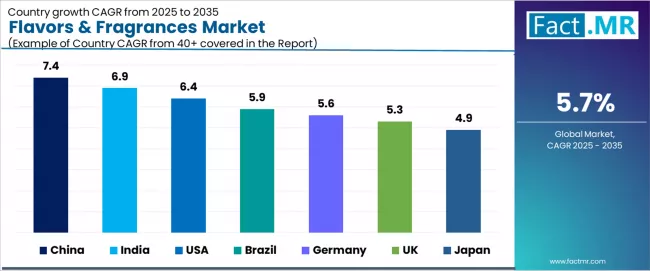
China (7.4%) and India (6.9%) are the key growth markets during the forecast period.
Demand and Growth Drivers
Growing consumer demand for natural and clean-label flavor and fragrance ingredients is driving reformulation away from synthetic compounds across food and personal care manufacturing.
Premiumization in food, beverage, and personal care categories is increasing demand for differentiated, high-quality flavor and fragrance solutions.
Expanding FMCG manufacturing in emerging markets is creating volume demand for flavor and fragrance ingredients across food, beverage, and household product categories.
Regulatory pressure to disclose ingredient sourcing and reduce synthetic additive use is supporting adoption of natural extraction and fermentation-based production.
Flavor and fragrance customization capabilities are enabling manufacturers to develop region-specific and product-specific taste and scent profiles.
Product and Segment View
Flavors account for 62% of market value in 2026, reflecting the dominance of taste-related applications in food and beverage manufacturing.
Liquid form holds 52% of the form segment, reflecting preference for liquid-based flavor and fragrance delivery in manufacturing processes.
Key segmentation includes:
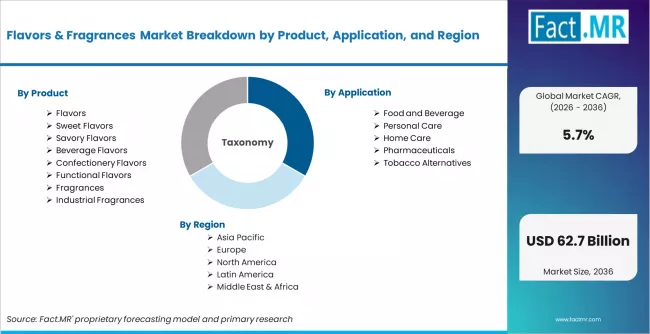
Product Type: Flavors, Fragrances
Application: Food and Beverage, Personal Care, Household Products, Pharmaceuticals
Form: Liquid, Powder, Paste, Encapsulated
These systems enable:
Taste differentiation and sensory appeal in food and beverage products
Scent-based brand positioning in personal care and household products
Clean-label aromatic ingredient delivery through natural sourcing
Geography and Competitive Outlook
Europe and North America together represent the largest markets, supported by established flavor and fragrance manufacturing and strong FMCG demand.
Asia Pacific is the fastest-growing region, with China (7.4%) and India (6.9%) leading through expanding food and personal care manufacturing.
China (7.4%) and India (6.9%) are the key growth markets, with USA (6.4%), Brazil (5.9%), and Germany (5.6%) also recording steady growth.
Some of the major players are Givaudan, Firmenich (now dsm-firmenich), Symrise AG, IFF, Sensient Technologies, BASF SE, Mane SA, Takasago International, Alpha Aromatics, and Ozone Naturals.
Analyst Opinion
The flavors and fragrances market is defined by a small number of large integrated players that control the majority of global supply and innovation capability. Growth is shaped by the tension between natural ingredient demand and the cost efficiency of synthetic production. Companies that combine natural sourcing capability with fermentation-based production technology are best positioned to serve the growing clean-label market without sacrificing margin. The next phase of growth will be defined by biotechnology-enabled ingredient creation, sustainability-certified supply chains, and the ability to deliver customized solutions at speed for FMCG manufacturers.
Key Growth Drivers, Constraints, and Opportunities
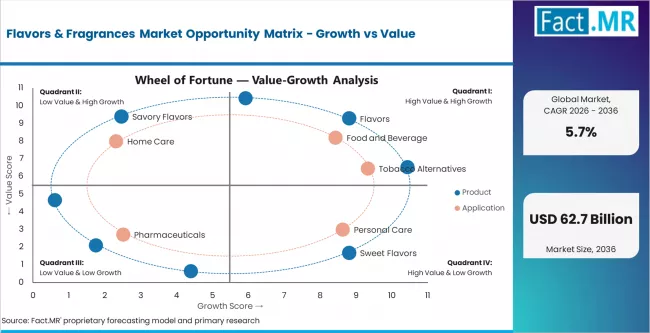
Flavors & Fragrances Market Opportunity Matrix Growth Vs Value | Source: Fact.MR
Key Factors Driving Growth
Natural ingredient demand is driving reformulation from synthetic to extraction and fermentation-based flavor and fragrance production.
FMCG manufacturing expansion in emerging markets creates volume demand for flavor and fragrance ingredients.
Premiumization across food, beverage, and personal care categories increases demand for differentiated sensory solutions.
Key Market Constraints
Natural ingredient supply variability due to climate, crop yield, and geopolitical factors creates pricing and availability risks.
Regulatory fragmentation across markets in natural vs. synthetic classification creates compliance complexity for global suppliers.
High R&D costs for natural ingredient development and biotechnology-based production limit smaller players' ability to compete.
Key Opportunity Areas
Biotechnology and fermentation-based production enables natural-equivalent ingredient creation at industrial scale with lower environmental impact.
Customization and speed-to-market capability in flavor and fragrance development supports premium service models for brand-specific solutions.
Segment-wise Analysis of the Flavors and Fragrances Market
Flavors hold 62% of the product segment in 2026, reflecting the dominance of taste-related applications in food and beverage manufacturing.
Food and beverage accounts for 40% of the application segment, representing the largest demand channel for flavor ingredients.
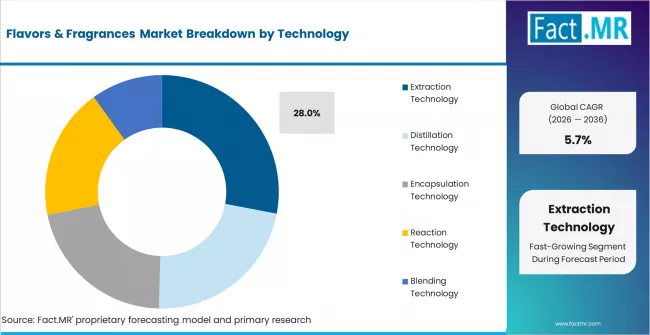
Extraction technology holds 28% of the technology segment, reflecting the importance of natural extraction in clean-label flavor production.
The flavors and fragrances market is segmented by product type, application, form, technology, end use, and region. By product type, the market is divided into flavors and fragrances. By application, coverage includes food and beverage, personal care, household products, and pharmaceuticals. Flavors lead by share through food manufacturing dominance, while fragrances are shaped by personal care and household demand.
Which Product Type Dominates the Flavors and Fragrances Market?
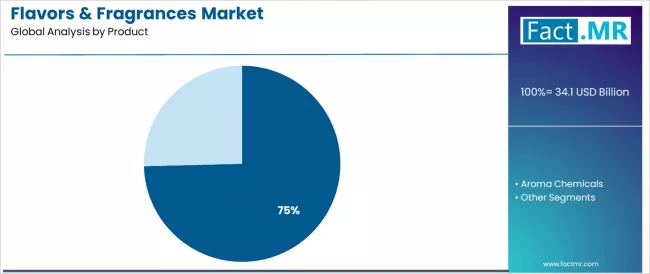
Flavors & Fragrances Market Analysis By Product | Source: Fact.MR
Flavors account for 62% of the product segment in 2026, reflecting the dominant role of taste-related applications across food and beverage manufacturing. Flavor ingredients serve virtually every processed food and beverage category, from dairy and bakery to snacks, beverages, and confectionery.
The flavor segment benefits from non-discretionary demand, as taste remains the primary driver of food purchase decisions. Natural flavor demand is growing faster than synthetic, supported by clean-label consumer preferences and regulatory attention to ingredient disclosure.
Which Application Dominates the Flavors and Fragrances Market?
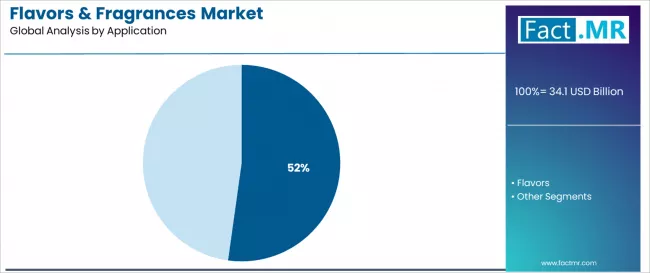
Flavors & Fragrances Market Analysis By Application | Source: Fact.MR
Food and beverage accounts for 40% of the application segment in 2026, representing the largest demand channel for both flavors and, to a lesser extent, fragrances used in food product scent development. Beverage flavoring, dairy, bakery, confectionery, and snack applications drive the bulk of flavor ingredient demand.
Personal care represents the largest application for fragrance ingredients, with perfumes, skin care, hair care, and body care products driving demand for differentiated scent profiles. Household products including cleaning supplies and air fresheners represent the third-largest application.
Which Technology Dominates the Flavors and Fragrances Market?
Flavors & Fragrances Market Analysis By Technology | Source: Fact.MR
Extraction technology accounts for 28% of the technology segment in 2026, reflecting the importance of natural extraction methods including distillation, cold pressing, and solvent extraction in producing clean-label flavor and fragrance ingredients from plant, fruit, and botanical sources.
Fermentation-based production is the fastest-growing technology, enabling natural-equivalent ingredient creation through microbial processes that offer cost advantages over traditional extraction while meeting natural ingredient classification requirements.
Which Product Trend is Shaping the Next Phase of Growth in the Flavors and Fragrances Market?
Biotechnology and fermentation-derived flavors and fragrances are not yet the largest production category, but they are emerging as the fastest-growing part of the market. Their share is projected to rise as FMCG manufacturers increasingly demand natural-classified ingredients at industrial scale and competitive pricing. Fermentation enables production of vanilla, citrus, and other high-demand flavor compounds without reliance on agricultural commodity supply chains.
The shift toward biotech-derived ingredients reflects a broader change in ingredient sourcing strategy. Manufacturers increasingly want natural-classified ingredients with supply security, consistent quality, and lower environmental impact than traditional extraction. As a result, fermentation-based production is moving from a specialty capability into a central technology platform for major F&F houses.
Regional Outlook Across Key Markets
Top Country Growth Comparison Flavors & Fragrances Market Cagr (2026 2036) | Source: Fact.MR
China leads growth at 7.4%, supported by expanding food and personal care manufacturing, growing demand for flavor differentiation, and increasing adoption of natural ingredient sourcing.
India records growth at 6.9%, supported by large-scale FMCG manufacturing expansion, growing consumer product premiumization, and increasing domestic flavor and fragrance production capacity.
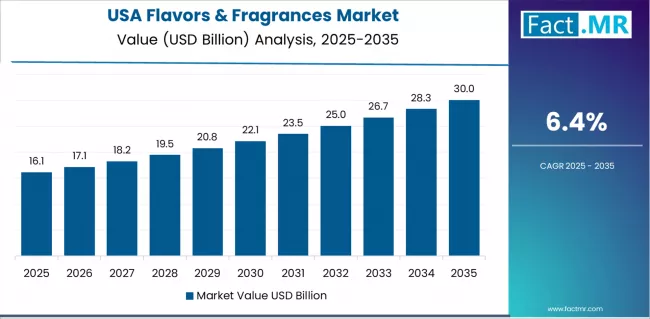
North America shows steady growth, with the USA at 6.4% supported by natural ingredient demand, premiumization across food and personal care, and strong R&D investment by major F&F houses.
CAGR Table
Country
CAGR (%)
China
7.4%
India
6.9%
USA
6.4%
Brazil
5.9%
Germany
5.6%
UK
5.3%
Japan
4.9%
Source: Fact.MR (FMR) analysis, based on proprietary forecasting model and primary research.
Flavors & Fragrances Market Cagr Analysis By Country | Source: Fact.MR
China Flavors and Fragrances Market Growth Assessment
The China Flavors and Fragrances market is projected to grow at a CAGR of 7.4% through 2036. Demand is shaped by expanding food and personal care manufacturing, growing flavor differentiation demand, and increasing adoption of natural ingredient sourcing by domestic FMCG producers.
Food and personal care manufacturing expansion creates volume demand.
Flavor differentiation demand is increasing across consumer product categories.
Natural ingredient adoption is growing among domestic manufacturers.
India Flavors and Fragrances Market Opportunity Outlook
The India Flavors and Fragrances market is projected to grow at a CAGR of 6.9% through 2036. Demand is supported by large-scale FMCG manufacturing growth, consumer product premiumization, and expanding domestic production of flavor and fragrance ingredients.
Premiumization increases demand for differentiated flavor and fragrance solutions.
Domestic production capacity is expanding through investment.
USA Flavors and Fragrances Market Growth Outlook
Flavors & Fragrances Market Country Value Analysis | Source: Fact.MR
The USA Flavors and Fragrances market is projected to grow at a CAGR of 6.4% through 2036. Demand is sustained by natural ingredient demand, premiumization across food and personal care, and strong R&D investment by major F&F houses headquartered in the market.
Premiumization supports demand for higher-value flavor and fragrance compounds.
R&D investment sustains technology leadership in biotechnology-derived ingredients.
Brazil Flavors and Fragrances Market Demand Analysis
The Brazil Flavors and Fragrances market is projected to grow at a CAGR of 5.9% through 2036. Demand is shaped by expanding food and personal care manufacturing, growing consumer product diversity, and increasing adoption of flavored and scented consumer goods.
Food and personal care manufacturing expansion drives ingredient demand.
Consumer product diversity increases demand for differentiated flavors and scents.
Growing middle class supports premiumization in consumer goods.
Germany Flavors and Fragrances Market Demand Trends
The Germany Flavors and Fragrances market is projected to grow at a CAGR of 5.6% through 2036. Demand is supported by established F&F manufacturing, strong regulatory frameworks for natural ingredients, and growing demand for sustainable, traceable ingredient supply chains.
Established F&F manufacturing sustains consistent demand.
Regulatory frameworks support natural ingredient adoption.
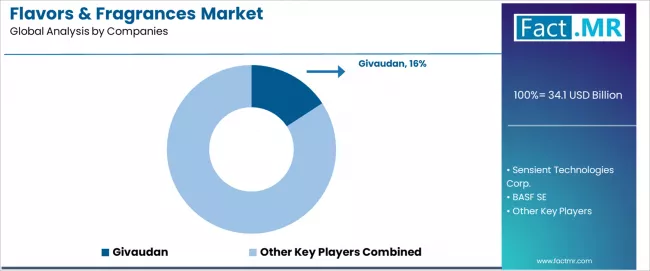
Flavors & Fragrances Market Analysis By Company | Source: Fact.MR
Flavors and Fragrances Market Analysis By Company
Givaudan, dsm-firmenich (formerly Firmenich), and Symrise AG hold dominant positions through global R&D capability, broad ingredient portfolios, and deep FMCG manufacturer relationships.
IFF, Sensient Technologies, and Mane SA participate meaningfully through technology specialization, natural ingredient focus, and regional production strength.
R&D capability, natural ingredient sourcing, biotechnology investment, and FMCG customer relationships create significant competitive barriers in a market where innovation speed and supply reliability define market position.
The competitive landscape is concentrated among a small number of global F&F houses, with Givaudan holding a leading position at approximately 16% market share. Givaudan's advantage is built on the world's largest flavor and fragrance R&D platform, global production infrastructure, and deep customer relationships across food, beverage, and personal care manufacturing.
dsm-firmenich (following the Firmenich-DSM merger) and Symrise compete through broad ingredient portfolios, natural ingredient sourcing capability, and growing biotechnology-based production platforms.
IFF, Sensient, and regional players including Mane, Takasago, and Alpha Aromatics serve specific customer segments through technology specialization, natural ingredient focus, and regional production advantages.
Strategic priorities include investing in fermentation and biotechnology production, expanding natural ingredient supply chains, building sustainability-certified sourcing, and developing speed-to-market customization capabilities for FMCG customers.
Key Companies in the Flavors and Fragrances Market
Givaudan, dsm-firmenich AG (formerly Firmenich SA), and Symrise AG are among the leading global players.
International Flavors and Fragrances Inc. (IFF), Sensient Technologies Corp., and Mane SA hold established positions through technology specialization.
Takasago International Corp., BASF SE, Alpha Aromatics, Ozone Naturals, and Elevance Renewable Sciences compete through regional strength and niche positioning.
Givaudan expanded its biotechnology-based flavor and fragrance production platform, investing in fermentation capabilities to produce natural-equivalent ingredients at industrial scale. The expansion supports growing FMCG demand for clean-label ingredients.
Symrise launched a comprehensive traceable supply chain program for its natural flavor and fragrance ingredients, providing FMCG customers with verified sustainability credentials for their product ingredient sourcing.
IFF - Product Innovation / Natural Flavor System Launch (2026)
IFF launched a new range of natural flavor systems for clean-label food and beverage manufacturing, combining extraction and fermentation-derived ingredients to deliver taste performance with clean-label compliance.
Leading Companies Shaping the Flavors and Fragrances Market
Global Players
Givaudan
Symrise AG
dsm-firmenich AG
International Flavors & Fragrances Inc. (IFF)
Sensient Technologies Corp.
Regional Players
Mane SA
Takasago International Corp.
BASF SE
Emerging / Start-up Players
Alpha Aromatics
Ozone Naturals
Elevance Renewable Sciences Inc.
Market Segmentation Analysis
Flavors & Fragrances Market Market Segmented by Product:
Flavors
Natural Flavors
Artificial Flavors
Nature Identical Flavors
Sweet Flavors
Fruit Flavors
Vanilla Flavors
Chocolate Flavors
Savory Flavors
Spice Flavors
Meat Flavors
Smoke Flavors
Beverage Flavors
Carbonated Drink Flavors
Alcoholic Beverage Flavors
Dairy Flavors
Confectionery Flavors
Candy Flavors
Bakery Flavors
Frozen Dessert Flavors
Functional Flavors
Probiotic Masking Flavors
Protein Masking Flavors
Fragrance Encapsulated Flavors
Fragrances
Personal Care Fragrances
Home Care Fragrances
Fine Fragrances
Industrial Fragrances
Cleaning Product Fragrances
Air Care Fragrances
Flavors & Fragrances Market Market Segmented by Application:
Food and Beverage
Bakery Products
Beverages
Confectionery
Personal Care
Skincare Products
Hair Care Products
Fragrances and Perfumes
Home Care
Detergents
Air Fresheners
Cleaning Products
Pharmaceuticals
Syrups
Tablet Coatings
Therapeutic Aromas
Tobacco Alternatives
Nicotine Free Flavors
Electronic Vapor Flavors
Flavors & Fragrances Market Market Segmented by Form:
Liquid
Oil Soluble Flavors
Water Soluble Flavors
Powder
Spray Dried Flavors
Encapsulated Flavors
Paste
Concentrated Flavor Pastes
Flavor Bases
Encapsulated Form
Release Controlled Flavors
Heat Stable Flavors
Flavors & Fragrances Market Market Segmented by Technology:
Extraction Technology
Solvent Extraction
Supercritical CO2 Extraction
Distillation Technology
Steam Distillation
Molecular Distillation
Encapsulation Technology
Spray Dry Encapsulation
Liposome Encapsulation
Reaction Technology
Maillard Reaction Flavors
Enzymatic Flavor Development
Blending Technology
Aroma Blending Systems
Stability Enhancement Systems
Flavors & Fragrances Market Market Segmented by End Use:
Food Manufacturers
Beverage Companies
Snack Manufacturers
Personal Care Companies
Cosmetic Brands
Perfume Manufacturers
Home Care Manufacturers
Cleaning Product Companies
Air Freshener Brands
Pharmaceutical Companies
Syrup Manufacturers
Tablet Manufacturers
Industrial Users
Chemical Manufacturers
Aromatherapy Product Companies
Flavors & Fragrances Market Market by Region:
North America
USA
Canada
Mexico
Latin America
Brazil
Chile
Rest of Latin America
Western Europe
Germany
UK
Italy
Spain
France
Nordic
BENELUX
Rest of Western Europe
Eastern Europe
Russia
Poland
Hungary
Balkan & Baltic
Rest of Eastern Europe
East Asia
China
Japan
South Korea
South Asia and Pacific
India
ASEAN
Australia & New Zealand
Rest of South Asia and Pacific
Middle East & Africa
Kingdom of Saudi Arabia
Other GCC Countries
Turkiye
South Africa
Other African Union
Rest of Middle East & Africa
Sources and Research References
International Organization of the Flavor Industry (IOFI). Global flavor production and trade data.
International Fragrance Association (IFRA). Fragrance industry standards and market reports.
Food and Agriculture Organization of the United Nations (FAO). Agricultural commodity and ingredient production data.
European Commission. Flavor and fragrance regulatory frameworks.
Primary interviews with F&F houses, food manufacturers, personal care companies, and ingredient distributors.
This bibliography is provided for reader reference and is not exhaustive. The full report contains the complete reference list and detailed citations.
Key Questions This Report Addresses
What is the current and future size of the Flavors and Fragrances market?
How fast is the market expected to grow between 2026 and 2036?
Which product type leads?
Which application holds the largest share?
What factors are fueling demand?
How is natural ingredient demand shaping the market?
Why are China and India the fastest-growing markets?
How is biotechnology influencing F&F production?
Which countries show the fastest growth through 2036?
Who are the key companies?
How does Fact.MR validate the market forecast?
Flavors & Fragrances Market Definition
The flavors and fragrances market covers natural and synthetic aromatic compounds used to impart taste and scent in food, beverage, personal care, household, and pharmaceutical products, including extraction-based, fermentation-based, and chemically synthesized ingredients.
Flavors & Fragrances Market Inclusions
The scope covers global and regional market size and forecasts for 2026 to 2036 across product type, application, form, technology, end use, and region.
It includes pricing analysis, ingredient sourcing assessment, production technology evaluation, and regulatory compliance review.
The report includes demand analysis across food, beverage, personal care, household, and pharmaceutical applications.
It covers technology trends, market drivers and constraints, and competitive benchmarking of leading F&F houses.
Flavors & Fragrances Market Exclusions
The scope excludes raw agricultural commodities used as flavor or fragrance sources before processing.
It excludes finished consumer products containing flavors and fragrances.
The report excludes essential oils sold directly to consumers without industrial processing.
It also excludes tobacco flavoring, which is regulated separately in most markets.
Flavors & Fragrances Market Research Methodology
The methodology combines secondary research, primary interviews, and forecast modelling.
It draws on 120+ secondary sources and benchmarks 60+ company profiles.
Market sizing covers 30+ countries through a demand-side model, supported by top-down validation.
Key inputs include FMCG production volumes, natural ingredient sourcing data, flavor and fragrance pricing, and technology adoption rates.
The model cross-checks demand with production capacity, trade flows, and ingredient distribution data.
Primary validation includes 25+ interviews across F&F houses, food manufacturers, personal care companies, and ingredient distributors.
Final estimates go through trade-flow checks, sales-pattern review, and sensitivity testing.
Scope of Analysis
Flavors & Fragrances Market Breakdown By Product, Application, And Region | Source: Fact.MR
Parameter
Details
Quantitative Units
USD 36.0 billion to USD 62.7 billion, at a CAGR of 5.7%
Market Definition
The Flavors and Fragrances market covers natural and synthetic aromatic compounds for food, beverage, personal care, household, and pharmaceutical applications.
Regions Covered
North America, Latin America, Europe, East Asia, South Asia and Pacific, Middle East and Africa
Countries Covered
China, India, USA, Brazil, Germany, UK, Japan, 30 plus countries
Hybrid demand-side and top-down methodology built on FMCG production, natural ingredient sourcing, technology adoption, pricing, and primary interviews across F&F houses, food manufacturers, personal care companies, and ingredient distributors
Frequently Asked Questions
How big is the flavors and fragrances market in 2025?
The global market is estimated at USD 34.1 billion in 2025.
What will be the size in 2036?
The market is projected to reach USD 62.7 billion by 2036.
How much will it grow between 2026 and 2036?
The market is expected to grow at a 5.7% CAGR.
Which product type leads?
Flavors lead with 62% share in 2026.
Which application is most significant?
Food and beverage accounts for 40% of the application segment in 2026.
.webp "Top Country Growth Comparison Flavors & Fragrances Market Cagr (2026 2036)")