- Market Value (2025): USD 3870.1 Mn
- Estimated Value (2026): USD 4110.0 Mn
- Forecast Value (2036): USD 7500.4 Mn
- CAGR (2026-2036): 6.2%
What is the Meat Flavors Market forecast to be worth by 2036?
USD 4,110.0 million in 2026 to USD 7,500.4 million by 2036, at 6.2% CAGR.
- The meat flavors market crossed a valuation of USD 3,870.1 million in 2025 influenced by food manufacturing and ingredient formulation channels.
- Demand is projected to increase from USD 4,110.0 million in 2026 to USD 7,500.4 million by 2036.
- The market is forecast to record a 6.2% CAGR from 2026 to 2036 as food manufacturers and seasoning houses reformulate savory products for clearer meat identity.
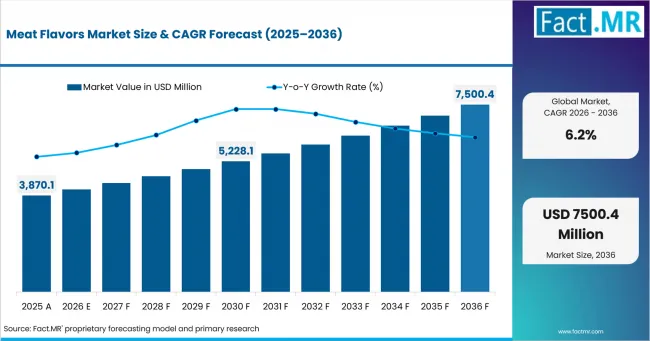
Meat Flavors Market Market Value Analysis | Source: Fact.MR
What are the defining numbers behind Meat Flavors Market growth?
USD 3,630.3 million absolute opportunity by 2036, led by Natural Flavor and Beef Flavor alongside Processed Meat applications.
- Demand Drivers in the Market
- Processed-meat manufacturers need stable roasted and grilled notes because thermal processing often weakens recognizable meat aromas during commercial production.
- Seasoning formulators need concentrated flavor systems that survive dry blending and deliver repeatable profiles across snacks and instant foods.
- Ready-meal brands need label-compatible flavor tools while recipes face sodium targets and tighter scrutiny of smoke flavoring inputs.
- Industrial ingredient distributors need format flexibility so customers switch among liquid and powder formats or higher-viscosity paste systems without redesigning formulations.
- Key Segments Analyzed
- By Type: Natural Flavor is expected to hold 63% share in 2026 supported by label clarity and broader work on source-specific reaction profiles.
- By Source: Beef is projected to account for 31% share in 2026 owing to broad use across broths and sauces alongside processed-meat recipes.
- By Form: Liquid is anticipated to capture 46% share in 2026 shaped by accurate dosing and rapid dispersion across industrial wet-processing lines.
- By Application: Processed Meat is estimated to represent 34% share in 2026 attributable to direct use in cooked and cured product formulation.
- By Distribution Channel: Hypermarkets & Supermarkets are forecast to account for 31% share in 2026 driven by packaged savory-food turnover in the channel framework.
- Analyst Opinion at Fact.MR
- Shambhu Nath Jha, Senior Analyst at Fact.MR, states: “Meat flavor sourcing is becoming a formulation problem that extends beyond selecting a single savory note. Adoption is expected to favor suppliers that prove flavor stability under retort and extrusion conditions while documenting source claims clearly. Product teams are expected to combine reaction flavor chemistry with culinary validation and application support.”
- Strategic Implications
- Flavor houses should validate beef and chicken profiles under real processing conditions before presenting application claims to industrial food manufacturers.
- Processed-meat formulators should compare thermal stability and salt interaction before replacing established flavor systems across high-volume production lines.
- Seasoning blenders should maintain separate development routes for dry powders and wet systems because dispersion behavior changes final flavor release.
- Ingredient distributors should document source claims and regulatory status clearly before extending meat-flavor portfolios across multiple national markets.
dsm-firmenich broke ground on a Parma production facility in June 2025 to expand concentrated powder flavors and reaction flavors. The site is scheduled for completion during the first quarter of 2027 and is designed to support culinary blends alongside functional blends. The move reflects the market shift toward reaction-flavor capacity and format engineering for savory products that require repeatable processing performance.
Germany is expected to record a 6.5% CAGR through 2036 driven by processed-meat manufacturing depth and established culinary formulation capabilities. India is projected to post a 6.4% CAGR through 2036 supported by poultry processing and expanding packaged-food production. The United Kingdom is anticipated to advance at a 6.3% CAGR through 2036 owing to recipe reformulation across meat products and prepared foods. China is estimated to record a 6.0% CAGR through 2036 attributable to a large meat-processing base and expanding convenience channels. Brazil is forecast to post a 5.9% CAGR through 2036 shaped by beef and poultry processing alongside localized seasoning development.
How does the Meat Flavors Market break down by segment?
Natural Flavor leads at 63%, Beef leads at 31%.
Which type dominates?
Natural Flavor holds 63% share in 2026.
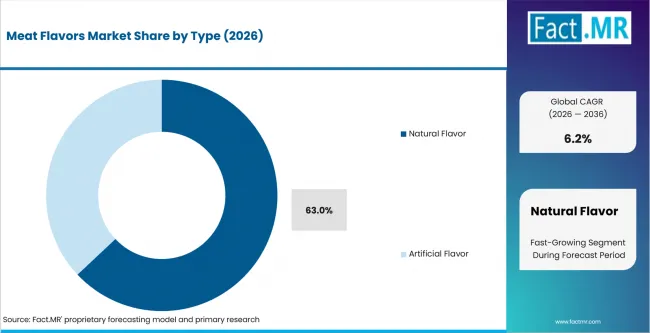
Meat Flavors Market Analysis By Type | Source: Fact.MR
Natural Flavor is expected to hold 63% share in 2026 supported by demand for source clarity and authentic culinary cues. Artificial Flavor remains relevant where formulators prioritize cost control and long processing stability across standardized recipes. Reaction-based natural profiles are expanding into roasted and grilled applications that require more specific aroma sequencing. Sensient introduced its BioSymphony natural flavor portfolio in June 2025 using biotransformation routes for food and beverage applications.
What leads the Source segment?
Beef holds 31% share in 2026.
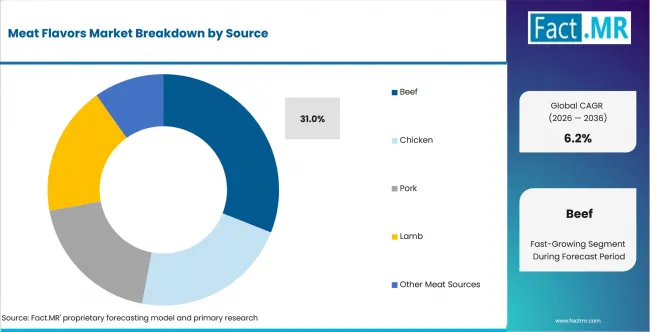
Meat Flavors Market Analysis By Source | Source: Fact.MR
Beef is projected to account for 31% share in 2026 owing to its broad use across broths and sauces alongside processed-meat recipes. Chicken follows across soups and snack seasonings where lighter savory profiles work across wider product families. Pork remains relevant for regional sausages and prepared foods while lamb profiles serve smaller culinary niches. In August 2025, USDA ERS estimated 226 pounds of red meat and poultry availability per United States consumer for 2025. A broad protein reference base keeps recognizable beef cues commercially relevant across retail foods and foodservice recipes.
How does Form shape demand?
Liquid holds 46% share in 2026.
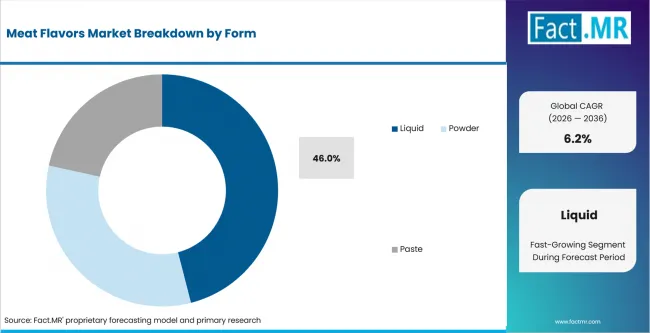
Meat Flavors Market Analysis By Form | Source: Fact.MR
Liquid is anticipated to capture 46% share in 2026 shaped by accurate dosing and rapid dispersion across sauces and marinades. Powder formats serve snack seasoning and dry soup production where low moisture and storage stability influence procurement. Paste formats support concentrated applications that need slower flavor release inside dense meat systems during mixing and thermal processing. In May 2024, IFF detailed six smoke-replacement profiles offered in powder and liquid formats for food producers preparing for European regulatory change.
What supports Processed Meat within Application?
Processed Meat is projected to hold 34% share in 2026.
Processed Meat is estimated to represent 34% share in 2026 attributable to direct flavor use in cooked and cured product systems. Savory Snacks follow where beef or chicken notes are layered with seasonings to create recognizable profiles. Soups & Sauces need flavor continuity after heat treatment while Ready Meals require stability through reheating. In December 2025, FAO reported that world meat production reached 374 million tonnes during 2024. That production base gives formulators many meat applications where repeatable flavor systems support product consistency during industrial processing.
What leads the Distribution Channel segment?
Hypermarkets & Supermarkets hold 31% share in 2026.
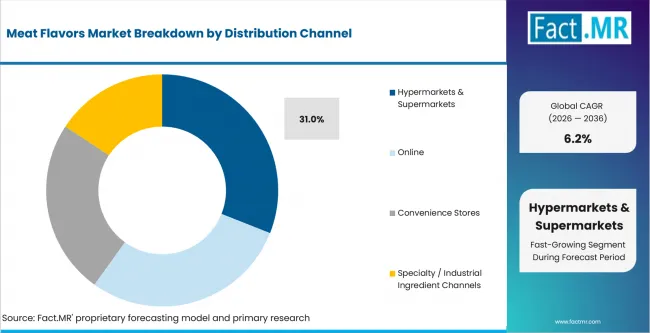
Meat Flavors Market Analysis By Distribution Channel | Source: Fact.MR
Hypermarkets & Supermarkets are forecast to account for 31% share in 2026. Specialty industrial ingredient channels remain central for bulk procurement and technical support across food factories. Online channels expand access for smaller brands and development teams that purchase trial quantities before larger qualification orders. In January 2026, China’s National Bureau of Statistics reported supermarket retail sales growth of 4.3% during 2025. Continued packaged-food turnover supports recurring product renovation cycles that pull meat-flavor systems into new formulations and line extensions.
What is accelerating Meat Flavors Market adoption, and what is holding it back?
Processed-food reformulation is anticipated to drive the market growth, regulatory transition costs restrain it.
Drivers Impact Analysis
| DRIVER | (~) % IMPACT ON CAGR | GEOGRAPHIC RELEVANCE | IMPACT TIMELINE |
|---|---|---|---|
| Processed meat and ready-meal reformulation around authentic cooked profiles | +0.8% | Asia Pacific and Europe | Medium term (2-4 years) |
| Natural flavor and source-transparent formulation requirements | +0.7% | Europe and North America | Medium term (2-4 years) |
| Smoke flavor transition and replacement development | +0.5% | European Union and United Kingdom | Short term (<= 2 years) |
| Sodium reduction programs increasing taste-modulation needs | +0.4% | Global with Europe emphasis | Medium term (2-4 years) |
| Localized beef and chicken profiles for convenience foods | +0.3% | China and India alongside Brazil | Long term (>= 4 years) |
Source: Fact.MR analysis. Updated Jul 7, 2026
- Processed-food reformulation: Food manufacturers are rebuilding savory recipes around clearer cooked and roasted profiles while maintaining processing consistency at commercial scale. Reformulation work expands flavor qualification across existing products instead of relying only on new launches. Product teams are expected to favor suppliers that validate taste under the same thermal conditions used during factory production.
- Natural flavor positioning: Brands are asking formulators for clearer sourcing logic and fewer ambiguous flavor descriptions across packaged foods. Natural reaction routes and biotransformation tools give flavor houses more ways to build specific meat cues from documented inputs. Adoption is projected to expand where technical teams provide both sensory evidence and regulatory documentation for each intended market.
- Smoke flavor transition: European regulatory changes are forcing manufacturers to review smoke flavor systems used across meat and savory recipes. In July 2024, the European Commission removed entries SF-001 to SF-010 from the Union list of authorized smoke flavor primary products. Replacement work is anticipated to increase application testing because alternative systems must reproduce smoke character without disrupting established product identity.
- Sodium reduction programs: Lower sodium targets create a taste problem when salt reduction changes body and perceived savory intensity across processed foods. In April 2024, the World Health Organization published updated sodium benchmarks covering 70 food subcategories. Flavor suppliers are estimated to gain more formulation work where umami and roasted notes help preserve product acceptance after salt reduction.
- Localized taste profiles: Regional food manufacturers need beef and chicken profiles that fit local cooking styles instead of uniform international taste references. Culinary teams increasingly compare broth depth and roast character against familiar dishes before approving industrial flavor systems. Demand is forecast to widen where local application kitchens shorten the distance between sensory development and factory trials.
Opportunity Impact Analysis
| OPPORTUNITY | (~) % IMPACT ON CAGR | GEOGRAPHIC RELEVANCE | IMPACT TIMELINE |
|---|---|---|---|
| Reaction flavor systems for heat-processed meat applications | +0.5% | Asia Pacific and Europe | Medium term (2-4 years) |
| Powder flavor encapsulation for snacks and dry meals | +0.4% | India and China | Medium term (2-4 years) |
| Smoke-replacement systems for European meat formulations | +0.4% | Europe and United Kingdom | Short term (<= 2 years) |
| Localized beef and chicken profiles for high-output protein markets | +0.3% | Brazil and India | Long term (>= 4 years) |
Source: Fact.MR analysis. Updated Jul 7, 2026
- Reaction flavor systems: Heat-processed foods create room for reaction flavors that build roasted character while remaining stable through retort or extrusion conditions. Suppliers are projected to invest more effort in application testing that links sensory targets to actual factory temperatures. Suppliers that move from bench formulation to plant validation without changing the intended meat profile gain a clearer route to production approval.
- Powder flavor engineering: Snack seasonings and dry meal systems need flavors that disperse evenly and remain stable during storage before consumer preparation. Encapsulation work helps manage controlled aroma release while protecting volatile notes inside low-moisture products during storage and preparation. Opportunity is expected to expand where suppliers combine powder processing knowledge with direct seasoning application support for regional manufacturers.
- Smoke replacement systems: European meat formulators need alternatives that preserve familiar smoked profiles while regulatory transition periods move closer to completion. Replacement programs require sensory matching and process trials because smoke character affects aroma depth alongside color perception. Development activity is anticipated to concentrate on systems that provide repeatable character across sausages and ready meals without broad recipe disruption.
- Localized protein profiles: Brazil and India offer formulation opportunities because large protein industries create many regional meat and poultry references for product developers. In March 2026, IBGE reported that Brazil slaughtered 6.69 billion chickens during 2025. Local application teams are forecast to benefit where they translate those culinary references into scalable chicken profiles for snacks and prepared foods.
Restraints Impact Analysis
| RESTRAINT | (~) % IMPACT ON CAGR | GEOGRAPHIC RELEVANCE | IMPACT TIMELINE |
|---|---|---|---|
| Regulatory cost for smoke-flavor replacement | -0.5% | Europe and United Kingdom | Short term (<= 2 years) |
| Natural ingredient price and source volatility | -0.4% | Global | Medium term (2-4 years) |
| Flavor instability during retort and extrusion processing | -0.3% | Global industrial processors | Medium term (2-4 years) |
| Channel mismatch between retail framing and industrial ingredient procurement | -0.2% | Global | Long term (>= 4 years) |
Source: Fact.MR analysis. Updated Jul 7, 2026
- Regulatory transition cost: Smoke flavor replacement requires laboratory work and plant trials before a manufacturer changes an established meat product. The July 2024 European Union phase-out framework allows the affected primary products to remain on the market until July 1, 2029. Near-term adoption is expected to slow where technical teams must reformulate several products while preserving familiar sensory profiles and production yields.
- Natural input volatility: Natural flavor systems depend on agricultural feedstocks and processing inputs that do not move with uniform cost or availability. A source change also triggers sensory review because minor raw-material variation often alters roasted or fatty notes. Procurement teams are projected to qualify secondary sources more carefully where continuity has a direct bearing on high-volume recipes.
- Process stability risk: Retort cooking and extrusion expose flavor systems to heat conditions that often flatten top notes or distort intended meat character. Laboratory samples do not always predict final sensory performance after scale-up inside industrial equipment and commercial heat-processing conditions. Adoption is anticipated to remain selective when suppliers cannot demonstrate stability under the customer process profile before full production approval.
- Channel structure mismatch: The segmentation includes consumer retail channels while industrial meat flavors are commonly purchased through direct technical and ingredient distribution relationships. That structural difference complicates channel interpretation unless retail turnover is treated as a downstream demand signal. The channel view becomes more useful when commercial teams separate ingredient procurement routes from packaged-food sales signals.
Which countries are scaling Meat Flavors Market fastest?
Germany 6.5%, India 6.4%, United Kingdom 6.3%, China 6.0%, Brazil 5.9% through 2036.
Regional analysis covers North America, Europe, Asia Pacific, Central & South America, and the Middle East & Africa.
| COUNTRY | CAGR |
|---|---|
| Germany | 6.5% |
| India | 6.4% |
| United Kingdom | 6.3% |
| China | 6.0% |
| Brazil | 5.9% |
Source: Fact.MR analysis. Updated Jul 7, 2026
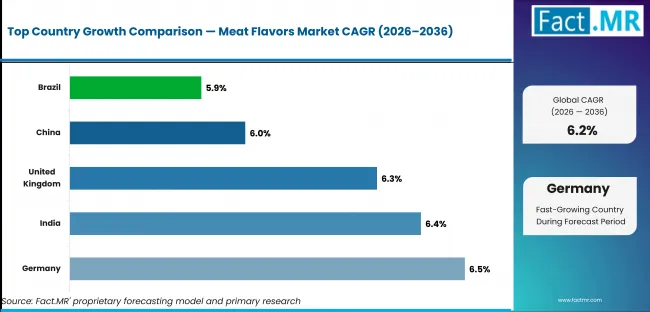
Meat Flavors Market Cagr Analysis By Country | Source: Fact.MR
What is driving Germany's growth through 2036?
6.5% CAGR through 2036, driven by processed-meat manufacturing and culinary formulation depth.
Germany retains a large meat-processing base that gives flavor houses recurring reformulation work across industrial accounts. In February 2025, Destatis reported 6.9 million tonnes of meat production during 2024. The market is expected to record a 6.5% CAGR through 2036 supported by technical application capabilities around cooked meat profiles.
How is India scaling Meat Flavors demand?
6.4% CAGR through 2036, supported by poultry processing and packaged-food expansion.
India combines rising poultry output with a growing packaged-food manufacturing base that needs familiar chicken and grilled profiles at scale. In November 2025, the Department of Animal Husbandry and Dairying reported total meat production of 10.50 million tonnes during 2024-25. The market is projected to expand at a 6.4% CAGR through 2036 as local application teams translate regional dishes into stable industrial flavor systems.
What supports the United Kingdom outlook?
6.3% CAGR through 2036, owing to meat-product reformulation and prepared-food development.
United Kingdom manufacturers face continuing recipe work across sausages and prepared foods where taste retention must survive reformulation pressure. In July 2025, DEFRA reported UK pig meat production of 920 thousand tonnes during 2024, confirming an established base for pork-profile development. Demand is anticipated to post a 6.3% CAGR through 2036 owing to frequent product renovation and strong retailer involvement in specifications.
What underpins China’s growth?
6.0% CAGR through 2036, attributable to processing scale and expanding convenience channels.
China offers broad processing scale for beef and chicken profiles used in instant foods, sauces and prepared meat products. In February 2026, the National Bureau of Statistics reported combined meat output of 100.72 million tonnes during 2025. The market is estimated to record a 6.0% CAGR through 2036 as domestic product teams seek localized roast character and faster formulation support near manufacturing clusters.
How is Brazil developing Meat Flavors demand?
5.9% CAGR through 2036, shaped by beef processing and poultry-based food formulation.
In March 2026, IBGE reported 42.94 million cattle slaughtered during 2025, reflecting the scale of Brazil’s local beef reference base. The Brazilian market is forecast to post a 5.9% CAGR through 2036 shaped by local seasoning preferences and export-oriented food processing. Local application teams benefit from distinct beef and poultry references when adapting industrial flavor systems to regional recipes.
Who leads the Meat Flavors Market?
Givaudan and Kerry Group lead direct meat-flavor coverage, while IFF and Symrise strengthen smoke and processed-meat formulation capabilities.
Givaudan brings a broad food flavor portfolio and local application support across savory product programs. Kerry Group added Smart Taste in September 2025, combining flavor expertise and food science to address cost pressure and supply risk. The range also targets recipe changes required by new nutrition rules and other regulations. IFF contributes culinary application support across processed foods and savory formulations. These companies compete on taste accuracy and heat stability, while application teams translate recipe targets into scalable production formulas.
Symrise expanded Barcelona application labs for ready meals and processed meat in April 2026, adding local testing and production-scale support. In August 2025, dsm-firmenich announced a Kerala seasoning plant expansion designed to increase tailored seasoning capacity for Asia and the Middle East. Sensient provides broader savory flavor capabilities for processed foods, while Takasago adds flavor research and regional market knowledge to the provider set. Competition through 2036 is expected to be shaped by clear source documentation, process testing and local application support.
Which companies are the key providers?
Givaudan and Kerry Group are key providers. IFF and Symrise are also profiled. dsm-firmenich, Sensient Technologies and Takasago complete the company set.
- Givaudan
- Kerry Group
- International Flavors & Fragrances (IFF)
- Symrise AG
- dsm-firmenich
- Sensient Technologies Corporation
- Takasago International Corporation
Bibliography
- Brazilian Institute of Geography and Statistics. (2026, March 18). In 2025, Brazil registers the highest production of milk, leather and eggs in history, slaughter of cattle, chickens and pigs also hits record. IBGE News Agency.
- Department of Animal Husbandry and Dairying. (2025, November 26). Basic Animal Husbandry Statistics 2025. Government of India.
- Department for Environment, Food & Rural Affairs. (2025, July 10). Chapter 8: Livestock. GOV.UK.
- dsm-firmenich. (2025, June 4). dsm-firmenich breaks ground on new state-of-the-art production facility for the development of flavors and functional blends in Parma, Italy. dsm-firmenich.
- dsm-firmenich. (2025, August 26). dsm-firmenich unveils major plant investments, emphasizing commitment to shaping the future of flavor in India. dsm-firmenich.
- European Commission. (2024, July 31). Commission Implementing Regulation (EU) 2024/2067 of 31 July 2024 amending Implementing Regulation (EU) No 1321/2013 as regards the deletion of entries SF-001 to SF-010 from the Union list of authorised smoke flavouring primary products. Official Journal of the European Union.
- Food and Agriculture Organization of the United Nations. (2025, December 31). Agricultural production statistics 2010-2024. Food and Agriculture Organization of the United Nations.
- Givaudan. (2026, January 29). 2025 full year results. Givaudan.
- Grossen, G. (2025, August 21). Per capita availability of red meat and poultry projected higher in 2025 and 2026. U.S. Department of Agriculture, Economic Research Service.
- International Flavors & Fragrances Inc. (2024, May 7). Smoke-flavor replacement solutions: Supplanting smoke condensates. IFF.
- Kerry Group. (2025, September 30). Kerry launches Smart Taste to help customers navigate market complexities without compromising on taste. Kerry Group.
- National Bureau of Statistics of China. (2026, January 20). Total retail sales of consumer goods in December 2025. National Bureau of Statistics of China.
- National Bureau of Statistics of China. (2026, February 28). Statistical communiqué of the People’s Republic of China on the 2025 national economic and social development. National Bureau of Statistics of China.
- Sensient Flavors & Extracts. (2025, June 25). Sensient Flavors & Extracts introduces BioSymphony. Sensient Technologies Corporation.
- Statistisches Bundesamt. (2025, February 7). Fleischproduktion im Jahr 2024 um 1,4 % gestiegen. Destatis.
- Symrise AG. (2026, April 30). Building Bridges: Symrise strengthens Food & Beverage capabilities in Barcelona and shortens distances. Symrise AG.
- Takasago International Corporation. (2025, December 25). Integrated Report 2025 has been published. Takasago International Corporation.
- World Health Organization. (2024, April 17). WHO global sodium benchmarks for different food categories, 2nd ed. World Health Organization.
This Report Addresses
- The report provides strategic intelligence on Meat Flavors across Type and Source choices that shape industrial food formulation programs.
- Segment analysis identifies Natural Flavor and Beef as the leading segments within the 2026 market structure.
- Regional outlook evaluates Germany and India alongside the United Kingdom while China and Brazil complete the country growth comparison.
- Competitive analysis profiles Givaudan and Kerry Group alongside IFF and Symrise, followed by three additional active savory flavor providers.
- Type assessment covers Natural Flavor and Artificial Flavor systems across industrial formulation needs that require different sourcing and performance logic.
- Use-case assessment covers Processed Meat and Savory Snacks alongside Soups & Sauces, Ready Meals and Pet Food applications.
- The forecast uses official production statistics and regulator evidence alongside company portfolio checks to interpret market values and growth assumptions.
What does the Meat Flavors Market cover?
Natural Flavor, Artificial Flavor, Beef Flavor, and Chicken Flavor systems used to reproduce meat taste in food formulations.
The Meat Flavors Market covers flavor systems designed to create or reinforce recognizable meat profiles across industrial food applications. Coverage includes natural and artificial routes that reproduce Beef and Chicken cues alongside Pork and Lamb profiles in different processing formats.
The market differs from meat commodities because commercial value comes from concentrated flavor function and formulation support. Whole meat products and general seasoning blends remain outside the boundary unless their principal commercial function is delivery of a defined meat profile.
What is included in the scope?
Meat flavor systems used in processed foods and seasoning formulations across industrial production environments.
The scope includes Natural Flavor and Artificial Flavor systems across Beef and Chicken profiles alongside Pork and Lamb profiles. Coverage spans liquid and powder formats alongside paste systems used in Processed Meat and Savory Snacks. Soups & Sauces, Ready Meals and Pet Food are included when a defined meat profile is the purchased function. Adjacent work on natural flavor systems informs source positioning, while seasoning and spice blends provide downstream application context. Coverage also considers retail channel signals and specialty industrial ingredient routes because both influence product renovation activity across the segmentation framework.
What is excluded from the scope?
Whole meat ingredients and standalone smoke flavor primary products are outside the scope.
The scope excludes meat and poultry commodities sold as food instead of concentrated flavoring systems. General seasoning blends are excluded unless the principal commercial function is delivery of a defined meat profile. Standalone smoked dextrose ingredients remain adjacent inputs unless they are formulated and sold within a meat-flavor system for a defined food application.
How was the analysis built?
120+ sources, 40+ company portfolios, 25+ countries, 20+ interviews.
- Primary Research:
- Primary research includes interviews with flavor manufacturers, savory ingredient suppliers, processed-meat formulators and seasoning blenders. It also includes input from food technologists, procurement managers, application specialists and distributor sales teams involved in meat flavor development and commercialization.
- Desk Research:
- Desk research reviews official livestock production statistics, food ingredient regulations, savory flavor product portfolios, smoke-flavor regulatory updates and supplier product catalogs. Company announcements, technical publications and food-processing industry reports are also evaluated to assess market developments and competitive positioning.
- Market-Sizing and Forecasting:
- Forecasting uses meat-processing activity, packaged-food production trends, flavor attachment rates, application-specific demand, natural versus artificial flavor adoption and average ingredient pricing. Forecast models also consider reformulation activity, regional consumption patterns and flavor format preferences across end-use applications.
- Data Validation and Update Cycle:
- Forecasts are validated through supplier checks and industry interviews that test assumptions on product demand, sourcing trends and application adoption. Portfolio mapping, regional demand assessment and distributor feedback help confirm market direction, while ongoing reviews of regulatory developments and company product launches support forecast updates.
Segmentation
What is the report’s scope and coverage?
| Attribute | Details |
|---|---|
| Quantitative Units | USD Million in 2026 to USD Million by 2036 |
| Market Definition | Concentrated flavor systems designed to create or reinforce recognizable meat profiles across processed foods and industrial savory formulations |
| Type | Natural Flavor; Artificial Flavor; Reaction-based Natural Profiles |
| Source | Beef; Chicken; Pork; Lamb; Other Meat Profiles |
| Form | Liquid; Powder; Paste |
| Application | Processed Meat; Savory Snacks; Soups & Sauces; Ready Meals; Pet Food |
| Distribution Channel | Hypermarkets & Supermarkets; Specialty Industrial Ingredient Channels; Online Channels |
| Regions Covered | North America; Europe; Asia Pacific; Central and South America; Middle East and Africa |
| Countries Covered | Germany; India; United Kingdom; China; Brazil |
| Key Companies Profiled | Givaudan; Kerry Group; International Flavors & Fragrances (IFF); Symrise AG; dsm-firmenich; Sensient Technologies Corporation; Takasago International Corporation |
| Forecast Period | 2026 to 2036 |
| Approach | Hybrid top-down and bottom-up approach using meat-processing activity; packaged-food production; flavor attachment rates; natural and artificial flavor adoption; reformulation cycles; format preferences and supplier validation |
Source: Fact.MR analysis. Updated Jul 7, 2026
How is the market segmented?
-
By Type:
- Natural Flavor
- Artificial Flavor
-
By Source:
- Beef
- Chicken
- Pork
- Lamb
- Other Meat Profiles
-
By Form:
- Liquid
- Powder
- Paste
-
By Application:
- Processed Meat
- Savory Snacks
- Soups & Sauces
- Ready Meals
- Pet Food
-
By Distribution Channel:
- Hypermarkets & Supermarkets
- Specialty Industrial Ingredient Channels
- Online Channels
- Other Channels
-
Region:
- North America
- United States
- Canada
- Europe
- Germany
- United Kingdom
- France
- Italy
- Spain
- Asia Pacific
- India
- China
- Japan
- South Korea
- Australia
- Central & South America
- Brazil
- Argentina
- Mexico
- Chile
- Middle East & Africa
- UAE
- Saudi Arabia
- South Africa
- North America
Frequently Asked Questions
Which Type leads the Meat Flavors Market?
Which Source leads the Meat Flavors Market?
Which Form leads the Meat Flavors Market?
Which Application leads the Meat Flavors Market?
Which Distribution Channel leads the Meat Flavors Market?
Which country records the highest CAGR in the Meat Flavors Market?
How does India perform in the Meat Flavors Market?
How does the United Kingdom perform in the Meat Flavors Market?
How does China perform in the Meat Flavors Market?
How does Brazil perform in the Meat Flavors Market?
What is the primary driver in the Meat Flavors Market?
What is the main restraint in the Meat Flavors Market?
Why is Natural Flavor important?
Why do processed-meat manufacturers dominate demand?
Who worked on this report


Preview the report firsthand - request a free sample
Free SampleGet the brochure for pricing and purchase details
Download PDF