- Base Value(2025): 11.60 Bn
- Estimated Value(2026): 12.66 Bn
- Forecast Value (2036): 30.24 Bn
- CAGR (2026 - 2036): 9.1%
Fluoropolymers Market Size, Market Forecast and Outlook By Fact.MR
The fluoropolymers market was valued at USD 11.60 billion in 2025, projected to reach USD 12.66 billion in 2026, and is forecast to expand to USD 30.24 billion by 2036 at a 9.1% CAGR. Semiconductor fabrication facility construction programs requiring ultra-pure PTFE and PFA piping systems and lithium-ion battery production lines specifying PVDF binder materials are creating sustained procurement pressure for fluoropolymer resins across global manufacturing corridors. Chemical process engineers that once specified fluoropolymer components only for extreme corrosion service now mandate PTFE and FEP linings across entire fluid handling systems to eliminate contamination risk in high-purity manufacturing environments.
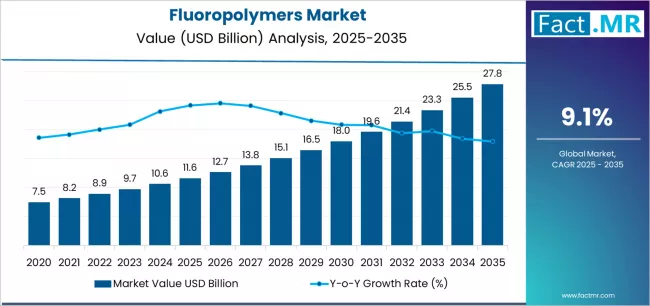
Fluoropolymers Market Market Value Analysis | Source: Fact.MR
Summary of Fluoropolymers Market
- Market Overview
- The fluoropolymers market is valued at USD 11.60 billion in 2025 and is projected to reach USD 30.24 billion by 2036.
- The industry is expected to grow at a 9.1% CAGR from 2026 to 2036, creating an incremental opportunity of USD 17.58 billion.
- The market is a high-performance polymer category where semiconductor ultra-purity requirements, battery PVDF binder demand, chemical process corrosion resistance, and PFAS regulatory dynamics define competitive positioning.
- Demand and Growth Drivers
- Demand is accelerating as semiconductor fabrication facilities require ultra-pure PTFE and PFA piping systems for contamination-free fluid handling.
- Lithium-ion battery production lines are driving PVDF binder material consumption as global battery manufacturing capacity expands.
- Chemical process engineers are expanding fluoropolymer specification from extreme corrosion service to entire fluid handling systems in high-purity manufacturing environments.
- Among key countries, India leads at 12.0% CAGR, followed by China at 10.5%, South Korea at 9.0%, the USA at 8.2%, Germany at 7.5%, the UK at 7.3%, and Japan at 7.0%.
- Product and Segment View
- Fluoropolymers are high-performance thermoplastic and elastomeric polymers containing fluorine atoms that provide chemical inertness, thermal stability, low friction, and electrical insulation properties unmatched by conventional polymers.
- Primary applications span industrial process equipment linings, semiconductor fluid handling, battery electrode binders, automotive seals and gaskets, and architectural membranes.
- PTFE leads by Product with 65.1% share in 2026.
- Industrial Processing leads by Application with 31.0% share in 2026.
- Scope includes PTFE, PVDF, FEP, PFA, ETFE, fluoroelastomers, and other fluoropolymer resins, excluding fluorosurfactants, fluorinated gases, and fluorocarbon solvents.
- Geography and Competitive Outlook
- India and China are the fastest-growing markets due to chemical processing expansion, battery manufacturing PVDF demand, and semiconductor facility construction, while the USA and South Korea represent mature high-specification markets driven by semiconductor purity requirements.
- Competition is shaped by fluoropolymer polymerization technology, PFAS-compliant production processes, and semiconductor-grade material qualification status.
- Key companies include The Chemours Company, Daikin Industries, Ltd., 3M Company, Solvay S.A., Arkema S.A., AGC Chemicals, Dongyue Group Limited, Gujarat Fluorochemicals Limited, Halopolymer OJSC, and Kureha Corporation.
- Analyst Opinion at Fact.MR
- Shambhu Nath Jha', Principal Consultant for Chemicals and Materials, opines: 'In my analysis, I have observed that the true supply chain risk in fluoropolymers is not production capacity but the regulatory uncertainty surrounding PFAS classification that could disrupt established polymerization processes. Manufacturers investing in alternative non-PFAS-assisted polymerization technologies face 3 to 5 year development timelines before achieving production-grade material quality equivalent to current processes. Semiconductor fabrication facilities specifying ultra-pure fluoropolymer piping cannot accept material quality variations during process transitions. Companies delaying closed-loop production system investments face increasing regulatory compliance costs and potential production authorization restrictions in key manufacturing jurisdictions.'
- Strategic Implications / Executive Takeaways
- Fluoropolymer producers must invest in closed-loop production systems and alternative non-PFAS-assisted polymerization technologies to maintain regulatory compliance across major manufacturing jurisdictions.
- Semiconductor facility procurement teams should establish multi-year fluoropolymer supply agreements with producers demonstrating PFAS-compliant production capability to secure material availability during regulatory transition periods.
- Battery cell manufacturers must qualify multiple PVDF binder suppliers with documented regulatory compliance status to avoid supply disruption as PFAS restrictions tighten in European and North American markets.
Fluoropolymers Market Key Takeaways
| Metric | Details |
|---|---|
| Industry Size (2026) | USD 12.66 billion |
| Industry Value (2036) | USD 30.24 billion |
| CAGR (2026 to 2036) | 9.1% |
Source: Fact.MR analysis. Updated Apr 8, 2026
Source: Future Market Insights, 2026
The absolute dollar opportunity of USD 17.58 billion between 2026 and 2036 reflects expanding specification-driven consumption across semiconductor, battery, chemical processing, and automotive seal and gasket applications. PTFE dominates volume consumption through gaskets, seals, tube linings, and non-stick coatings, while PVDF captures growth in lithium-ion battery electrode binder applications and architectural membrane structures. Fluoroelastomer demand from automotive powertrain seal applications remains structurally tied to vehicle production volumes and increasingly stringent fuel system emission standards. PFAS regulatory scrutiny creates supply chain uncertainty for some fluoropolymer production processes, forcing manufacturers to invest in closed-loop production systems and alternative polymerization technologies.
All major fluoropolymer consumption corridors reflect accelerated growth. India sets the pace with a 12.0% CAGR as chemical processing, pharmaceutical, and electronics manufacturing expand fluoropolymer specification volumes. China follows at 10.5% with battery manufacturing PVDF demand and semiconductor facility construction. South Korea tracks at 9.0% through semiconductor and display manufacturing ultra-pure fluid handling requirements. United States operations advance at 8.2%, supported by semiconductor fab construction incentives and chemical plant modernization. Germany registers a 7.5% pace anchored by automotive seal specifications and industrial chemical processing demand. United Kingdom expands at 7.3% through pharmaceutical and chemical processing fluoropolymer adoption. Japan tracks at 7.0% through semiconductor and electronics manufacturing specifications.
Imperatives for Stakeholders in Fluoropolymers Market
Design for extreme performance and reliability, not just chemical resistance
- Offer complete material solutions: advanced fluoropolymer grades + processing technical support + application engineering + performance validation systems + sustainability documentation platforms.
- Preconfigured material packages: semiconductor processing specifications, chemical handling configurations, automotive sealing programs, and combination polymer protocols for diverse industrial requirements.
Technical validation readiness for high-performance applications
- Comprehensive performance documentation, processing guidelines systems, and material infrastructure (thermal analysis, chemical compatibility, regulatory compliance protocols).
Affordability-by-design approach
- Cost-optimized polymer portfolios, flexible supply pricing models, manufacturer partnership programs, and transparent total material cost documentation.
Application engineering-focused market penetration
- Established materials processing workshops + comprehensive certification programs (polymer selection, fabrication techniques, performance optimization); direct OEM engagement for relationship development and material confidence building.
Segmental Analysis
The market segments by product into PTFE, PVDF, FEP, Fluoroelastomers, and Others, representing the evolution from general-purpose fluoropolymers toward specialized high-performance validation with processing capabilities, chemical resistance characteristics, and application-specific requirements.
The application segmentation shows Industrial Processing's commanding 31.0% position, followed by Electrical & Electronics, Automotive, Construction, and Others, demonstrating varied performance requirement specialization levels and chemical resistance infrastructure concentrations.
The segmentation structure reveals fluoropolymer evolution from basic chemical resistance technology toward comprehensive extreme-condition material platforms with enhanced thermal characteristics and multi-dimensional performance capabilities, while product diversity spans from commodity PTFE to specialized fluoroelastomers requiring advanced polymerization techniques.
What makes PTFE Command the Largest Share in the Fluoropolymers Market?
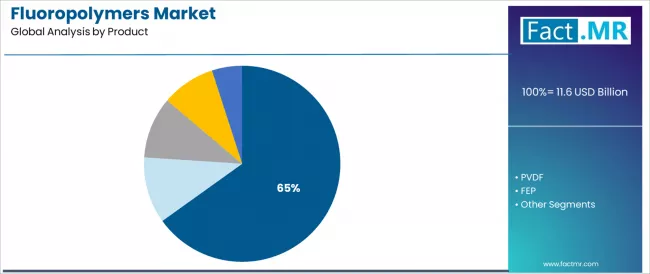
Fluoropolymers Market Analysis By Product | Source: Fact.MR
PTFE commands the leading position in the fluoropolymers market with a 65.1% market share through superior versatility characteristics, including universal chemical resistance, wide temperature range capability, and established manufacturing infrastructure that enable processors to achieve predictable performance outcomes across varied industrial applications and diverse processing demographics.
The segment benefits from property advantages through exceptional chemical inertness, lowest friction coefficient among polymers, and proven long-term stability without requiring complex processing procedures. Advanced polymer technology enables particle size optimization, dispersion formulation, and mechanical property customization, where non-stick performance and electrical insulation represent critical industrial application requirements.
Virgin PTFE resins hold significant share within the product segment, appealing to manufacturers seeking maximum purity capabilities for demanding applications. PTFE products differentiate through proven versatility profiles, established processing advantages, and integration with diverse fabrication protocols that enhance manufacturing flexibility while maintaining reliable performance outcomes for varied industrial applications.
Key market characteristics:
- Advanced chemical properties with universal solvent resistance and reproducible performance for extreme conditions
- Superior temperature stability, enabling continuous operation from -200°C to +260°C for industrial applications
- Comprehensive industry acceptance, including decades of proven installations and standard material inclusion for critical applications
Which Application Category Dominates in the Fluoropolymers Market?
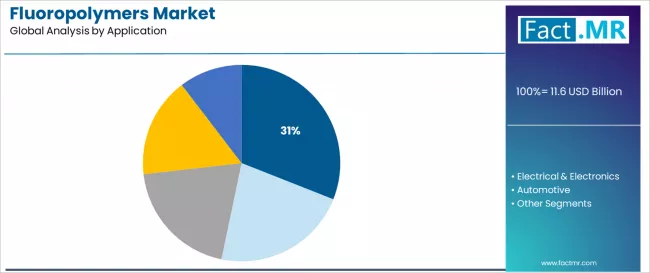
Fluoropolymers Market Analysis By Application | Source: Fact.MR
Industrial processing demonstrates application leadership in the fluoropolymers market with a 31.0% share due to widespread chemical handling requirements and established focus on corrosion prevention, process equipment lining, and chemical transfer that maximizes equipment longevity while maintaining consistent operational safety characteristics.
Chemical processors and equipment manufacturers prioritize industrial applications for critical corrosion resistance, comprehensive chemical compatibility, and integration with established processing workflows that enables coordinated production experiences across multiple chemical handling scenarios. The segment benefits from substantial chemical industry maturity and safety standard campaigns that emphasize fluoropolymer-based equipment delivery for critical chemical processing applications.
Chemical processing equipment lining captures significant share within the industrial processing segment, demonstrating manufacturer preference for long-term corrosion protection capabilities. Specialty chemical production expansion incorporates fluoropolymer linings as essential equipment protection protocols for aggressive chemical handling, while pharmaceutical manufacturing development increases cleanroom-compatible material demand that meets purity requirements and ensures contamination prevention capabilities.
What Establishes Asia Pacific's Geographic Leadership in Fluoropolymers?
Asia Pacific establishes geographic dominance in the fluoropolymers market with a 42.9% share through comprehensive electronics manufacturing concentration and sustained focus on semiconductor production, chemical processing expansion, and automotive component manufacturing that maximizes regional industrial output while maintaining cost-competitive production.
Electronics manufacturers and chemical processors prioritize Asia Pacific locations for established manufacturing ecosystems, supply chain integration, and cost-effective production that enables competitive manufacturing across multiple industrial sectors. The region benefits from substantial semiconductor industry infrastructure that emphasizes fluoropolymer material delivery for advanced technology applications.
Semiconductor fabrication expansion incorporates fluoropolymer materials as critical processing components for wafer handling equipment, while electronics miniaturization increases high-performance dielectric demand that meets signal integrity requirements and ensures thermal management capabilities.
Regional dynamics include:
- Strong growth in China semiconductor manufacturing requiring ultra-pure fluoropolymer materials and contamination-free processing
- Increasing adoption in South Korea electronics for 5G infrastructure and advanced display technology
- Rising integration with Taiwan semiconductor fabs for advanced node processing and equipment material requirements
What are the Drivers, Restraints, and Key Trends of the Fluoropolymers Market?
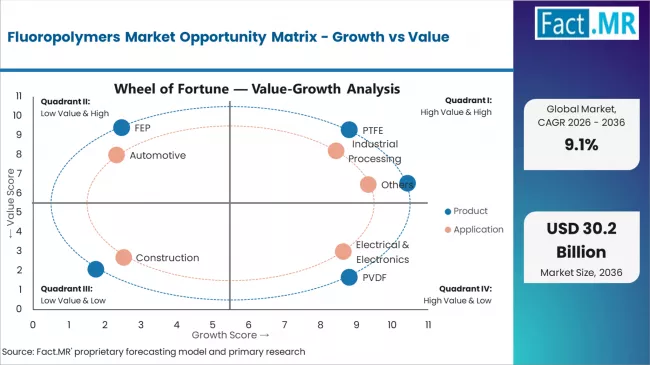
Fluoropolymers Market Opportunity Matrix Growth Vs Value | Source: Fact.MR
| Category | Factor | Impact | Why It Matters |
|---|---|---|---|
| Driver | Rising semiconductor manufacturing and electronics miniaturization (5G deployment, advanced nodes) | ★★★★★ | Technology advancement enables fluoropolymer demand for extreme purity validation; increasing chip production drives material adoption across semiconductor markets and diverse fabrication segments. |
| Driver | Growth in electric vehicle production and battery systems (automotive electrification, energy storage) | ★★★★★ | Drives demand for high-temperature sealing systems and chemical-resistant components; manufacturers providing reliable EV materials gain competitive advantage in mobility-focused industrial segments. |
| Driver | Chemical processing expansion and corrosion prevention requirements (specialty chemicals, pharmaceuticals) | ★★★★☆ | Processors demand chemically-inert materials and long-lasting equipment protection; chemical industry growth expanding addressable segments beyond traditional industrial demographics and conventional polymer clientele. |
| Restraint | High material costs & processing complexity (expensive raw materials, specialized fabrication) | ★★★★☆ | Cost-conscious manufacturers face budget limitations and material selection constraints, restricting fluoropolymer adoption and affecting penetration in price-sensitive applications and commodity product segments. |
| Restraint | Environmental concerns & PFAS regulations (regulatory scrutiny, sustainability pressures) | ★★★☆☆ | Environmentally-focused markets face regulatory limitations and public perception challenges; increases compliance complexity and affects adoption patterns in consumer-facing applications and environmentally-sensitive sectors. |
| Trend | Advanced semiconductor materials and ultra-high purity grades (leading-edge nodes, contamination control) | ★★★★★ | Growing demand for extreme-purity fluoropolymers and specialized processing materials beyond conventional industrial grades; semiconductor advancement becomes core differentiation strategy for high-value material positioning. |
| Trend | Sustainable fluoropolymer development and recycling initiatives (circular economy, alternative chemistries) | ★★★★☆ | Material selection evolving beyond traditional fluoropolymers toward environmentally responsible alternatives; sustainability positioning drives enhanced regulatory acceptance and market access in regulated environments. |
Source: Fact.MR analysis. Updated Apr 8, 2026
Analysis of the Fluoropolymers Market by Key Countries
The fluoropolymers market demonstrates robust regional growth dynamics with emerging leaders including India (10.9% CAGR) and China (10.5% CAGR) driving expansion through electronics manufacturing programs and semiconductor infrastructure development. Strong performers encompass Japan (9.8% CAGR) and USA (9.1% CAGR), benefiting from established semiconductor infrastructure and advanced technology adoption demographics. Developed markets feature Germany (8.7% CAGR), Brazil (8.2% CAGR), and UAE (7.9% CAGR), where chemical processing normalization and industrial application expertise support consistent growth patterns.
Regional synthesis reveals Asian markets leading adoption through comprehensive electronics capacity positioning and semiconductor production expansion, while Western countries demonstrate measured growth potential supported by automotive electrification preferences and chemical processing influence. North American and European markets show solid development driven by advanced manufacturing integration and specialty chemical infrastructure.
.webp "Top Country Growth Comparison Fluoropolymers Market Cagr (2026 2036)")
Top Country Growth Comparison Fluoropolymers Market Cagr (2026 2036) | Source: Fact.MR
| Region/Country | 2025-2035 Growth | How to win | What to watch out |
|---|---|---|---|
| India | 10.9% | Focus on electronics manufacturing portfolios | Infrastructure gaps; technical expertise |
| China | 10.5% | Lead with semiconductor-grade positioning | PFAS regulations; environmental scrutiny |
| Japan | 9.8% | Provide ultra-high purity materials | Market maturity; domestic competition |
| USA | 9.1% | Offer specialty application solutions | Regulatory complexity; PFAS concerns |
| Germany | 8.7% | Maintain automotive excellence positioning | Environmental regulations; cost pressures |
| Brazil | 8.2% | Deliver chemical processing solutions | Economic volatility; infrastructure limitations |
| UAE | 7.9% | Push industrial application programs | Market size limitations; regional competition |
Source: Fact.MR analysis. Updated Apr 8, 2026
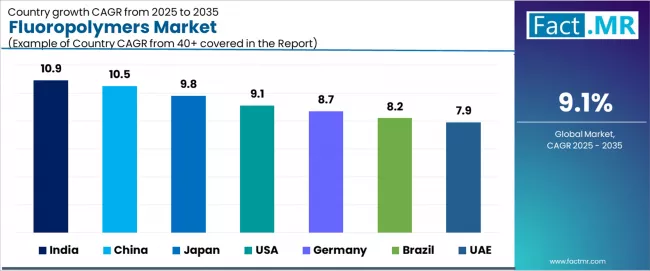
Fluoropolymers Market Cagr Analysis By Country | Source: Fact.MR
India Drives Fastest Market Growth
India establishes fastest market growth through progressive electronics manufacturing expansion and comprehensive semiconductor infrastructure development, positioning fluoropolymer technologies as essential material solutions in electronics facilities and emerging chemical processing complexes.
The country's 10.9% growth rate reflects rising technology investment levels supporting advanced material procurement spending and growing manufacturing sectors that encourage the deployment of high-performance polymers in diverse industrial settings. Growth concentrates in major technology clusters, including Bangalore, Hyderabad, and Gujarat, where manufacturing facilities showcase increasing capacity for advanced material adoption that appeal to quality-focused producers demanding chemical resistance and thermal stability outcomes.
Indian manufacturers are developing material specification protocols that combine international fluoropolymer technologies with domestic processing partnerships, including local fabrication expansion and technical support network growth. Distribution channels through specialty chemical distributors and industrial material suppliers expand market access, while technical training initiatives support adoption across diverse facility types and manufacturing specialization levels.
China Emerges as Semiconductor Materials Powerhouse
In Shanghai, Beijing, and Jiangsu regions, semiconductor facilities and electronics manufacturers are adopting advanced fluoropolymer technologies as essential processing materials for fabrication operations, driven by increasing technology independence goals and elevation of material purity expectations that emphasize the importance of ultra-clean polymers.
The market holds a 10.5% growth rate, supported by semiconductor park development and advanced materials infrastructure investment that promote fluoropolymer adoption for technology applications. Chinese manufacturers are favoring domestically produced high-purity fluoropolymers that provide comprehensive quality documentation and competitive pricing, particularly appealing in semiconductor clusters where material cleanliness and supply security represent critical operational factors.
Market expansion benefits from substantial semiconductor industry investment and fluoropolymer production capacity establishment that enable widespread adoption of high-performance material methodologies for diverse technology applications. Industry adoption follows patterns established in technology manufacturing excellence, where material purity advantages and performance documentation drive manufacturer confidence and specification integration.
Japan Shows Ultra-High Purity Leadership
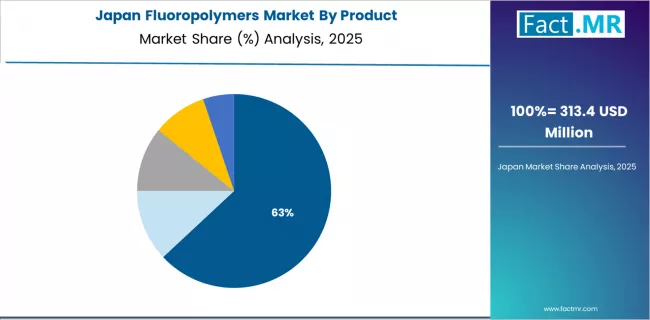
Fluoropolymers Market Japan Market Share Analysis By Product | Source: Fact.MR
Japan's sophisticated materials market demonstrates comprehensive fluoropolymer integration with documented quality emphasis in material purity and semiconductor application execution through leading electronics corporations and established chemical manufacturers. The country maintains a 9.8% growth rate, leveraging established materials engineering excellence and comprehensive quality oversight frameworks in fluoropolymer production.
Major manufacturing regions, including Tokyo, Osaka, and Kyushu semiconductor areas, showcase quality-driven material priorities where fluoropolymers integrate with established semiconductor cultures and meticulous processing practices to optimize fabrication reliability and maintain contamination control under rigorous cleanroom requirements.
Japanese manufacturers prioritize comprehensive purity documentation and semiconductor compatibility in fluoropolymer procurement implementation, creating demand for ultra-high-grade products with extensive analytical characterization, including trace metal analysis, particle count validation, and comprehensive outgassing data. The market benefits from established semiconductor leadership and quality-focused materials culture that provide premium positioning opportunities and comply with strict Japanese semiconductor material specifications.
USA Shows Advanced Technology Leadership
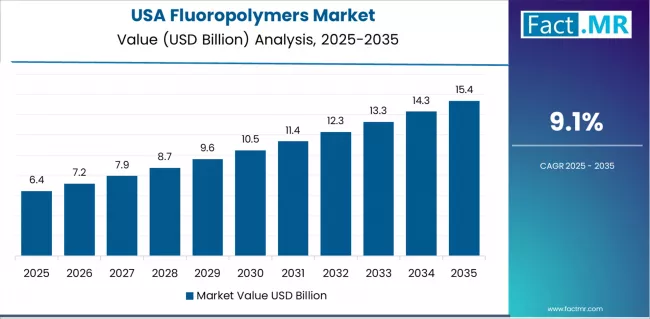
Fluoropolymers Market Country Value Analysis | Source: Fact.MR
USA establishes advanced technology leadership through comprehensive semiconductor infrastructure and established fluoropolymer ecosystem, integrating specialty polymers across chip fabrication facilities, aerospace manufacturers, and chemical processing operations. The country's 9.1% growth rate reflects established EPA regulatory framework awareness and sophisticated material science capabilities that support widespread deployment of fluoropolymer products in technology and industrial applications.
Growth concentrates in established technology regions, including Silicon Valley, Texas, and Arizona, where operations showcase advanced material adoption that appeals to innovation-focused manufacturers seeking specialized fluoropolymer grades and comprehensive technical support.
American manufacturers leverage established material supplier relationships and comprehensive performance frameworks, including regulatory compliance understanding and sustainability evaluation programs that create procurement confidence and application assurance. The market benefits from substantial semiconductor reshoring initiatives and electric vehicle development that encourage premium fluoropolymer purchases while supporting continuous materials innovation investments and application engineering funding.
Germany Shows Automotive Application Excellence
Germany's advanced automotive market demonstrates sophisticated fluoropolymer integration with documented performance emphasis in material selection and engineering precision through specialized automotive manufacturers and established chemical processing networks.
The country leverages rigorous engineering principles and evidence-based material approaches to maintain an 8.7% growth rate. Premium automotive centers, including Bavaria, Baden-Württemberg, and North Rhine-Westphalia, showcase application excellence priorities where fluoropolymers integrate with established automotive cultures and thorough validation practices to optimize component reliability and ensure appropriate sealing performance.
German manufacturers prioritize comprehensive material validation and automotive qualification in fluoropolymer implementation, creating demand for engineering-certified products with extensive performance characteristics, including thermal cycling data, chemical compatibility validation, and comprehensive mechanical property documentation. The market benefits from established automotive component segments and engineering maturity that provide differentiation opportunities and compliance with strict German automotive specifications.
Brazil Shows Chemical Processing Expansion
Brazil's developing chemical market demonstrates progressive fluoropolymer adoption with documented corrosion resistance emphasis in equipment protection and chemical handling through expanding petrochemical facilities and established processing operations. The country maintains an 8.2% growth rate, leveraging growing industrial infrastructure and chemical processing development in manufacturing regions. Key industrial areas, including São Paulo, Rio de Janeiro, and chemical processing zones, showcase equipment protection priorities where fluoropolymers integrate with developing processing environments and corrosion prevention practices to optimize equipment longevity and maintain operational safety under chemical exposure conditions.
Brazilian processors prioritize cost-effectiveness and corrosion protection in fluoropolymer program development, creating demand for industrial-grade products with demonstrated performance, including chemical resistance documentation, thermal stability validation, and affordability positioning. The market benefits from expanding chemical processing sectors and industrial modernization initiatives that provide growth positioning opportunities and support alignment with Brazilian industrial safety standards.
UAE Shows Industrial Diversification Potential
UAE's developing industrial market demonstrates progressive fluoropolymer adoption with documented diversification emphasis in petrochemical processing and advanced manufacturing through expanding industrial zones and established oil and gas operations. The country maintains a 7.9% growth rate, leveraging economic diversification initiatives and industrial infrastructure development in key manufacturing regions.
Major industrial centers, including Dubai, Abu Dhabi, and Sharjah industrial areas, showcase technology-driven industrial priorities where fluoropolymers integrate with developing manufacturing environments and quality improvement practices to optimize operational reliability and advance industrial capabilities under evolving UAE economic frameworks.
UAE industrial operators prioritize performance reliability and international standards compliance in fluoropolymer selection implementation, creating demand for certified products with established quality, including international approvals, performance validation, and technical support availability. The market benefits from expanding non-oil industrial sectors and manufacturing diversification programs that provide market development opportunities and support alignment with UAE industrial development initiatives.
Europe Market Split by Country
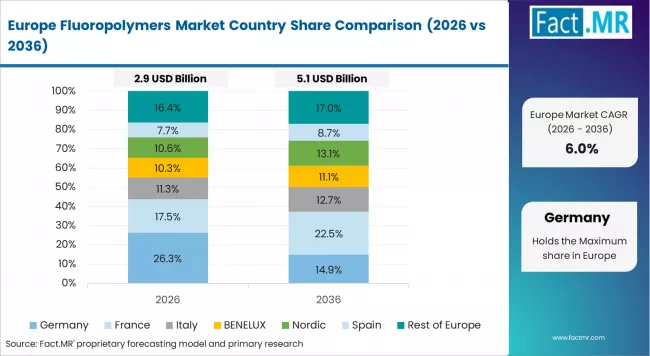
Fluoropolymers Market Europe Country Market Share Analysis, 2026 & 2036 | Source: Fact.MR
The fluoropolymers market in Europe is projected to grow from USD 3.0 billion in 2025 to USD 7.14 billion by 2035, representing 25.7% of the global market in 2025 and maintaining 25.7% by 2035. Germany is expected to maintain its leadership position with USD 0.80 billion in 2025, accounting for 26.8% of the European market, supported by its advanced automotive manufacturing infrastructure and established chemical processing networks.
France follows with USD 0.57 billion, representing 18.9% of the European market in 2025, driven by comprehensive aerospace integration and chemical industry concentration. UK holds USD 0.52 billion with 17.3% market share through established pharmaceutical manufacturing pathways and specialty chemical density.
Italy commands USD 0.43 billion representing 14.2% share, while Spain accounts for USD 0.35 billion or 11.6% in 2025. The rest of Europe region maintains USD 0.34 billion, representing 11.2% of the European market, attributed to increasing fluoropolymer adoption in Nordic countries and emerging Eastern European manufacturing sectors implementing advanced material programs.
Competitive Landscape of the Fluoropolymers Market
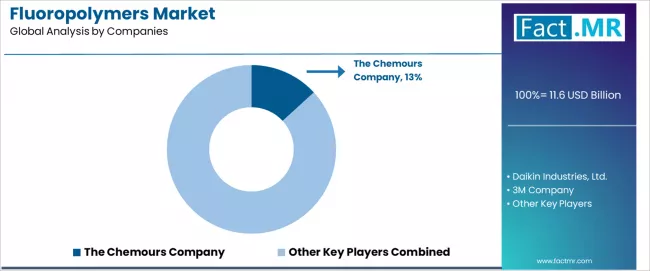
Fluoropolymers Market Analysis By Company | Source: Fact.MR
The fluoropolymers market exhibits a moderately consolidated competitive structure with approximately 40-60 active players operating across global specialty polymer networks and regional fluoropolymer distribution portfolios. The Chemours Company maintains market leadership at a 13.2% share, reflecting strong product portfolio positioning across diverse fluoropolymer applications with sophisticated global manufacturing strategies.
This competitive landscape demonstrates the maturation of specialty polymer technology, where established players leverage technical expertise advantages, extensive application validation evidence documentation, and manufacturer relationship programs to maintain dominant positions, while emerging sustainable fluoropolymer developers and regional specialty polymer companies create niche opportunities through alternative chemistry offerings and application-specific development strategies.
Market leadership is maintained through several critical competitive advantages extending beyond manufacturing capabilities and product portfolios. Global production networks enable leading players to navigate diverse application requirements and access varied industrial segments including semiconductor manufacturers, automotive suppliers, and chemical processors.
Technical support infrastructure and application engineering program availability represent crucial differentiators in fluoropolymer categories, where decades of polymer processing expertise, fabrication optimization protocols, and performance validation frameworks create purchasing preference among quality-focused manufacturers.
Manufacturing efficiency in fluorination facilities, supply chain specialty monomer management, and polymerization process control separate major suppliers from smaller competitors, while comprehensive technical documentation addressing thermal stability standards, chemical resistance validation studies, and regulatory compliance strengthen market position and customer confidence.
The market demonstrates emerging differentiation opportunities in sustainable fluoropolymer categories and ultra-high purity semiconductor grade technologies, where traditional PTFE products face competition from innovation-focused entrants offering environmental advantages.
Significant competitive advantages persist in established industrial PTFE categories through comprehensive application proven portfolios and manufacturing relationship depth. Premium positioning strategies with semiconductor-grade purity capabilities and custom formulation platforms command margin premiums through superior performance and application specificity integration.
Specialized polymer portfolios combining multiple fluoropolymer types with application-specific grades create comprehensive positioning that justifies higher price points beyond commodity fluoropolymer competition. Integrated material solution offerings emphasizing complementary processing compatibility, unified technical support, and cross-application development programs generate brand loyalty and material specification preferences beyond transactional polymer purchases.
| Stakeholder | What they actually control | Typical strengths | Typical blind spots |
|---|---|---|---|
| Global fluoropolymer corporations | Comprehensive polymer portfolios; global manufacturing; technical documentation | Brand recognition; performance validation; OEM relationships; application expertise | Innovation speed; sustainability solutions; regional customization; PFAS alternatives |
| Specialized fluoropolymer manufacturers | Polymer chemistry; grade development; application innovation | Product differentiation; technical sophistication; processing expertise; customer loyalty | Market penetration; production scale; cost competitiveness; geographic coverage |
| Regional polymer producers | Local manufacturing; cost optimization; regional supply; customer proximity | Affordability positioning; market understanding; delivery flexibility; local support | Technical sophistication; brand recognition; semiconductor grades; specialty applications |
| Semiconductor materials companies | Ultra-high purity; cleanroom compatibility; fab qualification; technical service | Purity standards; semiconductor knowledge; quality systems; fab relationships | Industrial applications; cost optimization; commodity grades; broad market access |
| Chemical processors | Downstream integration; application expertise; customer access; formulation capability | Market knowledge; application understanding; customer relationships; processing support | Polymer manufacturing; monomer production; technical innovation; upstream integration |
Source: Fact.MR analysis. Updated Apr 8, 2026
Key Players in the Fluoropolymers Market
- The Chemours Company
- Daikin Industries, Ltd.
- 3M Company
- Solvay S.A.
- Arkema S.A.
- AGC Chemicals (AGC Inc.)
- Dongyue Group Limited
- Gujarat Fluorochemicals Limited
- Halopolymer OJSC
- Kureha Corporation
Bibliography
- European Chemicals Agency. (2025, February). Universal PFAS restriction proposal: Impact assessment on fluoropolymer manufacturing. ECHA.
- Semiconductor Equipment and Materials International. (2024). SEMI F57-2024: Specification for polymer materials used in ultra-pure water distribution systems. SEMI.
- International Energy Agency. (2025, March). Global battery supply chain outlook: PVDF and electrolyte material demand projections. IEA.
- ASTM International. (2024). ASTM D4894-24 Standard specification for PTFE granular molding and ram extrusion materials. ASTM.
- Ministry of Economy, Trade and Industry, Japan. (2024). Fluoropolymer supply chain security: National strategy for critical material domestic production. METI.
This bibliography is provided for reader reference. The full Fact.MR report contains the complete reference list with primary research documentation.
This Report Addresses
- Market sizing and quantitative forecast metrics detailing fluoropolymer resin expenditure across industrial processing, semiconductor, battery, and automotive sectors through 2036.
- Segmentation analysis mapping adoption by product type and evaluating semiconductor purity and battery binder performance specifications.
- Regional deployment intelligence comparing rapid semiconductor and battery facility construction in Asia against mature chemical processing and automotive seal markets in North America and Europe.
- PFAS regulatory assessment analyzing how fluorinated substance restriction proposals affect fluoropolymer production processes and supply chain continuity.
- Competitive posture evaluation tracking polymerization technology IP, PFAS-compliant production investments, and semiconductor-grade material qualification status.
- Technology guidance defining the purity and performance specifications required for fluoropolymers in semiconductor fluid handling and battery electrode applications.
- Supply chain analysis identifying regulatory transition risks and alternative polymerization technology development timelines.
- Custom data delivery formats encompassing interactive dashboards, raw Excel datasets, and comprehensive PDF narrative reports.
Fluoropolymers Market Definition
Fluoropolymers are high-performance polymeric materials in which some or all hydrogen atoms in the polymer backbone are replaced by fluorine, creating materials with exceptional chemical resistance, thermal stability, low surface energy, electrical insulation, and weathering resistance. Major product categories include polytetrafluoroethylene (PTFE), polyvinylidene fluoride (PVDF), fluorinated ethylene propylene (FEP), perfluoroalkoxy polymer (PFA), ethylene tetrafluoroethylene (ETFE), and fluoroelastomers. These materials are processed by molding, extrusion, dispersion coating, and film casting for use in chemical processing, semiconductor manufacturing, battery production, automotive, and construction applications.
Fluoropolymers Market Inclusions
Market scope includes PTFE, PVDF, FEP, PFA, ETFE, fluoroelastomers, and other fluoropolymer resins sold in granular, fine powder, dispersion, and pellet forms. The report covers global and regional market sizes, forecast period 2026 to 2036, and segment breakdowns by product and application.
Fluoropolymers Market Exclusions
The scope excludes fluorosurfactants and fluorinated processing aids, fluorocarbon refrigerant gases, fluorinated pharmaceutical intermediates, and fluoropolymer coating formulations classified under the coatings market.
Fluoropolymers Market Research Methodology
Primary Research: Analysts engaged with fluoropolymer resin producers, semiconductor facility material engineers, and battery cell PVDF procurement leads to map material qualification cycles and supply chain formation timelines.
Desk Research: Data collection aggregated semiconductor fab construction databases, battery manufacturing capacity announcements, PFAS regulatory restriction timelines, and fluoropolymer production capacity data.
Market-Sizing and Forecasting: Baseline values derive from a bottom-up aggregation of fluoropolymer consumption per semiconductor wafer fab, battery cell gigawatt-hour capacity, and chemical processing vessel fabricated, applying application-specific material intensity factors.
Data Validation and Update Cycle: Projections are tested against publicly reported fluoropolymer segment revenues from major producers and semiconductor and battery industry material procurement disclosures.
Segmentation
Scope of the Report
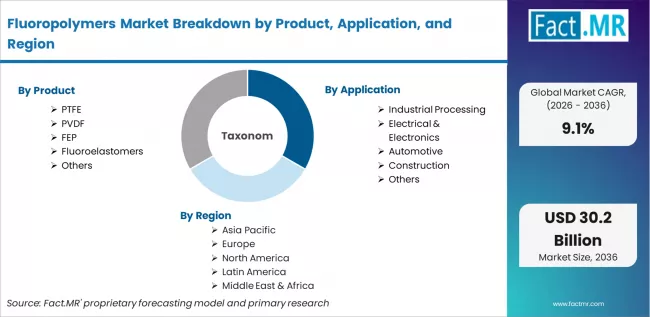
Fluoropolymers Market Breakdown By Product, Application, And Region | Source: Fact.MR
| Metric | Value |
|---|---|
| Quantitative Units | USD 12.66 billion to USD 30.24 billion, at a CAGR of 9.1% |
| Market Definition | Fluoropolymers are high-performance polymeric materials in which some or all hydrogen atoms in the polymer backbone are replaced by fluorine, creating materials with exceptional chemical resistance, thermal stability, low surface energy, electrical insulation, and weathering resistance. Major product categories include polytetrafluoroethylene (PTFE), polyvinylidene fluoride (PVDF), fluorinated ethylene propylene (FEP), perfluoroalkoxy polymer (PFA), ethylene tetrafluoroethylene (ETFE), and fluoroelastomers. These materials are processed by molding, extrusion, dispersion coating, and film casting for use in chemical processing, semiconductor manufacturing, battery production, automotive, and construction applications. |
| Product Segmentation | PTFE, PVDF, FEP, Fluoroelastomers, Others |
| Application Segmentation | Industrial Processing, Electrical & Electronics, Automotive, Construction, Others |
| Regions Covered | North America, Latin America, Europe, East Asia, South Asia, Oceania, Middle East & Africa |
| Countries Covered | India, China, USA, Germany, Japan, South Korea, UK, and 40 plus countries |
| Key Companies Profiled | The Chemours Company, Daikin Industries, Ltd., 3M Company, Solvay S.A., Arkema S.A., AGC Chemicals (AGC Inc.), Dongyue Group Limited, Gujarat Fluorochemicals Limited, Halopolymer OJSC, Kureha Corporation |
| Forecast Period | 2026 to 2036 |
| Approach | Baseline values derive from a bottom-up aggregation of fluoropolymer consumption per semiconductor wafer fab, battery cell gigawatt-hour capacity, and chemical processing vessel fabricated, applying application-specific material intensity factors. |
Source: Fact.MR analysis. Updated Apr 8, 2026
Fluoropolymers Market by Segments
-
Product :
- PTFE
- PVDF
- FEP
- Fluoroelastomers
- Others
-
Application :
- Industrial Processing
- Electrical & Electronics
- Automotive
- Construction
- Others
-
Region :
- North America
- USA
- Canada
- Mexico
- Europe
- Germany
- France
- UK
- Italy
- Spain
- Rest of Europe
- Asia Pacific
- India
- China
- Japan
- South Korea
- ASEAN
- Australia & New Zealand
- Rest of Asia Pacific
- Latin America
- Brazil
- Rest of Latin America
- MEA
- GCC Countries
- South Africa
- Rest of MEA
- North America
Frequently Asked Questions
How large is the demand for fluoropolymers in the global market in 2026?
What will be the market size of fluoropolymers by 2036?
What is the expected demand growth between 2026 and 2036?
Which Product is poised to lead global sales by 2026?
How significant is Industrial Processing in driving fluoropolymer adoption in 2026?
What is the India growth outlook in this report?
What are fluoropolymers and what are they mainly used for?
Who worked on this report


Preview the report firsthand - request a free sample
Free SampleGet the brochure for pricing and purchase details
Download PDF