Aviation Drop-In Biomass Renewable Fuels Market

Aviation Drop-In Biomass Renewable Fuels Market Size and Share Forecast Outlook 2026 to 2036

Aviation drop-in biomass renewable fuels market is projected to grow from USD 1.8 billion in 2026 to USD 3.3 billion by 2036, at a CAGR of 6.5%. HEFA-SAF will dominate with a 46.0% market share, while waste oils & fats will lead the feedstock segment with a 49.0% share.

Aviation Drop-In Biomass Renewable Fuels Market Forecast and Outlook 2026 to 2036

The global market for aviation drop-in biomass renewable fuels, commonly termed sustainable aviation fuel (SAF), is projected to grow from USD 1.78 billion in 2026 to USD 3.33 billion by 2036, advancing at a CAGR of 6.5%.
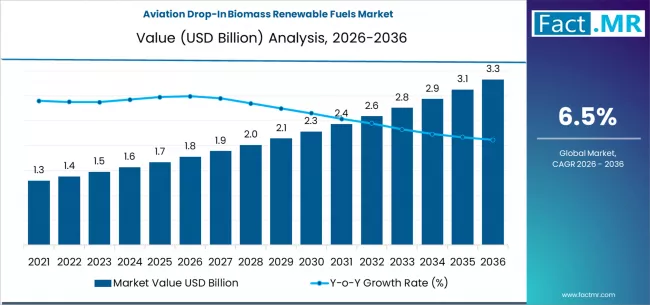
Key Takeaways from the Aviation Drop-In Biomass Renewable Fuels Market

  • Market Value for 2026: USD 1.78 Billion
  • Market Value for 2036: USD 3.33 Billion
  • Forecast CAGR (2026-2036): 6.5%
  • Leading Fuel Pathway Segment (2026): HEFA-SAF (46%)
  • Leading Feedstock Segment (2026): Waste Oils & Fats (49%)
  • Leading End User Segment (2026): Commercial Airlines (68%)
  • Key Growth Countries: USA (6.50% CAGR), Netherlands (6.00% CAGR), UK (5.80% CAGR), Brazil (5.50% CAGR)
  • Key Players in the Market: Neste, World Energy, TotalEnergies, Shell Aviation, BP Bioenergy, Eni Sustainable Mobility

Aviation Drop In Biomass Renewable Fuels Market Market Value Analysis

Growth is fundamentally driven by the aviation industry's urgent mandate to decarbonize and achieve net-zero carbon emissions by 2050. These drop-in biofuels, chemically identical to conventional jet fuel, offer the most viable near-to-mid-term pathway for reducing lifecycle carbon emissions without requiring modifications to existing aircraft or fueling infrastructure.

Market expansion is propelled by a combination of ambitious regulatory policies, corporate sustainability commitments from airlines, and increasing air travel demand. The evolution focuses on scaling up production capacity, diversifying sustainable feedstocks, and reducing the price premium to fossil jet fuel, making SAF a cornerstone of sustainable aviation.

Metric

Metric Value
Market Value (2026) USD 1.78 Billion
Market Forecast Value (2036) USD 3.33 Billion
Forecast CAGR (2026-2036) 6.5%

Category

Category Segments
Fuel Pathway HEFA-SAF, FT-SPK, ATJ, Co-processed SAF, PtL Blends
Feedstock Waste Oils & Fats, Agri Residue, MSW/Industrial Waste, Energy Crops
End User Commercial Airlines, Military Aviation, Business Aviation
Region North America, Latin America, Western Europe, Eastern Europe, East Asia, South Asia & Pacific, MEA

Segmental Analysis

By Fuel Pathway, Which Technology is Currently Dominant?
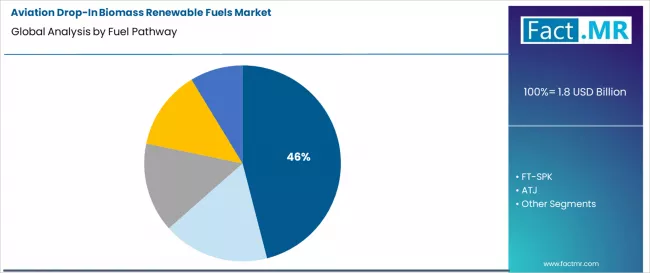
Aviation Drop In Biomass Renewable Fuels Market Analysis By Fuel Pathway

Hydroprocessed esters and fatty acids (HEFA-SAF) leads the fuel pathway segment with a 46% share. Its dominance is due to its technological maturity, as it is the only pathway currently approved for commercial use at up to 50% blends and has established production at scale.

HEFA offers a reliable, scalable route to SAF using existing refinery infrastructure, making it the workhorse technology for early market build-out and the foundation for near-term supply agreements between producers and airlines.

By Feedstock, What is the Primary Source for Current Production?
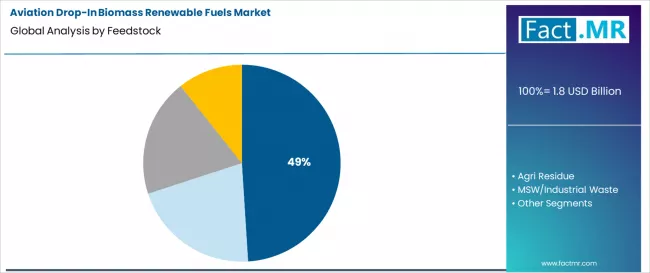
Aviation Drop In Biomass Renewable Fuels Market Analysis By Feedstock

Waste oils & fats constitute the leading feedstock segment, holding a 49% share. This includes used cooking oil (UCO) and animal fats, which are favored due to their high sustainability credentials, offering significant lifecycle emission reductions without competing directly with food crops.

Market growth is constrained by the limited global supply of these waste streams, driving intense competition and innovation toward alternative feedstocks like agricultural residues and municipal solid waste to meet long-term demand.

By End User, Who is the Primary Driver of Demand?
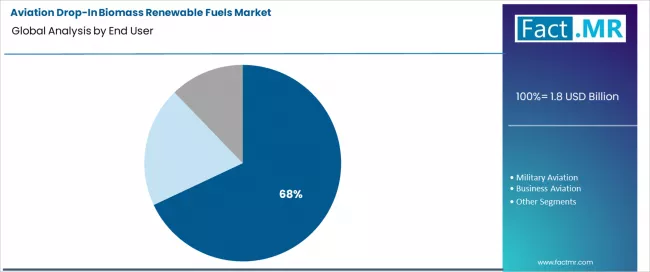
Aviation Drop In Biomass Renewable Fuels Market Analysis By End User

Commercial airlines are the dominant end user, accounting for 68% of demand. This sector faces the most significant regulatory and public pressure to reduce emissions. Airlines are securing long-term SAF offtake agreements to meet CORSIA obligations, corporate sustainability targets, and consumer expectations. Their large, centralized fuel procurement operations make them the anchor customers essential for financing and scaling up production facilities.

What are the Market’s Drivers, Restraints, Opportunities and Trends?

The paramount market driver is the implementation of binding regulatory frameworks like the EU’s ReFuelEU Aviation mandate and the U.S. Inflation Reduction Act (IRA) tax credits, which create compliance obligations and improve SAF's economic viability.

A primary restraint is the significant green premium cost of SAF compared to conventional jet fuel, coupled with limited current production capacity and feedstock availability, which hinders widespread adoption.

A major opportunity lies in the development and commercialization of pathways for advanced feedstocks, such as agricultural and forestry residues for FT-SPK, ATJ and municipal solid waste, which offer greater scalability and sustainability.

The dominant trend is the strategic shift by major oil and energy companies to integrate SAF production into their core refining and fuel distribution businesses, leveraging their capital, infrastructure, and customer relationships to scale the market and develop integrated energy transition strategies.

Analysis of the Aviation Drop-In Biomass Renewable Fuels Market by Key Countries
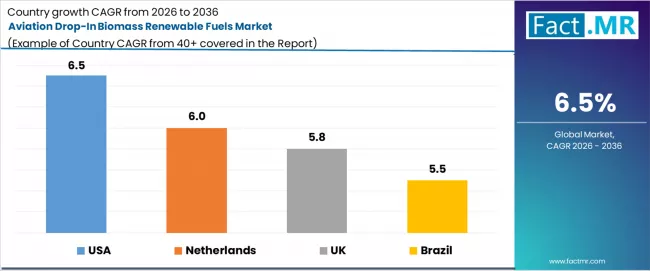
Aviation Drop In Biomass Renewable Fuels Market Cagr Analysis By Country

Country CAGR (2026-2036)
USA 6.50%
Netherlands 6.00%
UK 5.80%
Brazil 5.50%

How do Policy Incentives and Airline Demand Stimulate the Market in the USA?
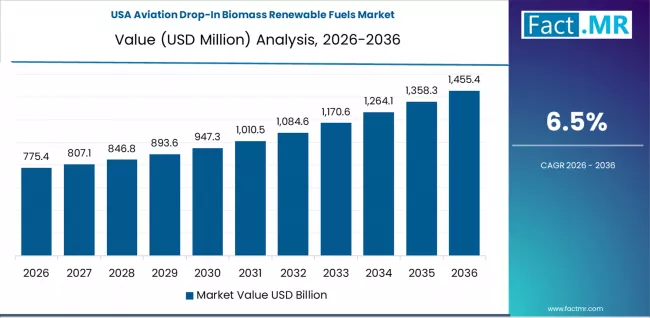
Aviation Drop In Biomass Renewable Fuels Market Country Value Analysis

The USA's 6.50% CAGR is primarily fueled by powerful policy support, most notably the tax credits in the Inflation Reduction Act (IRA) that significantly improve SAF's cost competitiveness.

Coupled with ambitious SAF production goals from the Biden administration and proactive offtake agreements from major U.S.-based airlines, the policy environment is catalyzing massive investments in new production facilities, positioning the U.S. as a central hub for both supply and demand.

Why is the Netherlands a Central European Hub for SAF Production and Logistics?

The Netherlands' 6.00% growth is driven by its strategic position as a European energy and logistics gateway. Home to the Port of Rotterdam, one of the world's largest refining and fuel distribution hubs, the country is leveraging its existing infrastructure to become a central SAF production, blending, and export center for the continent.

National policy, including ambitious blending mandates and support for first-of-a-kind plants, is designed to capitalize on this logistical advantage, attracting investment from major energy companies to build integrated supply chains that serve major European airline hubs.

What Makes the UK a Leader in Regulatory Framework and Industry Demonstration?

The UK's 5.80% growth is underpinned by its early and comprehensive regulatory approach, including a firm SAF mandate that guarantees future demand. The UK has positioned itself as a leader in testing and validation, highlighted by the world’s first commercial passenger flight using 100% SAF.

This demonstrative leadership, combined with targeted government funding for fuel plants and a focus on developing power-to-liquid (PtL) pathways, fosters strong collaboration between government, airlines, and fuel producers to de-risk investment and accelerate market development.

What is Brazil's Strategic Advantage in the Renewable Fuels Ecosystem?

Brazil's 5.50% CAGR is underpinned by its unparalleled expertise and scale in biofuel production from agriculture, primarily for ethanol. The country possesses vast potential feedstocks, including sugarcane, soybean oil, and other agricultural residues, and has a mature biofuels industry capable of pivoting toward SAF production. Brazil’s strategic focus is on developing integrated biorefineries and leveraging its feedstock advantage to become a major exporter of SAF to global markets.

Competitive Landscape of the Aviation Drop-In Biomass Renewable Fuels Market
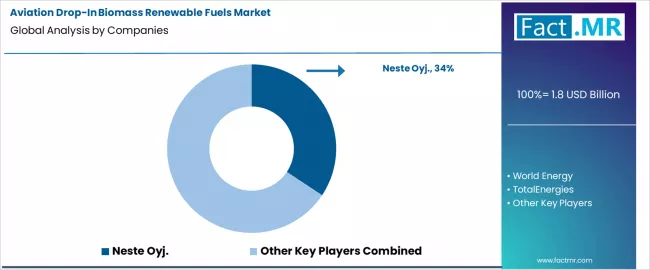
Aviation Drop In Biomass Renewable Fuels Market Analysis By Company

The competitive landscape is increasingly dominated by traditional energy majors (TotalEnergies, Shell, BP, Eni) who are leveraging their existing refining assets, capital, and global fuel supply chains to scale SAF production. They compete with specialized pure-play renewable fuel producers (Neste, World Energy) who have first-mover advantage and deep expertise in specific pathways like HEFA.

Competition revolves around securing long-term feedstock supply agreements, forming strategic partnerships with airlines and airports, and advancing next-generation technologies (like FT and ATJ) to utilize more abundant feedstocks. Success depends on navigating complex sustainability certification, managing production costs, and integrating into the global aviation fuel logistics network.

Key Players in the Aviation Drop-In Biomass Renewable Fuels Market

  • Neste Oyj.
  • World Energy
  • TotalEnergies
  • Shell Aviation
  • BP Bioenergy
  • Eni Sustainable Mobility

Scope of Report

Items Values
Quantitative Units USD Billion
Fuel Pathway HEFA-SAF, FT-SPK, ATJ, Co-processed SAF, PtL Blends
Feedstock Waste Oils & Fats, Agri Residue, MSW/Industrial Waste, Energy Crops
End User Commercial Airlines, Military Aviation, Business Aviation
Key Countries USA, Netherlands, UK, Brazil
Key Companies Neste, World Energy, TotalEnergies, Shell Aviation, BP Bioenergy, Eni Sustainable Mobility
Additional Analysis Lifecycle carbon intensity analysis of different feedstock/pathway combinations; policy and regulatory comparative analysis across key regions; study of feedstock supply chain logistics and sustainability certification (RSB, ISCC); price parity analysis and impact of carbon credits/taxes; assessment of blending, storage, and distribution infrastructure requirements.

Market by Segments

  • Fuel Pathway :

    • HEFA-SAF
    • FT-SPK
    • ATJ
    • Co-processed SAF
    • PtL Blends
  • Feedstock :

    • Waste Oils & Fats
    • Agri Residue
    • MSW/Industrial Waste
    • Energy Crops
  • End User :

    • Commercial Airlines
    • Military Aviation
    • Business Aviation
  • Region :

    • North America

      • USA
      • Canada
    • Latin America

      • Brazil
      • Mexico
      • Argentina
      • Rest of Latin America
    • Western Europe

      • Germany
      • France
      • Italy
      • Spain
      • UK
      • BENELUX
      • Rest of Western Europe
    • Eastern Europe

      • Russia
      • Poland
      • Czech Republic
      • Rest of Eastern Europe
    • East Asia

      • China
      • Japan
      • South Korea
      • Rest of East Asia
    • South Asia & Pacific

      • India
      • ASEAN
      • Australia
      • Rest of South Asia & Pacific
    • MEA

      • GCC Countries
      • South Africa
      • Turkiye
      • Rest of MEA

References

  • Air Transport Action Group (ATAG). (2024). Fact Sheet: Sustainable Aviation Fuel Policy and Deployment. ATAG Publications.
  • International Air Transport Association (IATA). (2024). Sustainable Aviation Fuel (SAF) Deployment Guidelines. IATA.
  • International Civil Aviation Organization (ICAO). (2024). CORSIA Eligible Fuels - Life Cycle Assessment Methodology. ICAO Publications.
  • Roundtable on Sustainable Biomaterials (RSB). (2024). RSB Standard for Sustainable Aviation Fuels. RSB.
  • U.S. Department of Energy. (2024). SAF Grand Challenge Roadmap: A Flight Plan for Sustainable Aviation Fuel. DOE/EE.
  • Wang, M., & Lee, D. (2023). Life-cycle analysis of drop-in biofuels for aviation. Biofuels, Bioproducts and Biorefining, 17(3), 456-470.

Table of Content

  1. Executive Summary
    • Global Market Outlook
    • Demand to side Trends
    • Supply to side Trends
    • Technology Roadmap Analysis
    • Analysis and Recommendations
  2. Market Overview
    • Market Coverage / Taxonomy
    • Market Definition / Scope / Limitations
  3. Market Background
    • Market Dynamics
      • Drivers
      • Restraints
      • Opportunity
      • Trends
    • Scenario Forecast
      • Demand in Optimistic Scenario
      • Demand in Likely Scenario
      • Demand in Conservative Scenario
    • Opportunity Map Analysis
    • Product Life Cycle Analysis
    • Supply Chain Analysis
    • Investment Feasibility Matrix
    • Value Chain Analysis
    • PESTLE and Porter’s Analysis
    • Regulatory Landscape
    • Regional Parent Market Outlook
    • Production and Consumption Statistics
    • Import and Export Statistics
  4. Global Market Analysis 2021 to 2025 and Forecast, 2026 to 2036
    • Historical Market Size Value (USD Million) Analysis, 2021 to 2025
    • Current and Future Market Size Value (USD Million) Projections, 2026 to 2036
      • Y to o to Y Growth Trend Analysis
      • Absolute $ Opportunity Analysis
  5. Global Market Pricing Analysis 2021 to 2025 and Forecast 2026 to 2036
  6. Global Market Analysis 2021 to 2025 and Forecast 2026 to 2036, By Fuel Pathway
    • Introduction / Key Findings
    • Historical Market Size Value (USD Million) Analysis By Fuel Pathway, 2021 to 2025
    • Current and Future Market Size Value (USD Million) Analysis and Forecast By Fuel Pathway, 2026 to 2036
      • HEFA-SAF
      • FT-SPK
      • ATJ
      • Co-processed SAF
      • PtL blends
    • Y to o to Y Growth Trend Analysis By Fuel Pathway, 2021 to 2025
    • Absolute $ Opportunity Analysis By Fuel Pathway, 2026 to 2036
  7. Global Market Analysis 2021 to 2025 and Forecast 2026 to 2036, By Feedstock
    • Introduction / Key Findings
    • Historical Market Size Value (USD Million) Analysis By Feedstock, 2021 to 2025
    • Current and Future Market Size Value (USD Million) Analysis and Forecast By Feedstock, 2026 to 2036
      • Waste Oils & Fats
      • Agri Residue
      • MSW/Industrial Waste
      • Energy Crops
    • Y to o to Y Growth Trend Analysis By Feedstock, 2021 to 2025
    • Absolute $ Opportunity Analysis By Feedstock, 2026 to 2036
  8. Global Market Analysis 2021 to 2025 and Forecast 2026 to 2036, By End User
    • Introduction / Key Findings
    • Historical Market Size Value (USD Million) Analysis By End User, 2021 to 2025
    • Current and Future Market Size Value (USD Million) Analysis and Forecast By End User, 2026 to 2036
      • Commercial Airlines
      • Military Aviation
      • Business Aviation
    • Y to o to Y Growth Trend Analysis By End User, 2021 to 2025
    • Absolute $ Opportunity Analysis By End User, 2026 to 2036
  9. Global Market Analysis 2021 to 2025 and Forecast 2026 to 2036, By Region
    • Introduction
    • Historical Market Size Value (USD Million) Analysis By Region, 2021 to 2025
    • Current Market Size Value (USD Million) Analysis and Forecast By Region, 2026 to 2036
      • North America
      • Latin America
      • Western Europe
      • Eastern Europe
      • East Asia
      • South Asia and Pacific
      • Middle East & Africa
    • Market Attractiveness Analysis By Region
  10. North America Market Analysis 2021 to 2025 and Forecast 2026 to 2036, By Country
    • Historical Market Size Value (USD Million) Trend Analysis By Market Taxonomy, 2021 to 2025
    • Market Size Value (USD Million) Forecast By Market Taxonomy, 2026 to 2036
      • By Country
        • USA
        • Canada
        • Mexico
      • By Fuel Pathway
      • By Feedstock
      • By End User
    • Market Attractiveness Analysis
      • By Country
      • By Fuel Pathway
      • By Feedstock
      • By End User
    • Key Takeaways
  11. Latin America Market Analysis 2021 to 2025 and Forecast 2026 to 2036, By Country
    • Historical Market Size Value (USD Million) Trend Analysis By Market Taxonomy, 2021 to 2025
    • Market Size Value (USD Million) Forecast By Market Taxonomy, 2026 to 2036
      • By Country
        • Brazil
        • Chile
        • Rest of Latin America
      • By Fuel Pathway
      • By Feedstock
      • By End User
    • Market Attractiveness Analysis
      • By Country
      • By Fuel Pathway
      • By Feedstock
      • By End User
    • Key Takeaways
  12. Western Europe Market Analysis 2021 to 2025 and Forecast 2026 to 2036, By Country
    • Historical Market Size Value (USD Million) Trend Analysis By Market Taxonomy, 2021 to 2025
    • Market Size Value (USD Million) Forecast By Market Taxonomy, 2026 to 2036
      • By Country
        • Germany
        • UK
        • Italy
        • Spain
        • France
        • Nordic
        • BENELUX
        • Rest of Western Europe
      • By Fuel Pathway
      • By Feedstock
      • By End User
    • Market Attractiveness Analysis
      • By Country
      • By Fuel Pathway
      • By Feedstock
      • By End User
    • Key Takeaways
  13. Eastern Europe Market Analysis 2021 to 2025 and Forecast 2026 to 2036, By Country
    • Historical Market Size Value (USD Million) Trend Analysis By Market Taxonomy, 2021 to 2025
    • Market Size Value (USD Million) Forecast By Market Taxonomy, 2026 to 2036
      • By Country
        • Russia
        • Poland
        • Hungary
        • Balkan & Baltic
        • Rest of Eastern Europe
      • By Fuel Pathway
      • By Feedstock
      • By End User
    • Market Attractiveness Analysis
      • By Country
      • By Fuel Pathway
      • By Feedstock
      • By End User
    • Key Takeaways
  14. East Asia Market Analysis 2021 to 2025 and Forecast 2026 to 2036, By Country
    • Historical Market Size Value (USD Million) Trend Analysis By Market Taxonomy, 2021 to 2025
    • Market Size Value (USD Million) Forecast By Market Taxonomy, 2026 to 2036
      • By Country
        • China
        • Japan
        • South Korea
      • By Fuel Pathway
      • By Feedstock
      • By End User
    • Market Attractiveness Analysis
      • By Country
      • By Fuel Pathway
      • By Feedstock
      • By End User
    • Key Takeaways
  15. South Asia and Pacific Market Analysis 2021 to 2025 and Forecast 2026 to 2036, By Country
    • Historical Market Size Value (USD Million) Trend Analysis By Market Taxonomy, 2021 to 2025
    • Market Size Value (USD Million) Forecast By Market Taxonomy, 2026 to 2036
      • By Country
        • India
        • ASEAN
        • Australia & New Zealand
        • Rest of South Asia and Pacific
      • By Fuel Pathway
      • By Feedstock
      • By End User
    • Market Attractiveness Analysis
      • By Country
      • By Fuel Pathway
      • By Feedstock
      • By End User
    • Key Takeaways
  16. Middle East & Africa Market Analysis 2021 to 2025 and Forecast 2026 to 2036, By Country
    • Historical Market Size Value (USD Million) Trend Analysis By Market Taxonomy, 2021 to 2025
    • Market Size Value (USD Million) Forecast By Market Taxonomy, 2026 to 2036
      • By Country
        • Kingdom of Saudi Arabia
        • Other GCC Countries
        • Turkiye
        • South Africa
        • Other African Union
        • Rest of Middle East & Africa
      • By Fuel Pathway
      • By Feedstock
      • By End User
    • Market Attractiveness Analysis
      • By Country
      • By Fuel Pathway
      • By Feedstock
      • By End User
    • Key Takeaways
  17. Key Countries Market Analysis
    • USA
      • Pricing Analysis
      • Market Share Analysis, 2025
        • By Fuel Pathway
        • By Feedstock
        • By End User
    • Canada
      • Pricing Analysis
      • Market Share Analysis, 2025
        • By Fuel Pathway
        • By Feedstock
        • By End User
    • Mexico
      • Pricing Analysis
      • Market Share Analysis, 2025
        • By Fuel Pathway
        • By Feedstock
        • By End User
    • Brazil
      • Pricing Analysis
      • Market Share Analysis, 2025
        • By Fuel Pathway
        • By Feedstock
        • By End User
    • Chile
      • Pricing Analysis
      • Market Share Analysis, 2025
        • By Fuel Pathway
        • By Feedstock
        • By End User
    • Germany
      • Pricing Analysis
      • Market Share Analysis, 2025
        • By Fuel Pathway
        • By Feedstock
        • By End User
    • UK
      • Pricing Analysis
      • Market Share Analysis, 2025
        • By Fuel Pathway
        • By Feedstock
        • By End User
    • Italy
      • Pricing Analysis
      • Market Share Analysis, 2025
        • By Fuel Pathway
        • By Feedstock
        • By End User
    • Spain
      • Pricing Analysis
      • Market Share Analysis, 2025
        • By Fuel Pathway
        • By Feedstock
        • By End User
    • France
      • Pricing Analysis
      • Market Share Analysis, 2025
        • By Fuel Pathway
        • By Feedstock
        • By End User
    • India
      • Pricing Analysis
      • Market Share Analysis, 2025
        • By Fuel Pathway
        • By Feedstock
        • By End User
    • ASEAN
      • Pricing Analysis
      • Market Share Analysis, 2025
        • By Fuel Pathway
        • By Feedstock
        • By End User
    • Australia & New Zealand
      • Pricing Analysis
      • Market Share Analysis, 2025
        • By Fuel Pathway
        • By Feedstock
        • By End User
    • China
      • Pricing Analysis
      • Market Share Analysis, 2025
        • By Fuel Pathway
        • By Feedstock
        • By End User
    • Japan
      • Pricing Analysis
      • Market Share Analysis, 2025
        • By Fuel Pathway
        • By Feedstock
        • By End User
    • South Korea
      • Pricing Analysis
      • Market Share Analysis, 2025
        • By Fuel Pathway
        • By Feedstock
        • By End User
    • Russia
      • Pricing Analysis
      • Market Share Analysis, 2025
        • By Fuel Pathway
        • By Feedstock
        • By End User
    • Poland
      • Pricing Analysis
      • Market Share Analysis, 2025
        • By Fuel Pathway
        • By Feedstock
        • By End User
    • Hungary
      • Pricing Analysis
      • Market Share Analysis, 2025
        • By Fuel Pathway
        • By Feedstock
        • By End User
    • Kingdom of Saudi Arabia
      • Pricing Analysis
      • Market Share Analysis, 2025
        • By Fuel Pathway
        • By Feedstock
        • By End User
    • Turkiye
      • Pricing Analysis
      • Market Share Analysis, 2025
        • By Fuel Pathway
        • By Feedstock
        • By End User
    • South Africa
      • Pricing Analysis
      • Market Share Analysis, 2025
        • By Fuel Pathway
        • By Feedstock
        • By End User
  18. Market Structure Analysis
    • Competition Dashboard
    • Competition Benchmarking
    • Market Share Analysis of Top Players
      • By Regional
      • By Fuel Pathway
      • By Feedstock
      • By End User
  19. Competition Analysis
    • Competition Deep Dive
      • Neste Oyj.
        • Overview
        • Product Portfolio
        • Profitability by Market Segments (Product/Age /Sales Channel/Region)
        • Sales Footprint
        • Strategy Overview
          • Marketing Strategy
          • Product Strategy
          • Channel Strategy
      • World Energy
      • TotalEnergies
      • Shell Aviation
      • BP Bioenergy
      • Eni Sustainable Mobility
  20. Assumptions & Acronyms Used
  21. Research Methodology

List Of Table

  • Table 1: Global Market Value (USD Million) Forecast by Region, 2021 to 2036
  • Table 2: Global Market Value (USD Million) Forecast by Fuel Pathway, 2021 to 2036
  • Table 3: Global Market Value (USD Million) Forecast by Feedstock, 2021 to 2036
  • Table 4: Global Market Value (USD Million) Forecast by End User, 2021 to 2036
  • Table 5: North America Market Value (USD Million) Forecast by Country, 2021 to 2036
  • Table 6: North America Market Value (USD Million) Forecast by Fuel Pathway, 2021 to 2036
  • Table 7: North America Market Value (USD Million) Forecast by Feedstock, 2021 to 2036
  • Table 8: North America Market Value (USD Million) Forecast by End User, 2021 to 2036
  • Table 9: Latin America Market Value (USD Million) Forecast by Country, 2021 to 2036
  • Table 10: Latin America Market Value (USD Million) Forecast by Fuel Pathway, 2021 to 2036
  • Table 11: Latin America Market Value (USD Million) Forecast by Feedstock, 2021 to 2036
  • Table 12: Latin America Market Value (USD Million) Forecast by End User, 2021 to 2036
  • Table 13: Western Europe Market Value (USD Million) Forecast by Country, 2021 to 2036
  • Table 14: Western Europe Market Value (USD Million) Forecast by Fuel Pathway, 2021 to 2036
  • Table 15: Western Europe Market Value (USD Million) Forecast by Feedstock, 2021 to 2036
  • Table 16: Western Europe Market Value (USD Million) Forecast by End User, 2021 to 2036
  • Table 17: Eastern Europe Market Value (USD Million) Forecast by Country, 2021 to 2036
  • Table 18: Eastern Europe Market Value (USD Million) Forecast by Fuel Pathway, 2021 to 2036
  • Table 19: Eastern Europe Market Value (USD Million) Forecast by Feedstock, 2021 to 2036
  • Table 20: Eastern Europe Market Value (USD Million) Forecast by End User, 2021 to 2036
  • Table 21: East Asia Market Value (USD Million) Forecast by Country, 2021 to 2036
  • Table 22: East Asia Market Value (USD Million) Forecast by Fuel Pathway, 2021 to 2036
  • Table 23: East Asia Market Value (USD Million) Forecast by Feedstock, 2021 to 2036
  • Table 24: East Asia Market Value (USD Million) Forecast by End User, 2021 to 2036
  • Table 25: South Asia and Pacific Market Value (USD Million) Forecast by Country, 2021 to 2036
  • Table 26: South Asia and Pacific Market Value (USD Million) Forecast by Fuel Pathway, 2021 to 2036
  • Table 27: South Asia and Pacific Market Value (USD Million) Forecast by Feedstock, 2021 to 2036
  • Table 28: South Asia and Pacific Market Value (USD Million) Forecast by End User, 2021 to 2036
  • Table 29: Middle East & Africa Market Value (USD Million) Forecast by Country, 2021 to 2036
  • Table 30: Middle East & Africa Market Value (USD Million) Forecast by Fuel Pathway, 2021 to 2036
  • Table 31: Middle East & Africa Market Value (USD Million) Forecast by Feedstock, 2021 to 2036
  • Table 32: Middle East & Africa Market Value (USD Million) Forecast by End User, 2021 to 2036

List Of Figures

  • Figure 1: Global Market Pricing Analysis
  • Figure 2: Global Market Value (USD Million) Forecast 2021 to 2036
  • Figure 3: Global Market Value Share and BPS Analysis by Fuel Pathway, 2026 and 2036
  • Figure 4: Global Market Y to o to Y Growth Comparison by Fuel Pathway, 2026 to 2036
  • Figure 5: Global Market Attractiveness Analysis by Fuel Pathway
  • Figure 6: Global Market Value Share and BPS Analysis by Feedstock, 2026 and 2036
  • Figure 7: Global Market Y to o to Y Growth Comparison by Feedstock, 2026 to 2036
  • Figure 8: Global Market Attractiveness Analysis by Feedstock
  • Figure 9: Global Market Value Share and BPS Analysis by End User, 2026 and 2036
  • Figure 10: Global Market Y to o to Y Growth Comparison by End User, 2026 to 2036
  • Figure 11: Global Market Attractiveness Analysis by End User
  • Figure 12: Global Market Value (USD Million) Share and BPS Analysis by Region, 2026 and 2036
  • Figure 13: Global Market Y to o to Y Growth Comparison by Region, 2026 to 2036
  • Figure 14: Global Market Attractiveness Analysis by Region
  • Figure 15: North America Market Incremental Dollar Opportunity, 2026 to 2036
  • Figure 16: Latin America Market Incremental Dollar Opportunity, 2026 to 2036
  • Figure 17: Western Europe Market Incremental Dollar Opportunity, 2026 to 2036
  • Figure 18: Eastern Europe Market Incremental Dollar Opportunity, 2026 to 2036
  • Figure 19: East Asia Market Incremental Dollar Opportunity, 2026 to 2036
  • Figure 20: South Asia and Pacific Market Incremental Dollar Opportunity, 2026 to 2036
  • Figure 21: Middle East & Africa Market Incremental Dollar Opportunity, 2026 to 2036
  • Figure 22: North America Market Value Share and BPS Analysis by Country, 2026 and 2036
  • Figure 23: North America Market Value Share and BPS Analysis by Fuel Pathway, 2026 and 2036
  • Figure 24: North America Market Y to o to Y Growth Comparison by Fuel Pathway, 2026 to 2036
  • Figure 25: North America Market Attractiveness Analysis by Fuel Pathway
  • Figure 26: North America Market Value Share and BPS Analysis by Feedstock, 2026 and 2036
  • Figure 27: North America Market Y to o to Y Growth Comparison by Feedstock, 2026 to 2036
  • Figure 28: North America Market Attractiveness Analysis by Feedstock
  • Figure 29: North America Market Value Share and BPS Analysis by End User, 2026 and 2036
  • Figure 30: North America Market Y to o to Y Growth Comparison by End User, 2026 to 2036
  • Figure 31: North America Market Attractiveness Analysis by End User
  • Figure 32: Latin America Market Value Share and BPS Analysis by Country, 2026 and 2036
  • Figure 33: Latin America Market Value Share and BPS Analysis by Fuel Pathway, 2026 and 2036
  • Figure 34: Latin America Market Y to o to Y Growth Comparison by Fuel Pathway, 2026 to 2036
  • Figure 35: Latin America Market Attractiveness Analysis by Fuel Pathway
  • Figure 36: Latin America Market Value Share and BPS Analysis by Feedstock, 2026 and 2036
  • Figure 37: Latin America Market Y to o to Y Growth Comparison by Feedstock, 2026 to 2036
  • Figure 38: Latin America Market Attractiveness Analysis by Feedstock
  • Figure 39: Latin America Market Value Share and BPS Analysis by End User, 2026 and 2036
  • Figure 40: Latin America Market Y to o to Y Growth Comparison by End User, 2026 to 2036
  • Figure 41: Latin America Market Attractiveness Analysis by End User
  • Figure 42: Western Europe Market Value Share and BPS Analysis by Country, 2026 and 2036
  • Figure 43: Western Europe Market Value Share and BPS Analysis by Fuel Pathway, 2026 and 2036
  • Figure 44: Western Europe Market Y to o to Y Growth Comparison by Fuel Pathway, 2026 to 2036
  • Figure 45: Western Europe Market Attractiveness Analysis by Fuel Pathway
  • Figure 46: Western Europe Market Value Share and BPS Analysis by Feedstock, 2026 and 2036
  • Figure 47: Western Europe Market Y to o to Y Growth Comparison by Feedstock, 2026 to 2036
  • Figure 48: Western Europe Market Attractiveness Analysis by Feedstock
  • Figure 49: Western Europe Market Value Share and BPS Analysis by End User, 2026 and 2036
  • Figure 50: Western Europe Market Y to o to Y Growth Comparison by End User, 2026 to 2036
  • Figure 51: Western Europe Market Attractiveness Analysis by End User
  • Figure 52: Eastern Europe Market Value Share and BPS Analysis by Country, 2026 and 2036
  • Figure 53: Eastern Europe Market Value Share and BPS Analysis by Fuel Pathway, 2026 and 2036
  • Figure 54: Eastern Europe Market Y to o to Y Growth Comparison by Fuel Pathway, 2026 to 2036
  • Figure 55: Eastern Europe Market Attractiveness Analysis by Fuel Pathway
  • Figure 56: Eastern Europe Market Value Share and BPS Analysis by Feedstock, 2026 and 2036
  • Figure 57: Eastern Europe Market Y to o to Y Growth Comparison by Feedstock, 2026 to 2036
  • Figure 58: Eastern Europe Market Attractiveness Analysis by Feedstock
  • Figure 59: Eastern Europe Market Value Share and BPS Analysis by End User, 2026 and 2036
  • Figure 60: Eastern Europe Market Y to o to Y Growth Comparison by End User, 2026 to 2036
  • Figure 61: Eastern Europe Market Attractiveness Analysis by End User
  • Figure 62: East Asia Market Value Share and BPS Analysis by Country, 2026 and 2036
  • Figure 63: East Asia Market Value Share and BPS Analysis by Fuel Pathway, 2026 and 2036
  • Figure 64: East Asia Market Y to o to Y Growth Comparison by Fuel Pathway, 2026 to 2036
  • Figure 65: East Asia Market Attractiveness Analysis by Fuel Pathway
  • Figure 66: East Asia Market Value Share and BPS Analysis by Feedstock, 2026 and 2036
  • Figure 67: East Asia Market Y to o to Y Growth Comparison by Feedstock, 2026 to 2036
  • Figure 68: East Asia Market Attractiveness Analysis by Feedstock
  • Figure 69: East Asia Market Value Share and BPS Analysis by End User, 2026 and 2036
  • Figure 70: East Asia Market Y to o to Y Growth Comparison by End User, 2026 to 2036
  • Figure 71: East Asia Market Attractiveness Analysis by End User
  • Figure 72: South Asia and Pacific Market Value Share and BPS Analysis by Country, 2026 and 2036
  • Figure 73: South Asia and Pacific Market Value Share and BPS Analysis by Fuel Pathway, 2026 and 2036
  • Figure 74: South Asia and Pacific Market Y to o to Y Growth Comparison by Fuel Pathway, 2026 to 2036
  • Figure 75: South Asia and Pacific Market Attractiveness Analysis by Fuel Pathway
  • Figure 76: South Asia and Pacific Market Value Share and BPS Analysis by Feedstock, 2026 and 2036
  • Figure 77: South Asia and Pacific Market Y to o to Y Growth Comparison by Feedstock, 2026 to 2036
  • Figure 78: South Asia and Pacific Market Attractiveness Analysis by Feedstock
  • Figure 79: South Asia and Pacific Market Value Share and BPS Analysis by End User, 2026 and 2036
  • Figure 80: South Asia and Pacific Market Y to o to Y Growth Comparison by End User, 2026 to 2036
  • Figure 81: South Asia and Pacific Market Attractiveness Analysis by End User
  • Figure 82: Middle East & Africa Market Value Share and BPS Analysis by Country, 2026 and 2036
  • Figure 83: Middle East & Africa Market Value Share and BPS Analysis by Fuel Pathway, 2026 and 2036
  • Figure 84: Middle East & Africa Market Y to o to Y Growth Comparison by Fuel Pathway, 2026 to 2036
  • Figure 85: Middle East & Africa Market Attractiveness Analysis by Fuel Pathway
  • Figure 86: Middle East & Africa Market Value Share and BPS Analysis by Feedstock, 2026 and 2036
  • Figure 87: Middle East & Africa Market Y to o to Y Growth Comparison by Feedstock, 2026 to 2036
  • Figure 88: Middle East & Africa Market Attractiveness Analysis by Feedstock
  • Figure 89: Middle East & Africa Market Value Share and BPS Analysis by End User, 2026 and 2036
  • Figure 90: Middle East & Africa Market Y to o to Y Growth Comparison by End User, 2026 to 2036
  • Figure 91: Middle East & Africa Market Attractiveness Analysis by End User
  • Figure 92: Global Market - Tier Structure Analysis
  • Figure 93: Global Market - Company Share Analysis

- FAQs -

How big is the aviation drop-in biomass renewable fuels market in 2026?

The global aviation drop-in biomass renewable fuels market is estimated to be valued at USD 1.8 billion in 2026.

What will be the size of aviation drop-in biomass renewable fuels market in 2036?

The market size for the aviation drop-in biomass renewable fuels market is projected to reach USD 3.3 billion by 2036.

How much will be the aviation drop-in biomass renewable fuels market growth between 2026 and 2036?

The aviation drop-in biomass renewable fuels market is expected to grow at a 6.5% CAGR between 2026 and 2036.

What are the key product types in the aviation drop-in biomass renewable fuels market?

The key product types in aviation drop-in biomass renewable fuels market are hefa-saf, ft-spk, atj, co-processed saf and ptl blends.

Which feedstock segment to contribute significant share in the aviation drop-in biomass renewable fuels market in 2026?

In terms of feedstock, waste oils & fats segment to command 49.0% share in the aviation drop-in biomass renewable fuels market in 2026.

Aviation Drop-In Biomass Renewable Fuels Market