- Market Value (2025): USD 628.5 Mn
- Estimated Value (2026): USD 680.0 Mn
- Forecast Value (2036): USD 1495.5 Mn
- CAGR (2026-2036): 8.2%
What is the Food-Grade Dewpoint Sensors Market forecast to be worth by 2036?
USD 680.0 million in 2026 to USD 1495.5 million by 2036 at an 8.2% CAGR.
- The Food-Grade Dewpoint Sensors Market crossed a valuation of USD 628.5 million in 2025.
- Demand is projected to increase from USD 680.0 million in 2026 to USD 1495.5 million by 2036.
- The market is forecast to record an 8.2% CAGR from 2026 to 2036 as food processors and plant engineers document dry-air quality in production areas.
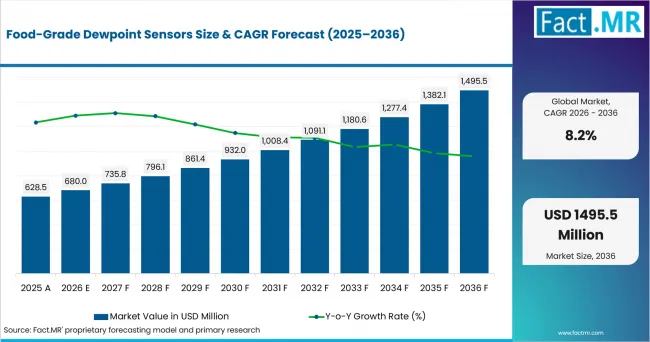
Food Grade Dewpoint Sensors Value Analysis | Source: Fact.MR
What are the defining numbers behind Food-Grade Dewpoint Sensors Market growth?
USD 815.4831 million absolute opportunity by 2036, led by compressed air, capacitive polymer sensors and Switzerland.
- Demand Drivers in the Market
- Food plants need controlled compressed-air quality where air or other gases are mechanically introduced into food or used to clean food-contact surfaces or equipment. 21 CFR 117.40(g) requires these gases to be treated so food is not contaminated with unlawful indirect food additives.
- Plant engineers need dryer alarms where refrigeration and desiccant dryers protect dry ingredients, pneumatic systems and packaging gas from moisture carryover.
- Packaging engineers need low-moisture gas checks since modified-atmosphere packs lose shelf-life value when water vapor enters the sealed headspace.
- Maintenance teams need portable verification to compare dryer outlets and fixed transmitters before recurring moisture faults reach filling or conveying equipment.
- Key Segments Analyzed
- By Sensor Type: Capacitive polymer is expected to hold 34.0% share in 2026 due to stable trace-moisture measurement in compressed air and dryer outlets.
- By Measurement Range: -20 to -40°C is projected to account for 29.0% share in 2026, supported by routine plant-air and packaging-gas checks.
- By Application: Compressed air is anticipated to capture 37.0% share in 2026 because food plants use dry air across pneumatic tools and contact-adjacent systems.
- By Hygienic Design: Stainless hygienic probe is estimated to represent 36.0% share in 2026 owing to washdown exposure and product-zone installation needs.
- Analyst Opinion at Fact.MR
- Shambhu Nath Jha, Principal Consultant at Fact.MR, states, “The commercial test in this market is sensor accuracy with usable proof. Food plants are expected to favor suppliers that pair reliable dew-point readings with clean installation hardware and serviceable calibration records. Sensor vendors with food-ready fittings, portable checks and clear alarm integration have a clear route into production utilities.”
- Strategic Implications
- Sensor manufacturers should pair dew-point accuracy with calibration guidance that quality teams can place directly into audit records.
- Compressed-air specialists should package transmitters with dryers and sampling chambers to simplify installation at critical air points.
- Food equipment integrators should connect dew-point readings to plant dashboards so alarms appear before water reaches product areas.
- Distributor teams should separate food-grade applications from general factory moisture checks when recommending probe materials and process fittings.
Switzerland is forecast to record 9.2% CAGR through 2036, supported by export-oriented processed food and strict hygiene controls. The USA is projected to post 8.7% CAGR as food facilities keep adding dry-air documentation. The UK is anticipated to reach 8.4% CAGR due to prepared-food output and packaging-gas use. Germany is estimated to record 7.9% CAGR, driven by ready-meal production and industrial air-treatment replacement cycles. Japan is expected to reach 6.9% CAGR as packaged-food quality management keeps dry-gas checks relevant.
How does the Food-Grade Dewpoint Sensors Market break down by segment?
Capacitive polymer leads Sensor Type at 34.0%; Compressed air leads Application at 37.0%.
Which Sensor Type dominates?
Capacitive polymer is expected to hold 34.0% share in 2026.
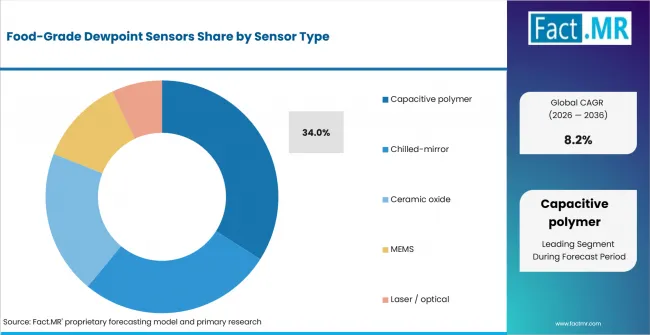
Food Grade Dewpoint Sensors Analysis By Sensor Type | Source: Fact.MR
Capacitive polymer sensors fit many food-grade compressed-air systems because they respond to trace moisture with smaller hardware and lower upkeep than chilled-mirror instruments. Plant teams use them where readings need to be continuous and easy to connect to alarms.
The segment benefits from compact transmitter designs that fit sampling chambers and inline assemblies. Adjacent use of digital temperature and humidity sensors reinforces plant comfort with polymer-based sensing where the measurement point is close to production equipment.
What leads the Measurement Range segment?
-20 to -40°C is projected to account for 29.0% share in 2026.
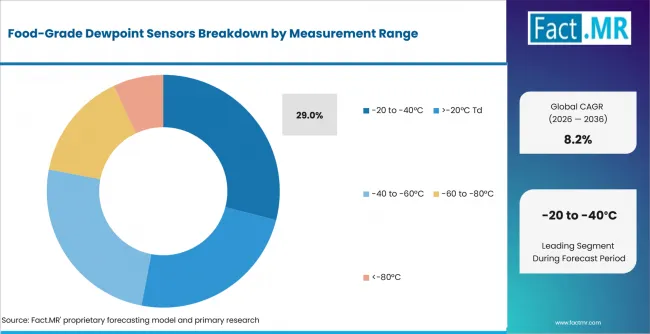
Food Grade Dewpoint Sensors Analysis By Measurement Range | Source: Fact.MR
The -20 to -40°C range suits refrigeration dryers, membrane dryers and many desiccant systems used in food plants. It covers routine dryness targets while leaving ultra-low dew-point hardware for drier lines.
Demand is linked to air-treatment systems that need stable checks after drying and filtration. Related compressed air dryers and refrigerant compressed air dryers create a familiar installed base for transmitter attachment.
How does Application shape demand?
Compressed air is anticipated to capture 37.0% share in 2026.
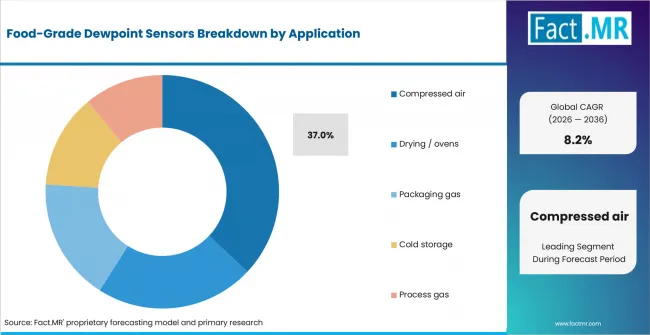
Food Grade Dewpoint Sensors Analysis By Application | Source: Fact.MR
Compressed air leads because it touches many points in food plants, from pneumatic actuation to packaging support. Moisture in these lines damages equipment and weakens quality control when it reaches dry ingredients or product-facing equipment.
CS Instruments offers dew-point sensors for residual-moisture measurement in compressed air and gases with measuring ranges including −80 to +20 °Ctd, together with stationary and portable dew-point monitoring solutions. That range gives service teams a practical tool for dryers, nitrogen lines and other clean utility checks.
What supports Hygienic Design demand?
Stainless hygienic probe is estimated to represent 36.0% share in 2026.
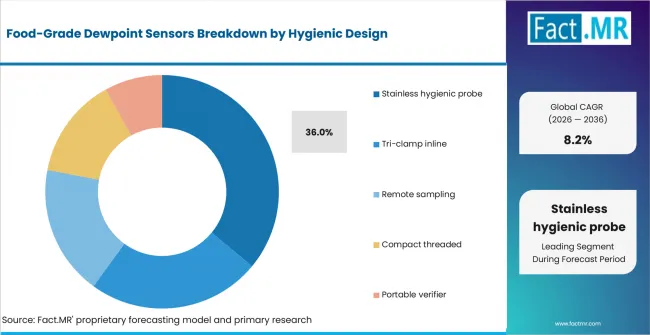
Food Grade Dewpoint Sensors Analysis By Hygienic Design | Source: Fact.MR
Stainless hygienic probes lead where sensors operate near washdown zones, filling lines or product-contact support systems. Food processors prefer smooth housings and cleanable fittings when the measurement point is close to regulated spaces.
Tri-clamp and threaded designs remain relevant when plant engineers need faster retrofit options. Hygienic dewpoint sensors and air preparation equipment both show how moisture measurement is moving closer to production equipment.
What is accelerating Food-Grade Dewpoint Sensors Market adoption, and what is holding it back?
Demand is expected to rise through compressed-air validation and moisture-sensitive packaging. Growth is constrained by calibration cost and retrofit complexity.
Drivers Impact Analysis
| DRIVER | (~) % IMPACT ON CAGR | GEOGRAPHIC RELEVANCE | IMPACT TIMELINE |
|---|---|---|---|
| Food-contact compressed-air assurance | +1.0% | North America, Western Europe | Short term (<= 2 years) |
| Dryer breakthrough prevention | +0.8% | Global | Medium term (2-4 years) |
| Packaging gas moisture control | +0.7% | North America, Europe, East Asia | Medium term (2-4 years) |
| Hygienic inline measurement | +0.5% | Western Europe, Japan | Long term (>= 4 years) |
Opportunity Impact Analysis
| OPPORTUNITY | (~) % IMPACT ON CAGR | GEOGRAPHIC RELEVANCE | IMPACT TIMELINE |
|---|---|---|---|
| Inline hygienic probe upgrades | +0.7% | Western Europe, North America | Short term (<= 2 years) |
| Portable verification services | +0.5% | Global | Medium term (2-4 years) |
| Digital alarm and recorder integration | +0.4% | Europe, East Asia | Long term (>= 4 years) |
Restraints Impact Analysis
| RESTRAINT | (~) % IMPACT ON CAGR | GEOGRAPHIC RELEVANCE | IMPACT TIMELINE |
|---|---|---|---|
| Calibration and validation cost | -0.4% | North America, Western Europe, Japan | Short term (<= 2 years) |
| Sampling-line and condensate errors | -0.3% | Global | Medium term (2-4 years) |
| Slow replacement of periodic checks | -0.2% | Small and mid-sized plants | Long term (>= 4 years) |
Which countries are scaling the Food-Grade Dewpoint Sensors Market through 2036?
- The country comparison spans 2.3 percentage points and forms three practical growth bands across the forecast period.
- Switzerland remains 0.5 percentage point above the USA through high-value processed-food exports and strict food safety oversight.
- The USA remains 0.3 percentage point above the UK as food facilities keep adding documentation around compressed-air quality.
- The UK remains 0.5 percentage point above Germany due to prepared-food output and sensor demand in packaging environments.
- Germany remains 1.0 percentage point above Japan through ready-meal production and industrial air-treatment replacement cycles.
- Japan closes the displayed range through packaged-food quality management and tighter imported-food monitoring.
Comparable CAGRs create different entry conditions due to food-output mix, plant-air standards, hygiene enforcement and retrofit cost. Full report coverage includes North America, Latin America, Western Europe, Eastern Europe, East Asia, South Asia & Pacific, Middle East & Africa.
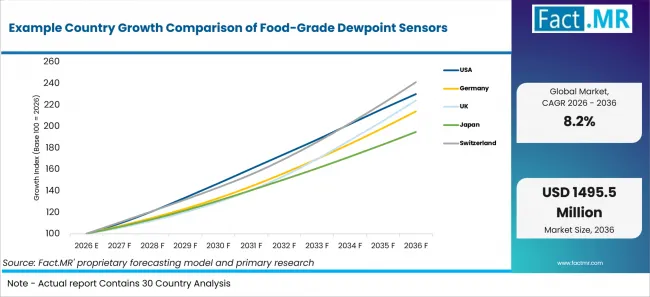
Example Country Growth Comparison Of Food Grade Dewpoint Sensors | Source: Fact.MR
| Country | CAGR (2026-2036) |
|---|---|
| Switzerland | 9.2% |
| United States | 8.7% |
| United Kingdom | 8.4% |
| Germany | 7.9% |
| Japan | 6.9% |
What supports Switzerland adoption?
9.2% CAGR, supported by processed-food trade and food safety controls.
Switzerland’s food import and export base is expected to support stable moisture records around packaging and storage. The Federal Office for Customs and Border Security reported on January 29, 2026 that imports increased by CHF 10.1 billion in 2025, with food, beverages and tobacco contributing CHF 1.2 billion. Dew-point sensors help plants verify dry air before products move into sealed packs or controlled rooms. Food-grade measurement is likely to gain value where trade-facing lines need repeatable proof of air dryness.
What supports USA adoption?
8.7% CAGR, supported by food manufacturing scale and compressed-air documentation.
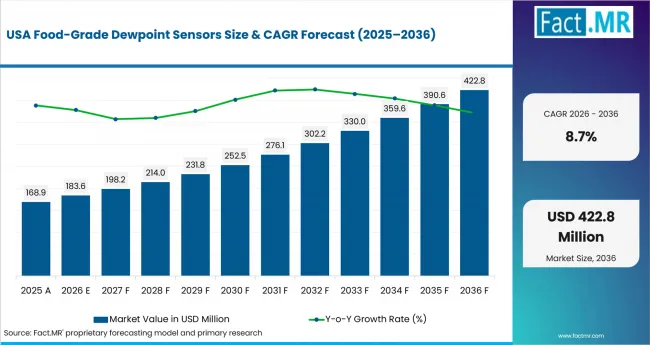
Food Grade Dewpoint Sensors Country Value Analysis | Source: Fact.MR
The USA has a large food economy where compressed air supports conveying, filling and packaging. USDA Economic Research Service reported in June 2026 that total U.S. food spending reached USD 2.51 trillion in 2025. Dew-point sensors fit that operating environment by giving plants a measured view of water vapor in utility air. Adoption is expected to advance where quality teams link dryer performance to production records and corrective actions.
What supports the United Kingdom’s growth?
8.4% CAGR, backed by food product sales and prepared-meal output.
The United Kingdom’s prepared-food base supports sensor use in packaging gas, drying and compressed-air systems. The Office for National Statistics reported in July 2026 that food represented 22.9% of total UK manufacturers’ product sales in 2025. That production base creates practical use cases for low-moisture gas checks and portable verification. Inline sensors are expected to help plants compare dryer output with quality records.
What is supporting Germany’s adoption?
7.9% CAGR, supported by ready-meal production and industrial drying control.
Germany’s demand is tied to prepared-food output and engineered utility systems in food factories. Destatis reported in January 2026 that German industry produced 1.7 million tonnes of ready meals worth EUR 5.9 billion in 2024. That base makes drying, oven and packaging-gas control more visible to plant engineers. Sensor selection remains practical, with the -20 to -40°C range covering many routine plant-air checks before deeper dew-point transmitters are justified.
How does Japan perform?
6.9% CAGR, led by packaged-food quality control and import monitoring.
Japan’s market is shaped by packaged-food quality control and space-limited plant layouts. USDA Foreign Agricultural Service reported in April 2026 that Japan’s food processing sector contracted by 3% in 2025 to USD 174 billion. Soft drinks, health foods, frozen foods and shelf-stable products still give sensor vendors relevant application points. Compact threaded sensors and remote sampling are expected to remain useful for constrained packaging areas.
Who leads the Food-Grade Dewpoint Sensors Market?
Vaisala participates through its DRYCAP dew-point measurement portfolio for applications including compressed air, industrial drying and very dry process environments. In March 2026, Vaisala launched the DMT153 Dew Point Transmitter for ultra-dry industrial processes, with measurement down to −80 °C dew point and connectivity designed for OEM and process environments.
Michell Instruments, part of the Process Sensing Technologies portfolio, provides dew-point transmitters and precision chilled-mirror instruments. The Michell SF82 Online provides a −60 to +60 °C dew-point measurement range, 4–20 mA output and Modbus RTU over RS485 connectivity for moisture-measurement applications including compressed air.
CS Instruments offers stationary and portable dew-point monitoring solutions for compressed air and gases. Its portfolio covers refrigeration, adsorption and membrane dryer monitoring, portable service measurements and stainless-steel measuring chambers for compressed-air and gas applications.
Testo supplies dew-point transmitters for trace-humidity measurement in compressed air and dry air; its trace-humidity guidance specifies calibration at −40 °Ctd using a high-precision dew-point-mirror reference and readings down to −60 °Ctd.
Which companies are the key providers?
Key companies include Vaisala; Michell Instruments; CS Instruments; and Testo.
- Vaisala
- Michell Instruments
- CS Instruments
- Testo
Bibliography
- Aoki, S. (2026, April 1). Food processing ingredients annual (Report No. JA2026-0012). U.S. Department of Agriculture, Foreign Agricultural Service.
- Federal Office for Customs and Border Security. (2026, January 29). 2025: Exports hit a new record, driven by chemicals and pharmaceuticals.
- Office for National Statistics. (2026, July 24). UK manufacturers’ sales by product: 2025.
- Statistisches Bundesamt (Destatis). (2026, January 14). Produktion von Fertiggerichten binnen fünf Jahren mengenmäßig um 25,6 % gestiegen.
- Vaisala. (2026, March 5). Vaisala launches DMT153 dew point transmitter for ultra-dry processes.
- Zeballos, E., & Sinclair, W. (2026, June 11). Total U.S. food spending reached $2.51 trillion in 2025. U.S. Department of Agriculture, Economic Research Service.
This Report Answers
- The report explains where food-grade dewpoint sensors are used across sensor type, measurement range, application and hygienic design.
- Segment analysis identifies the leading subsegments and explains why food plants prioritize compressed-air and stainless-probe installations.
- Country analysis examines the listed markets and the food-output, energy and compliance factors shaping adoption.
- Competitive analysis reviews verified providers across dew-point transmitters, compressed-air sensors, portable meters and humidity instrumentation.
- Application analysis assesses how dryer outlets, packaging gas and clean utility systems influence sensor selection.
What does the Food-Grade Dewpoint Sensors Market cover?
The Food-Grade Dewpoint Sensors Market covers instruments used to measure moisture in food-related air and gas systems. The scope includes dew-point transmitters, pressure dew-point probes, portable meters and inline assemblies used around dryers, ovens, cold rooms and packaging lines.
The assessment covers capacitive polymer, chilled-mirror, ceramic oxide, MEMS and laser or optical technologies. It also covers fixed and portable measurement formats where plant teams need documented dryness in compressed air, nitrogen or other process gases.
What is included in the scope?
The scope includes food-grade dew-point transmitters, pressure dew-point probes, inline hygienic assemblies, remote sampling systems and portable verifiers. Adjacent coverage includes adsorption air dryers where sensor attachment supports air-quality checks.
Included applications span food processing and handling equipment, packaging gas, drying ovens, cold storage and clean process gas. Related industrial air compressors provide the utility-air base where dew-point measurement becomes a routine control point.
What is excluded from the scope?
The scope excludes general room humidity meters used for comfort monitoring or building ventilation. It also excludes laboratory reference instruments when they are sold only for calibration labs outside food-plant monitoring.
General environmental monitoring is excluded outside dew-point or water-vapor measurement in controlled air. Active and modified atmospheric packaging remains adjacent when the product is packaging material, instead of a moisture-measurement device.
How Was the Analysis Built?
The analysis draws on 120+ sources, 35+ company portfolios, 25+ countries, and more than 20 industry interviews.
- Primary Research: Primary research includes discussions with manufacturers, service providers, technology developers, distributors, end users, and subject-matter experts. These conversations examine purchasing priorities, product adoption, operational challenges, approval requirements, competitive positioning, and the factors that influence wider market acceptance.
- Desk Research: Desk research covers government statistics, regulatory publications, company filings, trade data, technical studies, industry associations, standards, public policy, and other authoritative sources. Every source used in the analysis is documented in the bibliography.
- Market Sizing and Forecasting: Market estimates combine historical performance, demand indicators, pricing and volume trends, segment shares, company participation, country-level growth, adoption patterns, investment activity, and barriers to market expansion.
- Data Validation and Update Cycle: Findings are validated by comparing primary interviews with public data, company activity, regulatory changes, trade patterns, and industry developments. Regular updates review new product launches, capacity changes, partnerships, approvals, and shifts in commercial adoption.
What is the report’s scope and coverage?
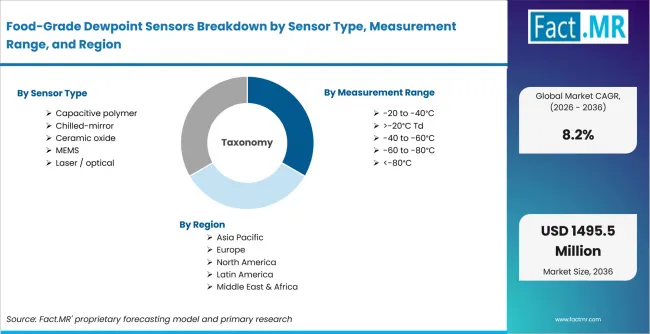
Food Grade Dewpoint Sensors Breakdown By Sensor Type, Measurement Range, And Region | Source: Fact.MR
| Attribute | Details |
|---|---|
| Quantitative Units | USD million in 2026 to USD million by 2036 at an CAGR |
| Market Definition | Sensors and transmitters used to measure dew point or water vapor in food-grade compressed air, process gas, drying, packaging gas and clean utility applications. |
| Sensor Type | Capacitive polymer; Chilled-mirror; Ceramic oxide; MEMS; Laser / optical |
| Measurement Range | >-20°C Td; -20 to -40°C; -40 to -60°C; -60 to -80°C; <-80°C |
| Application | Compressed air; Drying / ovens; Packaging gas; Cold storage; Process gas |
| Hygienic Design | Stainless hygienic probe; Tri-clamp inline; Remote sampling; Compact threaded; Portable verifier |
| Regions Covered | North America; Latin America; Western Europe; Eastern Europe; East Asia; South Asia & Pacific; Middle East & Africa |
| Countries Covered | Switzerland; United States; United Kingdom; Germany; Japan |
| Key Companies Profiled | Vaisala; Michell Instruments; CS Instruments; Testo |
| Forecast Period | 2026 to 2036 |
| Approach | Hybrid top-down and bottom-up approach using food-plant installed base, compressed-air dryer attachment, packaging-gas use, sensor portfolio validation, country adoption and provider review. |
How is the market segmented?
-
By Sensor Type
- Capacitive polymer
- Chilled-mirror
- Ceramic oxide
- MEMS
- Laser / optical
-
By Measurement Range
- >-20°C Td
- -20 to -40°C
- -40 to -60°C
- -60 to -80°C
- <-80°C
-
By Application
- Compressed air
- Drying / ovens
- Packaging gas
- Cold storage
- Process gas
-
By Hygienic Design
- Stainless hygienic probe
- Tri-clamp inline
- Remote sampling
- Compact threaded
- Portable verifier
-
By Region
- North America
- Latin America
- Western Europe
- Eastern Europe
- East Asia
- South Asia & Pacific
- Middle East & Africa