- Base Value(2025): 1.8 Bn
- Estimated Value(2026): 1.9 Bn
- Forecast Value (2036): 3.1 Bn
- CAGR (2026 - 2036): 5.2%
Refrigerant Compressed Air Dryers Market Forecast 2026 to 2036
In 2025, the refrigerant compressed air dryers market was valued at USD 1.8 billion. Based on Fact MR's analysis, demand for refrigerant compressed air dryers is estimated to grow to USD 1.9 billion in 2026 and USD 3.1 billion by 2036. FMR projects a CAGR of 5.2% during the forecast period.
The absolute dollar growth from 2026 to 2036 is USD 1.2 billion. This growth is driven by the increasing demand for energy-efficient solutions to remove moisture from compressed air systems across various industries, including manufacturing, automotive, and energy. However, challenges such as fluctuating refrigerant prices and environmental regulations may impact the pace of market expansion in some regions.
India leads with a CAGR of 6.4%, driven by rapid industrial growth and the increasing demand for efficient air compression solutions. Indonesia follows with a 6.0% CAGR, fueled by infrastructure development and industrial expansion. Vietnam grows at 5.8%, supported by growing industrial activity and demand for air compression systems. Mexico shows a 5.5% CAGR, driven by expanding manufacturing sectors and energy efficiency initiatives. Saudi Arabia and the UAE show growth rates of 5.1% and 4.9%, respectively, due to rising industrialization and infrastructure projects. The USA shows slower growth at 3.3%, driven by a mature market, while Germany experiences the slowest growth at 2.8%, reflecting a stable, established demand for energy-efficient systems.
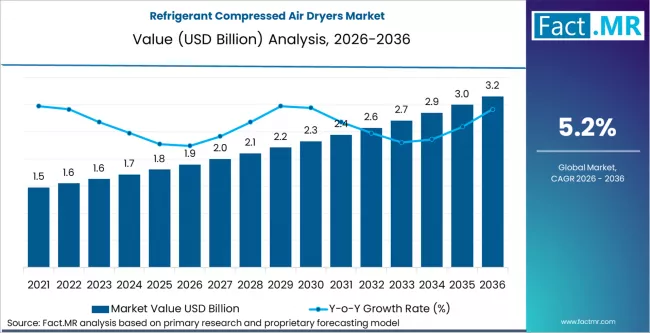
Refrigerant Compressed Air Dryers Market Market Value Analysis | Source: Fact.MR
Refrigerant Compressed Air Dryers Market Definition
The Refrigerant Compressed Air Dryers Market refers to the production and sale of dryer units that use refrigerant cooling to remove moisture from compressed air systems. These dryers cool compressed air to condense and separate water vapor, protecting downstream equipment from corrosion, freezing, and damage. Their primary function is to deliver dry, clean compressed air suited for industrial processes. Key end uses include manufacturing, automotive plants, food and beverage processing, pharmaceuticals, and petrochemical facilities where moisture‑free air is essential for quality and reliability.
Market Inclusions
This report covers global and regional market sizes for refrigerant compressed air dryers over a defined forecast period. It includes segment breakdowns by dryer type (cycling, non‑cycling/regenerative), compressor type (reciprocating, rotary, centrifugal), and end‑use industry (manufacturing, oil and gas, food processing, automotive, pharmaceuticals). The analysis also includes pricing trends, component and refrigerant supply dynamics, and trade flow data to reflect overall market behavior.
Market Exclusions
The scope excludes other compressed air treatment products such as desiccant dryers, membrane dryers, and general filtration systems unless integrated within a refrigerant dryer unit. It does not cover standalone air compressors, receivers, or unrelated pneumatic equipment. Niche moisture management technologies used exclusively outside compressed air applications are omitted.
Research Methodology
- Primary Research: Interviews were conducted with product engineers, OEM procurement specialists, and industrial end users.
- Desk Research: Data was sourced from industry reports, manufacturing statistics, and trade association publications.
- Market‑Sizing and Forecasting: A hybrid method was used, combining top‑down compressed air system demand estimates with bottom‑up shipment and revenue data.
- Data Validation and Update Cycle: Findings were validated through expert review and aligned with recent production, trade, and sales figures, with periodic updates.
Refrigerant Compressed Air Dryers Market Summary
-
Refrigerant Compressed Air Dryers Market Definition
- The Refrigerant Compressed Air Dryers Market refers to the production and sale of systems that use refrigerants to remove moisture from compressed air. These dryers cool compressed air to condense and separate water vapor, ensuring that the air used in industrial systems remains dry and free of contaminants. The primary function of these dryers is to prevent moisture-related damage to downstream equipment, protecting components from corrosion, freezing, and other forms of damage. Key industries utilizing refrigerant compressed air dryers include manufacturing, automotive, food and beverage processing, pharmaceuticals, and petrochemicals, where maintaining clean, dry air is essential for quality and system reliability.
-
Demand Drivers in the Market
- Growing Demand for Energy-Efficient Solutions: As industries seek to reduce energy consumption and operational costs, the demand for energy-efficient refrigerant air dryers is rising. These dryers are designed to provide effective moisture removal while minimizing energy use.
- Increasing Industrial Automation: The rise of automated manufacturing processes, particularly in automotive, food, and pharmaceutical industries, is driving demand for high-quality refrigerant compressed air dryers to ensure the reliable operation of automated systems that rely on clean air.
- Regulatory Pressure for Energy Management: Governments and regulatory bodies are increasingly imposing standards for energy efficiency and environmental sustainability, particularly in industrial sectors. This drives the adoption of refrigerant air dryers that comply with these regulations and contribute to energy savings.
- Industrial Growth in Emerging Markets: Rapid industrialization and infrastructure development in regions like South Asia, Southeast Asia, and Latin America are creating a rising demand for air compression systems and efficient moisture removal solutions, driving market growth.
-
Key Segments Analyzed in the FMR Report
- Dryer Configuration: Cycling refrigerated dryers are projected to capture the largest market share, owing to their energy-efficient operation, which only activates the refrigeration compressor when necessary.
- Capacity: The 50-300 scfm capacity range is expected to lead the market, ideal for medium-sized industrial applications that require efficient moisture removal while balancing energy consumption.
- End Use: The manufacturing sector is anticipated to lead the demand for refrigerant compressed air dryers, driven by the increasing need for clean and dry compressed air in production lines and other industrial operations.
-
Analyst Opinion at FMR
- Fact MR analysts predict, "The refrigerant compressed air dryers market will continue to expand at a steady pace, driven by increasing industrial applications, energy-efficiency mandates, and growth in emerging markets, especially in Asia-Pacific and Latin America."
-
Strategic Implications/Executive Takeaways
- Invest in Energy-Efficient Models: Manufacturers should focus on developing advanced refrigerant compressed air dryers with energy-saving features, such as cycling systems, to meet growing demand for cost-effective and environmentally friendly solutions.
- Target Emerging Markets: Companies should prioritize market entry or expansion in rapidly growing regions like India, Vietnam, and Mexico, where industrialization and infrastructure projects are fueling the demand for efficient air treatment systems.
- Enhance Product Customization: To cater to diverse industry needs, companies should offer customized refrigerant dryers tailored to specific applications, such as high-performance systems for food processing or low-maintenance options for automotive plants.
- Ensure Regulatory Compliance: As global regulations on energy use and emissions become more stringent, manufacturers should ensure that their products meet all necessary standards, such as ISO 8573, to remain competitive and appeal to a broader customer base.
-
Methodology
- Primary Research: Interviews were conducted with product engineers, OEM procurement specialists, and industrial end users to gather insights into market needs and challenges.
- Desk Research: Data was sourced from industry reports, manufacturing statistics, and trade publications to assess market trends and dynamics.
- Market Sizing and Forecasting: A hybrid model combining top-down industrial demand forecasts with bottom-up shipment and revenue data was used for accurate market sizing and growth projections, validated through expert reviews and market insights.
Segmental Analysis
Refrigerant Compressed Air Dryers Market Analysis by Capacity
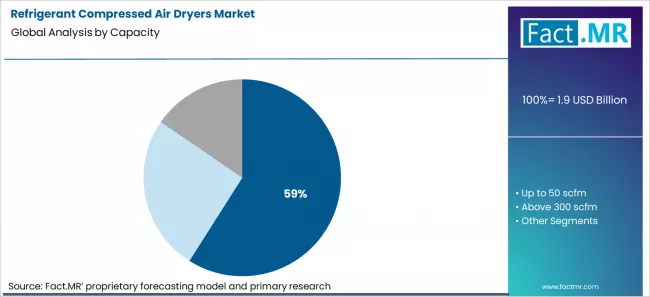
Refrigerant Compressed Air Dryers Market Analysis By Capacity | Source: Fact.MR
- Market Overview: The 50-300 scfm (Standard Cubic Feet per Minute) capacity range is expected to hold 59% of the refrigerant compressed air dryers market by 2026. This capacity range is ideal for small to medium-sized industrial and commercial applications that require efficient and reliable drying of compressed air, balancing performance and energy efficiency.
- Demand Drivers:
- Medium-Sized Industrial Applications: The 50-300 scfm range is highly demanded in industries such as manufacturing, food processing, and automotive, where moderate amounts of compressed air are required for operations. These dryers ensure that air is free of moisture, preventing damage to equipment and maintaining product quality.
- Energy Efficiency and Cost Savings: Air dryers in this capacity range are increasingly designed to operate efficiently, offering a balance between drying capacity and energy consumption. Companies look for dryers that can maintain low operational costs while ensuring reliable performance.
- Versatility in Operations: The 50-300 scfm capacity is widely adaptable to various industrial settings, making these dryers a popular choice for a range of applications, driving demand across multiple sectors.
Refrigerant Compressed Air Dryers Market Analysis by Dryer Configuration
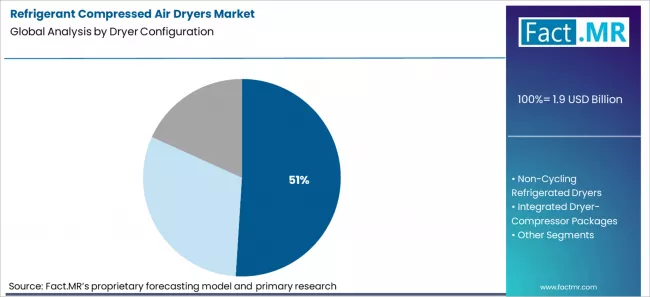
Refrigerant Compressed Air Dryers Market Analysis By Dryer Configuration | Source: Fact.MR
- Market Overview: Cycling refrigerated dryers are expected to capture 51% of the market share by 2026. These dryers are widely used due to their energy-efficient operation. They work by cycling the refrigeration compressor on and off to maintain the required air temperature and remove moisture, resulting in reduced energy consumption compared to non-cycling systems.
- Demand Drivers:
- Energy Efficiency: Cycling refrigerated dryers are favored for their ability to reduce energy consumption by operating only when necessary. This efficiency is highly valued in industries looking to lower their operational costs, particularly in environments where air drying is needed intermittently.
- Cost-Effectiveness: These dryers offer a more affordable option for businesses that require consistent, low-maintenance operation, making them attractive to medium-sized industries and those focused on energy-saving measures.
- Growing Demand for Sustainable Solutions: With increasing pressure on industries to adopt more sustainable technologies, cycling refrigerated dryers offer an ideal solution for companies looking to meet energy-saving targets while maintaining high-quality compressed air.
Refrigerant Compressed Air Dryers Market Drivers, Restraints, and Opportunities
FMR analysts observe that the refrigerant compressed air dryers market is a mature, performance‑driven segment anchored in the long‑standing need to remove moisture from compressed air to protect pneumatic systems and processes. Historically, desiccant and basic dryer systems served general industrial applications; as compressed air quality expectations tightened across manufacturing, food and beverage, and automation, refrigerant dryers gained structural demand for reliable dew point control at moderate compressed air loads. The 2026 valuation reflects this baseline demand linked to global industrial activity and equipment performance needs.
While demand for desiccant and simple dryers persists in specialized or extreme dew point applications, refrigerant dryers engineered for energy efficiency and consistent moisture removal are gaining share. These engineered units carry higher per‑unit pricing, contributing to net market value growth even though unit volumes align with broader industrial installation cycles. The market exists at its current size because compressed air quality directly affects equipment uptime, product quality, and maintenance costs, and regulatory and performance standards increasingly influence dryer selection.
- Industrial Performance Demand: End‑users specify refrigerant dryers to achieve stable dew point control and protect pneumatic equipment versus basic solutions that cannot maintain consistent moisture levels.
- Energy & Efficiency Standards: Regulations such as ISO 8573 air quality classifications and energy performance criteria push adoption of certified, energy‑optimized dryer systems.
- Regional Industrial Trends: In Asia‑Pacific and North America, strong manufacturing bases and performance expectations drive uptake of advanced refrigerant dryers, while cost‑led options remain common in smaller markets.
Regional Analysis
The market analysis covers key global regions, including South Asia and Pacific, Middle East & Africa, North America, and Western Europe. It is segmented geographically, with specific market dynamics for each region. The full report provides a detailed market attractiveness analysis.
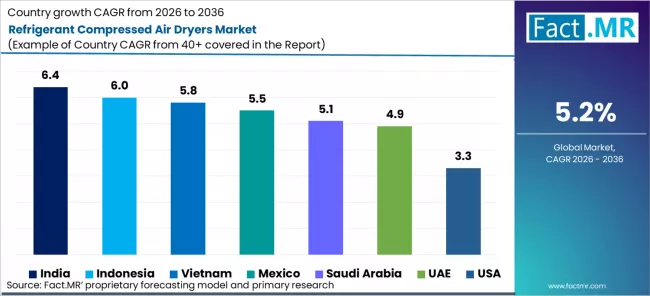
Refrigerant Compressed Air Dryers Market Cagr Analysis By Country | Source: Fact.MR
| Country | CAGR (2026-2036) |
|---|---|
| India | 6.4% |
| Indonesia | 6.0% |
| Vietnam | 5.8% |
| Mexico | 5.5% |
| Saudi Arabia | 5.1% |
| UAE | 4.9% |
| USA | 3.3% |
| Germany | 2.8% |
Source: Fact.MR analysis. Updated Feb 23, 2026
Source: Fact MR (FMR) analysis, based on proprietary forecasting model and primary research.
South Asia and Pacific:
South Asia and Pacific are "key growing markets" for refrigerant compressed air dryers, with rapid industrialization and increasing demand for efficient air treatment systems in countries like India, Indonesia, and Vietnam.
- India: Demand for refrigerant compressed air dryers in India is projected to rise at 6.4% CAGR through 2036. India’s growing industrial and manufacturing sectors continue to drive the demand for efficient compressed air systems.
- Indonesia: Demand for refrigerant compressed air dryers in Indonesia is projected to rise at 6.0% CAGR through 2036. Indonesia’s expanding industrial base and increasing demand for energy-efficient air treatment solutions contribute to steady market growth.
- Vietnam: Demand for refrigerant compressed air dryers in Vietnam is projected to rise at 5.8% CAGR through 2036. Vietnam’s industrial development and growing need for high-efficiency equipment support market demand.
Middle East & Africa:
In the Middle East, particularly Saudi Arabia and the UAE, demand for refrigerant compressed air dryers is driven by industrial growth and a focus on energy-efficient solutions.
- Saudi Arabia: Demand for refrigerant compressed air dryers in Saudi Arabia is projected to rise at 5.1% CAGR through 2036. Saudi Arabia’s expanding industrial sector and focus on reducing energy consumption drive the demand for these systems.
- UAE: Demand for refrigerant compressed air dryers in the UAE is projected to rise at 4.9% CAGR through 2036. UAE’s industrial expansion and demand for sustainable technologies contribute to the growth of air treatment systems like refrigerant compressed air dryers.
Latin America:
In Latin America, particularly in Mexico, demand for refrigerant compressed air dryers is increasing due to growing industrial sectors and the need for energy-efficient systems in manufacturing.
- Mexico: Demand for refrigerant compressed air dryers in Mexico is projected to rise at 5.5% CAGR through 2036. Mexico’s industrial development and increasing adoption of energy-efficient air treatment technologies contribute to the growth of the market.
North America:
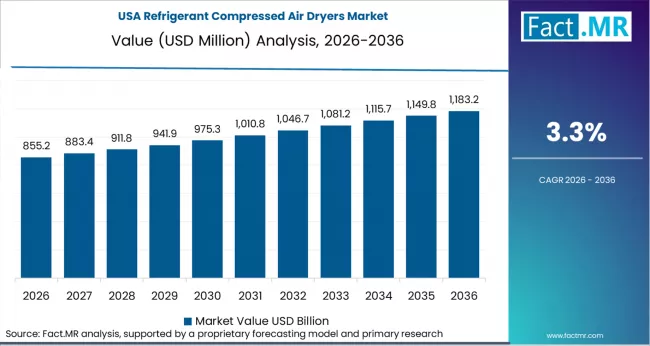
Refrigerant Compressed Air Dryers Market Country Value Analysis | Source: Fact.MR
In North America, the USA remains a significant market for refrigerant compressed air dryers, driven by the need for efficient and reliable air treatment solutions in industrial applications.
- USA: Demand for refrigerant compressed air dryers in the U.S. is projected to rise at 3.3% CAGR through 2036. The USA’s focus on sustainable and energy-efficient industrial solutions continues to drive the adoption of refrigerant compressed air dryers.
Western Europe:
In Western Europe, Germany remains a key market for refrigerant compressed air dryers, with demand driven by industrial growth and environmental regulations pushing for energy-efficient systems.
- Germany: Demand for refrigerant compressed air dryers in Germany is projected to rise at 2.8% CAGR through 2036. Germany’s commitment to energy efficiency and strong manufacturing sector support demand for air treatment solutions.
Fact MR's analysis of the refrigerant compressed air dryers market in South Asia and Pacific, Middle East & Africa, North America, and Western Europe consists of country-wise assessments that include India, Indonesia, Vietnam, Mexico, Saudi Arabia, UAE, the USA, and Germany. Readers can find detailed trends, regulatory updates, and company-specific investments shaping the market’s growth in these countries.
How Are Key Players Competing in the Refrigerant Compressed Air Dryers Market?
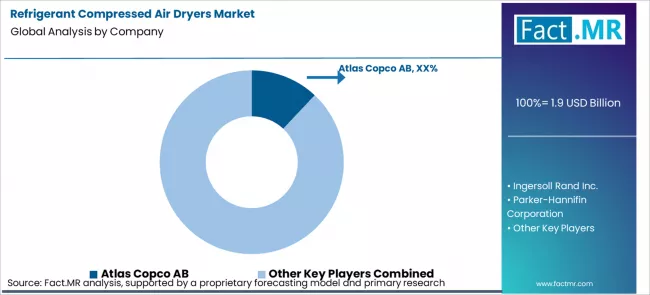
Refrigerant Compressed Air Dryers Market Analysis By Company | Source: Fact.MR
The refrigerant compressed air dryers market is marked by significant competition from leading players such as Atlas Copco AB and Ingersoll Rand Inc., which offer energy-efficient and high-performance dryers designed to optimize compressed air systems. Parker-Hannifin Corporation and KAESER KOMPRESSOREN SE are also competing by offering advanced refrigerant dryers that reduce operational costs through innovative heat exchange technologies. SPX FLOW, Inc. and Donaldson Company, Inc. focus on providing compact, reliable, and cost-effective solutions for diverse industrial applications, addressing the growing demand for air purity and energy efficiency. BEKO TECHNOLOGIES GmbH leads in offering custom solutions with integrated monitoring and advanced features for industrial air drying needs. Sullair, LLC (Hitachi Global Air Power) and Fusheng Industrial Co., Ltd. (FS-Curtis) differentiate themselves with rugged, durable products aimed at heavy-duty industries. These players are focusing on sustainability, reducing energy consumption, and improving product lifespan to cater to the expanding industrial sector.
Recent Industry Developments
- Atlas Copco | Strategic Acquisition of Trident Pneumatics | February 2025 Atlas Copco acquired Trident Pneumatics Pvt. Ltd., a specialist in air treatment and onsite gas generation. This acquisition bolsters Atlas Copco’s 2026 portfolio of high-efficiency refrigerant and desiccant dryers, particularly for the Indian and global export markets, and integrates Trident’s expertise in localized manufacturing and cost-effective air treatment.
- Ingersoll Rand | Sanand Facility Expansion & Localization | February 2026 Ingersoll Rand inaugurated its new manufacturing facility in Sanand, Gujarat, specifically designed to produce engineered-to-order refrigerant dryers and centrifugal compressors. The company announced a 2026 strategic goal to achieve over 90% localization of its rotary screw and air treatment products in India, incorporating digital monitoring and energy-efficient technologies into its dryer line.
- Parker Hannifin | Sustainability & Low-GWP Transition | February 2026 In its Fiscal Year 2025 Sustainability Report released in February 2026, Parker Hannifin detailed the transition of its PNC and DRD series refrigerant dryers toward low-GWP refrigerants to comply with evolving EU F-gas regulations and U.S. EPA mandates. The newest 2026 models feature integrated Smart Energy Saving (DRD) controls that adjust power consumption based on real-time air demand.
Key Players of the Refrigerant Compressed Air Dryers Market
- Atlas Copco AB
- Ingersoll Rand Inc.
- Parker-Hannifin Corporation
- KAESER KOMPRESSOREN SE
- SPX FLOW, Inc.
- Donaldson Company, Inc.
- BEKO TECHNOLOGIES GmbH
- Sullair, LLC (Hitachi Global Air Power)
- Fusheng Industrial Co., Ltd. (FS-Curtis)
Report Scope
| Metric | Value |
|---|---|
| Quantitative Units | USD 1.9 billion (2026) to USD 3.1 billion (2036), at a CAGR of 5.2% |
| Market Definition | The Refrigerant Compressed Air Dryers Market includes systems that use refrigerants to remove moisture from compressed air, ensuring air quality and preventing equipment damage in various industrial applications. |
| By Dryer Configuration | Cycling Refrigerated Dryers, Non-Cycling Refrigerated Dryers, Integrated Dryer-Compressor Packages, Other |
| By Capacity | Up to 50 scfm, 50-300 scfm, Above 300 scfm, Other |
| By End Use | Manufacturing, Automotive & Metalworking, Food & Beverage, Others |
| By Sales Channel | Compressor OEM Networks, Distributors, System Integrators, Other |
| Regions Covered | North America, Latin America, Europe, East Asia, South Asia, Oceania, Middle East and Africa |
| Countries Covered | United States, Canada, Mexico, Brazil, Argentina, Germany, France, United Kingdom, Italy, Spain, China, India, Japan, South Korea, Indonesia, Australia, and 40+ countries |
| Key Companies Profiled | Atlas Copco AB, Ingersoll Rand Inc., Parker-Hannifin Corporation, KAESER KOMPRESSOREN SE, SPX FLOW, Inc., Donaldson Company, Inc., BEKO TECHNOLOGIES GmbH, Sullair, LLC (Hitachi Global Air Power), Fusheng Industrial Co., Ltd. (FS-Curtis) |
| Forecast Period | 2026 to 2036 |
| Approach | Hybrid top-down and bottom-up market modeling validated through primary interviews with manufacturers and supported by trade data benchmarking and market research. |
Source: Fact.MR analysis. Updated Feb 23, 2026
Bibliographies
- BEKO TECHNOLOGIES GmbH. (2025). Refrigeration dryers and condensate treatment systems for compressed air. BEKO TECHNOLOGIES GmbH.
- Sullair, LLC (Hitachi Global Air Power). (2025). Refrigerated air dryers for industrial compressed air systems. Hitachi Global Air Power.
- Fusheng Industrial Co., Ltd. (FS-Curtis). (2025). Refrigerated compressed air dryers for industrial operations. Fusheng Industrial Co., Ltd.
- Atlas Copco AB. (2025, February). Atlas Copco acquires Trident Pneumatics to expand air treatment portfolio [Press release]. Atlas Copco AB.
- Ingersoll Rand Inc. (2026, February). Ingersoll Rand inaugurates manufacturing facility in Sanand and advances localization strategy [Press release]. Ingersoll Rand Inc.
- Parker-Hannifin Corporation. (2025). Sustainability report 2025: Transition toward low global warming potential refrigerants. Parker-Hannifin Corporation.
Segmentation
Refrigerant Compressed Air Dryers Market Key Segments
-
By Dryer Configuration :
- Cycling Refrigerated Dryers
- Non-Cycling Refrigerated Dryers
- Integrated Dryer-Compressor Packages
- Other
-
By Capacity :
- Up to 50 scfm
- 50-300 scfm
- Above 300 scfm
- Other
-
By End Use :
- Manufacturing
- Automotive & Metalworking
- Food & Beverage
- Others
-
By Sales Channel :
- Compressor OEM Networks
- Distributors
- System Integrators
- Other
-
Region :
- North America
- USA
- Canada
- Mexico
- Europe
- Germany
- UK
- France
- Italy
- Spain
- Nordic Countries
- BENELUX
- Rest of Europe
- Asia Pacific
- China
- Japan
- South Korea
- India
- Australia
- Rest of Asia Pacific
- Latin America
- Brazil
- Argentina
- Rest of Latin America
- Middle East and Africa
- Kingdom of Saudi Arabia
- United Arab Emirates
- South Africa
- Rest of Middle East and Africa
- Other Regions
- Oceania
- Central Asia
- Other Markets
- North America
Frequently Asked Questions
How large is the demand for Refrigerant Compressed Air Dryers in the global market in 2026?
What will be the market size of Refrigerant Compressed Air Dryers in the global market by 2036?
What is the expected demand growth for Refrigerant Compressed Air Dryers in the global market between 2026 and 2036?
Which capacity range is expected to dominate the market?
Which region is expected to show the highest growth rate for Refrigerant Compressed Air Dryers?
How significant is the growth outlook for Indonesia in this market?
What is the growth outlook for the United States in this report?
What is the growth forecast for Saudi Arabia in the Refrigerant Compressed Air Dryers market?
Which European market is highlighted in this analysis?
Which company is identified as a leading player in the Refrigerant Compressed Air Dryers market?
What are Refrigerant Compressed Air Dryers used for?
What does the Refrigerant Compressed Air Dryers market include in this report?
How is the market forecast developed in this report?
What is meant by the Refrigerant Compressed Air Dryers market in this report?
Who worked on this report


Preview the report firsthand - request a free sample
Free SampleGet the brochure for pricing and purchase details
Download PDF