- Base Value(2025): 1.6 Bn
- Estimated Value(2026): 1.7 Bn
- Forecast Value (2036): 3.0 Bn
- CAGR (2026 - 2036): 5.9%
Adsorption Air Dryers Market Forecast 2026 to 2036
In 2025, the adsorption air dryers market was valued at USD 1.6 billion. Based on Fact MR's analysis, demand for adsorption air dryers is estimated to grow to USD 1.7 billion in 2026 and USD 3.0 billion by 2036. FMR projects a CAGR of 5.9% during the forecast period.
The absolute dollar growth from 2026 to 2036 is USD 1.3 billion. This growth is driven by increasing industrial demand for efficient moisture removal in compressed air systems, which is crucial for improving equipment lifespan and operational efficiency. The rising adoption of adsorption air dryers across sectors such as manufacturing, automotive, and energy is expected to support this growth. However, challenges like fluctuating raw material prices and the need for energy-efficient solutions may affect the pace of expansion in some regions.
India leads with a CAGR of 6.7%, driven by rapid industrial growth and rising demand for energy-efficient air drying solutions. Vietnam follows with a 6.4% CAGR, fueled by expanding industrial sectors and the growing need for moisture control. China grows at 6.0%, supported by its large manufacturing base and demand for reliable air compression solutions. Indonesia grows at 5.8%, benefiting from the rise in industrial activities. Malaysia experiences a 5.5% growth rate, while Mexico shows 5.2% growth, driven by increasing industrial production. The USA grows at 3.6%, reflecting a mature market, while Germany shows the slowest growth at 3.1%, due to a stable demand and developed industrial base.
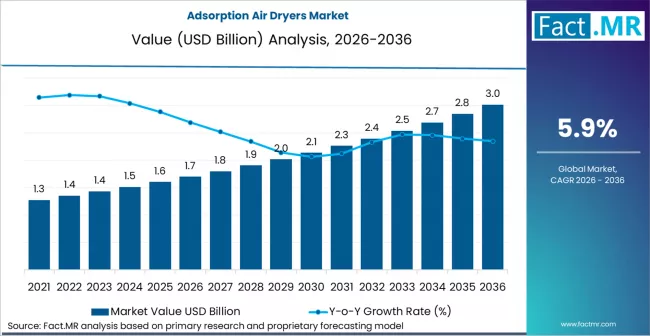
Adsorption Air Dryers Market Market Value Analysis | Source: Fact.MR
Adsorption Air Dryers Market Definition
The adsorption air dryers market refers to the production and sale of drying systems that remove moisture from compressed air using adsorbent materials such as silica gel, activated alumina, or molecular sieves. These dryers operate by binding water vapor onto the surface of the adsorbent medium, producing very low‑dew‑point air essential for applications sensitive to moisture. Their primary function is to protect pneumatic equipment, instrumentation, and processes where dry air is critical. Key end uses include manufacturing, food and beverage, pharmaceuticals, electronics, automotive, and petrochemical industries.
Market Inclusions
This report covers global and regional market sizes for adsorption air dryers over a defined forecast period. It includes segment breakdowns by dryer type (heatless, heated, blower‑purge, and rotary wheel), compressor type (reciprocating, rotary, centrifugal), and end‑use industry (manufacturing, automotive, food processing, pharmaceuticals, oil and gas). Pricing trends, component and desiccant supply dynamics, and trade flow data are included to reflect overall market behavior.
Market Exclusions
The scope excludes other compressed air treatment products such as refrigerant dryers, membrane dryers, and filtration unless integrated within an adsorption dryer unit. It does not cover air compressors, receivers, or unrelated pneumatic equipment. Niche moisture management technologies used exclusively outside compressed air systems are omitted.
Research Methodology
- Primary Research: Interviews were conducted with product engineers, OEM procurement specialists, and industrial end users.
- Desk Research: Data was sourced from industry reports, manufacturing statistics, and trade association publications.
- Market‑Sizing and Forecasting: A hybrid model was used, combining top‑down compressed air and industrial drying demand estimates with bottom‑up shipment and revenue data.
Data Validation and Update Cycle
Findings were validated through expert review and aligned with recent production, trade, and sales figures, with periodic updates.
Adsorption Air Dryers Market Summary
Adsorption Air Dryers Market Definition
The Adsorption Air Dryers Market encompasses systems designed to remove moisture from compressed air using adsorbent materials such as silica gel, activated alumina, or molecular sieves. These dryers work by binding water vapor to the surface of the adsorbent material, producing dry compressed air suitable for sensitive industrial applications. The primary function of adsorption air dryers is to protect pneumatic equipment, instruments, and processes where dry air is critical for quality and reliability. They are widely used across industries like manufacturing, pharmaceuticals, food and beverage, automotive, and electronics.
Demand Drivers in the Market
- Increasing Industrial Demand for Moisture Removal: Industries are increasingly adopting adsorption air dryers for their ability to efficiently remove moisture, which is crucial for enhancing equipment longevity, reducing corrosion, and maintaining operational efficiency.
- Energy Efficiency and Regulatory Compliance: With growing pressure for energy-efficient operations, especially in sectors like pharmaceuticals and electronics, adsorption air dryers are favored for their energy savings and ability to meet stringent regulatory moisture control standards.
- Expanding Industrial Applications in Emerging Markets: The demand for energy-efficient and reliable air treatment solutions is on the rise in emerging markets, particularly in countries like India, Vietnam, and China, which are witnessing rapid industrialization and an increased focus on sustainable technologies.
- Technological Advancements in Adsorption Dryers: Continuous improvements in desiccant materials and drying technologies are driving the adoption of more effective and reliable adsorption air dryers, particularly for industries that require precise moisture control, such as electronics and healthcare.
Key Segments Analyzed in the FMR Report
- Technology: Heatless desiccant dryers are expected to dominate the market due to their energy efficiency and simple design, widely adopted in industrial applications for their low-maintenance needs.
- Dew Point: The -40°C dew point is projected to capture the largest share of the market, as it meets the demands of industries requiring moisture-free air to prevent equipment damage and ensure process integrity.
- End Use: The manufacturing sector is expected to be the largest user of adsorption air dryers, followed by the food and beverage and pharmaceutical industries, where clean, dry air is essential for maintaining product quality and system performance.
Analyst Opinion at FMR
Fact MR analysts predict that, "The adsorption air dryers market will continue to experience robust growth, driven by increasing demand for reliable moisture removal solutions across industrial sectors, particularly in emerging markets with a focus on sustainability and efficiency."
Strategic Implications/Executive Takeaways
- Focus on Energy-Efficient Solutions: Manufacturers should prioritize developing energy-efficient adsorption dryers that meet the growing demand for cost-effective and sustainable air treatment solutions across diverse industrial applications.
- Capitalize on Emerging Markets: Companies should expand their presence in rapidly growing markets such as India, Vietnam, and Indonesia, where industrial growth is driving the adoption of air treatment solutions like adsorption air dryers.
- Adapt to Regulatory Requirements: With industries facing increasing regulatory pressure on air quality and moisture levels, manufacturers should ensure their products comply with industry standards such as ISO 8573 for compressed air quality.
- Invest in Technological Advancements: Advancements in desiccant technology and dryer performance should be a priority, as industries demand higher moisture removal efficiency and more reliable, low-maintenance systems.
Methodology
- Primary Research: Interviews were conducted with key stakeholders, including product engineers, OEM procurement specialists, and industrial end users, to gain insights into market needs, challenges, and preferences.
- Desk Research: Data was sourced from industry reports, manufacturing statistics, and trade publications to support market sizing and trend analysis.
- Market Sizing and Forecasting: A hybrid model combining top-down industrial demand forecasts with bottom-up shipment and revenue data was used to generate reliable market projections, validated through expert insights and data reviews.
Segmental Analysis
Adsorption Air Dryers Market Analysis by Dew Point
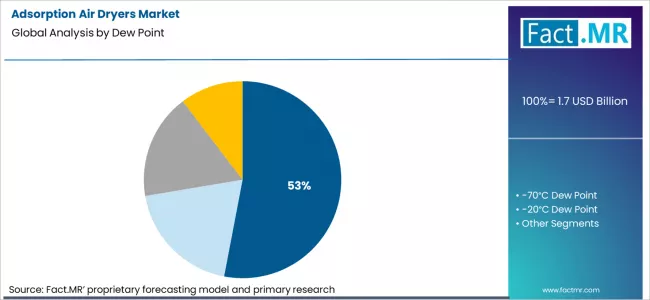
Adsorption Air Dryers Market Analysis By Dew Point | Source: Fact.MR
- Market Overview: -40°C dew point is expected to capture 53% of the adsorption air dryers market by 2026. Air dryers with a -40°C dew point are commonly used in applications that require high levels of moisture removal, such as industrial settings, food processing, and pharmaceutical manufacturing, where the quality of compressed air must meet stringent standards.
- Demand Drivers:
- Standard for Industrial Applications: -40°C dew point is considered the industry standard for many industrial applications where compressed air must be dry enough to prevent equipment corrosion, contamination, or performance issues.
- Energy Efficiency and Cost-Effectiveness: Dew point levels of -40°C are sufficient for most applications while providing an optimal balance between performance and energy efficiency, making them a preferred choice in industries with moderate to high compressed air requirements.
- Regulatory Compliance and Quality Standards: In sectors like pharmaceuticals and food processing, where compressed air comes into direct contact with products, -40°C dew point ensures that moisture levels in the air are sufficiently low to meet regulatory requirements and maintain product quality.
Adsorption Air Dryers Market Analysis by Technology
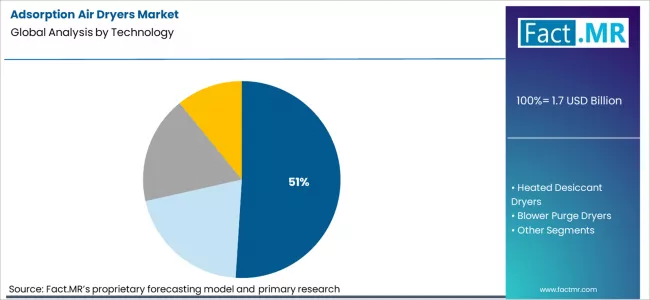
Adsorption Air Dryers Market Analysis By Technology | Source: Fact.MR
- Market Overview: Heatless desiccant dryers are projected to hold 51% of the market share by 2026. Heatless desiccant dryers are widely used in applications where energy efficiency and reliable performance are critical. These dryers utilize a desiccant material to adsorb moisture from compressed air, regenerating without the need for external heat, making them particularly effective in industrial environments.
- Demand Drivers:
- Energy Efficiency and Cost-Effectiveness: Heatless desiccant dryers are favored for their low energy consumption and simple design. They regenerate desiccant materials using compressed air instead of heat, making them more energy-efficient and cost-effective than other dryer types.
- Reliability and Ease of Maintenance: These dryers are known for their durability and low maintenance requirements, which is crucial in industrial applications where downtime can be costly. Their design makes them easy to maintain and operate.
- High-Performance Standards in Critical Applications: Heatless desiccant dryers provide high-quality moisture removal, making them ideal for critical applications in industries such as manufacturing, pharmaceuticals, and food processing, where clean and dry compressed air is essential.
Adsorption Air Dryers Market Drivers, Restraints, and Opportunities
FMR analysts observe that the adsorption air dryers market is a mature, performance‑centric segment anchored in industrial and commercial compressed air systems that require very low dew points for sensitive processes. Historically, refrigerant dryers served general moisture removal needs, but as automation, instrumentation, and precision manufacturing expanded, conditions requiring extremely dry air created structural demand for adsorption technology. The 2026 valuation reflects this reality, where adoption aligns with global manufacturing activity and stringent compressed air quality requirements in food processing, pharmaceuticals, electronics, and petrochemicals.
While demand for basic refrigerant dryers remains significant in moderate load applications, adsorption dryers designed for ultra‑low dew points and continuous operation are gaining share. These engineered systems carry higher per‑unit pricing, contributing to net market value growth even though unit volumes grow in line with broader industrial investment cycles. The market exists at its current size because critical applications cannot tolerate moisture‑induced corrosion or contamination, and regulatory and performance standards increasingly influence dryer selection.
- Critical Quality Demand: End‑users in precision industries adopt adsorption dryers to achieve very low dew points that basic refrigerant solutions cannot deliver, protecting equipment and processes.
- Standards & Compliance Pressure: Standards such as ISO 8573 compressed air quality classes push facilities toward certified, high‑performance drying solutions that meet defined moisture limits.
- Regional Industrial Trends: In North America and Europe, stringent industry quality and reliability expectations drive higher uptake of adsorption dryers, while cost‑led systems remain common in some Asia‑Pacific segments.
Regional Analysis
The market analysis covers key global regions, including South Asia and Pacific, East Asia, Southeast Asia, North America, and Western Europe. It is segmented geographically, with specific market dynamics for each region. The full report provides a detailed market attractiveness analysis.
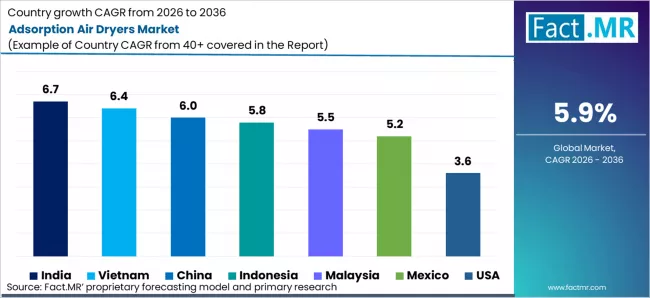
Adsorption Air Dryers Market Cagr Analysis By Country | Source: Fact.MR
| Country | CAGR (%) |
|---|---|
| India | 6.7% |
| Vietnam | 6.4% |
| China | 6.0% |
| Indonesia | 5.8% |
| Malaysia | 5.5% |
| Mexico | 5.2% |
| USA | 3.6% |
| Germany | 3.1% |
Source: Fact.MR analysis. Updated Feb 20, 2026
Source: Fact MR (FMR) analysis, based on proprietary forecasting model and primary research.
South Asia and Pacific:
South Asia and Pacific are "key growing markets" for adsorption air dryers, driven by industrial expansion and the rising need for energy-efficient air treatment systems in countries like India, Vietnam, and Indonesia.
- India: Demand for adsorption air dryers in India is projected to rise at 6.7% CAGR through 2036. India’s industrial growth and increased demand for energy-efficient air drying solutions continue to drive the market for adsorption air dryers.
- Vietnam: Demand for adsorption air dryers in Vietnam is projected to rise at 6.4% CAGR through 2036. Vietnam’s growing industrial sector and demand for sustainable technologies in manufacturing contribute to the demand for advanced air dryers.
- Indonesia: Demand for adsorption air dryers in Indonesia is projected to rise at 5.8% CAGR through 2036. Indonesia’s expanding manufacturing base and focus on energy-efficient solutions in industrial processes drive market growth.
East Asia:
East Asia, particularly China, is a "key region" for adsorption air dryers, supported by strong industrialization and the adoption of energy-efficient technologies in various manufacturing processes.
- China: Demand for adsorption air dryers in China is projected to rise at 6.0% CAGR through 2036. China’s rapid industrialization and focus on energy-efficient solutions in various industrial sectors continue to fuel demand for these air dryers.
Southeast Asia:
In Southeast Asia, countries like Malaysia are seeing increasing demand for adsorption air dryers, driven by industrial expansion and growing demand for high-efficiency air treatment systems.
- Malaysia: Demand for adsorption air dryers in Malaysia is projected to rise at 5.5% CAGR through 2036. Malaysia’s focus on energy-efficient systems and growing industrial sector contribute to the adoption of adsorption air dryers.
Latin America:
In Latin America, particularly Mexico, demand for adsorption air dryers is rising due to the country’s industrial growth and increasing adoption of energy-efficient technologies in manufacturing.
- Mexico: Demand for adsorption air dryers in Mexico is projected to rise at 5.2% CAGR through 2036. Mexico’s expanding industrial base and focus on reducing energy consumption in industrial processes support market growth for air dryers.
North America:
In North America, the USA remains a significant market for adsorption air dryers, driven by manufacturing sector demand for efficient and reliable air treatment systems.
- USA: Demand for adsorption air dryers in the U.S. is projected to rise at 3.6% CAGR through 2036. The U.S. industrial sector and increased emphasis on energy efficiency in manufacturing drive steady demand for these air treatment systems.
Western Europe:
In Western Europe, Germany remains a key market for adsorption air dryers, with demand driven by the strong industrial sector and focus on energy-efficient technologies.
- Germany: Demand for adsorption air dryers in Germany is projected to rise at 3.1% CAGR through 2036. Germany’s industrial manufacturing and demand for sustainable, energy-efficient technologies continue to contribute to steady market growth.
Fact MR's analysis of the Adsorption Air Dryers Market in South Asia and Pacific, East Asia, Southeast Asia, North America, and Western Europe consists of country-wise assessments that include India, Vietnam, China, Indonesia, Malaysia, Mexico, the USA, and Germany. Readers can find detailed trends, regulatory updates, and company-specific investments shaping the market’s growth in these countries.
How Are Key Players Competing in the Adsorption Air Dryers Market?
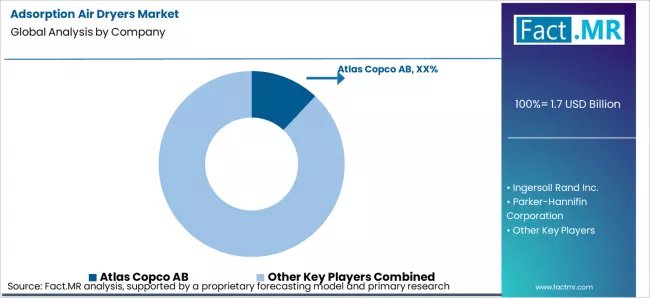
Adsorption Air Dryers Market Analysis By Company | Source: Fact.MR
The adsorption air dryers market is highly competitive, with leading players like Atlas Copco AB and Ingersoll Rand Inc. offering cutting-edge technologies focused on high efficiency and low energy consumption. Parker-Hannifin Corporation and KAESER KOMPRESSOREN SE are advancing with compact, reliable, and energy-saving dryers designed for industrial applications. Donaldson Company, Inc. and SPX FLOW, Inc. focus on offering dryers that deliver exceptional performance while reducing maintenance needs. BEKO TECHNOLOGIES GmbH and Gardner Denver Holdings, Inc. emphasize providing solutions for a wide range of industries, from manufacturing to food processing, by offering durable, versatile dryers. Sullair, LLC (Hitachi Global Air Power) competes by providing high-quality air dryers that ensure consistent performance even in challenging environments. The market is driven by innovations aimed at improving energy efficiency, reducing environmental impact, and enhancing the lifespan of air dryer systems.
Recent Industry Developments
- ISO (International Organization for Standardization) | ISO 7183:2026 Draft | January 2026 The Technical Committee for Compressors (ISO/TC 118) released a 2026 draft update to ISO 7183, extending standardized test methods for "Hybrid" dryers. This standard provides a non-commercial methodology for measuring the performance of dual-stage systems (Refrigerant + Adsorption) that target the -40°C dew point more efficiently than standalone towers.
- NIST (National Institute of Standards and Technology) | Structured Desiccant Research | November 2025 NIST’s Materials Infrastructure Report detailed the performance of 3D-printed ceramic desiccant structures (such as Cerades™ tech benchmarks) compared to traditional beads. The study validated that structured media can reduce pressure drop by up to 70%, effectively lowering the energy required for the compressor to push air through the dryer bed.
- EASA (European Union Aviation Safety Agency) | Nitrogen Generation Safety | February 2026 EASA updated its technical monitoring for on-board Nitrogen Generation Systems (NGS) which utilize adsorption technology. The 2026 guidance mandates stricter dew point monitoring (-70°C) for air entering fuel-tank inerting systems to prevent the buildup of static-conductive moisture in composite tanks.
Key Players of the Adsorption Air Dryers Market
- Atlas Copco AB
- Ingersoll Rand Inc.
- Parker-Hannifin Corporation
- Donaldson Company, Inc.
- KAESER KOMPRESSOREN SE
- SPX FLOW, Inc.
- BEKO TECHNOLOGIES GmbH
- Gardner Denver Holdings, Inc.
- Sullair, LLC (Hitachi Global Air Power)
Report Scope
| Metric | Value |
|---|---|
| Quantitative Units | USD 1.5 billion (2026) to USD 2.4 billion (2036), at a CAGR of 4.8% |
| Market Definition | The Air Compressor Hose Market includes hoses used in air compressors for various applications, offering durability and flexibility for industries such as manufacturing, construction, and automotive workshops. |
| By Material | Rubber Hoses, PVC Hoses, PU Hoses, Other |
| By Pressure Rating | Up to 10 bar, 10–20 bar, Above 20 bar, Other |
| By End Use | Industrial & Factory Use, Construction Tools, Automotive Workshops, Other |
| By Sales Channel | Industrial Distributors, Retail & E-commerce, OEM/Tool Bundles, Other |
| Regions Covered | North America, Latin America, Europe, East Asia, South Asia, Oceania, Middle East and Africa |
| Countries Covered | United States, Canada, Mexico, Brazil, Argentina, Germany, France, United Kingdom, Italy, Spain, China, India, Japan, South Korea, Indonesia, Australia, and 40+ countries |
| Key Companies Profiled | Parker-Hannifin Corporation, Continental AG, Gates Industrial Corporation plc, Eaton Corporation plc, Bridgestone Corporation, Manuli Rubber Industries S.p.A., Alfagomma S.p.A., Kuriyama Holdings Corporation, TOYOX Co., Ltd. |
| Forecast Period | 2026 to 2036 |
| Approach | Hybrid top-down and bottom-up market modeling validated through primary interviews with manufacturers and supported by trade data benchmarking and market research. |
Source: Fact.MR analysis. Updated Feb 20, 2026
Bibliographies
- Atlas Copco AB. (2025). Adsorption (desiccant) air dryers for industrial compressed air systems. Atlas Copco AB.
- Ingersoll Rand Inc. (2025). Desiccant/adsorption air dryers for industrial moisture control. Ingersoll Rand Inc.
- Parker-Hannifin Corporation. (2025). Desiccant air drying solutions for compressed air preparation. Parker-Hannifin Corporation.
- KAESER KOMPRESSOREN SE. (2025). Desiccant (adsorption) dryers for compressed air systems. KAESER KOMPRESSOREN SE.
- Donaldson Company, Inc. (2025). Compressed air drying and filtration solutions (desiccant drying systems). Donaldson Company, Inc.
Segmentation
Adsorption Air Dryers Market Key Segments
-
By Technology :
- Heatless Desiccant Dryers
- Heated Desiccant Dryers
- Blower Purge Dryers
- Other
-
By Dew Point :
- -40°C Dew Point
- -70°C Dew Point
- -20°C Dew Point
- Other
-
By End Use :
- Electronics & Semiconductors
- Pharma & Healthcare
- Manufacturing
- Others
-
By Sales Channel :
- Compressor OEM Networks
- Specialty Air Treatment OEMs
- Distributors
- Other
-
Region :
- North America
- USA
- Canada
- Mexico
- Europe
- Germany
- UK
- France
- Italy
- Spain
- Nordic Countries
- BENELUX
- Rest of Europe
- Asia Pacific
- China
- Japan
- South Korea
- India
- Australia
- Rest of Asia Pacific
- Latin America
- Brazil
- Argentina
- Rest of Latin America
- Middle East and Africa
- Kingdom of Saudi Arabia
- United Arab Emirates
- South Africa
- Rest of Middle East and Africa
- Other Regions
- Oceania
- Central Asia
- Other Markets
- North America
Frequently Asked Questions
How large is the demand for Adsorption Air Dryers in the global market in 2026?
What will be the market size of Adsorption Air Dryers in the global market by 2036?
What is the expected demand growth for Adsorption Air Dryers in the global market between 2026 and 2036?
Which dew point is expected to dominate the market?
Which region is expected to show the highest growth rate for Adsorption Air Dryers?
How significant is the growth outlook for Vietnam in this market?
What is the growth outlook for China in this report?
What is the growth forecast for Indonesia in the Adsorption Air Dryers market?
Which European market is highlighted in this analysis?
Which company is identified as a leading player in the Adsorption Air Dryers market?
What are Adsorption Air Dryers used for?
What does the Adsorption Air Dryers market include in this report?
How is the market forecast developed in this report?
What is meant by the Adsorption Air Dryers market in this report?
Who worked on this report


Preview the report firsthand - request a free sample
Free SampleGet the brochure for pricing and purchase details
Download PDF