- Market Value (2025): USD 536.7 Mn
- Estimated Value (2026): 570.0 Mn
- Forecast Value (2036): USD 1040.0 Mn
- CAGR (2026-2036): 6.2%
What is the Formaldehyde-Free Textile Binders Market forecast to be worth by 2036?
USD 570.0 million in 2026 to USD 1,040.0 million by 2036, at a 6.2% CAGR.
- The formaldehyde-free textile binders market crossed a valuation of USD 536.7 million in 2025, driven by wider use in textile finishing and stricter wastewater rules.
- Demand is projected to increase from USD 570.0 million in 2026 to USD 1,040.0 million by 2036.
- The market is forecast to record a 6.2% CAGR from 2026 to 2036 as textile mills seek binders that meet emission limits without reducing fabric strength, softness, appearance, or wash performance.
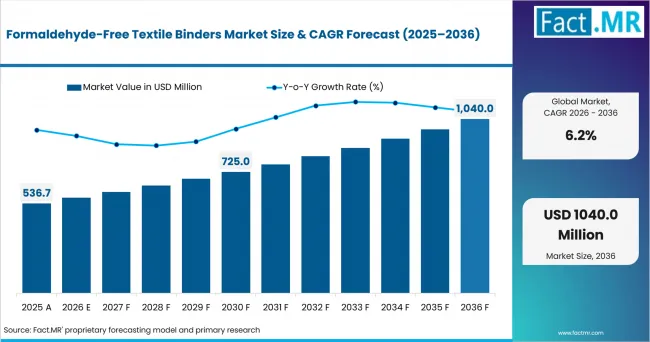
Formaldehyde Free Textile Binders Market Market Value Analysis | Source: Fact.MR
What are the defining numbers behind Formaldehyde-Free Textile Binders Market growth?
The market offers a USD 470.0 million absolute opportunity by 2036.
- Demand Drivers in the Market
- Nonwovens are expected to grow quickly where wastewater rules are strict. The binder must also keep the material strong without making it stiff.
- Acrylic binders need testing under normal production heat and timing. They must hold color or coating material without slowing the line.
- Surface treatment products are judged on safety records, wash performance, and fabric appearance.
- Softness depends on using the right amount of binder. Too much makes the fabric stiff, while too little weakens it.
- Textile mills decide whether a binder meets wastewater rules and still gives the needed strength, feel, and color.
- Key Segments Analyzed
- By Application: Nonwovens is expected to hold 38% share in 2026 due to the need for strong fiber bonding without making the material stiff.
- By Chemistry: Acrylic is projected to account for 32% share in 2026 owing to its reliable strength, softness, and performance during normal production.
- By Textile Type: Apparel is anticipated to capture 32% share in 2026 because fabric feel, wash life, color, and appearance are closely checked.
- By Performance: Soft hand is estimated to represent 30% share in 2026 since mills need binders that maintain strength without making fabrics hard.
- By Buyer Type: Textile mills are forecast to account for 41% share in 2026 driven by their direct role in recipe testing, curing, and final product approval.
- Analyst Opinion at Fact.MR
- Shambhu Nath Jha, Senior Analyst at Fact.MR, states, “Textile mills approve formaldehyde-free binders only after checking how they perform in normal production. They look at fabric strength, softness, wash life, appearance, heating needs, and wastewater results before using the product on a larger scale.”
- Strategic Implications
- Nonwoven binders should be tested under normal factory conditions. Mills need to see how they perform during application, drying, heating, handling, and final strength checks.
- Mills should compare binders under the same conditions. This helps them judge changes in softness, strength, appearance, and wash performance fairly.
- Distributors should prepare clear safety records before testing begins. The product name, test notes, and approval documents should match throughout the review.
Stricter rules on long-lasting chemicals are changing the products used in textiles and coatings. More companies are choosing PFAS-free options, but these products still need to perform well. The binder must keep color or coating material in place, prevent yellowing, and hold up during regular use and washing.
China is expected to lead with an 8.4% CAGR through 2036. India follows at 7.7%, while Germany is projected to grow at 7.1%. Brazil is estimated to record a 6.5% CAGR. The United States is anticipated to expand at 5.9%. Growth will depend on textile output, factory readiness, wastewater rules, and product approval timelines.
How does the Formaldehyde-Free Textile Binders Market break down by segment?
Nonwovens leads Application with 38% share in 2026, while Acrylic leads Chemistry at 32%.
What leads the Application segment?
Nonwovens hold 38% share in 2026.
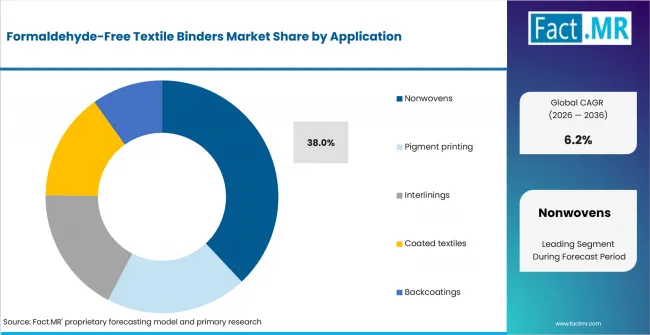
Formaldehyde Free Textile Binders Market Analysis By Application | Source: Fact.MR
Nonwovens lead because binder performance affects several stages of production. The binder must hold the fibers together during storage, processing, and regular use. It also needs to provide wet strength without making the material stiff or changing its appearance. Mills check how well it works at the usual heating time and temperature before approval.
Pigment printing, interlinings, coated textiles, and backcoatings make up the rest of the application category. Each use needs a different balance of strength, softness, color hold, and wash life. Repeat orders are more likely when the binder gives the same result during normal production.
How does Chemistry shape demand?
Acrylic leads with 32% share in 2026.
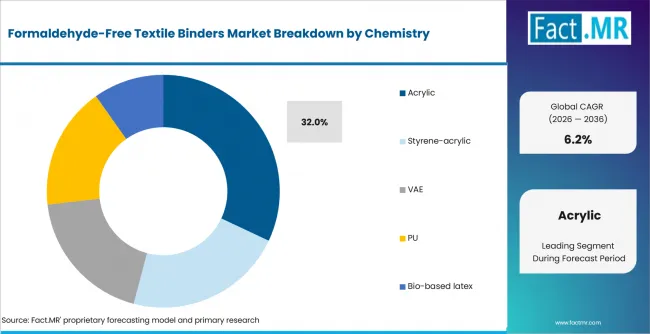
Formaldehyde Free Textile Binders Market Analysis By Chemistry | Source: Fact.MR
Mills often choose acrylic because it is familiar and easy to check during regular production trials. The main test is whether it gives the fabric enough strength while keeping it soft and even in appearance. Drying time, heating needs, and wash performance also affect approval. Styrene-acrylic, VAE, PU, and bio-based latex are used when a different level of softness, strength, or heat resistance is needed.
Where is Textile Type demand strongest?
Apparel holds 32% share in 2026.
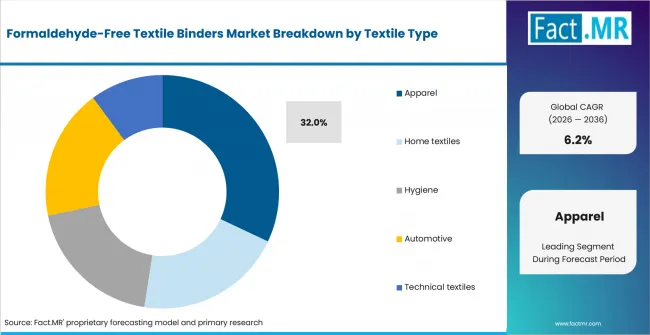
Formaldehyde Free Textile Binders Market Analysis By Textile Type | Source: Fact.MR
In clothing, the binder can directly affect how the fabric feels and looks. It must add strength without making the material rough, stiff, or yellow after heating. The fabric also needs to stay strong and keep its appearance after repeated washing. Home textiles, hygiene products, automotive fabrics, and technical textiles have different needs, so each one requires separate testing before wider use.
What supports Performance adoption?
Soft hand accounts for 30% share in 2026.
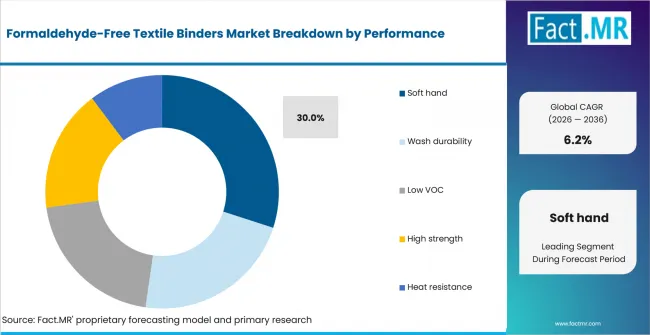
Formaldehyde Free Textile Binders Market Analysis By Performance | Source: Fact.MR
Mills prefer binders that keep the fabric soft without weakening it during use or washing. The product must also hold fibers, color, or coating material firmly in place. Low emissions, high strength, wash life, and heat resistance are reviewed during testing. Mills also check whether the binder works with the usual heating time and temperature. A product is less likely to be approved if it raises energy use or changes the fabric’s appearance.
Which Buyer Type dominates?
Textile mills hold 41% share in 2026.
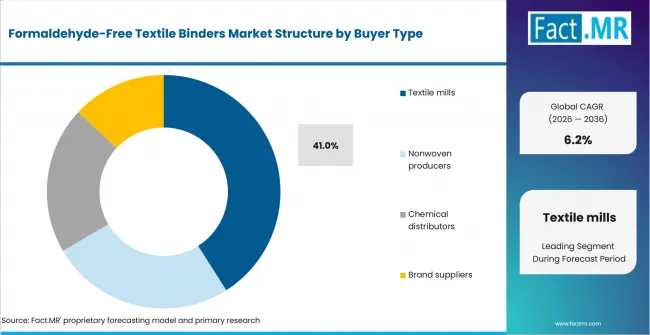
Formaldehyde Free Textile Binders Market Analysis By Buyer Type | Source: Fact.MR
Textile mills lead because they decide whether a binder works during normal production. They prepare the mix, apply it to the fabric, control drying and heating, and check the final result. The fabric must meet the required level of strength, softness, appearance, and wash life before it moves forward.
Nonwoven producers, chemical distributors, and brand companies also take part in the review. However, final approval depends on mill trials. Mills also check wastewater records and restricted chemical rules. Repeat use follows only when the binder gives the same result without extra work or frequent production problems.
What is accelerating Formaldehyde-Free Textile Binders Market adoption, and what is holding it back?
PFAS-free textile demand is expected to drive market growth, while qualification costs and production fit are anticipated to restrain it.
Drivers Impact Analysis
| DRIVER | (~) % IMPACT ON CAGR | GEOGRAPHIC RELEVANCE | IMPACT TIMELINE |
|---|---|---|---|
| Pfas persistence control in Nonwovens | +0.8% | China and export suppliers | Medium term (2-4 years) |
| Water discharge testing | +0.6% | Europe and North America | Short term (<= 2 years) |
| Nonwovens approval programs | +0.5% | Asia Pacific | Medium term (2-4 years) |
| Local support near textile finishers | +0.4% | Global | Long term (>= 4 years) |
Source: Fact.MR analysis. Updated Jul 15, 2026
- PFAS control in nonwovens: Stricter PFAS rules are pushing mills to review new binders. The product must still keep the material strong, soft, and durable during normal use.
- Wastewater testing: Mills are checking wastewater results more often before approval. A binder has a better chance of being used when it meets chemical rules and still performs well on the fabric.
- Nonwoven testing programs: These tests show whether the binder holds fibers together and keeps its strength when dry or wet. Mills also check fabric feel and heating needs before regular production.
- Local technical support: Nearby technical staff can help when factory results differ from laboratory tests. They review application, drying, heating, strength, feel, and appearance to find the cause of the problem.
Opportunity Impact Analysis
| OPPORTUNITY | (~) % IMPACT ON CAGR | GEOGRAPHIC RELEVANCE | IMPACT TIMELINE |
|---|---|---|---|
| Grades tuned for Nonwovens | +0.5% | Global | Medium term (2-4 years) |
| Application labs for Acrylic | +0.4% | Asia Pacific and Europe | Short term (<= 2 years) |
| Rule-ready documentation | +0.4% | Europe and United Kingdom | Medium term (2-4 years) |
| Local trials with surface treatment buyers | +0.3% | India and Brazil | Long term (>= 4 years) |
Source: Fact.MR analysis. Updated Jul 15, 2026
- Binders made for nonwovens: These products have a better chance of approval when factory trials match the lab results. They must keep the material strong and soft while working well with the usual heating process.
- Acrylic testing labs: These labs help mills find the right mix and working conditions. The binder should perform well without special steps that slow normal production.
- Clear approval documents: Well-organized records make chemical and emission checks easier. The files should match the product tested and the results used for approval.
- Local surface treatment trials: Local testing shows how the binder works on the actual fabric and equipment. It also helps fix problems with color hold, appearance, softness, or wash performance before larger orders begin.
Restraints Impact Analysis
| RESTRAINT | (~) % IMPACT ON CAGR | GEOGRAPHIC RELEVANCE | IMPACT TIMELINE |
|---|---|---|---|
| Qualification cost | -0.4% | Global processors | Medium term (2-4 years) |
| Fit limits in Acrylic | -0.3% | Global | Short term (<= 2 years) |
| Documentation burden | -0.3% | Europe and North America | Medium term (2-4 years) |
| Scale-up risk | -0.2% | High-volume plants | Long term (>= 4 years) |
Source: Fact.MR analysis. Updated Jul 15, 2026
- High testing cost: Changing an approved binder requires lab work, fabric samples, factory time, performance checks, and customer approval. Mills may delay the change when the expected benefit does not clearly outweigh the risk of weak bonding, a rough fabric feel, poor wash life, or extra rework.
- Limits of acrylic binders: Acrylic may lead the chemistry category, but it does not suit every fabric or production method. Problems with film formation, heating needs, stiffness, yellowing, or wet strength can limit its use to small trials.
- Heavy paperwork: Safety records, wastewater details, test notes, and final fabric results must all refer to the same product and working conditions. Missing or mismatched information can slow approval, especially when restricted chemical lists are part of the review.
- Risk during larger production runs: A binder that performs well in a small trial may behave differently during full production. Changes in drying, heating time, application level, or fabric condition can affect strength, softness, color hold, and appearance. Large plants usually keep using an approved recipe until the new binder gives the same result across repeated runs.
Which countries are scaling Formaldehyde-Free Textile Binders Market fastest?
Germany 7.1%, Brazil 6.5%, United States 5.9%.
.webp "Top Country Growth Comparison Formaldehyde Free Textile Binders Market Cagr (2026 2036)")
Top Country Growth Comparison Formaldehyde Free Textile Binders Market Cagr (2026 2036) | Source: Fact.MR
Regional analysis covers Asia Pacific, Europe, North America, the Middle East & Africa, and Latin America.
| COUNTRY | CAGR |
|---|---|
| Germany | 7.1% |
| Brazil | 6.5% |
| United States | 5.9% |
Source: Fact.MR analysis. Updated Jul 15, 2026
7.1% CAGR, driven by local textile production and customer testing of low-emission binders.
Germany is expected to record a 7.1% CAGR through 2036. Mills usually begin with sample testing before placing repeat orders. The test records need to show the exact binder grade, the textile used, the application method, the heating time, and the final fabric result. Mill staff compare softness with strength and check whether heat causes yellowing or any other visible change. Approval is easier when safety checks, wastewater results, and emission records are kept in one file. This helps the mill and the customer review the same information before regular use begins.
What underpins Brazil's growth?
6.5% CAGR, backed by local textile production and practical testing near major mills.
Brazil offers a good setting for factory trials because many textile operations are close to the main production areas. When a binder does not perform as expected, staff can review the way it was applied and heated before running another test. They also check whether it holds the fabric or coating properly. Before regular orders begin, the product must give steady softness, strength, appearance, and wash performance. Safety records and emission results also need to be complete. Keeping each trial change on record makes the next review clearer and reduces repeated testing.
What is driving United States' growth through 2036?
5.9% CAGR, led by local textile production and regular testing of low-emission binders.
In the United States, mills use factory trials to see whether a binder that worked in the lab also performs well on the production line. They check whether it sticks properly and keeps the fabric or coating together after drying and heating. These trials also show whether better strength affects softness, wash life, or appearance. Approval moves faster when test results are linked with wastewater data, safety checks, and emission records so the mill and customer can review the same information.
Who leads the Formaldehyde-Free Textile Binders Market?
BASF and Archroma lead the named company set, while Dow, Synthomer, Wacker, and Trinseo add strength in textile binder products and technical support.
Competition depends on how well each company proves its product during real factory use. The binder must work with the mill’s usual recipe and production settings. It also needs to hold fibers, color, or coating material in place without making the fabric too stiff or changing its look. Heating needs and wash life also affect approval.
Companies can reduce approval delays by keeping safety and emission records linked to the exact product tested. Mills also need clear results for dry strength, wet strength, washing, yellowing, and production performance before placing repeat orders.
Which companies are the key providers?
BASF and Archroma are key providers. Dow and Synthomer are also profiled. Wacker and Trinseo complete the company set.
- BASF
- Archroma
- Dow
- Synthomer
- Wacker
- Trinseo
Bibliography
- Brazilian Institute of Geography and Statistics. (2026, June 3). Brazilian industrial production changed 0.7% in April.
- Department of Chemicals and Petrochemicals. (2026, February 6). Annual report 2025–26. Ministry of Chemicals and Fertilizers, Government of India.
- European Commission. (2026). PFAS pollution.
- Federal Statistical Office of Germany. (2026, July 7). Production in May 2026: 0.9% on the previous month.
- National Bureau of Statistics of China. (2026, February 28). Statistical communiqué of the People’s Republic of China on the 2025 national economic and social development.
- National Institute for Public Health and the Environment. (2025, August 26). Next milestone in universal PFAS restriction process completed.
This Report Addresses
- The report reviews the formaldehyde-free textile binders market by application and chemistry. It looks at how well each binder holds to fibers or coatings and how the textile performs after heating.
- Nonwovens and Acrylic lead their categories in 2026. Apparel, Soft hand, and Textile mills are also covered to show how fabric type, feel, and factory testing affect product choice.
- The country review starts with China and India, followed by Germany, Brazil, and the United States. The comparison considers local production, factory trials, plant conditions, and the time needed for approval.
- BASF and Archroma receive the main company coverage. Dow, Synthomer, Wacker, and Trinseo complete the company list. The review looks at product testing, technical help, and approval records.
- The use-case section covers Nonwovens and related textile applications. It checks strength, softness, appearance, wash life, heating needs, fiber hold, and emission records.
What Does the Formaldehyde-Free Textile Binders Market Cover?
The market includes acrylic, styrene-acrylic, VAE, PU, and bio-based latex binders. These products are used in nonwovens, pigment printing, interlinings, coated textiles, and backcoatings. Their use is also reviewed across apparel, home textiles, hygiene products, automotive fabrics, and technical textiles.
The market value comes from how well the binder performs in the intended textile use. It must hold fibers or coating material in place and provide the needed strength, softness, wash life, or heat resistance. It must also meet formaldehyde emission limits. A general chemical product is not included unless it is sold for one of these textile uses.
The scope includes binders used in nonwovens, pigment printing, textile coatings, and fabric finishing. These products are made to reduce or remove formaldehyde emissions.
Testing and product support are also included when they are linked to product approval and repeat orders. Mills may check fabric strength, softness, wash life, heat resistance, appearance, drying time, heating needs, wastewater results, safety records, and emission levels before approval.
What Is Excluded from the Scope?
Products that do not perform a textile binding role are excluded. Machinery used for applying, drying, or heating the binder is also outside the scope.
General textile chemicals are not included unless they are sold for a listed binder use and are made to reduce or remove formaldehyde emissions. Basic raw materials are included only when they are sold as part of a formaldehyde-free textile binder product.
How was the analysis built?
120+ sources, 35+ company portfolios, 25+ countries, and 20+ industry interviews.
- Primary Research: Primary research reflects discussions with formulators, manufacturers, distributors, mill staff, and application specialists working with textile binders and low-emission textile chemicals.
- Desk Research: Desk research reviews public policy, technical papers, government data, standards guidance, wastewater rules, safety guidance, and other non-commercial sources.
- Market-Sizing and Forecasting: Forecasting combines the starting value, end value, growth rate, segment shares, company presence, country trends, application demand, pricing assumptions, and approval barriers.
- Data Validation and Update Cycle: Forecast checks compare company activity with policy changes, country developments, mill testing, production conditions, fabric results, and repeat orders. The update cycle reviews whether products are moving from trial use to regular factory use.
Segmentation
What is the report's scope and coverage?
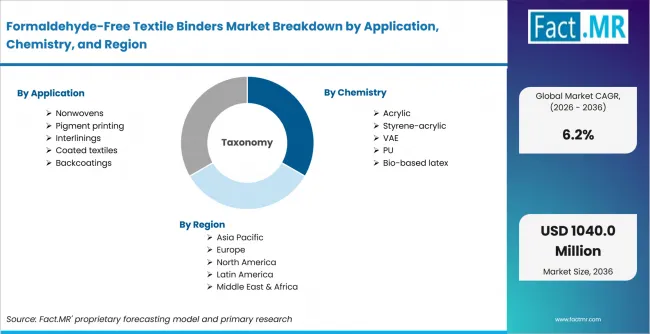
Formaldehyde Free Textile Binders Market Breakdown By Application, Chemistry, And Region | Source: Fact.MR
| Attribute | Details |
|---|---|
| Quantitative Units | USD Million in 2026 to USD Million by 2036 at CAGR |
| Market Definition | Binders for nonwovens, pigment printing, coatings, and textile finishing formulated to minimize or eliminate formaldehyde emissions. |
| Application | Nonwovens, Pigment printing, Interlinings, Coated textiles, Backcoatings |
| Chemistry | Acrylic, Styrene-acrylic, VAE, PU, Bio-based latex |
| Textile Type | Apparel, Home textiles, Hygiene, Automotive, Technical textiles |
| Performance | Soft hand, Wash durability, Low VOC, High strength, Heat resistance |
| Buyer Type | Textile mills, Nonwoven producers, Chemical distributors, Brand suppliers |
| Regions Covered | North America, Europe, Asia Pacific, Central and South America, Middle East and Africa |
| Countries Covered | Germany, Brazil, United States |
| Key Companies Profiled | BASF, Archroma, Dow, Synthomer, Wacker, Trinseo |
| Forecast Period | 2026 to 2036 |
| Approach | Hybrid top-down and bottom-up approach using Textile Binders / Low-Emission Textile Chemicals, segment shares, country growth, supplier mapping, and technical validation |
Source: Fact.MR analysis. Updated Jul 15, 2026
How is the market segmented?
-
By Application
- Nonwovens
- Pigment printing
- Interlinings
- Coated textiles
- Backcoatings
-
By Chemistry
- Acrylic
- Styrene-acrylic
- VAE
- PU
- Bio-based latex
-
By Textile Type
- Apparel
- Home textiles
- Hygiene
- Automotive
- Technical textiles
-
By Performance
- Soft hand
- Wash durability
- Low VOC
- High strength
- Heat resistance
-
By Buyer Type
- Textile mills
- Nonwoven producers
- Chemical distributors
- Brand suppliers
-
By Region
- North America
- United States
- Canada
- Europe
- Germany
- United Kingdom
- France
- Italy
- Spain
- Asia Pacific
- Japan
- South Korea
- Australia
- Latin America
- Brazil
- Argentina
- Mexico
- Chile
- Middle East & Africa
- UAE
- Saudi Arabia
- South Africa
- North America
Frequently Asked Questions
Which Application leads the Formaldehyde-Free Textile Binders Market?
Which Chemistry leads the Formaldehyde-Free Textile Binders Market?
What is the primary driver in the Formaldehyde-Free Textile Binders Market?
What is the main restraint in the Formaldehyde-Free Textile Binders Market?
Who worked on this report


Preview the report firsthand - request a free sample
Free SampleGet the brochure for pricing and purchase details
Download PDF