- Market Value (2025): USD 277.5 Mn
- Estimated Value (2026): USD 296.7 Mn
- Forecast Value (2036): USD 578.2Mn
- CAGR (2026-2036): 6.9%
What is the Friction Stir Welding Equipment Market forecast to be worth by 2036?
USD 296.7 million in 2026 to USD 578.2 million by 2036, at 6.9% CAGR.
- The friction stir welding equipment market crossed a valuation of USD 277.5 million in 2025.
- Demand is projected to increase from USD 296.7 million in 2026 to USD 578.2 million by 2036 across the forecast horizon.
- The market is forecast to record a 6.9% CAGR from 2026 to 2036 as aerospace teams and vehicle manufacturers expand qualified solid-state joining programs.
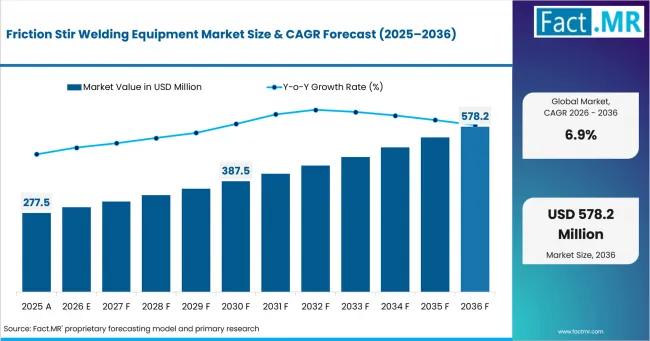
Friction Stir Welding Equipment Market Market Value Analysis | Source: Fact.MR
What are the defining numbers behind Friction Stir Welding Equipment Market growth?
USD 281.5 million absolute opportunity by 2036, led by Fixed FSW Equipment, Aerospace and Aluminum Alloy joining programs.
- Demand Drivers in the Market
- Battery enclosure engineers require repeatable low-distortion welds because cooling plates and structural trays must maintain tight interfaces throughout long weld paths.
- Aerospace production teams depend on controlled heat input and robust process traceability for aluminum structures that undergo demanding qualification and inspection procedures.
- Rail vehicle manufacturers rely on long linear welding capability to join large extrusions with minimal distortion correction before assembly and finishing.
- Shipyard engineering teams prioritize equipment scalability and precise fixture control, as thicker aluminum panels demand stable force management across extended weld lengths.
- Key Segments Analyzed
- By Type: Fixed FSW Equipment is expected to hold 39% share in 2026 supported by stiffness and repeatability across dedicated production programs.
- By End Use: Aerospace is projected to account for 30% share in 2026 owing to qualification-led joining requirements for structural aluminum components.
- By Installation Format: Gantry and Portal FSW Systems are anticipated to capture 33% share in 2026 shaped by long travel ranges and high reaction-force capacity.
- By Material Focus: Aluminum Alloys are estimated to represent 46% share in 2026 because the process fits high-value joints that need low distortion and limited melting defects.
- By Region: North America is forecast to account for 32% share in 2026 driven by aerospace qualification programs and automated vehicle manufacturing investment.
- Analyst Opinion at Fact.MR
- Shambhu Nath Jha, Senior Analyst at Fact.MR states: “Commercial success depends on proving repeatable force control across each customer process window. Adoption is expected to favor equipment teams that shorten qualification without weakening traceability. Suppliers should combine rigid mechanics with process monitoring and application engineering.”
- Strategic Implications
- Machine builders should package force control and data capture around the qualification evidence required by each target end use.
- Aerospace integrators should map fixture access before choosing between fixed gantries and robot-based cells for complex component geometry.
- Vehicle engineering teams should validate cooling-plate and battery-tray distortion limits during pilot production before locking full line layouts.
- Service organizations should build local tool support and process troubleshooting capacity near customer clusters that run continuous production schedules.
KUKA received a follow-up order for twelve additional FSW cells in July 2025 after an earlier twenty-three-cell program for a major automotive manufacturer. The KR FORTEC robot cells join electric-vehicle battery cases and cooling jackets, reflecting demand for integrated assembly and commissioning alongside training and acceptance support.
Argentina is expected to record a 9.4% CAGR by 2036, driven by electrified-mobility investment and renewed industrial equipment purchasing across automotive supply chains. India is projected to post a 9.1% CAGR during the forecast period, supported by vehicle production scale and expanding local FSW machine capability. China is anticipated to advance at an 8.6% CAGR over the assessment period, owing to high-volume new-energy vehicle production and aluminum-intensive battery structures. Brazil is estimated to record a 7.8% CAGR between 2026 and 2036, shaped by aerospace production and transport-equipment investment. Japan is forecast to post a 7.4% CAGR by 2036, as vehicle engineering depth supports tightly controlled joining cells for electrified platforms.
How does the Friction Stir Welding Equipment Market break down by segment?
Fixed FSW Equipment leads at 39%, Aerospace leads at 30%.
Which Type dominates?
Fixed FSW Equipment holds 39% share in 2026.
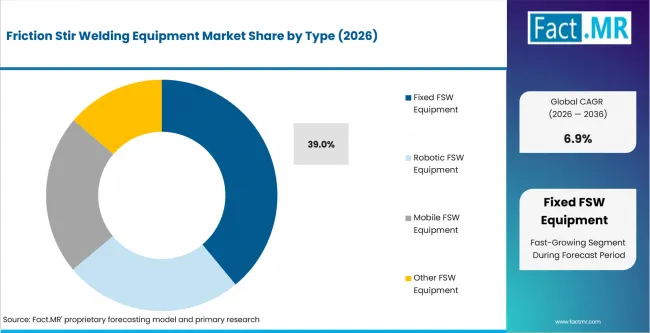
Friction Stir Welding Equipment Market Analysis By Type | Source: Fact.MR
Fixed FSW Equipment is expected to hold 39% share in 2026 supported by rigid structures and repeatable force control on dedicated production lines. Robotic FSW Equipment serves three-dimensional seams where flexible tool orientation carries greater value than maximum linear travel. Mobile FSW Equipment addresses large assemblies that are difficult to move into a conventional cell. Other configurations remain relevant for specialized research and production tasks. ETA Technology positions three-axis to five-axis systems around customized force and travel requirements for industrial programs.
What leads the End Use segment?
Aerospace is estimated at 30% share in 2026.
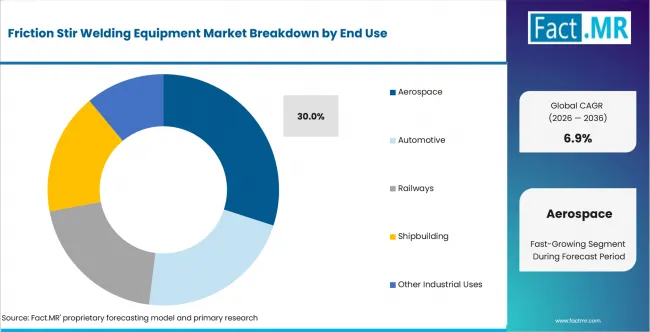
Friction Stir Welding Equipment Market Analysis By End Use | Source: Fact.MR
Aerospace is projected to account for 30% share in 2026 owing to high-value aluminum structures and demanding process qualification. Automotive programs follow through battery trays and cooling components that need long sealed joints with limited distortion. Railways use FSW for large extrusions and extended linear seams across vehicle structures. Shipbuilding remains relevant where aluminum decks and panels require repeatable long-path joining. PAR Systems positions its I-STIR platform for aerospace and defense programs that require controlled process development and production integration. That application focus keeps qualification support central to equipment selection.
How does Installation Format shape equipment demand?
Gantry and Portal FSW Systems accounts for 33% share in 2026.
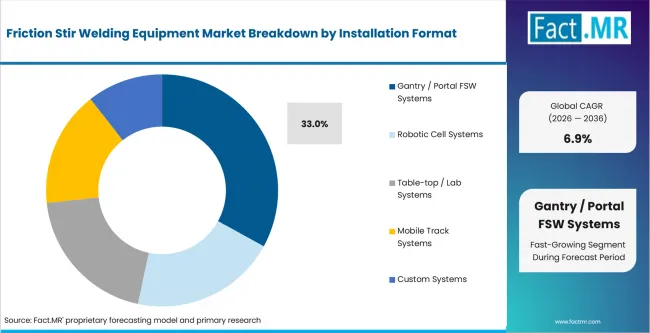
Friction Stir Welding Equipment Market Analysis By Installation Format | Source: Fact.MR
Gantry and Portal FSW Systems are anticipated to capture 33% share in 2026 shaped by long travel ranges and reaction-force capacity. Robotic Cell Systems provide flexible path control for battery enclosures and other three-dimensional components. Table-top and Lab Systems support process development before teams commit production tooling and fixtures. Mobile Track Systems serve large structures where moving the workpiece is impractical. The International Federation of Robotics reported 542,000 industrial robot installations during 2024. That installed automation base widens the integration pool available for robot-led joining cells.
What supports Aluminum Alloys within Material Focus?
Aluminum Alloys are estimated at 46% share in 2026.
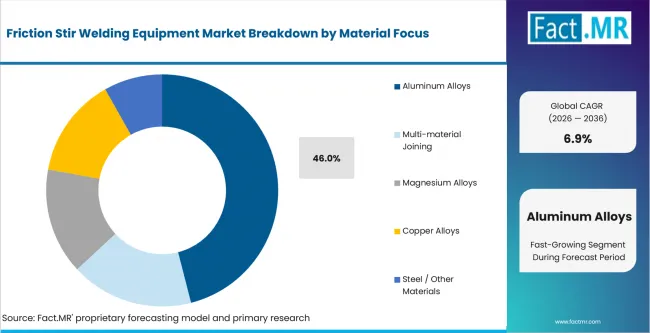
Friction Stir Welding Equipment Market Analysis By Material Focus | Source: Fact.MR
Aluminum Alloys are estimated to represent 46% share in 2026 because friction stir welding avoids full melting while controlling distortion across long joints. Multi-material Joining follows where engineering teams test process windows between dissimilar alloys or transition structures. Magnesium Alloys and Copper Alloys require separate tooling or thermal strategies that limit simple process transfer. Steel and other materials remain specialized equipment targets. The U.S. Geological Survey reported that transportation applications accounted for 36% of United States aluminum consumption during 2025. Mobility production therefore keeps aluminum joining performance central to equipment selection.
What is accelerating Friction Stir Welding Equipment Market adoption, and what is holding it back?
Electrified vehicle structures drive it, qualification cost and equipment rigidity requirements restrain it.
Drivers Impact Analysis
| DRIVER | (~) % IMPACT ON CAGR | GEOGRAPHIC RELEVANCE | IMPACT TIMELINE |
|---|---|---|---|
| EV battery enclosure and cooling-plate production | +1.0% | China, India and Japan | Medium term (2-4 years) |
| Aerospace lightweight structure programs | +0.8% | North America, Brazil and Europe | Long term (>= 4 years) |
| Robot-based joining cell adoption | +0.6% | Japan, China and North America | Medium term (2-4 years) |
| Rail aluminum extrusion fabrication | +0.5% | Europe and Asia Pacific | Medium term (2-4 years) |
| Commercial shipbuilding orderbook expansion | +0.4% | Asia Pacific and Europe | Long term (>= 4 years) |
Source: Fact.MR analysis. Updated Jul 7, 2026
- EV battery enclosure production: New-energy vehicle lines create repeated welding tasks across trays and cooling structures that require leak control and low distortion. The International Energy Agency reported that electric car sales exceeded 17 million during 2024. Equipment demand is expected to favor robot cells and fixed systems that connect seam quality records with line acceptance requirements.
- Aerospace lightweight structures: Aircraft producers use friction stir welding where aluminum structures benefit from solid-state joining and stable geometry. Passenger traffic rose 5.3% during 2025 according to IATA, sustaining production pressure across commercial aviation programs. Equipment procurement is projected to concentrate on qualification support and process repeatability across long service lives.
- Robot-based joining cells: Flexible automation expands the addressable geometry beyond straight linear seams and supports repeatable tool orientation around vehicle structures. The International Federation of Robotics reported 13,700 robot installations in the United States automotive industry during 2024. Adoption is anticipated to expand where integrators combine robot path control with force management and fixture engineering.
- Rail extrusion fabrication: Long aluminum extrusions create natural use cases for gantry systems that keep heat input and distortion under control over extended seams. Public rail investment sustains vehicle and infrastructure supply chains that depend on repeatable fabrication capacity. The United States Federal Railroad Administration awarded over USD 1.1 billion for 123 rail crossing projects in January 2025. Equipment demand is estimated to benefit where fabrication capacity expands alongside fleet programs.
- Shipbuilding orderbook: Large aluminum panels and deck structures reward long travel ranges and stable process forces across extended joints. OECD reported a 169 million CGT shipbuilding orderbook during 2025. Procurement is forecast to favor builders that provide scalable gantry layouts and on-site process support for complex yard conditions.
Opportunity Impact Analysis
| OPPORTUNITY | (~) % IMPACT ON CAGR | GEOGRAPHIC RELEVANCE | IMPACT TIMELINE |
|---|---|---|---|
| Multi-material process development | +0.5% | Europe, Japan and North America | Long term (>= 4 years) |
| Three-dimensional robotic FSW cells | +0.4% | China, Japan and United States | Medium term (2-4 years) |
| Mobile and modular systems for large structures | +0.3% | Shipyards and rail corridors | Medium term (2-4 years) |
| Inline monitoring and qualification support | +0.3% | Aerospace and automotive hubs | Short term (<= 2 years) |
Source: Fact.MR analysis. Updated Jul 7, 2026
- Multi-material process development: Engineering teams are testing dissimilar joints where weight reduction or thermal management justifies extra process development. Equipment builders gain access when machines provide precise force control and flexible parameter logging across trial programs. Opportunity is projected to widen for suppliers that support tooling design and metallurgical validation with the machine package.
- Three-dimensional robotic cells: Battery housings and cooling structures increasingly require tool access around complex paths instead of a single straight seam. Grenzebach offers robot-based FSW systems for three-dimensional aluminum components and integrates tooling with process control. Commercial openings are expected to expand where turnkey cells combine robotics with acceptance testing and operator training.
- Mobile and modular equipment: Railcars and ship structures create workpieces that are expensive to move through a dedicated machine envelope. Track systems and modular fixtures bring the process to the assembly while preserving controlled travel. Demand is anticipated to increase where equipment providers prove stable force transfer on site and simplify setup between large components.
- Inline monitoring and qualification support: ISO 25239 organizes aluminum FSW requirements across terminology and design alongside procedure qualification and inspection. That structure pushes equipment selection toward parameter capture and repeatable control during customer approval. Suppliers are estimated to gain more qualification work when software records connect machine settings with weld inspection and acceptance evidence.
Restraints Impact Analysis
| RESTRAINT | (~) % IMPACT ON CAGR | GEOGRAPHIC RELEVANCE | IMPACT TIMELINE |
|---|---|---|---|
| High machine stiffness and fixture cost | -0.6% | Global industrial programs | Medium term (2-4 years) |
| Qualification cycles for safety-critical parts | -0.4% | Aerospace and transport hubs | Long term (>= 4 years) |
| Process-force limits on flexible cells | -0.3% | Robot-based installations | Medium term (2-4 years) |
| Tool wear and specialist process support | -0.2% | Emerging production clusters | Short term (<= 2 years) |
Source: Fact.MR analysis. Updated Jul 7, 2026
- Machine stiffness and fixture cost: FSW places substantial axial and traverse loads into the machine structure and workholding system. Capital requirements rise when long travel and thick sections demand larger frames or heavier fixtures. Adoption is expected to remain selective among smaller fabricators until modular platforms and shared application support reduce entry risk.
- Qualification cycles: Safety-critical programs require procedure qualification and inspection evidence before a new machine process moves into serial production. Engineering time expands when tooling or joint design changes trigger fresh validation work. Procurement is projected to proceed slowly where suppliers cannot demonstrate comparable reference parts and stable parameter records.
- Process-force limits: Robot-based systems provide path flexibility but their stiffness and load capacity differ from dedicated gantry structures. Complex geometry therefore requires careful balancing of reach and reaction forces during cell design. Deployment is anticipated to favor applications where payload and tool-force requirements fit the selected robot envelope without excessive reinforcement.
- Tool wear and process support: Production consistency depends on tool material and shoulder design alongside stable plunge depth or force control. Local teams need troubleshooting support when wear changes heat generation and weld appearance. Market access is forecast to remain uneven where machine suppliers lack regional application engineers or replacement tooling support near customer plants.
Which countries are scaling Friction Stir Welding Equipment fastest?
Argentina 9.4%, India 9.1%, China 8.6%, Brazil 7.8%, Japan 7.4% through 2036.
By region, friction stir welding equipment market is segmented into North America, Asia Pacific, Europe, Latin America, and the Middle East & Africa.
| COUNTRY | CAGR |
|---|---|
| Argentina | 9.4% |
| India | 9.1% |
| China | 8.6% |
| Brazil | 7.8% |
| Japan | 7.4% |
Source: Fact.MR analysis. Updated Jul 7, 2026
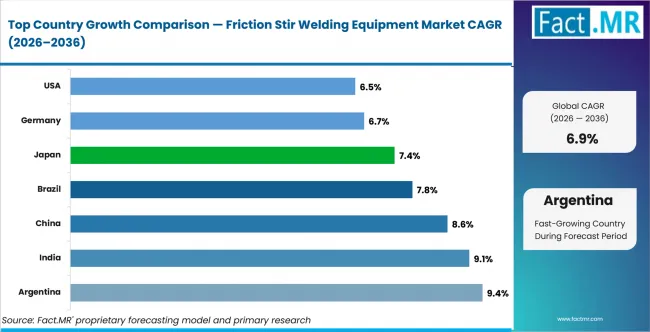
Friction Stir Welding Equipment Market Cagr Analysis By Country | Source: Fact.MR
What is powering Argentina's expansion?
9.4% CAGR through 2036, driven by electrified-mobility investment and industrial equipment renewal.
Argentina is rebuilding equipment demand around mobility investment and broader factory renewal after a volatile capital-spending cycle. The national government created a 50,000-unit annual electrified-vehicle import quota in 2025, giving engineering teams a clearer mobility technology reference point. The market is expected to record 9.4% CAGR through 2036 as manufacturers review joining processes for aluminum-intensive transport structures.
How is India scaling Friction Stir Welding Equipment demand?
9.1% CAGR through 2036, supported by vehicle production scale and local machine-building capability.
India combines large vehicle output with domestic machine builders that shorten application support for customer trials. The Press Information Bureau reported 4.4 million registered electric vehicles by March 2025 while ETA Technology markets customized FSW systems from India. Equipment demand is projected to post 9.1% CAGR through 2036 as local engineering teams move pilot weld development into repeatable production cells.
What supports the China outlook?
8.6% CAGR, owing to high-volume new-energy vehicle production and battery structure manufacturing.
China offers dense production clusters for battery systems and vehicle structures that reward repeatable automated joining. Government data placed new-energy vehicle production near 13.02 million units during the first ten months of 2025. Industry is anticipated to advance at 8.6% CAGR through 2036 owing to rapid output and supplier localization.
What underpins Brazil growth?
7.8% CAGR, shaped by aerospace manufacturing and transport-equipment investment.
Brazil has a concentrated aerospace manufacturing base and established aluminum transport fabrication skills that support specialized joining equipment. Embraer delivered 244 aircraft during 2025 across its commercial and executive businesses alongside defense programs. The market is estimated to record 7.8% CAGR through 2036 as local engineering capability gives equipment providers a route into high-value qualification projects.
How is Japan developing Friction Stir Welding Equipment demand?
7.4% CAGR, because vehicle engineering depth supports tightly controlled joining cells.
Japan links precision machine-tool capability with a large automotive engineering base and established automation integration networks. Yamazaki Mazak positions FSW solutions for battery cases and inverter cases alongside motor cases and cooling components. Equipment demand is forecast to post 7.4% CAGR through 2036 as Japanese manufacturers prioritize controlled cell integration and repeatable acceptance procedures.
Who leads the Friction Stir Welding Equipment Market?
ETA Technology and Yamazaki Mazak lead direct equipment coverage, while FOOKE and KUKA strengthen large-format and robot-based FSW capability.
Key players in the market such as ETA Technology are focusing on customized three-axis to five-axis systems and a broad installed-machine base across solid-phase equipment. Yamazaki Mazak brings machining-platform experience into FSW solutions aimed at battery and thermal-management components. FOOKE focuses on large travel ranges and high-performance machines for rail or aerospace structures. PAR Systems adds aerospace and defense integration experience through its I-STIR platform and process support.
Grenzebach offers gantry and robot-based systems for aluminum joining programs while Stirtec supplies vertical and horizontal machines alongside gantry formats. KUKA adds robot-led cells and turnkey integration for electric-vehicle battery cases or cooling jackets. Competition through 2036 is expected to be shaped by force-control repeatability and qualification support. Local tooling access and service response are also projected to influence awards for production systems.
Which companies are the key providers?
ETA Technology and Yamazaki Mazak are key providers. FOOKE and PAR Systems are also profiled providers. Grenzebach, Stirtec and KUKA complete the company set.
- ETA Technology
- Yamazaki Mazak Corporation
- FOOKE GmbH
- PAR Systems
- Grenzebach Maschinenbau GmbH
- Stirtec GmbH
- KUKA AG
Bibliography
- Government of Argentina, Ministry of Economy. (2025, July 28). Llegarán al país 50.000 autos eléctricos e híbridos. Government of Argentina.
- International Air Transport Association. (2026, January 29). Strong 2025 passenger demand masks ongoing capacity constraints. IATA.
- International Federation of Robotics. (2025, September 25). Global robot demand in factories doubles over 10 years. IFR.
- International Federation of Robotics. (2025, May 8). Robot installed in US auto industry up by double digits. IFR.
- International Energy Agency. (2025, May 14). Global EV Outlook 2025. IEA.
- International Organization for Standardization. (2026). ISO 25239 series: Friction stir welding - Aluminium. ISO.
- KUKA AG. (2025, July 9). State-of-the-art welding technologies for e-mobility: KUKA receives follow-up order from major automotive manufacturer. KUKA.
- Organisation for Economic Co-operation and Development. (2026). Shipbuilding. OECD.
- Press Information Bureau, Government of India. (2025, March 25). Revolutionizing mobility. Government of India.
- State Council Information Office of the People’s Republic of China. (2025, November 11). China’s NEV output, sales surge in first 10 months of 2025. Government of China.
- U.S. Department of Transportation, Federal Railroad Administration. (2025, January 10). Investing in America: Biden-Harris Administration announces over USD 1.1 billion in grants to improve 123 rail crossings. Federal Railroad Administration.
- U.S. Geological Survey. (2026, February). Mineral commodity summaries 2026: Aluminum. U.S. Department of the Interior.
- Embraer S.A. (2026, January 6). Embraer reports 91 aircraft delivered in the fourth quarter, closing 2025 with 244 total deliveries. Embraer.
- ETA Technology. (2026). Friction stir welding systems. ETA Technology.
- Yamazaki Mazak Corporation. (2026). Friction Stir Welding (FSW). Yamazaki Mazak Corporation.
- FOOKE GmbH. (2026). High-performance friction stir welding machines. FOOKE.
- PAR Systems. (2026). Friction stir welding. PAR Systems.
- Grenzebach Maschinenbau GmbH. (2026). Friction stir welding. Grenzebach.
- Stirtec GmbH. (2026). Full-line supplier for friction stir welding. Stirtec.
This Report Addresses
- The report provides strategic intelligence on Friction Stir Welding Equipment across Type and End Use choices that shape industrial joining programs.
- Segment analysis identifies Fixed FSW Equipment and Aerospace as the leading segments within the 2026 equipment structure.
- Regional outlook evaluates Argentina and India alongside China while Brazil and Japan complete the country growth comparison.
- Competitive analysis profiles ETA Technology and Yamazaki Mazak alongside FOOKE or PAR Systems and three additional active FSW equipment providers.
- Technology assessment covers Fixed FSW Equipment and Robotic FSW Equipment alongside Mobile FSW Equipment or Other FSW Equipment configurations.
- Use-case assessment covers Aerospace and Automotive alongside Railways or Shipbuilding and Other Industrial Uses within industrial production programs.
What does the Friction Stir Welding Equipment Market cover?
Fixed FSW Equipment, Robotic FSW Equipment, Mobile FSW Equipment and other dedicated systems used for solid-state industrial joining.
The friction stir welding equipment market covers machines and integrated cells that generate controlled tool rotation and travel while applying process force across a solid-state joint. Coverage includes fixed machines and robotic cells alongside mobile systems used in industrial production or qualification environments.
The market differs from the broader welding equipment category because FSW depends on solid-state plasticization under a rotating tool instead of a fusion arc or laser heat source. Conventional fusion welding systems remain outside the boundary unless they are sold inside a combined production line that contains dedicated FSW equipment.
What is included in the scope?
Friction stir welding systems used for aerospace, automotive, railway, shipbuilding and other industrial production programs.
The scope includes fixed and robotic FSW equipment alongside mobile machines across aerospace or automotive and railway or shipbuilding programs. Installation coverage includes gantry and portal systems together with robotic cells or lab systems and mobile track formats. Material coverage spans aluminum alloys and multi-material joints alongside magnesium or copper alloys and specialized steel applications. Broader welding equipment technologies provide adjacent fabrication context without replacing the FSW equipment boundary.
Automation comparisons also consider industrial robotics systems where robot stiffness and force control influence three-dimensional seam access. Upstream material planning references aluminium alloy applications because transport structures remain a central FSW use case.
What is excluded from the scope?
Rotary friction welding machines and standalone fusion welding systems are outside the scope.
The scope excludes rotary friction welding machines that join axisymmetric parts through a different process architecture. Arc and resistance systems are excluded unless they form part of a production line containing dedicated FSW equipment. Research tools used only for friction stir processing are outside the boundary when they are not sold for welding or joining operations.
How was the analysis built?
120+ sources, 28 company portfolios, 22+ countries, 16+ primary interviews.
- Primary Research:
- Primary research includes interviews with welding engineers and plant automation managers alongside aerospace manufacturing specialists or battery enclosure process teams. It also includes input from machine-tool distributors and robot integrators together with fixture engineers or metallurgical specialists who evaluate FSW process windows and production acceptance needs.
- Desk Research:
- Desk research reviews official transport production statistics and aerospace activity data alongside shipbuilding orderbooks or industrial robot installation records. It also examines ISO welding standards and company machine portfolios together with technical product pages or supplier announcements that verify active equipment capability and current application focus.
- Market-Sizing and Forecasting:
- Forecasting uses equipment replacement cycles and production-line attachment rates together with machine price ranges or installation format mix. End-use capital spending and aluminum joining intensity also inform the model while country outlooks reflect local vehicle scale and aerospace capability alongside automation investment or supplier support access.
- Data Validation and Update Cycle:
- Forecasts are validated through provider portfolio checks and technical interviews alongside country evidence reviews or end-use demand comparisons. Machine configuration mapping and material-use analysis support cross-checks while periodic supplier updates help confirm active product coverage and the commercial direction of new joining programs.
Segmentation
What is the report’s scope and coverage?
| Attribute | Details |
|---|---|
| Quantitative Units | USD Million in 2026 to USD Million by 2036 |
| Market Definition | Equipment and integrated cells that apply controlled tool rotation and process force for solid-state joining across qualified industrial production programs |
| Type | Fixed FSW Equipment; Robotic FSW Equipment; Mobile FSW Equipment; Other FSW Equipment |
| End Use | Aerospace; Automotive; Railways; Shipbuilding; Other Industrial Uses |
| Installation Format | Gantry and Portal FSW Systems; Robotic Cell Systems; Table-top and Lab Systems; Mobile Track Systems |
| Material Focus | Aluminum Alloys; Multi-material Joining; Magnesium Alloys; Copper Alloys; Steel and Other Materials |
| Regions Covered | North America; Europe; Asia Pacific; Latin America; Middle East and Africa |
| Countries Covered | Argentina; India; China; Brazil; Japan |
| Key Companies Profiled | ETA Technology; Yamazaki Mazak Corporation; FOOKE GmbH; PAR Systems; Grenzebach Maschinenbau GmbH; Stirtec GmbH; KUKA AG |
| Forecast Period | 2026 to 2036 |
| Approach | Hybrid top-down and bottom-up approach using equipment replacement cycles; production-line attachment rates; machine price ranges; installation format mix; aluminum joining intensity; end-use capital spending and provider validation |
Source: Fact.MR analysis. Updated Jul 7, 2026
How is the market segmented?
-
By Type:
- Fixed FSW Equipment
- Robotic FSW Equipment
- Mobile FSW Equipment
- Other FSW Equipment
-
By End Use:
- Aerospace
- Automotive
- Railways
- Shipbuilding
- Other Industrial Uses
-
By Installation Format:
- Gantry and Portal FSW Systems
- Robotic Cell Systems
- Table-top and Lab Systems
- Mobile Track Systems
-
By Material Focus:
- Aluminum Alloys
- Multi-material Joining
- Magnesium Alloys
- Copper Alloys
- Steel and Other Materials
-
Region:
- North America
- United States
- Canada
- Europe
- Germany
- United Kingdom
- France
- Italy
- Spain
- Asia Pacific
- Japan
- China
- South Korea
- India
- Australia
- Central & South America
- Brazil
- Argentina
- Mexico
- Chile
- Middle East & Africa
- UAE
- Saudi Arabia
- South Africa
- North America
Frequently Asked Questions
Which Type leads the Friction Stir Welding Equipment Market?
Which End Use leads the Friction Stir Welding Equipment Market?
Which Installation Format leads the Friction Stir Welding Equipment Market?
Which Material Focus leads the Friction Stir Welding Equipment Market?
Which Region leads the Friction Stir Welding Equipment Market?
Which country records the highest CAGR in the Friction Stir Welding Equipment Market?
How does India perform in the Friction Stir Welding Equipment Market?
How does China perform in the Friction Stir Welding Equipment Market?
How does Brazil perform in the Friction Stir Welding Equipment Market?
How does Japan perform in the Friction Stir Welding Equipment Market?
What is the primary driver in the Friction Stir Welding Equipment Market?
What is the main restraint in the Friction Stir Welding Equipment Market?
Why is Fixed FSW Equipment important?
Why do aerospace manufacturers dominate demand?
Who worked on this report


Preview the report firsthand - request a free sample
Free SampleGet the brochure for pricing and purchase details
Download PDF