- Market Value (2025): USD 101.7 Mn
- Estimated Value (2026): USD 120 Mn
- Forecast Value (2036):USD 628.1 Mn
- CAGR (2026-2036): 18.0%
What is the port equipment telemetry units market forecast to be worth by 2036?
USD 120 million in 2026 to USD 628.1 million by 2036, at 18.0% CAGR.
- The port equipment telemetry units market crossed a valuation of USD 101.7 million in 2025. Demand is expected to increase from USD 120 million in 2026 to USD 628.1 million by 2036.
- The market is forecast to record a 18.0% CAGR from 2026 to 2036 as ports add asset-level telemetry for maintenance and energy optimization.
- Trelleborg’s 2024 SmartPort article states that the system integrates assets such as fenders, mooring equipment, ship performance monitoring and navigation systems through cloud and IoT technologies.
- This supports the market boundary because telemetry units are hardware-led data capture products installed close to port assets.
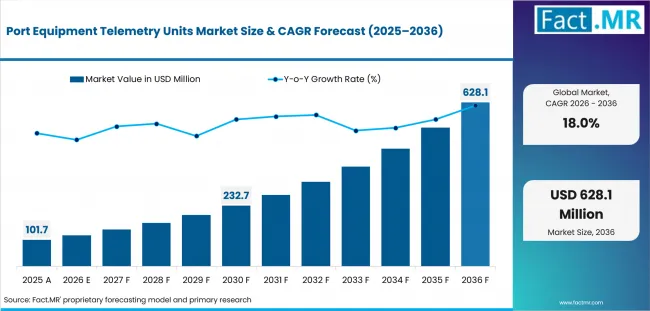
Port Equipment Telemetry Units Market Market Value Analysis | Source: Fact.MR
What are the defining numbers behind port equipment telemetry units market growth?
USD 508.1 million absolute opportunity by 2036, led by cranes and yard vehicles.
- Demand Drivers in the Market
- Terminal operators need equipment data that reduces unplanned downtime across cranes and yard assets.
- Port authorities need asset-level records for compliance, maintenance and safety reviews.
- Equipment OEMs need connected hardware that supports service contracts and lifecycle support.
- Maintenance contractors need condition data before failures interrupt berthing or cargo operations.
- Key Segments Analyzed
- By Equipment Monitored: Cranes are expected to hold 36.0% share in 2026 because downtime has high operational cost.
- By Data Type: Condition data leads because maintenance teams need early fault indicators. The segment is projected to capture 34.0% share in 2026.
- By Connectivity: Private LTE/5G is likely to account for 31.0% share in 2026 because ports need reliable low-latency coverage.
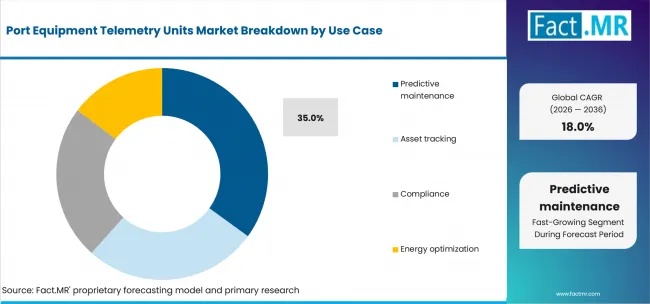
- By Use Case: Predictive maintenance is expected to hold 35.0% share in 2026 because telemetry turns asset data into service planning.
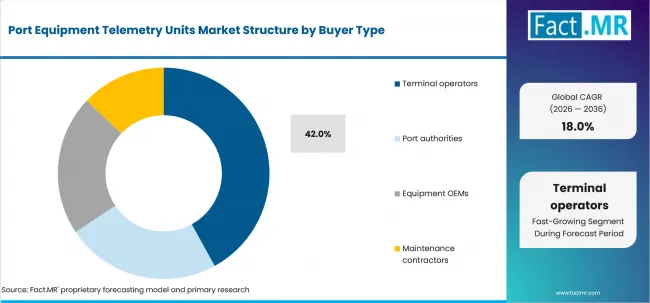
- By Buyer Type: Terminal operators are projected to record 42.0% share in 2026 because they own the operational pain from equipment downtime.
- Analyst Opinion at Fact.MR
- Shambhu Nath Jha, Senior Analyst at Fact.MR, states, “Port equipment telemetry units are becoming the practical layer of smart-port adoption. Ports do not always need a full platform replacement first. They need trusted equipment data from cranes and yard vehicles. Suppliers that provide rugged hardware, clean integration and maintenance-ready data will be better placed than software-only providers.”
- Strategic Implications
- Telemetry suppliers should design rugged sensor nodes for salt, shock and vibration.
- Equipment OEMs should embed telemetry into service contracts and lifecycle support.
- Terminal operators should prioritize high-downtime assets before site-wide deployment.
- Port authorities should use telemetry data for compliance, inspection and energy reporting.
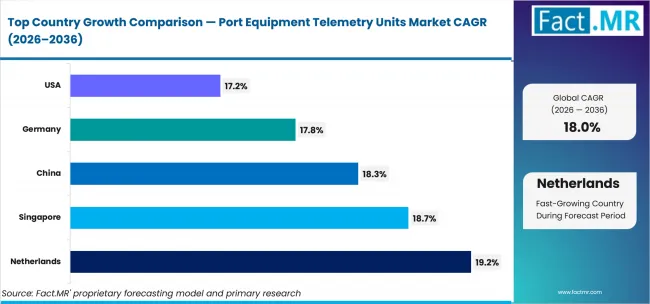
The Netherlands is projected to record 19.2% CAGR through 2036 as highly automated terminals expand crane, shore-power and yard telemetry. Singapore is expected to post 18.7% CAGR through 2036 as port authorities and terminal operators scale digital port operations. China is likely to record 18.3% CAGR as large container terminals expand automation and equipment monitoring. Germany is forecast to advance at 17.8% CAGR as equipment OEMs and industrial connectivity vendors support smart-port upgrades. The United States is set to record 17.2% CAGR as terminal operators adopt crane monitoring, yard-vehicle telemetry and energy optimization.
How does the port equipment telemetry units market break down by segment?
Cranes lead at 36.0%; condition data leads at 34.0%.
Which equipment monitored dominates?
Cranes hold 36.0% share in 2026.
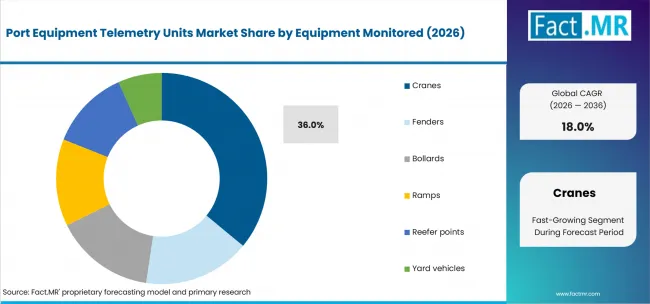
Port Equipment Telemetry Units Market Analysis By Equipment Monitored | Source: Fact.MR
Cranes are expected to hold 36.0% share in 2026 because terminal productivity depends heavily on port equipment availability, usage and maintenance condition. Fender and bollard telemetry follows because impact events and mooring loads can affect safety and infrastructure life. Ramps are important for RoRo and ferry terminals. Reefer points need energy and operational status data. Yard vehicles need location, utilization and charging information. Konecranes stated in 2024 that its digital services became available as standard on all port cranes and lift trucks, with TRUCONNECT Remote Monitoring collecting data on safety alerts, fuel consumption, emissions, battery status and equipment usage.
Which data type dominates?
Condition data leads with 34.0% share in 2026.
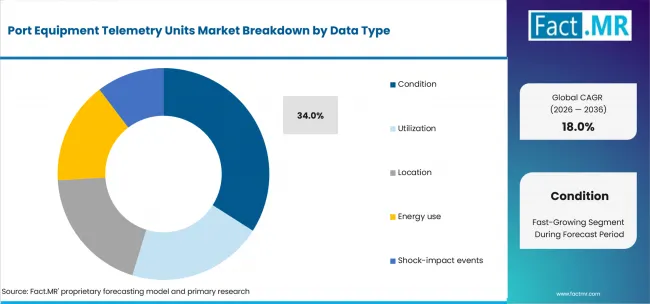
Port Equipment Telemetry Units Market Analysis By Data Type | Source: Fact.MR
Condition data leads because maintenance teams need asset health signals before failure. The segment is projected to capture 34.0% share in 2026 as cranes, fenders, bollards and ramps require monitoring for wear, impact, overload and electrical health. Utilization data helps terminal operators improve fleet planning. Location data supports yard visibility. Energy-use data grows as ports electrify equipment. Shock and impact events matter for fenders, bollards and ramps. Kalmar’s 2025 SmartPort article says the solution improves information accuracy and reduces manual data entry in container terminal operations.
Which connectivity type dominates?
Private LTE/5G holds 31.0% share in 2026.
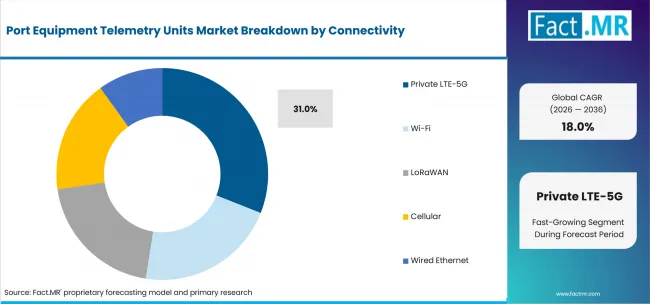
Port Equipment Telemetry Units Market Analysis By Connectivity | Source: Fact.MR
Private LTE/5G leads because terminal yards need secure coverage across large outdoor areas, moving equipment and high-interference environments. The connectivity segment is likely to account for 31.0% share in 2026 as ports move from isolated Wi-Fi networks toward more controlled 5G New Radio coverage. Cellular supports fast retrofit deployment. Wi-Fi works for fixed assets and buildings. LoRaWAN supports low-power sensors on fenders, bollards and remote assets. Wired Ethernet remains important for fixed crane and reefer systems where reliability is critical.
Which use case dominates?
Predictive maintenance holds 35.0% share in 2026.
Port Equipment Telemetry Units Market Analysis By Use Case | Source: Fact.MR
Predictive maintenance leads because telemetry units turn equipment signals into service decisions. The use case is expected to hold 35.0% share in 2026 as terminal operators try to reduce unplanned crane stoppages, reefer outages and infrastructure damage. Asset tracking follows where yard vehicles and mobile equipment need location visibility. Compliance uses data records for inspections and safety checks. Energy optimization grows as ports electrify cranes, charging systems and shore-power assets. Cavotec’s 2025 PowerAlign release shows how container terminals are adopting modular shore-power equipment designed for safe and reliable connections.
Which buyer type dominates?
Terminal operators hold 42.0% share in 2026.
Port Equipment Telemetry Units Market Analysis By Buyer Type | Source: Fact.MR
Terminal operators lead because they manage daily equipment uptime, yard movement and vessel turnaround pressure. The buyer type segment is projected to record 42.0% share in 2026 as operators install telemetry on cranes, reefer points, yard vehicles and quay assets. Port authorities follow where compliance, infrastructure safety and public investment are central. Equipment OEMs use telemetry to support service contracts. Maintenance contractors use sensor data for inspection planning. ABB’s 2025 port AI article notes that new technologies can enhance machinery performance and terminal operations.
What is accelerating port equipment telemetry unit adoption, and what is holding it back?
Crane downtime and yard congestion drive it; Harsh marine environments restrain it.
Drivers Impact Analysis
| DRIVER | (~) % IMPACT ON CAGR | GEOGRAPHIC RELEVANCE | IMPACT TIMELINE |
|---|---|---|---|
| Ports shifting from manual checks to asset-level condition monitoring | +1.8% | Europe, Singapore, United States, China | Short term (≤ 2 years) |
| Crane downtime and yard congestion increasing demand for utilization data | +1.5% | Netherlands, China, United States, Germany | Medium term (2–4 years) |
| Energy optimization needs growing with electrified port equipment | +1.3% | Europe, North America, East Asia | Medium term (2–4 years) |
| Private LTE/5G improving telemetry reliability across terminal yards | +1.1% | Singapore, Germany, United States, China | Short term (≤ 2 years) |
| Smart fenders and berthing systems creating infrastructure telemetry demand | +0.9% | Europe, Middle East, Asia-Pacific | Long term (≥ 4 years) |
Source: Fact.MR analysis. Updated Jul 6, 2026
Asset-level condition monitoring
Asset-level condition monitoring is the strongest driver because port operators need early warning before equipment failure affects vessel work. Manual inspection can miss intermittent faults or impact events. Telemetry units create a continuous record of equipment condition. This supports better maintenance planning and faster response.
Crane downtime and yard congestion
Crane downtime and yard congestion support demand because terminal productivity depends on equipment flow. Utilization telemetry helps managers see idle time, overload events and bottlenecks. Data from cranes and yard vehicles can improve shift planning. This driver is strongest in high-throughput container terminals.
Energy optimization
Energy optimization is gaining importance as ports electrify cranes, reefer points, shore-power systems and yard vehicles. Telemetry units help measure consumption, charging status and unusual load patterns. This supports cost control and emissions reporting. Energy data will become more important as terminal electrification expands.
Private LTE/5G coverage
Private LTE/5G improves telemetry reliability because port yards are large and equipment is constantly moving. Wireless coverage must handle cranes, vehicles and fixed infrastructure. Better connectivity helps telemetry units transmit data without gaps. This driver supports both retrofit and new-build smart-port projects.
Smart fender and berth telemetry
Smart fender and berth telemetry create demand because berth interfaces experience high mechanical stress. Impact events, mooring loads and docking behavior can affect infrastructure safety. Sensors on fenders and bollards help ports document asset condition. This driver is strongest in terminals handling larger vessels and higher berth intensity.
Opportunity Impact Analysis
| OPPORTUNITY | (~) % IMPACT ON CAGR | GEOGRAPHIC RELEVANCE | IMPACT TIMELINE |
|---|---|---|---|
| Retrofit telemetry kits for older cranes and yard vehicles | +1.4% | United States, Germany, China, India | Short term (≤ 2 years) |
| Low-power LoRaWAN nodes for fenders, bollards and ramps | +1.2% | Europe, Middle East, Asia-Pacific | Medium term (2–4 years) |
| Reefer-point energy telemetry for terminal energy optimization | +1.0% | Netherlands, Singapore, China, United States | Medium term (2–4 years) |
| OEM service bundles linking telemetry data with maintenance contracts | +0.9% | Global, strongest in crane and equipment OEM channels | Long term (≥ 4 years) |
Source: Fact.MR analysis. Updated Jul 6, 2026
Retrofit telemetry kits
Retrofit telemetry kits create opportunity because many ports operate mixed fleets and older equipment. A gateway or sensor node can add data capture without replacing the asset. This lowers the first step into smart-port deployment. The strongest opportunity sits in cranes, terminal tractors and reefer infrastructure.
Low-power infrastructure nodes
Low-power nodes create opportunity on fenders, bollards and ramps where battery life and ruggedness matter. These assets may not have easy power access. LoRaWAN and similar low-power options can support impact records, inspection alerts and location status. The opportunity is strongest for port authorities and infrastructure maintenance teams.
Reefer-point energy telemetry
Reefer-point energy telemetry creates opportunity because refrigerated containers consume power and need reliable connection status. Terminals can use telemetry to detect faults, track energy use and reduce service calls. The use case also supports compliance and customer reporting. It will grow in terminals with rising cold-chain cargo.
OEM service bundles
OEM service bundles can turn telemetry into recurring revenue. Equipment suppliers can combine hardware and parts support. This helps customers move from reactive repairs to planned service. It also helps OEMs protect aftermarket relationships.
Restraints Impact Analysis
| RESTRAINT | (~) % IMPACT ON CAGR | GEOGRAPHIC RELEVANCE | IMPACT TIMELINE |
|---|---|---|---|
| Harsh marine environments increasing hardware failure risk | -1.2% | Global | Short term (≤ 2 years) |
| Integration burden with TOS, CMMS and legacy equipment systems | -1.0% | Global, strongest in brownfield ports | Medium term (2–4 years) |
| Connectivity gaps across quay, yard and remote port zones | -0.8% | Asia-Pacific, Latin America, Africa | Medium term (2–4 years) |
| Cybersecurity and data ownership concerns slowing wider rollout | -0.7% | Europe, North America, Singapore | Long term (≥ 4 years) |
Source: Fact.MR analysis. Updated Jul 6, 2026
Harsh environment risk
Harsh marine environments are the main restraint because telemetry units must tolerate salt, water, shock, vibration and heat. Hardware failure can reduce trust in monitoring systems. Suppliers need rugged enclosures, tested connectors and simple field replacement. Maintenance access also matters because ports cannot stop equipment often.
Integration burden
Integration burden slows adoption because telemetry data must connect with terminal operating systems, maintenance tools and OEM service portals. Brownfield ports often have mixed equipment and custom workflows. Data mapping can take longer than hardware installation. Open APIs and standard data models reduce the barrier.
Connectivity gaps
Connectivity gaps can weaken the value of telemetry because ports need data across quay, yard, gate, reefer and maintenance zones. Wi-Fi may not cover moving equipment well. Cellular may not meet all latency or security needs. Private networks can solve this but raise deployment cost.
Cybersecurity and ownership
Cybersecurity and data ownership concerns slow broader rollout. Port equipment data can reveal operational patterns, asset weakness and security-sensitive movement. Operators need access control, encryption and clear rules on who owns OEM-collected data. This restraint grows as telemetry expands from single assets to full fleets.
Which countries are scaling port equipment telemetry units fastest?
Netherlands 19.2%; Singapore 18.7%; China 18.3%; Germany 17.8%; United States 17.2%.
Based on regional analysis, the port equipment telemetry units market is segmented into North America, Western Europe, East Asia, South Asia, Latin America, and the Middle East & Africa.
| Country | CAGR |
|---|---|
| Netherlands | 19.2% |
| Singapore | 18.7% |
| China | 18.3% |
| Germany | 17.8% |
| United States | 17.2% |
Source: Fact.MR analysis. Updated Jul 6, 2026
Port Equipment Telemetry Units Market Cagr Analysis By Country | Source: Fact.MR
What is powering the Netherlands lead?
19.2% CAGR, driven by ABB port automation and shore-power-linked equipment upgrades.
The Netherlands is projected to record 19.2% CAGR from 2026 to 2036 as large container terminals use automation, electrification and asset monitoring to improve uptime. Telemetry demand will focus on cranes and yard equipment. Growth will favor wired Ethernet and retrofit sensor gateways.
How is Singapore scaling port equipment telemetry demand?
18.7% CAGR, supported by smart-port operations and terminal-wide asset visibility.
Singapore is expected to post 18.7% CAGR through 2036 as port authorities and terminal operators continue to expand digital operations. Asset tracking and compliance records will shape telemetry adoption. Growth will favor rugged hardware that can operate across high-density quay and yard environments.
What supports China’s outlook?
18.3% CAGR, driven by ZPMC equipment scale and automated terminal modernization.
China is likely to record 18.3% CAGR by 2036 as large ports expand crane telemetry, yard vehicle monitoring and connected terminal operations. Domestic equipment fleets create a strong installed base for retrofit and embedded telemetry. Growth will favor private networks and OEM-integrated service models.
What underpins Germany’s growth?
Germany is at 17.8% CAGR, scaling through Siemens AG and industrial connectivity expertise.
Germany is forecast to advance at 17.8% CAGR through 2036 as ports and equipment suppliers apply industrial automation practices to terminal assets. Predictive maintenance and condition monitoring will be strong use cases. Equipment OEMs and system integrators will play an important role in brownfield deployment.
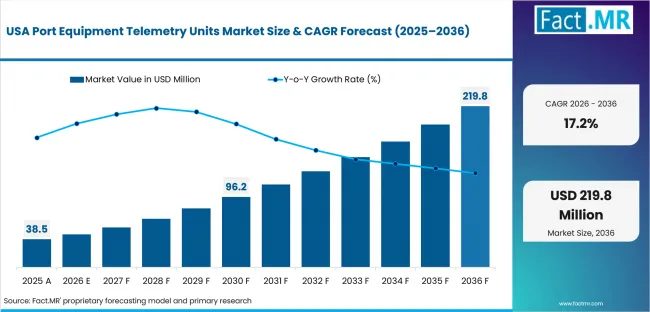
How is the United States scaling port equipment telemetry adoption?
17.2% CAGR, backed by Konecranes, Kalmar and terminal fleet modernization.
Port Equipment Telemetry Units Market Country Value Analysis | Source: Fact.MR
The United States is set to record 17.2% CAGR through 2036 as terminal operators add telemetry to cranes, terminal tractors, reefer infrastructure and yard equipment. Growth will favor digital service portals, OEM maintenance bundles, and private network deployment. Maintenance contractors will use telemetry to plan field service more effectively.
Who leads the port equipment telemetry units market?
Konecranes and Kalmar lead through equipment telemetry and terminal visibility, while Trelleborg strengthens infrastructure sensor coverage.
Port equipment telemetry units are supplied by crane OEMs, port automation vendors, marine infrastructure suppliers and industrial connectivity companies. Konecranes is directly relevant through TRUCONNECT remote monitoring and port crane digital services. Kalmar supports telemetry through SmartPort, MyKalmar INSIGHT and equipment-level visibility. Trelleborg is important through SmartPort, smart fender and berth-interface monitoring concepts.
ABB Ltd. and Siemens AG support port automation, electrification and industrial data integration. Cavotec is relevant through shore-power, charging and automated mooring equipment that needs status, energy and service data. ZPMC shapes the installed equipment base in large terminals, especially for cranes.
Competition through 2036 will be shaped by rugged hardware, sensor accuracy, equipment compatibility, connectivity support and maintenance integration. Hardware suppliers that send clean data into maintenance systems will be better placed than vendors that only provide dashboards.
Which companies are the key providers?
Konecranes and Kalmar are key providers. Trelleborg and Cavotec are also profiled. ABB Ltd., Siemens AG, ZPMC completes the company set.
- ABB Ltd.
- Siemens AG
- Trelleborg
- Cavotec
- Konecranes
- Kalmar
- ZPMC
Bibliography
- Trelleborg Marine & Infrastructure. (2024, May 13). Reinforcing the front line of port operations. Trelleborg.
- Konecranes. (2024, April 3). Asset management made easy: Digital services now available as standard on all Konecranes port cranes and lift trucks. Konecranes.
- Kalmar. (2025, September 22). 4 ways Kalmar SmartPort can transform your operations. Kalmar.
- Cavotec. (2025, June 17). Cavotec launches PowerAlign: A new shore power solution designed for container terminals. Cavotec.
- ABB Ltd.. (2025, June 5). AI accelerates productivity and safety in the world of ports. ABB Ltd..
- Siemens AG. (2026). Industrial communication. Siemens AG.
- Shanghai Zhenhua Heavy Industries Co., Ltd. (2026). Port machinery and automated terminal equipment. ZPMC.
This Report Addresses
- Strategic intelligence on port equipment telemetry units across equipment monitored and data type.
- Segment analysis covering Cranes and Condition Data.
- Regional outlook covering the Netherlands, Singapore, China, Germany and the United States.
- Competitive analysis of ABB Ltd., Siemens AG, Trelleborg, Cavotec, Konecranes, Kalmar, ZPMC.
- Technology assessment covering cellular, Wi-Fi, LoRaWAN, private LTE/5G and wired Ethernet telemetry.
- Use case assessment covering asset tracking, predictive maintenance, compliance and energy optimization.
- Primary interviews, provider checks and official source review support the forecast.
What does the port equipment telemetry units market cover?
Hardware gateways and sensor nodes used to monitor port equipment and terminal assets.
The port equipment telemetry units market covers telemetry units installed on cranes and yard vehicles. These units capture condition and shock or impact events.
The market differs from broad terminal operating systems because it focuses on data capture from physical assets. It excludes full TOS platforms and control-room dashboards unless revenue is tied to hardware telemetry units or embedded sensor nodes.
What is included in the scope?
Asset-mounted telemetry units and gateway hardware for ports.
The scope includes telemetry hardware for cranes, fenders, bollards, ramps, reefer points, and yard vehicles. Connectivity coverage includes cellular, Wi-Fi, LoRaWAN, private LTE/5G, and wired Ethernet.
Use case coverage includes asset tracking and energy optimization. Buyer-type coverage includes terminal operators and maintenance contractors. The scope includes retrofit telemetry units where older equipment needs connectivity hardware to transmit data.
What is excluded from the scope?
Full port management software and general terminal platforms are outside the scope.
The scope excludes berth planning platforms and broad digital twin platforms unless they include hardware telemetry revenue. It also excludes ordinary fleet tracking for road vehicles outside port facilities.
How was the analysis built?
100+ sources, 40+ company portfolios, 25+ countries, 20+ interviews.
- Primary Research: Primary research includes interviews with terminal operators, port authorities and equipment OEM teams. It includes input from maintenance contractors, marine infrastructure suppliers, crane service teams and industrial connectivity providers.
- Desk Research: Desk research reviews official product pages, port automation releases, crane remote monitoring services, smart fender systems, shore-power equipment and yard visibility platforms.
- Market-Sizing and Forecasting: Forecasting uses port equipment installed base, retrofit attachment rates, connectivity hardware pricing, crane telemetry adoption and maintenance-use intensity.
- Data Validation and Update Cycle: Forecasts are validated through provider checks and technical interviews. Equipment SKU mapping, port modernization plans and retrofit telemetry demand help confirm market direction.
Segmentation
What is the report’s scope and coverage?
| Attribute | Details |
|---|---|
| Quantitative Units | USD Million in 2026 to USD Million by 2036 at CAGR |
| Market Definition | Hardware gateways and sensor nodes used to monitor port equipment and terminal assets |
| Equipment Monitored | Cranes; fenders; bollards; ramps; reefer points; yard vehicles |
| Data Type | Condition; utilization; location; energy use; shock/impact events |
| Connectivity | Cellular; Wi-Fi; LoRaWAN; private LTE/5G; wired Ethernet |
| Use Case | Asset tracking; predictive maintenance; compliance; energy optimization |
| Buyer Type | Terminal operators; port authorities; equipment OEMs; maintenance contractors |
| Regions Covered | North America; Western Europe; East Asia; South Asia; Latin America; Middle East and Africa |
| Countries Covered | Netherlands; Singapore; China; Germany; United States |
| Key Companies Profiled | ABB Ltd.; Siemens AG; Trelleborg; Cavotec; Konecranes; Kalmar; ZPMC |
| Forecast Period | 2026 to 2036 |
| Approach | Hybrid top-down and bottom-up approach using port equipment installed base, telemetry attachment rates, retrofit demand and provider validation |
Source: Fact.MR analysis. Updated Jul 6, 2026
How is the market segmented?
-
By Equipment Monitored:
- Cranes
- Fenders
- Bollards
- Ramps
- Reefer points
- Yard vehicles
-
By Data Type:
- Condition
- Utilization
- Location
- Energy use
- Shock/impact events
-
By Connectivity:
- Cellular
- Wi-Fi
- LoRaWAN
- Private LTE/5G
- Wired Ethernet
-
By Use Case:
- Asset tracking
- Predictive maintenance
- Compliance
- Energy optimization
-
By Buyer Type:
- Terminal operators
- Port authorities
- Equipment OEMs
- Maintenance contractors
-
Region:
- North America
- United States
- Canada
- Western Europe
- Netherlands
- Germany
- United Kingdom
- France
- Belgium
- East Asia
- China
- Japan
- South Korea
- South Asia
- Singapore
- India
- Thailand
- Latin America
- Brazil
- Mexico
- Chile
- Middle East & Africa
- UAE
- Saudi Arabia
- South Africa
- North America
Frequently Asked Questions
Which equipment monitored leads the Port Equipment Telemetry Units Market?
Which data type leads the Port Equipment Telemetry Units Market?
Which connectivity type leads the Port Equipment Telemetry Units Market?
Which use case leads the Port Equipment Telemetry Units Market?
Which buyer type leads the Port Equipment Telemetry Units Market?
Which country expands fastest in the Port Equipment Telemetry Units Market?
How does Singapore perform in the Port Equipment Telemetry Units Market?
How does China perform in the Port Equipment Telemetry Units Market?
How does Germany perform in the Port Equipment Telemetry Units Market?
How does the United States perform in the Port Equipment Telemetry Units Market?
What is the primary driver in the Port Equipment Telemetry Units Market?
What is the main restraint in the Port Equipment Telemetry Units Market?
Why are cranes important?
Why do terminal operators dominate demand?
Who worked on this report


Preview the report firsthand - request a free sample
Free SampleGet the brochure for pricing and purchase details
Download PDF