- Market Value (2025): USD 1817.3 Bn
- Estimated Value (2026): USD 1850.0 Bn
- Forecast Value (2036): USD 2211.3 Bn
- CAGR (2026-2036): 1.8%
What is the Gasoline As A Fuel Market forecast to be worth by 2036?
USD 1,850.0 billion in 2026 to USD 2,211.3 billion by 2036 at 1.8% CAGR.
- The gasoline as a fuel market reached USD 1817.3 billion in 2025 as road transport and established combustion fleets kept baseline demand steady.
- Demand is projected to move from USD 1850.0 billion in 2026 to USD 2211.3 billion by 2036.
- The market is forecast to record 1.8% CAGR from 2026 to 2036 owing to mature fuel use and slower volume expansion in major vehicle markets.
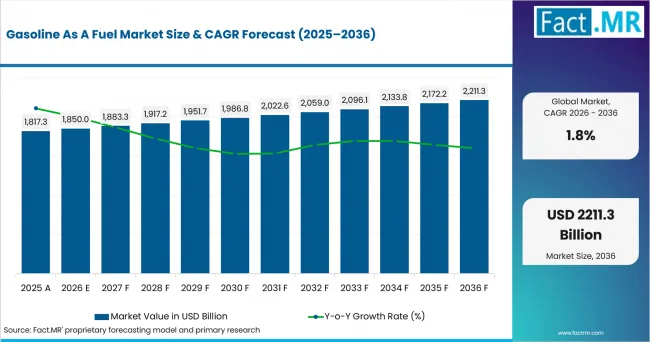
Gasoline As A Fuel Market Value Analysis | Source: Fact.MR
What are the defining numbers behind Gasoline As A Fuel Market growth?
USD 361.3 billion absolute opportunity by 2036.
- Demand Drivers in the Market
- Regular gasoline remains the reference product for daily mobility where customers compare pump price and engine requirements before changing grade behavior.
- Passenger vehicle use is expected to anchor volume since household travel creates repeat fuel purchases across commuting and local errands.
- Retail fuel stations are expected to support repeat demand through location access and payment convenience. This purchase route keeps gasoline close to daily vehicle use.
- Key Segments Analyzed
- By Product Type: Regular Gasoline is projected to hold 37.0% share in 2026 because it matches the broadest vehicle base and the most common pump position.
- By Application: Passenger Vehicles are expected to hold 30.6% share in 2026 with personal mobility creating more repeat purchases than industrial use.
- By End User: Individual Consumers are anticipated to capture 31.2% share in 2026 since private driving creates the main purchase route.
- By Distribution Channel: Retail Fuel Stations are estimated to represent 30.9% share in 2026 through daily access and consumer refueling behavior.
- By Grade: Regular Grade is forecast to lead with 37.4% share in 2026 due to broad engine compatibility and lower price exposure.
- Analyst Opinion at Fact.MR
- Shambhu Nath Jha, Principal Consultant at Fact.MR, states, “Gasoline demand is expected to depend on retail reliability and grade clarity. Service coverage is expected to decide whether regular gasoline keeps repeat purchases across the installed vehicle base.”
- Strategic Implications
- Fuel retailers should protect core gasoline volume by tracking grade choice and station-level repeat visits.
- Refiners and distributors need clear grade messages for regular and premium gasoline.
- Investors should separate road gasoline demand from equipment fuel use.
Mexico leads at 0.9% CAGR, supported by regular gasoline use in daily travel. Germany follows at 2.7% CAGR through fuel-quality demand. Brazil records 2.4% CAGR, while the USA reaches 2.1% CAGR. The UK posts 1.8% CAGR, Japan 1.5% CAGR and Canada 1.2% CAGR, reflecting slower volume growth, efficiency gains and long-distance mobility needs.
How does the Gasoline As A Fuel Market break down by segment?
Regular Gasoline is expected to lead Product Type at 37.0% share in 2026. Passenger Vehicles are projected to lead Application at 30.6% share in 2026.
Which product type dominates?
Regular Gasoline is projected to account for 37.0% share in 2026.
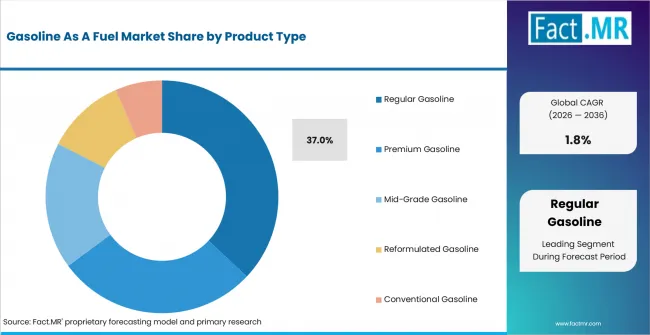
Gasoline As A Fuel Market Analysis By Product Type | Source: Fact.MR
Regular gasoline leads because it serves the largest gasoline-vehicle base. Premium gasoline retains demand where engines require higher octane. Reformulated and low-sulfur grades remain relevant where local rules change pump choice.
What leads the Application segment?
Passenger Vehicles are expected to hold 30.6% share in 2026.
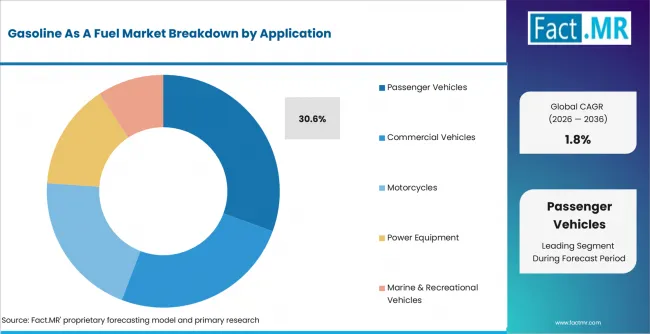
Gasoline As A Fuel Market Analysis By Application | Source: Fact.MR
Passenger vehicles create frequent refueling through commuting and household travel. Commercial vehicles add steadier route-based demand but face tighter cost review. Motorcycles widen access in dense cities. Power equipment creates smaller seasonal pockets.
How does End User shape demand?
Individual Consumers are anticipated to capture 31.2% share in 2026.
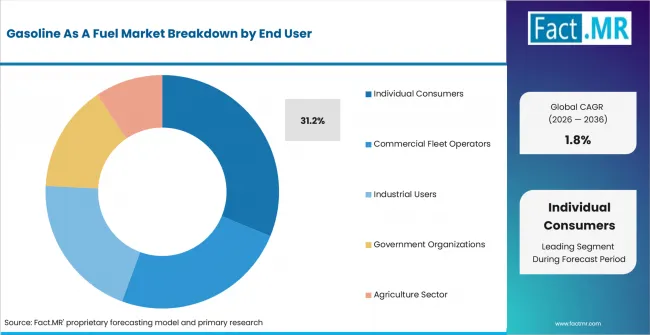
Gasoline As A Fuel Market Analysis By End User | Source: Fact.MR
Individual consumers lead because they buy gasoline directly through retail stations and choose grades at the pump. Fleet operators rely more on pricing contracts. Industrial users add planned purchases where equipment needs fuel availability.
What supports Retail Fuel Stations?
Retail Fuel Stations are estimated to represent 30.9% share in 2026.
Retail stations lead through location access and routine payment behavior. Wholesale distribution remains important for fleets and bulk users. Direct industrial supply serves customers that cannot rely on retail visits. Mobile refueling remains selective.
Why does Regular Grade lead Grade?
Regular Grade is forecast to lead with 37.4% share in 2026.
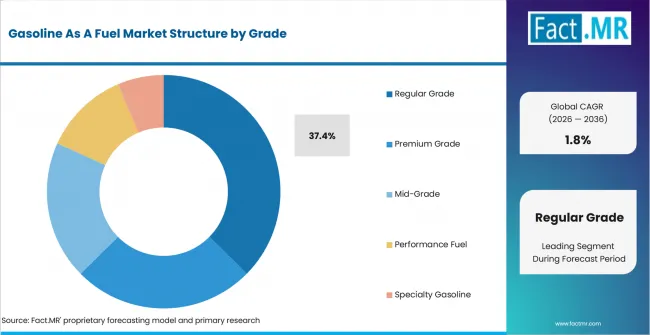
Gasoline As A Fuel Market Analysis By Grade | Source: Fact.MR
Regular grade leads when vehicle guidance does not require premium octane. Mid-grade and premium grade serve customers that need higher knock resistance. Performance fuel and ethanol-free gasoline remain narrower choices for recreational engines.
What is accelerating Gasoline As A Fuel Market adoption, and what is holding it back?
Demand is expected to remain steady through regular gasoline availability and passenger vehicle use. Better fuel efficiency, electric vehicle adoption and changing fuel prices may limit growth.
Drivers Impact Analysis
| DRIVER | (~) % IMPACT ON CAGR | GEOGRAPHIC RELEVANCE IMPACT TIMELINE | |
|---|---|---|---|
| Regular gasoline retail depth | +0.6% | Mexico and Brazil | Short term (<= 2 years) |
| Passenger-vehicle installed base | +0.5% | Germany and USA | Short term (<= 2 years) |
| Fuel-station channel access | +0.4% | Latin America and North America | Medium term (2-4 years) |
| Regular grade price fit | +0.3% | UK and Japan | Medium term (2-4 years) |
| Equipment and backup-power use | +0.2% | Canada and remote markets | Long term (>= 4 years) |
Source: Fact.MR analysis. Updated Jul 31, 2026
- Regular gasoline retail depth: A broad station base is expected to keep regular gasoline easy to purchase where customers compare price and availability before changing fuel behavior.
- Passenger-vehicle installed base: Combustion cars are expected to maintain recurring demand since the purchase cycle depends on travel frequency and station access.
- Fuel-station channel access: Retail networks are expected to support volume where operators need daily replenishment and dependable pump coverage.
Opportunity Impact Analysis
| OPPORTUNITY | (~) % IMPACT ON CAGR | GEOGRAPHIC RELEVANCE | IMPACT TIMELINE |
|---|---|---|---|
| Regular-grade loyalty programs | +0.4% | Mexico | Medium term (2-4 years) |
| Station service bundles | +0.3% | Germany and Brazil | Medium term (2-4 years) |
| Fleet refueling contracts | +0.2% | USA and Canada | Long term (>= 4 years) |
| Emergency and equipment fuel | +0.1% | UK and Japan | Long term (>= 4 years) |
Source: Fact.MR analysis. Updated Jul 31, 2026
- Regular-grade loyalty programs: Retailers are expected to gain repeat purchases when pricing and fuel-quality messages are simple enough for everyday customers.
- Station service bundles: Operators can improve retention by pairing fuel sales with maintenance, food retail and payment convenience at high-traffic locations.
- Fleet refueling contracts: Contracted refueling is expected to support predictable volumes where commercial fleets value price visibility and reliable station access.
Restraints Impact Analysis
| RESTRAINT | (~) % IMPACT ON CAGR | GEOGRAPHIC RELEVANCE | IMPACT TIMELINE |
|---|---|---|---|
| Vehicle-efficiency gains | -0.4% | Global | Short term (<= 2 years) |
| Urban electrification pressure | -0.3% | USA, UK and Japan | Medium term (2-4 years) |
| Fuel-price sensitivity | -0.2% | Mexico and Brazil | Short term (<= 2 years) |
| Quality and octane verification | -0.1% | Retail channels | Medium term (2-4 years) |
Source: Fact.MR analysis. Updated Jul 31, 2026
- Vehicle-efficiency gains: Better fuel economy is expected to reduce gasoline volume per mile even when travel activity stays stable.
- Urban electrification pressure: Electric mobility is expected to restrain gasoline expansion in cities where charging access improves faster than station growth.
- Fuel-price sensitivity: Customers are expected to reduce discretionary trips or switch grades when pump prices rise faster than household income.
Which countries are scaling Gasoline As A Fuel Market fastest?
- Mexico leads the country comparison as regular gasoline remains central to daily commuting. Germany and Brazil follow through large vehicle bases, broad station coverage and steady household mobility.
- The USA expands more slowly because efficiency gains reduce fuel demand despite high vehicle ownership. The UK and Japan also record measured growth as urban transport options and efficient vehicles limit new volume.
- Canada grows slowest, although long travel distances continue to support gasoline access.
- Comparable CAGRs can therefore hide different route-to-market conditions. Mexico depends more on retail access. Germany depends more on quality trust. Canada depends more on reliable coverage outside dense cities.
The full report provides country-level CAGR analysis across North America; Latin America; Europe; East Asia; South Asia and Oceania; and the Middle East and Africa.
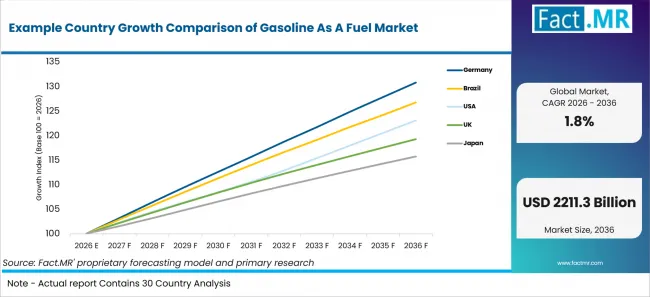
Example Country Growth Comparison Of Gasoline As A Fuel Market | Source: Fact.MR
| Country | CAGR (2026-2036) |
|---|---|
| Mexico | 0.9% |
| Germany | 2.7% |
| Brazil | 2.4% |
| USA | 2.1% |
| UK | 1.8% |
| Japan | 1.5% |
| Canada | 1.2% |
Source: Fact.MR analysis. Updated Jul 31, 2026
What is shaping Mexico's outlook through 2036?
2.3% CAGR, supported by retail access and regular gasoline use.
Mexico leads the country set through regular gasoline use in everyday mobility. Retail access is expected to decide how quickly demand converts into repeat purchases. Price-sensitive consumers are expected to favor regular grade when it meets engine guidance and keeps travel cost manageable.
What is shaping Germany's outlook through 2036?
2.1% CAGR, based on passenger-vehicle use and fuel-quality discipline.
Germany reflects a mature vehicle base where customers expect consistent fuel quality and clear grade labeling. Growth is expected to remain measured because efficiency rules and alternative mobility limit new gasoline volume.
How is Brazil supporting demand?
1.9% CAGR, supported by station coverage and consumer refueling needs.
Brazil stays above the global pace through routine private mobility and a broad fuel-station network. Gasoline purchases are expected to remain practical for households that weigh pump price against driving needs.
What defines the USA outlook?
1.7% CAGR, shaped by a large but mature consumption base.
The USA remains important because vehicle ownership and driving distances keep gasoline in regular use. Expansion is expected to be slower than Mexico because fuel economy improvement reduces volume per mile.
How does the UK perform?
1.5% CAGR, constrained by efficiency and alternative mobility pressure.
The UK outlook is more replacement-led than expansion-led. Urban travel choices and vehicle-efficiency gains are expected to reduce the pace of gasoline volume growth. Retail demand still remains supported where drivers need fast refueling and trusted grade availability.
What supports Japan's demand?
1.4% CAGR, based on quality expectations and slower volume expansion.
Japan is expected to move carefully because vehicle use is stable and customers place value on reliability. Gasoline demand stays close to commuting and local mobility.
What keeps Canada in the forecast?
1.2% CAGR, supported by fuel access across wide geographies.
Canada records the slowest listed pace but still requires dependable gasoline access across long-distance routes. Retail coverage outside dense cities supports continued use. Weather exposure and travel distance are expected to keep gasoline relevant for routine and backup mobility needs.
Who leads the Gasoline As A Fuel Market?
Saudi Aramco, ExxonMobil and Shell plc are among the most visible companies in gasoline supply and downstream fuel retail.
BP plc completes the group with Chevron Corporation and TotalEnergies. China Petroleum & Chemical Corporation (Sinopec) completes the profiled company set. Competition is expected to center on refining access and retail branding. Grade reliability is expected to decide repeat demand.
Which companies are the key providers?
Key companies include Saudi Aramco; ExxonMobil; Shell plc; BP plc; Chevron Corporation; TotalEnergies; and China Petroleum & Chemical Corporation (Sinopec).
- Saudi Aramco
- ExxonMobil
- Shell plc
- BP plc
- Chevron Corporation
- TotalEnergies
- China Petroleum & Chemical Corporation (Sinopec)
Bibliography
- Eurostat. (2024, October 8). Energy consumption in transport at pre-pandemic levels. European Commission.
- U.S. Environmental Protection Agency. (2026, April 7). Modifications to standards and requirements for reformulated and conventional gasoline, including butane blenders and attest engagements.
- Saudi Arabian Oil Company. (2024, March 1). Aramco completes acquisition of Esmax.
- Shell plc. (2024, March 22). Shell-branded fuel retailing to enter Sri Lanka with RM Parks and Tristar Group partnership.
This Report Answers
- The report provides strategic intelligence on the Gasoline As A Fuel Market across Product Type and Application choices that shape regular gasoline demand.
- Segment analysis covers Regular Gasoline and Passenger Vehicles as the share leaders within the 2026 market structure.
- Country outlook evaluates Mexico and Germany alongside Brazil and the USA. UK, Japan and Canada complete the profiled country comparison.
- Competitive analysis profiles Saudi Aramco and ExxonMobil alongside Shell plc and BP plc. Chevron Corporation, TotalEnergies and Sinopec complete the provider set.
- Channel assessment covers Retail Fuel Stations and Wholesale Distribution. Passenger mobility is read alongside the cars market to test where regular gasoline demand remains closest to daily use.
What does the Gasoline As A Fuel Market cover?
Gasoline as a fuel covers finished gasoline sold for transport and equipment use.
The Gasoline As A Fuel Market includes regular gasoline and premium gasoline. Mid-grade and specialty gasoline are included when they are sold for vehicles, power equipment and recreational applications. The market includes retail stations, wholesale distribution and direct supply where the product is purchased as finished fuel.
What is included in the scope?
Gasoline used by individual consumers and fleets is included. Industrial users and public agencies are included where the product is purchased as fuel.
The scope includes Product Type and Application alongside End User, Distribution Channel and Grade. Coverage spans regular gasoline and passenger vehicles. It includes individual consumers, retail fuel stations and regular grade. Commercial vehicle use and motorcycles are included. Power equipment, marine applications and agriculture-related use are included when finished gasoline is the purchased fuel.
What is excluded from the scope?
Crude oil extraction, diesel fuel and unrelated petrochemical products remain outside the scope of this market.
The scope excludes products that are not finished gasoline. Diesel and jet fuel are excluded. Propane and natural gas are excluded. Crude trading is outside the boundary. General refinery revenue is excluded when it cannot be separated from gasoline sold for transport or equipment use. Company revenue without a clear finished-gasoline connection is excluded.
How Was the Analysis Built?
The analysis draws on 120+ sources, 35+ company portfolios, 25+ countries, and more than 20 interviews.
- Primary Research: Interviews with manufacturers, retailers, salon operators, and experts examine purchase priorities, adoption, approval requirements, and competitive positioning.
- Desk Research: Desk research covers government statistics, regulatory publications, company filings, trade data, technical studies, industry associations, standards, and public policy.
- Market Sizing and Forecasting: Estimates combine historical performance, demand indicators, pricing, segment shares, company participation, country growth, adoption patterns, and barriers to expansion.
- Data Validation and Update Cycle: Findings are validated against public data, company activity, regulatory changes, product launches, recalls, and adoption shifts.
Segmentation
What is the report's scope and coverage?
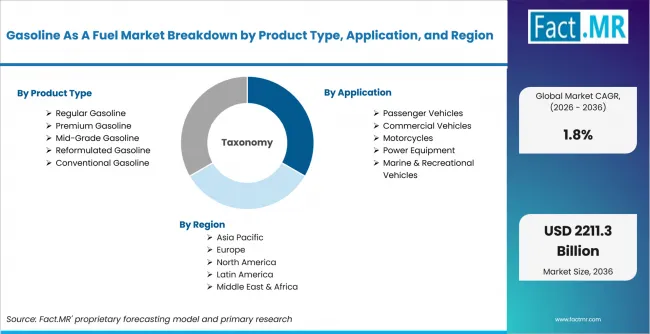
Gasoline As A Fuel Market Breakdown By Product Type, Application, And Region | Source: Fact.MR
| Attribute | Details |
|---|---|
| Quantitative Units | USD billion in 2026 to USD billion by 2036 at CAGR |
| Market Definition | Finished gasoline sold for transport and equipment use where regular gasoline, passenger vehicles, retail fuel stations and grade-level purchase behavior shape demand |
| Product Type | Regular Gasoline; 87 Octane; 88 Octane; Premium Gasoline; 91 Octane; 93 Octane; Mid-Grade Gasoline; 89 Octane; 90 Octane; Reformulated Gasoline; Low Sulfur Gasoline; Oxygenated Gasoline; Conventional Gasoline; Leaded Replacement Fuel; Non-Oxygenated Gasoline |
| Application | Passenger Vehicles; Sedans; SUVs & Crossovers; Commercial Vehicles; Light Commercial Vehicles; Heavy Commercial Vehicles; Motorcycles; Standard Motorcycles; Sports Motorcycles; Power Equipment; Lawn & Garden Equipment; Portable Generators; Marine & Recreational Vehicles; Recreational Boats; All-Terrain Vehicles |
| End User | Individual Consumers; Private Vehicle Owners; Two-Wheeler Owners; Commercial Fleet Operators; Logistics Companies; Rental Fleet Operators; Industrial Users; Construction Companies; Mining Companies; Government Organizations; Public Transport Agencies; Defense Organizations; Agriculture Sector; Farm Equipment Operators; Agricultural Cooperatives |
| Distribution Channel | Retail Fuel Stations; Branded Fuel Stations; Independent Fuel Stations; Wholesale Distribution; Bulk Fuel Suppliers; Commercial Fuel Contracts; Direct Industrial Supply; On-Site Fuel Delivery; Bulk Storage Supply; Government Fuel Depots; Defense Fuel Depots; Public Utility Depots; Online Fuel Delivery Services; Mobile Refueling Services; On-Demand Fuel Platforms |
| Grade | Regular Grade; 87 AKI; 88 AKI; Premium Grade; 91 AKI; 93 AKI; Mid-Grade; 89 AKI; 90 AKI; Performance Fuel; Racing Fuel; High-Octane Blend; Specialty Gasoline; Ethanol-Free Gasoline; Recreational Fuel |
| Regions Covered | North America; Latin America; Europe; East Asia; South Asia and Oceania; Middle East and Africa |
| Countries Covered | Mexico; Germany; Brazil; USA; UK; Japan; Canada |
| Key Companies Profiled | Saudi Aramco; ExxonMobil; Shell plc; BP plc; Chevron Corporation; TotalEnergies; China Petroleum & Chemical Corporation (Sinopec) |
| Forecast Period | 2026 to 2036 |
| Approach | Hybrid top-down and bottom-up approach using gasoline demand indicators; passenger vehicle use; grade mix; retail station access; country growth; company participation; retail channel assessment and public evidence relevant to finished gasoline demand |
Source: Fact.MR analysis. Updated Jul 31, 2026
How is the market segmented?
-
By Product Type
- Regular Gasoline
- 87 Octane
- 88 Octane
- Premium Gasoline
- 91 Octane
- 93 Octane
- Mid-Grade Gasoline
- 89 Octane
- 90 Octane
- Reformulated Gasoline
- Low Sulfur Gasoline
- Oxygenated Gasoline
- Conventional Gasoline
- Leaded Replacement Fuel
- Non-Oxygenated Gasoline
- Regular Gasoline
-
By Application
- Passenger Vehicles
- Sedans
- SUVs & Crossovers
- Commercial Vehicles
- Light Commercial Vehicles
- Heavy Commercial Vehicles
- Motorcycles
- Standard Motorcycles
- Sports Motorcycles
- Power Equipment
- Lawn & Garden Equipment
- Portable Generators
- Marine & Recreational Vehicles
- Recreational Boats
- All-Terrain Vehicles
- Passenger Vehicles
-
By End User
- Individual Consumers
- Private Vehicle Owners
- Two-Wheeler Owners
- Commercial Fleet Operators
- Logistics Companies
- Rental Fleet Operators
- Industrial Users
- Construction Companies
- Mining Companies
- Government Organizations
- Public Transport Agencies
- Defense Organizations
- Agriculture Sector
- Farm Equipment Operators
- Agricultural Cooperatives
- Individual Consumers
-
By Distribution Channel
- Retail Fuel Stations
- Branded Fuel Stations
- Independent Fuel Stations
- Wholesale Distribution
- Bulk Fuel Suppliers
- Commercial Fuel Contracts
- Direct Industrial Supply
- On-Site Fuel Delivery
- Bulk Storage Supply
- Government Fuel Depots
- Defense Fuel Depots
- Public Utility Depots
- Online Fuel Delivery Services
- Mobile Refueling Services
- On-Demand Fuel Platforms
- Retail Fuel Stations
-
By Grade
- Regular Grade
- 87 AKI
- 88 AKI
- Premium Grade
- 91 AKI
- 93 AKI
- Mid-Grade
- 89 AKI
- 90 AKI
- Performance Fuel
- Racing Fuel
- High-Octane Blend
- Specialty Gasoline
- Ethanol-Free Gasoline
- Recreational Fuel
- Regular Grade
-
By Region
- North America
- Latin America
- Europe
- East Asia
- South Asia and Oceania
- Middle East and Africa
Frequently Asked Questions
Which Product Type leads the market?
Which Application leads the market?
Which End User leads the market?
Which Distribution Channel leads the market?
Which Grade leads the market?
Which country records the highest listed CAGR?
What is the primary driver in this market?
What is the main restraint?
Why do retail fuel stations lead distribution?
Who worked on this report


Preview the report firsthand - request a free sample
Free SampleGet the brochure for pricing and purchase details
Download PDF