- Market Value (2025): USD 2.2 Bn
- Estimated Value (2026): USD 2.4 Bn
- Forecast Value (2036): USD 5.2 Bn
- CAGR (2026-2036): 8.3%
What is the Aseptic Fruit Pouches Market forecast to be worth by 2036?
USD 2.4 billion in 2026 to USD 5.2 billion by 2036, at an 8.3% CAGR.
- The market is valued at USD 2.2 billion in 2025.
- Demand is projected to increase from USD 2.4 billion in 2026 to USD 5.2 billion by 2036.
- The market is forecast to record an 8.3% CAGR from 2026 to 2036 as fruit processors and packaging buyers qualify shelf-stable pouch systems across consumer, foodservice and processing applications.
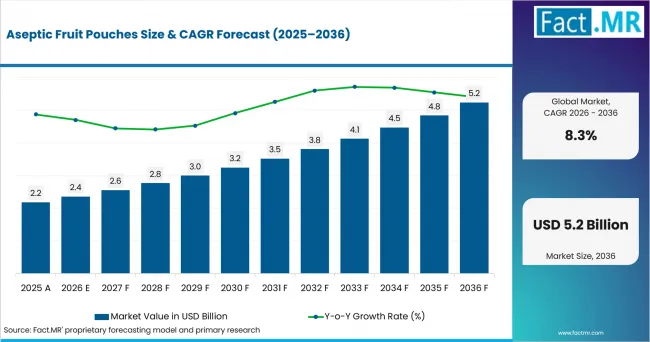
Aseptic Fruit Pouches Value Analysis | Source: Fact.MR
What are the defining numbers behind Aseptic Fruit Pouches Market growth?
The market is projected to create an absolute dollar opportunity of USD 2.9 billion between 2026 and 2036.
- Demand Drivers in the Market
- Shelf-stable fruit products require packaging structures that can maintain sterile conditions after filling while protecting quality through distribution and storage.
- Food-contact requirements keep film chemistry, sealants and fitments within the package qualification process in the USA and European markets.
- Flexible-packaging recovery rules are increasing pressure to document how multilayer structures and closures fit collection and recycling systems.
- Fruit processing creates demand across puree, blended fruit, particulate fruit, concentrate and functional preparations that require different filling and barrier conditions.
- Key Segments Analyzed
- By Fruit Format: Puree accounts for 34.0% share in 2026, supported by its compatibility with controlled pumping, portioning and aseptic filling across several fruit applications.
- By Pouch Format: Spouted pouch holds 37.0% share in 2026, with dispensing convenience and fitment-based closure systems supporting consumer and foodservice use.
- By Fill Volume: 150-250 mL represents 31.0% share in 2026, reflecting demand for portioned and resealable fruit formats.
- By End-user: Baby food accounts for 29.0% share in 2026, supported by portion-controlled puree and blended-fruit applications.
- Analyst Opinion at Fact.MR
- Shambhu Nath Jha, Senior Consultant, Fact.MR, notes that aseptic fruit pouch growth will depend on package-system reliability rather than film performance alone. Processors need the pouch body, fitment and seal interface to work together under sterilization, filling and storage conditions, which makes qualification a central part of supplier selection.
- Strategic Implications
- Pouch suppliers should qualify films, fitments and seal interfaces as one package system rather than treating each component as an isolated specification.
- Fruit processors should align viscosity and particulate size with filling-path and fitment design before scaling a pouch format across multiple fruit preparations.
- Packaging teams serving Europe should document recyclability claims against practical collection and sorting routes as regulatory requirements tighten.
- Suppliers targeting Brazil should connect pouch development with fruit-processing conditions and upstream availability rather than relying on packaging regulation alone.
The USA is forecast to grow at 7.6% CAGR from 2026 to 2036, the UK at 8.5%, Germany at 9.3%, Italy at 8.0% and Brazil at 8.9%. Each market is shaped by a different operating mechanism, including food-contact clearance, recovery infrastructure, recyclate certification, collection systems and fruit supply.
How does the Aseptic Fruit Pouches Market break down by segment?
The Aseptic Fruit Pouches Market is segmented by Fruit Format into Puree, Smoothie / blended fruit, Diced / particulate, Juice concentrate and Functional fruit prep; by Pouch Format into Spouted pouch, Flat pouch, Stand-up pouch, Bag-in-box inner pouch and Bulk liner; by Fill Volume into <150 mL, 150-250 mL, 251-500 mL, 501 mL-1 L and >1 L; and by End-user into Baby food, Dairy / yogurt, Snacks, Beverages and Foodservice.
Which Fruit Format dominates?
Puree holds 34.0% share in 2026.
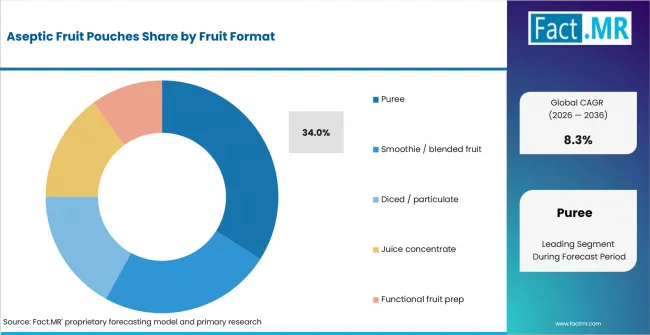
Aseptic Fruit Pouches Analysis By Fruit Format | Source: Fact.MR
Puree is expected to lead the Fruit Format category in 2026. Its relatively uniform texture supports controlled pumping and filling across aseptic systems, while its use extends into baby food, dairy / yogurt preparations, beverages and foodservice applications.
Puree applications also feature prominently in the baby food packaging market, where portion control and package integrity influence format selection.
Which Pouch Format dominates?
Spouted pouch holds 37.0% share in 2026.
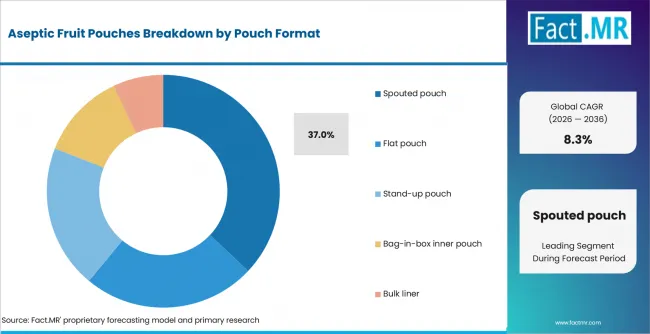
Aseptic Fruit Pouches Analysis By Pouch Format | Source: Fact.MR
Spouted pouch is projected to lead the Pouch Format category in 2026. The format supports controlled dispensing and resealability, while package performance depends on the fitment, cap, film and seal area maintaining integrity as a single system.
The same fitment and closure requirements are relevant to the broader aseptic spouted pouches market, particularly where sterile filling and resealable dispensing are required.
What supports 150-250 mL within Fill Volume?
150-250 mL holds 31.0% share in 2026.
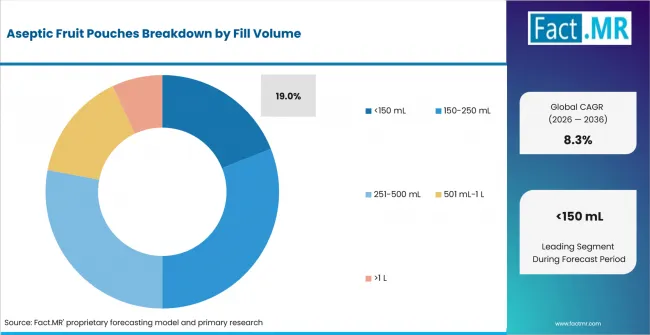
Aseptic Fruit Pouches Analysis By Fill Volume | Source: Fact.MR
The 150-250 mL range leads Fill Volume demand in 2026. It suits portioned fruit products and resealable use without moving into larger handling sizes, making it relevant across consumer and selected institutional applications.
How does End-user shape demand?
Baby food accounts for 29.0% share in 2026.
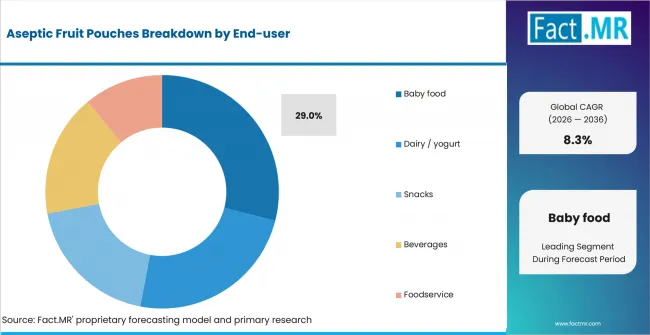
Aseptic Fruit Pouches Analysis By End User | Source: Fact.MR
Baby food leads End-user demand in 2026, supported by puree and blended-fruit products that fit portion-controlled pouch formats. The application places particular emphasis on clean dispensing, package integrity and food-contact suitability.
These package-system requirements also sit within the broader aseptic packaging market, while this assessment remains specific to fruit and fruit-based preparations sold in pouch formats.
What is accelerating Aseptic Fruit Pouches Market adoption, and what is holding it back?
Shelf-stable fruit distribution, food-contact qualification and pouch convenience support adoption; recycling-route gaps and package requalification can slow material changes.
Drivers Impact Analysis
| DRIVER | (~) % IMPACT ON CAGR | GEOGRAPHIC RELEVANCE | IMPACT TIMELINE |
|---|---|---|---|
| Food-contact qualification for aseptic pouch systems | +1.4% | USA, Europe | Short term (<= 2 years) |
| Shelf-stable fruit distribution and portioned formats | +1.1% | Global | Short term (<= 2 years) |
| Flexible-packaging redesign under recovery rules | +0.8% | UK, Germany, Italy | Medium term (2-4 years) |
| Fruit processing and puree supply expansion | +0.6% | Brazil, Global | Long term (>= 4 years) |
Source: Fact.MR analysis. Updated Sep 15, 2026
- Food-contact qualification: FDA food-contact controls and the EU food-contact framework keep pouch films, sealants and fitments within a safety and intended-use review. For aseptic fruit pouches, material substitution therefore needs evidence at the package-system level.
- Shelf-stable fruit distribution: Aseptic filling allows fruit preparations to move through storage and distribution without relying on the same cold-chain conditions as chilled products. Package integrity after sterilization and sealing is central to that value proposition.
- Flexible-packaging redesign: Regulation (EU) 2025/40 applies from 12 August 2026 and raises the importance of eco-design, recycled content and high-quality collection and recycling. Pouch structures face more scrutiny where barrier performance depends on multilayer materials or mixed-material closures.
- Fruit processing and supply: Brazil adds a production-side mechanism through its large fruit base and public agricultural research. Upstream fruit availability supports pouch demand when processors can convert that supply into aseptically filled fruit preparations.
Opportunity Impact Analysis
| OPPORTUNITY | (~) % IMPACT ON CAGR | GEOGRAPHIC RELEVANCE | IMPACT TIMELINE |
|---|---|---|---|
| Recyclability-led pouch redesign | +0.9% | UK, Germany, Italy | Long term (>= 4 years) |
| Spouted portion packs for puree and baby food | +0.7% | Global | Short term (<= 2 years) |
| Fitment and seal optimization for validated aseptic systems | +0.5% | USA, Europe | Medium term (2-4 years) |
| Foodservice and larger-volume inner pouch formats | +0.4% | Brazil, Global | Medium term (2-4 years) |
Source: Fact.MR analysis. Updated Sep 15, 2026
- Recyclability-led redesign: Flexible-packaging strategies are creating room for structures that simplify material combinations while preserving barrier and seal performance. The commercial opening is strongest where a technically recyclable structure also fits a real collection and sorting route.
- This design challenge is also central to the high-recyclability mono-material flexible packaging market, where material simplification has to preserve functional performance.
- Spouted portion packs: Portioned puree applications create a focused development area for clean dispensing and resealability without requiring larger-volume handling.
- Fitment and seal optimization: A validated aseptic pouch depends on interfaces between the pouch body, fitment and seal area. Suppliers that can document package-level compatibility can reduce the risk attached to material or closure changes.
- Foodservice and larger-volume formats: Bag-in-box inner pouches and bulk liners provide an application route for fruit preparations moving through kitchens, dairy processing and ingredient handling.
Restraints Impact Analysis
| RESTRAINT | (~) % IMPACT ON CAGR | GEOGRAPHIC RELEVANCE | IMPACT TIMELINE |
|---|---|---|---|
| Multilayer recycling-route constraints | -0.7% | UK, Germany, Italy | Short term (<= 2 years) |
| Qualification burden for film, fitment and seal changes | -0.5% | USA, Europe | Medium term (2-4 years) |
| Cost of validated aseptic barrier systems | -0.3% | Global | Short term (<= 2 years) |
| Collection and sorting gaps for flexible packaging | -0.2% | Europe | Long term (>= 4 years) |
Source: Fact.MR analysis. Updated Sep 15, 2026
- Multilayer recycling-route constraints: Aseptic fruit pouches can require barrier layers, adhesives, sealants and fitments that complicate end-of-life processing. The issue is most acute where design claims move faster than collection and recycling infrastructure.
- Qualification burden: Changing a pouch component can alter sealing behavior, sterilization tolerance, food-contact status or package integrity. The resulting approval work can slow substitution even when a new material offers an environmental advantage.
- Validated system cost: Aseptic pouch economics include more than film cost because the package must deliver barrier performance, clean sealing and fitment reliability under the intended process conditions.
- Collection and sorting gaps: Well-designed flexible packaging can still lack a credible recycling route. That infrastructure gap can delay packaging changes where end-of-life performance is part of the purchasing decision.
- For buyers comparing alternative pack structures, the fruit packaging market provides a wider view of flexible and rigid formats used around fruit applications.
Which countries are scaling Aseptic Fruit Pouches Market through 2036?
- USA: 7.6% CAGR, with food-contact substance controls shaping material and fitment qualification.
- UK: 8.5% CAGR, with flexible-packaging design increasingly tied to collection, sorting and recycling routes.
- Germany: 9.3% CAGR, with producer responsibility and recycled-plastics certification influencing material claims.
- Italy: 8.0% CAGR, with separate collection and circular-economy programs shaping the practical recovery environment.
- Brazil: 8.9% CAGR, with fruit supply and processing capability providing the main production-side mechanism.
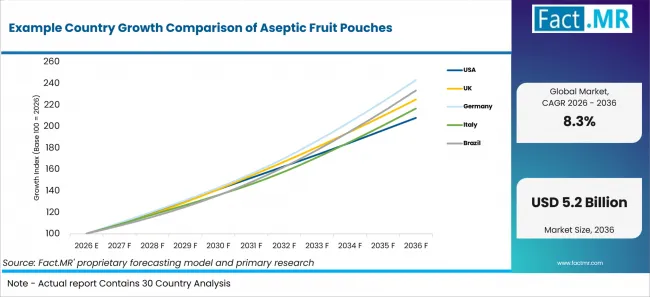
Example Country Growth Comparison Of Aseptic Fruit Pouches | Source: Fact.MR
| Country | CAGR |
|---|---|
| USA | 7.6% |
| UK | 8.5% |
| Germany | 9.3% |
| Italy | 8.0% |
| Brazil | 8.9% |
Source: Fact.MR analysis. Updated Sep 15, 2026
What supports USA adoption?
7.6% CAGR through 2036, shaped by food-contact qualification requirements.
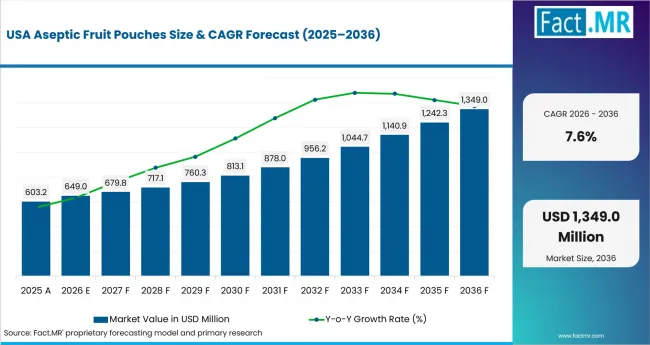
Aseptic Fruit Pouches Country Value Analysis | Source: Fact.MR
The USA market is forecast to expand at 7.6% CAGR from 2026 to 2036. FDA oversight of food-contact substances affects material selection because pouch films, fitments and sealants can fall within food-contact controls. This keeps intended-use conditions and package qualification central when processors change a validated aseptic structure.
What supports the UK outlook?
8.5% CAGR through 2036, shaped by flexible-packaging design and recovery infrastructure.
The UK market is forecast to expand at 8.5% CAGR from 2026 to 2036. WRAP's 2026 Films and Flexibles Strategy covers design, collection, sorting, recycling, investment and end markets. For aseptic fruit pouches, the practical test is whether a technically recyclable structure also has a credible route through the local recovery system.
How is Germany scaling demand?
9.3% CAGR through 2036, shaped by producer responsibility and recyclate certification.
Germany is forecast to expand at 9.3% CAGR from 2026 to 2036. UBA places emphasis on waste avoidance, producer responsibility and secondary raw materials. Its 2026 work on certification systems for recycled plastics adds a verification layer for packaging claims, increasing the importance of documented recyclability and material evidence.
What supports Italy adoption?
8.0% CAGR through 2036, shaped by separate collection and circular-economy implementation.
Italy is forecast to expand at 8.0% CAGR from 2026 to 2036. ISPRA's circular-economy work and 2026 Facciamo Circolare activity emphasize separate collection and broader circular practices. For flexible aseptic packs, compatibility with collection and sorting systems remains a practical condition for packaging redesign.
What supports Brazil growth?
8.9% CAGR through 2036, supported by fruit supply and processing activity.
Brazil is forecast to expand at 8.9% CAGR from 2026 to 2036. Embrapa and the Ministry of Agriculture support fruit-sector development through cultivars, production guidance and agricultural programs. Aseptic pouch demand depends on converting that upstream fruit base into processed formats that can be sterilized, filled, sealed and distributed under controlled conditions.
Who leads the Aseptic Fruit Pouches Market?
SIG, including Scholle IPN, is among the leading participants in aseptic pouch and bag-in-box packaging systems. Its presence spans pouch bodies, fitments and filling-system compatibility across food and beverage applications.
Gualapack, Amcor, ProAmpac and Mondi also participate across flexible packaging formats relevant to fruit products. Competitive positioning depends on food-contact compliance, barrier performance, dispensing design and the ability to support packaging changes under tighter recovery requirements.
Supplier evaluation is therefore tied to package-system capability rather than film supply alone. Buyers need fitment compatibility, sealing evidence and material documentation before changing a validated aseptic pouch platform.
Which companies are the key providers?
Key companies include SIG, including Scholle IPN, Gualapack, Amcor, ProAmpac and Mondi.
- SIG, including Scholle IPN
- Gualapack
- Amcor
- ProAmpac
- Mondi
Bibliography
- U.S. Food and Drug Administration. Food Ingredients & Packaging.
- WRAP. (2026, August 6). Films and Flexibles Strategy.
- Umweltbundesamt. Waste | Resources.
- ISPRA, Istituto Superiore per la Protezione e la Ricerca Ambientale.
- Embrapa, Brazilian Agricultural Research Corporation.
- Brazil Ministry of Agriculture and Livestock.
- European Commission, Directorate-General for Environment. Packaging waste.
- European Food Safety Authority. Food Contact Materials.
- Food and Agriculture Organization of the United Nations.
- DIN, German Institute for Standardization.
This Report Answers
- The report explains aseptic fruit pouch demand across Fruit Format, Pouch Format, Fill Volume and End-user.
- Segment analysis identifies the leading category within each market segment and explains the operating reasons behind adoption.
- Country analysis examines the USA, UK, Germany, Italy and Brazil without using CAGR as a proxy for market size.
- Competitive analysis reviews SIG including Scholle IPN, Gualapack, Amcor, ProAmpac and Mondi.
- Regulatory assessment covers food-contact controls, flexible-packaging recovery requirements and recyclate verification.
- Supply-side assessment covers fruit production and processing context relevant to Brazil and fruit-based pouch demand.
- The forecast covers 2026 to 2036 across the defined market segments and country markets.
What does the Aseptic Fruit Pouches Market cover?
The Aseptic Fruit Pouches Market covers flexible aseptic pouch systems used for fruit and fruit-based preparations across consumer, foodservice and processing applications.
The scope spans puree, smoothie / blended fruit, diced / particulate fruit, juice concentrate and functional fruit preparations that are filled and sealed under aseptic conditions for shelf-stable storage and distribution.
The market is defined by the pouch system used to contain the fruit product. Pouch body, fitment and seal interfaces are included where they form part of the packaged aseptic solution.
What is included in the scope?
Aseptic fruit pouch formats across the specified fruit, pouch, fill-volume and end-user categories are included.
The scope includes spouted pouches, flat pouches, stand-up pouches, bag-in-box inner pouches and bulk liners used for fruit-based products. It includes fill volumes below 150 mL through volumes above 1 L.
Applications include baby food, dairy / yogurt, snacks, beverages and foodservice. Pouch bodies, fitments and sealing structures are included when supplied as part of the aseptic fruit-pouch packaging system.
What is excluded from the scope?
Rigid aseptic packages, non-aseptic flexible packs, standalone filling equipment and non-fruit applications are outside the scope.
Rigid aseptic cartons, bottles, cans and jars are excluded when sold outside pouch systems. Non-aseptic flexible pouches that do not rely on sterile filling and sealing conditions are also outside the market boundary.
Packaging machinery sold independently, raw fruit cultivation, fruit-processing equipment and non-fruit aseptic pouch applications are excluded as separate markets.
How Was the Analysis Built?
The analysis covers market size, segment structure, country growth, food-contact requirements, packaging recovery conditions and fruit-supply factors.
- Primary Research: Research inputs consider purchasing requirements, package qualification, filling compatibility, application needs and adoption barriers across relevant industry participants.
- Desk Research: Public evidence includes food-contact requirements, flexible-packaging strategy, waste and recyclate-certification work, circular-economy activity, fruit-sector research, packaging rules, food-contact materials and standardization.
- Market Sizing and Forecasting: The assessment covers market value, segment structure, country growth and the operating factors that influence adoption across 2026 to 2036.
- Data Validation and Update Cycle: Findings are reviewed against regulatory developments, country-level market conditions and company participation where relevant to competitive analysis.
Segmentation
What is the report’s scope and coverage?
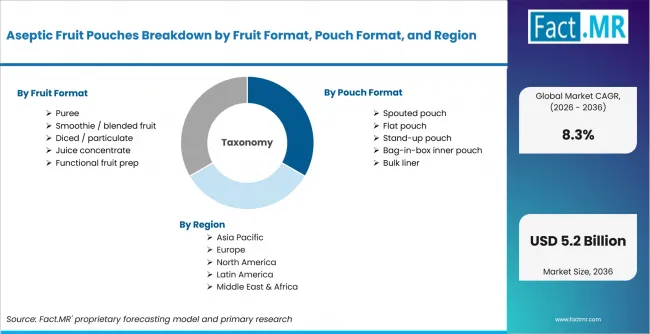
Aseptic Fruit Pouches Breakdown By Fruit Format, Pouch Format, And Region | Source: Fact.MR
| Attribute | Details |
|---|---|
| Quantitative Units | USD billion |
| Market Definition | Flexible pouch packaging for fruit and fruit-based preparations that are filled and sealed under aseptic conditions for shelf-stable storage and distribution. |
| Fruit Format | Puree; Smoothie / blended fruit; Diced / particulate; Juice concentrate; Functional fruit prep |
| Pouch Format | Spouted pouch; Flat pouch; Stand-up pouch; Bag-in-box inner pouch; Bulk liner |
| Fill Volume | <150 mL; 150-250 mL; 251-500 mL; 501 mL-1 L; >1 L |
| End-user | Baby food; Dairy / yogurt; Snacks; Beverages; Foodservice |
| Regions Covered | North America; Latin America; Western Europe; Eastern Europe; East Asia; South Asia & Pacific; Middle East & Africa |
| Countries Covered | USA; UK; Germany; Italy; Brazil |
| Key Companies Profiled | SIG including Scholle IPN; Gualapack; Amcor; ProAmpac; Mondi |
| Forecast Period | 2026 to 2036 |
| Approach | Market sizing, segment analysis and country growth assessment, with coverage of food-contact regulation, packaging recovery and fruit-supply conditions. |
Source: Fact.MR analysis. Updated Sep 15, 2026
How is the market segmented?
-
By Fruit Format
- Puree
- Smoothie / blended fruit
- Diced / particulate
- Juice concentrate
- Functional fruit prep
-
By Pouch Format
- Spouted pouch
- Flat pouch
- Stand-up pouch
- Bag-in-box inner pouch
- Bulk liner
-
By Fill Volume
- <150 mL
- 150-250 mL
- 251-500 mL
- 501 mL-1 L
- >1 L
-
By End-user
- Baby food
- Dairy / yogurt
- Snacks
- Beverages
- Foodservice
-
By Region
- North America
- Latin America
- Western Europe
- Eastern Europe
- East Asia
- South Asia & Pacific
- Middle East & Africa
Frequently Asked Questions
How big is the Aseptic Fruit Pouches Market in 2026?
What is the CAGR of the Aseptic Fruit Pouches Market from 2026 to 2036?
Which fruit format leads the Aseptic Fruit Pouches Market?
Spouted pouch accounts for 37.0% of the Pouch Format category in 2026.
Who are the leading companies in the Aseptic Fruit Pouches Market?
Who worked on this report


Preview the report firsthand - request a free sample
Free SampleGet the brochure for pricing and purchase details
Download PDF