- Market Value (2025): USD 323.3 Mn
- Estimated Value (2026): USD 430 Mn
- Forecast Value (2036): USD 7447 Mn
- CAGR (2026-2036): 33.0%
What is the Graphene Battery Anodes Market forecast to be worth by 2036?
USD 430 million in 2026 to USD 7,447 million by 2036, at 33.0% CAGR.
- The graphene battery anodes market reached USD 323.3 million in 2025.
- Demand is projected to increase from USD 430 million in 2026 to USD 7,447 million by 2036.
- The market is forecast to record 33.0% CAGR from 2026 to 2036 as cell makers and anode-material suppliers use graphene to improve conductivity, fast charging and silicon loading.
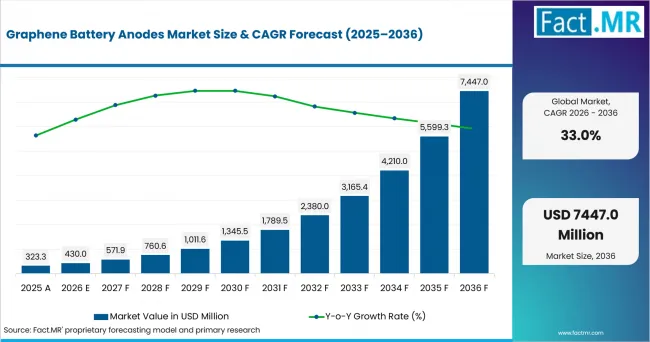
Graphene Battery Anodes Market Value Analysis | Source: Fact.MR
What are the defining numbers behind Graphene Battery Anodes Market growth?
An absolute opportunity of USD 7,017 million is expected between 2026 and 2036.
- Demand Drivers in the Market
- Cell engineers need higher anode capacity with controlled swelling because silicon-rich loading expands during charge cycles and requires a conductive carbon network.
- EV battery teams need faster charging without excessive heat, so graphene-coated and graphene-silicon anodes are being assessed for low-resistance electrode pathways.
- Consumer electronics brands need thinner cells with longer runtime, supported by anode materials that raise energy density without forcing a full cell redesign.
- Stationary-storage integrators need cycle-life consistency under repeated partial charge, while anode suppliers use coated graphite and frameworks to reduce performance drift.
- Key Segments Analyzed
- By Anode Material: Graphene-silicon is expected to hold 36.0% share in 2026 owing to its fit with high-capacity anode programs.
- By Supply Form: Active powder is projected to account for 48.0% share in 2026 because it fits existing electrode-mixing and coating workflows.
- By Battery Application: EV traction is anticipated to capture 35.0% share in 2026, supported by vehicle programs that prioritize charge time and range.
- By Performance Target: Fast charging is estimated to represent 47.0% share in 2026 due to visible consumer and fleet pressure on charging downtime.
- Analyst Opinion at Fact.MR
- Shambhu Nath Jha, Principal Consultant at Fact.MR, states, “Graphene battery anodes are moving from material curiosity into cell-engineering discussions because they address conductivity and silicon-swelling limits together. Suppliers are expected to win qualification when material data matches electrode-coating realities. Cell makers want proof on cycle life, dispersion and charge behavior before broad adoption.”
- Strategic Implications
- Anode-material producers should document particle size, dispersion behavior and batch consistency before approaching cell manufacturers.
- Battery cell makers should test graphene-silicon and graphene-coated graphite under fast-charge profiles that match EV warranty conditions.
- Automotive procurement teams should compare energy-density gains with manufacturing changeover cost and supplier qualification time.
- Graphene producers should align material grades with electrode-coating processes so customers avoid extra formulation work during scale-up. Broader graphene materials suppliers need this proof before moving from sample orders to battery-grade volumes.
The UK is forecast to post 38.5% CAGR through 2036 through gigafactory and EV registration support. The USA is projected at 36.8% as federal programs support anode and silicon-anode work. Germany is anticipated at 35.3% through cell sites and EV registrations. South Korea is estimated at 34.3% through next-generation battery R&D. Japan is forecast at 26.8% through battery strategy and supply-chain cooperation.
How does the Graphene Battery Anodes Market break down by segment?
Graphene-silicon leads Anode Material at 36.0%; Active powder leads Supply Form at 48.0%.
Which Anode Material dominates?
Graphene-silicon is expected to hold 36.0% share in 2026.
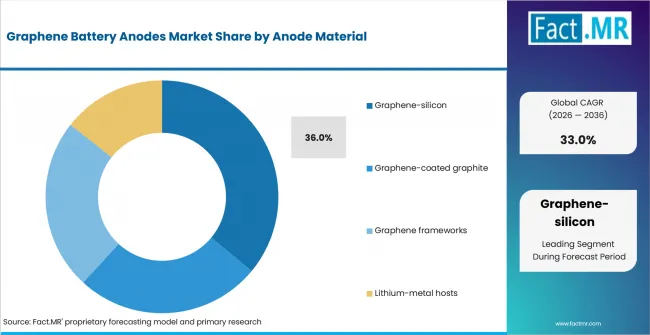
Graphene Battery Anodes Market Analysis By Anode Material | Source: Fact.MR
Graphene-silicon leads because it targets the central trade-off in next-generation anodes. Silicon raises capacity, but expansion can damage the electrode. Graphene gives formulators a conductive support material that helps the anode retain electrical contact during repeated charge cycles.
The U.S. Department of Energy proposed federal funding in April 2026 for a University of North Dakota project to design, develop, fabricate and test a prototype plasma-assisted reactor for silicon-anode production.
What leads the Supply Form segment?
Active powder is projected to account for 48.0% share in 2026.
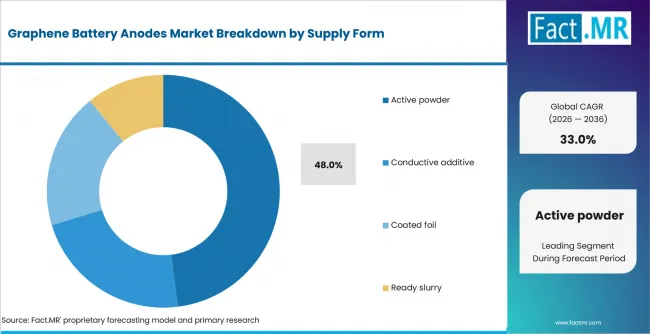
Graphene Battery Anodes Market Analysis By Supply Form | Source: Fact.MR
Active powder leads because it fits the way anode producers already qualify new electrode materials. Powder can be blended with graphite or silicon-bearing formulations before slurry preparation. NanoXplore’s November 2025 investor presentation identifies active anode materials and silicon/graphene battery technology among its battery-material activities, illustrating its positioning toward battery-cell customers.
How does Battery Application shape demand?
EV traction is anticipated to capture 35.0% share in 2026.
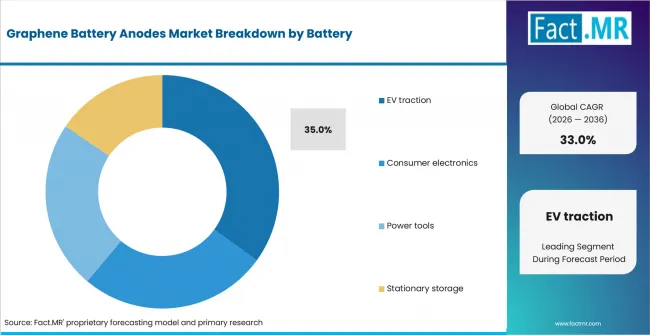
Graphene Battery Anodes Market Analysis By Battery | Source: Fact.MR
EV traction cells create the clearest commercial test for graphene battery anodes. Automakers need higher energy density and faster charging while protecting warranty life. The UK Department for Transport reported on April 29, 2026 that 473,226 road-using zero-emission cars were registered for the first time in 2025.
What supports Performance Target demand?
Fast charging is estimated to represent 47.0% share in 2026.
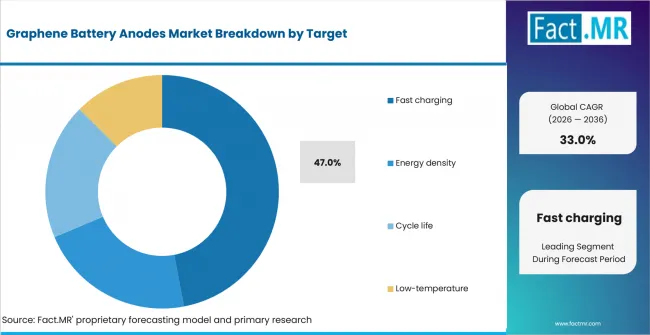
Graphene Battery Anodes Market Analysis By Target | Source: Fact.MR
Fast charging leads because it turns anode performance into a customer-visible metric. A low-resistance anode reduces heat and supports higher current. Graphene’s value is tied to that electrical pathway, especially when silicon or coated graphite needs better conductive contact. Demand for graphene electrodes is therefore linked to proof that resistance gains survive cell-level testing.
How does Region shape adoption?
The UK leads the listed countries at 38.5% CAGR through 2036.
Regional adoption is shaped by battery manufacturing, EV demand and critical-mineral policy. The UK and USA show faster rates because funding and cell investment shorten trials. Germany and South Korea rely on cell production and R&D programs. Japan leans more on policy coordination and supply security.
What is accelerating Graphene Battery Anodes Market adoption, and what is holding it back?
Demand is expected to rise through fast-charge requirements, silicon-rich anode programs and battery-material localization. Adoption is constrained by cell qualification time, graphite supply risk and the cost of consistent graphene dispersion.
Drivers Impact Analysis
| DRIVER | (~) % IMPACT ON CAGR | GEOGRAPHIC RELEVANCE | IMPACT TIMELINE |
|---|---|---|---|
| Fast-charge qualification at EV cell producers | +3.8% | North America, Europe, East Asia | Short term (<= 2 years) |
| Silicon-rich anode development for higher energy density | +3.1% | USA, UK, Japan | Medium term (2-4 years) |
| Domestic battery-material funding and anode localization | +2.7% | USA, UK, Germany, South Korea | Medium term (2-4 years) |
| Conductive additive use in coated graphite formulations | +1.7% | Global | Long term (>= 4 years) |
- Fast-charge qualification at EV cell producers: Vehicle programs make charge time and battery warranty visible procurement tests, which favors anode materials that reduce resistance and heat.
- Silicon-rich anode development for higher energy density: Graphene-silicon blends give material teams a route to raise capacity while managing conductivity inside the electrode.
- Domestic battery-material funding and anode localization: The U.S. Department of Energy issued a January 2025 notice of intent for up to USD 725 million covering battery critical materials, components and advanced batteries.
Opportunity Impact Analysis
| OPPORTUNITY | (~) % IMPACT ON CAGR | GEOGRAPHIC RELEVANCE | IMPACT TIMELINE |
|---|---|---|---|
| Active powder supply for pilot and pre-commercial lines | +2.0% | Global | Medium term (2-4 years) |
| Lithium-metal host and high-silicon electrode testing | +1.5% | USA, Japan, South Korea | Long term (>= 4 years) |
| Recycled graphite and graphene-coated anode routes | +1.3% | UK, Germany, South Korea | Long term (>= 4 years) |
- Active powder supply for pilot and pre-commercial lines: Powder formats let suppliers enter early cell trials with fewer equipment changes than coated foil or finished slurry routes.
- Lithium-metal host and high-silicon electrode testing: Graphene frameworks are expected to gain attention where dendrite control and electronic contact are both part of the performance problem.
- Recycled graphite and graphene-coated anode routes: Circular battery programs create a path for premium materials when graphite supply needs performance upgrading.
Restraints Impact Analysis
| RESTRAINT | (~) % IMPACT ON CAGR | GEOGRAPHIC RELEVANCE | IMPACT TIMELINE |
|---|---|---|---|
| Long qualification cycles for new anode chemistries | -1.2% | Global | Short term (<= 2 years) |
| Critical mineral and graphite supply exposure | -0.9% | Europe, Japan | Medium term (2-4 years) |
| Cost of consistent graphene dispersion at scale | -0.7% | Global | Long term (>= 4 years) |
- Long qualification cycles for new anode chemistries: Cell manufacturers test cycle life, swelling, safety and warranty behavior before accepting a new anode material.
- Critical mineral and graphite supply exposure: The U.S. Department of Energy announced in August 2025 that it intended to issue funding opportunities totaling nearly USD 1 billion for critical minerals and materials supply chains.
- Cost of consistent graphene dispersion at scale: Material gains lose value when graphene batches vary or require extra mixing steps during electrode production.
Which countries are scaling the Graphene Battery Anodes Market through 2036?
- The country comparison spans 11.7 percentage points between the UK and Japan across the displayed forecast period.
- The UK remains 1.7 percentage points above the USA as gigafactory support and zero-emission vehicle registrations create a nearer cell qualification base.
- The USA remains 1.5 percentage points above Germany through federal anode-material funding and silicon-anode research activity.
- Germany remains 1.0 percentage point above South Korea because operating battery-cell sites create a local route for material trials.
- South Korea remains 7.5 percentage points above Japan as next-generation battery R&D programs support local anode testing.
- Japan closes the displayed range while battery supply-chain diplomacy and storage-battery strategy keep anode materials within industrial policy.
Comparable CAGRs create different entry conditions due to battery manufacturing depth, EV registration momentum and critical-mineral policy. Full report coverage includes North America, Latin America, Western Europe, Eastern Europe, East Asia, South Asia & Pacific, Middle East & Africa.
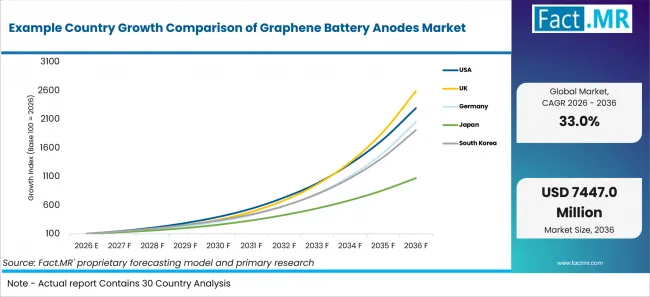
Example Country Growth Comparison Of Graphene Battery Anodes Market | Source: Fact.MR
| Country | CAGR (2026-2036) |
|---|---|
| UK | 38.5% |
| USA | 36.8% |
| Germany | 35.3% |
| South Korea | 34.3% |
| Japan | 26.8% |
What supports UK adoption?
38.5% CAGR, supported by gigafactory investment and EV registrations.
The UK has a direct manufacturing signal because Agratas is building a domestic gigafactory base. The Department for Business and Trade reported in April 2026 that a £380 million government grant supports Agratas’ battery gigafactory in Somerset. The Department for Transport reported on April 29, 2026 that 473,226 road-using zero-emission cars were registered for the first time in the UK in 2025. Active powder and graphene-silicon suppliers gain a clearer route into local qualification work.
How is the USA scaling demand?
36.8% CAGR, led by battery-material funding and silicon-anode research.
The USA is linking anode materials to public battery programs and university scale-up work. DOE issued a January 2025 notice of intent for up to USD 725 million for battery critical materials, components and advanced batteries. In April 2026, DOE proposed funding for a University of North Dakota silicon-anode reactor project. Graphene-coated silicon and active powder suppliers benefit when domestic content and fast-charge claims are tested together.
What supports Germany adoption?
35.3% CAGR, driven by battery-cell sites and electric-drive registrations.
Germany’s anode opportunity is tied to local cell production and automotive testing. The German Bundestag reported in March 2026 that 10 battery-cell production sites were operating in the country. Destatis reported in January 2026 that electric cars and plug-in hybrids represented 30.0% of new passenger-car registrations in 2025. These conditions favor formats that fit existing validation routines.
How is South Korea developing demand?
34.3% CAGR, backed by next-generation battery R&D and EV manufacturing depth.
South Korea has a strong battery manufacturing base, but graphene anodes still need proof under demanding cell tests. MOTIR said in November 2025 that the government plans to invest KRW 280 billion through 2029 in next-generation battery technologies. MOTIR also reported that eco-friendly vehicle sales rose 5.5% year over year to 77,000 units in May 2026. These signals keep pilot-line testing active.
How does Japan perform?
26.8% CAGR, supported by battery strategy and supply-chain cooperation.
Japan’s displayed rate is lower than the other listed countries, yet policy support remains relevant to qualification. METI revised the Battery Industry Strategy in June 2026 and set a target to triple the global battery-related sales of Japanese companies from 2025 to 2035. Japan’s Ministry of Foreign Affairs reported in August 2025 that Japan and Canada reviewed progress on concrete actions under their battery supply-chain cooperation framework. These actions support coated graphite and graphene frameworks when sourcing and cell evidence improve together.
Who leads the Graphene Battery Anodes Market?
NanoXplore Inc. and Solidion Technology, Inc. show the clearest direct relevance to graphene-enabled battery anode development, while Talga Group Ltd., JNC Materials Co., Ltd. and Global Graphene Group / Angstron Energy broaden the competitive landscape across graphite, graphene and advanced anode materials.
NanoXplore contributes graphene materials and battery-focused anode development capabilities. Solidion Technology supports advanced lithium-ion battery architectures using graphene-rich electrode technologies. Talga Group adds graphite-based anode materials and vertically integrated battery-material development. JNC Materials contributes advanced carbon and functional materials relevant to battery electrodes. Global Graphene Group / Angstron Energy extends the market through graphene materials, energy-storage technologies and graphene-enhanced electrode development. Competition is expected to center on conductivity improvement, cycle life, charge performance, scalable material production and compatibility with commercial cell-manufacturing processes.
Which companies are the key providers?
Key companies include NanoXplore Inc.; Solidion Technology, Inc.; JNC Materials Co., Ltd.; Talga Group Ltd.; Global Graphene Group / Angstron Energy.
- NanoXplore Inc.
- Solidion Technology, Inc.
- JNC Materials Co., Ltd.
- Talga Group Ltd.
- Global Graphene Group / Angstron Energy
Bibliography
- Department for Business and Trade. (2026, April 9). Business Secretary champions flagship investment in UK’s largest gigafactory. GOV.UK.
- Department for Transport. (2026, April 29). Vehicle licensing statistics, United Kingdom: 2025. GOV.UK.
- Deutscher Bundestag. (2026, March 10). Rückzahlung der Fördermittel offen.
- Deutscher Bundestag. (2026, March 25). Batterieproduktionsstätten in Deutschland.
- Statistisches Bundesamt. (2026, January 22). E-Autos und Plug-in-Hybride: Ausstattung in Haushalten hängt stark vom Einkommen ab.
- Ministry of Economy, Trade and Industry. (2026, June 2). “Battery Industry Strategy” revised as the “Battery and Power Industry Strategy.”
- Ministry of Foreign Affairs of Japan. (2025, August 27). The second meeting of the dialogue based on the Japan-Canada Memorandum of Cooperation concerning battery supply chains (overview).
- Ministry of Trade, Industry and Resources. (2025, December 1). K-Battery to power Korea’s future industries.
- NanoXplore Inc. (2026, May 13). Interim management’s discussion and analysis for the three and nine-month periods ended March 31, 2026 and 2025.
- Talga Group Ltd. (2025, September 9). Talga enters US battery anode market through strategic agreement with United Catalyst Corporation.
- U.S. Department of Energy. (2025, January 10). DOE issues notice of intent for funding in strengthening domestic critical materials processing and manufacturing to enhance national security.
- U.S. Department of Energy. (2026, April 29). CX-035620: Producing silicon anode materials for Li-ion batteries.
This Report Answers
- The report explains where graphene battery anodes are used across anode material, supply form, battery application and performance target.
- Segment analysis identifies the 2026 leading subsegments and explains why each fits current battery-manufacturing requirements.
- Country analysis examines the listed markets and the policy, EV and battery-manufacturing signals that support adoption.
- Competitive analysis reviews current providers across graphene powders, silicon-graphene additives, graphite anode technology and broader graphene energy-storage materials.
- Application analysis assesses how fast charging, energy density, cycle life and low-temperature performance shape anode-material selection.
What does the Graphene Battery Anodes Market cover?
The Graphene Battery Anodes Market covers graphene-enabled anode materials used to improve rechargeable battery performance. It includes graphene-silicon materials, graphene-coated graphite and frameworks used inside anode structures. The assessment also considers adjacent graphene energy storage technology where anode-grade requirements overlap with stationary and mobility cells.
The assessment covers active powder, conductive additives, coated foil and ready slurry. It reflects demand from EV traction batteries, consumer electronics, power tools and stationary storage.
What is included in the scope?
The scope includes graphene-silicon powders, coated graphite, graphene frameworks and lithium-metal host materials when graphene improves electrode conductivity, charge acceptance or cycle-life performance.
Commercial analysis includes direct material sales and supplier portfolios where graphene is part of the anode value proposition. Adjacent solid-state materials are reviewed only when the anode pathway overlaps with graphene frameworks or lithium-metal hosts.
What is excluded from the scope?
The scope excludes cathode active materials, separators and electrolytes sold without graphene-enabled anode function. It also excludes finished battery packs, battery-management systems and unrelated graphene composites.
Battery manufacturing equipment, cell assembly and recycling services are excluded unless the offer includes a graphene-enabled anode material. Research-only materials are excluded without customer-facing cell testing evidence.
How Was the Analysis Built?
The analysis draws on 120+ sources, 35+ company portfolios, 25+ countries, and more than 20 industry interviews.
- Primary Research: Primary research includes discussions with manufacturers, service providers, technology developers, distributors, end users, procurement teams, and subject-matter experts. These conversations examine purchasing priorities, product adoption, operational challenges, approval requirements, competitive positioning, and the factors that influence wider market acceptance.
- Desk Research: Desk research covers government statistics, regulatory publications, company filings, trade data, technical studies, industry associations, standards, public policy, and other authoritative sources. Every source used in the analysis is documented in the bibliography.
- Market Sizing and Forecasting: Market estimates combine historical performance, demand indicators, pricing and volume trends, segment shares, company participation, country-level growth, adoption patterns, investment activity, and barriers to market expansion.
- Data Validation and Update Cycle: Findings are validated by comparing primary interviews with public data, company activity, regulatory changes, trade patterns, and industry developments. Regular updates review new product launches, capacity changes, partnerships, approvals, procurement trends, and shifts in commercial adoption.
What is the report’s scope and coverage?
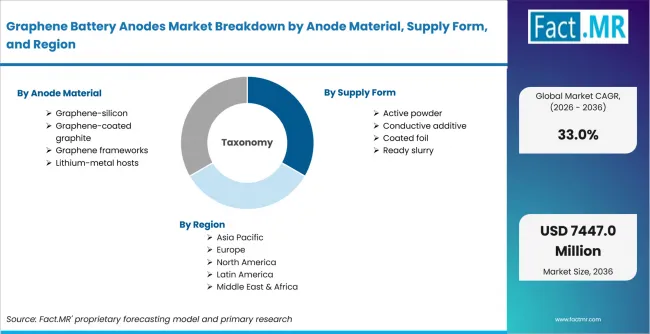
Graphene Battery Anodes Market Breakdown By Anode Material, Supply Form, And Region | Source: Fact.MR
| Attribute | Details |
|---|---|
| Quantitative Units | USD million |
| Market Definition | Graphene-enabled anode materials used in rechargeable batteries, including graphene-silicon blends, graphene-coated graphite, graphene frameworks and lithium-metal host materials. |
| Anode Material | Graphene-silicon; Graphene-coated graphite; Graphene frameworks; Lithium-metal hosts |
| Supply Form | Active powder; Conductive additive; Coated foil; Ready slurry |
| Battery Application | EV traction; Consumer electronics; Power tools; Stationary storage |
| Performance Target | Fast charging; Energy density; Cycle life; Low-temperature |
| Regions Covered | North America; Latin America; Western Europe; Eastern Europe; East Asia; South Asia & Pacific; Middle East & Africa |
| Countries Covered | UK; USA; Germany; South Korea; Japan |
| Key Companies Profiled | NanoXplore Inc.; Solidion Technology, Inc.; JNC Materials Co., Ltd.; Talga Group Ltd.; Global Graphene Group / Angstron Energy |
| Forecast Period | 2026 to 2036 |
| Approach | Hybrid top-down and bottom-up approach using battery-material demand indicators, anode-chemistry adoption, country policy evidence, segment share modeling and provider portfolio review. |
How is the market segmented?
-
By Anode Material:
- Graphene-silicon
- Graphene-coated graphite
- Graphene frameworks
- Lithium-metal hosts
-
By Supply Form:
- Active powder
- Conductive additive
- Coated foil
- Ready slurry
-
By Battery Application:
- EV traction
- Consumer electronics
- Power tools
- Stationary storage
-
By Performance Target:
- Fast charging
- Energy density
- Cycle life
- Low-temperature
-
By Region:
- North America
- Latin America
- Western Europe
- Eastern Europe
- East Asia
- South Asia & Pacific
- Middle East & Africa