- Market Value (2025): USD 666.4 Mn
- Estimated Value (2026): USD 807.0 Mn
- Forecast Value (2036): USD 5474.1 Mn
- CAGR (2026-2036): 21.1%
What is the Graphene Cathode Active Coatings Market forecast to be worth by 2036?
USD 807.0 million in 2026 to USD 5474.1 million by 2036 at a 21.1% CAGR.
- The Graphene Cathode Active Coatings Market reached USD 666.4 million in 2025.
- Demand is projected to increase from USD 807.0 million in 2026 to USD 5474.1 million by 2036.
- The market is forecast to record 21.1% CAGR from 2026 to 2036 as battery-material developers pursue higher conductivity, faster charging and more stable cathode interfaces.
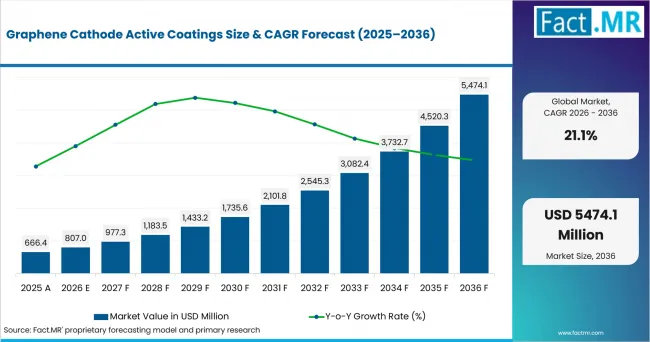
Graphene Cathode Active Coatings Value Analysis | Source: Fact.MR
What are the defining numbers behind Graphene Cathode Active Coatings Market growth?
An absolute opportunity of USD 4667.1 million is expected between 2026 and 2036.
- Demand Drivers in the Market
- Cathode-material producers need surface treatments that preserve electrical contact as active particles age while remaining compatible with lithium-ion production.
- EV cell developers need lower interfacial resistance because charge rate and usable cycle life directly affect traction-battery performance. The U.S. Energy Information Administration reported in August 2026 that light-duty EVs consumed 23,532,855 MWh of electricity in 2025.
- High-voltage programs need coatings that limit cathode-electrolyte reactions while retaining the underlying active-material chemistry.
- Stationary-storage developers need repeatable cycling, making conductive composite layers relevant when dispersion and particle coverage remain consistent.
- Key Segments Analyzed
- By Coating Architecture: Graphene shell on cathode particles is expected to hold 35.0% share in 2026 because conformal encapsulation directly addresses particle-level conductivity and surface stability.
- By Cathode Chemistry: LFP is projected to account for 30.0% share in 2026 owing to its broad use in cost-focused EV and stationary-storage cells where conductivity improvement remains commercially relevant.
- By Performance Target: Fast charge is anticipated to capture 38.0% share in 2026 as coating developers focus on lowering interfacial resistance and sustaining power delivery during repeated high-rate charging.
- By Application: EV cells are estimated to represent 49.0% share in 2026 since traction batteries combine large material volumes with strict requirements for charging, cycle life and thermal stability.
- Analyst Opinion at Fact.MR
- Shambhu Nath Jha, Principal Consultant at Fact.MR, states, “Commercial success depends on repeatable particle coverage in existing cathode processes. The market is expected to reward formulations that pair electrochemical evidence with manufacturing compatibility.”
- Strategic Implications
- Cathode-material suppliers should publish coating uniformity and electrochemical results by chemistry so cell engineers can compare performance against processing cost. Conductive-additive comparisons can draw on the conductive CNT dispersions for battery electrodes category.
- Graphene producers should offer dispersion forms that fit slurry and dry-electrode workflows alongside clear powder specifications. Binder integration is adjacent to the lithium-ion battery binders market.
- Cell developers should validate coated materials at realistic loading and charge rates before production qualification. Evaluation should extend beyond early coin-cell results to larger formats where coating uniformity and thermal behavior become easier to compare against existing cathode formulations.
- Coating firms should protect particle-coverage know-how while giving battery partners reproducible qualification packages. Clear process windows for mixing, coating and heat treatment can shorten technical review and help engineering teams distinguish coating performance from changes caused by the underlying cathode chemistry.
South Korea is projected to record 22.3% CAGR through 2036 as battery R&D supports material qualification. The USA is anticipated to post 21.7% as domestic battery investment expands. Japan is forecast at 19.6% under its battery strategy. Germany is estimated at 18.5% as EV and battery activity grows. Switzerland is projected at 16.5% through research-led materials development.
How does the Graphene Cathode Active Coatings Market break down by segment?
Graphene shell on cathode particles is projected to lead Coating Architecture at 35.0% share in 2026; EV cells are expected to lead Application at 49.0% share.
Which Coating Architecture dominates?
Graphene shell on cathode particles is expected to hold 35.0% share in 2026.
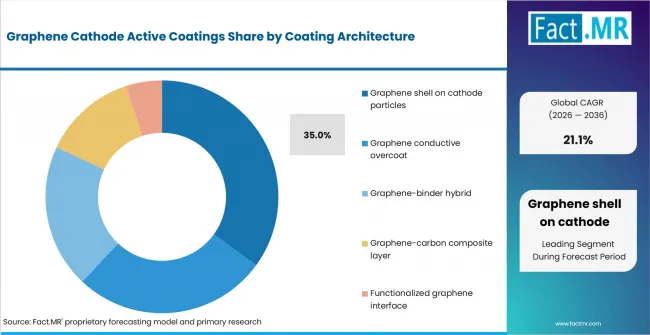
Graphene Cathode Active Coatings Analysis By Coating Architecture | Source: Fact.MR
Graphene shells place conductive material directly at the active-material interface and can preserve electron pathways during cycling.
Particle-level encapsulation is expected to suit programs that need conductivity gains at low graphene loading. The commercial test is coating consistency across large cathode batches because irregular coverage can change impedance from lot to lot. Suppliers that control surface treatment during scale-up can present a clearer path from laboratory cells to production-oriented validation.
What leads the Cathode Chemistry segment?
LFP is projected to account for 30.0% share in 2026.
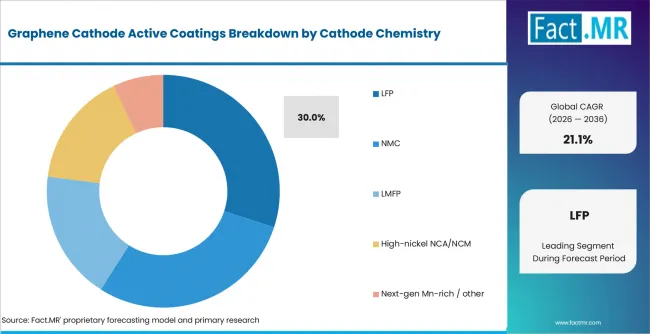
Graphene Cathode Active Coatings Analysis By Cathode Chemistry | Source: Fact.MR
LFP is cost-focused and thermally stable but has limited electronic conductivity. Graphene layers can target that constraint. Japan’s Ministry of Economy, Trade and Industry set a 150 GWh annual domestic battery-manufacturing target from 2030 to the mid-2030s in June 2026.
For LFP programs, the coating decision is expected to depend on the balance between conductivity improvement and added processing cost. A thin graphene interface can support electron transport while leaving the established LFP chemistry in place. This makes the approach relevant to developers seeking performance gains within familiar cathode platforms and manufacturing routines.
How does Performance Target shape demand?
Fast charge is anticipated to capture 38.0% share in 2026.
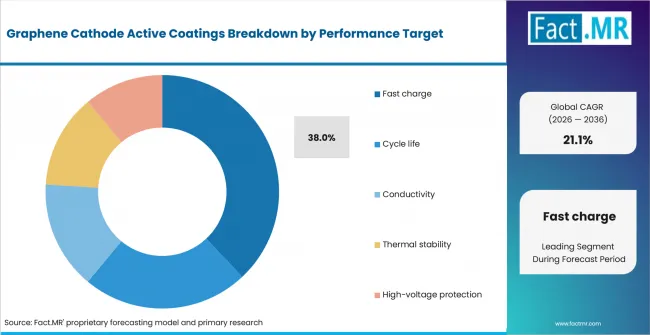
Graphene Cathode Active Coatings Analysis By Performance Target | Source: Fact.MR
Fast charging raises current density and exposes resistive losses at the electrode interface. Conductive coatings can reduce that constraint, but qualification still depends on full-cell charge, safety and durability testing.
Fast-charge qualification is expected to focus on whether the coating maintains lower resistance across repeated cycles and changing temperatures. A useful result must remain visible at practical electrode loading and cell format. Coating suppliers therefore need comparable data across charge rate, heat generation and retained capacity instead of a single early-cycle performance result.
What supports EV cells within Application?
EV cells are estimated to represent 49.0% share in 2026.
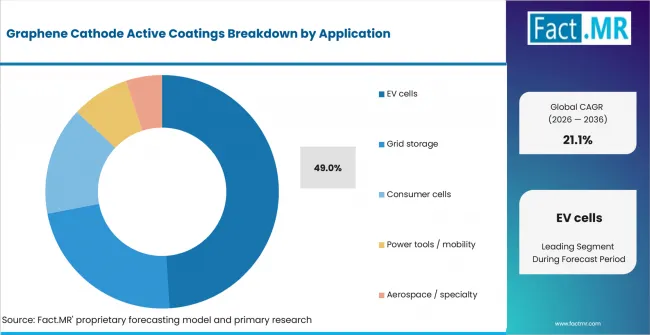
Graphene Cathode Active Coatings Analysis By Application | Source: Fact.MR
EV cells combine high material volumes with strict charge and service-life targets. The Swiss Federal Statistical Office reported that new registrations of electric passenger cars increased 16% in 2025 compared with 2024.
Automotive programs are expected to place the greatest emphasis on repeatability because a cathode change affects warranty life and pack-level thermal behavior. Graphene coatings that fit existing cathode handling can reduce integration work. Commercial adoption still depends on consistent results across larger cells and manufacturing-scale material batches.
What is accelerating Graphene Cathode Active Coatings Market adoption, and what is holding it back?
Demand is expected to rise through EV-cell qualification, fast-charge targets and battery-material localization. Adoption is constrained by coating consistency, qualification time and the need to prove benefits at commercial electrode loading.
Driver Impact Analysis
| DRIVER | (~) % IMPACT ON CAGR | GEOGRAPHIC RELEVANCE | IMPACT TIMELINE |
|---|---|---|---|
| EV-cell fast-charge requirements | +2.1% | North America, East Asia | Short term (<= 2 years) |
| Battery-material localization and supply-chain investment | +1.6% | North America, Europe, East Asia | Medium term (2-4 years) |
| Higher-voltage and longer-cycle cathode development | +1.2% | Global | Medium term (2-4 years) |
| Drop-in coating compatibility with existing cathode lines | +0.9% | Global | Long term (>= 4 years) |
Opportunity Impact Analysis
| OPPORTUNITY | (~) % IMPACT ON CAGR | GEOGRAPHIC RELEVANCE | IMPACT TIMELINE |
|---|---|---|---|
| Graphene encapsulation for LFP and LMFP cathodes | +1.4% | East Asia, North America | Medium term (2-4 years) |
| Conductive coatings for high-nickel and Mn-rich cathodes | +1.0% | Europe, East Asia | Long term (>= 4 years) |
| Dry-electrode compatible graphene interfaces | +0.8% | North America, East Asia | Medium term (2-4 years) |
Restraint Impact Analysis
| RESTRAINT | (~) % IMPACT ON CAGR | GEOGRAPHIC RELEVANCE | IMPACT TIMELINE |
|---|---|---|---|
| Battery qualification and validation cycles | -0.7% | Global | Short term (<= 2 years) |
| Dispersion and coating-uniformity control | -0.5% | Global | Medium term (2-4 years) |
| Added material and processing cost | -0.4% | North America, Europe | Long term (>= 4 years) |
Which countries are scaling the Graphene Cathode Active Coatings Market through 2036?
- South Korea leads the displayed country set at 22.3% CAGR as battery R&D and EV deployment support advanced-material qualification.
- The USA follows at 21.7% CAGR as federal programs support critical-material processing and domestic battery manufacturing.
- Japan reaches 19.6% CAGR as national policy targets a larger domestic battery manufacturing base and next-generation chemistries.
- Germany records 18.5% CAGR as electric-vehicle registrations, charging infrastructure and battery projects expand the qualification base.
- Switzerland reaches 16.5% CAGR as federal research programs and battery-material projects support specialized coating development.
Country entry conditions differ by battery demand, policy support and qualification capacity. Coverage also spans North America, Latin America, Western and Eastern Europe, East Asia, South Asia & Pacific, and Middle East & Africa.
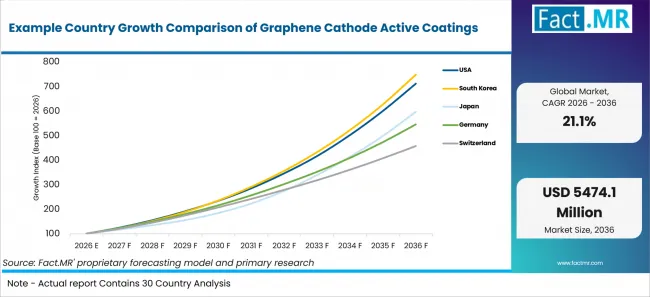
Example Country Growth Comparison Of Graphene Cathode Active Coatings | Source: Fact.MR
| Country | CAGR (2026-2036) |
|---|---|
| South Korea | 22.3% |
| United States | 21.7% |
| Japan | 19.6% |
| Germany | 18.5% |
| Switzerland | 16.5% |
What supports USA adoption?
21.7% CAGR, supported by domestic battery investment and EV-linked cathode demand.
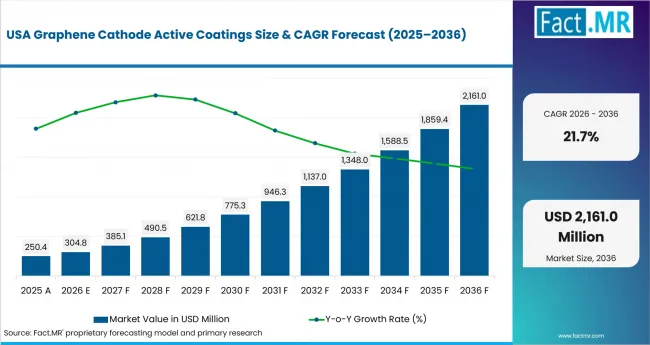
Graphene Cathode Active Coatings Country Value Analysis | Source: Fact.MR
U.S. battery investment is expected to widen local qualification routes for coated cathode materials. The U.S. Department of Energy announced in August 2026 that USD 500 million was selected for seven critical-mineral and battery projects covering processing, battery manufacturing and recycling capacity. Graphene coating suppliers can use this expanding battery base to pursue cell-level validation around charge rate and interface stability. Programs that fit established cathode handling are expected to move more easily into pilot and production reviews.
How is South Korea scaling demand?
22.3% CAGR, led by battery R&D and EV-linked material qualification.
South Korea combines a large battery manufacturing base with expanding electric mobility. The Ministry of Climate, Energy and Environment reported in January 2026 that registered electric vehicles reached 899,101 in 2025. Higher cell demand is expected to keep cathode conductivity and charging performance central to materials qualification across Korean battery programs. Suppliers are expected to face close evaluation of coating uniformity because Korean cell makers operate at large commercial scale.
What supports Japan growth?
19.6% CAGR, driven by battery policy and next-generation cell development.
Japan is directing policy toward domestic battery manufacturing and next-generation cell systems. In December 2025, Japan’s Ministry of Economy, Trade and Industry stated that the maximum subsidy for eligible electric vehicles would increase to JPY 1.3 million for vehicles newly registered on or after January 1, 2026. The policy environment is expected to support cathode-interface work linked with solid-state battery materials. Graphene coatings are expected to gain attention where they fit long qualification cycles and chemistry-specific performance targets.
What supports Germany growth?
18.5% CAGR, backed by EV registrations and battery-material qualification.
Germany links automotive electrification with a large engineering base for battery materials. Destatis reported in January 2026 that 856,500 electrically powered passenger cars were newly registered in 2025. The scale of electrified vehicle activity is expected to sustain cell-development work where graphene cathode coatings must demonstrate repeatable electrochemical and manufacturing performance. Suppliers are expected to benefit when coating data align with automotive validation and European battery documentation requirements.
How is Switzerland developing demand?
16.5% CAGR, shaped by specialized battery research and materials development.
Switzerland is expected to remain a specialized research and materials-development market. The Swiss Federal Statistical Office reported in June 2026 that federal research and development expenditure reached CHF 3.2 billion in 2025. This research base supports advanced electrochemistry and surface-engineering work that can move graphene cathode coatings from laboratory validation toward industrial partnerships. Commercial scale-up is expected to rely on cross-border cell and materials partners that can absorb specialized Swiss research outputs.
Who leads the Graphene Cathode Active Coatings Market?
Volexion positions its technology as graphene encapsulation for lithium-ion cathode active materials, with a drop-in approach designed for compatibility with current and next-generation lithium-ion manufacturing.
Volexion has direct cathode-specific positioning through conformal nanoscale graphene encapsulation of cathode active materials. Broader graphene producers can participate in battery applications through conductive graphene powders and other battery-material platforms. Competitive differentiation includes cathode-specific integration, graphene material properties, manufacturing compatibility and cell-level performance evidence.
Qualification capability is particularly relevant because new battery materials need to demonstrate consistent performance under cell-testing conditions. NanoXplore launched xGnP™ D500-HP in May 2026 with verified purity of 99.8% at full commercial volumes. The company states that initial customers validated the product’s performance data and that broader qualification programs with target customers are underway.
Commercial differentiation also includes the ability to reproduce graphene quality at scale and provide technical support during battery-material integration. Suppliers can strengthen their positioning by documenting conductivity, material consistency, processing compatibility and electrochemical performance across relevant battery chemistries. Such evidence gives cell-development teams a clearer basis for comparing graphene materials during technical evaluation and qualification.
Which companies are the key providers?
Key companies include Volexion; NanoXplore; NEI Corporation; Graphene Manufacturing Group (GMG); CARBON T&C; and HydroGraph.
- Volexion
- NanoXplore
- NEI Corporation
- Graphene Manufacturing Group (GMG)
- CARBON T&C
- HydroGraph
Bibliography
- U.S. Department of Energy. (2026, August 20). Energy Department announces $500 million to secure America’s critical mineral and battery supply chains.
- U.S. Energy Information Administration. (2026, August 26). Table D.1. U.S. estimated consumption of electricity by light-duty electric vehicle types, 2018–May 2026. Electric Power Monthly.
- Ministry of Economy, Trade and Industry. (2026, June 2). “Battery Industry Strategy” revised as the “Battery and Power Industry Strategy”.
- Ministry of Economy, Trade and Industry. (2025, December 19). Press conference by Minister Akazawa (Excerpt).
- Statistisches Bundesamt (Destatis). (2026, January 22). E-Autos und Plug-in-Hybride: Ausstattung in Haushalten hängt stark vom Einkommen ab [Electric cars and plug-in hybrids: Household ownership depends strongly on income].
- Federal Statistical Office. (2026, February 4). Renewed surge in electric vehicles [Press release].
- Federal Statistical Office. (2026, June 25). Marked increase in federal R&D expenditure in 2025 [Press release].
- NanoXplore Inc. (2025, October 6). NanoXplore receives up to $2.75M contribution from the Government of Canada [Press release].
- NanoXplore Inc. (2026, May 5). NanoXplore launches xGnP™ D500-HP, high-purity graphene to replace conventional conductive additives [Press release].
- NanoXplore Inc. (2025, September 16). Annual information form: For the year ended June 30, 2025.
This Report Answers
- The report covers graphene cathode active coatings by architecture, cathode chemistry, performance target and application.
- Segment analysis identifies the 2026 leaders and the battery requirements behind their shares.
- Country analysis compares five markets using official battery, EV, research and policy evidence.
- Competitive analysis distinguishes direct cathode encapsulation from broader graphene battery-material activity.
- Application analysis links coating selection with charge rate, cycle life, conductivity and thermal stability.
What does the Graphene Cathode Active Coatings Market cover?
The market covers graphene-enabled layers applied to cathode active material to improve the electrode interface. It focuses on cathode-surface and conductive-interface treatments used within rechargeable battery development.
The assessment separates cathode coatings from general graphene powders, anode materials and complete battery cells so the market boundary remains specific to cathode-active surface treatment.
What is included in the scope?
Included products cover graphene shells, conductive overcoats, graphene-binder hybrids, graphene-carbon composite layers and functionalized interfaces across the listed cathode chemistries. Coverage extends to coating formats used with slurry or dry-electrode processing when the function remains tied to cathode-active material.
What is excluded from the scope?
The scope focuses on cathode-active coating offerings. Anode-only materials, complete cells centered on other functions and general conductive carbon fall outside the core boundary. These adjacent categories are treated as boundary references rather than part of the target market.
How Was the Analysis Built?
The analysis draws on 120+ sources, 35+ company portfolios, 25+ countries, and more than 20 industry interviews.
- Primary Research: Primary research includes discussions with manufacturers, service providers, technology developers, distributors, end users, and subject-matter experts. These conversations examine purchasing priorities, product adoption, operational challenges, approval requirements, competitive positioning, and the factors that influence wider market acceptance.
- Desk Research: Desk research covers government statistics, regulatory publications, company filings, trade data, technical studies, industry associations, standards, public policy, and other authoritative sources. Every source used in the analysis is documented in the bibliography.
- Market Sizing and Forecasting: Market estimates combine historical performance, demand indicators, pricing and volume trends, segment shares, company participation, country-level growth, adoption patterns, investment activity, and barriers to market expansion.
- Data Validation and Update Cycle: Findings are validated by comparing primary interviews with public data, company activity, regulatory changes, trade patterns, and industry developments. Regular updates review new product launches, capacity changes, partnerships, approvals, and shifts in commercial adoption.
What is the report’s scope and coverage?
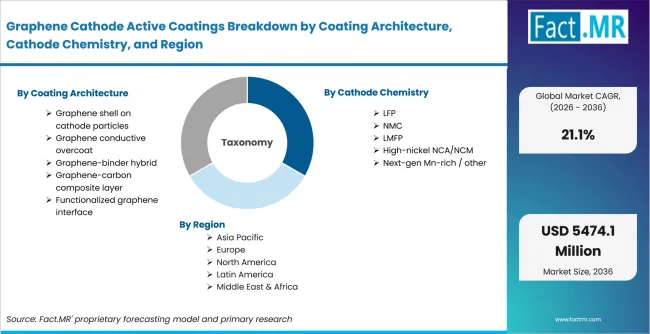
Graphene Cathode Active Coatings Breakdown By Coating Architecture, Cathode Chemistry, And Region | Source: Fact.MR
| Attribute | Details |
|---|---|
| Quantitative Units | USD million |
| Market Definition | Graphene-enabled coatings and conductive interface layers applied to lithium-ion cathode active materials or cathode particles to improve conductivity, surface stability, cycle life, fast-charge behavior or high-voltage performance. |
| Coating Architecture | Graphene shell on cathode particles; Graphene conductive overcoat; Graphene-binder hybrid; Graphene-carbon composite layer; Functionalized graphene interface |
| Cathode Chemistry | LFP; NMC; LMFP; High-nickel NCA/NCM; Next-gen Mn-rich / other |
| Performance Target | Fast charge; Cycle life; Conductivity; Thermal stability; High-voltage protection |
| Application | EV cells; Grid storage; Consumer cells; Power tools / mobility; Aerospace / specialty |
| Regions Covered | North America; Latin America; Western Europe; Eastern Europe; East Asia; South Asia & Pacific; Middle East & Africa |
| Countries Covered | United States; South Korea; Japan; Germany; Switzerland |
| Key Companies Profiled | Volexion; NanoXplore; NEI Corporation; Graphene Manufacturing Group (GMG); CARBON T&C; HydroGraph |
| Forecast Period | 2026 to 2036 |
| Approach | Hybrid top-down and bottom-up approach using cathode-material demand, EV and storage adoption, coating architecture, country policy evidence, company portfolio review and material qualification logic. |
How is the market segmented?
-
By Coating Architecture
- Graphene shell on cathode particles
- Graphene conductive overcoat
- Graphene-binder hybrid
- Graphene-carbon composite layer
- Functionalized graphene interface
-
By Cathode Chemistry
- LFP
- NMC
- LMFP
- High-nickel NCA/NCM
- Next-gen Mn-rich / other
-
By Performance Target
- Fast charge
- Cycle life
- Conductivity
- Thermal stability
- High-voltage protection
-
By Application
- EV cells
- Grid storage
- Consumer cells
- Power tools / mobility
- Aerospace / specialty
-
By Region
- North America
- Latin America
- Western Europe
- Eastern Europe
- East Asia
- South Asia & Pacific
- Middle East & Africa