The Solid-State Battery Precursor-Free Cathodes Market is analyzed across its key product, application and end-use segments, with regional trends and demand outlook, forecast 2026 to 2036.
By Fact.MR Technology DeskLead analyst:
Ganesh PaiPublished :
Updated :
11 min read
Fact-checked under the Fact.MR editorial process
Solid-State Battery Precursor-Free Cathodes Market Forecast and Outlook By Fact.MR
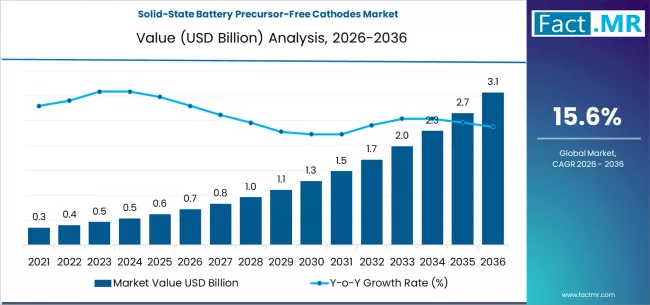
The global market for solid-state battery precursor-free cathodes is projected to surge from USD 0.72 billion in 2026 to USD 3.07 billion by 2036, accelerating at a remarkable 15.6% CAGR.
This extraordinary growth is driven by the fundamental shift from liquid-electrolyte lithium-ion batteries to solid-state architectures, where the cathode's synthesis and integration pathway becomes a critical determinant of performance, cost, and scalability.
Solid State Battery Precursor Free Cathodes Market Market Value Analysis | Source: Fact.MR
Summary of Solid-State Battery Precursor-Free Cathodes Market
Market Snapshot
Global solid-state battery precursor-free cathodes market revenue stood at USD 0.72 billion in 2026 and is forecast to reach USD 3.07 billion by 2036.
At a 15.6% CAGR from 2026 to 2036, this market is set to expand4.3x in value, adding USD 2.35 billion in absolute opportunity.
Growth is being driven by the transition from conventional lithium-ion batteries toward solid-state battery architectures, where precursor-free cathode manufacturing enables lower complexity and improved scalability.
Precursor-free cathodes are evolving into next-generation battery manufacturing solutions,eliminatingtraditional precursor synthesisstepsand reducing energy consumption, process complexity, and material waste.
Demand and Growth Drivers
Increasing demand for higher energy density and improved battery safety in electric vehicles is accelerating adoption of solid-state battery technologies.
Growing focus on solvent-free and sustainable battery manufacturing processes is reinforcing investment in precursor-free cathode production.
Rising pressure to reduce battery production costs, factory footprint, and material waste is driving interest in dry electrode and direct fabrication methods.
Expansion of EVgiga-factories and next-generation battery commercialization programs is supporting wider deployment of advanced cathode technologies.
Advancements in AI-assisted cathode material design, dry powder processing, and interfacial engineering are improving scalability and electrochemical performance.
Product and Segment View
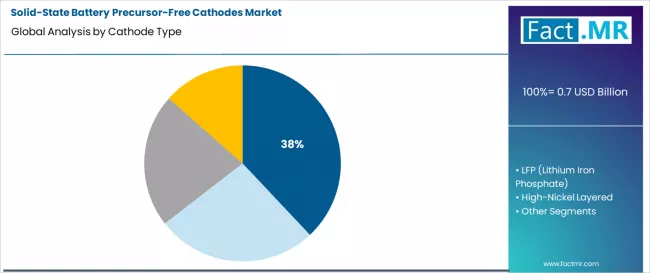
NMC (Nickel-Manganese-Cobalt) cathodes hold 38.0% of cathode type share in 2026,emergingas the leading segment due to their strong energy-density performance for EV applications.
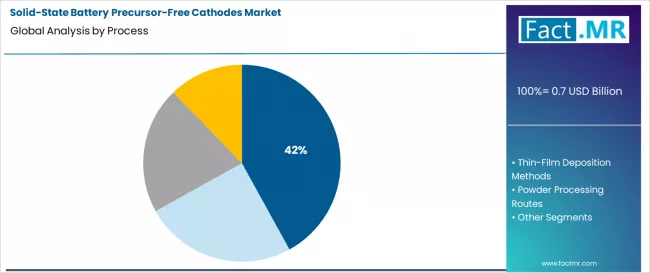
Dry electrode manufacturing accounts for 42.0% of process share in 2026, positioning it as the dominant segment driven by solvent-free manufacturing efficiency and scalability advantages.
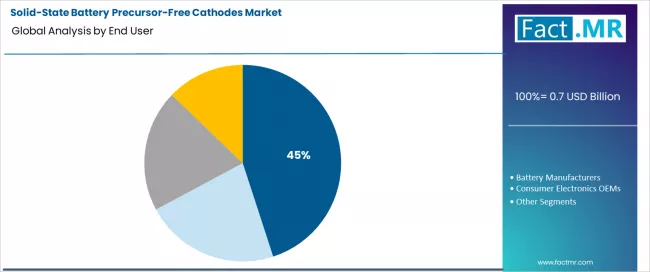
EV OEMsrepresent45% of end-user share in 2026, reflecting strong demand from automotive manufacturers investing in next-generation battery platforms.
These cathode technologies are widely used across:
Electric vehicles
Consumer electronics
Energy storage systems
Advanced battery manufacturing platforms
Geography and Competitive Outlook
Growth is supported across East Asia, North America, and Europe, aligned with strong battery manufacturing ecosystems and EV investments.
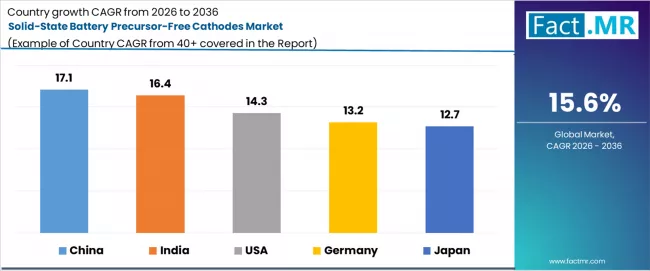
China (17.10% CAGR), India (16.40%), USA (14.30%), Germany (13.20%), and Japan (12.70%) are key growth markets.
Market expansion is closely tied to solid-state battery commercialization, EV adoption, and investments in next-generation battery production technologies.
Key companies active in this market include Toyota Central R&D Labs,QuantumScapeCorporation, Solid Power Inc., Samsung SDI, and Panasonic Energy.
Solid-State Battery Precursor-Free Cathodes Market — At a Glance
Attribute
Details
Market Value 2026
USD 0.72 billion
Market Value 2036
USD 3.07 billion
Absolute Dollar Opportunity 2026–2036
USD 2.35 billion
Total Growth 2026–2036
326.4%
CAGR 2026–2036
15.6%
Growth Multiple
4.3x
Key Demand Theme
Increasing adoption of precursor-free cathode manufacturing for scalable solid-state battery production
Leading Segment by Cathode Type (2026)
NMC (Nickel-Manganese-Cobalt)
Segment Share (2026)
38.0%
Leading Segment by Process (2026)
Dry Electrode Manufacturing
Segment Share (2026)
42.0%
Leading Segment by End User (2026)
EV OEMs
Segment Share (2026)
45%
Key Growth Regions
East Asia, North America, Europe
Country CAGRs
China 17.10%, India 16.40%, USA 14.30%, Germany 13.20%, Japan 12.70%
Top Companies
Toyota Central R&D Labs,QuantumScape, Solid Power, Samsung SDI, Panasonic Energy
EV OEMs, Battery Manufacturers, Consumer Electronics OEMs, Energy Storage Integrators
Segmentation by Region
North America, Latin America, Western Europe, Eastern Europe, East Asia, South Asia & Pacific, MEA
Source: Fact.MR analysis. Updated May 25, 2026
Precursor-free cathodes represent a disruptive manufacturing approach, eliminating the traditional, multi-step process of synthesizing cathode precursor powders before electrode fabrication. Instead, these cathodes are formed directly onto current collectors or solid electrolytes using advanced deposition or powder processing routes. This paradigm significantly reduces manufacturing complexity, energy consumption, and material waste, directly addressing the key bottlenecks in solid-state battery commercialization. China's 17.10% CAGR reflects its aggressive, state-coordinated push to control the next generation of battery manufacturing technology, not just cell assembly. The market's trajectory is defined by the convergence of advanced material science and novel, simplified production processes, aiming to deliver the step-change in energy density, safety, and production economics required for mass-market electric vehicle adoption.
Category
Category
Segments
Cathode Type
NMC (Nickel-Manganese-Cobalt), LFP (Lithium Iron Phosphate), High-Nickel Layered, Others
EV OEMs, Battery Manufacturers, Consumer Electronics OEMs, Energy Storage System Integrators
Region
North America, Latin America, Western Europe, Eastern Europe, East Asia, South Asia & Pacific, MEA
Source: Fact.MR analysis. Updated May 25, 2026
Segmental Analysis
By Cathode Type, Which Chemistry is the Focus for Maximizing Energy Density in Next-Generation Cells?
Solid State Battery Precursor Free Cathodes Market Analysis By Cathode Type | Source: Fact.MR
Nickel-manganese-cobalt (NMC) cathodes hold a leading 38% share. Their dominance in the precursor-free segment is due to their established performance pedigree in high-energy-density applications, particularly electric vehicles.
The challenge and focus of R&D are to adapt high-nickel NMC formulations such as NMC 811, 9xx to direct manufacturing processes without compromising their structural stability when coupled with a solid electrolyte. Success in creating a precursor-free, high-nickel NMC cathode is viewed as the key to unlocking the full potential of solid-state batteries for long-range EVs, driving intense investment in this area.
By Process, Which Manufacturing Route Offers the Most Direct Path to Scalability and Cost Reduction?
Solid State Battery Precursor Free Cathodes Market Analysis By Process | Source: Fact.MR
Dry electrode manufacturing is the predominant process, accounting for 42% of the segment. This technology, which involves mixing active cathode material, solid electrolyte, and conductive additives into a dry powder and then compacting it directly onto a current collector under heat and pressure, eliminates the energy-intensive solvent drying and recovery steps of slurry casting.
Its alignment with the solvent-free nature of solid-state batteries and its potential for radical cost and factory footprint reduction make it the most strategically significant process for scaling production, attracting major investments from automotive and battery giants.
By End User, Who is Driving Specification and Providing the Capital for Scale-Up?
Solid State Battery Precursor Free Cathodes Market Analysis By End User | Source: Fact.MR
Electric vehicle OEMs are the primary end-users, constituting 45% of the market. Their product roadmaps and multi-billion-dollar investments in next-generation battery technology are the ultimate market drivers.
EV manufacturers are not just customers but active co-developers, setting stringent targets for energy density, cycle life, and cost-per-kilowatt-hour that dictate cathode development. Their demand for secure, scalable supply chains for solid-state components makes them the central force pulling precursor-free cathode technologies from the lab into giga-scale production planning.
What are the Drivers, Restraints, and Key Trends of the Solid-State Battery Precursor-Free Cathodes Market?
The primary driver is the EV industry's urgent need for higher energy density and inherent safety, which solid-state batteries promise, coupled with sustainability mandates favoring solvent-free, low-waste manufacturing like precursor-free cathode production.
A key restraint is the extreme difficulty in forming a perfect, low-resistance interface between the directly deposited cathode and solid electrolyte, alongside the prohibitive cost of building entirely new production lines and an immature supply chain for specialized materials and equipment.
Major trends include using AI to design optimal cathode materials, developing hybrid processes that merge dry powder and sintering techniques, engineering graded cathodes for better performance, and forming strategic partnerships across the supply chain to create integrated manufacturing solutions.
Analysis of the Solid-State Battery Precursor-Free Cathodes Market by Key Countries
Solid State Battery Precursor Free Cathodes Market Cagr Analysis By Country | Source: Fact.MR
Country
CAGR (2026 to 2036)
China
17.10%
India
16.40%
USA
14.30%
Germany
13.20%
Japan
12.70%
Source: Fact.MR analysis. Updated May 25, 2026
How is China's Vertical Integration Strategy and Giga-Factory Scale Driving Leadership?
China's leading 17.10% CAGR is fueled by its strategy of controlling the entire solid-state battery value chain. National research programs and state-backed companies are investing heavily in domestic dry electrode equipment manufacturing, cathode material synthesis, and cell prototyping.
The sheer scale of its planned battery giga-factories provides a testbed for scaling precursor-free processes, aiming to leverage manufacturing scale to drive down costs and establish a dominant position in the next technological cycle.
What is the Impact of India's Focus on Cost-Effective Manufacturing and EV Adoption?
India's 16.40% growth is propelled by its ambition to become a global hub for cost-competitive EV and battery manufacturing. Indian research institutions and companies are focusing on adapting precursor-free processes, particularly dry electrode methods, to use locally sourced materials and achieve lower capital intensity. The goal is to develop a simplified, frugal innovation pathway for solid-state components that aligns with the price sensitivity of the massive domestic and emerging market EV sectors.
Why is the USA's Innovation Ecosystem and Automotive OEM Partnerships a Key Factor?
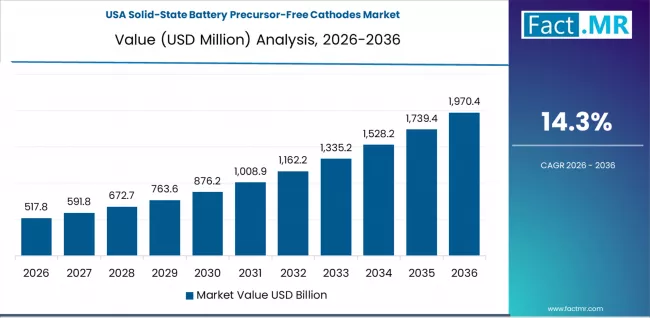
Solid State Battery Precursor Free Cathodes Market Country Value Analysis | Source: Fact.MR
The USA's 14.30% growth is centered on its world-leading ecosystem of venture-backed startups (like QuantumScape, Solid Power), national laboratories, and ambitious automotive OEMs with deep capital.
The U.S. approach emphasizes disruptive, IP-protected technology platforms. Growth is driven by close-knit partnerships where OEMs provide funding and engineering expertise to startups to co-develop tailored precursor-free cathode solutions for specific vehicle platforms, aiming for a technology leapfrog.
How is Germany's Engineering Precision and Materials Science Excellence Shaping Demand?
Germany's 13.20% CAGR reflects its engineering-driven approach, where precision, reproducibility, and quality are paramount. German automotive OEMs and chemical giants are investing in perfecting the powder metallurgy and processing fundamentals of dry cathode fabrication.
The focus is on achieving flawless process control, rigorous quality standards, and developing the sophisticated production equipment that will be needed for high-volume, zero-defect manufacturing.
What Role does Japan's Foundational R&D and Consortium-Based Approach Play?
Japan's 12.70% growth is rooted in its long-term, foundational research in solid-state electrochemistry and its tradition of industry consortiums. Japanese companies excel in fundamental material innovation and thin-film technologies.
Key players like Toyota and Panasonic work within collaborative frameworks to solve shared technical hurdles, such as interfacial stability, with the aim of developing robust, licensable manufacturing platforms for precursor-free cathodes.
Competitive Landscape of the Solid-State Battery Precursor-Free Cathodes Market
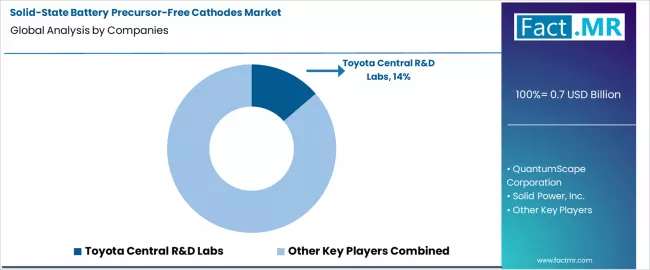
Solid State Battery Precursor Free Cathodes Market Analysis By Company | Source: Fact.MR
The competitive landscape is fragmented, featuring a mix of automotive OEMs with in-house R&D labs, specialized solid-state battery startups, and established cathode material suppliers seeking to adapt. Competition is intensely focused on securing foundational intellectual property related to specific cathode compositions compatible with direct manufacturing processes and the equipment designs for those processes.
Success is currently measured by achieving technical milestones that trigger further investment from automotive partners, rather than near-term sales. The race is to transition from producing impressive lab-scale pouch cells to demonstrating a scalable, reproducible manufacturing process that can be piloted at a megawatt-hour scale.
Recommendations for Key Market Players
Strategic Recommendation
Rationale & Target Player
Focus on Interface Engineering
Prioritize R&D on ensuring pristine, stable interfaces between the directly deposited cathode and the solid electrolyte. This is the single greatest technical hurdle and a key IP differentiator (for Startups & Material Suppliers).
Develop Open, Licensable Platform Technology
For startups, designing a cathode/process package that can be licensed to multiple cell manufacturers may create a larger market than attempting to become a high-volume cell producer alone (for Solid-State Battery Startups).
Secure Strategic Feedstock Partnerships
Form long-term agreements with miners and refiners for ultra-pure nickel, lithium, and cobalt supplies tailored for direct powder processing, ensuring quality and cost control (for Integrated Battery Manufacturers & OEMs).
Invest in Pilot-Scale Equipment Co-Development
Partner directly with equipment manufacturers (e.g., vacuum system, powder handling firms) to co-design the first generation of production-scale tools, de-risking the scale-up path (for All Major Players).
Source: Fact.MR analysis. Updated May 25, 2026
Key Players in the Solid-State Battery Precursor-Free Cathodes Market
Toyota Central R&D Labs
QuantumScape Corporation
Solid Power, Inc.
Samsung SDI
Panasonic Energy
References
Albertus, P., Babinec, S., & Litzelman, S. (2023). Status and challenges in enabling the solid-state battery revolution. Nature Energy.
Janek, J., & Zeier, W. G. (2023). Challenges in speeding up solid-state battery development. Nature Energy.
Lee, Y. G., & Choi, J. W. (2024). Dry electrode technology for scalable and sustainable battery manufacturing. Advanced Materials.
Luntz, A. C., & McCloskey, B. D. (2024). Beyond lithium-ion: The solid-state battery landscape. Chemical Reviews.
Mauger, A., & Julien, C. M. (2023). Critical review on cathode materials for next-generation solid-state lithium batteries. Journal of Power Sources.
U.S. Department of Energy. (2024). Battery500 Consortium: Progress and goals for next-generation batteries. DOE Vehicle Technologies Office.
Yamada, H., & Chung, S. C. (2023). Material design of lithium superionic conductors for solid-state batteries. Accounts of Chemical Research.
EV OEMs, Battery Manufacturers, Consumer Electronics OEMs, Energy Storage System Integrators
Key Countries
China, India, USA, Germany, Japan
Key Companies
Toyota Central R&D Labs, QuantumScape Corporation, Solid Power, Inc., Samsung SDI, Panasonic Energy
Additional Analysis
Detailed analysis of ionic and electronic conductivity within directly deposited cathodes; mechanical stress modeling at the cathode-solid electrolyte interface; lifecycle assessment comparing precursor-free vs. traditional cathode manufacturing; cost breakdown analysis at pilot- versus giga-scale production; analysis of IP landscape and key patent holdings across different process technologies; impact of solid electrolyte choice (sulfide, oxide, polymer) on cathode process and performance.
Source: Fact.MR analysis. Updated May 25, 2026
Market by Segments
Cathode Type :
NMC
LFP
High-Nickel Layered
Others
Process :
Dry Electrode Manufacturing
Thin-Film Deposition
Powder Processing Routes
Others
End User :
EV OEMs
Battery Manufacturers
Consumer Electronics OEMs
Energy Storage System Integrators
Region :
North America
USA
Canada
Latin America
Brazil
Mexico
Argentina
Rest of Latin America
Western Europe
Germany
UK
France
Italy
Spain
BENELUX
Rest of Western Europe
Eastern Europe
Poland
Russia
Czech Republic
Rest of Eastern Europe
East Asia
China
Japan
South Korea
Rest of East Asia
South Asia & Pacific
India
ASEAN
Australia
Rest of South Asia & Pacific
MEA
Saudi Arabia
South Africa
Turkiye
Rest of MEA
Questions Answered
Frequently Asked Questions
How big is the solid-state battery precursor-free cathodes market in 2026?
The global solid-state battery precursor-free cathodes market is estimated to be valued at USD 0.7 billion in 2026.
What will be the size of solid-state battery precursor-free cathodes market in 2036?
The market size for the solid-state battery precursor-free cathodes market is projected to reach USD 3.1 billion by 2036.
How much will be the solid-state battery precursor-free cathodes market growth between 2026 and 2036?
The solid-state battery precursor-free cathodes market is expected to grow at a 15.6% CAGR between 2026 and 2036.
What are the key product types in the solid-state battery precursor-free cathodes market?
The key product types in solid-state battery precursor-free cathodes market are nmc (nickel-manganese-cobalt), lfp (lithium iron phosphate), high-nickel layered and others.
Which process segment to contribute significant share in the solid-state battery precursor-free cathodes market in 2026?
In terms of process, dry electrode manufacturing segment to command 42.0% share in the solid-state battery precursor-free cathodes market in 2026.