- Base Value(2025): 58.6 Mn
- Forecast Value (2035): 371.9 Mn
- CAGR (2035): 21.6%
Graphene VOC Sensor Market Outlook 2025 to 2035
The global graphene VOC sensor market is expected to reach USD 371.9 million by 2035, up from USD 58.6 million in 2025. During the forecast period 2025 to 2035, the industry is projected to expand at a CAGR of 20.3%.
The use of graphene VOC sensors is driven by global responsibility in sustainable manufacturing and safety of workplaces. With the increasing number of emission regulations by the government and the industries focusing on clean technologies, the demand of graphene-enabled solutions is expected to keep growing in the next decade.
Increased attention to the industrial digitization and smart building management systems is enhancing sensor integration. The fact that graphene-based devices can be used with a high level of selectivity and low energy consumption allows them to be optimal in the field of air quality and hazard detection in real-time. Such pressure is especially high in the automotive, semiconductor, and healthcare settings that can only be monitored continuously and reliably.
Quick Stats for Graphene VOC Sensor Market
- Industry Value (2025E): USD 58.6 Million
- Projected Value (2035F): USD 371.9 Million
- Forecast CAGR (2025 to 2035): 20.3%
- Leading Segment (2025): Resistive Sensor (34% Market Share)
- Fastest Growing Country (2025-2035): United States (21.8% CAGR)
- Top Key Players: Graphenea S.A., Haydale Graphene Industries Plc, Grolltex Inc., NanoXplore Inc., Versarien Plc, and Applied Graphene Materials Plc
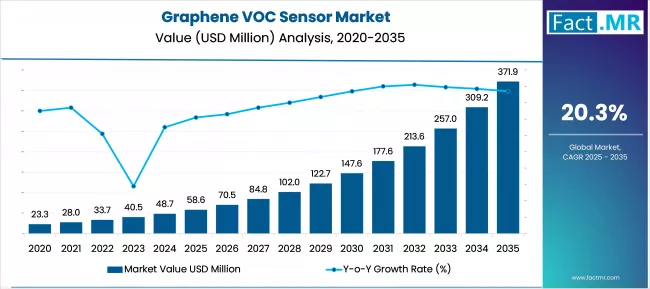
Graphene Voc Sensor Market Market Value Analysis | Source: Fact.MR
The players in the industry are shifting more towards large-scale and automated production lines to cater to the needs of the world. The emerging technologies in the fields of portable devices, environmental compliance technologies, and predictive industrial analytics are generating new opportunities.
Although pricing limits, materials issues and synthetic complexity are all major challenges, steady advances in R&D are resolving them. With the positive government funding and investment by the companies, it is likely that the graphene VOC sensors will be more universal in terms of commercialization and international adoption. The future of the market is positive since sustainability, health, and safety issues are transforming the industrial monitoring horizons across the globe.
What are the drivers of the graphene VOC sensor market?
The most significant adoption is seen in the United States, China, Japan, Germany, and the United Kingdom, as all countries engage in heavy investment of smart manufacturing, clean air, and AI-enabled environmental management platforms. These countries have strong and well-developed R&D infrastructure and high-speed digital infrastructure, which enhances commercialization of high-sensitivity graphene VOC detection devices in industrial, automotive, and smart building applications.
The best conductivity of graphene, surface chemistry controllability, and flexibility make it possible to detect VOC in real-time with ultra-low VOCs, which is crucial in the global effort to limit emissions and protect workers at work. Certain trends toward greater automation of industries and predictive maintenance keep on promoting the implementation of graphene sensors as the main elements of connected environmental monitoring systems.
Major economic regulatory systems are tending towards stricter regulations concerning volatile organic compounds emissions, as well as workplace exposure levels. This is pressuring industries to adopt graphene-based sensors that will comply with air-quality standards, minimize energy consumption and allow constant calibration of systems. In Asia and Europe, research institutes and sensor manufacturers are working together through collaborative programs to enable standardized and eco-friendly sensor technologies, mass-producible sensor technologies.
What are the regional trends of the graphene VOC sensor market?
The region of Asia Pacific is the most promising in terms of developing the market of graphene VOC sensors due to the increasing number of environmental regulations, high rates of industrialization and the widespread use of smart manufacturing systems.
China is a pioneer with massive investment in the production of graphene oxide and national clean air projects, encouraging the use of graphene-based sensors in the mass production of emission, automotive and city-wide smoke breathing systems. There is a boom in certified and eco-friendly grain of graphene VOC sensor integration in Europe, in line with the Green Deal and the high-quality air-quality requirements of the EU.
Germany, France and the United Kingdom are leading the way in integrating smart factories and implementing the powerful graphene sensors in the automotive, pharmaceutical and building management markets. The dedication of the region to emission cut-off and circular production remains a root of technological inventiveness and investment in innovative sensing product.
The United States and Canada are still the leaders in the mainstream of implementing graphene-based environmental monitoring. Graphene VOC sensors are being applied in the fields of energy, manufacturing, and automotive, and their application is being accelerated by federal funding of clean air research, and by investment by the industrial internet of things in IoT systems. As the concerns of safety and compliance with sustainability grow at the workplace, the market growth of North America will be stable until 2035.
What are the challenges and restraining factors of the graphene VOC sensor market?
The multi-complexity of the process of making graphene materials and the making of sensors still remains a major obstacle to commercialization at large scale. The manufacturing of high-quality graphene with homogeneous electrical characteristics needs state of the art infrastructure, accuracy in engineering and expensive cleanroom facilities. These divert away mass production and increase the cost of sensors, where economies of scale are hard to achieve, such as small-scale manufacturing and consumer electronics.
Another major issue is that of standardization. The lack of internationally recommended standards on the purity, conductivity and performance testing of graphene results in inconsistency in the quality of sensors and calibration stability. This absence of coherent regulatory advice slows down the process of certifying products and moves the process of pilot-scale development and commercial deployment of a product. Consequently, long term adoption has been approached with a lot of hesitation by many industrial users, especially in areas that lack in both technical capability and proper testing systems.
Strict compliance and validation processes associated with monitoring devices of VOC are another factor which prolongs commercialization time. In other markets like the United States, Europe, Japan, and South Korea, there are stringent environmental and safety controls that would compel extensive tests on the quality of the emissions, the protection of cybersecurity and certification of material safety. They are costly processes and pose serious challenge to smaller companies to compete with well-established sensor manufacturers due to the high cost involved in these processes and an additional high level of R&D.
Country-Wise Insights
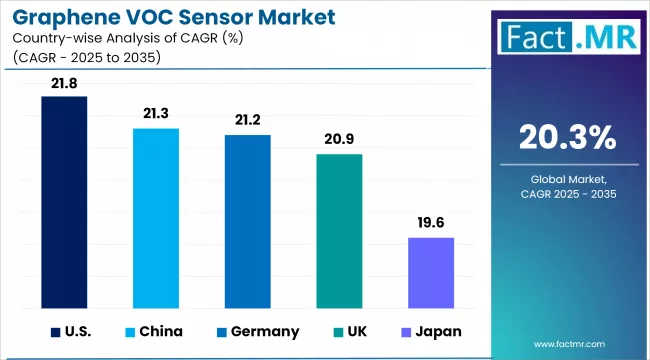
Graphene Voc Sensor Market Cagr Analysis By Country | Source: Fact.MR
Rising Smart Manufacturing Investments and Air-Quality Regulations Propel Graphene VOC Sensor Demand in China
Graphene VOC sensors are becoming a worldwide center of production, which is actively supported by the strong governmental funding and program of industrial modernisation in China. Graphene is fertilized by national programs like the Made in China 2025 campaign that focuses on high material and environmental surveillance. The increased automation of industries and the automotive electronics and the growth of the smart city are increasing the demand of high-precision VOC detection systems to guarantee that the strict air-quality regulations are met.
Chinese manufacturers are currently incorporating the technology based on graphene to substitute the traditional sensing materials with the better sensitivity, scalability, and less consumption of power. An ongoing commitment to clean technologies and digitalisation will assist in penetrating the market with new industrial segments, and China will be the most vital growth hub of graphene-enabled air-quality monitoring systems.
Government-Led Nanotech Innovation and Sustainability Policies Drive Graphene VOC Sensor Growth in Japan
The market of graphene VOC sensors in Japan is predetermined with powerful governmental research policies and severe sustainability requirements. The innovations in the field of advanced nanomaterials and environmental technologies have led Japan to become one of the pioneers in terms of high-resolution air-quality measurements. This trend of smart infrastructure and automotive efficiency of the country allows to stimulate the introduction of graphene-based VOC sensors in the transport sector, electronics, and healthcare fields.
The market of Japan will experience further growth due to the sustained government funding and the introduction of graphene sensors into the platforms based on the IoT. Japan should become even more of an innovation hub in the region as the need to create compact, low-power, and high-sensitivity monitoring devices grows. The emphasis on research quality and clean manufacturing of the country will promote consistent growth and competitiveness in the worldwide market of the graphene VOC sensor technology.
Category-Wise Analysis
High Sensitivity and Scalability Make Resistive Sensors the Prime Growth Catalyst
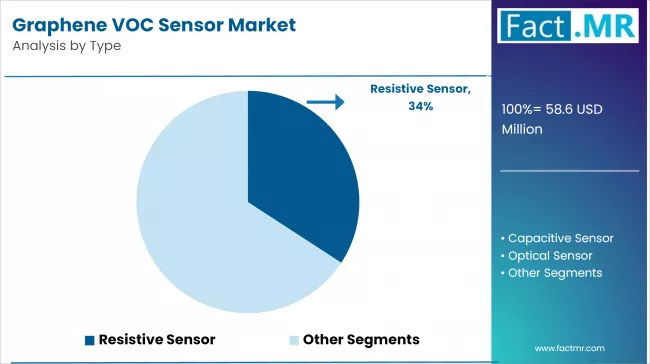
Graphene Voc Sensor Market Analysis By Type | Source: Fact.MR
The sensors of VOCs based on resistive graphene are ruling the market as they have a higher sensitization, are easy to fabricate, and can be used with mass-scale production processes. With the more digital monitoring and emission control systems being implemented in industries, resistive sensors are gaining popularity as scalable environmental sensing.
These sensors have fast response and great temperature stability, which is why they are to be used in tough manufacturing conditions. Manufacturers are also putting emphasis on creating low-power modules that are small and can easily be integrated with internet of things platforms to predictive monitoring. The high level of technological flexibility and cost-effectiveness of this segment will balance its lead in the next decade making it the backbone of the future graphene VOC sensing networks.
Industrial Emission Monitoring Leads Growth Through Regulatory and Technological Synergy
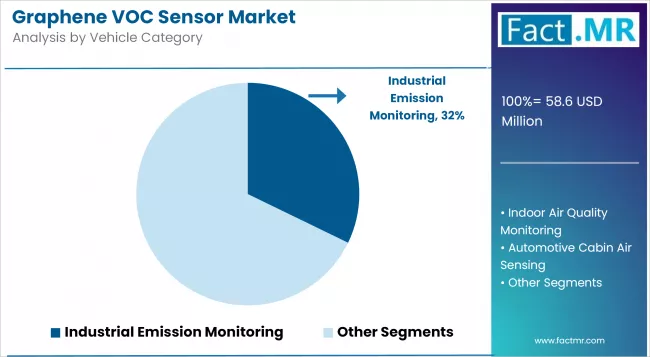
Graphene Voc Sensor Market Analysis By Vehicle Category | Source: Fact.MR
Monitoring of industrial emissions has continued to be the most important area of application due to increasing global air-quality regulations and the digital transformation of the industry. Graphene VOC sensors are being incorporated by manufacturers into factory systems in order to monitor hazardous emissions and also make sure that the factory meets the changing environmental standards. This tendency coincides with the growing attention to sustainability, safety of employees, and transparency of processes in the whole world.
The high surface reactivity and conductivity of graphene allow the real-time detection of VOCs even at the trace level, thus providing the industries with the advantage of maximizing their operations and pollution mitigation. The wireless communication and data analytics tools make it even easier to adapt the technology to the smart manufacturing and process automation setting.
Competitive Analysis
Key players in the graphene VOC sensor market are Graphenea S.A., Haydale Graphene Industries Plc, Grolltex Inc., NanoXplore Inc., Versarien Plc, Applied Graphene Materials Plc, Angstron Materials Inc., Skeleton Technologies, Paragraf Ltd., First Graphene Ltd.., ACS Material LLC, Talga Group Ltd., Nanoinnova Technologies SL, Emberion Ltd., and Global Graphene Group
The market of graphene VOC sensors is becoming increasingly competitive with businesses struggling to provide the fastest, most sensitive and regulation compliant detection systems. Companies are putting their efforts on creating proprietary graphene formulations and sensor designs that can retain accuracy in various environmental set-ups and less energy is used.
The new competitive advantage is the focus on the balance between technological efficiency and the environmental and cost concerns. Graphene oxide and nanocomposites development Graphene oxide and nanocomposites are finding application in companies such as Graphenea, Haydale, and NanoXplore to increase sensitivity and manufacturability, through scalable development. With the increasing regulatory pressure, companies that have certified sensor technologies and end-to-end environmental monitoring solutions will be likely to capture long-term market leadership till 2035.
Recent Development
- The Graphene S.A. announced graphene oxide (GO) pilot plant production capacity in 2025. This growth was to manufacture a larger quantity of graphene oxide batches of better quality, enhance reproducibility and to enable large scale use in the advanced material and sensor manufacturing industries.
- Haydale Graphene Industries Plc has also appointed a new Chief Executive Officer and a strategic refocus program in 2024. The relocation was aimed at very lucrative customer segments and major geographies in order to increase operational effectiveness and overall business profitability.
Fact.MR has provided detailed information about the price points of key manufacturers of Graphene VOC Sensor Market positioned across regions, sales growth, production capacity, and speculative technological expansion, in the recently published report.
Methodology and Industry Tracking Approach
The 2025 graphene VOC sensor market report by Fact.MR is based on insights collected from 1,200 stakeholders across 12 countries, with a minimum of 75 respondents per country. Among the participants, 65% were end users including biopolymer converters, specialty chemical formulators, and FMCG sustainability teams while the remaining 35% included sourcing managers, R&D directors, environmental compliance leads, and bioeconomy consultants.
Data collection was conducted between July 2024 and June 2025, focusing on parameters such as monomer purity, conversion yield, cost per ton, end-use compatibility, feedstock availability, and regulatory alignment. A regionally weighted calibration model ensured balanced representation across North America, Europe, and Asia-Pacific.
The study triangulated over 95 validated sources, including patent databases, sustainability disclosures, process modeling datasets, and annual reports from monomer and biopolymer producers.
Fact.MR applied rigorous analytical tools such as multi-variable regression and scenario modeling to ensure data robustness. With continuous monitoring of the glass adhesives space since 2018, this report offers a comprehensive roadmap for firms seeking competitive advantage, innovation, and sustainable growth within the sector.
Segmentation
Segmentation of Graphene VOC Sensor Market
-
By Type :
- Resistive Sensor
- Capacitive Sensor
- Optical Sensor
- Field Effect Transistor (FET) Sensor
- Electrochemical Sensor
-
By Technology :
- Graphene Oxide-Based
- Reduced Graphene Oxide-Based
- Functionalized Graphene-Based
- Hybrid Nanocomposite-Based
-
By Detection Range :
- Low Concentration (ppb Level)
- Medium Concentration (ppm Level)
- High Concentration (High ppm Level)
-
By Application :
- Industrial Emission Monitoring
- Indoor Air Quality Monitoring
- Automotive Cabin Air Sensing
- Smart Building & Home Automation
- Healthcare Diagnostics
- Environmental Safety
-
By End User :
- Industrial & Manufacturing
- Healthcare & Medical
- Automotive & Transportation
- Environmental Agencies
- Consumer Electronics
- Research Institutions
-
By Region :
- North America
- Latin America
- Western Europe
- Eastern Europe
- East Asia
- South Asia & Pacific
- Middle East & Africa
Frequently Asked Questions
What was the Global Graphene VOC Sensor Market Size Reported by Fact.MR for 2025?
Who are the Major Players Operating in the Graphene VOC Sensor Market?
What is the Estimated Valuation of the Graphene VOC Sensor Market in 2035?
What Value CAGR did the Graphene VOC Sensor Market Exhibit Over the Last Five Years?
Who worked on this report


Preview the report firsthand - request a free sample
Free SampleGet the brochure for pricing and purchase details
Download PDF