Hair Transplant Service Market Size, Share, Growth and Forecast (2026 - 2036)

Hair Transplant Service Market is segmented by Method (FUE, FUT, Others), Gender (Male, Female), Service Provider (Specialized Clinics, Hospitals, Others), and Region, with forecasts covering the period from 2026 to 2036.

According to Fact.MR estimates, the global hair transplant service market market was valued at USD 7.4 billion in 2025. The market is projected to reach USD 7.8 billion in 2026 and is expected to grow to USD 12.7 billion by 2036, expanding at a CAGR of 5.0%. FUE is anticipated to account for 65.0% of the product segment in 2026, while Male is expected to remain the leading application with around 80.0% share.

Hair Transplant Service Market Analysis and Forecast by Fact.MR

The hair transplant service market, valued at USD 7.4 billion in 2025, is projected to expand at a 5.0% CAGR to reach USD 12.657 billion by 2036. Hair transplant services encompass follicular unit extraction (FUE), follicular unit transplantation (FUT), and emerging robotic-assisted techniques performed by dermatologists and plastic surgeons in specialised clinics, hospitals, and medical tourism facilities. Growth reflects rising male grooming consciousness, normalisation of aesthetic procedures across younger demographics, and the emergence of medical tourism corridors offering procedures at 50 to 80% lower cost than Western markets.
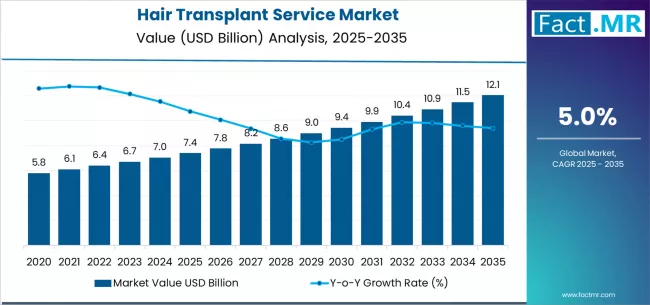
Hair Transplant Service Market Market Value Analysis

Summary of Hair Transplant Service Market

  • Market Snapshot
    • The market is valued at USD 7.4 billion in 2025.
    • Revenue is estimated to reach USD 7.77 billion in 2026 and USD 12.657 billion by 2036.
    • A CAGR of 5.0% is forecast for the 2026 to 2036 assessment period.
    • Incremental opportunity of USD 4.887 billion is projected between 2026 and 2036.
    • FUE procedures hold a 65.0% share of the method segment.
    • India (7.0% CAGR) and China (6.2% CAGR) are the fastest-expanding country markets.
  • Demand and Growth Drivers
    • Growing male grooming awareness and the destigmatisation of cosmetic surgery among men aged 25 to 45 are increasing first-consultation rates at hair restoration clinics globally.
    • Medical tourism growth in Turkey, India, and Mexico is creating price-competitive treatment corridors that attract patients from high-cost markets in Europe and North America.
    • Advancement of robotic-assisted FUE systems is improving graft survival rates and reducing procedure times, making transplants more accessible in high-throughput clinic settings.
    • Social media before-and-after content from public figures and influencers is normalising hair transplant procedures and reducing the stigma barrier for new patients.
  • Product and Segment View
    • FUE procedures command 65.0% of the method segment, reflecting patient preference for scarless extraction and faster recovery times.
    • Male patients account for 80.0% of total demand, driven by androgenetic alopecia affecting approximately 50% of men by age 50.
    • Specialised clinics represent 60.0% of service provider demand, operating as the primary delivery setting for elective hair restoration.
    • Key segmentation includes:
      • Method: FUE, FUT, Others
      • Gender: Male, Female
      • Service Provider: Specialized Clinics, Hospitals, Others
      • End Use: Specialized Clinics, Hospitals, Medical Tourism Facilities
  • Geography and Competitive Outlook
    • North America accounts for the largest regional share, with the USA generating USD 2.886 billion in 2025 revenue.
    • East Asia contributes growing demand, with Japan (USD 0.4 billion) and South Korea (USD 0.198 billion) in 2025.
    • Bosley leads the competitive field with an estimated 12.0% revenue share.
    • Bernstein Medical, Eugenix, and DHI Global are principal challengers across global markets.
  • Analyst Opinion
    • The hair transplant service market is structurally shifting from a surgeon-dependent craft toward a technology-enabled, scalable service model. Robotic-assisted FUE systems are reducing procedure variability and enabling clinics to increase daily procedure volumes without proportional increases in surgical staff. Medical tourism is compressing pricing in developed markets as patients benchmark costs against international alternatives. Clinic chains that invest in standardised training, branded patient experiences, and multi-location operations will gain structural advantages over solo practitioner models through 2036.

Key Growth Drivers, Constraints, and Opportunities
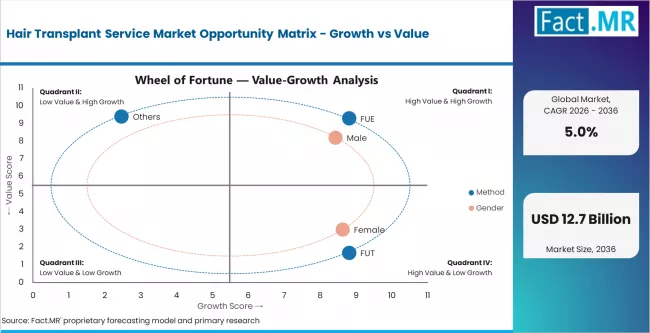
Hair Transplant Service Market Opportunity Matrix Growth Vs Value

Key Factors Driving Growth

  • Androgenetic alopecia prevalence, affecting approximately 50% of men and 25% of women by age 50 according to dermatological epidemiology literature, creates a large and growing addressable patient population as global populations age and life expectancy increases.
  • Medical tourism infrastructure development in Turkey (performing over 500,000 procedures annually per Turkish Health Tourism Council data), India, and Mexico is making transplant services accessible to price-sensitive patients from higher-cost markets.
  • Robotic-assisted FUE platforms, including the ARTAS system, are reducing operator dependency and improving graft harvesting precision, enabling clinics to achieve 95%+ graft survival rates and scale daily procedure volumes.

Key Market Constraints

  • High out-of-pocket procedure costs, ranging from USD 4,000 to USD 15,000 in developed markets, limit addressable demand to higher-income demographics and exclude patients without financing options.
  • Unregulated clinic proliferation in medical tourism hubs, particularly in Turkey, has led to quality concerns and adverse outcomes that generate negative media coverage and reduce patient confidence in cross-border procedures.
  • Limited insurance coverage for elective cosmetic procedures in most markets means transplant services compete with other discretionary consumer spending categories for patient wallet share.

Key Opportunity Areas

  • Female hair restoration is an underpenetrated segment at 20.0% of current demand, with growing awareness of female pattern hair loss and traction alopecia creating an expanding patient pipeline as clinical protocols improve for female-specific hair loss patterns.
  • Integration of PRP therapy, low-level laser therapy, and topical biologics as adjunct treatments to transplant procedures is increasing per-patient revenue and improving clinical outcomes, creating premium service tiers.
  • Standardised clinic franchise models, as deployed by DHI Global and Hair Club, are enabling rapid geographic expansion into tier-2 cities in Asia Pacific and Latin America where demand exists but specialist supply is limited.

Segment-wise Analysis of the Hair Transplant Service Market

  • FUE procedures hold 65.0% of the method segment, reflecting strong patient preference for minimally invasive extraction.
  • Male patients account for 80.0% of total demand, with female patients comprising the remaining 20.0%.
  • Specialised clinics represent 60.0% of service provider revenue, with hospitals and medical tourism facilities comprising the balance.

Which method dominates the Hair Transplant Service Market?
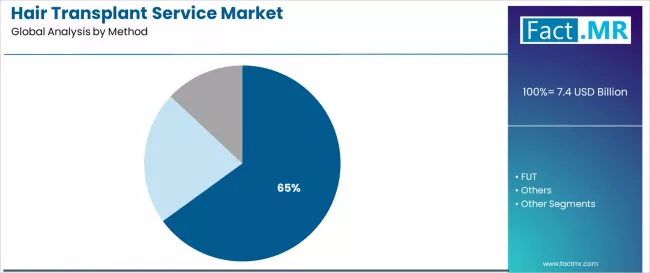
Hair Transplant Service Market Analysis By Method

FUE procedures control 65.0% of the method segment. Patient preference for FUE reflects the technique's advantages: no linear scar, faster recovery (5 to 7 days versus 10 to 14 for FUT), and suitability for shorter hairstyles that would expose FUT strip scars. FUE's adaptability to robotic assistance further strengthens its position, as automated graft harvesting reduces procedure duration and operator fatigue while improving consistency.

FUT retains relevance for patients requiring large graft counts (3,000+ grafts) in a single session, as strip harvesting can yield higher graft volumes per session. Cost considerations also favour FUT in some markets, as the technique is typically priced 20 to 30% below FUE. Other techniques, including DHI and body-to-scalp transplantation, serve niche patient needs.

Which gender segment drives the Hair Transplant Service Market?
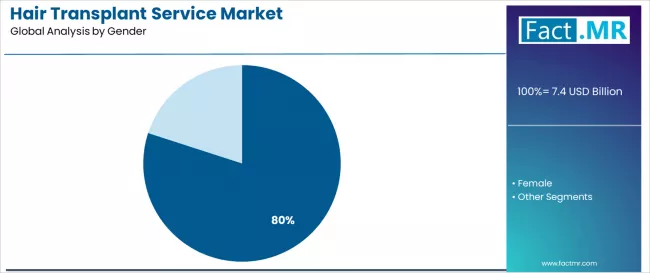
Hair Transplant Service Market Analysis By Gender

Male patients generate 80.0% of market revenue. Androgenetic alopecia, the primary indication for hair transplantation, has a well-established male prevalence pattern with onset typically beginning in the mid-20s and progressing with age. The normalisation of male cosmetic procedures in the last decade, driven by social media, celebrity endorsements, and workplace appearance standards, has expanded the male patient funnel significantly.

Female patients at 20.0% represent the fastest-growing gender segment on a percentage basis. Female pattern hair loss, post-partum shedding, and traction alopecia from styling practices are driving consultations. Clinic operators report that female patients tend to pursue higher-value treatment packages that combine transplantation with PRP therapy and topical maintenance programmes.

Which service provider captures the largest share in the Hair Transplant Service Market?
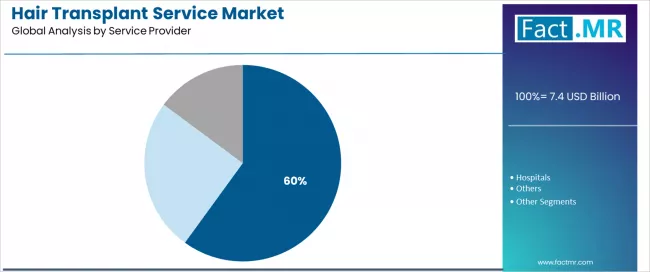
Hair Transplant Service Market Analysis By Service Provider

Specialised clinics account for 60.0% of service provider demand. These facilities are purpose-built for hair restoration, with operating rooms configured for multi-hour FUE sessions, on-site consultation suites, and post-operative recovery areas. Specialised clinics benefit from concentrated expertise, high procedure volumes, and the ability to build patient referral networks through branded experiences and published results.

Hospitals hold a secondary position, typically serving patients with complex medical histories or those seeking transplantation in conjunction with reconstructive procedures. Medical tourism facilities represent a growing channel, particularly in Turkey and India, where integrated service packages covering travel, accommodation, and procedure fees attract international patients.

Which Product Trend is Shaping the Next Phase of Growth in the Hair Transplant Service Market?

The most commercially significant trend in the hair transplant service market is the deployment of robotic-assisted FUE systems. The ARTAS robotic platform, now in its latest generation, uses AI-powered image guidance to identify optimal donor follicles, calculate extraction angles, and execute precise punches with sub-millimetre accuracy. Clinics operating robotic systems report 15 to 20% improvements in graft survival rates compared to manual FUE, along with 30 to 40% reductions in procedure time for large-session transplants. The capital cost of robotic systems (USD 250,000 to USD 400,000) creates a scale advantage for larger clinic chains that can amortise equipment across higher procedure volumes.

A second defining trend is the professionalisation and branding of hair transplant services through franchise and clinic chain models. DHI Global operates over 75 clinics across 45 countries using a standardised DHI implantation technique and branded patient journey. Hair Club and Bosley have built consumer-facing brands with national advertising campaigns in North America. This brand-building approach is shifting competitive dynamics from individual surgeon reputation toward institutional trust, enabling geographic expansion into markets where specialist surgeon supply is limited. The franchise model also enables standardised pricing, quality control, and training protocols that address the quality inconsistency problems plaguing fragmented markets.

Regional Outlook Across Key Markets

Top Country Growth Comparison Hair Transplant Service Market Cagr (2026 2036)

  • North America holds the largest regional revenue share, anchored by the USD 2.886 billion USA market in 2025.
  • East Asia contributes growing demand, with Japan at USD 0.4 billion and South Korea at USD 0.198 billion in 2025.
  • South Asia and Pacific is the fastest-growing region, led by India's 7.0% CAGR.
  • Latin America is an emerging growth corridor, with Mexico recording a 4.8% CAGR.

CAGR Table

Country CAGR (%)
India 7.0%
China 6.2%
Mexico 4.8%
Germany 4.5%
USA 4.0%
South Korea 4.0%
Japan 3.2%

Source: Fact.MR analysis, based on proprietary forecasting model and primary research.
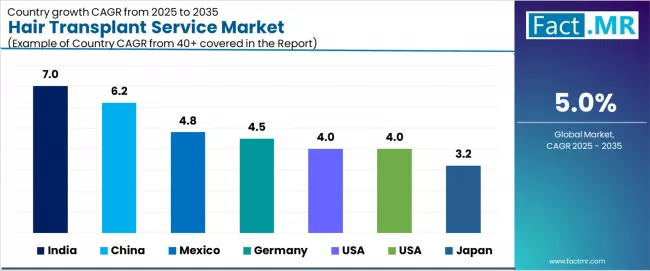
Hair Transplant Service Market Cagr Analysis By Country

India: medical tourism hub status and domestic demand expansion drive leadership

India leads global growth at a 7.0% CAGR, supported by a dual-engine demand structure. Domestically, urban professionals in metropolitan areas are driving first-time consultations, with hair transplant clinics in Delhi, Mumbai, and Bangalore reporting 25 to 30% annual patient volume growth. Internationally, India attracts medical tourism patients from the Middle East, Africa, and Southeast Asia, offering FUE procedures at USD 1,500 to USD 3,000 compared to USD 8,000 to USD 15,000 in the USA.

  • India performed an estimated 150,000 hair transplant procedures in 2024, per Indian Association of Dermatologists, Venereologists and Leprologists data.

China: male grooming culture shift and clinic network expansion fuel rapid growth

China records a 6.2% CAGR, driven by a generational shift in male grooming attitudes among the post-1990s urban demographic. Hair transplant clinic chains such as Yonghe and Simson have scaled rapidly, operating over 50 locations across major Chinese cities. Social media platforms Douyin and Xiaohongshu have normalised hair transplant discussions, generating significant patient inquiry volumes.

  • China's hair transplant procedure volume exceeded 500,000 annually by 2024, with FUE accounting for over 80% of procedures performed, per Chinese Medical Association estimates.

USA: premium pricing and mature infrastructure sustain the largest absolute market
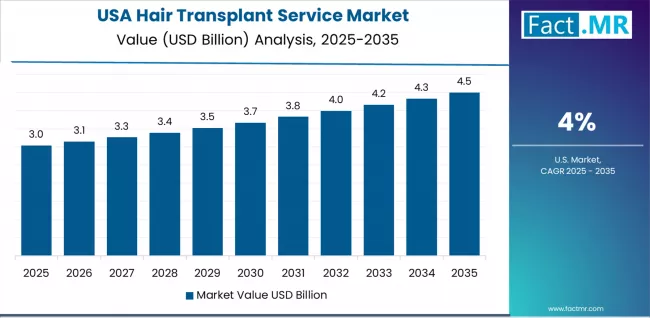
Hair Transplant Service Market Country Value Analysis

The USA generates USD 2.886 billion in 2025, the largest single-country market, growing at a 4.0% CAGR. Demand is concentrated in the 30 to 55 male demographic, with average procedure prices of USD 8,000 to USD 15,000 for FUE. Growth is more moderate than emerging markets due to market maturity, though patient financing programmes (CareCredit, Prosper Healthcare Lending) continue to expand the addressable demographic by spreading procedure costs over 12 to 60 month terms.

  • The ISHRS reports that the USA accounts for approximately 18% of global hair transplant procedure volume, with over 120,000 procedures performed annually.

Germany: specialist dermatology networks and quality-conscious patients support steady growth

Germany grows at a 4.5% CAGR, reflecting demand from quality-conscious patients who prefer domestic procedures over medical tourism alternatives. German hair transplant clinics compete on clinical outcomes, surgeon credentials, and facility accreditation rather than price. The concentration of specialist dermatology practices in cities such as Berlin, Munich, and Hamburg creates a well-established referral network.

  • Germany's Federal Statistical Office recorded over 15,000 elective hair restoration procedures in 2024, with FUE representing approximately 75% of methods used.

South Korea: cosmetic surgery culture and technology adoption create a concentrated market
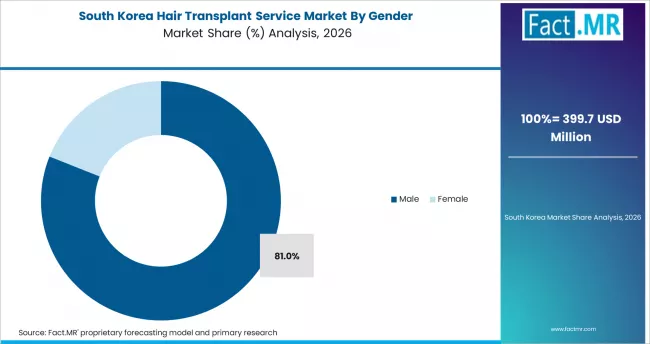
Hair Transplant Service Market South Korea Market Share Analysis By Gender

South Korea generates USD 0.198 billion in 2025, growing at 4.0% CAGR. The country's established cosmetic surgery culture, centred in Seoul's Gangnam district, provides a receptive market for hair transplant services. South Korean clinics are early adopters of robotic-assisted systems and offer combination packages that pair hair transplantation with other aesthetic procedures.

  • South Korea's hair transplant clinics report that 35% of patients are international visitors, primarily from Japan and Southeast Asia, per Korean Association of Hair Restoration Surgeons data.

Japan: ageing population and conservative adoption create a measured growth trajectory
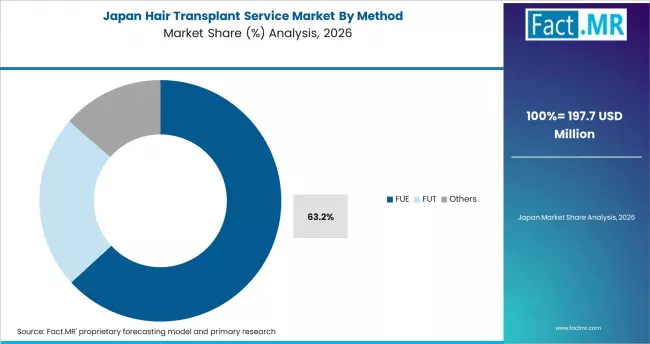
Hair Transplant Service Market Japan Market Share Analysis By Method

Japan contributes USD 0.4 billion in 2025, growing at 3.2% CAGR, the slowest among profiled countries. Cultural reservations about cosmetic surgery, combined with a preference for non-surgical hair loss management (topical treatments, wigs), moderate procedure uptake. Growth is driven by younger urban males in Tokyo and Osaka who are more receptive to surgical intervention.

  • Japan's hair transplant market remains concentrated among approximately 50 specialised clinics, with the top five operators accounting for over 60% of domestic procedure volume per Japan Society of Clinical Hair Restoration data.

Competitive Benchmarking and Company Positioning
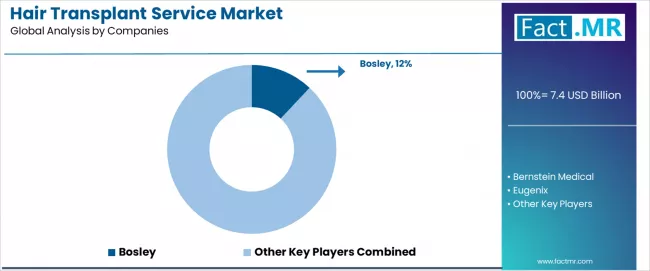
Hair Transplant Service Market Analysis By Company

Hair Transplant Service Market Analysis By Company

  • Bosley holds approximately 12.0% of global revenue, maintaining its position through branded consumer marketing, multi-location operations across North America, and integrated patient journey management.
  • Bernstein Medical, Eugenix, and DHI Global collectively hold significant shares, competing on surgical technique specialisation, geographic reach, and branded franchise models.
  • Regional specialists including Vinci Hair, NeoGraft, and Istanbul Hair serve specific geographic markets or technique niches within the fragmented competitive field.

The competitive structure is highly fragmented, with no single provider exceeding 12% global share. Bosley's relative leadership reflects its early investment in consumer brand building and multi-city clinic infrastructure in the USA. The company operates over 80 offices nationally, offering consultations, procedures, and post-operative maintenance products as an integrated service bundle.

DHI Global differentiates through its proprietary DHI implantation technique and franchise-based expansion model, operating clinics across 45 countries. Eugenix, based in India, competes on surgical innovation, having developed the Direct Hair Transplant technique that enables mega-sessions of 5,000+ grafts. The fragmented market structure creates opportunities for consolidation, as smaller single-surgeon practices face competitive pressure from branded chains with larger marketing budgets and standardised quality protocols.

Medical tourism operators in Turkey (Istanbul Hair and similar entities) compete on price, offering all-inclusive packages at USD 2,000 to USD 4,000 that include procedure, hotel, and airport transfers. This price-led competition has commoditised the lower end of the market while pushing premium players to differentiate on outcomes, technology, and patient experience.

Key Companies in the Hair Transplant Service Market

The hair transplant service competitive field includes Bosley, Bernstein Medical, Eugenix, DHI Global, Harley Street Clinic, Vinci Hair, NeoGraft, Aderans, Moser Medical, MediTresse, Hair Club, HLC Hairline Clinic, Dermamagnetica, Istanbul Hair, and Alvi Armani.

Recent Industry Developments

  • DHI Global: Southeast Asia franchise expansion (2025)
    • DHI Global opened new franchise clinics in Vietnam and Indonesia, extending its branded hair transplant service network to 45 countries with a standardised DHI implantation protocol and centralised training programme.
  • Bosley: robotic FUE programme rollout (2025)
    • Bosley expanded its ARTAS robotic-assisted FUE programme to 25 additional locations across the USA, increasing the share of robotic procedures from 15% to over 30% of total FUE volume performed across its clinic network.
  • Eugenix: mega-session technique clinical publication (2025)
    • Eugenix published peer-reviewed clinical outcomes data for its Direct Hair Transplant mega-session technique, reporting 97% graft survival rates in sessions exceeding 5,000 grafts, setting a new clinical benchmark for high-volume procedures.
  • Hair Club: female hair restoration programme launch (2026)
    • Hair Club introduced a dedicated female hair restoration programme combining FUE transplantation with PRP therapy and topical biologic maintenance, targeting the underserved female patient segment with gender-specific clinical protocols.

Leading Companies Shaping the Hair Transplant Service Market

  • Global Players

    • Bosley
    • DHI Global
    • Hair Club
    • Aderans
    • NeoGraft
    • Bernstein Medical
  • Regional Players

    • Eugenix
    • Harley Street Clinic
    • Vinci Hair
    • Istanbul Hair
    • Moser Medical
  • Emerging / Start-up Players

    • MediTresse
    • HLC Hairline Clinic
    • Alvi Armani
    • Dermamagnetica

Sources and Research References

  • International Society of Hair Restoration Surgery (ISHRS) Practice Census (2024, 2025)
  • Turkish Health Tourism Council annual statistics on hair transplant procedure volumes
  • Indian Association of Dermatologists, Venereologists and Leprologists procedure data
  • U.S. Bureau of Labor Statistics data on personal care services and medical tourism
  • Korean Association of Hair Restoration Surgeons patient volume registry
  • Japan Society of Clinical Hair Restoration annual practice survey
  • Chinese Medical Association cosmetic surgery procedure estimates (2024)

All numerical data in this report is derived from Fact.MR proprietary forecasting models, validated through primary research interviews and cross-referenced with the public-domain sources listed above. No data from syndicated market research publishers has been used.

Key Questions This Report Addresses

  • What is the projected size of the hair transplant service market by 2036?
  • Which transplant method holds the largest share of the hair transplant service market?
  • What CAGR is forecast for the hair transplant service market between 2026 and 2036?
  • Which gender segment generates the most revenue in the hair transplant service market?
  • Which country is expected to grow fastest in the hair transplant service market?
  • Who is the leading company in the global hair transplant service market?
  • What is the incremental opportunity in the hair transplant service market between 2026 and 2036?
  • How is medical tourism affecting hair transplant service pricing globally?
  • What share of procedures uses the FUE method?

Hair Transplant Service Market Definition

The hair transplant service market covers the provision of surgical hair restoration procedures, including follicular unit extraction (FUE), follicular unit transplantation (FUT), and other techniques such as direct hair implantation (DHI) and robotic-assisted transplantation. Services are delivered by licensed dermatologists, plastic surgeons, and trained technicians in specialised clinics, hospital outpatient departments, and medical tourism facilities. The market scope includes procedure fees, pre-operative consultations, and post-operative follow-up care.

Hair Transplant Service Market Inclusions

  • All commercially offered hair transplant procedures using FUE, FUT, DHI, and robotic-assisted extraction methods.
  • Revenue from procedure fees charged by specialised clinics, hospitals, and medical tourism facilities globally.
  • Services for both male and female patients addressing androgenetic alopecia, traction alopecia, scarring alopecia, and eyebrow/beard restoration.
  • Ancillary services bundled with transplant procedures, including pre-operative assessment, PRP therapy, and post-operative care packages.

Hair Transplant Service Market Exclusions

  • Non-surgical hair restoration products including minoxidil, finasteride, and topical hair growth treatments sold independently of transplant services.
  • Hair replacement systems, wigs, and non-surgical hairpieces not involving follicular transplantation.
  • Standalone platelet-rich plasma (PRP) therapy offered as a cosmetic treatment without concurrent transplant procedures.
  • Research-stage hair cloning and stem cell-based hair regeneration therapies not yet commercially available.

Hair Transplant Service Market Research Methodology

  • Primary research with hair transplant surgeons, clinic operators, and medical tourism facilitators across 10 countries.
  • Revenue modelling based on average procedure pricing, annual procedure volumes, and clinic capacity utilisation data from industry surveys.
  • Pricing analysis using published clinic fee schedules, medical tourism comparison platforms, and patient review aggregator data.
  • Competitive share estimation through clinic network expansion tracking, franchise disclosure documents, and company-reported procedure volumes.
  • Demand validation through International Society of Hair Restoration Surgery (ISHRS) census data and dermatology association patient volume registries.
  • Forecast calibration against medical tourism growth trends, robotic system installation rates, and demographic hair loss prevalence data.

Scope of Analysis

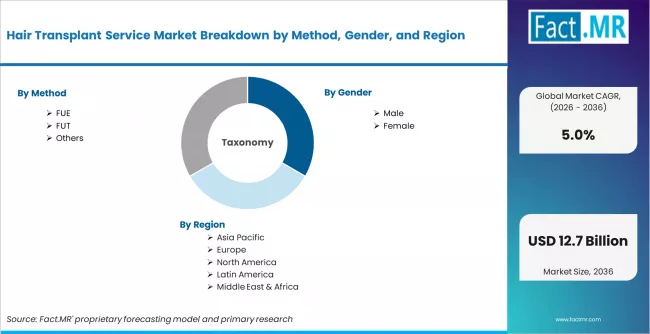
Hair Transplant Service Market Breakdown By Method, Gender, And Region

Parameter Details
Report Coverage Global market analysis with country-level forecasts for 7 countries and 40+ additional markets
Base Year 2025
Forecast Period 2026 to 2036
Market Size (2025) USD 7.4 Billion
Units USD Billion
Segments Covered Method (FUE, FUT, Others), Gender (Male, Female), Service Provider (Specialized Clinics, Hospitals, Others), End Use (Specialized Clinics, Hospitals, Medical Tourism Facilities)
Regions Covered North America, Latin America, Europe, East Asia, South Asia and Pacific, Middle East and Africa
Countries Profiled India, China, Mexico, Germany, USA, South Korea, Japan
Companies Profiled Bosley, Bernstein Medical, Eugenix, DHI Global, Harley Street Clinic, Vinci Hair, NeoGraft, Aderans, Moser Medical, MediTresse, Hair Club, HLC Hairline Clinic, Dermamagnetica, Istanbul Hair, Alvi Armani
Forecast Methodology Bottom-up revenue modelling validated through primary research, company filings, and ISHRS census data

Market Segmentation Analysis

  • Hair Transplant Service Market Market Segmented by Method:

    • FUE
      • Follicular Unit Extraction Standard
      • Follicular Unit Extraction Sapphire Blade
      • Follicular Unit Extraction Robotic Assisted
    • FUT
      • Strips Harvesting Technique
      • Linear Closure Method
      • Modified Strip Technique
    • Others
      • Body Hair Transplant
      • Beard Transplant
      • Eyebrow Transplant
  • Hair Transplant Service Market Market Segmented by Gender:

    • Male
      • Hairline Restoration
      • Crown Baldness Treatment
      • Full Scalp Coverage
    • Female
      • Hairline Correction
      • Diffuse Thinning Treatment
      • Eyebrow Restoration
  • Hair Transplant Service Market Market Segmented by Service Provider:

    • Specialized Clinics
      • Dermatology Clinics
      • Trichology Centers
      • Medical Aesthetic Clinics
    • Hospitals
      • Multi Specialty Hospitals
      • Tertiary Care Hospitals
      • Plastic Surgery Departments
    • Others
      • Wellness Centers
      • Medical Tourism Providers
      • Independent Surgeons Clinics
  • Hair Transplant Service Market Market Segmented by End Use:

    • Specialized Clinics
      • Hair Transplant Clinics
      • Standalone Clinics
      • Chain Clinics
    • Hospitals
      • Multi Specialty Hospitals
      • Cosmetic Surgery Departments
      • Dermatology Departments
    • Medical Tourism Facilities
      • International Patient Centers
      • Luxury Healthcare Facilities
      • Recovery Centers
  • Hair Transplant Service Market Market by Region:

    • North America
      • USA
      • Canada
      • Mexico
    • Latin America
      • Brazil
      • Chile
      • Rest of Latin America
    • Western Europe
      • Germany
      • UK
      • Italy
      • Spain
      • France
      • Nordic
      • BENELUX
      • Rest of Western Europe
    • Eastern Europe
      • Russia
      • Poland
      • Hungary
      • Balkan & Baltic
      • Rest of Eastern Europe
    • East Asia
      • China
      • Japan
      • South Korea
    • South Asia and Pacific
      • India
      • ASEAN
      • Australia & New Zealand
      • Rest of South Asia and Pacific
    • Middle East & Africa
      • Kingdom of Saudi Arabia
      • Other GCC Countries
      • Turkiye
      • South Africa
      • Other African Union
      • Rest of Middle East & Africa

- Frequently Asked Questions -

What is the current size of the hair transplant service market?

The hair transplant service market is valued at USD 7.4 billion in 2025.

What CAGR is expected for the hair transplant service market?

The market is forecast to grow at a 5.0% CAGR from 2026 to 2036.

Which method leads the hair transplant service market?

FUE procedures hold a 65.0% share of the method segment.

Which gender segment is largest in the hair transplant service market?

Male patients account for 80.0% of total market demand.

Which country will grow fastest in the hair transplant service market?

India is projected to grow at a 7.0% CAGR through 2036.

Who is the leading company in the hair transplant service market?

Bosley holds an estimated 12.0% global revenue share.

What is the forecast value of the hair transplant service market by 2036?

The market is projected to reach USD 12.657 billion by 2036.

Table of Content

  1. Executive Summary
    • Global Market Outlook
    • Demand to side Trends
    • Supply to side Trends
    • Technology Roadmap Analysis
    • Analysis and Recommendations
  2. Market Overview
    • Market Coverage / Taxonomy
    • Market Definition / Scope / Limitations
  3. Research Methodology
    • Chapter Orientation
    • Analytical Lens and Working Hypotheses
      • Market Structure, Signals, and Trend Drivers
      • Benchmarking and Cross-market Comparability
      • Market Sizing, Forecasting, and Opportunity Mapping
    • Research Design and Evidence Framework
      • Desk Research Programme (Secondary Evidence)
        • Company Annual and Sustainability Reports
        • Peer-reviewed Journals and Academic Literature
        • Corporate Websites, Product Literature, and Technical Notes
        • Earnings Decks and Investor Briefings
        • Statutory Filings and Regulatory Disclosures
        • Technical White Papers and Standards Notes
        • Trade Journals, Industry Magazines, and Analyst Briefs
        • Conference Proceedings, Webinars, and Seminar Materials
        • Government Statistics Portals and Public Data Releases
        • Press Releases and Reputable Media Coverage
        • Specialist Newsletters and Curated Briefings
        • Sector Databases and Reference Repositories
        • Fact.MR Internal Proprietary Databases and Historical Market Datasets
        • Subscription Datasets and Paid Sources
        • Social Channels, Communities, and Digital Listening Inputs
        • Additional Desk Sources
      • Expert Input and Fieldwork (Primary Evidence)
        • Primary Modes
          • Qualitative Interviews and Expert Elicitation
          • Quantitative Surveys and Structured Data Capture
          • Blended Approach
        • Why Primary Evidence is Used
        • Field Techniques
          • Interviews
          • Surveys
          • Focus Groups
          • Observational and In-context Research
          • Social and Community Interactions
        • Stakeholder Universe Engaged
          • C-suite Leaders
          • Board Members
          • Presidents and Vice Presidents
          • R&D and Innovation Heads
          • Technical Specialists
          • Domain Subject-matter Experts
          • Scientists
          • Physicians and Other Healthcare Professionals
        • Governance, Ethics, and Data Stewardship
          • Research Ethics
          • Data Integrity and Handling
      • Tooling, Models, and Reference Databases
    • Data Engineering and Model Build
      • Data Acquisition and Ingestion
      • Cleaning, Normalisation, and Verification
      • Synthesis, Triangulation, and Analysis
    • Quality Assurance and Audit Trail
  4. Market Background
    • Market Dynamics
      • Drivers
      • Restraints
      • Opportunity
      • Value Chain Analysis
      • PESTLE and Porter’s Analysis
      • Regulatory Landscape
      • Regional Parent Market Outlook
      • Production and Consumption Statistics
      • Import and Export Statistics
    • Global Market Analysis 2021 to 2025 and Forecast, 2026 to 2036
      • Historical Market Size Value (USD Million) Analysis, 2021 to 2025
      • Current and Future Market Size Value (USD Million) Projections, 2026 to 2036
        • Y to o to Y Growth Trend Analysis
        • Absolute $ Opportunity Analysis
    • Global Market Pricing Analysis 2021 to 2025 and Forecast 2026 to 2036
    • Global Market Analysis 2021 to 2025 and Forecast 2026 to 2036, By Method
      • Introduction / Key Findings
      • Historical Market Size Value (USD Million) Analysis By Method , 2021 to 2025
      • Current and Future Market Size Value (USD Million) Analysis and Forecast By Method , 2026 to 2036
        • FUE
          • Follicular Value (USD Million) Extraction Standard
          • Follicular Value (USD Million) Extraction Sapphire Blade
          • Follicular Value (USD Million) Extraction Robotic Assisted
        • FUT
          • Strips Harvesting Technique
          • Linear Closure Method
          • Modified Strip Technique
        • Others
          • Body Hair Transplant
          • Beard Transplant
          • Eyebrow Transplant
      • Y to o to Y Growth Trend Analysis By Method , 2021 to 2025
      • Absolute $ Opportunity Analysis By Method , 2026 to 2036
    • Global Market Analysis 2021 to 2025 and Forecast 2026 to 2036, By Gender
      • Introduction / Key Findings
      • Historical Market Size Value (USD Million) Analysis By Gender, 2021 to 2025
      • Current and Future Market Size Value (USD Million) Analysis and Forecast By Gender, 2026 to 2036
        • Male
          • Hairline Restoration
          • Crown Baldness Treatment
          • Full Scalp Coverage
        • Female
          • Hairline Correction
          • Diffuse Thinning Treatment
          • Eyebrow Restoration
      • Y to o to Y Growth Trend Analysis By Gender, 2021 to 2025
      • Absolute $ Opportunity Analysis By Gender, 2026 to 2036
    • Global Market Analysis 2021 to 2025 and Forecast 2026 to 2036, By Service Provider
      • Introduction / Key Findings
      • Historical Market Size Value (USD Million) Analysis By Service Provider, 2021 to 2025
      • Current and Future Market Size Value (USD Million) Analysis and Forecast By Service Provider, 2026 to 2036
        • Specialized Clinics
          • Dermatology Clinics
          • Trichology Centers
          • Medical Aesthetic Clinics
        • Hospitals
          • Multi Specialty Hospitals
          • Tertiary Care Hospitals
          • Plastic Surgery Departments
        • Others
          • Wellness Centers
          • Medical Tourism Providers
          • Independent Surgeons Clinics
      • Y to o to Y Growth Trend Analysis By Service Provider, 2021 to 2025
      • Absolute $ Opportunity Analysis By Service Provider, 2026 to 2036
    • Global Market Analysis 2021 to 2025 and Forecast 2026 to 2036, By End Use
      • Introduction / Key Findings
      • Historical Market Size Value (USD Million) Analysis By End Use, 2021 to 2025
      • Current and Future Market Size Value (USD Million) Analysis and Forecast By End Use, 2026 to 2036
        • Specialized Clinics
          • Hair Transplant Clinics
          • Standalone Clinics
          • Chain Clinics
        • Hospitals
          • Multi Specialty Hospitals
          • Cosmetic Surgery Departments
          • Dermatology Departments
        • Medical Tourism Facilities
          • International Patient Centers
          • Luxury Healthcare Facilities
          • Recovery Centers
      • Y to o to Y Growth Trend Analysis By End Use, 2021 to 2025
      • Absolute $ Opportunity Analysis By End Use, 2026 to 2036
    • Global Market Analysis 2021 to 2025 and Forecast 2026 to 2036, By Region
      • Introduction
      • Historical Market Size Value (USD Million) Analysis By Region, 2021 to 2025
      • Current Market Size Value (USD Million) Analysis and Forecast By Region, 2026 to 2036
        • North America
        • Latin America
        • Western Europe
        • Eastern Europe
        • East Asia
        • South Asia and Pacific
        • Middle East & Africa
      • Market Attractiveness Analysis By Region
    • North America Market Analysis 2021 to 2025 and Forecast 2026 to 2036, By Country
      • Historical Market Size Value (USD Million) Trend Analysis By Market Taxonomy, 2021 to 2025
      • Market Size Value (USD Million) Forecast By Market Taxonomy, 2026 to 2036
        • By Country
          • USA
          • Canada
          • Mexico
        • By Method
        • By Gender
        • By Service Provider
        • By End Use
      • Market Attractiveness Analysis
        • By Country
        • By Method
        • By Gender
        • By Service Provider
        • By End Use
      • Key Takeaways
    • Latin America Market Analysis 2021 to 2025 and Forecast 2026 to 2036, By Country
      • Historical Market Size Value (USD Million) Trend Analysis By Market Taxonomy, 2021 to 2025
      • Market Size Value (USD Million) Forecast By Market Taxonomy, 2026 to 2036
        • By Country
          • Brazil
          • Chile
          • Rest of Latin America
        • By Method
        • By Gender
        • By Service Provider
        • By End Use
      • Market Attractiveness Analysis
        • By Country
        • By Method
        • By Gender
        • By Service Provider
        • By End Use
      • Key Takeaways
    • Western Europe Market Analysis 2021 to 2025 and Forecast 2026 to 2036, By Country
      • Historical Market Size Value (USD Million) Trend Analysis By Market Taxonomy, 2021 to 2025
      • Market Size Value (USD Million) Forecast By Market Taxonomy, 2026 to 2036
        • By Country
          • Germany
          • UK
          • Italy
          • Spain
          • France
          • Nordic
          • BENELUX
          • Rest of Western Europe
        • By Method
        • By Gender
        • By Service Provider
        • By End Use
      • Market Attractiveness Analysis
        • By Country
        • By Method
        • By Gender
        • By Service Provider
        • By End Use
      • Key Takeaways
    • Eastern Europe Market Analysis 2021 to 2025 and Forecast 2026 to 2036, By Country
      • Historical Market Size Value (USD Million) Trend Analysis By Market Taxonomy, 2021 to 2025
      • Market Size Value (USD Million) Forecast By Market Taxonomy, 2026 to 2036
        • By Country
          • Russia
          • Poland
          • Hungary
          • Balkan & Baltic
          • Rest of Eastern Europe
        • By Method
        • By Gender
        • By Service Provider
        • By End Use
      • Market Attractiveness Analysis
        • By Country
        • By Method
        • By Gender
        • By Service Provider
        • By End Use
      • Key Takeaways
    • East Asia Market Analysis 2021 to 2025 and Forecast 2026 to 2036, By Country
      • Historical Market Size Value (USD Million) Trend Analysis By Market Taxonomy, 2021 to 2025
      • Market Size Value (USD Million) Forecast By Market Taxonomy, 2026 to 2036
        • By Country
          • China
          • Japan
          • South Korea
        • By Method
        • By Gender
        • By Service Provider
        • By End Use
      • Market Attractiveness Analysis
        • By Country
        • By Method
        • By Gender
        • By Service Provider
        • By End Use
      • Key Takeaways
    • South Asia and Pacific Market Analysis 2021 to 2025 and Forecast 2026 to 2036, By Country
      • Historical Market Size Value (USD Million) Trend Analysis By Market Taxonomy, 2021 to 2025
      • Market Size Value (USD Million) Forecast By Market Taxonomy, 2026 to 2036
        • By Country
          • India
          • ASEAN
          • Australia & New Zealand
          • Rest of South Asia and Pacific
        • By Method
        • By Gender
        • By Service Provider
        • By End Use
      • Market Attractiveness Analysis
        • By Country
        • By Method
        • By Gender
        • By Service Provider
        • By End Use
      • Key Takeaways
    • Middle East & Africa Market Analysis 2021 to 2025 and Forecast 2026 to 2036, By Country
      • Historical Market Size Value (USD Million) Trend Analysis By Market Taxonomy, 2021 to 2025
      • Market Size Value (USD Million) Forecast By Market Taxonomy, 2026 to 2036
        • By Country
          • Kingdom of Saudi Arabia
          • Other GCC Countries
          • Turkiye
          • South Africa
          • Other African Union
          • Rest of Middle East & Africa
        • By Method
        • By Gender
        • By Service Provider
        • By End Use
      • Market Attractiveness Analysis
        • By Country
        • By Method
        • By Gender
        • By Service Provider
        • By End Use
      • Key Takeaways
    • Key Countries Market Analysis
      • USA
        • Pricing Analysis
        • Market Share Analysis, 2025
          • By Method
          • By Gender
          • By Service Provider
          • By End Use
      • Canada
        • Pricing Analysis
        • Market Share Analysis, 2025
          • By Method
          • By Gender
          • By Service Provider
          • By End Use
      • Mexico
        • Pricing Analysis
        • Market Share Analysis, 2025
          • By Method
          • By Gender
          • By Service Provider
          • By End Use
      • Brazil
        • Pricing Analysis
        • Market Share Analysis, 2025
          • By Method
          • By Gender
          • By Service Provider
          • By End Use
      • Chile
        • Pricing Analysis
        • Market Share Analysis, 2025
          • By Method
          • By Gender
          • By Service Provider
          • By End Use
      • Germany
        • Pricing Analysis
        • Market Share Analysis, 2025
          • By Method
          • By Gender
          • By Service Provider
          • By End Use
      • UK
        • Pricing Analysis
        • Market Share Analysis, 2025
          • By Method
          • By Gender
          • By Service Provider
          • By End Use
      • Italy
        • Pricing Analysis
        • Market Share Analysis, 2025
          • By Method
          • By Gender
          • By Service Provider
          • By End Use
      • Spain
        • Pricing Analysis
        • Market Share Analysis, 2025
          • By Method
          • By Gender
          • By Service Provider
          • By End Use
      • France
        • Pricing Analysis
        • Market Share Analysis, 2025
          • By Method
          • By Gender
          • By Service Provider
          • By End Use
      • India
        • Pricing Analysis
        • Market Share Analysis, 2025
          • By Method
          • By Gender
          • By Service Provider
          • By End Use
      • ASEAN
        • Pricing Analysis
        • Market Share Analysis, 2025
          • By Method
          • By Gender
          • By Service Provider
          • By End Use
      • Australia & New Zealand
        • Pricing Analysis
        • Market Share Analysis, 2025
          • By Method
          • By Gender
          • By Service Provider
          • By End Use
      • China
        • Pricing Analysis
        • Market Share Analysis, 2025
          • By Method
          • By Gender
          • By Service Provider
          • By End Use
      • Japan
        • Pricing Analysis
        • Market Share Analysis, 2025
          • By Method
          • By Gender
          • By Service Provider
          • By End Use
      • South Korea
        • Pricing Analysis
        • Market Share Analysis, 2025
          • By Method
          • By Gender
          • By Service Provider
          • By End Use
      • Russia
        • Pricing Analysis
        • Market Share Analysis, 2025
          • By Method
          • By Gender
          • By Service Provider
          • By End Use
      • Poland
        • Pricing Analysis
        • Market Share Analysis, 2025
          • By Method
          • By Gender
          • By Service Provider
          • By End Use
      • Hungary
        • Pricing Analysis
        • Market Share Analysis, 2025
          • By Method
          • By Gender
          • By Service Provider
          • By End Use
      • Kingdom of Saudi Arabia
        • Pricing Analysis
        • Market Share Analysis, 2025
          • By Method
          • By Gender
          • By Service Provider
          • By End Use
      • Turkiye
        • Pricing Analysis
        • Market Share Analysis, 2025
          • By Method
          • By Gender
          • By Service Provider
          • By End Use
      • South Africa
        • Pricing Analysis
        • Market Share Analysis, 2025
          • By Method
          • By Gender
          • By Service Provider
          • By End Use
    • Market Structure Analysis
      • Competition Dashboard
      • Competition Benchmarking
      • Market Share Analysis of Top Players
        • By Regional
        • By Method
        • By Gender
        • By Service Provider
        • By End Use
    • Competition Analysis
      • Competition Deep Dive
        • Bosley
          • Overview
          • Product Portfolio
          • Profitability by Market Segments (Product/Age /Sales Channel/Region)
          • Sales Footprint
          • Strategy Overview
            • Marketing Strategy
            • Product Strategy
            • Channel Strategy
        • Bernstein Medical
        • Eugenix
        • DHI Global
        • Harley Street Clinic
        • Vinci Hair
        • NeoGraft
        • Aderans
        • Moser Medical
        • MediTresse
        • Hair Club
        • HLC Hairline Clinic
        • Dermamagnetica
        • Istanbul Hair
        • Alvi Armani
  5. Assumptions & Acronyms Used

List Of Table

  • Table 1: Global Market Value (USD Million) Forecast by Region, 2021 to 2036
  • Table 2: Global Market Value (USD Million) Forecast by Method , 2021 to 2036
  • Table 3: Global Market Value (USD Million) Forecast by Gender, 2021 to 2036
  • Table 4: Global Market Value (USD Million) Forecast by Service Provider, 2021 to 2036
  • Table 5: Global Market Value (USD Million) Forecast by End Use, 2021 to 2036
  • Table 6: North America Market Value (USD Million) Forecast by Country, 2021 to 2036
  • Table 7: North America Market Value (USD Million) Forecast by Method , 2021 to 2036
  • Table 8: North America Market Value (USD Million) Forecast by Gender, 2021 to 2036
  • Table 9: North America Market Value (USD Million) Forecast by Service Provider, 2021 to 2036
  • Table 10: North America Market Value (USD Million) Forecast by End Use, 2021 to 2036
  • Table 11: Latin America Market Value (USD Million) Forecast by Country, 2021 to 2036
  • Table 12: Latin America Market Value (USD Million) Forecast by Method , 2021 to 2036
  • Table 13: Latin America Market Value (USD Million) Forecast by Gender, 2021 to 2036
  • Table 14: Latin America Market Value (USD Million) Forecast by Service Provider, 2021 to 2036
  • Table 15: Latin America Market Value (USD Million) Forecast by End Use, 2021 to 2036
  • Table 16: Western Europe Market Value (USD Million) Forecast by Country, 2021 to 2036
  • Table 17: Western Europe Market Value (USD Million) Forecast by Method , 2021 to 2036
  • Table 18: Western Europe Market Value (USD Million) Forecast by Gender, 2021 to 2036
  • Table 19: Western Europe Market Value (USD Million) Forecast by Service Provider, 2021 to 2036
  • Table 20: Western Europe Market Value (USD Million) Forecast by End Use, 2021 to 2036
  • Table 21: Eastern Europe Market Value (USD Million) Forecast by Country, 2021 to 2036
  • Table 22: Eastern Europe Market Value (USD Million) Forecast by Method , 2021 to 2036
  • Table 23: Eastern Europe Market Value (USD Million) Forecast by Gender, 2021 to 2036
  • Table 24: Eastern Europe Market Value (USD Million) Forecast by Service Provider, 2021 to 2036
  • Table 25: Eastern Europe Market Value (USD Million) Forecast by End Use, 2021 to 2036
  • Table 26: East Asia Market Value (USD Million) Forecast by Country, 2021 to 2036
  • Table 27: East Asia Market Value (USD Million) Forecast by Method , 2021 to 2036
  • Table 28: East Asia Market Value (USD Million) Forecast by Gender, 2021 to 2036
  • Table 29: East Asia Market Value (USD Million) Forecast by Service Provider, 2021 to 2036
  • Table 30: East Asia Market Value (USD Million) Forecast by End Use, 2021 to 2036
  • Table 31: South Asia and Pacific Market Value (USD Million) Forecast by Country, 2021 to 2036
  • Table 32: South Asia and Pacific Market Value (USD Million) Forecast by Method , 2021 to 2036
  • Table 33: South Asia and Pacific Market Value (USD Million) Forecast by Gender, 2021 to 2036
  • Table 34: South Asia and Pacific Market Value (USD Million) Forecast by Service Provider, 2021 to 2036
  • Table 35: South Asia and Pacific Market Value (USD Million) Forecast by End Use, 2021 to 2036
  • Table 36: Middle East & Africa Market Value (USD Million) Forecast by Country, 2021 to 2036
  • Table 37: Middle East & Africa Market Value (USD Million) Forecast by Method , 2021 to 2036
  • Table 38: Middle East & Africa Market Value (USD Million) Forecast by Gender, 2021 to 2036
  • Table 39: Middle East & Africa Market Value (USD Million) Forecast by Service Provider, 2021 to 2036
  • Table 40: Middle East & Africa Market Value (USD Million) Forecast by End Use, 2021 to 2036

List Of Figures

  • Figure 1: Global Market Pricing Analysis
  • Figure 2: Global Market Value (USD Million) Forecast 2021-2036
  • Figure 3: Global Market Value Share and BPS Analysis by Method, 2026 and 2036
  • Figure 4: Global Market Y-o-Y Growth Comparison by Method,2026 to 2036
  • Figure 5: Global Market Attractiveness Analysis by Method
  • Figure 6: Global Market Value Share and BPS Analysis by Gender, 2026 and 2036
  • Figure 7: Global Market Y-o-Y Growth Comparison by Gender,2026 to 2036
  • Figure 8: Global Market Attractiveness Analysis by Gender
  • Figure 9: Global Market Value Share and BPS Analysis by Service Provider, 2026 and 2036
  • Figure 10: Global Market Y-o-Y Growth Comparison by Service Provider,2026 to 2036
  • Figure 11: Global Market Attractiveness Analysis by Service Provider
  • Figure 12: Global Market Value Share and BPS Analysis by End Use, 2026 and 2036
  • Figure 13: Global Market Y-o-Y Growth Comparison by End Use,2026 to 2036
  • Figure 14: Global Market Attractiveness Analysis by End Use
  • Figure 15: Global Market Value (USD Million) Share and BPS Analysis by Region, 2026 and 2036
  • Figure 16: Global Market Y-o-Y Growth Comparison by Region,2026 to 2036
  • Figure 17: Global Market Attractiveness Analysis by Region
  • Figure 18: North America Market Incremental Dollar Opportunity,2026 to 2036
  • Figure 19: Latin America Market Incremental Dollar Opportunity,2026 to 2036
  • Figure 20: Western Europe Market Incremental Dollar Opportunity,2026 to 2036
  • Figure 21: Eastern Europe Market Incremental Dollar Opportunity,2026 to 2036
  • Figure 22: East Asia Market Incremental Dollar Opportunity,2026 to 2036
  • Figure 23: South Asia and Pacific Market Incremental Dollar Opportunity,2026 to 2036
  • Figure 24: Middle East & Africa Market Incremental Dollar Opportunity,2026 to 2036
  • Figure 25: North America Market Value Share and BPS Analysis by Country, 2026 and 2036
  • Figure 26: North America Market Value Share and BPS Analysis by Method, 2026 and 2036
  • Figure 27: North America Market Y-o-Y Growth Comparison by Method,2026 to 2036
  • Figure 28: North America Market Attractiveness Analysis by Method
  • Figure 29: North America Market Value Share and BPS Analysis by Gender, 2026 and 2036
  • Figure 30: North America Market Y-o-Y Growth Comparison by Gender,2026 to 2036
  • Figure 31: North America Market Attractiveness Analysis by Gender
  • Figure 32: North America Market Value Share and BPS Analysis by Service Provider, 2026 and 2036
  • Figure 33: North America Market Y-o-Y Growth Comparison by Service Provider,2026 to 2036
  • Figure 34: North America Market Attractiveness Analysis by Service Provider
  • Figure 35: North America Market Value Share and BPS Analysis by End Use, 2026 and 2036
  • Figure 36: North America Market Y-o-Y Growth Comparison by End Use,2026 to 2036
  • Figure 37: North America Market Attractiveness Analysis by End Use
  • Figure 38: Latin America Market Value Share and BPS Analysis by Country, 2026 and 2036
  • Figure 39: Latin America Market Value Share and BPS Analysis by Method, 2026 and 2036
  • Figure 40: Latin America Market Y-o-Y Growth Comparison by Method,2026 to 2036
  • Figure 41: Latin America Market Attractiveness Analysis by Method
  • Figure 42: Latin America Market Value Share and BPS Analysis by Gender, 2026 and 2036
  • Figure 43: Latin America Market Y-o-Y Growth Comparison by Gender,2026 to 2036
  • Figure 44: Latin America Market Attractiveness Analysis by Gender
  • Figure 45: Latin America Market Value Share and BPS Analysis by Service Provider, 2026 and 2036
  • Figure 46: Latin America Market Y-o-Y Growth Comparison by Service Provider,2026 to 2036
  • Figure 47: Latin America Market Attractiveness Analysis by Service Provider
  • Figure 48: Latin America Market Value Share and BPS Analysis by End Use, 2026 and 2036
  • Figure 49: Latin America Market Y-o-Y Growth Comparison by End Use,2026 to 2036
  • Figure 50: Latin America Market Attractiveness Analysis by End Use
  • Figure 51: Western Europe Market Value Share and BPS Analysis by Country, 2026 and 2036
  • Figure 52: Western Europe Market Value Share and BPS Analysis by Method, 2026 and 2036
  • Figure 53: Western Europe Market Y-o-Y Growth Comparison by Method,2026 to 2036
  • Figure 54: Western Europe Market Attractiveness Analysis by Method
  • Figure 55: Western Europe Market Value Share and BPS Analysis by Gender, 2026 and 2036
  • Figure 56: Western Europe Market Y-o-Y Growth Comparison by Gender,2026 to 2036
  • Figure 57: Western Europe Market Attractiveness Analysis by Gender
  • Figure 58: Western Europe Market Value Share and BPS Analysis by Service Provider, 2026 and 2036
  • Figure 59: Western Europe Market Y-o-Y Growth Comparison by Service Provider,2026 to 2036
  • Figure 60: Western Europe Market Attractiveness Analysis by Service Provider
  • Figure 61: Western Europe Market Value Share and BPS Analysis by End Use, 2026 and 2036
  • Figure 62: Western Europe Market Y-o-Y Growth Comparison by End Use,2026 to 2036
  • Figure 63: Western Europe Market Attractiveness Analysis by End Use
  • Figure 64: Eastern Europe Market Value Share and BPS Analysis by Country, 2026 and 2036
  • Figure 65: Eastern Europe Market Value Share and BPS Analysis by Method, 2026 and 2036
  • Figure 66: Eastern Europe Market Y-o-Y Growth Comparison by Method,2026 to 2036
  • Figure 67: Eastern Europe Market Attractiveness Analysis by Method
  • Figure 68: Eastern Europe Market Value Share and BPS Analysis by Gender, 2026 and 2036
  • Figure 69: Eastern Europe Market Y-o-Y Growth Comparison by Gender,2026 to 2036
  • Figure 70: Eastern Europe Market Attractiveness Analysis by Gender
  • Figure 71: Eastern Europe Market Value Share and BPS Analysis by Service Provider, 2026 and 2036
  • Figure 72: Eastern Europe Market Y-o-Y Growth Comparison by Service Provider,2026 to 2036
  • Figure 73: Eastern Europe Market Attractiveness Analysis by Service Provider
  • Figure 74: Eastern Europe Market Value Share and BPS Analysis by End Use, 2026 and 2036
  • Figure 75: Eastern Europe Market Y-o-Y Growth Comparison by End Use,2026 to 2036
  • Figure 76: Eastern Europe Market Attractiveness Analysis by End Use
  • Figure 77: East Asia Market Value Share and BPS Analysis by Country, 2026 and 2036
  • Figure 78: East Asia Market Value Share and BPS Analysis by Method, 2026 and 2036
  • Figure 79: East Asia Market Y-o-Y Growth Comparison by Method,2026 to 2036
  • Figure 80: East Asia Market Attractiveness Analysis by Method
  • Figure 81: East Asia Market Value Share and BPS Analysis by Gender, 2026 and 2036
  • Figure 82: East Asia Market Y-o-Y Growth Comparison by Gender,2026 to 2036
  • Figure 83: East Asia Market Attractiveness Analysis by Gender
  • Figure 84: East Asia Market Value Share and BPS Analysis by Service Provider, 2026 and 2036
  • Figure 85: East Asia Market Y-o-Y Growth Comparison by Service Provider,2026 to 2036
  • Figure 86: East Asia Market Attractiveness Analysis by Service Provider
  • Figure 87: East Asia Market Value Share and BPS Analysis by End Use, 2026 and 2036
  • Figure 88: East Asia Market Y-o-Y Growth Comparison by End Use,2026 to 2036
  • Figure 89: East Asia Market Attractiveness Analysis by End Use
  • Figure 90: South Asia and Pacific Market Value Share and BPS Analysis by Country, 2026 and 2036
  • Figure 91: South Asia and Pacific Market Value Share and BPS Analysis by Method, 2026 and 2036
  • Figure 92: South Asia and Pacific Market Y-o-Y Growth Comparison by Method,2026 to 2036
  • Figure 93: South Asia and Pacific Market Attractiveness Analysis by Method
  • Figure 94: South Asia and Pacific Market Value Share and BPS Analysis by Gender, 2026 and 2036
  • Figure 95: South Asia and Pacific Market Y-o-Y Growth Comparison by Gender,2026 to 2036
  • Figure 96: South Asia and Pacific Market Attractiveness Analysis by Gender
  • Figure 97: South Asia and Pacific Market Value Share and BPS Analysis by Service Provider, 2026 and 2036
  • Figure 98: South Asia and Pacific Market Y-o-Y Growth Comparison by Service Provider,2026 to 2036
  • Figure 99: South Asia and Pacific Market Attractiveness Analysis by Service Provider
  • Figure 100: South Asia and Pacific Market Value Share and BPS Analysis by End Use, 2026 and 2036
  • Figure 101: South Asia and Pacific Market Y-o-Y Growth Comparison by End Use,2026 to 2036
  • Figure 102: South Asia and Pacific Market Attractiveness Analysis by End Use
  • Figure 103: Middle East & Africa Market Value Share and BPS Analysis by Country, 2026 and 2036
  • Figure 104: Middle East & Africa Market Value Share and BPS Analysis by Method, 2026 and 2036
  • Figure 105: Middle East & Africa Market Y-o-Y Growth Comparison by Method,2026 to 2036
  • Figure 106: Middle East & Africa Market Attractiveness Analysis by Method
  • Figure 107: Middle East & Africa Market Value Share and BPS Analysis by Gender, 2026 and 2036
  • Figure 108: Middle East & Africa Market Y-o-Y Growth Comparison by Gender,2026 to 2036
  • Figure 109: Middle East & Africa Market Attractiveness Analysis by Gender
  • Figure 110: Middle East & Africa Market Value Share and BPS Analysis by Service Provider, 2026 and 2036
  • Figure 111: Middle East & Africa Market Y-o-Y Growth Comparison by Service Provider,2026 to 2036
  • Figure 112: Middle East & Africa Market Attractiveness Analysis by Service Provider
  • Figure 113: Middle East & Africa Market Value Share and BPS Analysis by End Use, 2026 and 2036
  • Figure 114: Middle East & Africa Market Y-o-Y Growth Comparison by End Use,2026 to 2036
  • Figure 115: Middle East & Africa Market Attractiveness Analysis by End Use
  • Figure 116: Global Market - Tier Structure Analysis
  • Figure 117: Global Market - Company Share Analysis

Hair Transplant Service Market