- Base Value(2025): 120 Bn
- Estimated Value(2026): 132 Bn
- Forecast Value (2036): 298 Bn
- CAGR (2026 - 2036): 8.6%
Health and Fitness Club Market Forecast and Outlook 2026 to 2036
In 2025, the health and fitness club market was valued at USD 120 billion. Based on Fact.MR analysis, demand for fitness club services is estimated to grow to USD 132 billion in 2026 and USD 298 billion by 2036. Fact.MR projects a CAGR of 8.6% during the forecast period.
The absolute dollar growth from 2026 to 2036 represents an incremental gain of USD 166 billion, a transformational expansion that reflects both the recovery and structural repositioning of the global fitness club industry following the pandemic-driven contraction. The primary structural constraint is the real estate and labour cost intensity of physical club operations in high-rent urban markets, which limits margin expansion in established geographies even as revenue per member grows through premium service attachment.
As Liz Clark, President and CEO of the Health & Fitness Association said, “More people than ever are viewing fitness as essential, not optional. This year’s report highlights not just where the industry is going, but also how operators, advocates, and consumers are shaping that future together.”
Growth varies across regions. South Korea leads at 8.1% CAGR, driven by strong wellness culture and government support. The United Kingdom follows at 7.3% with low-cost chain expansion and corporate wellness growth. Japan records 7.0% supported by updated activity guidelines and ageing demographics. China posts 6.6% on urbanization and Healthy China 2030. The United States grows at 6.1% as a mature, premium-led market.
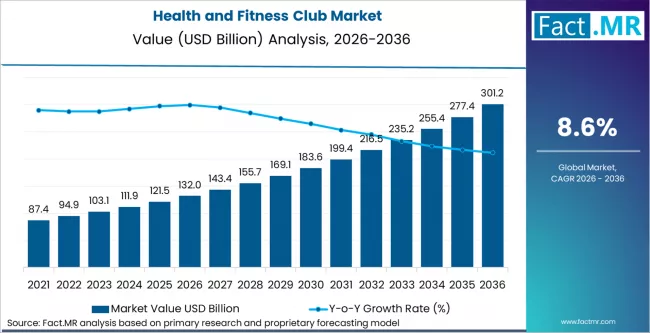
Health And Fitness Club Market Market Value Analysis | Source: Fact.MR
Market Definition
The health and fitness club market includes commercial facilities that provide structured exercise environments, equipment access, group classes, personal training, and related wellness services through subscription or fee-based models. Formats range from low-cost gyms offering basic access to premium clubs delivering spa, nutrition, physiotherapy, and health screening services. End users include individual consumers across age groups and corporate employers offering fitness access as part of employee wellness benefits.
Market Inclusions
The report provides global and regional forecasts from 2026 to 2036, segmented by service type, business model, and end-user category. It analyzes membership pricing across budget and premium formats, personal training and ancillary revenue trends, corporate wellness contract structures, hybrid digital-physical adoption rates, and competitive positioning of major global chains and regional operators.
Market Exclusions
The scope excludes standalone digital fitness apps not linked to physical clubs, home fitness equipment sales, hospital-based rehabilitation centers, elite sports academies, and independent yoga or martial arts studios operating outside commercial gym membership models. The focus remains strictly on commercial physical fitness club operations and related membership revenue.
Research Methodology
- Primary Research: Structured interviews were conducted with club operations leaders, franchise executives, corporate wellness procurement managers in the United States, United Kingdom, South Korea, and Japan, independent club owners in China and Brazil, and national fitness association representatives.
- Desk Research: Research incorporated public health and activity guidelines from global and national health authorities, investor filings from major fitness chains, and industry revenue and membership statistics from leading fitness associations for 2024 and 2025.
- Market-Sizing and Forecasting: Market sizing combined national membership penetration rates with average annual revenue per member by format and geography. Estimates were validated against disclosed revenues from publicly listed operators and industry association data.
- Data Validation and Update Cycle: Outputs were cross-checked against company financial filings, reconciled with industry association updates, and refreshed annually using government physical activity participation data and employer wellness spending surveys.
Summary
-
Market Definition
- The health and fitness club market includes commercial gym and wellness operators generating revenue through recurring memberships, personal training, and ancillary wellness services across physical and hybrid fitness environments globally.
-
Demand Drivers
- South Korea’s National Health Promotion Program expansion in 2024 increased affordability of club memberships, supporting growth across budget and premium formats.
- The United Kingdom’s updated workforce health framework in 2024 strengthened employer-sponsored fitness access, boosting corporate wellness contracts.
- Japan’s 2024 Physical Activity Guidelines raised recommended exercise targets, supporting membership demand among ageing and urban working populations.
-
Key Segments Analyzed
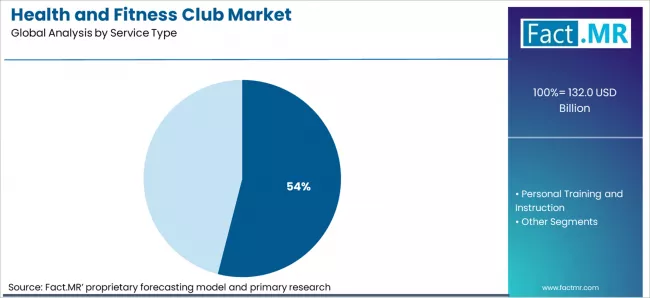
- By service type, membership fees hold 54% share, reflecting the dominance of recurring subscription revenue across budget and premium formats. Predictable monthly income supports facility investment and workforce planning regardless of member usage frequency.
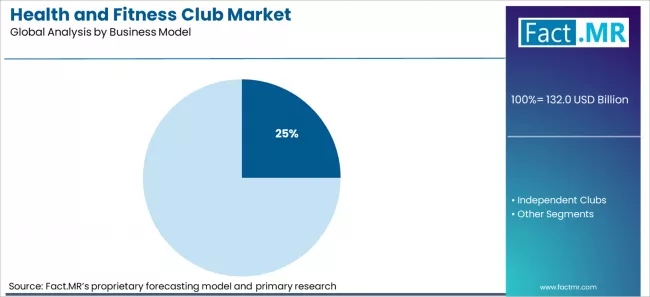
- By business model, chain clubs account for 45% share, driven by multi-location brand strength, centralized technology platforms, standardized programming, and franchise expansion. Chains can deliver consistent member experience and national corporate wellness coverage at scale.
- By end-user, women hold 49% share, representing the largest consumer base globally. Female participation leads in developed markets, and high-growth categories such as group fitness, yoga, Pilates, and barre are predominantly female-driven.
-
Analyst Opinion at FACT.MR
- Shambhu Nath Jha, Principal Consultant at Fact.MR, states that CXOs should view the convergence of corporate wellness expansion, AI-enabled personalized programming, and government physical activity mandates as a differentiated revenue opportunity. Operators integrating institutional memberships, premium wellness services, and digital engagement can create value beyond basic gym or pure digital models during the forecast period.
-
Strategic Implications / Executive Takeaways
- Chain operators entering South Korea, Japan, and the United Kingdom should prioritize corporate wellness sales before rapid club expansion. Employer-funded memberships provide stable revenue that supports capital investment in competitive urban markets.
- Independent clubs competing with budget chains should integrate medical wellness services such as physiotherapy and nutrition counseling. Premium positioning enables higher fees and stronger member retention than equipment-only formats.
- Operators expanding in China and Southeast Asia should consider franchise or management contract models. Partner-led expansion reduces real estate risk while capturing growth in Tier 2 and Tier 3 cities.
-
Methodology
- Market size estimates were based on national adult fitness club membership penetration rates combined with average annual revenue per member by club format, cross-checked against disclosed system-wide revenue from publicly listed chain operators including Planet Fitness, Basic-Fit NV, and The Gym Group for 2024.
- Segment analysis used national fitness industry association membership and revenue statistics from IHRSA 2024 Global Report, UK Active 2024 State of the UK Fitness Industry Report, and government physical activity programme participation data from South Korea, Japan, and the United Kingdom.
- Country forecasts were validated using government public health programme budget allocations, employer corporate wellness benefit spending surveys, national fitness club network expansion announcement data, and consumer health behaviour tracking studies published in 2024 and 2025.
Segmental Analysis
Health and Fitness Club Market Analysis by Service Type
Health And Fitness Club Market Analysis By Service Type | Source: Fact.MR
Membership fees are projected to hold 54% share in 2026. The subscription model underpins club economics across all formats. Recurring monthly revenue supports lease, staffing, and equipment costs regardless of visit frequency, creating predictable cash flow stability.
- Planet Fitness Membership Expansion: In its February 2025 earnings release, Planet Fitness reported system membership exceeding 19 million. Tiered pricing increased average revenue per member alongside continued member growth. [5]
- Basic-Fit Digital Membership Integration: Basic-Fit’s March 2025 annual results highlighted expansion of its AI-enabled fitness app bundled with memberships. Increased engagement supported lower churn across key European markets. [6]
- Personal Training Revenue Growth Trend: Personal training is the fastest-growing service segment. UK Active’s 2024 report noted higher session volumes in 2024 versus 2023, reflecting stronger demand for supervised, outcome-focused programs. [7]
Health and Fitness Club Market Analysis by Business Model
Health And Fitness Club Market Analysis By Business Model | Source: Fact.MR
Chain clubs are projected to hold 45% share in 2026. Scale advantages include brand recognition, technology investment leverage, and eligibility for national corporate contracts. Large employers requiring multi-city access favor chain networks with centralized billing and consistent standards.
- PureGym UK Expansion Programme: PureGym’s April 2025 report confirmed over 380 UK locations after new openings in 2024. Growth is shifting toward suburban and secondary cities as major urban markets mature. [8]
- Self Esteem Brands Franchise Growth: Self Esteem Brands reported in 2024 that Anytime Fitness surpassed 5,000 franchised clubs across 30+ countries, with strong expansion in South Korea, Australia, and Canada. [9]
- Independent Club Differentiation Trend: Independent clubs retain 55% combined share and compete through medical wellness integration, community focus, and premium positioning. IHRSA 2024 data showed higher per-member revenue and lower churn among premium independents compared with budget chains. [1]
Drivers, Restraints, and Opportunities
Fact.MR analysis values the health and fitness club market at USD 120 billion, reflecting a strong post-pandemic rebound. The recovery has reshaped the value proposition rather than simply restoring pre-2020 trends. During 2020-2022, closures and rapid growth in home fitness created hybrid behavior patterns. Members who returned to clubs now expect more than equipment access. They seek community, coaching quality, upgraded facilities, and measurable health outcomes that digital-only models struggled to deliver.
A key market divide is emerging between budget chains and premium wellness operators. Budget brands such as Planet Fitness and Basic-Fit have driven volume recovery through low pricing and network expansion, but revenue per member remains capped. Premium operators such as Equinox, Life Time, and David Lloyd generate higher per-member revenue through personal training, spa, nutrition, and corporate contracts.
- Corporate Wellness Mandate Expansion: Updated U.S. federal employer guidance in October 2024 formally supported fitness access as a preventive health strategy. Large self-insured employers are expanding corporate wellness contracts with fitness operators, creating a stable institutional revenue channel. [2]
- South Korea Fitness Subsidy Policy: South Korea expanded its National Health Promotion Fund subsidies in 2024, increasing voucher values and widening eligibility. This directly supports membership growth among middle-income and price-sensitive groups in major cities. [3]
Regional Analysis
The health and fitness club market is analyzed across North America, Europe, Asia Pacific, Latin America, and Middle East and Africa. Regional demand patterns reflect the maturity of consumer fitness culture, the penetration of corporate wellness program procurement, national public health policy support for structured physical activity participation, urban consumer income levels supporting premium fitness spending, and the depth of chain club network expansion in each geography. The full report offers detailed market attractiveness analysis comparing consumer membership penetration rates, corporate wellness contract intensity, and competitive operator density by region.
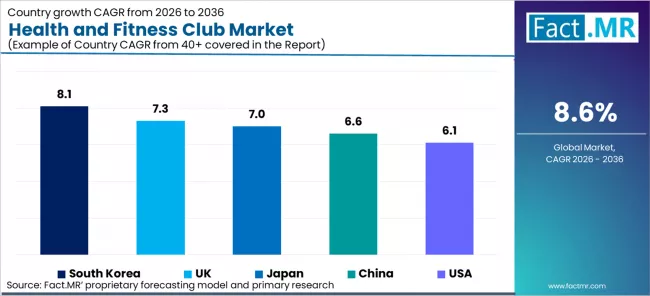
Health And Fitness Club Market Cagr Analysis By Country | Source: Fact.MR
| Country | CAGR% |
|---|---|
| South Korea | 8.1% |
| United Kingdom | 7.3% |
| Japan | 7.0% |
| China | 6.6% |
| United States | 6.1% |
Source: Fact.MR analysis. Updated Feb 24, 2026
Source: Fact.MR (FACT.MR) analysis, based on proprietary forecasting model and primary research
Asia Pacific Health and Fitness Club Market Analysis
Asia Pacific is the main volume growth region for the global health and fitness club market. Growth is supported by South Korea’s strong fitness culture and China’s expanding urban middle class treating gym membership as a lifestyle expense. International chains such as Anytime Fitness have a wide presence, while domestic South Korean and Chinese brands are expanding through franchise and owned models. Japan’s ageing population creates steady demand for health-focused club programming.
- South Korea: Demand is projected to grow at 8.1% CAGR through 2036. Growth reflects strong cultural participation, government subsidies, and rising urban wellness spending. The Ministry of Health and Welfare expanded its 2024 fitness voucher program, increasing annual support and widening age eligibility to 30-49. This directly boosts demand among working-age consumers. Anytime Fitness surpassed 1,500 locations by end-2024, confirming high franchise density and continued regional expansion.
- Japan: Demand is projected to grow at 7.0% CAGR through 2036. Growth is driven by ageing demographics and updated national physical activity targets under the Fourth Basic Plan for Health Promotion in 2024. The policy sets participation goals for adults aged 40-74, encouraging structured exercise. Major operators are expanding programs focused on older adults, including low-impact training and integrated health monitoring.
- China: Demand is projected to grow at 6.6% CAGR through 2036. Growth is supported by the Healthy China 2030 plan and updated national fitness guidelines promoting facility expansion. Urban governments are increasing commercial fitness access per capita. Keep expanded its hybrid digital-physical studio network beyond 90 locations by end-2024, targeting urban professionals seeking AI-driven group programming.
FACT.MR’s Asia Pacific analysis covers South Korea, Japan, China, Australia, India, and ASEAN markets. It assesses national fitness policy impacts, subsidy programs, corporate wellness trends, and competitive positioning of major operators.
Europe Health and Fitness Club Market Analysis
Europe is a leading region for low-cost fitness innovation. Budget chains dominate markets such as the United Kingdom, Netherlands, Belgium, and France. Corporate wellness contracts are becoming a structural demand channel alongside individual memberships. Basic-Fit and PureGym lead by scale, while David Lloyd and Virgin Active focus on premium segments. EU workforce wellbeing initiatives are supporting employer-sponsored fitness benefits.
- United Kingdom: Demand is projected to grow at 7.3% CAGR through 2036. Growth comes from continued budget chain expansion and rising corporate wellness adoption under updated NHS workforce guidance in 2024. Employer-funded memberships are increasing across major chains. UK sector revenue reached GBP 5.6 billion in 2024, exceeding pre-pandemic levels and confirming structural recovery.
FACT.MR’s Europe analysis includes the United Kingdom, Germany, France, the Netherlands, Spain, and Nordic markets. It evaluates workforce health policy impacts, budget chain expansion, premium differentiation, and industry revenue data for 2024 and 2025.
North America Health and Fitness Club Market Analysis
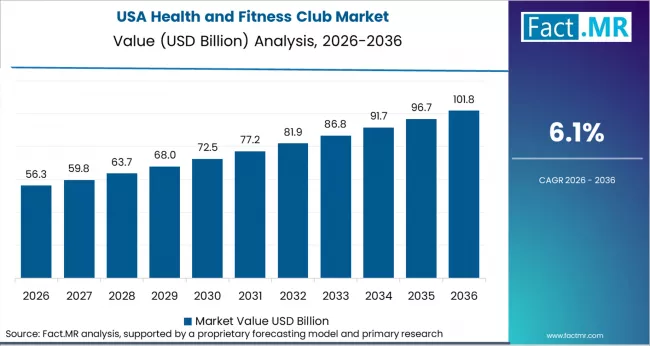
Health And Fitness Club Market Country Value Analysis | Source: Fact.MR
North America is the global revenue leader and benchmark for corporate wellness integration. The United States has the highest density of commercial clubs and the largest employer wellness market. Budget chains lead in membership volume, while premium operators generate higher per-member revenue through integrated wellness services. Canada shows steady growth through budget expansion and public health-supported wellness programs.
- United States: Demand is projected to grow at 6.1% CAGR through 2036. As a mature market, growth is driven by premium upgrades and corporate wellness contracts rather than new mass membership gains. Federal employer physical activity guidance published in October 2024 supports fitness access as a preventive health strategy. Premium operators reported improved margins in 2024, driven by higher ancillary service revenue per member.
FACT.MR’s North America analysis covers the United States and Canada. It includes federal policy impacts, corporate wellness penetration data, segment competition, and financial performance analysis for major operators in 2024 and 2025.
Competitive Aligners for Market Players
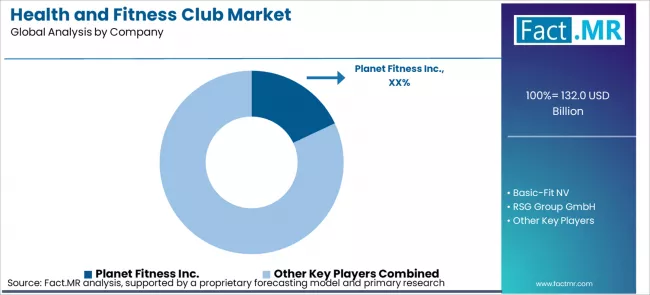
Health And Fitness Club Market Analysis By Company | Source: Fact.MR
The global health and fitness club market is highly fragmented. The top ten global chains account for only about 20 to 25 percent of total revenue, while thousands of independent clubs and regional operators serve local markets. In the low-cost segment, Planet Fitness leads the United States with more than 19 million members across 2,600+ clubs. In Europe, Basic-Fit drives budget expansion with over 1,400 locations across key markets. Competition differs by segment. Budget operators compete on scale, pricing, and real estate efficiency. Premium and corporate-focused clubs compete on revenue per member, service depth, and long-term contracts.
Scale creates clear structural advantages. Large chains can invest in proprietary digital apps, AI-based programming, and member engagement platforms that smaller operators cannot afford. These tools improve retention and spread development costs across millions of members. National geographic coverage also enables participation in corporate wellness contracts, which typically require multi-location access and centralized billing.
Consumers remain price-sensitive in the budget segment and experience-focused in the premium segment. Mid-market operators face pressure from both sides. Corporate wellness contracts provide multi-year stability, shifting pricing power toward large national chains.
Key Players
- Planet Fitness Inc.
- Basic-Fit NV
- RSG Group GmbH
- Life Time Group Holdings Inc.
- Equinox Holdings Inc.
- Fitness International LLC
- Self Esteem Brands LLC
- PureGym Ltd.
Bibliography
- [1] IHRSA (International Health Racquet and Sportsclub Association), 2024 Global Fitness Industry Report, June 2024.
- [2] U.S. Department of Health and Human Services, Physical Activity Guidelines for Americans Employer Implementation Guidance, October 2024.
- [3] Ministry of Health and Welfare of South Korea, National Health Promotion Fund Fitness Activity Voucher Programme 2024 Expansion Announcement, January 2024.
- [4] Life Time Group Holdings Inc., Full-Year 2024 Annual Report and Investor Communications, February 2025.
- [5] Planet Fitness Inc., Full-Year 2024 Earnings Release, February 2025.
- [6] Basic-Fit NV, Full-Year 2024 Annual Results, March 2025.
- [7] UK Active, State of the UK Fitness Industry Report 2024, September 2024.
- [8] PureGym Ltd., Annual Report 2024, April 2025. Available at: https://www.puregym.com/media/press/
- [9] Self Esteem Brands LLC, Anytime Fitness Global Franchise Development Report 2024, December 2024.
- [10] Equinox Holdings Inc., Corporate Communications and Investor Update 2024, November 2024.
This Report Addresses
- Market intelligence for strategic planning, tracking the shift from basic membership models to AI-enabled, personalised wellness platforms integrating corporate health contracts and hybrid digital-physical engagement.
- Market size and forecast projecting USD 132 billion in 2026 and USD 298 billion by 2036, reflecting an 8.6% CAGR.
- Growth opportunity mapping across corporate wellness expansion in the United Kingdom, United States, and South Korea, premium service upgrades, and budget franchise growth in Tier 2 and Tier 3 cities across China, Southeast Asia, and Latin America.
- Segment and regional forecasts by service type, business model, and end-user, including individual membership trends and employer wellness contract volumes by country.
- Competitive strategy analysis of major operators including Planet Fitness, Basic-Fit, PureGym, Life Time, and Equinox, assessing scale, digital investment, corporate penetration, franchise efficiency, and expansion pipelines.
- Regulatory and policy tracking covering national physical activity programs, NHS and EU employer wellness frameworks, and 2024-2025 industry statistics from IHRSA and UK Active.
- Technology adoption analysis of AI-based programming, hybrid engagement models, corporate wellness platforms, and digital differentiation across budget and premium formats.
- Report delivery in Excel, PowerPoint, and PDF formats with validated data, primary research inputs, and verified company and regulatory sources.
Segmentation
Scope of Report
| Items | Values |
|---|---|
| Quantitative Units | USD 132 billion (2026) to USD 298 billion (2036), at a CAGR of 8.6% |
| Market Definition | The health and fitness club market covers membership fee-based, personal training, and ancillary service revenues generated by independent and chain fitness clubs serving men, women, and corporate wellness program participants across physical club locations and digitally-integrated hybrid fitness service platforms globally. |
| By Service Type | Membership Fees, Personal Training and Instruction, Other Services |
| By Business Model | Independent Clubs, Chain Clubs |
| By End-User | Men, Women, Corporate/Employee Wellness |
| Regions Covered | Asia Pacific, Europe, North America, Latin America, Middle East & Africa |
| Countries Covered | China, Japan, South Korea, Australia & New Zealand, India, ASEAN, Rest of Asia Pacific, Norway, Germany, United Kingdom, France, Spain, Netherlands, Nordics, Rest of Europe, United States, Canada, Mexico, Brazil, Chile, Ecuador, Rest of Latin America, Kingdom of Saudi Arabia, United Arab Emirates, South Africa, Turkey, Rest of Middle East & Africa |
| Key Companies Profiled | Planet Fitness Inc., Basic-Fit NV, RSG Group GmbH, Life Time Group Holdings Inc., Equinox Holdings Inc., Fitness International LLC, Self Esteem Brands LLC, PureGym Ltd., The Gym Group plc, F45 Training Holdings Inc., Virgin Active Ltd. |
| Forecast Period | 2026 to 2036 |
| Quantitative Units | USD 132 billion (2026) to USD 298 billion (2036), at a CAGR of 8.6% |
Source: Fact.MR analysis. Updated Feb 24, 2026
Health and Fitness Club Market by Segment
-
By Service Type :
- Membership Fees
- Personal Training and Instruction
- Other Services
-
By Business Model :
- Independent Clubs
- Chain Clubs
-
By End-User :
- Men
- Women
- Corporate/Employee Wellness
-
Region :
- Asia Pacific
- China
- Japan
- South Korea
- Australia & New Zealand
- India
- ASEAN
- Rest of Asia Pacific
- Europe
- Norway
- Germany
- United Kingdom
- France
- Spain
- Netherlands
- Nordics
- Rest of Europe
- North America
- United States
- Canada
- Mexico
- Latin America
- Brazil
- Chile
- Ecuador
- Rest of Latin America
- Middle East & Africa
- Kingdom of Saudi Arabia
- United Arab Emirates
- South Africa
- Turkey
- Rest of Middle East & Africa
- Asia Pacific
Frequently Asked Questions
How large is the health and fitness club market in 2025?
What will the market size be in 2026?
What is the projected market size by 2036?
What is the expected CAGR for the forecast period 2026 to 2036?
Which Service Type segment holds the largest share?
Which Business Model segment holds the largest share?
Which End-User segment dominates in 2026?
Which country shows the fastest CAGR?
What is the absolute dollar growth from 2026 to 2036?
Who worked on this report


Preview the report firsthand - request a free sample
Free SampleGet the brochure for pricing and purchase details
Download PDF