- Base Value(2025): 2.0 Bn
- Estimated Value(2026): 2.2 Bn
- Forecast Value (2036): 5.7 Bn
- CAGR (2026 - 2036): 10.1%
Stand Up Paddle Board Analysis and Forecast by Fact.MR
- The Stand Up Paddle Board Market is expected to grow from USD 2.2 billion in 2026 to USD 5.7 billion by 2036, at a 10.1% CAGR.
- Driven by recreational water sports growth sustained by SUP accessibility, fitness paddling adoption widening the market beyond water sports enthusiasts, and water sports tourism and coastal lifestyle trends supporting equipment demand, with Inflatable Stand Up Paddle Boards accounting for 67.9% share.
- Recreational Water Sports contributing 42.6% share as consumers prioritize accessibility, affordability, and participation flexibility across recreational water sports activities.
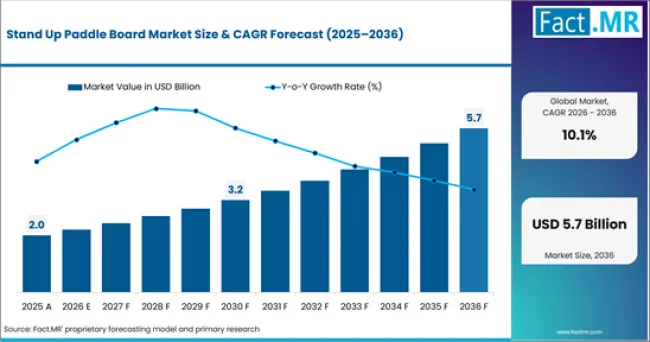
Stand Up Paddle Board Market Value Analysis | Source: Fact.MR
Summary of Stand Up Paddle Board Market
- Market Snapshot
- In 2025, the global Stand Up Paddle Board Market was valued at approximately USD 2.0 billion.
- The market is estimated to reach USD 2.2 billion in 2026 and is projected to attain USD 5.7 billion by 2036.
- The market is likely to expand at a CAGR of 10.1% during the forecast period.
- The market is anticipated to create an absolute dollar opportunity of USD 3.5 billion between 2026 and 2036.
- Inflatable Stand Up Paddle Boards accounts for 67.9% of product share in 2026.
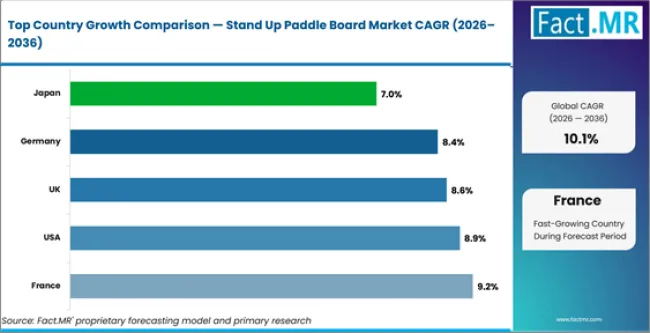
- France (9.2%) and USA (8.9%) are the key growth markets during the forecast period.
- Demand and Growth Drivers
- Recreational water sports participation growth, supported by SUP accessibility and low skill barriers, sustains the broadest demand pool for inflatable and entry-level paddle boards.
- Fitness paddling adoption, where SUP serves as a full-body workout on water, widens the market beyond traditional water sports enthusiasts.
- Water sports tourism and coastal lifestyle trends support equipment purchase and rental demand across resort, lake, and coastal markets.
- Inflatable SUP technology improvement in rigidity and performance closes the gap with hard boards, broadening the accessible buyer base.
- Fitness and wellness positioning creates year-round demand where indoor SUP fitness and pool-based paddling extend participation.
- Product and Segment View
- Inflatable Stand Up Paddle Boards accounts for 67.9% of the product segment in 2026, emerging as the leading category.
- Recreational Water Sports accounts for 42.6% of the application segment in 2026, making it the dominant use setting.
- Key segmentation includes:
- Product: Inflatable Stand Up Paddle Boards, Hard (Epoxy) Stand Up Paddle Boards, Racing Stand Up Paddle Boards, Yoga & Fitness SUP Boards
- Application: Recreational Water Sports, Fitness & Wellness Activities, Competitive Sports Applications, Tourism & Adventure Activities
- End Use: Individual Consumers, Rental Operators, Sports Clubs & Academies, Resorts & Hospitality Sector
- Technology: Inflatable Drop Stitch Technology, Composite Board Technology, Hydrodynamic Design Technology, Fin & Tracking Systems
- Formulation: Lightweight Performance Construction, Inflatable Air Chamber Systems, Modular Board Construction
- Distribution Channel: Specialty Sports Retail Stores, Online Retail Platforms, Rental & Experience Operators, Direct Brand Sales
- These systems enable:
- Portable inflatable paddle board recreation
- Fitness-oriented full-body water workout
- Premium touring and racing performance
- Geography and Competitive Outlook
- Europe leads on SUP participation rates, with France, the UK, and Germany showing the strongest adoption supported by coastal and lake access and water sports culture.
- North America leads on consumer spending per unit, with the US market anchored in coastal lifestyle and fitness paddle adoption.
- Asia Pacific shows growth supported by water sports tourism and coastal recreation development.
- France (9.2%) and USA (8.9%) lead country growth, with other major markets showing steady demand.
- Key companies include Red Paddle Co, Starboard (Svein Rasmussen), BOTE, LLC, Isle Surf & SUP, iROCKER, SIC Maui.
- Analyst Opinion
- Shambhu Nath Jha, Principal Consultant at Fact.MR, says "SUP demand is accessibility-driven, and the defining dynamic is inflatable technology making paddle boarding portable, storable, and affordable. Inflatables lead at nearly 68% share. Fitness paddling is the most consequential demand diversification, attracting gym and yoga consumers into water sports. France and the USA lead on participation and spending. Red Paddle Co and Starboard lead on brand and product breadth, while BOTE, Isle, and iROCKER capture D2C volume. Brands combining authentic water sports credibility with D2C e-commerce and community engagement capture both first-time and upgrading consumers."
Key Growth Drivers, Constraints, and Opportunities
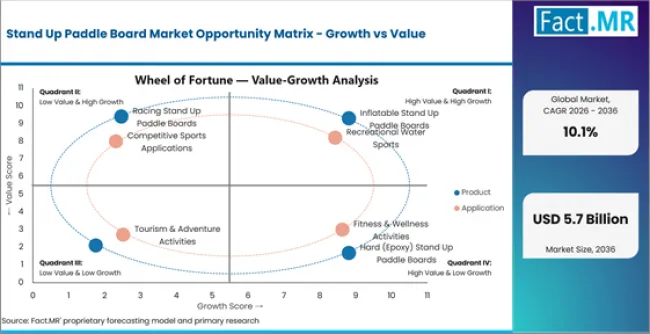
Stand Up Paddle Board Market Opportunity Matrix Growth Vs Value | Source: Fact.MR
Key Factors Driving Growth
- Recreational water sports participation growth, supported by SUP accessibility and low skill barriers, sustains the broadest demand pool for inflatable and entry-level paddle boards.
- Fitness paddling adoption, where SUP serves as a full-body workout on water, widens the market beyond traditional water sports enthusiasts.
- Water sports tourism and coastal lifestyle trends support equipment purchase and rental demand across resort, lake, and coastal markets.
Key Market Constraints
- Seasonal demand patterns in temperate climates create concentrated sales windows.
- Storage and transport logistics for hard boards limit adoption among urban consumers.
- Competition from kayaks, surfboards, and other water sports equipment for consumer spending and participation time.
Key Opportunity Areas
- Inflatable SUP technology improvement in rigidity and performance closes the gap with hard boards, broadening the accessible buyer base.
- Fitness and wellness positioning creates year-round demand where indoor SUP fitness and pool-based paddling extend participation.
- Emerging-market coastal tourism development widens the SUP consumer base.
Segment-wise Analysis of the Stand Up Paddle Board
- Inflatable Stand Up Paddle Boards holds 67.9% of the product segment in 2026, supported by strong consumer preference and broad market adoption.
- Recreational Water Sports represents 42.6% of the application segment in 2026, anchored by its dominant recreational use case.
The Stand Up Paddle Board Market is segmented by product, application, end use, technology, formulation, distribution channel. Demand is shaped by participation rates, tourism activity, consumer spending, and distribution-channel availability.
Which Product Segment Dominates the Stand Up Paddle Board?
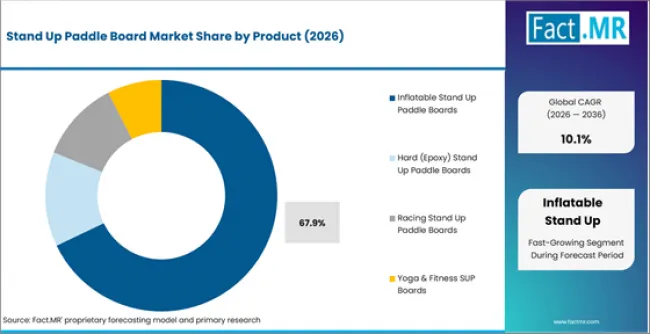
Stand Up Paddle Board Market Analysis By Product | Source: Fact.MR
Inflatable Stand Up Paddle Boards lead the product segment with 67.9% share in 2026, reflecting their portability, storage convenience, and improving rigidity that make them accessible to the broadest consumer base from first-time recreational paddlers to fitness users.
The segment is expected to retain dominant leadership as inflatable technology continues improving. Hard/epoxy and racing boards sustain premium positions, but inflatables anchor the largest share through their accessibility and versatility.
Which Application Segment Dominates the Stand Up Paddle Board?
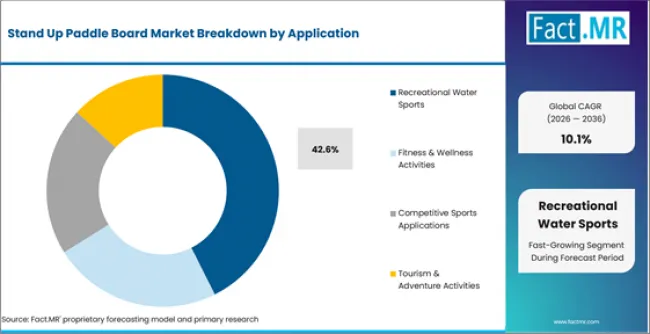
Stand Up Paddle Board Market Analysis By Application | Source: Fact.MR
Recreational Water Sports leads the application segment with 42.6% share in 2026, reflecting the broadest participation base where low skill barriers and accessible pricing attract first-time paddlers, families, and casual water sports participants.
The application is likely to hold its lead as recreational participation continues growing. Fitness, touring, and racing applications expand the market upward, but recreational water sports anchors the largest volume-driven demand channel.
Which Product Trend is Shaping the Next Phase of Growth in the Stand Up Paddle Board?
Inflatable Stand Up Paddle Boards lead the product segment at 67.9%, and the defining dynamic is their portability, storage convenience, and improving rigidity that make them accessible to the broadest consumer base. Recreational water sports anchors the largest application share, where low skill barriers and accessible pricing attract first-time and casual paddlers.
Fitness paddling is the most consequential demand diversification. SUP fitness positions paddle boarding as a full-body workout, attracting consumers from gym and yoga backgrounds who might not otherwise engage in traditional water sports. Advanced inflatable drop-stitch construction and lightweight carbon touring boards support premium pricing in performance segments.
Regional Outlook Across Key Markets
- Europe leads on SUP participation rates, with France, the UK, and Germany showing the strongest adoption supported by coastal and lake access and water sports culture.
- North America leads on consumer spending per unit, with the US market anchored in coastal lifestyle and fitness paddle adoption.
- Asia Pacific shows growth supported by water sports tourism and coastal recreation development.
- Latin America and Oceania sustain demand anchored in surf culture and coastal lifestyle.
.webp "Top Country Growth Comparison Stand Up Paddle Board Market Cagr (2026 2036)")
Top Country Growth Comparison Stand Up Paddle Board Market Cagr (2026 2036) | Source: Fact.MR
CAGR Table
| Country | CAGR (%) |
|---|---|
| France | 9.2% |
| USA | 8.9% |
| United Kingdom | 8.6% |
| Germany | 8.4% |
| Japan | 7.0% |
Source: Fact.MR analysis. Updated Jun 12, 2026
Source: Fact.MR analysis, based on proprietary forecasting model and primary research.
Stand Up Paddle Board Market Cagr Analysis By Country | Source: Fact.MR
Market Outlook for Stand Up Paddle Board in China
Coastal and lake recreation development and growing water sports tourism are creating SUP demand. Domestic manufacturing provides cost-competitive inflatable board supply for both domestic consumption and export, while urban fitness trends support paddle board adoption as a leisure activity.
- Coastal recreation development creates SUP demand in tourism markets.
- Domestic manufacturing provides cost-competitive inflatable board supply.
India Stand Up Paddle Board Demand Trends
Demand is shaped by growing coastal tourism and emerging recreational water sports participation. Cost-effectiveness favors entry-level inflatable paddle boards, while resort and tourism-driven rental operations create incremental equipment procurement.
- Coastal tourism drives emerging SUP demand.
- Resort and tourism rental operations create equipment procurement.
Stand Up Paddle Board Growth Assessment in Germany
The Germany Stand Up Paddle Board market is projected to grow at a CAGR of 8.4% through 2036. EU product safety regulation and German consumer quality expectations shape SUP specification. Lake and river paddle access, combined with fitness culture adoption, sustain demand across recreational and fitness segments, while sustainability-conscious consumers drive interest in eco-friendly board materials.
- Lake and river access sustains recreational SUP demand.
- Fitness culture adoption drives paddle board procurement as workout equipment.
United States Stand Up Paddle Board Market Opportunity Outlook
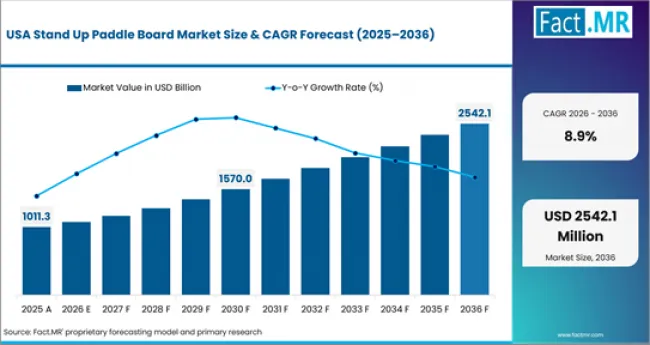
Stand Up Paddle Board Market Country Value Analysis | Source: Fact.MR
The United States Stand Up Paddle Board market is projected to grow at a CAGR of 8.9% through 2036. The largest SUP consumer spending market, anchored in coastal lifestyle and fitness paddle culture. D2C e-commerce has become a primary channel, while premium carbon touring and racing boards support margin alongside high-volume inflatable sales. Brand strength and community building drive consumer loyalty.
- Coastal lifestyle and fitness culture anchor the largest SUP consumer market.
- D2C e-commerce has become a primary SUP distribution channel.
Stand Up Paddle Board Demand Analysis in Japan
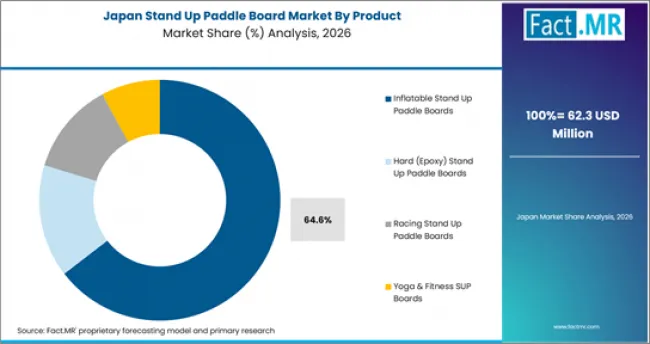
Stand Up Paddle Board Market Japan Market Share Analysis By Product | Source: Fact.MR
The Japan Stand Up Paddle Board market is projected to grow at a CAGR of 7.0% through 2036. Coastal geography and outdoor recreation culture support SUP participation. Domestic consumer preference for quality and lightweight construction shapes equipment specification, while fitness and wellness trends drive paddle boarding adoption as a recreational activity.
- Coastal geography supports recreational SUP participation.
- Quality preference shapes lightweight paddle board equipment specification.
Competitive Benchmarking and Company Positioning
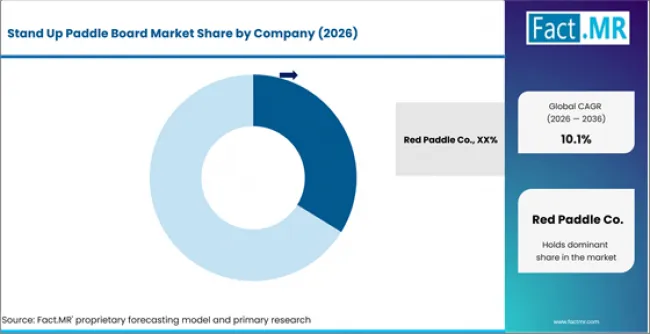
Stand Up Paddle Board Market Analysis By Company | Source: Fact.MR
Stand Up Paddle Board Analysis By Company
- Red Paddle Co and Starboard hold leading positions through premium inflatable and hard board portfolios, global distribution, and strong brand credibility in both recreational and performance SUP segments.
- BOTE, Isle, and iROCKER compete through D2C e-commerce strength, lifestyle brand positioning, and accessible price points that capture first-time and recreational paddler demand.
- Advanced inflatable technology and premium touring and racing boards increasingly differentiate suppliers as the market matures beyond entry-level recreational purchases.
The competitive landscape is fragmented among a mix of dedicated SUP brands, water sports equipment companies, and D2C e-commerce entrants. Red Paddle Co and Starboard lead through product breadth, brand heritage, and distribution across specialty retail and international markets.
Below the leaders, BOTE, Isle, iROCKER, SIC, Naish, Fanatic, Aqua Marina, and Tower maintain positions through specific market segments, price points, and channel strategies. Competition turns on inflatable rigidity, board weight, brand authenticity, and community engagement rather than price alone.
D2C e-commerce and community building are the competitive frontiers. Brands that combine strong online presence with authentic water sports credibility and product innovation capture both first-time buyers and upgrading enthusiasts. Premium carbon touring and racing boards sustain margin alongside high-volume inflatable sales.
Key Companies in the Stand Up Paddle Board
- Leading companies in the stand up paddle board market include Red Paddle Co, Starboard (Svein Rasmussen), BOTE, LLC, Isle Surf & SUP, which hold strong positions through portfolio breadth, brand recognition, product innovation, and broad distribution.
- iROCKER, SIC Maui, Naish International, Fanatic (Boards & More GmbH) maintain established positions across specific segments and channels, competing on product performance, brand positioning, service, and regional reach.
- Aqua Marina, Tower Paddle Boards and other specialists compete through focused offerings and niche strength, reinforcing relevance in a competitive but evolving market.
Recent Industry Developments
- Industry Trend - Advanced Inflatable SUP Technology Improvement (2025)
- Through 2025, inflatable SUP construction technology continued advancing in rigidity and performance, closing the gap with hard boards and broadening the accessible consumer base for portable paddle boards.
- Industry Trend - Fitness Paddle Boarding Adoption Growth (2025)
- Through 2025, fitness paddling continued growing as a wellness activity, positioning SUP as a full-body workout and attracting consumers from gym and yoga backgrounds into water sports equipment purchase.
Leading Companies Shaping the Stand Up Paddle Board
- Red Paddle Co
- Starboard (Svein Rasmussen)
- BOTE, LLC
- Isle Surf & SUP
- iROCKER
- SIC Maui
- Naish International
- Fanatic (Boards & More GmbH)
- Aqua Marina
- Tower Paddle Boards
Sources and Research References
- Outdoor Foundation. (2025). Outdoor participation trends report 2025. Outdoor Foundation.
- World Paddle Association. (2025). Stand up paddleboarding participation and industry trends. World Paddle Association.
This bibliography is provided for reader reference and is not exhaustive. The full report contains the complete reference list and detailed citations.
Key Questions This Report Addresses
- What is the current and future size of the Stand Up Paddle Board Market?
- How fast is the Stand Up Paddle Board Market expected to grow between 2026 and 2036?
- Which product segment is likely to lead the market by 2026?
- Which application segment is expected to account for the highest demand by 2026?
- What factors are driving demand in the stand up paddle board market globally?
- Which countries are projected to show the fastest growth through 2036?
- What is driving market expansion in France and USA?
- Who are the key companies active in the stand up paddle board market?
- How is inflatable SUP technology improvement broadening the accessible buyer base?
- What role does fitness paddling play in widening SUP beyond traditional water sports?
- How does Fact.MR estimate and validate the stand up paddle board market forecast?
Stand Up Paddle Board Market Definition
The stand up paddle board market covers inflatable, hard/epoxy, soft-top, and racing paddle boards used in recreational water sports, fitness paddling, touring, and competitive racing. It spans drop-stitch inflatable construction, EPS/epoxy layup, and soft-top foam technologies across recreational paddlers, fitness users, touring enthusiasts, and competitive racers through specialty water sports retail, sporting goods stores, and e-commerce channels.
Stand Up Paddle Board Market Inclusions
- The scope covers global and regional market size and forecasts for 2026 to 2036 across product type, application, end use, technology, formulation, and distribution channel.
- It includes demand tied to recreational water sports participation, fitness and wellness trends, water tourism, and competitive paddle sport growth.
- Pricing analysis spans entry-level inflatable to premium racing boards across specialty retail, sporting goods, and D2C e-commerce channels.
- Coverage includes advanced inflatable drop-stitch technology, lightweight carbon construction, and connected fitness paddle accessories.
Stand Up Paddle Board Market Exclusions
- The scope excludes kayaks, canoes, and other paddle craft outside the SUP definition.
- It excludes surfboards without a stand-up paddling design intent.
- General water sports accessories without a SUP-specific function are excluded.
- Paddle board rental-only operations without equipment procurement are excluded.
Stand Up Paddle Board Market Research Methodology
- The methodology combines secondary research, primary interviews, and demand-side modeling.
- It draws on 90 plus secondary sources and benchmarks 35 plus brand and retailer portfolios.
- Market sizing covers 30 plus countries through a water sports participation and consumer spending model with top-down validation.
- Key inputs include SUP participation rates, water sports tourism, fitness paddle adoption, and coastal and lake access populations.
- The model cross-checks demand with board shipments, brand revenue, and retail sell-through data.
- Primary validation includes 15 plus interviews across brand founders, specialty retailers, water sports associations, and distributors.
- Final estimates pass through participation-trend review and sensitivity testing.
Segmentation
Scope of Analysis
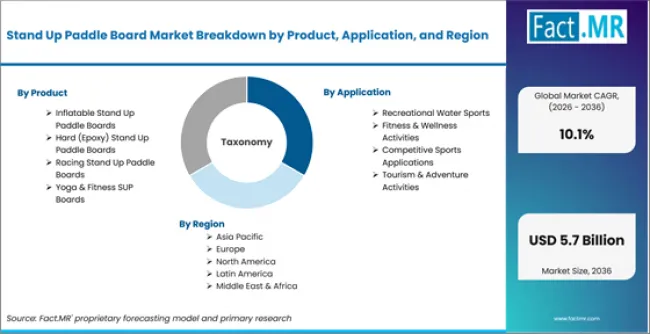
Stand Up Paddle Board Market Breakdown By Product, Application, And Region | Source: Fact.MR
| Parameter | Details |
|---|---|
| Quantitative Units | USD 2.2 billion to USD 5.7 billion, at a CAGR of 10.1% |
| Market Definition | The stand up paddle board market covers inflatable, hard, soft-top, and racing boards used in recreational, fitness, touring, and competitive paddle applications. |
| Regions Covered | North America, Latin America, Europe, East Asia, South Asia and Pacific, Middle East and Africa |
| Countries Covered | France, U.S., UK, Germany, Japan, 30 plus countries |
| Key Companies | Red Paddle Co, Starboard (Svein Rasmussen), BOTE, LLC, Isle Surf & SUP, iROCKER, SIC Maui, Naish International, Fanatic (Boards & More GmbH), Aqua Marina, Tower Paddle Boards |
| Forecast Period | 2026 to 2036 |
| Approach | Hybrid demand-side and top-down methodology built on country-level demand, product and technology benchmarking, pricing analysis, shipment validation, and primary interviews across manufacturers, retailers, distributors, rental operators, and end users. |
Source: Fact.MR analysis. Updated Jun 12, 2026
Stand Up Paddle Board Segmentation
-
Stand Up Paddle Board Market Segmented by Product:
- Inflatable Stand Up Paddle Boards
- All Round Inflatable SUP Boards
- Beginner Stability Boards
- Recreational Touring Boards
- Performance Inflatable SUP Boards
- Racing Inflatable Boards
- Long Distance Touring Boards
- All Round Inflatable SUP Boards
- Hard (Epoxy) Stand Up Paddle Boards
- Surf SUP Boards
- Short Wave Riding Boards
- High Maneuverability Boards
- Touring Hard Boards
- Speed Optimized Touring Boards
- Ocean Distance Boards
- Surf SUP Boards
- Racing Stand Up Paddle Boards
- Flatwater Racing Boards
- Sprint Racing Boards
- Endurance Racing Boards
- Open Water Racing Boards
- Ocean Racing Boards
- Downwind Racing Boards
- Flatwater Racing Boards
- Yoga & Fitness SUP Boards
- Wide Stability Boards
- Yoga Balance Boards
- Fitness Training Boards
- Multi Activity Boards
- Hybrid Exercise Boards
- Recreational Fitness Boards
- Wide Stability Boards
- Inflatable Stand Up Paddle Boards
-
Stand Up Paddle Board Market Segmented by Application:
- Recreational Water Sports
- Beach Leisure Activities
- Coastal Paddling Activities
- Shallow Water Recreation
- Lake & River Paddling
- Calm Water Exploration
- Inland Water Touring
- Beach Leisure Activities
- Fitness & Wellness Activities
- Water Based Fitness Training
- Core Strength Training SUP
- Balance Training Exercises
- Yoga on Water Applications
- Floating Yoga Sessions
- Mindfulness Water Training
- Water Based Fitness Training
- Competitive Sports Applications
- SUP Racing Events
- Sprint Paddle Competitions
- Long Distance Paddle Races
- Professional Training Programs
- Athlete Performance Training
- Endurance Conditioning Programs
- SUP Racing Events
- Tourism & Adventure Activities
- Water Tourism Activities
- Guided Paddle Tours
- Adventure Expedition Trips
- Eco Tourism Applications
- Nature Exploration Tours
- Wildlife Water Safaris
- Water Tourism Activities
- Recreational Water Sports
-
Stand Up Paddle Board Market Segmented by End Use:
- Individual Consumers
- Recreational Users
- Casual Water Sport Enthusiasts
- Weekend Hobby Users
- Fitness Enthusiasts
- Home Fitness Users
- Outdoor Training Individuals
- Recreational Users
- Rental Operators
- Water Sports Rental Shops
- Beach Rental Operators
- Resort Rental Services
- Tour Operators
- Adventure Tourism Companies
- Guided Paddle Tour Providers
- Water Sports Rental Shops
- Sports Clubs & Academies
- Water Sports Clubs
- Paddle Training Academies
- Professional Coaching Centers
- Educational Institutions
- Outdoor Activity Programs
- University Sports Programs
- Water Sports Clubs
- Resorts & Hospitality Sector
- Beach Resorts
- Luxury Resort Activity Centers
- Eco Resort Water Programs
- Adventure Resorts
- Outdoor Activity Resorts
- Water Sports Camps
- Beach Resorts
- Individual Consumers
-
Stand Up Paddle Board Market Segmented by Technology:
- Inflatable Drop Stitch Technology
- Single Layer Drop Stitch
- Lightweight Core Construction
- Entry Level Inflatable Design
- Double Layer Drop Stitch
- High Pressure Air Chambers
- Reinforced Structural Integrity
- Single Layer Drop Stitch
- Composite Board Technology
- Epoxy Composite Construction
- Fiberglass Reinforced Boards
- Carbon Fiber Reinforced Boards
- Hybrid Composite Systems
- Lightweight Performance Boards
- Impact Resistant Surf Boards
- Epoxy Composite Construction
- Hydrodynamic Design Technology
- Streamlined Hull Designs
- Racing Hull Optimization
- Touring Efficiency Hulls
- Stability Enhancement Systems
- Wide Deck Stability Design
- Anti Roll Balance Technology
- Streamlined Hull Designs
- Fin & Tracking Systems
- Removable Fin Systems
- Single Fin Tracking Systems
- Multi Fin Stability Systems
- Advanced Directional Control
- Race Grade Fin Systems
- Wave Performance Fin Systems
- Removable Fin Systems
-
Stand Up Paddle Board Market Segmented by Formulation:
- Lightweight Performance Construction
- Foam Core Construction
- EVA Foam Deck Integration
- EPS Foam Core Boards
- Composite Reinforced Layers
- Fiberglass Lamination Systems
- Carbon Reinforced Layers
- Foam Core Construction
- Inflatable Air Chamber Systems
- High Pressure Air Systems
- Triple Layer Air Chambers
- Seam Reinforced Air Structures
- PVC Reinforced Systems
- Military Grade PVC Layers
- UV Resistant PVC Coating
- High Pressure Air Systems
- Modular Board Construction
- Detachable Component Systems
- Interchangeable Fin Systems
- Modular Deck Attachments
- Convertible Board Systems
- SUP to Kayak Conversion Kits
- Multi Use Water Platforms
- Detachable Component Systems
- Lightweight Performance Construction
- Inflatable Drop Stitch Technology
-
Stand Up Paddle Board Market Segmented by Distribution Channel:
- Specialty Sports Retail Stores
- Water Sports Equipment Shops
- Coastal Sports Retailers
- Adventure Gear Stores
- Outdoor Lifestyle Stores
- Camping & Outdoor Retail Chains
- Fitness Equipment Stores
- Water Sports Equipment Shops
- Online Retail Platforms
- E Commerce Marketplaces
- Global Sports E Retailers
- Direct Brand Online Stores
- Specialized Online Stores
- Water Sports Web Stores
- Premium Paddle Board Brands
- E Commerce Marketplaces
- Rental & Experience Operators
- Tourism Rental Platforms
- Beach Equipment Rental Chains
- Resort Activity Providers
- Subscription Rental Services
- Water Sports Subscription Models
- Seasonal Equipment Leasing
- Tourism Rental Platforms
- Direct Brand Sales
- Manufacturer Direct Channels
- Factory Direct Sales Programs
- Custom Order Platforms
- Brand Experience Centers
- Demo & Trial Centers
- Flagship Brand Stores
- Manufacturer Direct Channels
- Specialty Sports Retail Stores
-
Stand Up Paddle Board Market by Region:
- North America
- USA
- Canada
- Mexico
- Latin America
- Brazil
- Chile
- Rest of Latin America
- Western Europe
- Germany
- UK
- Italy
- Spain
- France
- Nordic
- BENELUX
- Rest of Western Europe
- Eastern Europe
- Russia
- Poland
- Hungary
- Balkan & Baltic
- Rest of Eastern Europe
- East Asia
- China
- Japan
- South Korea
- South Asia and Pacific
- India
- ASEAN
- Australia & New Zealand
- Rest of South Asia and Pacific
- Middle East & Africa
- Kingdom of Saudi Arabia
- Other GCC Countries
- Turkiye
- South Africa
- Other African Union
- Rest of Middle East & Africa
- North America
Frequently Asked Questions
How big is the stand up paddle board market in 2026?
What will be the size of the stand up paddle board market in 2036?
How much will be the stand up paddle board market growth between 2026 and 2036?
What are the key products in the stand up paddle board market?
Which application segment is expected to contribute significant share in the stand up paddle board market in 2026?
Who worked on this report


Preview the report firsthand - request a free sample
Free SampleGet the brochure for pricing and purchase details
Download PDF