Hearing-Safe Tool Market (2026 - 2036)
Hearing-Safe Tool Market Size and Share Forecast Outlook 2026 to 2036
Core Findings
Hearing-Safe Tool Market Forecast and Outlook 2026 to 2036
The hearing-safe tool market is expected to be valued at USD 2,290.2 million in 2026, and reach USD 3,556.6 million by 2036, at 4.5% CAGR.
Hearing-Safe Tool Market Key Takeaways
- Hearing-Safe Tool Market Value (2026): USD 2,290.2 million
- Hearing-Safe Tool Market Forecast Value (2036): USD 3,556.6 million
- Hearing-Safe Tool Market Forecast CAGR 2026 to 2036: 4.5%
- Leading Tool Type in Hearing-Safe Tool Market: Drills & Drivers (30.0%)
- Key Growth Region in Hearing-Safe Tool Market: Asia Pacific
- Key Players in Hearing-Safe Tool Market: DEWALT, Bosch, Makita, Milwaukee, Hilti, Festool, Metabo, RIDGID, Ryobi, Fein
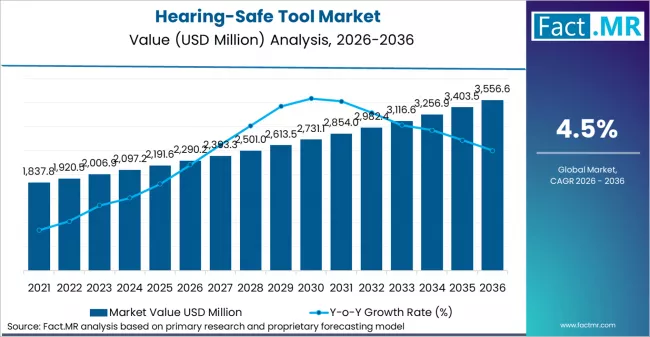
Market progression is shaped by stricter occupational noise exposure limits across construction, manufacturing, maintenance, and institutional work environments. Demand formation reflects sustained use of power tools in tasks involving prolonged close-range operation where cumulative noise exposure presents measurable health risk.
Employers increasingly specify low-noise tools as engineering controls to reduce dependence on personal protective equipment and support compliance with workplace safety standards. Adoption concentrates within professional trades and industrial MRO settings where tool usage duration, enclosed workspaces, and regulatory oversight intersect. Product preference aligns with tools delivering measurable decibel reduction while maintaining torque, cutting speed, and runtime consistency required for productivity-sensitive applications.
Growth characteristics remain anchored to replacement and specification-led upgrades rather than expansion of total tool fleets. Capital allocation favors brushless motor platforms, vibration isolation, and acoustic damping features integrated at the source of noise generation. Market momentum aligns with workforce retention strategies, liability mitigation, and standardized procurement policies that prioritize long-term hearing protection without sacrificing operational efficiency across diverse jobsite conditions.
Hearing-Safe Tool Market
| Metric | Value |
|---|---|
| Estimated Value in (2026E) | USD 2,290.2 million |
| Forecast Value in (2036F) | USD 3,556.6 million |
| Forecast CAGR 2026 to 2036 | 4.5% |
Category
| Category | Segments |
|---|---|
| Tool Type | Drills & Drivers; Saws; Sanders / Grinders; Nailers / Staplers; Others |
| Technology | Brushless Motors; Vibration Isolation; Acoustic Shrouds; Low-Noise Blades / Accessories |
| Power Source | Cordless / Battery; Corded Electric; Pneumatic; Manual |
| End User | Professional Trades; Industrial MRO; Residential DIY; Institutional |
| Region | North America; Europe; Asia Pacific; Latin America; Middle East & Africa |
Segmental Analysis
What Is the Impact of Tool Type on the Hearing-Safe Tool Market?
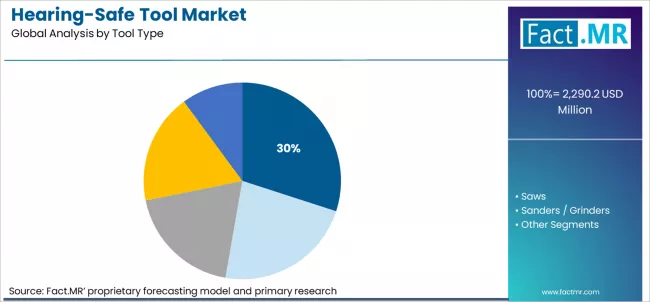
In the hearing-safe tool market, tool type influences noise exposure levels, usage duration, and adoption across professional work environments. Drills and drivers account for a 30.0% share, reflecting their widespread use across construction, assembly, and maintenance activities where prolonged operation is common. These tools are frequently operated at close proximity to users, increasing sensitivity to noise emissions. Demand for hearing-safe variants is driven by workplace safety compliance and the need to reduce cumulative noise exposure during repetitive fastening and drilling tasks in enclosed or occupied job sites.
How Does Technology Shape Adoption in the Hearing-Safe Tool Market?
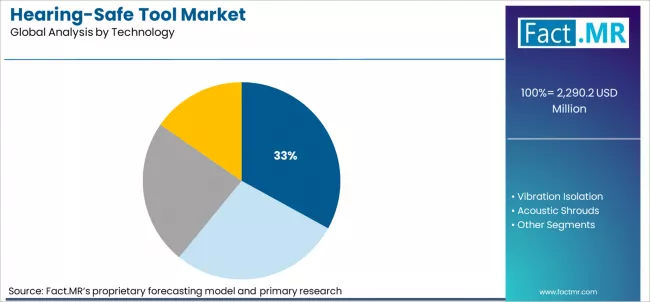
Technology selection plays a central role in determining achievable noise reduction without compromising tool performance. Brushless motors represent a 33.0% share, driven by their smoother operation, reduced mechanical friction, and lower acoustic output compared to brushed alternatives. These motors enable precise speed control and efficient power delivery, which helps minimize sudden noise spikes during operation. Adoption is strongest among professional-grade tools where durability, energy efficiency, and compliance with occupational noise standards are increasingly prioritized.
What are the Drivers, Restraints, and Key Trends in the Hearing-Safe Tool Market?
- Drivers: Demand for hearing-safe tools is shaped by occupational safety requirements and increasing awareness of noise-induced hearing loss in industrial, construction, and workshop environments. Manufacturers and facility managers specify low-noise alternatives to conventional power tools to protect workers’ hearing and meet regulatory noise exposure limits, such as those established by global occupational health organizations. Adoption is also influenced by growth in sectors where prolonged tool use is common, including automotive assembly, metalworking, woodworking, and home improvement, as well as by liability reduction initiatives and workforce wellbeing programs.
- Restraints: Higher upfront costs for engineered low-noise tools constrain adoption among small and mid-sized enterprises with limited capital budgets. In some heavy-duty applications, reduced operating noise may correlate with lower power output or slower material removal rates compared with standard tools, affecting productivity expectations. Shop environments with entrenched tool fleets face reluctance to replace legacy equipment absent compelling efficiency reads, and training on new ergonomic and noise-mitigation features can add to implementation time and cost.
- Trend 1: Integration of active noise control and vibration-damping technologies within power tools that reduce overall sound pressure levels at the source while preserving cutting, drilling, or fastening performance.
- Trend 2: Expansion of battery-powered tool portfolios engineered for noise-sensitive environments, enabling cordless operation with lower acoustic emissions and improved operator mobility without compromising torque or runtime.
Analysis of the Hearing-Safe Tool Market by Key Country
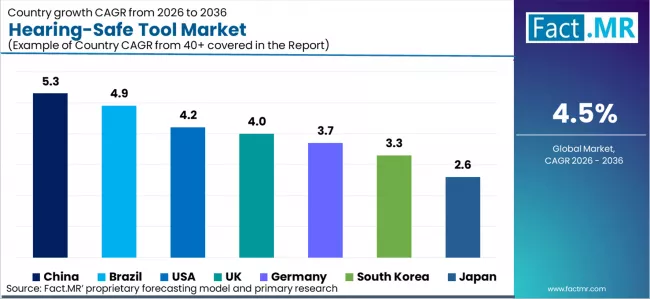
| Country | CAGR (%) |
|---|---|
| China | 5.3% |
| Brazil | 4.9% |
| USA | 4.2% |
| UK | 4.0% |
| Germany | 3.7% |
| South Korea | 3.3% |
| Japan | 2.6% |
The report covers an in-depth analysis of 40+ countries; top-performing countries are highlighted below.
What is driving growth of hearing-safe tool demand in China?
Demand for hearing-safe tools in China is expanding as industrial workplaces strengthen occupational health controls. Growth at 5.3% CAGR reflects rising enforcement of workplace noise regulations across construction sites, factories, and infrastructure projects. Rapid urban development increases usage of power tools requiring noise mitigation. Large employers prioritize integrated low-noise equipment to reduce compliance risk and workforce fatigue. Domestic manufacturers introduce hearing-safe variants aligned with cost-sensitive procurement. Demand remains concentrated within large construction contractors, manufacturing plants, and state-led infrastructure programs.
- Expansion of construction and infrastructure activity
- Enforcement of workplace noise regulations
- High utilization of power tools
- Availability of cost-competitive domestic equipment
Why is Brazil seeing expansion in hearing-safe tool adoption?
Hearing-safe tool demand in Brazil is rising as industrial safety practices mature across construction and manufacturing sectors. Growth at 4.9% CAGR reflects increasing attention to occupational health standards and reduced worker injury claims. Construction and mining activities drive demand for lower-noise equipment used in extended shifts. Employers focus on reducing absenteeism and compliance penalties. Equipment selection emphasizes durability and noise reduction suitable for harsh operating environments. Demand remains driven by domestic industrial activity rather than export-oriented manufacturing.
- Growth of construction and mining operations
- Rising focus on occupational health compliance
- Need to reduce worker fatigue and injury risk
- Preference for durable low-noise tools
What factors are shaping hearing-safe tool sales in the USA?
Sales of hearing-safe tools in the USA are increasing as employers strengthen noise exposure management programs. Growth at 4.2% CAGR reflects adoption across construction, manufacturing, and maintenance operations subject to strict safety oversight. Regulatory frameworks encourage engineering controls addressing noise at source. Labor availability challenges increase emphasis on worker retention and comfort. Tool manufacturers integrate acoustic dampening and vibration control features. Demand centers on professional-grade tools supporting compliance and productivity objectives.
- Strict occupational noise exposure regulations
- Emphasis on engineering-based noise controls
- Focus on worker retention and comfort
- Adoption in professional-grade tool segments
How is the UK supporting growth of hearing-safe tool demand?
Hearing-safe tool demand in the UK is advancing as workplace safety standards emphasize long-term health outcomes. Growth at 4.0% CAGR reflects demand from construction, utilities, and maintenance services. Employers prioritize low-noise equipment to meet exposure limits and reduce reliance on hearing protection. Public sector procurement incorporates noise criteria in equipment selection. Demand remains concentrated within regulated work environments requiring documented compliance.
- Emphasis on long-term occupational health
- Demand from construction and utilities sectors
- Procurement standards including noise limits
- Focus on compliance documentation
What is driving expansion of hearing-safe tool demand in Germany?
Demand for hearing-safe tools in Germany is rising as precision manufacturing and construction sectors align with strict safety norms. Growth at 3.7% CAGR reflects integration of low-noise equipment within regulated industrial environments. Engineering standards emphasize noise reduction, vibration control, and ergonomic design. Employers prioritize preventive safety measures within production planning. Demand remains driven by compliance-focused upgrades rather than expansion of tool fleets.
- Strong industrial safety regulations
- Focus on preventive occupational health
- Integration with ergonomic tool design
- Compliance-driven equipment replacement
How is South Korea shaping demand for hearing-safe tools?
Hearing-safe tool demand in South Korea is growing as industrial safety awareness strengthens. Growth at 3.3% CAGR reflects adoption across manufacturing, shipbuilding, and construction activities. Employers address noise exposure risks through equipment upgrades rather than procedural controls alone. Export-oriented manufacturers align safety practices with global standards. Demand centers on compact, efficient tools supporting productivity within space-constrained facilities.
- Expansion of industrial safety awareness
- Adoption within manufacturing and shipbuilding
- Alignment with global safety standards
- Demand for compact low-noise equipment
What factors are influencing hearing-safe tool demand in Japan?
Demand for hearing-safe tools in Japan is expanding gradually as workplaces emphasize precision and long-term workforce health. Growth at 2.6% CAGR reflects conservative investment patterns and focus on equipment longevity. Employers prioritize reliable low-noise tools supporting stable operations. Demand remains concentrated within specialized manufacturing and maintenance environments rather than high-volume construction activity.
- Conservative capital investment behavior
- Focus on long-term worker health
- Demand for reliable low-noise tools
- Concentration in specialized industrial settings
What Defines the Competitive Landscape for the Hearing-Safe Tool Market?
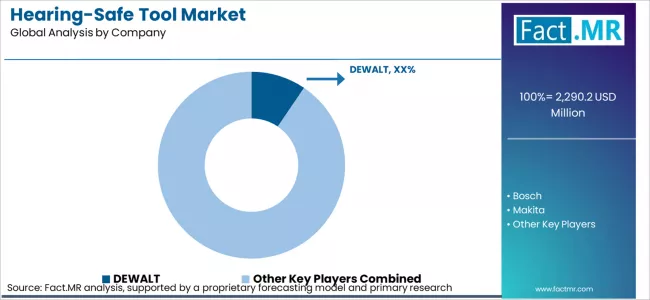
Global demand for hearing-safe tools is shaped by stricter occupational noise exposure limits, employer liability concerns, and rising awareness of long-term hearing damage. Industrial buyers and contractors evaluate tools based on measured decibel reduction, vibration control, productivity parity with conventional tools, and compliance with workplace safety standards. Assessment also includes durability under continuous use, ergonomics, battery efficiency for cordless platforms, and compatibility with existing tool ecosystems. Procurement behavior favors manufacturers offering certified noise data, fleet-level standardization, and strong service support. Industry direction reflects integration of low-noise engineering into professional-grade tools rather than reliance on personal protective equipment alone.
DEWALT holds leading positioning through broad professional tool portfolios engineered for reduced noise output without sacrificing power. Bosch competes with precision-focused designs emphasizing vibration damping and controlled motor performance. Makita maintains relevance via efficient brushless platforms balancing noise reduction and runtime. Milwaukee supports demand through high-torque cordless tools optimized for jobsite productivity while managing acoustic exposure. Hilti and Festool differentiate through premium systems targeting regulated industrial environments where noise compliance is critical. Competitive differentiation centers on verified noise performance, tool ecosystem breadth, reliability under heavy use, and alignment with occupational safety requirements.
Key Players in the Hearing-Safe Tool Market
- DEWALT
- Bosch
- Makita
- Milwaukee
- Hilti
- Festool
- Metabo
- RIDGID
- Ryobi
- Fein
Scope of the Report
| Items | Values |
|---|---|
| Quantitative Units | USD million |
| Tool Type | Drills & Drivers; Saws; Sanders / Grinders; Nailers / Staplers; Others |
| Technology | Brushless Motors; Vibration Isolation; Acoustic Shrouds; Low-Noise Blades / Accessories |
| Power Source | Cordless / Battery; Corded Electric; Pneumatic; Manual |
| End User | Professional Trades; Industrial MRO; Residential DIY; Institutional |
| Regions Covered | Asia Pacific, Europe, North America, Latin America, Middle East & Africa |
| Countries Covered | China, Brazil, USA, UK, Germany, South Korea, Japan, and 40+ countries |
| Key Companies Profiled | DEWALT; Bosch; Makita; Milwaukee; Hilti; Festool; Metabo; RIDGID; Ryobi; Fein |
| Additional Attributes | Dollar sales by tool type, power source, and end-user category; adoption driven by workplace noise exposure regulations and occupational safety standards; integration of brushless motors and low-noise accessories reducing decibel output during operation; rising demand from professional trades and industrial MRO environments prioritising hearing safety; product differentiation through vibration isolation and acoustic shrouding technologies improving operator comfort and compliance. |
Hearing-Safe Tool Market Key Segment
-
Tool Type :
- Drills & Drivers
- Saws
- Sanders / Grinders
- Nailers / Staplers
- Others
-
Technology :
- Brushless Motors
- Vibration Isolation
- Acoustic Shrouds
- Low-Noise Blades / Accessories
-
Power Source :
- Cordless / Battery
- Corded Electric
- Pneumatic
- Manual
-
End User :
- Professional Trades
- Industrial MRO
- Residential DIY
- Institutional
-
Region :
- North America
- USA
- Canada
- Mexico
- Europe
- Germany
- UK
- France
- Italy
- Spain
- Nordic Countries
- BENELUX
- Rest of Europe
- Asia Pacific
- China
- Japan
- South Korea
- India
- Australia
- Rest of Asia Pacific
- Latin America
- Brazil
- Argentina
- Rest of Latin America
- Middle East and Africa
- Kingdom of Saudi Arabia
- United Arab Emirates
- South Africa
- Rest of Middle East and Africa
- Other Regions
- Oceania
- Central Asia
- Other Markets
- North America
Bibliographies
- International Organization for Standardization. (2023). ISO 11201: Acoustics-Noise emitted by machinery and equipment-Measurement of emission sound pressure levels at a workstation. ISO.
- International Labour Organization. (2024). Prevention of noise-induced hearing loss in the workplace. ILO Publications.
- Makita Corporation. (2023). Brushless motor technology and acoustic performance in professional power tools. Makita Technical White Paper.
- Festool GmbH. (2023). Noise-reduced power tools for regulated work environments. Festool Application Engineering Notes.
- Occupational Safety and Health Administration. (2024). Occupational noise exposure: Engineering control guidance. U.S. Department of Labor.
Table of Content
- Executive Summary
- Global Market Outlook
- Demand to side Trends
- Supply to side Trends
- Technology Roadmap Analysis
- Analysis and Recommendations
- Market Overview
- Market Coverage / Taxonomy
- Market Definition / Scope / Limitations
- Research Methodology
- Chapter Orientation
- Analytical Lens and Working Hypotheses
- Market Structure, Signals, and Trend Drivers
- Benchmarking and Cross-market Comparability
- Market Sizing, Forecasting, and Opportunity Mapping
- Research Design and Evidence Framework
- Desk Research Programme (Secondary Evidence)
- Company Annual and Sustainability Reports
- Peer-reviewed Journals and Academic Literature
- Corporate Websites, Product Literature, and Technical Notes
- Earnings Decks and Investor Briefings
- Statutory Filings and Regulatory Disclosures
- Technical White Papers and Standards Notes
- Trade Journals, Industry Magazines, and Analyst Briefs
- Conference Proceedings, Webinars, and Seminar Materials
- Government Statistics Portals and Public Data Releases
- Press Releases and Reputable Media Coverage
- Specialist Newsletters and Curated Briefings
- Sector Databases and Reference Repositories
- FMR Internal Proprietary Databases and Historical Market Datasets
- Subscription Datasets and Paid Sources
- Social Channels, Communities, and Digital Listening Inputs
- Additional Desk Sources
- Expert Input and Fieldwork (Primary Evidence)
- Primary Modes
- Qualitative Interviews and Expert Elicitation
- Quantitative Surveys and Structured Data Capture
- Blended A9oach
- Why Primary Evidence is Used
- Field Techniques
- Interviews
- Surveys
- Focus Groups
- Observational and In-context Research
- Social and Community Interactions
- Stakeholder Universe Engaged
- C-suite Leaders
- Board Members
- Presidents and Vice Presidents
- R&D and Innovation Heads
- Technical Specialists
- Domain Subject-matter Experts
- Scientists
- Physicians and Other Healthcare Professionals
- Governance, Ethics, and Data Stewardship
- Research Ethics
- Data Integrity and Handling
- Primary Modes
- Tooling, Models, and Reference Databases
- Desk Research Programme (Secondary Evidence)
- Data Engineering and Model Build
- Data Acquisition and Ingestion
- Cleaning, Normalisation, and Verification
- Synthesis, Triangulation, and Analysis
- Quality Assurance and Audit Trail
- Market Background
- Market Dynamics
- Drivers
- Restraints
- Opportunity
- Trends
- Scenario Forecast
- Demand in Optimistic Scenario
- Demand in Likely Scenario
- Demand in Conservative Scenario
- Opportunity Map Analysis
- Product Life Cycle Analysis
- Supply Chain Analysis
- Investment Feasibility Matrix
- Value Chain Analysis
- PESTLE and Porter’s Analysis
- Regulatory Landscape
- Regional Parent Market Outlook
- Production and Consumption Statistics
- Import and Export Statistics
- Market Dynamics
- Global Market Analysis 2021 to 2025 and Forecast, 2026 to 2036
- Historical Market Size Value (USD Million) Analysis, 2021 to 2025
- Current and Future Market Size Value (USD Million) Projections, 2026 to 2036
- Y to o to Y Growth Trend Analysis
- Absolute $ Opportunity Analysis
- Global Market Pricing Analysis 2021 to 2025 and Forecast 2026 to 2036
- Global Market Analysis 2021 to 2025 and Forecast 2026 to 2036, By Tool Type
- Introduction / Key Findings
- Historical Market Size Value (USD Million) Analysis By Tool Type, 2021 to 2025
- Current and Future Market Size Value (USD Million) Analysis and Forecast By Tool Type, 2026 to 2036
- Drills & Drivers
- Saws
- Sanders / Grinders
- Nailers / Staplers
- Others
- Drills & Drivers
- Y to o to Y Growth Trend Analysis By Tool Type, 2021 to 2025
- Absolute $ Opportunity Analysis By Tool Type, 2026 to 2036
- Global Market Analysis 2021 to 2025 and Forecast 2026 to 2036, By Technology
- Introduction / Key Findings
- Historical Market Size Value (USD Million) Analysis By Technology, 2021 to 2025
- Current and Future Market Size Value (USD Million) Analysis and Forecast By Technology, 2026 to 2036
- Brushless Motors
- Vibration Isolation
- Acoustic Shrouds
- Low-Noise Blades / Accessories
- Brushless Motors
- Y to o to Y Growth Trend Analysis By Technology, 2021 to 2025
- Absolute $ Opportunity Analysis By Technology, 2026 to 2036
- Global Market Analysis 2021 to 2025 and Forecast 2026 to 2036, By Power Source
- Introduction / Key Findings
- Historical Market Size Value (USD Million) Analysis By Power Source, 2021 to 2025
- Current and Future Market Size Value (USD Million) Analysis and Forecast By Power Source, 2026 to 2036
- Cordless / Battery
- Corded Electric
- Pneumatic
- Manual
- Cordless / Battery
- Y to o to Y Growth Trend Analysis By Power Source, 2021 to 2025
- Absolute $ Opportunity Analysis By Power Source, 2026 to 2036
- Global Market Analysis 2021 to 2025 and Forecast 2026 to 2036, By End User
- Introduction / Key Findings
- Historical Market Size Value (USD Million) Analysis By End User, 2021 to 2025
- Current and Future Market Size Value (USD Million) Analysis and Forecast By End User, 2026 to 2036
- Professional Trades
- Industrial MRO
- Residential DIY
- Institutional
- Professional Trades
- Y to o to Y Growth Trend Analysis By End User, 2021 to 2025
- Absolute $ Opportunity Analysis By End User, 2026 to 2036
- Global Market Analysis 2021 to 2025 and Forecast 2026 to 2036, By Region
- Introduction
- Historical Market Size Value (USD Million) Analysis By Region, 2021 to 2025
- Current Market Size Value (USD Million) Analysis and Forecast By Region, 2026 to 2036
- North America
- Latin America
- Western Europe
- Eastern Europe
- East Asia
- South Asia and Pacific
- Middle East & Africa
- Market Attractiveness Analysis By Region
- North America Market Analysis 2021 to 2025 and Forecast 2026 to 2036, By Country
- Historical Market Size Value (USD Million) Trend Analysis By Market Taxonomy, 2021 to 2025
- Market Size Value (USD Million) Forecast By Market Taxonomy, 2026 to 2036
- By Country
- USA
- Canada
- Mexico
- By Tool Type
- By Technology
- By Power Source
- By End User
- By Country
- Market Attractiveness Analysis
- By Country
- By Tool Type
- By Technology
- By Power Source
- By End User
- Key Takeaways
- Latin America Market Analysis 2021 to 2025 and Forecast 2026 to 2036, By Country
- Historical Market Size Value (USD Million) Trend Analysis By Market Taxonomy, 2021 to 2025
- Market Size Value (USD Million) Forecast By Market Taxonomy, 2026 to 2036
- By Country
- Brazil
- Chile
- Rest of Latin America
- By Tool Type
- By Technology
- By Power Source
- By End User
- By Country
- Market Attractiveness Analysis
- By Country
- By Tool Type
- By Technology
- By Power Source
- By End User
- Key Takeaways
- Western Europe Market Analysis 2021 to 2025 and Forecast 2026 to 2036, By Country
- Historical Market Size Value (USD Million) Trend Analysis By Market Taxonomy, 2021 to 2025
- Market Size Value (USD Million) Forecast By Market Taxonomy, 2026 to 2036
- By Country
- Germany
- UK
- Italy
- Spain
- France
- Nordic
- BENELUX
- Rest of Western Europe
- By Tool Type
- By Technology
- By Power Source
- By End User
- By Country
- Market Attractiveness Analysis
- By Country
- By Tool Type
- By Technology
- By Power Source
- By End User
- Key Takeaways
- Eastern Europe Market Analysis 2021 to 2025 and Forecast 2026 to 2036, By Country
- Historical Market Size Value (USD Million) Trend Analysis By Market Taxonomy, 2021 to 2025
- Market Size Value (USD Million) Forecast By Market Taxonomy, 2026 to 2036
- By Country
- Russia
- Poland
- Hungary
- Balkan & Baltic
- Rest of Eastern Europe
- By Tool Type
- By Technology
- By Power Source
- By End User
- By Country
- Market Attractiveness Analysis
- By Country
- By Tool Type
- By Technology
- By Power Source
- By End User
- Key Takeaways
- East Asia Market Analysis 2021 to 2025 and Forecast 2026 to 2036, By Country
- Historical Market Size Value (USD Million) Trend Analysis By Market Taxonomy, 2021 to 2025
- Market Size Value (USD Million) Forecast By Market Taxonomy, 2026 to 2036
- By Country
- China
- Japan
- South Korea
- By Tool Type
- By Technology
- By Power Source
- By End User
- By Country
- Market Attractiveness Analysis
- By Country
- By Tool Type
- By Technology
- By Power Source
- By End User
- Key Takeaways
- South Asia and Pacific Market Analysis 2021 to 2025 and Forecast 2026 to 2036, By Country
- Historical Market Size Value (USD Million) Trend Analysis By Market Taxonomy, 2021 to 2025
- Market Size Value (USD Million) Forecast By Market Taxonomy, 2026 to 2036
- By Country
- India
- ASEAN
- Australia & New Zealand
- Rest of South Asia and Pacific
- By Tool Type
- By Technology
- By Power Source
- By End User
- By Country
- Market Attractiveness Analysis
- By Country
- By Tool Type
- By Technology
- By Power Source
- By End User
- Key Takeaways
- Middle East & Africa Market Analysis 2021 to 2025 and Forecast 2026 to 2036, By Country
- Historical Market Size Value (USD Million) Trend Analysis By Market Taxonomy, 2021 to 2025
- Market Size Value (USD Million) Forecast By Market Taxonomy, 2026 to 2036
- By Country
- Kingdom of Saudi Arabia
- Other GCC Countries
- Turkiye
- South Africa
- Other African Union
- Rest of Middle East & Africa
- By Tool Type
- By Technology
- By Power Source
- By End User
- By Country
- Market Attractiveness Analysis
- By Country
- By Tool Type
- By Technology
- By Power Source
- By End User
- Key Takeaways
- Key Countries Market Analysis
- USA
- Pricing Analysis
- Market Share Analysis, 2025
- By Tool Type
- By Technology
- By Power Source
- By End User
- Canada
- Pricing Analysis
- Market Share Analysis, 2025
- By Tool Type
- By Technology
- By Power Source
- By End User
- Mexico
- Pricing Analysis
- Market Share Analysis, 2025
- By Tool Type
- By Technology
- By Power Source
- By End User
- Brazil
- Pricing Analysis
- Market Share Analysis, 2025
- By Tool Type
- By Technology
- By Power Source
- By End User
- Chile
- Pricing Analysis
- Market Share Analysis, 2025
- By Tool Type
- By Technology
- By Power Source
- By End User
- Germany
- Pricing Analysis
- Market Share Analysis, 2025
- By Tool Type
- By Technology
- By Power Source
- By End User
- UK
- Pricing Analysis
- Market Share Analysis, 2025
- By Tool Type
- By Technology
- By Power Source
- By End User
- Italy
- Pricing Analysis
- Market Share Analysis, 2025
- By Tool Type
- By Technology
- By Power Source
- By End User
- Spain
- Pricing Analysis
- Market Share Analysis, 2025
- By Tool Type
- By Technology
- By Power Source
- By End User
- France
- Pricing Analysis
- Market Share Analysis, 2025
- By Tool Type
- By Technology
- By Power Source
- By End User
- India
- Pricing Analysis
- Market Share Analysis, 2025
- By Tool Type
- By Technology
- By Power Source
- By End User
- ASEAN
- Pricing Analysis
- Market Share Analysis, 2025
- By Tool Type
- By Technology
- By Power Source
- By End User
- Australia & New Zealand
- Pricing Analysis
- Market Share Analysis, 2025
- By Tool Type
- By Technology
- By Power Source
- By End User
- China
- Pricing Analysis
- Market Share Analysis, 2025
- By Tool Type
- By Technology
- By Power Source
- By End User
- Japan
- Pricing Analysis
- Market Share Analysis, 2025
- By Tool Type
- By Technology
- By Power Source
- By End User
- South Korea
- Pricing Analysis
- Market Share Analysis, 2025
- By Tool Type
- By Technology
- By Power Source
- By End User
- Russia
- Pricing Analysis
- Market Share Analysis, 2025
- By Tool Type
- By Technology
- By Power Source
- By End User
- Poland
- Pricing Analysis
- Market Share Analysis, 2025
- By Tool Type
- By Technology
- By Power Source
- By End User
- Hungary
- Pricing Analysis
- Market Share Analysis, 2025
- By Tool Type
- By Technology
- By Power Source
- By End User
- Kingdom of Saudi Arabia
- Pricing Analysis
- Market Share Analysis, 2025
- By Tool Type
- By Technology
- By Power Source
- By End User
- Turkiye
- Pricing Analysis
- Market Share Analysis, 2025
- By Tool Type
- By Technology
- By Power Source
- By End User
- South Africa
- Pricing Analysis
- Market Share Analysis, 2025
- By Tool Type
- By Technology
- By Power Source
- By End User
- USA
- Market Structure Analysis
- Competition Dashboard
- Competition Benchmarking
- Market Share Analysis of Top Players
- By Regional
- By Tool Type
- By Technology
- By Power Source
- By End User
- Competition Analysis
- Competition Deep Dive
- DEWALT
- Overview
- Product Portfolio
- Profitability by Market Segments (Product/Age /Sales Channel/Region)
- Sales Footprint
- Strategy Overview
- Marketing Strategy
- Product Strategy
- Channel Strategy
- Bosch
- Makita
- Milwaukee
- Hilti
- Festool
- Metabo
- RIDGID
- Ryobi
- Fein
- DEWALT
- Competition Deep Dive
- Assumptions & Acronyms Used
List Of Table
- Table 1: Global Market Value (USD Million) Forecast by Region, 2021 to 2036
- Table 2: Global Market Value (USD Million) Forecast by Tool Type, 2021 to 2036
- Table 3: Global Market Value (USD Million) Forecast by Technology, 2021 to 2036
- Table 4: Global Market Value (USD Million) Forecast by Power Source, 2021 to 2036
- Table 5: Global Market Value (USD Million) Forecast by End User, 2021 to 2036
- Table 6: North America Market Value (USD Million) Forecast by Country, 2021 to 2036
- Table 7: North America Market Value (USD Million) Forecast by Tool Type, 2021 to 2036
- Table 8: North America Market Value (USD Million) Forecast by Technology, 2021 to 2036
- Table 9: North America Market Value (USD Million) Forecast by Power Source, 2021 to 2036
- Table 10: North America Market Value (USD Million) Forecast by End User, 2021 to 2036
- Table 11: Latin America Market Value (USD Million) Forecast by Country, 2021 to 2036
- Table 12: Latin America Market Value (USD Million) Forecast by Tool Type, 2021 to 2036
- Table 13: Latin America Market Value (USD Million) Forecast by Technology, 2021 to 2036
- Table 14: Latin America Market Value (USD Million) Forecast by Power Source, 2021 to 2036
- Table 15: Latin America Market Value (USD Million) Forecast by End User, 2021 to 2036
- Table 16: Western Europe Market Value (USD Million) Forecast by Country, 2021 to 2036
- Table 17: Western Europe Market Value (USD Million) Forecast by Tool Type, 2021 to 2036
- Table 18: Western Europe Market Value (USD Million) Forecast by Technology, 2021 to 2036
- Table 19: Western Europe Market Value (USD Million) Forecast by Power Source, 2021 to 2036
- Table 20: Western Europe Market Value (USD Million) Forecast by End User, 2021 to 2036
- Table 21: Eastern Europe Market Value (USD Million) Forecast by Country, 2021 to 2036
- Table 22: Eastern Europe Market Value (USD Million) Forecast by Tool Type, 2021 to 2036
- Table 23: Eastern Europe Market Value (USD Million) Forecast by Technology, 2021 to 2036
- Table 24: Eastern Europe Market Value (USD Million) Forecast by Power Source, 2021 to 2036
- Table 25: Eastern Europe Market Value (USD Million) Forecast by End User, 2021 to 2036
- Table 26: East Asia Market Value (USD Million) Forecast by Country, 2021 to 2036
- Table 27: East Asia Market Value (USD Million) Forecast by Tool Type, 2021 to 2036
- Table 28: East Asia Market Value (USD Million) Forecast by Technology, 2021 to 2036
- Table 29: East Asia Market Value (USD Million) Forecast by Power Source, 2021 to 2036
- Table 30: East Asia Market Value (USD Million) Forecast by End User, 2021 to 2036
- Table 31: South Asia and Pacific Market Value (USD Million) Forecast by Country, 2021 to 2036
- Table 32: South Asia and Pacific Market Value (USD Million) Forecast by Tool Type, 2021 to 2036
- Table 33: South Asia and Pacific Market Value (USD Million) Forecast by Technology, 2021 to 2036
- Table 34: South Asia and Pacific Market Value (USD Million) Forecast by Power Source, 2021 to 2036
- Table 35: South Asia and Pacific Market Value (USD Million) Forecast by End User, 2021 to 2036
- Table 36: Middle East & Africa Market Value (USD Million) Forecast by Country, 2021 to 2036
- Table 37: Middle East & Africa Market Value (USD Million) Forecast by Tool Type, 2021 to 2036
- Table 38: Middle East & Africa Market Value (USD Million) Forecast by Technology, 2021 to 2036
- Table 39: Middle East & Africa Market Value (USD Million) Forecast by Power Source, 2021 to 2036
- Table 40: Middle East & Africa Market Value (USD Million) Forecast by End User, 2021 to 2036
List Of Figures
- Figure 1: Global Market Pricing Analysis
- Figure 2: Global Market Value (USD Million) Forecast 2021 to 2036
- Figure 3: Global Market Value Share and BPS Analysis by Tool Type, 2026 and 2036
- Figure 4: Global Market Y to o to Y Growth Comparison by Tool Type, 2026 to 2036
- Figure 5: Global Market Attractiveness Analysis by Tool Type
- Figure 6: Global Market Value Share and BPS Analysis by Technology, 2026 and 2036
- Figure 7: Global Market Y to o to Y Growth Comparison by Technology, 2026 to 2036
- Figure 8: Global Market Attractiveness Analysis by Technology
- Figure 9: Global Market Value Share and BPS Analysis by Power Source, 2026 and 2036
- Figure 10: Global Market Y to o to Y Growth Comparison by Power Source, 2026 to 2036
- Figure 11: Global Market Attractiveness Analysis by Power Source
- Figure 12: Global Market Value Share and BPS Analysis by End User, 2026 and 2036
- Figure 13: Global Market Y to o to Y Growth Comparison by End User, 2026 to 2036
- Figure 14: Global Market Attractiveness Analysis by End User
- Figure 15: Global Market Value (USD Million) Share and BPS Analysis by Region, 2026 and 2036
- Figure 16: Global Market Y to o to Y Growth Comparison by Region, 2026 to 2036
- Figure 17: Global Market Attractiveness Analysis by Region
- Figure 18: North America Market Incremental Dollar Opportunity, 2026 to 2036
- Figure 19: Latin America Market Incremental Dollar Opportunity, 2026 to 2036
- Figure 20: Western Europe Market Incremental Dollar Opportunity, 2026 to 2036
- Figure 21: Eastern Europe Market Incremental Dollar Opportunity, 2026 to 2036
- Figure 22: East Asia Market Incremental Dollar Opportunity, 2026 to 2036
- Figure 23: South Asia and Pacific Market Incremental Dollar Opportunity, 2026 to 2036
- Figure 24: Middle East & Africa Market Incremental Dollar Opportunity, 2026 to 2036
- Figure 25: North America Market Value Share and BPS Analysis by Country, 2026 and 2036
- Figure 26: North America Market Value Share and BPS Analysis by Tool Type, 2026 and 2036
- Figure 27: North America Market Y to o to Y Growth Comparison by Tool Type, 2026 to 2036
- Figure 28: North America Market Attractiveness Analysis by Tool Type
- Figure 29: North America Market Value Share and BPS Analysis by Technology, 2026 and 2036
- Figure 30: North America Market Y to o to Y Growth Comparison by Technology, 2026 to 2036
- Figure 31: North America Market Attractiveness Analysis by Technology
- Figure 32: North America Market Value Share and BPS Analysis by Power Source, 2026 and 2036
- Figure 33: North America Market Y to o to Y Growth Comparison by Power Source, 2026 to 2036
- Figure 34: North America Market Attractiveness Analysis by Power Source
- Figure 35: North America Market Value Share and BPS Analysis by End User, 2026 and 2036
- Figure 36: North America Market Y to o to Y Growth Comparison by End User, 2026 to 2036
- Figure 37: North America Market Attractiveness Analysis by End User
- Figure 38: Latin America Market Value Share and BPS Analysis by Country, 2026 and 2036
- Figure 39: Latin America Market Value Share and BPS Analysis by Tool Type, 2026 and 2036
- Figure 40: Latin America Market Y to o to Y Growth Comparison by Tool Type, 2026 to 2036
- Figure 41: Latin America Market Attractiveness Analysis by Tool Type
- Figure 42: Latin America Market Value Share and BPS Analysis by Technology, 2026 and 2036
- Figure 43: Latin America Market Y to o to Y Growth Comparison by Technology, 2026 to 2036
- Figure 44: Latin America Market Attractiveness Analysis by Technology
- Figure 45: Latin America Market Value Share and BPS Analysis by Power Source, 2026 and 2036
- Figure 46: Latin America Market Y to o to Y Growth Comparison by Power Source, 2026 to 2036
- Figure 47: Latin America Market Attractiveness Analysis by Power Source
- Figure 48: Latin America Market Value Share and BPS Analysis by End User, 2026 and 2036
- Figure 49: Latin America Market Y to o to Y Growth Comparison by End User, 2026 to 2036
- Figure 50: Latin America Market Attractiveness Analysis by End User
- Figure 51: Western Europe Market Value Share and BPS Analysis by Country, 2026 and 2036
- Figure 52: Western Europe Market Value Share and BPS Analysis by Tool Type, 2026 and 2036
- Figure 53: Western Europe Market Y to o to Y Growth Comparison by Tool Type, 2026 to 2036
- Figure 54: Western Europe Market Attractiveness Analysis by Tool Type
- Figure 55: Western Europe Market Value Share and BPS Analysis by Technology, 2026 and 2036
- Figure 56: Western Europe Market Y to o to Y Growth Comparison by Technology, 2026 to 2036
- Figure 57: Western Europe Market Attractiveness Analysis by Technology
- Figure 58: Western Europe Market Value Share and BPS Analysis by Power Source, 2026 and 2036
- Figure 59: Western Europe Market Y to o to Y Growth Comparison by Power Source, 2026 to 2036
- Figure 60: Western Europe Market Attractiveness Analysis by Power Source
- Figure 61: Western Europe Market Value Share and BPS Analysis by End User, 2026 and 2036
- Figure 62: Western Europe Market Y to o to Y Growth Comparison by End User, 2026 to 2036
- Figure 63: Western Europe Market Attractiveness Analysis by End User
- Figure 64: Eastern Europe Market Value Share and BPS Analysis by Country, 2026 and 2036
- Figure 65: Eastern Europe Market Value Share and BPS Analysis by Tool Type, 2026 and 2036
- Figure 66: Eastern Europe Market Y to o to Y Growth Comparison by Tool Type, 2026 to 2036
- Figure 67: Eastern Europe Market Attractiveness Analysis by Tool Type
- Figure 68: Eastern Europe Market Value Share and BPS Analysis by Technology, 2026 and 2036
- Figure 69: Eastern Europe Market Y to o to Y Growth Comparison by Technology, 2026 to 2036
- Figure 70: Eastern Europe Market Attractiveness Analysis by Technology
- Figure 71: Eastern Europe Market Value Share and BPS Analysis by Power Source, 2026 and 2036
- Figure 72: Eastern Europe Market Y to o to Y Growth Comparison by Power Source, 2026 to 2036
- Figure 73: Eastern Europe Market Attractiveness Analysis by Power Source
- Figure 74: Eastern Europe Market Value Share and BPS Analysis by End User, 2026 and 2036
- Figure 75: Eastern Europe Market Y to o to Y Growth Comparison by End User, 2026 to 2036
- Figure 76: Eastern Europe Market Attractiveness Analysis by End User
- Figure 77: East Asia Market Value Share and BPS Analysis by Country, 2026 and 2036
- Figure 78: East Asia Market Value Share and BPS Analysis by Tool Type, 2026 and 2036
- Figure 79: East Asia Market Y to o to Y Growth Comparison by Tool Type, 2026 to 2036
- Figure 80: East Asia Market Attractiveness Analysis by Tool Type
- Figure 81: East Asia Market Value Share and BPS Analysis by Technology, 2026 and 2036
- Figure 82: East Asia Market Y to o to Y Growth Comparison by Technology, 2026 to 2036
- Figure 83: East Asia Market Attractiveness Analysis by Technology
- Figure 84: East Asia Market Value Share and BPS Analysis by Power Source, 2026 and 2036
- Figure 85: East Asia Market Y to o to Y Growth Comparison by Power Source, 2026 to 2036
- Figure 86: East Asia Market Attractiveness Analysis by Power Source
- Figure 87: East Asia Market Value Share and BPS Analysis by End User, 2026 and 2036
- Figure 88: East Asia Market Y to o to Y Growth Comparison by End User, 2026 to 2036
- Figure 89: East Asia Market Attractiveness Analysis by End User
- Figure 90: South Asia and Pacific Market Value Share and BPS Analysis by Country, 2026 and 2036
- Figure 91: South Asia and Pacific Market Value Share and BPS Analysis by Tool Type, 2026 and 2036
- Figure 92: South Asia and Pacific Market Y to o to Y Growth Comparison by Tool Type, 2026 to 2036
- Figure 93: South Asia and Pacific Market Attractiveness Analysis by Tool Type
- Figure 94: South Asia and Pacific Market Value Share and BPS Analysis by Technology, 2026 and 2036
- Figure 95: South Asia and Pacific Market Y to o to Y Growth Comparison by Technology, 2026 to 2036
- Figure 96: South Asia and Pacific Market Attractiveness Analysis by Technology
- Figure 97: South Asia and Pacific Market Value Share and BPS Analysis by Power Source, 2026 and 2036
- Figure 98: South Asia and Pacific Market Y to o to Y Growth Comparison by Power Source, 2026 to 2036
- Figure 99: South Asia and Pacific Market Attractiveness Analysis by Power Source
- Figure 100: South Asia and Pacific Market Value Share and BPS Analysis by End User, 2026 and 2036
- Figure 101: South Asia and Pacific Market Y to o to Y Growth Comparison by End User, 2026 to 2036
- Figure 102: South Asia and Pacific Market Attractiveness Analysis by End User
- Figure 103: Middle East & Africa Market Value Share and BPS Analysis by Country, 2026 and 2036
- Figure 104: Middle East & Africa Market Value Share and BPS Analysis by Tool Type, 2026 and 2036
- Figure 105: Middle East & Africa Market Y to o to Y Growth Comparison by Tool Type, 2026 to 2036
- Figure 106: Middle East & Africa Market Attractiveness Analysis by Tool Type
- Figure 107: Middle East & Africa Market Value Share and BPS Analysis by Technology, 2026 and 2036
- Figure 108: Middle East & Africa Market Y to o to Y Growth Comparison by Technology, 2026 to 2036
- Figure 109: Middle East & Africa Market Attractiveness Analysis by Technology
- Figure 110: Middle East & Africa Market Value Share and BPS Analysis by Power Source, 2026 and 2036
- Figure 111: Middle East & Africa Market Y to o to Y Growth Comparison by Power Source, 2026 to 2036
- Figure 112: Middle East & Africa Market Attractiveness Analysis by Power Source
- Figure 113: Middle East & Africa Market Value Share and BPS Analysis by End User, 2026 and 2036
- Figure 114: Middle East & Africa Market Y to o to Y Growth Comparison by End User, 2026 to 2036
- Figure 115: Middle East & Africa Market Attractiveness Analysis by End User
- Figure 116: Global Market - Tier Structure Analysis
- Figure 117: Global Market - Company Share Analysis
- FAQs -
How big is the hearing-safe tool market in 2026?
The global hearing-safe tool market is estimated to be valued at USD 2,290.2 million in 2026.
What will be the size of hearing-safe tool market in 2036?
The market size for the hearing-safe tool market is projected to reach USD 3,556.6 million by 2036.
How much will be the hearing-safe tool market growth between 2026 and 2036?
The hearing-safe tool market is expected to grow at a 4.5% CAGR between 2026 and 2036.
What are the key product types in the hearing-safe tool market?
The key product types in hearing-safe tool market are drills & drivers, saws, sanders / grinders, nailers / staplers and others.
Which technology segment to contribute significant share in the hearing-safe tool market in 2026?
In terms of technology, brushless motors segment to command 33.0% share in the hearing-safe tool market in 2026.