- Base Value(2025): 3.8 Bn
- Estimated Value(2026): 4.5 Bn
- Forecast Value (2036): 28.9 Bn
- CAGR (2026 - 2036): 20.4%
Heavy-Duty Truck Megapack Battery Systems Market Forecast and Outlook by Fact.MR
- In 2025, the heavy-duty truck megapack battery systems market was valued at USD 3.8 billion.
- It is estimated to reach USD 4.5 billion in 2026 and expand significantly to USD 28.9 billion by 2036, reflecting a CAGR of 20.4%.
- This trajectory highlights a structural shift rather than incremental growth.
- The market is being reshaped by fleet electrification mandates, continuous decline in battery cell costs, and rising investment in depot charging infrastructure.
- At the same time, adoption is not uniform. Grid interconnection delays, constraints in lithium and nickel supply chains, and high upfront capital requirements continue to slow penetration in cost-sensitive freight segments.
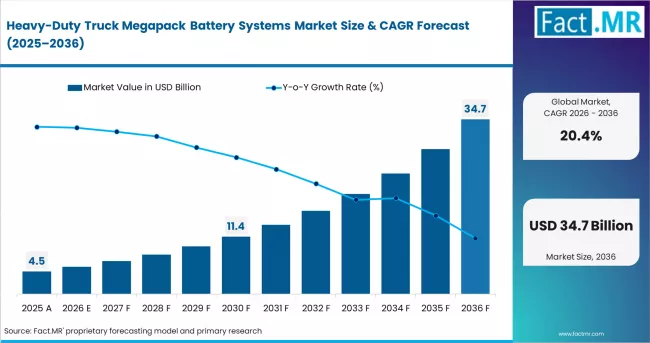
Heavy Duty Truck Megapack Battery Systems Market Value Analysis | Source: Fact.MR
| Metric | Value |
|---|---|
| Estimated Value in 2026 | USD 4.5 billion |
| Forecast Value in 2036 | USD 28.9 billion |
| Forecast CAGR (2026 to 2036) | 20.4% |
Source: Fact.MR analysis. Updated May 11, 2026
Summary of the Heavy-Duty Truck Megapack Battery Systems Market
- Market Definition
- Market covers large-format battery packs of 500 kWh and above integrated into Class 7–8 heavy freight vehicles, long-haul trucks, and industrial transport globally.
- Demand Drivers
- Stringent EPA 2027 heavy-duty emission standards are accelerating fleet procurement of zero-emission battery-electric trucks across North American freight corridors.
- China's MIIT commercial vehicle electrification mandates are driving large-format battery pack procurement by domestic logistics and fleet operators.
- Declining lithium-ion cell costs and expanding depot charging networks are reducing total cost of ownership barriers for megapack system adoption in long-haul freight.
- Key Segments Analyzed
- By System Capacity: 500 kWh–1 MWh pack systems lead with approximately 45% share in 2026, driven by regional haul and depot-based fleet operations requiring mid-to-high energy density.
- By Application: Long-haul and freight trucks lead with approximately 50% share in 2026, as electrification expands into heavy logistics corridors with high daily mileage requirements.
- By Geography: China leads with a 22.8% CAGR, supported by domestic cell manufacturing scale, state-backed fleet mandates, and low-cost pack assembly infrastructure.
- Analyst Opinion at FACT.MR
- Shambhu Nath Jha, Principal Consultant at Fact.MR, opines, CXOs will find that the 500 kWh to 1 MWh capacity tier is emerging as the most commercially actionable segment. It is where capital deployment aligns with fleet electrification mandates. It also matches the evolution of depot charging infrastructure.
- Strategic Implications / Executive Takeaways
- Prioritize 500 kWh–1 MWh pack system development targeting long-haul fleet operators in China, the United States, and Germany to capture the highest-volume procurement channels.
- Develop multi-year fleet supply agreements with integrated warranty and telematics offerings to lock in logistics customers and reduce switching risk.
- Align cell sourcing with CATL, LG Energy Solution, or Samsung SDI to ensure supply chain resilience under IRA domestic content requirements and EU battery regulation compliance.
- Methodology
- Market sizing uses OEM cell shipment volumes and pack-level average selling prices validated against fleet procurement and charging infrastructure deployment data.
- Incorporates IEA transport electrification statistics, MIIT commercial vehicle registrations, and EPA regulatory impact assessments.
- Forecasts factor in fleet adoption rates, battery cost curves, grid infrastructure rollout, and expert inputs from fleet electrification specialists.
Over the 2026 to 2036 period, the market is expected to create an absolute opportunity of USD 24.4 billion. This expansion is closely tied to regulatory enforcement and large-scale fleet transition strategies. Logistics operators are increasingly aligning procurement with high-capacity battery systems to meet emission targets and improve operational efficiency. However, infrastructure readiness and supply chain stability remain critical gating factors for sustained scale-up.
From a regional perspective, growth patterns vary based on policy intensity and industrial capability. China remains at the forefront with a projected CAGR of 22.8%, supported by strong regulatory backing and domestic battery manufacturing leadership led by CATL. India is emerging as a high-growth market at 21.2%, driven by FAME III incentives and production-linked schemes for battery manufacturing. In Europe, Sweden is advancing at 20.9% with support from Northvolt’s cell production ecosystem and Scania’s electrification roadmap. Germany and the Netherlands are also progressing steadily, supported by EU emissions targets and zero-emission freight regulations, though infrastructure coordination remains complex. The United States is expanding at 21.6%, driven by EPA 2027 emission standards and fiscal incentives under the Inflation Reduction Act, reinforcing long-term electrification of heavy-duty transport.
Segmental Analysis
Heavy-Duty Truck Megapack Battery Systems Market Analysis by System Capacity
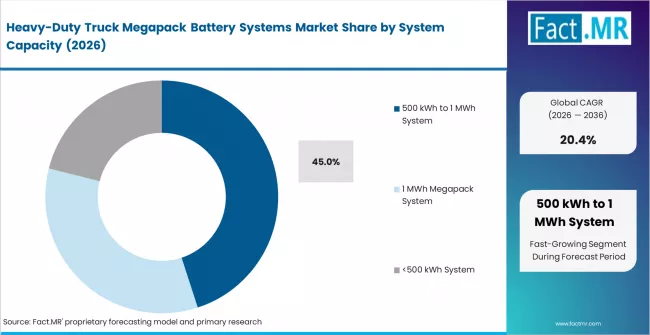
Heavy Duty Truck Megapack Battery Systems Market Analysis By System Capacity | Source: Fact.MR
Based on FACT.MR analysis, 500 kWh to 1 MWh systems hold 45% share in 2026. This segment aligns with regional haul operations. It matches depot-based charging infrastructure. These systems support sub-400 km duty cycles. They balance range and charging feasibility.
- Tesla Energy Megapack Truck Integration: Tesla, Inc. confirmed integration of semi-truck battery systems with Megacharger networks in Q3 2024. The system targets 500–800 kWh range. Pilot deployments are active in California and Texas [4].
- CATL Cell Technology Advancement: CATL launched Qilin 3.0 in 2025. The system supports 500 kWh and above applications. It improves energy density and thermal performance. It is designed for heavy-duty trucks [5].
- 1 MWh System Adoption Trend: The Global EV Outlook 2025 by the International Energy Agency shows rising adoption. Battery packs above 800 kWh increased share by 18% in 2024. Logistics operators in China and Europe are leading this shift [6].
Heavy-Duty Truck Megapack Battery Systems Market Analysis by Application
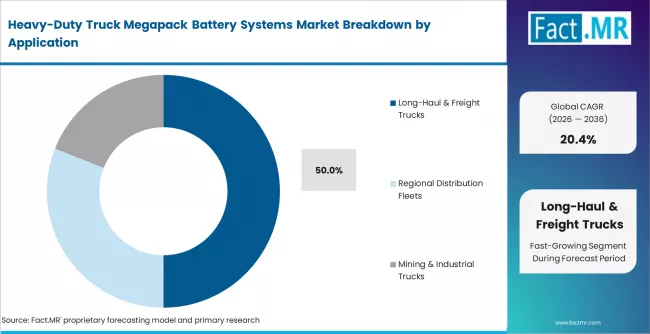
Heavy Duty Truck Megapack Battery Systems Market Analysis By Application | Source: Fact.MR
Based on FACT.MR analysis, long-haul and freight trucks hold 50% share in 2026. These applications require high daily energy throughput. Megawatt-class charging infrastructure is expanding. This supports long-distance freight electrification.
- BYD Freight Fleet Expansion: BYD delivered 3,000 electric freight trucks in H2 2024. Each unit uses 350–500 kWh packs. Deployments focus on major logistics corridors in China [7].
- Northvolt Mining Truck Development: Northvolt partnered with Epiroc in 2025. They are developing 1 MWh battery systems for mining trucks. The goal is zero-emission operations by 2027 [8].
- Regional Distribution Fleet Electrification Trend: BloombergNEF reported 34% growth in Europe in 2024. Battery pack sizes averaged 450 kWh. Adoption is strong across grocery and parcel logistics operators in Germany, France, and the Netherlands.
Drivers, Restraints, and Opportunities
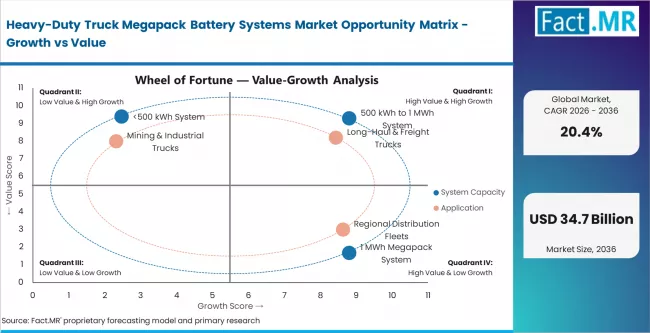
Heavy Duty Truck Megapack Battery Systems Market Opportunity Matrix Growth Vs Value | Source: Fact.MR
FACT.MR analysts observe that the heavy-duty truck megapack battery systems market has moved beyond pilot deployment. It is now in an early-commercial scaling phase. Earlier demand was driven by government-funded demonstration projects. It is now shaped by regulatory mandates and fleet cost structures.
Demand is shifting toward higher-capacity systems. Freight operators recognize that smaller packs increase lifecycle costs. Long-haul routes require 1 MWh and above configurations. These enable viable range and operational efficiency. Regional fleets are adopting 500–750 kWh systems.
- EPA 2027 Heavy-Duty Emission Standards: The United States Environmental Protection Agency finalized Phase 3 standards in 2024. These require major CO2 reductions for Class 7–8 trucks by 2027. Freight operators are placing early megapack orders. Cummins Inc. and Daimler Truck North America have accelerated electric truck development timelines [1].
- EU CO2 Fleet Regulation 2025: The EU regulation mandates a 45% CO2 reduction by 2030. Logistics operators are piloting electric freight trucks. DB Schenker and DHL are deploying megapack trucks on high-frequency routes. TRATON Group announced a EUR 2.6 billion electrification plan in Q1 2025 [2].
- China MIIT Electric Commercial Vehicle Mandate: China updated NEV quotas in 2024. These require increasing electric truck sales ratios. BYD and CATL are expanding supply capacity. This is supporting mandate-driven procurement and scaling production [3].
Regional Analysis
The heavy-duty truck megapack battery systems market is assessed across Asia Pacific, North America, Europe, Latin America, and Middle East and Africa, covering 40+ countries with distinct demand profiles shaped by fleet electrification mandates, charging infrastructure deployment, regulatory frameworks, and OEM battery pack supply strategies. The full report offers market attractiveness analysis by region and country.
.webp "Top Country Growth Comparison Heavy Duty Truck Megapack Battery Systems Market Cagr (2026 2036)")
Top Country Growth Comparison Heavy Duty Truck Megapack Battery Systems Market Cagr (2026 2036) | Source: Fact.MR
| Country | CAGR (2026 to 2036) |
|---|---|
| China | 22.8% |
| United States | 21.6% |
| Sweden | 20.9% |
| India | 21.2% |
| Netherlands | 19.8% |
| Germany | 19.4% |
Source: Fact.MR analysis. Updated May 11, 2026
Source: Fact.MR (FACT.MR) analysis, based on proprietary forecasting model and primary research
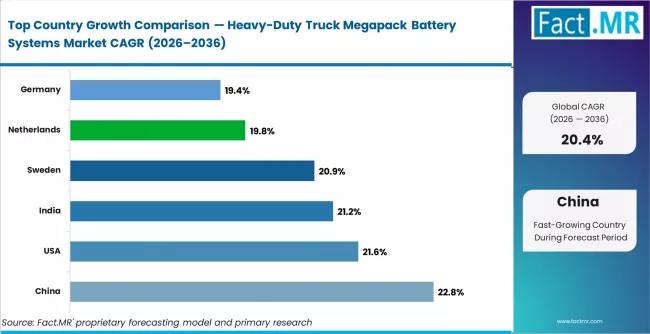
Heavy Duty Truck Megapack Battery Systems Market Cagr Analysis By Country | Source: Fact.MR
Asia Pacific Heavy-Duty Truck Megapack Battery Systems Market Analysis
Asia Pacific leads in both scale and execution depth. China anchors volume through policy-backed fleet electrification and domestic cell manufacturing strength. India is building momentum through incentive-driven fleet transition and local assembly expansion. CATL, BYD, and Tata Motors anchor regional supply through vertically integrated models and OEM-led programmes.
- China: China represents a mandate-driven scale market. Growth is tracking at 22.8% CAGR through 2036. MIIT commercial vehicle quotas are accelerating electric truck procurement. CATL and BYD delivered over 12,000 heavy-duty battery systems in 2024. State-backed tenders in Guangdong and Shandong are driving deployment. National highway charging corridors are enabling 1 MWh-class operations.
- India: India reflects a policy-supported transition market. Growth is tracking at 21.2% CAGR through 2036. FAME III incentives are expanding commercial EV adoption. Tata Motors and Olectra Greentech are investing in heavy-duty electric platforms. PLI schemes are strengthening domestic battery manufacturing. Highway charging plans are improving long-haul feasibility.
Fact.MR’s analysis covers China, India, Japan, South Korea, ASEAN, and Australia and New Zealand. It includes fleet procurement benchmarks, infrastructure rollout data, and policy impact analysis.
North America Heavy-Duty Truck Megapack Battery Systems Market Analysis
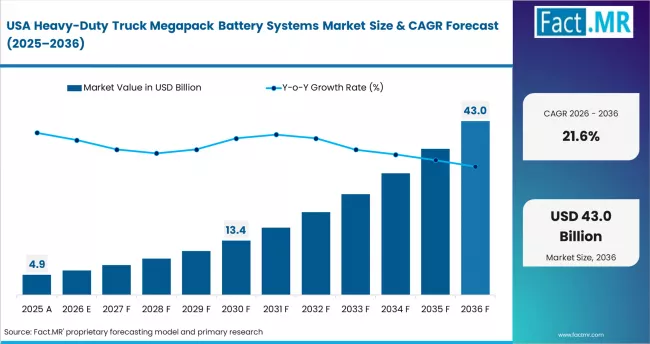
Heavy Duty Truck Megapack Battery Systems Market Country Value Analysis | Source: Fact.MR
North America is shaped by regulatory enforcement and large fleet procurement cycles. Federal incentives and emission standards are structuring adoption timelines. Tesla, Inc. and emerging integrators are competing for multi-year supply agreements.
- United States: The U.S. market reflects compliance-led electrification. Growth is tracking at 21.6% CAGR through 2036. EPA Phase 3 emission standards are mandating zero-emission truck adoption from 2027. The Inflation Reduction Act provides up to USD 40,000 per vehicle in incentives. Tesla, Inc. is scaling Semi production to meet fleet demand.
Fact.MR’s analysis covers the United States, Canada, and Mexico. It includes regulatory timelines, fleet procurement trends, and infrastructure investment benchmarks.
Europe Heavy-Duty Truck Megapack Battery Systems Market Analysis
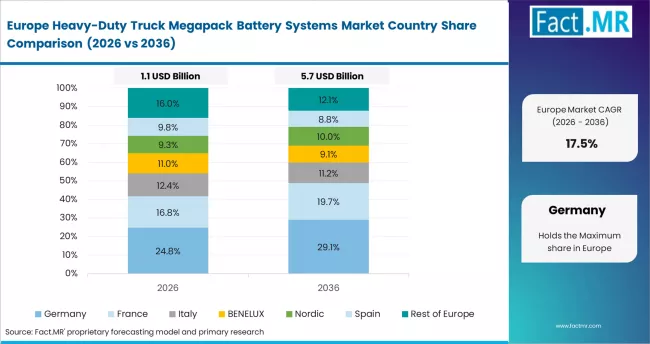
Heavy Duty Truck Megapack Battery Systems Market Europe Country Market Share Analysis, 2026 & 2036 | Source: Fact.MR
Europe is a compliance-intensive and OEM-led market. EU CO2 targets and national freight regulations are accelerating adoption. TRATON Group, Volvo Trucks, and Daimler Truck lead electrification investment.
- Germany: Germany represents the core engineering and deployment hub. Growth is tracking at 19.4% CAGR through 2036. EU fleet regulations are driving transition timelines. TRATON Group committed EUR 2.6 billion to heavy truck electrification. National policies support megawatt charging infrastructure across logistics hubs. Freight operators are piloting electric corridors to meet compliance targets.
- Sweden: Sweden reflects a supply chain-integrated innovation market. Growth is tracking at 20.9% CAGR through 2036. Northvolt is enabling domestic cell production. Scania is deploying battery-electric trucks for industrial fleets. Carbon policies and green corridor investments are supporting adoption.
- Netherlands: The Netherlands represents a regulation-driven logistics market. Growth is tracking at 19.8% CAGR through 2036. Zero-emission freight zones are mandating electric truck adoption. Port-led infrastructure is enabling continuous operations. DAF Trucks is scaling heavy-duty electric platforms for regional fleets.
Fact.MR’s analysis covers Germany, France, the United Kingdom, Italy, Spain, Sweden, the Netherlands, and Rest of Europe. It includes regulatory timelines, OEM investments, and infrastructure deployment trends.
Competitive Aligners for Market Players
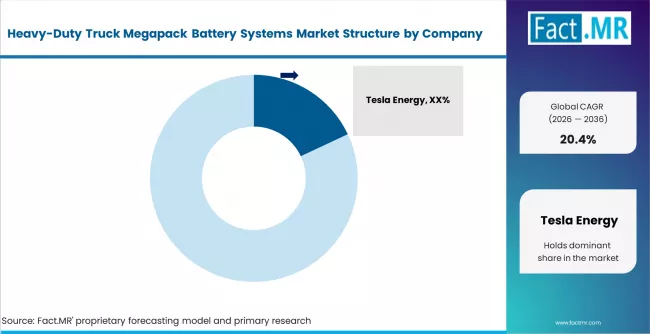
Heavy Duty Truck Megapack Battery Systems Market Analysis By Company | Source: Fact.MR
The heavy-duty truck megapack battery systems market shows a mixed structure. It is concentrated at the cell supply level but more fragmented at the system integration level. A few major players control core battery production. Tesla, Inc., CATL, and BYD benefit from strong vertical integration. They manage both cell manufacturing and pack assembly. In contrast, LG Energy Solution and Samsung SDI primarily act as Tier 1 suppliers to multiple OEMs. Northvolt holds a strategic position in Europe through close partnerships with Scania and Volkswagen Group commercial vehicles. Together, the top five players account for nearly 65% of global supply capacity.
Companies with in-house cell production enjoy clear advantages. CATL uses cell-to-pack architecture, reducing cost and weight. This provides a price advantage of around 12–18% over non-integrated competitors. BYD follows a similar approach with its blade battery design. These efficiencies create high entry barriers for smaller system integrators.
Fleet buyers follow cautious procurement strategies. Supplier qualification can take 18 to 24 months. Once approved, incumbents gain strong positioning. Large operators like Amazon and Walmart often work with two suppliers per platform. This reduces supply risk. While integrated players hold pricing power today, increasing competition is gradually putting pressure on margins.
Key Players
- Tesla Energy
- CATL (Contemporary Amperex Technology Co., Limited)
- BYD Co. Ltd
- LG Energy Solution Ltd
- Samsung SDI Co., Ltd
- Northvolt AB
- Daimler Truck AG
- TRATON Group SE
- Volvo Group
- Proterra Inc.
Bibliography
- [1] U.S. Environmental Protection Agency. (March 2024). EPA Phase 3 Greenhouse Gas Standards for Heavy-Duty Vehicles: Final Rule Including Zero-Emission Truck Sales Requirements for Class 7–8 Freight Vehicles from Model Year 2027. epa.gov/regulations-emissions-vehicles-and-engines/final-rule-srgreenhouse-gas-emissions-standards-heavy-duty
- [2] TRATON Group SE. (Q1 2025). Press Release: EUR 2.6 Billion Electrification Investment Programme for Battery-Electric Heavy Trucks Including Scania and MAN Commercial Vehicle Platforms. traton.com/en/newsroom
- [3] BloombergNEF. (2024). Electric Vehicle Outlook 2024: Heavy-Duty Commercial Vehicle Battery Pack Size Trends, Regional Distribution Fleet Electrification Growth, and Lithium-Ion Cell Cost Deflation Analysis. about.bnef.com/electric-vehicle-outlook
- [4] Tesla Inc. (Q3 2024). Investor Update: Tesla Semi Megacharger Network Deployment and 500–800 kWh Battery Pack Integration for Fleet Logistics Partners in California and Texas Operations. ir.tesla.com
- [5] CATL (Contemporary Amperex Technology Co., Limited). (Q1 2025). Product Launch: Qilin 3.0 Cell-to-Pack Battery System for Heavy Commercial Vehicle Applications Validated at 500 kWh and Above for Long-Haul Duty Cycles. catl.com/news
- [6] International Energy Agency. (2025). Global EV Outlook 2025: Heavy-Duty Commercial Vehicle Battery Pack Deployment Trends Including Share Growth of 800 kWh+ Systems in New Truck Registrations Across Key Markets. iea.org/reports/global-ev-outlook-2025
- [7] BYD Co. Ltd. (H2 2024). Corporate Announcement: Delivery of 3,000 Battery-Electric Heavy Freight Trucks to Chinese Logistics Operators Equipped with 350–500 kWh Pack Systems on Guangdong and Yangtze River Delta Freight Corridors. byd.com/en/news
- [8] Northvolt AB and Epiroc AB. (Q1 2025). Joint Programme Announcement: Development of 1 MWh Battery Systems for Underground Mining Trucks Targeting Scandinavian and Canadian Hard-Rock Mine Operators with Zero-Emission Compliance by 2027. northvolt.com/articles
This Report Addresses
- Strategic intelligence on heavy-duty truck megapack battery system demand across long-haul freight, regional distribution, and mining and industrial applications globally.
- Market forecast from USD 4.5 billion in 2026 to USD 28.9 billion by 2036, at a CAGR of 20.4%.
- Opportunity mapping across China MIIT-led fleet mandates, U.S. IRA incentive-driven procurement, EU CO2 regulation-led OEM electrification, Sweden Northvolt supply chain depth, and Netherlands zero-emission freight zone demand.
- Segment analysis by system capacity (sub-500 kWh, 500 kWh–1 MWh, 1 MWh+) and application (long-haul, regional distribution, mining) across global and regional markets.
- Regional outlook covering Asia Pacific fleet mandate-led growth, North America IRA-supported procurement, and Europe CO2 compliance-driven OEM investment.
- Competitive landscape of Tesla Energy, CATL, BYD, LG Energy Solution, Samsung SDI, and Northvolt covering cell integration depth, OEM alignment, and fleet qualification positioning.
- Regulatory analysis covering EPA Phase 3 emission standards, EU Heavy-Duty CO2 Regulation 2025, China MIIT commercial NEV quotas, India FAME III scheme, and national zero-emission freight zone mandates.
- Report delivered in PDF, Excel, and presentation formats supported by validated OEM shipment data, fleet procurement benchmarks, and industry expert inputs.
Heavy-Duty Truck Megapack Battery Systems Market Definition
The heavy-duty truck megapack battery systems market covers large-format battery packs of 500 kWh and above, designed for integration into Class 7–8 trucks, long-haul freight vehicles, and heavy industrial transport.
Heavy-Duty Truck Megapack Battery Systems Market Inclusions
Covers global and regional forecasts from 2026 to 2036 by system capacity and application. Includes 500 kWh–1 MWh pack systems, 1 MWh megapack systems, and sub-500 kWh configurations. Applications covered include long-haul freight, regional distribution, and mining and industrial transport.
Heavy-Duty Truck Megapack Battery Systems Market Exclusions
Excludes passenger electric vehicle battery systems and light commercial vehicle packs. Omits stationary grid-scale energy storage megapacks not integrated into vehicle powertrains. Also excludes hydrogen fuel cell systems and hybrid powertrain battery components below Class 6 vehicle classifications.
Heavy-Duty Truck Megapack Battery Systems Market Research Methodology
- Primary Research
- Interviews with battery pack integrators, fleet electrification managers, logistics operators, and charging infrastructure developers across key markets.
- Desk Research
- Analysis of reports from Tesla Energy, CATL, Northvolt, BYD, and LG Energy Solution, alongside IEA transport electrification data and regional fleet procurement benchmarks.
- Market-Sizing and Forecasting
- Hybrid approach using cell shipment volumes, pack-level average selling prices, application-specific adoption rates, and fleet electrification mandates across freight segments.
- Data Validation and Update Cycle
- Validated through OEM shipment data, freight fleet procurement records, and grid charging infrastructure deployment statistics. Updated through expert interviews and policy monitoring.
Segmentation
Scope of the Report
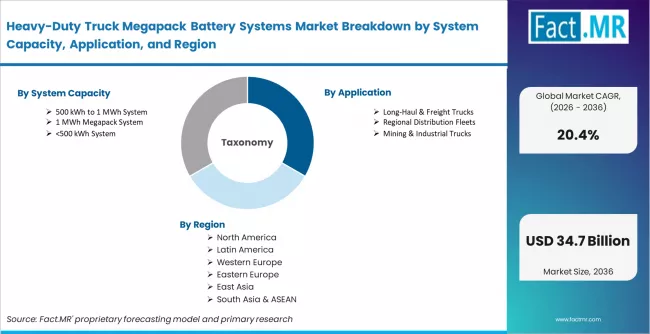
Heavy Duty Truck Megapack Battery Systems Market Breakdown By System Capacity, Application, And Region | Source: Fact.MR
| Attribute | Details |
|---|---|
| Quantitative Units | USD 4.5 billion (2026) to USD 28.9 billion (2036), at a CAGR of 20.4% |
| Market Definition | Large-format battery pack systems of 500 kWh and above, integrated into Class 7–8 heavy freight trucks, long-haul vehicles, and industrial transport, combining cell modules, battery management systems, and thermal regulation for sustained commercial duty cycles globally. |
| System Capacity Segmentation | 500 kWh – 1 MWh Pack Systems, 1 MWh Megapack Systems, <500 kWh Systems |
| Application Segmentation | Long-Haul & Freight Trucks, Regional Distribution Fleets, Mining & Industrial Trucks |
| Application Coverage | Long-haul intercity freight electrification, depot-charged regional logistics fleet operations, underground and surface mining truck zero-emission compliance, and industrial heavy transport electrification programmes. |
| Regions Covered | North America, Europe, Asia Pacific, Latin America, Middle East and Africa |
| Countries Covered | USA, Canada, Mexico, Germany, UK, France, Italy, Spain, Sweden, Netherlands, Nordic, BENELUX, China, Japan, South Korea, India, ASEAN, Australia and New Zealand, Brazil, Argentina, Chile, UAE, Saudi Arabia, GCC, Turkey, South Africa, Rest of MEA |
| Key Companies Profiled | Tesla Energy, CATL, BYD Co. Ltd, LG Energy Solution, Samsung SDI, Northvolt AB, Daimler Truck AG, TRATON Group SE, Volvo Group, Proterra Inc. |
| Forecast Period | 2026 to 2036 |
| Approach | Hybrid top-down and bottom-up model using OEM cell shipment volumes, pack-level average selling prices, fleet adoption rates by application segment, regulatory mandate timelines, and primary interviews with fleet operators, pack integrators, and charging infrastructure developers. |
Source: Fact.MR analysis. Updated May 11, 2026
Heavy-Duty Truck Megapack Battery Systems Market by Segments
-
By System Capacity:
- 500 kWh – 1 MWh Pack Systems
- 1 MWh Megapack Systems
- <500 kWh Systems
-
By Application:
- Long-Haul & Freight Trucks
- Regional Distribution Fleets
- Mining & Industrial Trucks
-
By Region:
- North America
- United States
- Canada
- Mexico
- Latin America
- Brazil
- Mexico
- Argentina
- Chile
- Rest of Latin America
- Western Europe
- Germany
- United Kingdom
- France
- Italy
- Spain
- Sweden
- Netherlands
- Nordic Countries
- BENELUX
- Rest of Western Europe
- Eastern Europe
- Russia
- Poland
- Hungary
- Balkan and Baltic
- Rest of Eastern Europe
- East Asia
- China
- Japan
- South Korea
- South Asia and Pacific
- India
- ASEAN
- Australia and New Zealand
- Rest of South Asia and Pacific
- Middle East and Africa
- Kingdom of Saudi Arabia
- UAE
- Other GCC Countries
- Turkey
- South Africa
- Rest of Middle East and Africa
- North America
Frequently Asked Questions
How large is the global heavy-duty truck megapack battery systems market in 2025?
What will the market size be in 2026?
What is the projected market size by 2036?
What is the expected CAGR from 2026 to 2036?
Which system capacity segment is poised to lead the market?
Which application segment holds the largest share?
Which country shows the fastest growth in the market?
What are the primary uses of heavy-duty truck megapack battery systems?
What drives demand in this market?
Who are the key players in the market?
Who worked on this report


Preview the report firsthand - request a free sample
Free SampleGet the brochure for pricing and purchase details
Download PDF