- Base Value(2025): 5.28 Bn
- Estimated Value(2026): 5.86 Bn
- Forecast Value (2036): 14.92 Bn
- CAGR (2026 - 2036): 9.8%
Heavy-Duty Truck Diagnostic and Programming Tools Market Forecast and Outlook By Fact.MR
- The heavy-duty truck diagnostic and programming tools market was valued at USD 5.28 billion in 2025.
- According to Fact.MR, demand is projected to reach USD 5.86 billion in 2026 and expand to USD 14.92 billion by 2036, reflecting a CAGR of 9.8% during the forecast period.
- The market is expected to generate an absolute opportunity of USD 9.06 billion between 2026 and 2036, supported by increasing service complexity and expansion of the global truck parc.
.webp "Image (8)")
Image (8) | Source: Fact.MR
| Metric | Value |
|---|---|
| Estimated Value in 2026 | USD 5.86 billion |
| Forecast Value in 2036 | USD 14.92 billion |
| Forecast CAGR (2026 to 2036) | 9.8% |
Source: Fact.MR analysis. Updated May 11, 2026
Summary of Heavy-Duty Truck Diagnostic and Programming Tools Market
- Market Definition
- The market includes professional diagnostic and programming tools used to service, troubleshoot, configure, and maintain heavy-duty trucks and related commercial vehicles.
- Demand Drivers
- Heavy-duty repair is becoming more software-dependent, which increases the need for guided diagnostics and ECU-level access. (Noregon)
- RP1210-compliant adapters and standardized communication layers continue to support multi-brand programming and diagnostics in truck service environments. (Cummins)
- Modern commercial vehicle brake, emissions, and safety systems require deeper diagnostics than simple code reading can provide. (Bendix)
- Key Segments Analyzed
- By Tool Type: Multi-Brand Diagnostic Software leads with approximately 31.2% share in 2026, driven by strong demand for guided diagnostics across mixed-brand truck fleets.
- By Application: Fault Diagnostics leads with approximately 27.8% share in 2026, supported by the need to identify and isolate failures across engine, brake, emissions, and body-control systems.
- By Geography: China leads growth at 10.5% CAGR through 2036, supported by commercial vehicle scale and increasing service complexity. These segment assumptions are aligned with the same structured report flow used in your uploaded reference.
- Analyst Opinion at Fact.MR
- Fact.MR opines that the market’s value is no longer defined by who can connect to the truck. It is defined by who can keep the technician inside one service and programming workflow for the longest time. Buyers no longer want broad truck coverage if the tool cannot complete bi-directional tests, aftertreatment service, or parameter changes with adequate reliability. Noregon’s and Jaltest’s current positioning reflects this shift directly. (Noregon)
- Strategic Implications
- Suppliers should deepen guided diagnostics, programming support, and standardized adapter compatibility rather than competing on scan hardware alone. (Noregon)
- Fleets and workshops should prioritize tool ecosystems that reduce dependence on multiple OEM environments for routine service workflows. (Noregon)
- Vendors with stronger safety-system, aftertreatment, and parameter-configuration coverage are better positioned than suppliers focused only on basic fault-code reading. (Bendix)
- Methodology
- Market sizing uses commercial vehicle production and service complexity, recurring software demand, and adapter-based diagnostic workflow value. (OICA)
- Analysis includes official supplier materials describing multi-brand diagnostics, programming interfaces, and heavy-duty electronic-system coverage. (Noregon)
- Forecasts account for rising ECU density, deeper service functions, and stronger preference for standardized multi-brand programming environments. (Softing Automotive)
Growth is driven by the rising complexity of commercial vehicle systems, including emissions controls, electronic control units, and software-driven diagnostics. At the same time, the installed base of trucks continues to grow, sustaining long-term demand for maintenance and repair tools. Data from the OICA shows global motor vehicle production reached 92.5 million units in 2024, with commercial vehicles forming a significant share of the serviceable fleet. Tool functionality is shifting toward software-led capabilities. Noregon highlights that its JPRO platform provides guided diagnostics, bi-directional commands, and aftertreatment system support, improving workflow efficiency. Jaltest positions its solutions around advanced multi-brand diagnostics covering trucks, buses, trailers, and pickups. [1]
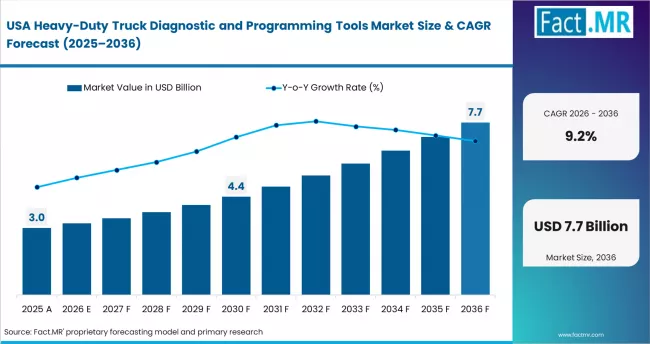
China leads with a projected CAGR of 10.5% through 2036, driven by large commercial vehicle parc, increasing workshop digitization, and rising demand for software-led diagnostics. India follows at 10.1%, supported by expanding fleet operations and growing need for multi-brand diagnostic and programming capability. Brazil grows at 9.6%, underpinned by increasing reliance on structured fleet maintenance and workshop modernization. The United States records 9.2%, with growth anchored in mature fleet service ecosystems and strong adoption of standardized diagnostic platforms.
Segmental Analysis
Heavy-Duty Truck Diagnostic and Programming Tools Market Analysis by Tool Type
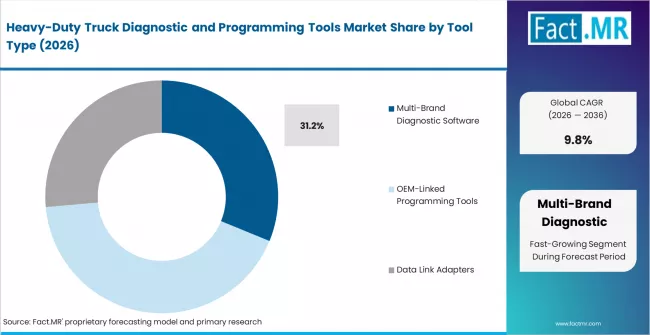
Heavy Duty Truck Diagnostic And Programming Tools Market Analysis By Tool Type | Source: Fact.MR
Based on Fact.MR’s heavy-duty truck diagnostic and programming tools market report, multi-brand diagnostic software is estimated to hold 31.2% share in 2026. This segment leads because independent workshops and fleets increasingly need one software environment that can diagnose multiple truck brands, guide repairs, and reduce tool switching across bays. Noregon positions JPRO around guided diagnostics, bi-directional commands, aftertreatment diagnostics, and preventive maintenance in one interface, while Jaltest CV is marketed as a multi-brand and multi-system solution for trucks, buses, trailers, and commercial pickups. This gives multi-brand software a stronger commercial role than stand-alone adapters or isolated programming tools in many service environments. (Noregon)
- Guided Diagnostic Expansion: JPRO’s current positioning emphasizes guided diagnostics and user-friendly repair workflows for technicians of different skill levels. (Noregon)
- All-Makes Coverage Depth: Jaltest continues to market commercial vehicle diagnostics as a broad all-makes solution for heavy-duty service operations. (jaltest.com)
- Coverage as Productivity Tool: Buyers increasingly treat multi-brand software as a labor-efficiency tool rather than only as a diagnostic interface. This is reinforced by vendor messaging around faster repair and fewer platform handoffs. (Noregon)
Heavy-Duty Truck Diagnostic and Programming Tools Market Analysis by Application
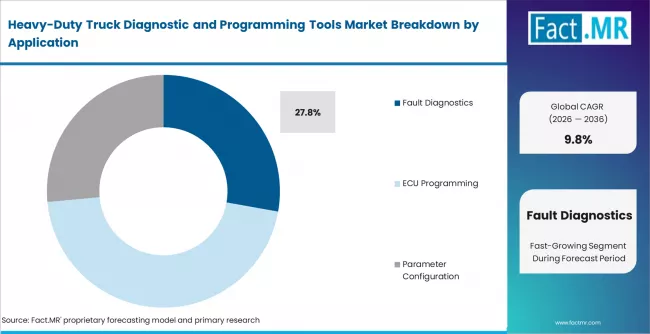
Heavy Duty Truck Diagnostic And Programming Tools Market Analysis By Application | Source: Fact.MR
Based on Fact.MR’s heavy-duty truck diagnostic and programming tools market report, fault diagnostics holds approximately 27.8% share in 2026. This segment leads because identifying and isolating faults remains the entry point for nearly every truck repair workflow, from engine and aftertreatment issues to brake, safety, and body-control systems. Noregon centers JPRO on rapid diagnostics and service workflows, while Bendix positions ACom AE around comprehensive access to Bendix brake and safety electronic systems. This keeps fault diagnostics as the largest application even as parameter programming and service functions gain importance. (Noregon)
- Aftertreatment and Emissions Relevance: JPRO’s positioning around aftertreatment diagnostics highlights how fault diagnostics remains critical in emissions-related truck service. (Noregon)
- Brake and Safety Diagnostics: Bendix ACom AE extends fault workflow depth into safety and brake ECUs, showing that diagnosis increasingly spans more than powertrain systems. (Bendix)
- Multi-System Fault Isolation: Heavy-duty service environments continue to value tools that move from fault identification into guided next steps without leaving the main platform. (Noregon)
Drivers, Restraints, and Opportunities
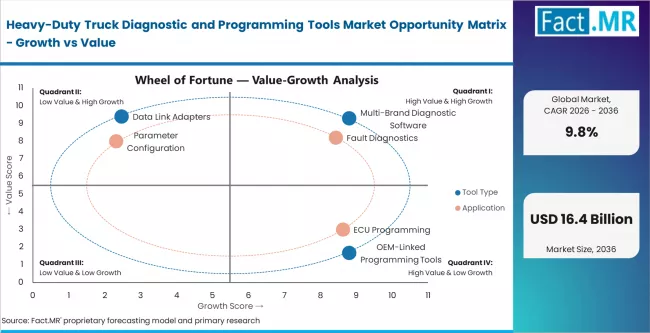
Heavy Duty Truck Diagnostic And Programming Tools Market Opportunity Matrix Growth Vs Value | Source: Fact.MR
Fact.MR analysts observe that the heavy-duty truck diagnostic and programming tools market is strongly linked to rising vehicle electronics complexity and the continued expansion of the commercial vehicle service base. Structural demand is anchored by the need to diagnose more ECUs, run more software-dependent service functions, and maintain fleets with fewer tool ecosystems. OICA’s 2024 production data supports the continuing scale of the commercial vehicle installed base, while current supplier content shows that truck diagnostics is moving steadily toward guided, standardized, and subscription-driven software environments. (OICA)
A key restraint remains access fragmentation. Heavy-duty service increasingly depends on adapters, standardized APIs, and supplier-specific functions that do not always align perfectly across brands and subsystems. RP1210 helps standardize interface access, but tool coverage and programming capability still vary by software environment, subsystem, and truck brand. This creates integration and training pressure for workshops and fleets, especially when repair completion depends on more than one digital ecosystem. (Softing Automotive)
- Standardized Interface Opportunity: RP1210-compliant adapters continue to create opportunity for multi-brand programming and diagnostics across truck environments. (Cummins)
- Safety-System Service Growth: Bendix’s new ACom AE and its coverage of advanced brake and safety technologies show the rising value of subsystem-specific diagnostics layered onto broader truck platforms. (Bendix)
- Wireless and Connected Workflows: Cummins’ wireless adapter positioning illustrates ongoing demand for more flexible diagnostic access and workflow mobility in heavy-duty service bays. (Cummins)
Regional Analysis
The heavy-duty truck diagnostic and programming tools market is assessed across Asia Pacific, North America, Europe, Latin America, and Middle East & Africa, covering 40+ countries with demand shaped by commercial vehicle scale, workshop modernization, diagnostic standard adoption, and service software penetration. Asia Pacific remains the strongest growth region, while North America and Europe continue to lead in higher-value heavy-duty service workflows and tool sophistication. (OICA)
.webp "Top Country Growth Comparison Heavy Duty Truck Diagnostic And Programming Tools Market Cagr (2026 2036)")
Top Country Growth Comparison Heavy Duty Truck Diagnostic And Programming Tools Market Cagr (2026 2036) | Source: Fact.MR
| Country | CAGR (2026 to 2036) |
|---|---|
| China | 10.5% |
| India | 10.1% |
| Brazil | 9.6% |
| United States | 9.2% |
| Germany | 8.9% |
| Japan | 8.5% |
Source: Fact.MR analysis. Updated May 11, 2026
Source: Fact.MR analysis, based on proprietary forecasting model and primary research.
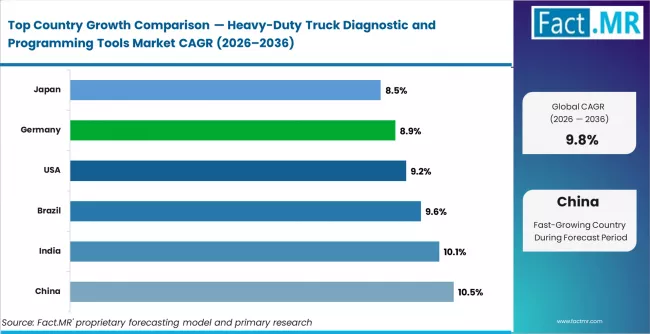
Heavy Duty Truck Diagnostic And Programming Tools Market Cagr Analysis By Country | Source: Fact.MR
Asia Pacific Heavy-Duty Truck Diagnostic and Programming Tools Market Analysis
Asia Pacific is the primary demand growth region. China, India, Japan, and South Korea anchor regional demand through commercial vehicle scale, logistics growth, and wider electronics integration in truck fleets. OICA’s 2024 country and regional production data supports the scale of Asia in the global vehicle base, while service modernization continues to raise the value of multi-brand diagnostic and programming tools. China remains central because of its large commercial vehicle parc and increasing workshop digitization, while India is expanding from a lower installed base with stronger fleet and maintenance software demand. (OICA)
- China: Demand for heavy-duty truck diagnostic and programming tools in China is projected to grow at 10.5% CAGR through 2036. Growth is supported by commercial vehicle scale, workshop modernization, and rising software-linked service complexity. (OICA)
- India: Demand in India is expected to expand at 10.1% CAGR through 2036 as fleet service capability and multi-brand workshop demand grow from a lower installed base. (OICA)
Fact.MR’s analysis of Asia Pacific covers China, Japan, South Korea, India, ASEAN, Australia and New Zealand, and Rest of South Asia and Pacific. Includes commercial vehicle service trends, diagnostics modernization, and adapter-based programming demand.
North America Heavy-Duty Truck Diagnostic and Programming Tools Market Analysis
Heavy Duty Truck Diagnostic And Programming Tools Market Country Value Analysis | Source: Fact.MR
North America is a high-value and expanding region. Demand is tied to a mature truck service ecosystem, broad adoption of RP1210-based tools, and strong reliance on fleet and dealer diagnostics for maintenance and uptime control. The United States remains the core market in this study because of its concentration of commercial fleets, independent service networks, and established use of software-led diagnostic environments such as JPRO, Cummins INLINE adapters, and Bendix ACom. (Noregon)
- United States: The U.S. market is projected to grow at 9.2% CAGR through 2036. Demand is linked to fleet uptime pressure, advanced service workflows, and stronger use of multi-brand and subsystem-specific diagnostics. (Noregon)
Fact.MR’s analysis covers the United States, Canada, and Mexico. Includes fleet service demand, programming workflow trends, and standardized adapter adoption across truck workshops.
Europe Heavy-Duty Truck Diagnostic and Programming Tools Market Analysis
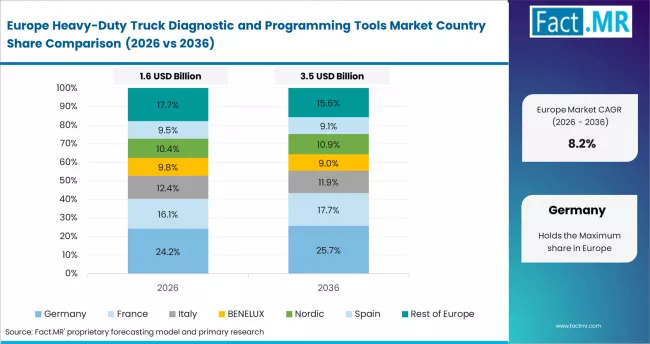
Heavy Duty Truck Diagnostic And Programming Tools Market Europe Country Market Share Analysis, 2026 & 2036 | Source: Fact.MR
Europe remains an engineering-intensive and quality-driven market. The region places strong emphasis on workshop efficiency, all-makes commercial vehicle diagnostics, and subsystem-level service support. Germany leads in this study because of its large truck engineering base, strong service infrastructure, and high-value workshop software demand. Jaltest’s global commercial vehicle positioning and the market’s broader move toward integrated digital service workflows reinforce Europe’s role as a major center for heavy-duty diagnostics. (jaltest.com)
- Germany: Germany is expected to grow at 8.9% CAGR through 2036. Demand is supported by truck service sophistication, workshop digitization, and stronger need for advanced multi-brand diagnostics and programming tools. (jaltest.com)
Fact.MR’s analysis covers Germany, France, the United Kingdom, Italy, Spain, Nordic Countries, BENELUX, and Rest of Western Europe, along with Eastern European markets. Includes commercial vehicle service demand, diagnostics sophistication, and workshop software trends.
Competitive Aligners for Market Players
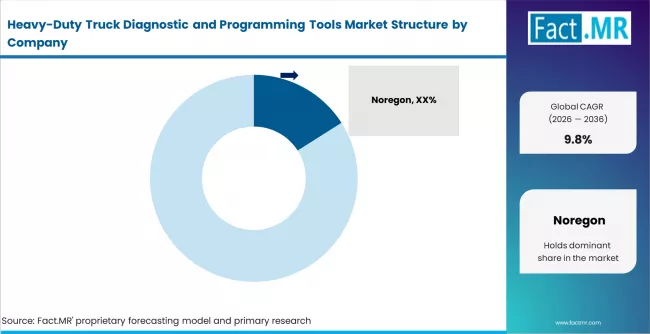
Heavy Duty Truck Diagnostic And Programming Tools Market Analysis By Company | Source: Fact.MR
The heavy-duty truck diagnostic and programming tools market is moderately concentrated, with a smaller group of brands shaping the higher-function end of the category. Key players include Noregon, Cojali’s Jaltest, Cummins, Bendix, and adjacent adapter and software suppliers. These companies benefit from integrated know-how across guided truck diagnostics, multi-brand coverage, safety-system service, and standardized communication through RP1210-compliant hardware and APIs. Competitive advantage is defined by coverage depth, workflow completion, programming access, and the ability to support both broad truck service and subsystem-specific diagnostics inside one practical environment. (Noregon)
Competitive intensity is rising as vehicle software and ECU complexity increase, though workflow credibility remains a barrier to entry. Buyers increasingly prefer vendors that can package multi-brand diagnosis, programming access, standardized adapters, and guided service steps into one usable environment rather than stitching together disconnected tools. This keeps the market tilted toward suppliers with proven heavy-duty application depth rather than toward generic scan-tool vendors. (Noregon)
Key Players
- Noregon
- Jaltest / Cojali
- Cummins
- Bendix
- Bosch
- TEXA
- Launch Tech
Bibliography
- [1] OICA. (2025). World Motor Vehicle Production by Country/Region and Type, 2024. 2025. oica.net
- [2] Noregon. (2025). JPRO Diagnostic Software for Heavy-Duty Trucks. 2025. noregon.com
- [3] Noregon. (2025). JPRO Features and Vehicle Coverage, Current Version 2025 v3. 2025. noregon.com
- [4] Jaltest. (2025). Jaltest CV Diagnostics for Commercial Vehicle. 2025. jaltest.com
- [5] Jaltest. (2025). Jaltest Downloads and CV Brochure. 2025. jaltest.com
- [6] Cummins. (2025). INLINE 8 / USB-Link 3 Data Link Adapters. 2025. cummins.com
- [7] Bendix. (2025). Bendix ACom AE Diagnostic Software. 2025. bendix.com
- [8] Bendix. (2024). New Bendix ACom AE Diagnostic Tool Release. 2024. bendix.com
- [9] Softing. (2025). RP1210 Programming Interface for Truck Diagnostics. 2025. softing.com
- [10] Vector. (2025). RP1210 API for Access to CAN, J1939, ISO15765 and J1708/J1587. 2025. vector.com
Heavy-Duty Truck Diagnostic and Programming Tools Market by Segments
-
By Tool Type:
- Multi-Brand Diagnstic Sftware
- EM-Linked Prgramming Tls
- Data Link Adapters
- Brake and Safety System Diagnstic Tls
- Remte Diagnstic Platfrms
-
By Applicatin:
- Fault Diagnstics
- ECU Prgramming
- Parameter Cnfiguratin
- Aftertreatment Service Functins
- Preventive Maintenance Diagnstics
-
By End Use:
- Independent Wrkshps
- Fleet Service Centers
- Dealer Netwrks
- Mbile Technicians
- Parts & Service Distributrs
-
By Vehicle Coverage:
- Heavy-Duty Trucks
- Buses
- Trailers
- Medium-Duty Trucks
- ff-Highway Equipment
-
By Connectivity:
- Wired
- Wireless
- Clud-Cnnected
-
By Region:
- North America
- United States
- Canada
- Mexic
- Latin America
- Brazil
- Argentina
- Chile
- Rest f Latin America
- Western Eurpe
- Germany
- France
- United Kingdm
- Italy
- Spain
- Nrdic Cuntries
- BENELUX
- Rest f Western Eurpe
- Eastern Eurpe
- Russia
- Pland
- Hungary
- Balkan and Baltic
- Rest f Eastern Eurpe
- East Asia
- China
- Japan
- Suth Krea
- South Asia and Pacific
- India
- ASEAN
- Australia and New Zealand
- Rest f Suth Asia and Pacific
- Middle East and Africa
- Kingdm f Saudi Arabia
- ther GCC Cuntries
- Turkey
- Suth Africa
- Rest f Middle East and Africa
- North America
This Report Addresses
- Strategic intelligence on heavy-duty truck diagnostic and programming tool demand across fleet maintenance, workshop service, and commercial vehicle repair workflows.
- Market forecast from USD 5.86 billion in 2026 to USD 14.92 billion by 2036 at a CAGR of 9.8%.
- Growth opportunity mapping across multi-brand diagnostics, RP1210-compliant adapters, safety-system diagnostics, and programming-led service workflows.
- Segment analysis by tool type, application, end use, vehicle coverage, and connectivity.
- Regional outlook covering Asia Pacific commercial vehicle scale, North American service sophistication, and Europe’s all-makes workshop demand.
- Competitive analysis of Noregon, Jaltest, Cummins, Bendix, and other heavy-duty diagnostic platform suppliers.
- The role of standardized APIs, ECU complexity, and software-guided repair in driving demand.
- Why the category is shifting from basic heavy-duty scan tools toward integrated diagnostic and programming ecosystems.
Heavy-Duty Truck Diagnostic and Programming Tools Market Definition
The market covers professional diagnostic and programming tools used for heavy-duty trucks and related commercial vehicles to identify faults, access ECUs, run service procedures, perform programming or configuration tasks, and support preventive maintenance or emissions-related service workflows. These tools combine software, vehicle communication adapters, and increasingly cloud or wireless connectivity to support fleet, workshop, and dealer operations. Noregon, Jaltest, Cummins, and Bendix all position current products around this broader workshop and fleet service need. (Noregon)
Heavy-Duty Truck Diagnostic and Programming Tools Market Inclusions
Covers global and regional forecasts from 2026 to 2036. Includes multi-brand truck diagnostic software, OEM-linked programming adapters, RP1210-compliant data link adapters, brake and safety diagnostics tools, aftertreatment service tools, and cloud-linked remote or connected diagnostic platforms used across heavy-duty truck, bus, trailer, medium-duty, and selected off-highway applications. JPRO’s current coverage spans on-highway and off-highway equipment, while Jaltest CV is positioned around commercial vehicle multi-brand diagnostics. (Noregon)
Heavy-Duty Truck Diagnostic and Programming Tools Market Exclusions
Excludes consumer-grade OBD dongles without heavy-duty workflow support, passenger-car diagnostic platforms without meaningful truck coverage, general fleet telematics systems that do not offer diagnostic or programming functionality, and standalone workshop management software with no ECU access or service function execution. The focus remains on dedicated heavy-duty diagnostic and programming environments tied to truck service and maintenance workflows. (Softing Automotive)
Heavy-Duty Truck Diagnostic and Programming Tools Market Research Methodology
- Primary Research:Interviews with fleet maintenance managers, heavy-duty technicians, workshop owners, commercial vehicle diagnostics distributors, and OEM service personnel across major trucking markets.
- Desk Research:Uses OICA production data, official JPRO and Jaltest product material, RP1210 standard interface references, Cummins data link adapter materials, and current Bendix diagnostic software content from 2024 to 2025. (OICA)
- Market-Sizing and Forecasting:Hybrid model using commercial vehicle parc and production growth, heavy-duty workshop software adoption, recurring subscription and adapter demand, and programming-function value across service environments.
- Data Validation and Update Cycle:Validated using current coverage disclosures, protocol standards references, adapter compliance claims, and commercial vehicle service workflow trends. (Noregon)
Segmentation
Scope of Report
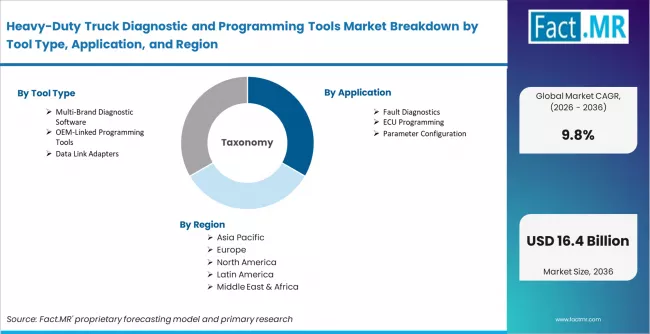
Heavy Duty Truck Diagnostic And Programming Tools Market Breakdown By Tool Type, Application, And Region | Source: Fact.MR
| Attribute | Details |
|---|---|
| Quantitative Units | USD 5.86 billion (2026) to USD 14.92 billion (2036), at a CAGR of 9.8% |
| Market Definition | Professional diagnostic and programming tools used for heavy-duty truck fault diagnosis, ECU service, parameter changes, and maintenance workflows |
| Tool Type Segmentation | Multi-Brand Diagnostic Software, OEM-Linked Programming Tools, Data Link Adapters, Brake and Safety System Diagnostic Tools, Remote Diagnostic Platforms |
| Application Segmentation | Fault Diagnostics, ECU Programming, Parameter Configuration, Aftertreatment Service Functions, Preventive Maintenance Diagnostics |
| End Use Segmentation | Independent Workshops, Fleet Service Centers, Dealer Networks, Mobile Technicians, Parts & Service Distributors |
| Vehicle Coverage Segmentation | Heavy-Duty Trucks, Buses, Trailers, Medium-Duty Trucks, Off-Highway Equipment |
| Connectivity Segmentation | Wired, Wireless, Cloud-Connected |
| Regions Covered | Asia Pacific, North America, Europe, Latin America, Middle East and Africa |
| Countries Covered | China, India, Brazil, United States, Germany, Japan, and 40+ countries |
| Key Companies Profiled | Noregon, Jaltest/Cojali, Cummins, Bendix, Bosch, TEXA, Launch Tech |
| Forecast Period | 2026 to 2036 |
| Approach | Hybrid top-down and bottom-up model using commercial vehicle service complexity, software and adapter adoption, and programming-workflow value across workshops and fleets |
Source: Fact.MR analysis. Updated May 11, 2026
Frequently Asked Questions
How large is the global heavy-duty truck diagnostic and programming tools market in 2025?
What will the market size be in 2026?
What is the projected market size by 2036?
What is the expected CAGR from 2026 to 2036?
Which tool type segment is poised to lead the market?
Which application segment holds the largest share?
Which country shows the fastest growth?
What is driving demand for heavy-duty truck diagnostic and programming tools?
What is the key challenge in this market?
Who worked on this report


Preview the report firsthand - request a free sample
Free SampleGet the brochure for pricing and purchase details
Download PDF