- Base Value(2025): 4.2 Bn
- Estimated Value(2026): 4.9 Bn
- Forecast Value (2036): 20.8 Bn
- CAGR (2026 - 2036): 15.6%
Heavy-Duty Truck Fleet Control Unit Architectures Market Forecast and Outlook
- In 2025, the heavy-duty truck fleet control unit architectures market was valued at USD 4.2 billion.
- Based on Fact.MR analysis, demand for fleet control unit architectures is estimated to grow to USD 4.9 billion in 2026 and USD 20.8 billion by 2036.
- FACT.MR projects a CAGR of 15.6% during the forecast period.
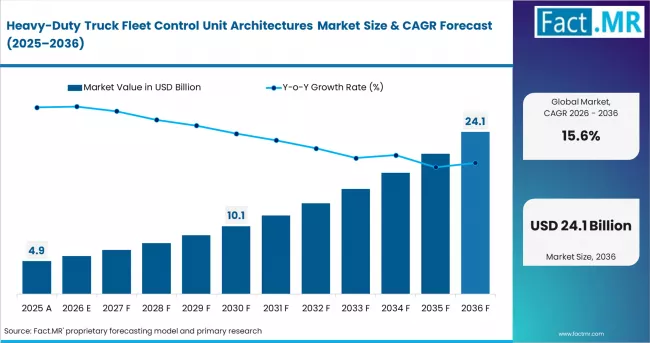
Heavy Duty Truck Fleet Control Unit Architectures Market Market Value Analysis | Source: Fact.MR
| Metric | Value |
|---|---|
| Estimated Value in 2026 | USD 4.9 billion |
| Forecast Value in 2036 | USD 20.8 billion |
| Forecast CAGR (2026 to 2036) | 15.6% |
Source: Fact.MR analysis. Updated May 11, 2026
Summary of Heavy-Duty Truck Fleet Control Unit Architectures Market
- Market Definition
- The market covers centralized AI-integrated, distributed ECU, and edge AI orchestration architectures deployed in heavy-duty commercial trucks to manage telematics, powertrain, dispatch, and ADAS fleet functions globally.
- Demand Drivers
- European fleet operators are adopting centralized control architectures to comply with EU tachograph regulation updates and CO2 emissions reporting mandates requiring real-time powertrain and routing data integration.
- U.S. logistics companies are deploying AI-integrated fleet control units to support ELD compliance, reduce driver idle time, and integrate predictive maintenance alerts within unified fleet management platforms.
- Indian logistics operators are accelerating control unit procurement under government fleet formalization mandates, with GPS-integrated ECU requirements now embedded in national freight vehicle registration frameworks.
- Key Segments Analyzed
- By Architecture Type: Centralized fleet control units with AI and telematics integration lead with 40% share in 2026, driven by logistics operator demand for unified fleet visibility and OTA update capability across large truck fleets.
- By Function: Fleet telematics and connectivity control leads with 35% share in 2026, reflecting the foundational role of connectivity and data transmission in enabling all higher-order fleet optimization and safety functions.
- By Geography: China leads at 17.2% CAGR through 2036, driven by the largest global freight truck population, national digital freight policies, and domestic OEM investment in connected fleet platforms.
- Analyst Opinion at FACT.MR
- Shambhu Nath Jha, Principal Consultant at Fact.MR, opines, ' CXOs will find that architecture standardization is emerging as the most critical fleet investment decision through 2036. Platform choices made today will define long-term operational efficiency. Centralized control architectures are becoming the preferred direction across heavy-duty fleets.’
- Strategic Implications
- Prioritize centralized AI-integrated architecture platforms with OTA update capability to capture high-value logistics operator procurement in North America, Europe, and China.
- Develop certified cybersecurity and functional safety (ISO 26262) compliance documentation to meet fleet procurement requirements at major European and U.S. logistics operators.
- Build go-to-market strategies for India and Brazil through OEM partnerships and compliance with local GPS and telematics regulatory mandates for fleet vehicle registration.
- Methodology
- Market sizing based on heavy-duty truck fleet population, control unit attach rates by architecture type, and average selling prices by region. Validated with 2024 to 2025 data.
- Uses NHTSA filings, EU Commission vehicle mandates, SAE J1939 standards, and China Ministry of Transport guidelines for demand and compliance analysis.
- Forecasts incorporate fleet electrification timelines, OTA platform rollouts, telematics mandate enforcement schedules, and OEM connected vehicle investment disclosures.
The market is projected to generate USD 15.9 billion in absolute opportunity between 2026 and 2036. Growth is transformational in scale, fuelled by accelerating fleet digitalization, EV powertrain integration requirements, and regulatory mandates for connected vehicle compliance. Adoption is moderated by high ECU replacement costs, OEM-specific integration barriers, and cybersecurity certification timelines for safety-critical control units.
Fleet operators are standardising on centralized AI-integrated control units to manage telematics, dispatch, and powertrain data from a unified architecture. Distributed legacy ECU networks lacking over-the-air (OTA) update capability are losing fleet procurement preference.
China leads with a projected CAGR of 17.2% through 2036, driven by the world's largest freight truck base and accelerated government-backed fleet digitalization programmes. India follows at 16.5%, supported by fleet formalization mandates and rapid logistics infrastructure expansion. The United States records 15.8%, anchored in advanced telematics penetration and a strong logistics technology ecosystem. Germany grows at 14.9%, driven by OEM-led fleet digitalization and regulatory efficiency requirements. Brazil records 15.2%, supported by growing long-haul freight networks and rising telematics adoption. Japan records 13.8%, with a mature fleet base where incremental AI adoption sustains moderate growth. Mature markets face longer fleet replacement cycles and incumbent OEM integration lock-in as structural limits.
Segmental Analysis
Heavy-Duty Truck Fleet Control Unit Architectures Market Analysis by Architecture Type
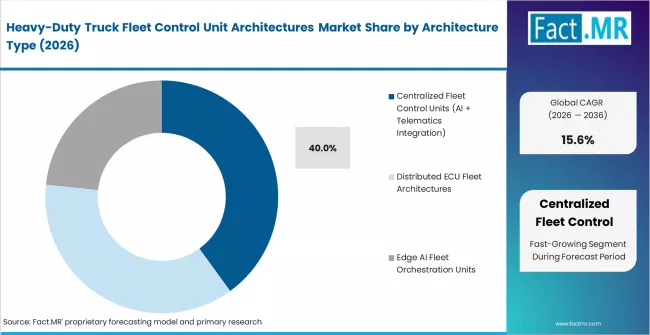
Heavy Duty Truck Fleet Control Unit Architectures Market Analysis By Architecture Type | Source: Fact.MR
Based on FACT.MR, centralized fleet control units with AI and telematics integration account for 40% share in 2026. This architecture leads due to system unification capability. It combines telematics, routing, powertrain, and safety data within one platform. OEMs and fleet operators prefer single-system visibility. OTA update capability is now a standard requirement. Fleet management platform compatibility is also mandatory for large operators.
- Volvo Group Platform Investment: Volvo Group expanded its connected vehicle platform in 2024. Centralized ECU architecture was integrated with the Volvo Trucks Uptime system. This enables real-time diagnostics and predictive maintenance. Deployment was extended to FH and FM series trucks in Q2 2024. The platform is now active across Europe and North America. [1]
- Bosch Fleet ECU Development: Robert Bosch launched its Vehicle Computer (VHC) platform in 2024. It consolidates multiple ECU functions into one system. The platform supports SAE J1939 and AUTOSAR Adaptive standards. OTA updates and edge AI inference are embedded. It is designed for fleet-scale deployment. [2]
- Centralized Architecture Procurement Trend: Trimble Transportation reported in 2024 that 61% of large fleets plan migration by 2027. This shift is driven by compliance and visibility requirements. ELD regulations are a major factor. Operators seek unified platforms to reduce integration complexity. [3]
Heavy-Duty Truck Fleet Control Unit Architectures Market Analysis by Function
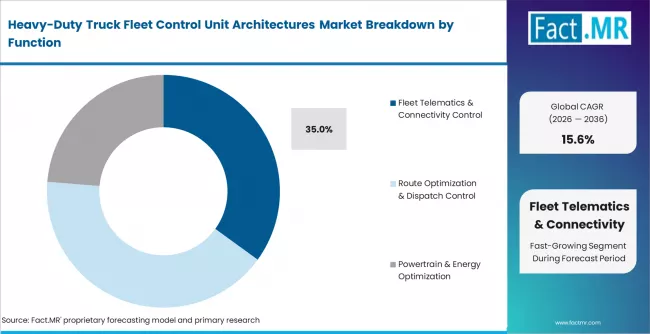
Heavy Duty Truck Fleet Control Unit Architectures Market Analysis By Function | Source: Fact.MR
Based on FACT.MR, fleet telematics and connectivity control holds 35% share in 2026. This segment forms the core of fleet intelligence systems. It enables data flow across all vehicle functions. High data volumes support optimization and safety use cases. Regulatory mandates continue to sustain adoption.
- Daimler Truck Connectivity Expansion: Daimler Truck expanded Truck Data Services in 2024. Connectivity was extended across Actros and eActros fleets. The system integrates powertrain and driver behaviour data. Predictive service alerts are embedded. It operates within centralized architecture frameworks. [4]
- Continental AG Telematics Module Launch: Continental AG introduced a new telematics control unit in Q1 2025. It includes 5G connectivity and dual-SIM redundancy. Firmware is AUTOSAR-compliant. The module targets centralized ECU platforms. It is aligned with OEM integration requirements. [5]
- Telematics Mandate Compliance Trend: The Federal Motor Carrier Safety Administration reported in 2024 that ELD enforcement is driving procurement. Class 7 and 8 truck fleets are increasing adoption. Telematics modules are the fastest-growing segment. Insurance-linked telematics is also expanding. Compliance remains the key driver. [6]
Drivers, Restraints, and Opportunities
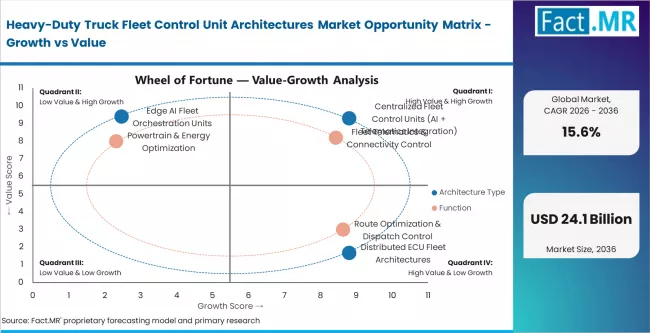
Heavy Duty Truck Fleet Control Unit Architectures Market Opportunity Matrix Growth Vs Value | Source: Fact.MR
FACT.MR analysis indicates that the market is driven by fleet digitalization and regulatory mandates. Electrification is adding further complexity. Fleet operators are shifting toward centralized architectures. These systems manage multi-source data streams efficiently. OEMs are aligning around connected platform standards.
Procurement preference is shifting toward integrated platforms. AI capability and OTA readiness are now essential. Legacy distributed ECUs are losing relevance. These systems lack connectivity and upgrade pathways. Centralized platforms carry a 30 to 50% price premium. However, lifecycle cost benefits are improving adoption economics.
- EU Smart Tachograph and CO2 Reporting Mandate: The European Commission enforced Smart Tachograph V2 in August 2023. Retrofit deadlines extend through 2025 and 2026. Real-time data transmission is mandatory. Fleets are replacing legacy systems to comply. Germany, France, and Benelux are key adoption regions. This is creating a replacement cycle.
- China Ministry of Transport Digital Freight Policy: The Ministry of Transport updated standards in 2024. New trucks must include connected telematics systems. Compliance with GB/T 19056 is required. OEMs like FAW, SAIC Motor, and Dongfeng Motor Corporation are integrating centralized ECUs. Policy is driving large-scale adoption.
- EV Powertrain Integration Driving Architecture Complexity: Electrification is increasing system requirements. Battery and energy management must be integrated. Regenerative braking coordination is required. Charging data exchange is becoming essential. Daimler Truck eActros 600 and Volvo Group FH Electric require centralized architectures.
Regional Analysis
The heavy-duty truck fleet control unit architectures market is assessed across Asia Pacific, North America, Europe, Latin America, and Middle East and Africa, covering 40+ countries with distinct demand profiles shaped by fleet size, digitalization policy, OEM investment, and regulatory compliance frameworks. The full report provides market attractiveness analysis by region and country.
.webp "Top Country Growth Comparison Heavy Duty Truck Fleet Control Unit Architectures Market Cagr (2026 2036)")
Top Country Growth Comparison Heavy Duty Truck Fleet Control Unit Architectures Market Cagr (2026 2036) | Source: Fact.MR
| Country | CAGR (2026 to 2036) |
|---|---|
| China | 17.2% |
| India | 16.5% |
| United States | 15.8% |
| Brazil | 15.2% |
| Germany | 14.9% |
| Japan | 13.8% |
Source: Fact.MR analysis. Updated May 11, 2026
Source: Fact.MR (FACT.MR) analysis, based on proprietary forecasting model and primary research
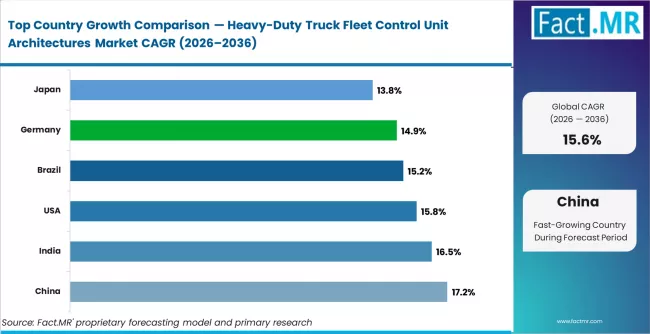
Heavy Duty Truck Fleet Control Unit Architectures Market Cagr Analysis By Country | Source: Fact.MR
Asia Pacific Heavy-Duty Truck Fleet Control Unit Architectures Market Analysis
Asia Pacific remains the dominant high-growth region and the largest freight truck production base. China and India are driving volume expansion at scale. Japan leads in technology depth and system maturity. Regional OEMs are strengthening integrated platform supply. FAW Group, Ashok Leyland, and Hino Motors are aligning architectures with domestic regulations. Connected fleet platforms are increasingly OEM-integrated.
- China: Fleet digitalization policies support a 17.2% CAGR through 2036. Growth is the fastest among major markets. The Ministry of Transport updated freight standards in 2024. New trucks must carry GB/T 19056-compliant control units. FAW Group and SAIC Motor initiated factory-level ECU integration in Q3 2024. Telematics and powertrain coordination are now standard features. Guangdong and Shandong subsidies are accelerating fleet upgrades.
- India: Fleet formalization measures support a 16.5% CAGR through 2036. The Ministry of Road Transport and Highways mandated GPS tracking from January 2024. This applies to vehicles above 7.5 tonnes. Immediate adoption of connected control units is visible. Ashok Leyland launched iEGR and Avtr platforms in 2024. These include AIS-140 compliant telematics units. Large fleet operators are the primary target. NITI Aayog prioritised fleet digitalization in 2024. PLI incentives are supporting domestic ECU manufacturing.
- Japan: Technology-led upgrades support a 13.8% CAGR through 2036. Market maturity remains high. The Ministry of Land, Infrastructure, Transport and Tourism updated fleet guidelines in 2024. Advanced telematics systems are recommended. Working-hour regulations are tightening compliance needs. Hino Motors upgraded fleet platforms in FY2024. Series 500 and 700 trucks received firmware updates. Real-time driver monitoring is enabled. Predictive brake alerts are integrated. Digital tachograph mandates were expanded in 2024. Fleets above 20 vehicles must comply.
Fact.MR’s analysis of Asia Pacific covers China, Japan, India, South Korea, ASEAN, and ANZ. It includes policy drivers, OEM investments, and telematics compliance timelines across countries.
North America Heavy-Duty Truck Fleet Control Unit Architectures Market Analysis
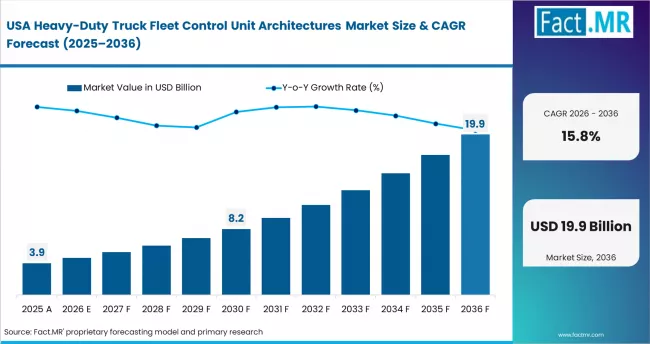
Heavy Duty Truck Fleet Control Unit Architectures Market Country Value Analysis | Source: Fact.MR
North America leads in market value and regulatory enforcement. Compliance mandates shape procurement behaviour. Telematics penetration is already high. Platform upgrades are now the key focus. PACCAR, Navistar, and Trimble Transportation lead platform integration.
- United States: Advanced infrastructure supports a 15.8% CAGR through 2036. The Federal Motor Carrier Safety Administration enforces ELD compliance. Adoption across Class 7 and 8 fleets is near universal. Upgrade cycles are shifting toward centralized architectures. PACCAR expanded Connected Services in Q1 2025. Centralized ECU integration now spans Kenworth and Peterbilt fleets. Real-time diagnostics and OTA updates are enabled. The US Department of Transportation updated its freight plan in Q3 2024. Fleet digitalization is identified as a priority.
Fact.MR’s analysis of North America covers the United States, Canada, and Mexico. It includes compliance timelines, policy incentives, and OEM platform strategies.
Europe Heavy-Duty Truck Fleet Control Unit Architectures Market Analysis
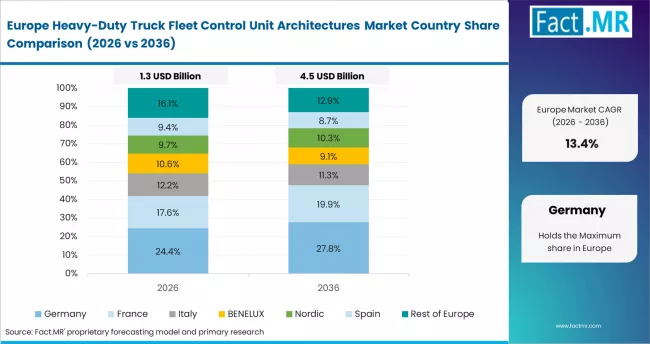
Heavy Duty Truck Fleet Control Unit Architectures Market Europe Country Market Share Analysis, 2026 & 2036 | Source: Fact.MR
Europe operates as a compliance-driven market. Regulatory mandates define procurement cycles. Smart Tachograph and CO2 rules are key drivers. OEM-led integration remains strong. Volvo Group, Daimler Truck, and Robert Bosch lead supply.
- Germany: OEM-led adoption supports a 14.9% CAGR through 2036. The Federal Office for Goods Transport increased enforcement in 2024. Smart Tachograph V2 compliance is mandatory. Daimler Truck upgraded Actros platforms in Q2 2024. Centralized ECU systems now include CO2 reporting modules. Robert Bosch expanded ECU production in Reutlingen in Q3 2024. Supply targets extend through 2027. Continental AG launched updated telematics units in Q1 2025. These support Smart Tachograph integration. Retrofit demand is rising among logistics fleets.
Fact.MR’s analysis of Europe covers Germany, France, the United Kingdom, Italy, Spain, and Rest of Europe. It includes regulatory timelines, CO2 mandates, and OEM platform investments.
Latin America Heavy-Duty Truck Fleet Control Unit Architectures Market Analysis
Governments are strengthening vehicle tracking mandates across key freight corridors in Latin America. Cross-border trade routes are accelerating digital fleet adoption. Compliance-driven upgrades are increasing across heavy vehicle segments.
- Brazil: Freight network expansion supports a 15.2% CAGR through 2036. The National Land Transport Agency updated tracking mandates in 2024. All heavy vehicles on federal highways must comply. Volkswagen Caminhões e Ônibus expanded the RIO platform in Q2 2024. Centralized ECU systems now support cargo tracking and driver monitoring. The Brazilian Development Bank launched a logistics credit line in Q3 2024. ECU upgrades are eligible for funding.
FACT.MR’s analysis of Latin America covers Brazil, Mexico, Argentina, and Rest of Latin America. It includes regulatory mandates, fleet modernization trends, and OEM platform deployment across regional freight markets.
Competitive Aligners for Market Players
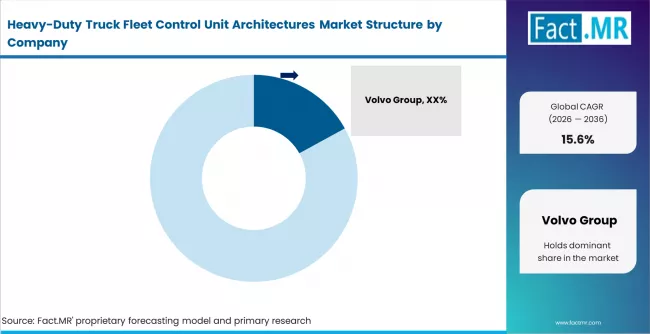
Heavy Duty Truck Fleet Control Unit Architectures Market Analysis By Company | Source: Fact.MR
The heavy-duty truck fleet control unit architectures market is evolving into a platform-driven competitive environment, where control is shifting from hardware supply to integrated system capability. Leading participants are positioning around centralized architectures that combine telematics, AI processing, and vehicle control within unified platforms. The competitive focus is no longer limited to ECU performance. It now includes software scalability, data orchestration capability, and compliance readiness across regions.
Global OEMs and Tier 1 suppliers are defining the core structure of competition. Companies such as Daimler Truck, Volvo Group, and PACCAR are embedding centralized control architectures directly into vehicle platforms. This allows tighter integration between powertrain, telematics, and safety systems. At the same time, Tier 1 suppliers like Robert Bosch and Continental AG are advancing vehicle computer platforms that consolidate multiple ECU functions into single high-performance units. Technology firms are also entering the competitive landscape through connectivity and fleet intelligence platforms. Trimble Transportation and similar players are strengthening their role in telematics integration and data-driven fleet optimization. This is creating a hybrid competitive model where hardware, software, and service layers are increasingly interconnected.
Strategic advantage is concentrated among players with end-to-end ecosystem control. This includes OTA update infrastructure, AI-enabled analytics, and regulatory compliance capability. OEM-aligned platforms benefit from long development cycles and high switching costs once deployed. As fleet operators consolidate technology vendors, competitive intensity is increasing around platform standardization, long-term contracts, and lifecycle service integration.
Key Players
- Volvo Group
- Daimler Truck
- PACCAR
- Navistar International
- Bosch Mobility Solutions
- Continental AG
- Trimble Transportation
- ZF Friedrichshafen
Bibliography
- [1] Volvo Group. Product Update: Volvo Trucks Uptime Platform Extended to FH and FM Series with Centralized ECU Architecture and OTA Firmware Update Capability for Heavy-Duty Fleet Customers in Europe and North America. Q2 2024. volvogroup.com/news
- [2] Bosch Mobility Solutions. Technology Launch: Vehicle Computer (VHC) Platform for Commercial Vehicles Consolidating Distributed ECU Functions into Centralized Compute Architecture Compatible with SAE J1939 and AUTOSAR Adaptive for Fleet Applications. 2024. bosch-mobility.com/press
- [3] Trimble Transportation. Industry Survey: Fleet Technology Adoption Trends 2024 — Centralized ECU Architecture Migration Plans, ELD Compliance Upgrade Cycles, and Fleet Management Platform Integration Priorities Among North American Class 7 and 8 Fleet Operators. 2024. trimble.com/transportation/insights
- [4] Daimler Truck AG. Platform Expansion Announcement: Truck Data Services Telematics Connectivity Control Extended Across Actros and eActros Fleet Lines in Europe and North America with Real-Time Powertrain Data and Predictive Service Alerting. Q2 2024. daimlertruck.com/newsroom
- [5] Continental AG. Product Release: Updated Fleet Telematics Control Unit with Integrated 5G Connectivity and AUTOSAR-Compliant Firmware for Heavy-Duty Truck OEM Integration Targeting Centralized Fleet Architecture Deployments. Q1 2025. continental.com/press
- [6] U.S. Federal Motor Carrier Safety Administration. Compliance and Enforcement Report: Electronic Logging Device Mandate Fleet Adoption Data and Telematics Control Unit Procurement Trends Across Class 7 and Class 8 Commercial Vehicle Fleets. 2024. fmcsa.dot.gov/hours-service/elds
This Report Addresses
- Strategic intelligence on fleet control unit architecture demand across centralized AI-integrated, distributed ECU, and edge orchestration platforms for heavy-duty truck fleet operators and OEMs globally.
- Market forecast from USD 4.9 billion in 2026 to USD 20.8 billion by 2036 at a CAGR of 15.6%.
- Growth opportunity mapping across China fleet digitalization mandates, India fleet formalization policies, U.S. ELD compliance cycles, Germany EU Smart Tachograph requirements, and Brazil freight network expansion.
- Segment analysis by architecture type (centralized, distributed ECU, edge AI), function (telematics, route optimization, powertrain, safety ADAS), and region.
- Regional outlook covering Asia Pacific fleet digitalization policy growth, North America ELD and freight strategy investment, and Europe EU Smart Tachograph and CO2 mandate compliance cycles.
- Competitive analysis of Volvo Group, Daimler Truck, PACCAR, Navistar, Bosch, Continental AG, and Trimble Transportation, focusing on OEM integration depth, regulatory compliance coverage, and fleet management platform ecosystem.
- Regulatory impact analysis covering FMCSA ELD mandates, EU Smart Tachograph V2 requirements, China GB/T 19056 connected vehicle standards, India AIS-140 telematics mandates, and Japan MLIT connected fleet guidelines.
- Report delivered in PDF, Excel datasets, and presentation formats. Supported by primary interviews, fleet operator procurement records, regulatory filings, OEM investment disclosures, and telematics platform commercial deployment data.
Market Definition
The market covers centralized, distributed, and edge AI control unit architectures embedded in heavy-duty commercial trucks to manage fleet telematics, powertrain optimization, route dispatch, and ADAS coordination.
Heavy-Duty Truck Fleet Control Unit Architectures Market Inclusions
Covers global and regional forecasts from 2026 to 2036. Includes architecture type, function, and regional segments. Covers centralized AI-integrated, distributed ECU, and edge orchestration platforms. Includes fleet telematics hardware, connectivity control modules, and powertrain optimization units across heavy-duty truck fleet operator and OEM procurement channels.
Heavy-Duty Truck Fleet Control Unit Architectures Market Exclusions
Excludes light commercial vehicle or passenger car ECU systems. Omits standalone telematics devices not integrated with fleet control architectures. Excludes trailer tracking units and aftermarket GPS dongles. Focus remains on OEM-integrated or fleet-installed control unit architectures for Class 7 and Class 8 heavy-duty trucks and equivalent global categories.
Heavy-Duty Truck Fleet Control Unit Architectures Market Research Methodology
- Primary Research:Interviews with fleet operations directors, logistics technology procurement heads, OEM powertrain engineers, and telematics platform developers at key companies across the United States, Germany, China, India, and Japan.
- Desk Research:Uses NHTSA regulatory filings, EU Commission connected vehicle mandates, China Ministry of Transport digital freight guidelines, SAE J1939 and ISO 11992 standards documentation, and company disclosures from Volvo Group, Daimler Truck, PACCAR, and Bosch from 2024 to 2025.
- Market-Sizing and Forecasting:Hybrid model using heavy-duty truck fleet population by region, control unit architecture attach rates by function type, and average system selling prices across OEM-integrated and retrofit procurement channels across all covered geographies.
- Data Validation and Update Cycle:Validated using fleet operator procurement records, OEM annual reports, and regulatory approval filings. Cross-checked with telematics platform commercial deployment data. Updated annually.
Segmentation
Scope of Report
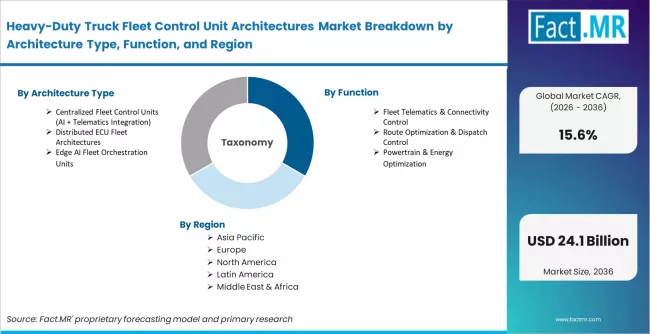
Heavy Duty Truck Fleet Control Unit Architectures Market Breakdown By Architecture Type, Function, And Region | Source: Fact.MR
| Attribute | Details |
|---|---|
| Quantitative Units | USD 4.9 billion (2026) to USD 20.8 billion (2036), at a CAGR of 15.6% |
| Market Definition | Centralized AI-integrated, distributed ECU, and edge AI orchestration control unit architectures deployed in heavy-duty commercial trucks to manage fleet telematics, powertrain optimization, route dispatch, and ADAS coordination, procured by fleet operators, logistics companies, and OEMs globally. |
| Architecture Type Segmentation | Centralized Fleet Control Units (AI + Telematics Integration), Distributed ECU Fleet Architectures, Edge AI Fleet Orchestration Units |
| Function Segmentation | Fleet Telematics & Connectivity Control, Route Optimization & Dispatch Control, Powertrain & Energy Optimization, Safety & ADAS Fleet Coordination |
| Application Coverage | Large fleet operator telematics compliance, EV powertrain BMS integration, regulatory tachograph and ELD compliance, predictive maintenance and routing optimization, and ADAS safety coordination across Class 7 and Class 8 heavy-duty truck fleets. |
| Regions Covered | North America, Europe, Asia Pacific, Latin America, Middle East and Africa |
| Countries Covered | USA, Canada, Mexico, Germany, UK, France, Italy, Spain, Nordic, BENELUX, China, Japan, South Korea, India, ASEAN, Australia and New Zealand, Brazil, Argentina, Chile, Saudi Arabia, GCC, Turkey, South Africa, Rest of MEA |
| Key Companies Profiled | Volvo Group, Daimler Truck, PACCAR, Navistar International, Bosch Mobility Solutions, Continental AG, Trimble Transportation, ZF Friedrichshafen |
| Forecast Period | 2026 to 2036 |
| Approach | Hybrid top-down and bottom-up model using heavy-duty truck fleet population by region, control unit architecture attach rates by function type, average selling prices by architecture category, regulatory compliance timelines, and primary interviews with fleet operations directors and OEM powertrain engineers. |
Source: Fact.MR analysis. Updated May 11, 2026
Heavy-Duty Truck Fleet Control Unit Architectures Market by Segments
-
By Architecture Type:
- Centralized Fleet Control Units (AI + Telematics Integration)
- Distributed ECU Fleet Architectures
- Edge AI Fleet Orchestration Units
-
By Function:
- Fleet Telematics & Connectivity Control
- Route Optimization & Dispatch Control
- Powertrain & Energy Optimization
- Safety & ADAS Fleet Coordination
-
By Region:
- North America
- United States
- Canada
- Mexico
- Latin America
- Brazil
- Mexico
- Argentina
- Chile
- Rest of Latin America
- Western Europe
- Germany
- United Kingdom
- France
- Italy
- Spain
- Nordic Countries
- BENELUX
- Rest of Western Europe
- Eastern Europe
- Russia
- Poland
- Hungary
- Balkan and Baltic
- Rest of Eastern Europe
- East Asia
- China
- Japan
- South Korea
- South Asia and Pacific
- India
- ASEAN
- Australia and New Zealand
- Rest of South Asia and Pacific
- Middle East and Africa
- Kingdom of Saudi Arabia
- Other GCC Countries
- Turkey
- South Africa
- Rest of Middle East and Africa
- North America
Frequently Asked Questions
How large is the global heavy-duty truck fleet control unit architectures market in 2025?
What will the market size be in 2026?
What is the projected market size by 2036?
What is the expected CAGR from 2026 to 2036?
Which architecture type segment is poised to lead the market?
Which function segment holds the largest share?
Which country shows the fastest growth?
What is driving demand for heavy-duty truck fleet control unit architectures?
What are the major restraints?
Who worked on this report


Preview the report firsthand - request a free sample
Free SampleGet the brochure for pricing and purchase details
Download PDF