- Market Value (2025): USD 3.1 Bn
- Estimated Value (2026): USD 3.3 Bn
- Forecast Value (2036): USD 6.0 Bn
- CAGR (2026-2036): 6.1%
What is the High-Runner Coating Lines Market forecast to be worth by 2036?
USD 3.3 billion in 2026 to USD 6.0 billion by 2036 at a 6.1% CAGR.
- 2025 Market Value: USD 3.1 billion.
- 2026 to 2036 Market Progression: USD 3.3 billion to USD 6.0 billion.
- Forecast CAGR (2026-2036): 6.1%.
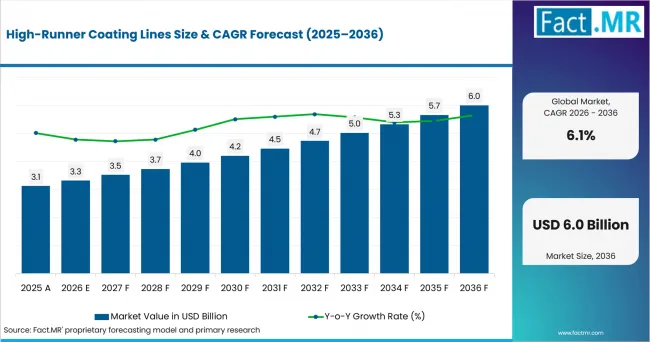
High Runner Coating Lines Value Analysis | Source: Fact.MR
What are the defining numbers behind High-Runner Coating Lines Market growth?
The market creates an absolute opportunity of USD 2.7 billion between 2026 and 2036.
- Demand Drivers in the Market
- High-volume manufacturers are tightening cycle-time and repeatability requirements. Automated coating lines let plants lock robot paths, fluid delivery, conveyor speed, and cure conditions into repeatable production recipes, which reduces variation when the same part families run for long periods. Dürr describes paint robots as systems built around precision, reproducibility, and coordinated dosing and color-change equipment, illustrating why automation becomes more valuable as line utilization rises.
- Air-emission rules and material-use economics are pushing buyers toward higher transfer efficiency, better overspray capture, and tighter booth control. The U.S. Environmental Protection Agency maintains sector-specific standards for solvent use and surface coating, while the European Union Industrial Emissions Directive governs emissions from large industrial installations. These requirements affect booth ventilation, abatement, coating choice, and the economics of replacing older application equipment.
- Changeover losses are becoming more visible in plants running several colors or product variants on the same line. Dürr states that its EcoBell4 architecture shortens color-change time while reducing paint and rinsing-agent losses. Nordson similarly designs automatic powder booths around recovery and quick color changes. This shifts investment toward atomizers, powder-recovery systems, recipe control, and line software that reduce non-productive time.
- Energy consumption in ovens and conditioned spray booths is another purchase trigger. GEICO markets paintshop systems that adjust ventilation and operating length to actual production demand, while recent Dürr paintshop projects combine application technology with integrated software and lower-carbon drying concepts. Buyers therefore evaluate line controls and thermal systems alongside coating quality, especially in continuous operations where energy cost compounds across long shifts.
- Key Segments Analyzed
- By Line Type: Automotive component coating accounts for 30.0% in 2026 because repeated part geometries and quality specifications support dedicated fixtures, programmed robot paths, and stable cure recipes.
- By Coating Process: Liquid spray represents 34.0% in 2026, supported by its fit across visible surfaces, complex geometries, and multiple industrial coating chemistries.
- By Automation Level: Robotic application holds 38.0% in 2026 as manufacturers seek repeatable film build and application quality at sustained line speeds.
- By Throughput Profile: Continuous low-mix accounts for 31.0% in 2026 because long production campaigns reduce changeover losses and make conveyor, booth, and oven utilization more predictable.
- Analyst Opinion at Fact.MR
- Shambhu Nath Jha, Principal Consultant at Fact.MR, states, “High-runner coating lines are purchased around cost per coated part and line availability. Buyers need the application system, conveyor, controls, and curing stage to hold a repeatable process at production speed. Suppliers that can shorten color change, reduce material loss, and retrofit automation without destabilizing an operating plant are better aligned with current procurement priorities.”
- Strategic Implications
- Coating-line suppliers should quantify availability, changeover loss, transfer efficiency, and energy demand at the line level rather than selling isolated machines. The commercial case is strongest when a buyer can connect equipment performance to coated parts per shift and planned maintenance windows.
- Automotive and industrial buyers should treat brownfield integration as a core purchasing criterion. New robots or controls create limited value if conveyor timing, booth airflow, ovens, and legacy PLC architecture prevent the line from operating as one synchronized system. This is especially relevant for automotive OEM coatings where finish quality and process traceability are tied to factory production routines.
- Plants comparing liquid and powder routes should evaluate geometry, finish class, changeover frequency, cure energy, and material recovery together. The economics of powder coatings can be attractive when recovery and durable film performance match the part, while liquid systems retain an advantage where finish flexibility and coating chemistry range are central.
- Automation teams should connect application recipes with PLC, MES, and inspection data so process drift is visible before it produces a long run of rejected parts. Closed-loop inspection has more value when it can trigger recipe or maintenance action rather than remain a separate quality record.
How does the High-Runner Coating Lines Market break down by segment?
The market is segmented by Line Type, Coating Process, Automation Level, and Throughput Profile.
Why does Automotive component coating lead Line Type?
Automotive component coating accounts for 30.0% of Line Type in 2026.
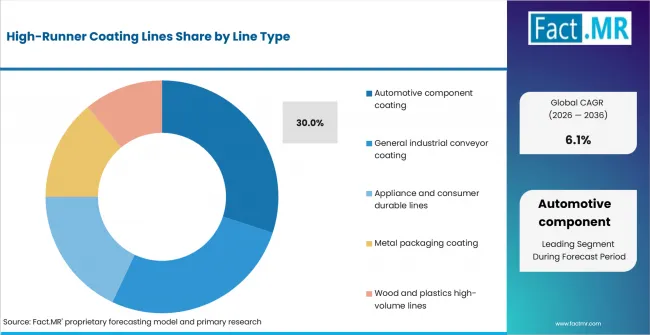
High Runner Coating Lines Analysis By Line Type | Source: Fact.MR
Automotive components combine repeat geometry with demanding surface requirements, making them well suited to high-runner line economics. Fixtures, robot paths, fluid settings, and cure profiles can be standardized for bumpers, wheels, structural parts, and other repeat programs, allowing plants to protect throughput while controlling film build.
Dürr states that its automated painting systems are designed for automobile bodies and small parts as well as general industry. The same production logic extends to component plants that need consistent application across long runs. Investment therefore concentrates on integrated conveying and application equipment rather than stand-alone manual finishing.
Why does Liquid spray lead Coating Process?
Liquid spray represents 34.0% of Coating Process in 2026.
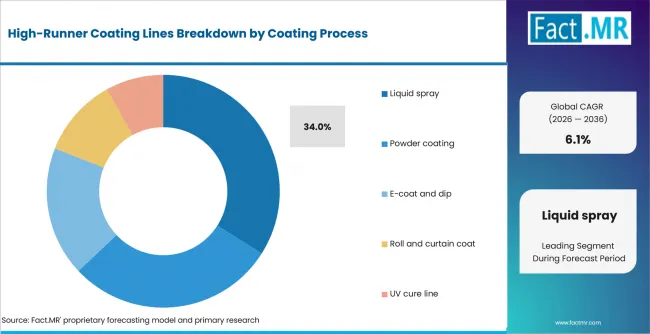
High Runner Coating Lines Analysis By Coating Process | Source: Fact.MR
Liquid spray supports a wide range of coating chemistries and can reach complex part surfaces with controlled atomization. That flexibility matters when one facility serves different component families or finish specifications while still operating at high throughput. Robotic atomizers, metering systems, and automatic color changers help preserve repeatability as line speed rises.
EPA surface-coating rules make transfer efficiency and solvent management part of line design in regulated U.S. applications. At the same time, buyers compare liquid systems with powder coating equipment where powder recovery, color-change design, and oven capacity can improve economics for suitable metal parts. Formulators also use specialized coating additives to stabilize flow, wetting, and surface quality in automated application.
Why does Robotic application lead Automation Level?
Robotic application holds 38.0% of Automation Level in 2026.
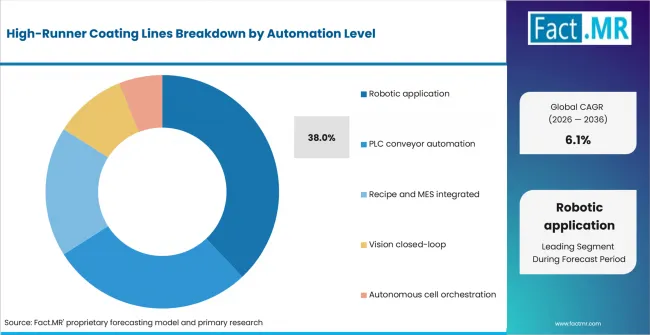
High Runner Coating Lines Analysis By Automation Level | Source: Fact.MR
Robots give high-runner lines a programmable method for maintaining gun distance, path speed, overlap, and orientation across thousands of repeated parts. That reduces operator-to-operator variation and allows the application stage to keep pace with conveyorized pretreatment and curing.
Dürr describes its paint robots as coordinated with dosing pumps, pressure regulators, color changers, and electrostatic atomizers. This integration matters because a robot alone does not create a stable coating process. Buyers therefore favor robotic cells that arrive with application controls and line-tracking logic that can be validated as one production system.
Why does Continuous low-mix lead Throughput Profile?
Continuous low-mix accounts for 31.0% of Throughput Profile in 2026.
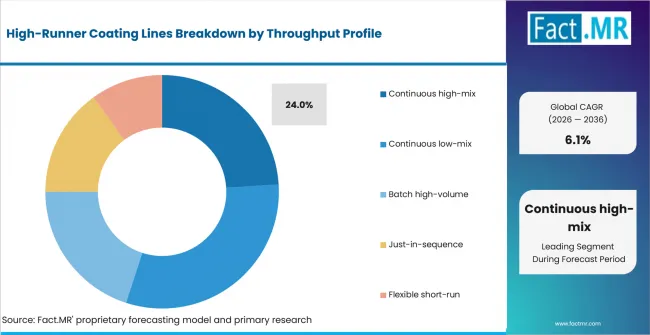
High Runner Coating Lines Analysis By Throughput Profile | Source: Fact.MR
Continuous low-mix lines run relatively stable product and color families for long campaigns. This allows conveyors, pretreatment stages, booths, and ovens to operate near steady-state conditions, reducing changeover losses and simplifying quality control. The model fits plants where cost per part depends on sustained utilization rather than frequent product switching.
GEICO describes modular paintshop systems that adjust booth or oven operation to actual production needs, showing how energy control is increasingly linked to throughput. Broader paints and coatings demand still influences chemistry and finish requirements, but the high-runner line purchase is determined by how consistently the full process can hold target output.
What is accelerating High-Runner Coating Lines Market adoption, and what is holding it back?
Adoption is being accelerated by the need to raise coated output without increasing defect rates, reduce material loss during application and color change, and lower the energy burden of booths and ovens. The main restraints are capital intensity, commissioning risk, and brownfield downtime.
Drivers Impact Analysis
| Factor | (~) % Impact on CAGR | Geographic Relevance | Impact Timeline |
|---|---|---|---|
| High-volume automotive and industrial line automation | +1.2% | Germany, USA, Japan | Medium term (2-4 years) |
| Robotic transfer efficiency and application repeatability | +1.0% | Global | Short term (<= 2 years) |
| VOC control and coating-material recovery requirements | +0.8% | Europe, USA | Medium term (2-4 years) |
| Energy-aware booth and oven operation | +0.6% | Europe, Japan | Long term (>= 4 years) |
Opportunity Impact Analysis
| Factor | (~) % Impact on CAGR | Geographic Relevance | Impact Timeline |
|---|---|---|---|
| Brownfield MES, recipe, and vision retrofits | +0.7% | Germany, USA, UK | Medium term (2-4 years) |
| Fast color-change upgrades for mixed-model production | +0.6% | USA, Japan, Germany | Short term (<= 2 years) |
| Powder and lower-emission process conversions | +0.5% | USA, Italy, Germany | Medium term (2-4 years) |
Restraints Impact Analysis
| Factor | (~) % Impact on CAGR | Geographic Relevance | Impact Timeline |
|---|---|---|---|
| Integrated-line capital and commissioning burden | -0.7% | Global | Short term (<= 2 years) |
| Brownfield downtime and production-ramp risk | -0.5% | Germany, USA, Japan | Medium term (2-4 years) |
| Energy and coating-material cost volatility | -0.4% | Europe, USA | Medium term (2-4 years) |
Which countries are scaling the High-Runner Coating Lines Market through 2036?
- Germany: Automotive production and an installed base of industrial paint shops support recurring investment in line modernization, electrified thermal processes, and automation upgrades.
- USA: A broad durable-goods manufacturing base supports conveyorized spray and powder systems, while air-quality requirements keep transfer efficiency and emission control central to equipment specification.
- Japan: Transport-equipment production and tightly controlled manufacturing routines support robotic application, recipe management, and stable high-utilization coating processes.
- Italy: Appliance, automotive-component, and furniture finishing activity supports line consolidation and brownfield automation where producers need more output from existing floor space.
- UK: Vehicle-plant retooling and industrial modernization create demand for flexible retrofits that can handle changing model mixes without requiring complete greenfield paint facilities.
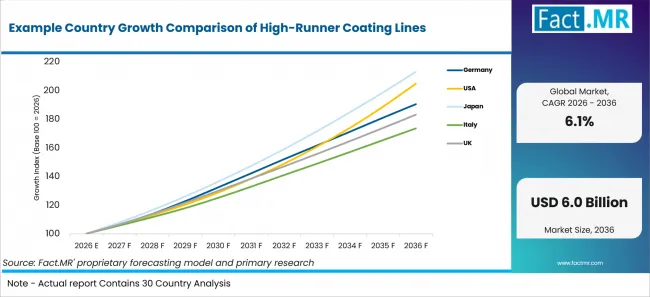
Example Country Growth Comparison Of High Runner Coating Lines | Source: Fact.MR
Country CAGR (2026-2036)
| Country | CAGR (2026-2036) |
|---|---|
| Germany | 6.7% |
| USA | 7.4% |
| Japan | 7.9% |
| Italy | 5.7% |
| UK | 6.2% |
What is driving Germany's growth through 2036?
Germany is projected to record a 6.7% CAGR from 2026 to 2036.
Germany combines automotive assembly with a dense supplier network that uses coating lines for body-related parts, wheels, structural components, and general industrial products. VDA reported 4.15 million passenger cars produced domestically in 2025. It also reported 1.67 million electric passenger cars produced in Germany during the year. Changes in vehicle architecture and component mix create recurring work for paintshop retrofits, new fixtures, robot programming, and line controls even when total factory floor space remains constrained.
The commercial mechanism is modernization rather than simple capacity addition. High-runner lines that reduce oven energy, shorten color changes, or connect application data to plant controls can be justified against an established production base where downtime is expensive and quality requirements are already formalized.
What is driving USA's growth through 2036?
The USA is projected to record a 7.4% CAGR from 2026 to 2036.
U.S. demand is spread across automotive components, fabricated metal products, appliances, and other durable-goods plants. The Federal Reserve reported that industrial production and manufacturing output each increased 0.2% in July 2026, while manufacturing excluding motor vehicles and parts increased 0.4%. A broad manufacturing base supports both new line investment and upgrades to aging spray, powder, and conveyor systems.
Regulation also shapes the equipment specification. EPA maintains dedicated requirements for solvent use and surface-coating operations, including standards for metal coil and other coating processes. Buyers therefore evaluate booth capture, VOC control, material efficiency, and automation together, which supports replacement of older equipment when compliance and operating cost can be addressed in the same project.
What is driving Japan's growth through 2036?
Japan is projected to record a 7.9% CAGR from 2026 to 2036.
Japan's coating-line demand is linked to transport equipment and production systems that emphasize repeatability. The Ministry of Economy, Trade and Industry reported that transport equipment excluding motor vehicles was the main contributor to the increase in industrial production in May 2026. Earlier 2026 releases also identified motor vehicles among the industries contributing to shipment growth.
This production profile favors automated application and stable process control. Robotic cells, PLC-linked conveyors, and recipe management reduce the risk that small process deviations become large batches of rejected parts. High-runner suppliers can therefore compete on availability, maintenance planning, and integration with existing Japanese production controls.
What is driving Italy's growth through 2036?
Italy is projected to record a 5.7% CAGR from 2026 to 2036.
Italian demand is supported by industrial finishing applications where floor-space efficiency and line consolidation matter. Cefla documented a project for Pianca in which three obsolete coating lines were replaced with one automated high-performance line to reduce downtime and raise productivity while preserving product customization. This type of brownfield project maps directly to the economics of high-runner coating lines outside automotive body painting.
Automotive output has also been under pressure, which increases the importance of cost control in supplier plants. ANFIA reported that Italy's automotive industrial production index fell 10.3% in 2025. In this environment, investment is more likely to favor selective automation, energy reduction, and consolidation of older lines than capacity expansion without a clear utilization case.
What is driving UK's growth through 2036?
The UK is projected to record a 6.2% CAGR from 2026 to 2036.
The UK retains a substantial vehicle-manufacturing base while plants adapt to changing model programs. SMMT reported that 717,371 cars were built in the UK in 2025. ONS also reported that production output increased 1.2% in the fourth quarter of 2025, with manufacturing up 0.9% over the previous quarter.
For coating-line suppliers, the practical opportunity is retooling. Plants need automation that can be installed around existing conveyors and utilities, support just-in-sequence or flexible production, and reduce the time required to qualify new models. Brownfield commissioning capability therefore has a direct influence on supplier selection.
Who Leads the High-Runner Coating Lines Market?
Key players in the High-Runner Coating Lines Market include Dürr, Eisenmann, Taikisha, GEICO, Cefla Finishing, and Nordson.
Competition centers on the ability to integrate application equipment with conveyors, curing, controls, and service support. Dürr combines robotic application with paint supply and software. Eisenmann remains active in industrial paint shops and conveyor technology and became part of Daifuku on July 1, 2026. Taikisha provides paint-finishing systems across automotive and industrial applications, while GEICO emphasizes automotive paintshop integration, energy management, and digital plant control.
Cefla Finishing is positioned around automated finishing lines for furniture and industrial surfaces, where product flexibility and retrofit productivity matter. Nordson competes through powder application, booth recovery, and color-change equipment. Across the market, installed-base service, process integration, commissioning discipline, and the ability to retrofit operating plants influence supplier selection more than the performance of a single machine.
Which companies are the key providers?
Key providers include Dürr, Eisenmann, Taikisha, GEICO, Cefla Finishing, and Nordson.
- Dürr
- Eisenmann
- Taikisha
- GEICO
- Cefla Finishing
- Nordson
Bibliography
- U.S. Environmental Protection Agency. (2026). Clean Air Act Guidelines and Standards for Solvent Use and Surface Coating Industry. U.S. EPA.
- U.S. Environmental Protection Agency. (2026). Metal Coil Surface Coating: New Source Performance Standards (NSPS). U.S. EPA.
- European Commission. (2026). Industrial and Livestock Rearing Emissions Directive (IED 2.0). Directorate-General for Environment.
- Dürr Systems AG. (2026, June 18). Dürr implementing a CO2-efficient paint shop with cross-plant system integration.
- Dürr Systems AG. (2022, February 23). EcoBell4 increases system availability and capacities.
- Dürr Systems AG. (n.d.). Paint Robots: Modular design, capacity to spare.
- Nordson Corporation. (n.d.). Automatic Powder Coating Booths.
- GEICO S.p.A. (n.d.). Paintshop.
- Cefla. (2023, December 19). Cefla Finishing designs a new automatic coating line for Pianca Design.
- Taikisha Ltd. (2026, February 12). Notice of Launch of the Paint Finishing System Business Website.
- Eisenmann GmbH. (2026, July 1). Eisenmann becomes part of Daifuku Co., Ltd. (Japan).
- Verband der Automobilindustrie. (2026, January 5). Passenger car production in 2025 slightly above previous year’s level. VDA.
- Board of Governors of the Federal Reserve System. (2026, August 18). Industrial Production and Capacity Utilization.
- Ministry of Economy, Trade and Industry. (2026, June 30). Indices of Industrial Production: Preliminary Report for May 2026. Government of Japan.
- Office for National Statistics. (2026, February 12). Index of Production, UK: December 2025. UK Statistics Authority.
- Society of Motor Manufacturers and Traders. (2026). UK Car Manufacturing.
- ANFIA. (2026, February 11). L’indice della produzione dell’industria automotive italiana riporta una crescita a dicembre (+13,5%), ma il 2025 si chiude in flessione a doppia cifra (-10,3%). Associazione Nazionale Filiera Industria Automobilistica.
This Report Answers
- How much revenue is generated by integrated high-runner coating lines, and how is that value expected to change through 2036?
- How do the 2026 shares differ across line type and coating process?
- Why do robotic application and continuous low-mix production receive more investment in high-utilization plants?
- How do VOC control, material recovery, oven energy, and color-change losses affect coating-line purchasing decisions?
- How do Germany, USA, Japan, Italy, and UK differ in the mechanisms supporting coating-line investment?
- Which capabilities distinguish Dürr, Eisenmann, Taikisha, GEICO, Cefla Finishing, and Nordson in integrated finishing systems?
What does the High-Runner Coating Lines Market cover?
The High-Runner Coating Lines Market covers integrated industrial finishing lines engineered for recurring, high-volume production. Commercial revenue includes line-level equipment and engineering associated with conveying, pretreatment where part of the line package, liquid or powder application, e-coat or dip stages, roll or curtain coating, UV curing, thermal curing, automation, recipe control, vision feedback, and related commissioning when included as part of the coating-line system.
The market covers automotive component coating, general industrial conveyor coating, appliance and consumer durable lines, metal packaging coating, and wood and plastics high-volume lines. Buyers include automotive suppliers, durable-goods manufacturers, packaging producers, furniture and wood-product manufacturers, plastics processors, and other factories operating repeat coating programs.
What is included in the scope?
The scope includes new coating lines, major line expansions, and brownfield modernization projects where coating application is integrated with production handling and process control. It includes liquid spray, powder coating, e-coat and dip, roll and curtain coat, and UV cure lines across the specified Line Type categories.
Automation coverage includes robotic application, PLC conveyor automation, recipe and MES integration, vision closed-loop control, and autonomous cell orchestration when these capabilities form part of the coating line. Throughput coverage includes continuous high-mix, continuous low-mix, batch high-volume, just-in-sequence, and flexible short-run configurations.
What is excluded from the scope?
The scope excludes paint, powder, resin, pigment, solvent, and other coating materials sold separately from line equipment. It also excludes manual low-volume job-shop spraying where equipment is not configured as an integrated high-runner production line, field-applied coatings, decorative architectural painting services, and stand-alone robots or conveyors used outside a coating process.
Routine maintenance parts and consumables are excluded when sold independently of a line modernization or service package. Adjacent pretreatment, curing, inspection, and factory software are counted only when they are commercially integrated into the coating-line offering addressed by this market.
How Was the Analysis Built?
- Primary Research: Primary research is structured around coating-line OEMs, plant engineering teams, manufacturing engineers, paintshop managers, automation integrators, maintenance leaders, coating-process specialists, and procurement teams. Interviews focus on line utilization, project timing, retrofit constraints, application quality, energy use, material loss, commissioning risk, and supplier selection.
- Desk Research: Desk research uses environmental regulations, industrial production statistics, automotive manufacturing data, technical publications from coating-line suppliers, equipment documentation, company filings, and relevant industry-body material. Public evidence is used to explain operating mechanisms, regulatory context, and corporate developments.
- Market Sizing and Forecasting: Sizing considers the installed base of industrial coating lines, new line investment, brownfield modernization, application-system content, conveyor and curing integration, automation intensity, line throughput, replacement cycles, and sector-specific manufacturing activity. Forecasting evaluates how these variables change across the defined line types, coating processes, automation levels, throughput profiles, and countries.
- Data Validation and Update Cycle: Validation checks market progression against line investment patterns, production activity, regulation, company portfolios, and current technology adoption. Updates review paintshop orders, retrofit programs, automation releases, ownership changes, environmental requirements, and manufacturing shifts that can alter project timing or line configuration.
What is the report's scope and coverage?
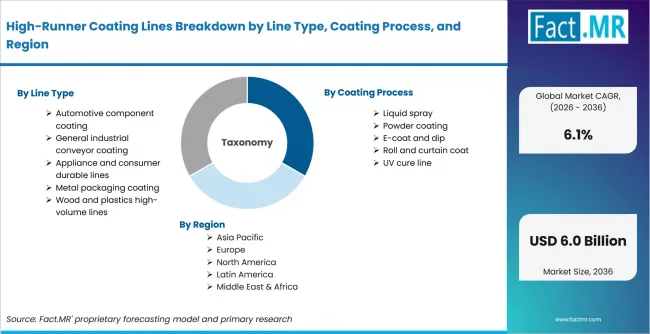
High Runner Coating Lines Breakdown By Line Type, Coating Process, And Region | Source: Fact.MR
| Attribute | Details |
|---|---|
| Quantitative Units | USD Billion |
| Market Definition | Integrated industrial coating lines designed for recurring, high-volume production with conveying, application, curing, automation, and line-level process control. |
| Segments Covered | Line Type; Coating Process; Automation Level; Throughput Profile |
| Regions Covered | North America; Latin America; Western Europe; Eastern Europe; East Asia; South Asia & Pacific; Middle East & Africa |
| Countries Covered | Germany; USA; Japan; Italy; UK |
| Key Companies Profiled | Dürr; Eisenmann; Taikisha; GEICO; Cefla Finishing; Nordson |
| Forecast Period | 2026 to 2036 |
| Base Year | 2025 |
| Market Value, 2026 | USD 3.3 billion |
| Market Value, 2036 | USD 6.0 billion |
| CAGR, 2026-2036 | 6.1% |
| Absolute Opportunity | USD 2.7 billion |
| Approach | Hybrid top-down and bottom-up approach using coating-line investment, installed-base modernization, automation content, manufacturing activity, throughput configuration, and country-level market conditions. |
How is the market segmented?
-
By Line Type:
- Automotive component coating
- General industrial conveyor coating
- Appliance and consumer durable lines
- Metal packaging coating
- Wood and plastics high-volume lines
-
By Coating Process:
- Liquid spray
- Powder coating
- E-coat and dip
- Roll and curtain coat
- UV cure line
-
By Automation Level:
- Robotic application
- PLC conveyor automation
- Recipe and MES integrated
- Vision closed-loop
- Autonomous cell orchestration
-
By Throughput Profile:
- Continuous high-mix
- Continuous low-mix
- Batch high-volume
- Just-in-sequence
- Flexible short-run
-
By Region:
- North America
- Latin America
- Western Europe
- Eastern Europe
- East Asia
- South Asia and Pacific
- Middle East & Africa