- Base Value(2025): 16.80 Bn
- Estimated Value(2026): 17.72 Bn
- Forecast Value (2036): 30.28 Bn
- CAGR (2026 - 2036): 5.50%
Automotive OEM Coatings Market Size, Market Forecast and Outlook By Fact.MR
The automotive oem coatings market was valued at USD 16.80 billion in 2025, projected to reach USD 17.72 billion in 2026, and is forecast to expand to USD 30.28 billion by 2036 at a 5.50% CAGR. Rising global vehicle production volumes, combined with regulatory mandates reducing volatile organic compound (VOC) emissions from automotive paint shops, are driving sustained investment in water-based and powder-based coating technologies that replace conventional solvent-based systems. Automaker colour complexity strategies, offering 15 to 25 exterior colour options per model, maintain paint shop throughput demands that support coating consumption volumes proportional to vehicle output.
The absolute dollar opportunity between 2026 and 2036 amounts to approximately USD 12.56 billion. Growth correlates with global vehicle assembly volumes and the value migration toward higher-performance coating systems. Primer leads the product segment because it is the mandatory first application layer on every vehicle body, applied after e-coat and before base coat in the standard four-layer OEM paint process. Based on Fact.MR's report, water-based technology is gaining share as European Industrial Emissions Directive compliance and Chinese VOC reduction targets compel paint shops to transition from solvent-based systems, despite the higher energy costs required for water-based coating flash-off and bake cycle temperatures.
India leads with a 7.8% CAGR as domestic vehicle assembly capacity expands and new paint shop investments specify water-based technology. China follows at 7.2%, supported by the world's largest vehicle production base. South Korea registers 5.5%. USA advances at 4.5%. UK tracks at 4.2%. Germany maintains 4.0%, and Japan at 3.8%.
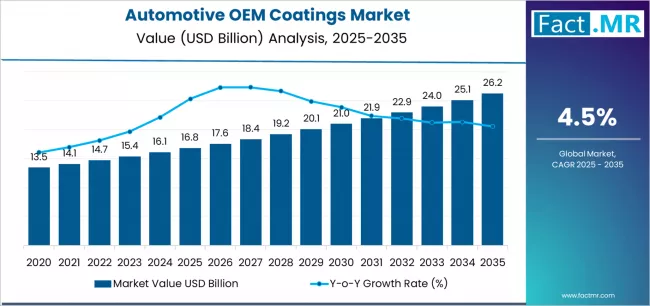
Automotive Oem Coatings Market Market Value Analysis | Source: Fact.MR
Automotive OEM Coatings Market Key Takeaways
| Metric | Details |
|---|---|
| Industry Size (2026) | USD 17.72 billion |
| Industry Value (2036) | USD 30.28 billion |
| CAGR (2026 to 2036) | 5.50% |
Source: Fact.MR analysis. Updated Mar 23, 2026
Automotive OEM Coatings Market Definition
Automotive OEM coatings are multi-layer paint systems applied during the vehicle manufacturing process to provide corrosion protection, surface finish quality, colour consistency, and weathering resistance across passenger car and commercial vehicle body structures. The market covers primer, base coat, clear coat, electrocoat (e-coat), and specialty coating layers formulated with epoxy, acrylic, polyurethane, and other resin systems in water-based, solvent-based, and powder-based application technologies.
Automotive OEM Coatings Market Inclusions
The report covers primer, base coat, clear coat, e-coat, and other product layers. Resin segmentation includes epoxy, acrylic, polyurethane, and other chemistries. Technology analysis spans water-based, solvent-based, powder-based, and other application methods. Vehicle application covers passenger cars and commercial vehicles across global regions for 2026 to 2036.
Automotive OEM Coatings Market Exclusions
Automotive refinish and body repair coatings, industrial coatings for non-automotive applications, decorative architectural paints, and raw pigment and additive chemicals sold as commodity inputs are excluded. Paint shop equipment manufacturing and coating application robotics fall outside the analytical scope.
Automotive OEM Coatings Market Research Methodology
- Primary Research: Analysts engaged with procurement directors, product engineers, and operations leads across the automotive oem coatings value chain to map adoption triggers and specification thresholds.
- Desk Research: Data collection aggregated regulatory filings, standards ratification records, trade body publications, and corporate annual reports from allowed source categories.
- Market-Sizing and Forecasting: Baseline values derive from a hybrid top-down and bottom-up aggregation, applying region-specific adoption curves to project demand velocity through 2036.
- Data Validation and Update Cycle: Projections undergo cross-validation against publicly reported financial guidance, regulatory compliance databases, and independent industry association benchmarks.
Why is the Automotive OEM Coatings Market Growing?
Market expansion is being supported by the exponential increase in global vehicle production investment and the corresponding need for protective coating systems in automotive manufacturing applications across worldwide assembly operations. Automotive manufacturers are increasingly focused on coating solutions that can ensure corrosion protection, enhance vehicle aesthetics, and optimize production efficiency while meeting stringent environmental requirements.
The proven efficacy of multi-layer coating systems in various vehicle applications makes them an essential component of comprehensive manufacturing strategies and quality assurance programs. The growing emphasis on environmental compliance standards and sustainable manufacturing integration is driving demand for advanced coating solutions that meet stringent performance specifications and regulatory requirements for automotive applications.
Vehicle manufacturers' preference for reliable, high-performance coating systems that can ensure consistent finish quality is creating opportunities for innovative water-based technologies and customized color formulations. The rising influence of electric vehicle trends and lightweight material adoption is also contributing to increased demand for specialized automotive OEM coatings across different vehicle categories and production systems requiring advanced surface treatment technology.
Opportunity Pathways - Automotive OEM Coatings Market
The automotive OEM coatings market represents a transformative growth opportunity, expanding from USD 16.8 billion in 2025 to USD 26.2 billion by 2035 at a 4.5% CAGR. As automotive manufacturers prioritize finish quality optimization, environmental compliance, and production excellence in competitive vehicle markets, OEM coatings have evolved from basic protective layers to essential manufacturing components enabling precise color matching, comprehensive corrosion prevention strategies, and multi-functional surface protection operations across vehicle assembly platforms and specialized coating applications.
The convergence of vehicle production acceleration, increasing environmental regulation penetration, advanced coating chemistry integration, and stringent quality assurance mandates creates momentum in demand. High-performance primer systems offering superior adhesion characteristics, cost-effective epoxy resin solutions balancing functionality with economics, and specialized passenger car applications will capture market premiums, while geographic expansion into high-growth Asian automotive markets and emerging electric vehicle ecosystems will drive volume leadership. Automotive manufacturer emphasis on quality innovation and environmental responsibility provides structural support.
- Pathway A - Primer Product Dominance: Leading with 37.8% market share, primer applications drive primary demand through diverse vehicle manufacturing workflows requiring comprehensive substrate preparation and corrosion protection for production optimization. Advanced electrocoat primer systems enabling improved corrosion resistance, enhanced adhesion properties, and superior coverage uniformity command consistent pricing from automotive OEMs requiring stringent performance specifications and durability compliance. Expected revenue pool: USD 6.3-9.9 billion.
- Pathway B - Epoxy Resin Leadership: Dominating with 33.4% market share through optimal balance of corrosion protection and adhesion requirements, epoxy resin applications serve most automotive coating needs while meeting diverse substrate demands. This resin category addresses both primer formulation expectations and electrocoat requirements, making it the preferred chemistry for automotive manufacturers and coating operations seeking comprehensive protective capabilities. Opportunity: USD 5.6-8.7 billion.
- Pathway C - Asian Market Acceleration: China (5.2% CAGR) and India (5.0% CAGR) lead global growth through vehicle production expansion, automotive assembly infrastructure development, and manufacturing capability advancement. Strategic partnerships with local automotive OEMs, technology localization expertise, and supply chain optimization enable expansion of coating system deployment in major vehicle manufacturing clusters and emerging production hubs. Geographic expansion upside: USD 3.2-5.0 billion.
- Pathway D - Water-based Technology Segment: Water-based coating systems serving critical VOC reduction requirements for environmental compliance. Optimized low-emission formulations supporting regulatory standards, application efficiency requirements, and proven environmental effectiveness maintain growing volumes from automotive manufacturers and paint shops implementing sustainable practices. Revenue potential: USD 4.2-6.5 billion.
- Pathway E - Advanced Formulation Technologies & Color Innovation: Companies investing in sophisticated color matching systems, nano-technology integration, and advanced clearcoat formulations gain competitive advantages through consistent finish quality delivery and aesthetic success. Advanced capabilities enabling customized color specifications and rapid formulation development capture premium automotive brand partnerships. Technology premium: USD 1.8-2.8 billion.
- Pathway F - Supply Chain Optimization & Technical Support: Specialized coating supply networks, strategic color management integration, and reliable application training systems create competitive differentiation in automotive markets requiring consistent coating availability. Companies offering guaranteed color accuracy, comprehensive technical support services, and application troubleshooting gain preferred supplier status with quality-focused manufacturing operations. Service network value: USD 1.5-2.3 billion.
- Pathway G - Emerging Applications & Market Development: Beyond traditional vehicle coating, automotive OEM coatings in electric vehicle battery enclosures, autonomous vehicle sensor housings, and specialized composite material substrates represent growth opportunities. Companies developing new coating formulations, supporting material innovation initiatives, and expanding into adjacent mobility and lightweight vehicle markets capture incremental demand while diversifying revenue streams. Emerging opportunity: USD 1.2-1.8 billion.
Segmental Analysis
The market is segmented by product, resin, technology, application, and region. By product, the market is divided into clear coat, base coat, primer, e-coat, and others. Based on resin, the market is categorized into polyurethane, acrylic, epoxy, and others. By technology, the market is segmented into solvent-based, water-based, powder-based, and others.
By application, the market is segmented into passenger cars and commercial vehicles. Regionally, the market is divided into Asia Pacific, North America, Europe, Latin America, and Middle East & Africa.
How Does Primer Product Drive Market Leadership in Automotive OEM Coatings?

Automotive Oem Coatings Market Analysis By Product | Source: Fact.MR
The primer product segment is projected to account for 37.8% of the automotive OEM coatings market in 2025, reaffirming its position as the category's dominant coating layer specification. Automotive manufacturers increasingly recognize the optimal balance of corrosion protection and surface preparation offered by primer systems for vehicle manufacturing applications, particularly in electrocoat operations and phosphate pre-treatment environments.
This product category addresses both substrate adhesion requirements and corrosion prevention demands while providing reliable performance outcomes across diverse automotive manufacturing operations. This segment forms the foundation of most automotive coating protocols for surface protection and paint system durability, as it represents the most technically critical and performance-essential product category in the automotive OEM coating industry.
Corrosion resistance validation standards and extensive field durability testing continue to strengthen confidence in primer systems among automotive OEMs and quality assurance professionals. With increasing recognition of primer performance impact on vehicle longevity and warranty cost requirements, primer coating systems align with both current manufacturing practices and durability enhancement evolution goals, making them the central growth driver of comprehensive vehicle protection strategies across multiple automotive platforms.
Primer products demonstrate essential functionality across diverse automotive substrates, providing superior adhesion promotion, effective corrosion barrier formation, and optimal surface leveling that meet stringent automotive quality requirements. The product's compatibility with various topcoat systems and ability to accommodate multiple substrate materials further strengthen market position, as manufacturers seek to optimize corrosion protection while maintaining production efficiency in competitive automotive markets.
Why do Epoxy Resins Command a Significant Market Share?
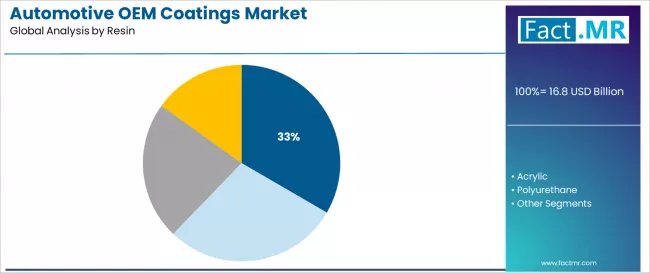
Automotive Oem Coatings Market Analysis By Resin | Source: Fact.MR
Epoxy resins are projected to represent 33.4% of automotive OEM coatings demand in 2025, underscoring its role as the primary resin chemistry category driving coating formulation and performance deployment. Automotive coating formulators recognize that epoxy requirements, including excellent adhesion characteristics, superior corrosion resistance properties, and comprehensive chemical resistance protocols, provide substantial resin chemistry advantages that alternative chemistries cannot match in primer and electrocoat applications.
Epoxy resins utilized in automotive coatings offer enhanced substrate wetting capabilities and proven durability compatibility essential for serving electrodeposition coating, primer surfacer, and corrosion protection requirements. The segment is supported by the expanding nature of global electrocoat application adoption, requiring resin chemistries capable of addressing cationic deposition processes, automotive corrosion warranty standards, and proven field performance applications, and the increasing recognition that epoxy-based systems can deliver superior protection and manufacturing efficiency.
Manufacturers are increasingly adopting electrocoat technology strategies that mandate epoxy resin integration for optimal deposition control and corrosion prevention. As understanding of coating chemistry advances and corrosion protection standards become more sophisticated, epoxy-based automotive coating systems will continue to play a crucial role in comprehensive vehicle durability differentiation strategies.
Epoxy resin benefits from proven electrocoat deposition chemistry and superior adhesion to metal substrates compared to alternative resin systems, where cationic epoxy electrocoat serves as the automotive industry standard for primer application. The resin's dominance reflects both the fundamental importance of corrosion protection in vehicle durability and the technical advantages that epoxy chemistry delivers in automotive coating applications across diverse vehicle manufacturing processes.
What drives the Water-based Technology Automotive OEM Coatings’ Segment Growth?
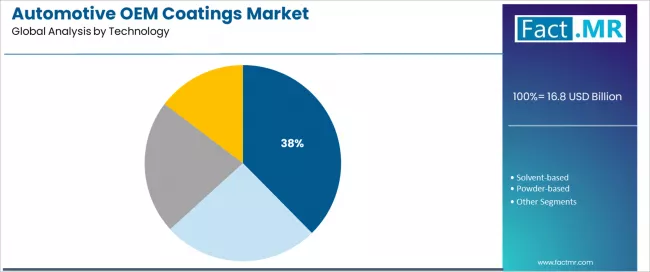
Automotive Oem Coatings Market Analysis By Technology | Source: Fact.MR
Water-based technology automotive OEM coatings represent a critical and growing component of the automotive OEM coatings market, serving essential environmental compliance requirements for VOC emission reduction. The segment contributes 37.6% of the total market share in 2025.
Automotive manufacturers increasingly recognize that water-based coating systems, encompassing low-emission formulations affecting air quality and regulatory compliance, represent technically advanced and environmentally responsible coating technologies requiring specialized application equipment due to regulatory pressure and sustainability commitments. This technology category addresses both emission reduction requirements and quality performance demands while delivering critical environmental outcomes across varied automotive production systems.
The segment is supported by the continuing nature of environmental regulation tightening in both developed and emerging automotive markets, driven by VOC reduction mandates, air quality improvement initiatives, and corporate sustainability goals enabling environmental leadership positioning. Additionally, automotive manufacturers are increasingly focusing on green manufacturing protocols that enhance brand reputation and regulatory compliance while maintaining finish quality standards. As coating technology expertise expands and environmental requirements intensify, water-based automotive coating systems will continue to serve a crucial role in ensuring regulatory compliance and environmental responsibility within the global automotive manufacturing market.
Water-based technology provides essential environmental performance advantages through reduced solvent emissions and improved workplace safety that differentiate this segment from conventional solvent-based approaches. The technology's growth reflects increasing regulatory scrutiny of industrial emissions and the strategic importance that environmental compliance represents in modern automotive manufacturing operations.
What are the Drivers, Restraints, and Key Trends of the Automotive OEM Coatings Market?
The automotive OEM coatings market is advancing rapidly due to increasing recognition of vehicle finish quality importance and growing demand for environmentally compliant coating systems across the automotive sector.
The market faces challenges, including raw material price volatility affecting coating economics, complex application equipment requirements for water-based technologies, and color matching consistency concerns in multi-plant production environments. Innovation in low-temperature cure technologies and nano-particle enhancement continues to influence coating development and market expansion patterns.
Proliferation of Advanced Water-based Technologies and Low-VOC Formulations
The accelerating adoption of sophisticated water-based coating platforms is enabling the development of more environmentally compliant automotive coating applications and formulation specifications that can meet stringent emission and performance requirements.
Automotive manufacturers demand comprehensive environmental credentials for coating systems, including ultra-low VOC content and high-performance finish characteristics that are particularly important for achieving regulatory compliance requirements in emission-controlled manufacturing regions.
Advanced water-based technologies provide access to reduced environmental impact that can optimize sustainability strategies and enhance regulatory compliance outcomes while maintaining cost-effectiveness for diverse automotive manufacturing environments.
Integration of Digital Color Matching and Quality Control Systems
Modern automotive manufacturing organizations are incorporating advanced technologies such as spectrophotometer color measurement, automated defect detection capabilities, and digital color formulation interfaces to enhance coating quality and production consistency.
These systems improve color accuracy, enable seamless manual operation-robotic application transitions, and provide better integration between paint shop operators and quality assurance teams throughout the coating application and curing experience.
Advanced digital quality control capabilities also enable real-time process optimization and early identification of application defects or color deviations, supporting proactive quality management and improved manufacturing efficiency outcomes.
Analysis of the Automotive OEM Coatings Market by Key Countries
.webp "Top Country Growth Comparison Automotive Oem Coatings Market Cagr (2026 2036)")
Top Country Growth Comparison Automotive Oem Coatings Market Cagr (2026 2036) | Source: Fact.MR
| Country | CAGR (2026-2036) |
|---|---|
| China | 5.2% |
| India | 5.0% |
| USA | 4.7% |
| Japan | 4.5% |
| Germany | 4.3% |
| South Korea | 4.1% |
| Brazil | 3.9% |
Source: Fact.MR analysis. Updated Mar 23, 2026
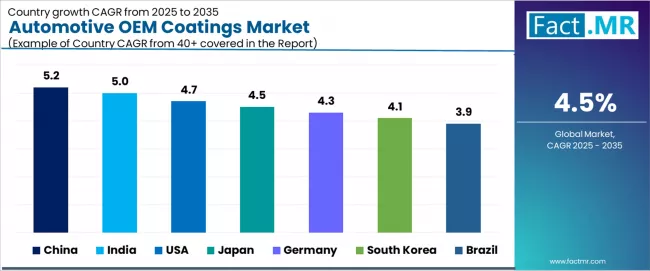
Automotive Oem Coatings Market Cagr Analysis By Country | Source: Fact.MR
The automotive OEM coatings market is experiencing exceptional growth globally, with China leading at a 5.2% CAGR through 2036, driven by massive vehicle production volumes, electric vehicle manufacturing expansion, and comprehensive automotive assembly infrastructure development across major industrial and coastal regions.
India follows at 5.0%, supported by domestic automotive manufacturing growth, foreign investment inflows, and vehicle production capacity modernization initiatives. The USA records 4.7% growth, benefiting from automotive manufacturing reshoring and electric vehicle factory development. Japan demonstrates 4.5% growth, emphasizing automotive quality excellence and coating technology innovation focus.
Germany shows 4.3% growth with premium vehicle manufacturing leadership and environmental compliance advancement. South Korea records 4.1% growth, representing automotive export manufacturing and coating technology capabilities, while Brazil shows 3.9% growth, representing regional automotive production and market development emphasis.
How does China Demonstrate Exceptional Market Potential with Vehicle Production Leadership?
Revenue from automotive OEM coatings in China is projected to exhibit exceptional growth with a CAGR of 5.2% through 2036, driven by world-leading vehicle production volumes and increasing recognition of coating quality as an essential component for vehicle durability and consumer satisfaction enhancement. The country's massive automotive manufacturing ecosystem and growing availability of advanced coating technology infrastructure are creating significant opportunities for automotive OEM coating deployment across both traditional internal combustion and electric vehicle production segments.
Major international coating suppliers and domestic chemical manufacturers are establishing comprehensive production facilities to serve the expanding population of automotive OEMs and tier suppliers requiring coating solutions across passenger car assembly plants, commercial vehicle facilities, and electric vehicle manufacturing operations throughout China's diverse industrial and automotive regions.
The Chinese automotive industry's strategic emphasis on electric vehicle leadership and manufacturing capability advancement is driving substantial investments in coating technology and application equipment infrastructure. This production growth, combined with the country's enormous domestic vehicle market and growing export manufacturing capacity, creates a favorable environment for automotive OEM coating market development. Chinese automotive manufacturers are increasingly focusing on coating quality improvement to enhance product competitiveness, with advanced coating systems representing a key component in this quality enhancement strategy.
- Government initiatives supporting electric vehicle production expansion and automotive manufacturing enhancement are driving demand for automotive OEM coatings across passenger car and commercial vehicle segments
- Manufacturing capacity expansion and coating technology advancement are supporting appropriate utilization of water-based and powder coating systems among OEMs and assembly facilities nationwide
- Automotive manufacturers and suppliers are increasingly recognizing coating quality importance in vehicle differentiation, creating new coating demand capabilities
- Rising vehicle production investment and growing awareness of corrosion protection benefits are accelerating automotive OEM coating adoption across production categories
What makes India Demonstrate Market Leadership with Manufacturing Growth Ecosystem?
Revenue from automotive OEM coatings in India is expanding at a CAGR of 5.0%, supported by domestic automotive manufacturing expansion, foreign direct investment growth, and advancing vehicle production capability integration across the country's developing industrial and automotive corridors.
The country's strategic position as an emerging automotive manufacturing hub and increasing sophistication of vehicle assembly platforms are driving demand for automotive OEM coating solutions in both domestic market and export-oriented production applications. International automotive manufacturers and domestic vehicle producers are establishing production capacity to serve the growing Indian demand for vehicles while supporting the country's position as a competitive automotive manufacturing and export market.
India's automotive sector continues to benefit from favorable government policies, developing manufacturing infrastructure, and growing industry willingness to invest in modern coating technologies. The country's focus on expanding automotive production capabilities is driving investments in coating system categories including water-based technologies and electrocoat systems.
This development is particularly important for passenger car applications, as manufacturers seek efficient coating solutions for high-volume production to meet quality standards and competitive positioning in domestic and export market environments.
- Rising manufacturing capabilities and improving automotive infrastructure are creating opportunities for automotive OEM coating solutions
- Growing vehicle production volumes and quality expectations are supporting increased deployment of advanced coating systems across production categories
- Expanding automotive engineering education capacity and emerging quality standards are driving adoption of modern coating technologies in assembly and manufacturing applications
- Production capability advancement is enabling competitive positioning, supporting market growth and attracting international automotive investment
Why does the USA Maintain Automotive Manufacturing Technology Leadership?
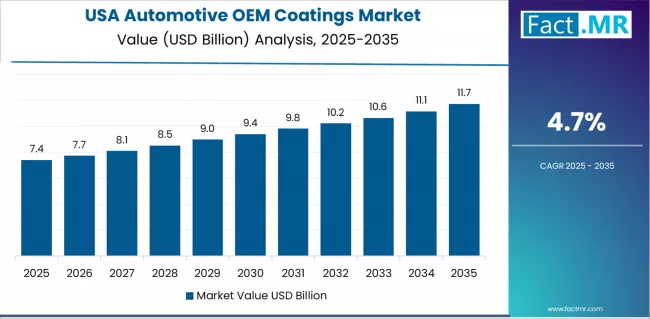
Automotive Oem Coatings Market Country Value Analysis | Source: Fact.MR
Revenue from automotive OEM coatings in the USA is projected to exhibit strong growth with a CAGR of 4.7% through 2036, driven by automotive manufacturing reshoring initiatives and electric vehicle factory development. The country's position as a major automotive producer and growing electric vehicle manufacturing base are creating significant opportunities for automotive OEM coating integration across both traditional vehicle assembly and innovative electric vehicle production applications.
Automotive manufacturers are leveraging manufacturing expertise to adopt advanced coating technologies while supporting the country's position as a leading automotive innovation economy. The market benefits from established automotive manufacturing infrastructure supporting coating technology adoption and comprehensive quality management system integration. This development is particularly important for electric vehicle applications, as manufacturers seek specialized coating solutions that address lightweight substrate requirements while ensuring corrosion protection in advanced vehicle architecture production and battery electric vehicle manufacturing environments.
Strategic Market Considerations:
- Electric vehicle and premium automotive segments leading growth with focus on coating innovation and environmental compliance applications
- Manufacturing economics and environmental regulations are driving diverse coating portfolios from conventional solvent systems to advanced water-based technology platforms
- Automotive engineering excellence and coating technology expertise supporting competitive positioning in North American vehicle markets
- Environmental regulations and corporate sustainability requirements driving coating specifications and water-based technology adoption acceleration
How does Japan Maintain Automotive Quality Excellence Leadership?
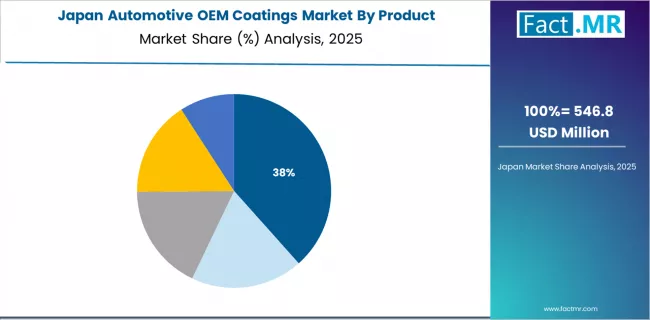
Automotive Oem Coatings Market Japan Market Share Analysis By Product | Source: Fact.MR
Japan's advanced automotive OEM coatings market demonstrates sophisticated coating application with documented effectiveness in premium vehicle platforms and quality-focused manufacturing through integration with cutting-edge robotic systems and precision protocols. The country leverages automotive manufacturing excellence and comprehensive quality management infrastructure to maintain a 4.5% CAGR through 2036.
Automotive manufacturers, including major premium vehicle producers in industrial regions and technology-leading assembly facilities, showcase advanced coating implementations where sophisticated multi-layer systems integrate with comprehensive quality platforms and ongoing innovation initiatives to optimize finish quality and durability outcomes.
Japanese automotive manufacturers prioritize quality perfection and manufacturing precision in coating operations, creating demand for premium coating systems with advanced capabilities, including high-gloss clearcoats and integration with comprehensive robotic application systems. The market benefits from established automotive excellence culture and commitment to continuous improvement that drive coating technology advancement.
Strategic Market Considerations:
- Premium vehicle and quality-focused segments leading growth with focus on finish excellence and comprehensive durability applications
- Quality expectations are driving sophisticated coating portfolios from standard automotive systems to advanced premium finish platforms
- Automotive manufacturing excellence and coating application precision supporting continued innovation in vehicle coating technology
- Quality standards and consumer expectations ensuring consistent coating performance and finish quality optimization
What drives Germany’s Market Growth with Premium Vehicle Manufacturing Excellence?
Germany's established automotive OEM coatings market demonstrates sophisticated coating technology adoption with a 4.3% CAGR through 2036, driven by premium vehicle manufacturing leadership, environmental compliance excellence, and comprehensive coating technology protocols across major automotive regions.
The country's dominance in luxury vehicle production and automotive engineering leadership is creating sustained demand for premium automotive OEM coating solutions across diverse high-end passenger car and specialized vehicle platforms. German automotive manufacturers and coating suppliers are maintaining advanced coating systems that incorporate cutting-edge technologies for optimal finish quality and environmental compliance enhancement.
Market dynamics focus on premium-quality automotive coatings that balance advanced finish characteristics with environmental considerations important to German manufacturing standards and European regulatory requirements. Leading domestic automotive and coating expertise creates opportunities for integrated technology development programs and advanced coating system deployment.
Strategic Market Considerations:
- Premium automotive and luxury vehicle segments leading growth with focus on finish excellence and comprehensive environmental compliance applications
- Environmental requirements driving advanced coating portfolios from conventional solvent systems to state-of-art water-based platforms
- Automotive manufacturing excellence supported by coating chemistry industry expertise and quality assurance capabilities
- Brand owner preferences emphasizing proven finish quality outcomes and comprehensive environmental validation in premium coating applications
How Does South Korea Demonstrate Automotive Export Manufacturing Leadership?

Automotive Oem Coatings Market South Korea Market Share Analysis By Resin | Source: Fact.MR
South Korea's expanding automotive OEM coatings market demonstrates sustained export-oriented growth with a 4.1% CAGR through 2036, driven by automotive export manufacturing strength, coating technology capabilities, and comprehensive vehicle production protocols across major industrial regions.
The country's position as a leading automotive exporter and growing electric vehicle production base is creating consistent demand for automotive OEM coating solutions across diverse passenger car and commercial vehicle platforms. Korean automotive manufacturers and coating technology companies are maintaining competitive coating systems that incorporate proven technologies for optimal production efficiency and quality outcomes enhancement.
Market dynamics focus on cost-competitive automotive coatings that balance performance capabilities with manufacturing economics important to Korean export competitiveness and global market requirements. Established automotive manufacturing expertise creates opportunities for efficient coating application programs and technology deployment.
Strategic Market Considerations:
- Export automotive and domestic market segments demonstrating growth with emphasis on manufacturing efficiency and comprehensive quality applications
- Global competitiveness requirements driving optimized coating portfolios from standard automotive systems to efficient advanced technology platforms
- Automotive production excellence supported by coating supply industry capabilities and export manufacturing expertise
- Market preferences emphasizing cost-performance balance and production efficiency optimization in competitive automotive applications
Why does Brazil Maintain Regional Automotive Production Leadership?
Brazil's expanding automotive OEM coatings market demonstrates regional growth with a 3.9% CAGR through 2036, driven by Latin American automotive production leadership and domestic market development. The country's position as the largest South American vehicle producer and established automotive manufacturing infrastructure are creating sustained demand for automotive OEM coating solutions across both domestic-focused and regional export production applications.
Brazilian automotive manufacturers are maintaining coating operations that support regional market requirements while adapting to evolving environmental standards and quality expectations enhancement.
The Brazilian market benefits from established automotive manufacturing base supporting coating consumption and regional supply chain integration. This positioning is particularly important for passenger car applications, as manufacturers balance production economics with quality requirements in domestic market vehicles and regional automotive manufacturing environments.
Strategic Market Considerations:
- Domestic automotive and regional production segments representing growth with emphasis on market development and manufacturing sustainability applications
- Economic considerations driving coating portfolios from conventional automotive systems to selectively upgraded technology platforms
- Automotive manufacturing capabilities supported by regional coating supply infrastructure and production expertise
- Market preferences emphasizing cost-effectiveness and appropriate quality levels in regional automotive production applications
Europe Market Split by Country
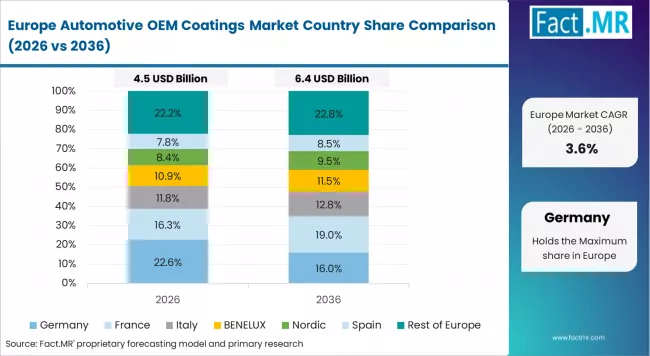
Automotive Oem Coatings Market Europe Country Market Share Analysis, 2026 & 2036 | Source: Fact.MR
The automotive OEM coatings market in Europe is projected to grow from USD 4.2 billion in 2026 to USD 6.4 billion by 2036, registering a CAGR of 4.3% over the forecast period. Germany is expected to maintain its leadership position with a 38.6% market share in 2026, rising to 40.1% by 2036, supported by its dominant premium automotive manufacturing infrastructure, comprehensive environmental compliance capabilities, and advanced coating technology excellence throughout major automotive production regions and assembly networks.
France follows with a 22.4% share in 2026, projected to reach 21.8% by 2036, driven by established automotive manufacturing base, domestic OEM presence, and comprehensive vehicle production sophistication serving both European and global markets. The UK holds a 16.8% share in 2026, expected to increase to 17.2% by 2036, supported by premium automotive manufacturing infrastructure and specialty vehicle production capabilities. Italy commands a 12.7% share in 2026, projected to reach 11.9% by 2036, while Spain accounts for 7.3% in 2026, expected to reach 6.8% by 2036.
The rest of Europe region, including Nordic countries with advanced environmental standards, Eastern European emerging automotive markets, and smaller Western European specialty production centers, is anticipated to hold 2.2% in 2026, declining slightly to 2.2% by 2036, attributed to market stability in specialized automotive manufacturing regions with established coating supply infrastructure and application expertise.
Competitive Landscape of the Automotive OEM Coatings Market
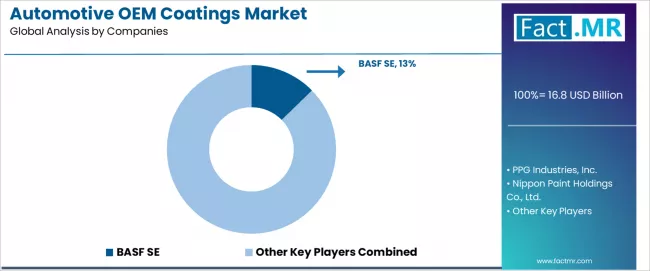
Automotive Oem Coatings Market Analysis By Company | Source: Fact.MR
The automotive OEM coatings market is characterized by intense competition among established coating manufacturers, specialized automotive paint suppliers, and comprehensive chemical solution organizations focused on delivering high-quality, reliable, and environmentally compliant coating systems.
Companies are investing in formulation innovation programs, advanced application technology development, strategic automotive OEM partnerships, and comprehensive technical support initiatives to deliver effective, efficient, and sustainable automotive coatings that meet stringent automotive quality standards and environmental expectations. Product standardization, color consistency optimization, and environmental performance strategies are central to strengthening product portfolios and market presence.
BASF SE leads the market with a 12.7% market share, offering comprehensive automotive OEM coating solutions with a focus on integrated coating system expertise and advanced environmental technology capabilities for global vehicle manufacturing applications. PPG Industries Inc. provides specialized automotive coating platforms with emphasis on color innovation and comprehensive application solutions across international automotive markets.
Nippon Paint Holdings Co., Ltd. focuses on Asian automotive market leadership and comprehensive coating technology solutions serving regional vehicle industries. Akzo Nobel N.V. delivers global coating expertise with strong European market presence and sustainability integration capabilities.
Axalta Coating Systems LLC. operates with a focus on bringing dedicated automotive coating specialization to global OEM markets and production applications. Berger Paints India Ltd. provides regional automotive coating solutions emphasizing emerging market development and localized manufacturing.
Kansai Paint Co., Ltd. specializes in Asian automotive coatings and quality-focused formulations with emphasis on Japanese quality standards. The Sherwin-Williams Company delivers comprehensive coating portfolios to enhance market coverage and provide integrated system solutions.
KCC Corporation and Covestro AG focus on specialized automotive coating technologies and raw material innovation, emphasizing technical quality and comprehensive technical support through dedicated automotive coating chemistry and application technology strategies.
Key Players in the Automotive OEM Coatings Market
- BASF SE
- PPG Industries, Inc.
- Nippon Paint Holdings Co., Ltd.
- Akzo Nobel N.V.
- Axalta Coating Systems, LLC
- Berger Paints India Limited
- Kansai Paint Co., Ltd.
- The Sherwin-Williams Company
- KCC Corporation
- Covestro AG
Bibliography
- European Automobile Manufacturers Association. (2024). ACEA environmental report: VOC emission reduction targets for automotive paint shops. ACEA.
- International Organization for Standardization. (2024). ISO 12944: Corrosion protection of steel structures by protective paint systems, automotive body application guide. ISO.
- European Commission. (2024). Industrial Emissions Directive (IED) 2024/xxx: Best available techniques for surface treatment of vehicles using organic solvents. EC.
- Society of Automotive Engineers. (2024). SAE J2527: Performance-based standard for accelerated exposure of automotive exterior materials using UV fluorescent devices. SAE.
- Japan Paint Manufacturers Association. (2024). JPMA statistics report: Automotive OEM coating production volumes and technology trends 2023 to 2024. JPMA.
- Bureau of Indian Standards. (2024). IS 101: Methods of testing for paints, varnishes, and related products, automotive grade performance requirements. BIS.
This bibliography is provided for reader reference. The full Fact.MR report contains the complete reference list with primary research documentation.
This Report Addresses
- Market sizing and quantitative forecast metrics detailing global and regional expenditure on automotive oem coatings through 2036.
- Segmentation analysis evaluating adoption patterns across product, resin, technology, application categories and their respective sub-segments.
- Regional deployment intelligence comparing growth trajectories, regulatory environments, and competitive dynamics across North America, Europe, Asia Pacific, Latin America, and the Middle East & Africa.
- Regulatory compliance assessment analyzing how safety, environmental, or performance standards shape procurement specifications and product development priorities.
- Competitive landscape evaluation tracking market structure, supplier positioning, and integration strategies among leading industry participants.
- Strategic investment guidance defining the procurement specifications, technology transitions, and capacity allocation decisions required for market positioning through the forecast period.
- Supply chain risk analysis identifying material sourcing constraints, manufacturing concentration vulnerabilities, and logistics dependencies affecting market participants.
- Custom data delivery formats encompassing interactive dashboards, raw Excel datasets, and comprehensive PDF narrative reports.
Segmentation
Scope of the Report
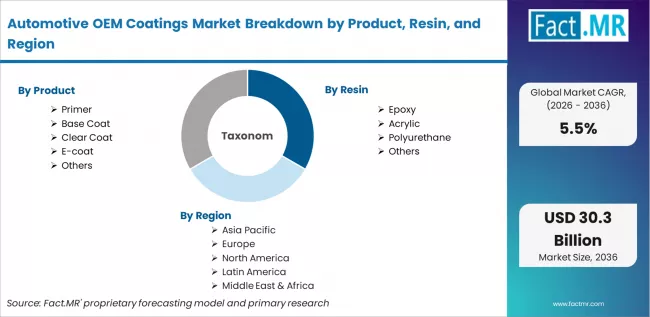
Automotive Oem Coatings Market Breakdown By Product, Resin, And Region | Source: Fact.MR
| Metric | Value |
|---|---|
| Quantitative Units | USD 17.72 billion to USD 30.28 billion, at a CAGR of 5.50% |
| Market Definition | Automotive OEM coatings are factory-applied multi-layer paint systems that provide corrosion protection, colour delivery, surface finish quality, and environmental weathering resistance on passenger car and commercial vehicle body structures during the manufacturing process. |
| Product Segmentation | Primer, Base Coat, Clear Coat, E-coat, Others |
| Resin Segmentation | Epoxy, Acrylic, Polyurethane, Others |
| Technology Segmentation | Water-based, Solvent-based, Powder-based, Others |
| Application Segmentation | Passenger Cars, Commercial Vehicles |
| Regions Covered | North America, Latin America, Europe, East Asia, South Asia, Oceania, Middle East & Africa |
| Countries Covered | India, China, USA, Canada, UK, Germany, Japan, and 40 plus countries |
| Key Companies Profiled | BASF SE, PPG Industries, Inc., Nippon Paint Holdings Co., Ltd., Akzo Nobel N.V., Axalta Coating Systems, LLC, Berger Paints India Limited, Kansai Paint Co., Ltd., The Sherwin-Williams Company, KCC Corporation, Covestro AG |
| Forecast Period | 2026 to 2036 |
| Approach | Forecasting models apply a hybrid top-down and bottom-up methodology, cross-validated against primary research and public industry filings. |
Source: Fact.MR analysis. Updated Mar 23, 2026
Automotive OEM Coatings Market by Segments
-
Product :
- Clear Coat
- Base Coat
- Primer
- E-coat
- Others
-
Resin :
- Polyurethane
- Acrylic
- Epoxy
- Others
-
Technology :
- Solvent-based
- Water-based
- Powder-based
- Others
-
Application :
- Passenger Cars
- Commercial Vehicles
-
Region :
-
Asia Pacific
- China
- India
- Japan
- South Korea
- ASEAN
- Australia & New Zealand
- Rest of Asia Pacific
-
North America
- United States
- Canada
- Mexico
-
Europe
- Germany
- France
- United Kingdom
- Italy
- Spain
- Nordic
- BENELUX
- Rest of Europe
-
Latin America
- Brazil
- Argentina
- Chile
- Rest of Latin America
-
Middle East & Africa
- Kingdom of Saudi Arabia
- Other GCC Countries
- Turkey
- South Africa
- Other African Countries
- Rest of Middle East & Africa
-
Frequently Asked Questions
How large is the automotive oem coatings market in 2026?
What will the automotive oem coatings market size be by 2036?
What is the expected CAGR for the automotive oem coatings market between 2026 and 2036?
Which product segment is poised to lead in 2026?
Which country is the fastest-growing market?
What is the scope of this automotive oem coatings market report?
What methodology does Fact.MR use for this forecast?
Which companies are profiled in this report?
Who worked on this report


Preview the report firsthand - request a free sample
Free SampleGet the brochure for pricing and purchase details
Download PDF