- Market Value (2025): USD 888.1 Mn
- Estimated Value (2026): USD 960.0 Mn
- Forecast Value (2036): USD 2091.8 Mn
- CAGR (2026-2036): 8.1%
What is the High-Speed Rail Coatings Market forecast to be worth by 2036?
Revenue is projected to move from USD 960.0 million in 2026 to USD 2,091.8 million by 2036, equivalent to an 8.1% CAGR over the forecast period.
- 2025 Market Value: USD 888.1 million
- 2026 to 2036 Market Progression: USD 960.0 million to USD 2,091.8 million
- Forecast CAGR (2026-2036): 8.1%
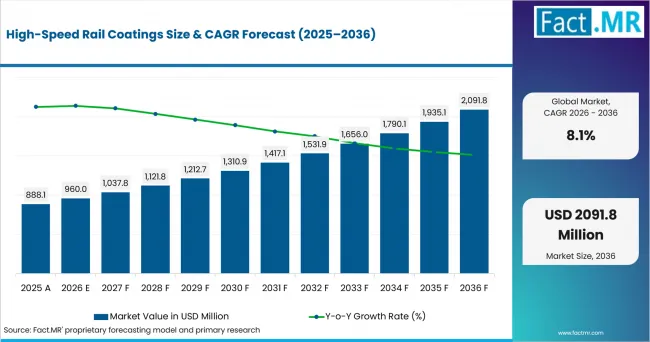
High Speed Rail Coatings Value Analysis | Source: Fact.MR
What are the defining numbers behind High-Speed Rail Coatings Market growth?
The ten-year increase amounts to USD 1,131.8 million. That additional revenue comes from two different coating events: paint consumed when new trainsets are built, and paint consumed when vehicles return to depots for repair or refurbishment. High-speed service raises the performance threshold for both.
ISO 9466:2025 gives this market a clearer technical reference. It covers coating-material performance, surface preparation, application, inspection, repair and refurbishment for passenger rolling stock. In practical terms, a rail coating is bought as part of a controlled process, not simply as a colored finish.
- Demand Drivers in the Market
- Fleet production is feeding coating lines with fresh surface area. JR Central is still adding N700S trainsets, SNCF is preparing the new TGV INOUI for deployment from autumn 2026, and Deutsche Bahn continued ICE 3neo acceptance in 2026. Each build program creates demand before a train carries its first passenger.
- Operating conditions punish weak exterior films. Nippon Paint describes railway coatings as having to withstand vibration at speed and pressure shocks in tunnels, in addition to dirt and seasonal weather. On a high-speed train, coating durability is therefore tied to service life and appearance at the same time.
- Maintenance creates a second purchase cycle. ISO 9466 includes repair and refurbishment within the coating process, which matters because operators eventually have to restore damaged topcoats, corroded areas and high-contact interior surfaces without keeping trains out of service longer than necessary.
- Interior formulations face a separate constraint: fire behavior. EN 45545-2 governs fire requirements for materials used on railway vehicles, so lower-emission formulations still have to fit passenger-safety specifications rather than being selected on VOC reduction alone.
- Key Segments Analyzed
- Layer: Exterior topcoat holds 31.0% in 2026. It is the exposed finish that has to retain color and gloss while taking weather, washing and mechanical abuse.
- Resin: Polyurethane represents 35.0% in 2026. Rail finishers use the chemistry where they need a durable exterior appearance with resistance to weather and wear.
- Performance: High-speed erosion resistance accounts for 26.0% in 2026. Nose sections and other exposed surfaces repeatedly meet particles, turbulent airflow and tunnel-pressure effects.
- Application Area: Carbody exterior represents 38.0% in 2026. The body shell combines a large coated area with visible appearance requirements and repeated exposure during operation.
- Analyst Opinion at Fact.MR
- “The useful question for a train builder is not whether a coating can achieve a high test value in isolation. It is whether the full paint system can be applied consistently on the line, repaired later in a depot and still meet the required surface quality after years of cleaning and outdoor exposure. That is why cure behavior and repair procedure matter alongside corrosion or weathering data,” notes Shambhu Nath Jha, Senior Consultant, Fact.MR.
- Strategic Implications
- For coating suppliers, the sale is rarely one layer at a time. A primer that cures slowly can hold up a paint shop even when the topcoat performs well, while an attractive finish loses value if local repairs leave visible differences. Qualification should therefore be built around the complete coating sequence used by the train manufacturer.
- Operators look at the same system from the opposite end of the vehicle life. They care about how often a train has to be repainted and how quickly a damaged area can return to service. Products that shorten repair work without forcing more frequent recoating have a stronger economic case than formulations sold primarily on chemistry.
- Resin suppliers need to attach each chemistry to a clear rail job. Polyurethane fits exposed finishes, epoxy is useful where corrosion protection matters, and specialty resins earn a place where cleanability or a specific surface requirement justifies the added formulation complexity.
How does the High-Speed Rail Coatings Market break down by segment?
The market is segmented by Layer, Resin, Performance and Application Area.
Why does Exterior topcoat lead Layer?
Exterior topcoat accounts for 31.0% of Layer in 2026.
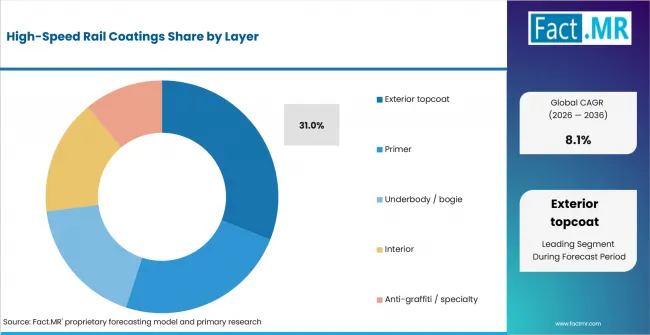
High Speed Rail Coatings Analysis By Layer | Source: Fact.MR
The outer finish is the part of the coating stack that passengers see and the environment attacks first. Mankiewicz specifies rail exterior systems around UV resistance, mechanical strength and contamination resistance, while also treating color and gloss as controlled design requirements. This places the topcoat inside the wider performance coatings field, but the buying decision is more specific: the finish must survive rail service without becoming a maintenance problem.
A small repair also has to blend into a much larger painted surface. That makes color consistency and clean repair edges commercially important. If a depot can restore a local area instead of repainting an entire car, the coating saves vehicle downtime as well as material.
Why does Polyurethane lead Resin?
Polyurethane accounts for 35.0% of Resin in 2026.
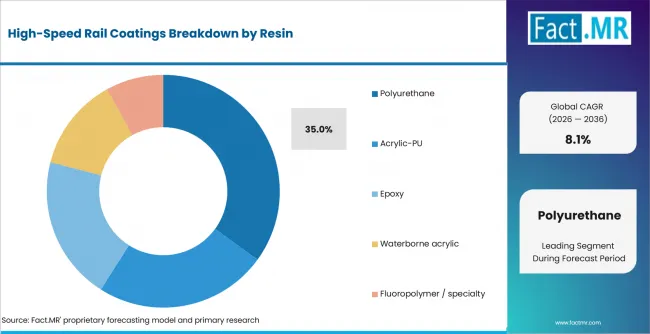
High Speed Rail Coatings Analysis By Resin | Source: Fact.MR
The resin works well where a rail operator wants an exterior finish that can stay glossy while resisting weather and repeated cleaning. Axalta’s Imron rail portfolio uses polyurethane technology across primers and topcoats, with products aimed at durability and wear resistance. That practical use case links high-speed train finishes with the broader urethane coatings category.
Polyurethane also fits the workflow of established rail paint shops. A train builder can work within a familiar multilayer process, which matters because changing resin chemistry can trigger fresh application trials and qualification work even when the final color looks unchanged.
Why does High-speed erosion resistance lead Performance?
High-speed erosion resistance accounts for 26.0% of Performance in 2026.
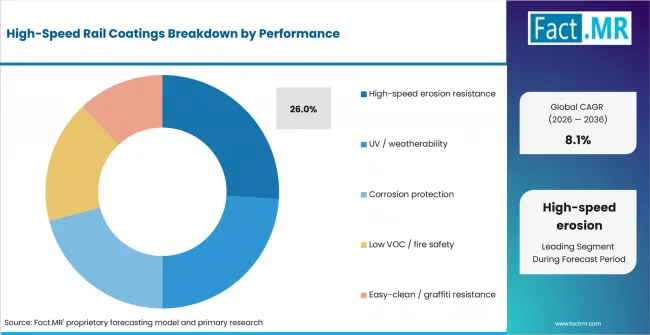
High Speed Rail Coatings Analysis By Performance | Source: Fact.MR
At speed, the exterior sees more than rain and sunlight. Nippon Paint points to vibration and tunnel pressure shocks as part of the service environment for railway paint. Track debris and airborne particles add repeated local impacts, especially around front-facing surfaces. The requirement therefore overlaps with abrasion-resistant coatings, although a rail finish must also retain adhesion and appearance after that exposure.
This changes how buyers read a coating data sheet. Hardness by itself is insufficient if the film becomes brittle or difficult to repair. Rail engineers need a balance between resistance to surface damage and the flexibility required by large vehicle panels and joints.
Why does Carbody exterior lead Application Area?
Carbody exterior accounts for 38.0% of Application Area in 2026.
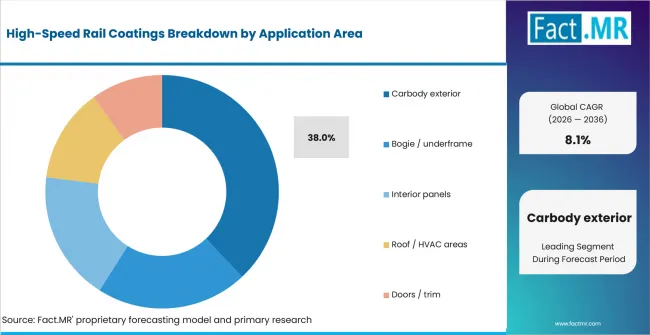
High Speed Rail Coatings Analysis By Application Area | Source: Fact.MR
The carbody concentrates several coating jobs on one visible surface: it carries the operator’s livery, shields the substrate and is cleaned throughout the service life of the train. Mankiewicz markets UV-durable topcoats and anti-graffiti systems for outer shells and door zones, while PPG emphasizes weather resistance and color retention for railcar coatings. Protection of metallic substrates also connects this application with anti-corrosion coatings.
Carbody work is also expensive to redo because of the area involved. This pushes buyers toward systems that can hold appearance for longer and accept local repair when scratches or contamination are concentrated in one section.
What is accelerating High-Speed Rail Coatings Market adoption, and what is holding it back?
The market is receiving demand from both sides of the fleet cycle. New train programs require factory-applied coating stacks, while older high-speed vehicles return for repainting and component refurbishment. ISO 9466 now gives manufacturers and operators a common reference for how coating performance, inspection and repair should be handled across that lifecycle.
The harder part is substitution. A new coating may promise lower emissions or faster cure, yet the operator still needs the same surface quality, fire behavior and repair reliability. Waterborne rail systems show how formulation can move in that direction, but adoption remains tied to qualification and shop conditions. The same formulation choices are visible in the broader waterborne acrylic field.
Drivers Impact Analysis
| DRIVER | (~) % IMPACT ON CAGR | GEOGRAPHIC RELEVANCE | IMPACT TIMELINE |
|---|---|---|---|
| High-speed fleet additions and replacement programs | +1.5% | Japan, France, Germany, Spain, UK | Near to Mid-term |
| Longer coating-service-life requirements for high-speed operation | +1.1% | Europe, Japan | Near to Mid-term |
| Rolling-stock refurbishment and repainting cycles | +0.8% | Japan, France, Germany, Spain, UK | Mid-term |
Opportunity Impact Analysis
| OPPORTUNITY | (~) % IMPACT ON CAGR | GEOGRAPHIC RELEVANCE | IMPACT TIMELINE |
|---|---|---|---|
| Waterborne exterior and interior systems | +0.9% | Europe, Japan | Near to Mid-term |
| Fast-dry primer and repair systems that reduce shop time | +0.7% | Germany, France, UK, Japan | Mid-term |
| Anti-graffiti and easy-clean finishes for high-use fleets | +0.5% | France, Germany, Spain, UK | Mid-term |
Restraints Impact Analysis
| RESTRAINT | (~) % IMPACT ON CAGR | GEOGRAPHIC RELEVANCE | IMPACT TIMELINE |
|---|---|---|---|
| Rail qualification and requalification burden | -0.9% | Global | Near to Mid-term |
| Multi-layer application and cure-time constraints | -0.6% | Global | Near-term |
| Fire-safety and low-VOC formulation tradeoffs | -0.4% | Europe, UK, Japan | Mid-term |
Which countries are scaling the High-Speed Rail Coatings Market through 2036?
- Japan: JR Central plans 78 N700S trainsets through fiscal 2028. The important coating effect is continuity of series production, which keeps exterior and component coating work active rather than depending on a one-off fleet order.
- France: SNCF Group states that the new TGV INOUI will be deployed from autumn 2026. The production program then extends the coating opportunity beyond initial delivery into later maintenance and refurbishment.
- Germany: Deutsche Bahn had 45 ICE 3neo trains in operation by mid-2026 and continued modernization of older ICE equipment. New manufacture and refurbishment are therefore contributing to coating consumption at the same time.
- Spain: Renfe has added 30 S-106 high-speed trains capable of operating at up to 330 km/h. As these vehicles accumulate service hours, the coating opportunity shifts gradually from original application toward repair and repainting.
- UK: The HS2 rolling-stock contract covers 54 trains, while the railway specification was reviewed again in 2026. Coating suppliers face a qualification opportunity during vehicle design and production before routine maintenance demand begins.
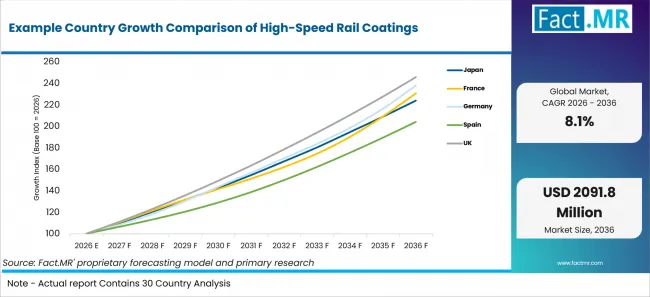
Example Country Growth Comparison Of High Speed Rail Coatings | Source: Fact.MR
Country CAGR (2026-2036)
| Country | CAGR (2026-2036) |
|---|---|
| Japan | 8.4% |
| France | 8.7% |
| Germany | 9.1% |
| Spain | 7.4% |
| UK | 9.4% |
What is driving Japan's growth through 2036?
Japan is projected to expand at a CAGR of 8.4% from 2026 to 2036.
JR Central’s N700S program provides a visible production schedule rather than a vague fleet-renewal signal. Its 2025 annual report sets out 78 trainsets through fiscal 2028. Every additional unit passes through exterior finishing and component coating before it can be accepted into service.
The country also has coating suppliers that understand the rail operating environment. Nippon Paint discusses tunnel pressure shocks and high-speed vibration as real paint-design constraints, while Kansai Paint describes separate coating demand from new rolling stock and repainted stock. That combination supports both original-build work and later depot consumption.
What is driving France's growth through 2036?
France is projected to expand at a CAGR of 8.7% from 2026 to 2036.
SNCF Group states that the fifth-generation TGV INOUI will be deployed from autumn 2026. The group’s 2025 financial report says production of the ordered trainsets runs through 2036, giving coating suppliers a sustained manufacturing program rather than a short delivery burst.
SNCF added another 15 TGV M trainsets to the order book in January 2026. For coatings, that matters because the same qualified paint stack can continue through successive production batches, while the first vehicles begin creating a separate maintenance history in service.
What is driving Germany's growth through 2036?
Germany is projected to expand at a CAGR of 9.1% from 2026 to 2036.
Deutsche Bahn reported 45 ICE 3neo trains in operation by mid-2026, including six accepted during the first half. At the same time, ICE 1 modernization continued. That creates two different coating workloads: untouched surfaces on new trains and restoration work on vehicles already deep into their service life.
Germany also has a domestic rail-coating supply base close to train builders and operators. Mankiewicz supplies systems for exteriors as well as bogies, with material options designed around railway specifications. Local application support is useful when a coating change has to be proven on an existing paint line rather than in a laboratory alone.
What is driving Spain's growth through 2036?
Spain is projected to expand at a CAGR of 7.4% from 2026 to 2036.
Renfe’s S-106 fleet adds 30 high-speed trainsets, with the platform designed for speeds up to 330 km/h. The direct coating demand begins at manufacture, where each body shell and underframe requires a controlled system before delivery.
The more durable opportunity develops after entry into service. Exterior films accumulate cleaning wear and impact damage, while interiors are exposed to repeated passenger use. Repair products and repainting systems become more relevant as the fleet moves from delivery into regular maintenance cycles.
What is driving UK's growth through 2036?
The UK is projected to expand at a CAGR of 9.4% from 2026 to 2036.
HS2’s rolling-stock contract covers a minimum of 54 high-speed trains to be supplied by the Hitachi-Alstom joint venture. The program therefore creates a defined vehicle platform on which exterior, interior and bogie coating systems must be selected and qualified before series production.
The 2026 HS2 specification review also shows that technical requirements are still being refined at program level. For coating suppliers, this puts value on early engineering support because materials need to fit the final manufacturing process and regulatory package before they become difficult to replace later in the fleet life.
Who Leads the High-Speed Rail Coatings Market?
Key players in the High-Speed Rail Coatings market include AkzoNobel, PPG, Axalta, Mankiewicz, Kansai Paint and Nippon Paint. Buyers compare them on rail qualification experience, system compatibility, local application support and the ability to reproduce the same finish across production and repair sites.
The portfolios are different enough to shape competition by application. Axalta markets waterborne Imron systems for rail interiors and exteriors. Mankiewicz covers the outer shell, passenger interior and bogie areas. Kansai Paint supplies coatings for new and repainted rolling stock, while PPG offers railcar systems focused on corrosion protection and shop productivity. Nippon Paint brings railway-specific formulation experience from Japan.
AkzoNobel and Axalta remain separate companies as of September 2026. Their shareholders approved a proposed merger in August, but the transaction still requires regulatory clearances and is expected to close in late 2026 or early 2027. They are therefore treated as distinct providers in the current market view.
Which companies are the key providers?
Key providers include AkzoNobel, PPG, Axalta, Mankiewicz, Kansai Paint and Nippon Paint.
- AkzoNobel
- PPG
- Axalta
- Mankiewicz
- Kansai Paint
- Nippon Paint
Bibliography
- Axalta Coating Systems. (2026, August 5). Axalta Shareholders Approve Proposed Merger of Equals with AkzoNobel. Axalta Coating Systems Ltd.
- Axalta. (n.d.). Rail Coatings. Axalta Mobility.
- Axalta. (n.d.). Imron polyurethane coatings for mobility applications. Axalta Coating Systems.
- British Standards Institution. (2023). BS EN 45545-2:2020+A1:2023 Railway applications: Fire protection on railway vehicles, requirements for fire behaviour of materials and components. BSI.
- Deutsche Bahn. (2026). Fleet development. Deutsche Bahn Interim Report 2026.
- High Speed Two Ltd. (2025). Supply chain FAQs: Rolling stock opportunities. HS2 Ltd.
- High Speed Two Ltd. (2026). Speed review: Change of HS2 railway specification and scope. UK Government.
- International Organization for Standardization. (2025). ISO 9466:2025 Railway applications: Coating of passenger rail vehicles. ISO.
- JR Central. (2025). Tokaido Shinkansen: Constant effort to enhance service. Central Japan Railway Company Annual Report 2025.
- Kansai Paint. (n.d.). Industrial Coatings: Rail. Kansai Paint Co., Ltd.
- Mankiewicz. (n.d.). Rail Coatings. Mankiewicz Gebr. & Co.
- Mankiewicz. (n.d.). Coating Systems Rail Exterior. Mankiewicz Gebr. & Co.
- Nippon Paint Holdings. (2025). How paint technology brings Kintetsu HINOTORI Limited Express to life. Nippon Paint Holdings Co., Ltd.
- PPG. (n.d.). Rail coating systems for railcars and bridges. PPG Industries.
- Renfe. (n.d.). Our trains: S-106 high-speed fleet. Renfe Group.
- SNCF Group. (2026). Full-year financial report 2025: New-generation TGV production program. SNCF Group.
- SNCF Voyageurs. (2026, May 29). Le TGV-M obtient l’autorisation de mise sur le marché et franchit les dernières étapes avant l’accueil des premiers voyageurs TGV INOUI. SNCF Voyageurs.
- SNCF Voyageurs. (2026). SNCF Voyageurs orders 15 additional TGV M trainsets. SNCF Voyageurs.
- SNCF Group. (2026, September 8). Discover the new TGV INOUI. SNCF Group.
This Report Answers
- How does market revenue change between 2026 and 2036?
- Why does the exterior topcoat account for 31.0% of Layer in 2026?
- Why is polyurethane used across a large share of high-speed rail coating systems?
- What makes erosion resistance a separate coating requirement at high operating speeds?
- Why does the carbody exterior account for 38.0% of Application Area in 2026?
- How do fleet production and refurbishment create different coating purchase cycles?
- What is driving coating demand in Japan, France, Germany, Spain and the UK?
- Which suppliers have active rail-coating capabilities?
What does the High-Speed Rail Coatings Market cover?
The market counts revenue from coating materials and coating systems applied to high-speed passenger rolling stock. It includes factory application on new vehicles and later repainting or refurbishment where the coating itself is part of the commercial purchase.
Included surfaces extend from the visible carbody to bogies, underframes and passenger interiors. Roof zones, doors and specialist protective finishes are also counted when they fall within the defined application taxonomy.
What is included in the scope?
- Exterior topcoats, primers, underbody and bogie coatings, interior coatings and anti-graffiti or specialty finishes used on high-speed passenger trains.
- Polyurethane, acrylic-PU, epoxy, waterborne acrylic and fluoropolymer or specialty resin systems.
- Performance requirements for erosion resistance, weatherability, corrosion protection, low-VOC or fire-safe formulations, and easy-clean or graffiti-resistant surfaces.
- Carbody exterior, bogie and underframe, interior panels, roof and HVAC areas, and doors or trim within the defined application hierarchy.
What is excluded from the scope?
- Paint used on stations, bridges, track structures or other rail infrastructure when it is not applied to rolling stock.
- Freight-wagon and conventional passenger-rail coating demand outside the high-speed train boundary.
- Spray booths, blasting machines, abrasives and other application equipment sold separately from coating materials.
- Adhesives, sealants, films and decorative wraps unless they form part of a qualifying coating system.
How Was the Analysis Built?
- Primary Research:Primary discussions focus on people who make or maintain the coating decision: rolling-stock paint engineers, depot maintenance teams, coating formulators, applicators and procurement managers. Compliance specialists are included where fire behavior or material approval affects the specification. The objective is to understand where a coating changes cost, line time or maintenance work.
- Desk Research:Desk research draws on railway coating standards and fire requirements, then cross-checks them against operator fleet plans and supplier product documentation. Train-program disclosures are used to understand when new surface area enters production and when refurbishment activity is likely to become relevant.
- Market Sizing and Forecasting:Sizing starts with high-speed rolling-stock build and refurbishment activity, then maps coated surface area to the number of layers and the resin mix used in each application. The forecast adjusts for fleet deliveries, repainting cycles and qualification timing, while also considering changes in application efficiency.
- Data Validation and Update Cycle:Updates track changes that can alter coating consumption or supplier position, such as revised train-delivery schedules, new rail standards, material approvals and refurbishment programs. Company portfolios are also checked so that rail capabilities reflect current products rather than legacy references.
What is the report's scope and coverage?
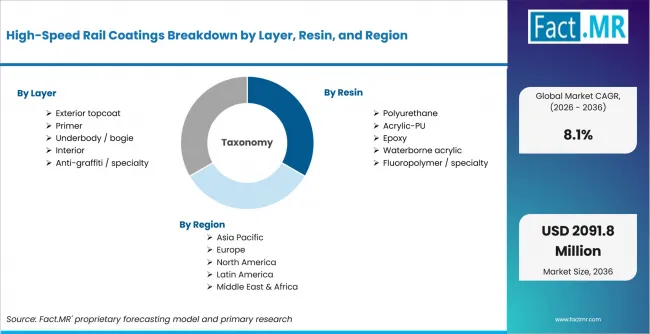
High Speed Rail Coatings Breakdown By Layer, Resin, And Region | Source: Fact.MR
| Attribute | Details |
|---|---|
| Quantitative Units | USD million |
| Market Definition | Coating systems used on high-speed passenger rolling stock for new-build and refurbishment applications |
| Segments | Layer; Resin; Performance; Application Area |
| Countries | Japan; France; Germany; Spain; UK |
| Key Companies | AkzoNobel; PPG; Axalta; Mankiewicz; Kansai Paint; Nippon Paint |
| Forecast Period | 2026-2036 |
| Base Year | 2026 |
| Market Value, 2026 | USD 960.0 million |
| Market Value, 2036 | USD 2,091.8 million |
| CAGR, 2026-2036 | 8.1% |
| Absolute Opportunity | USD 1,131.8 million |
| Approach | Bottom-up coating demand by rolling-stock application, layer and resin, adjusted for new-build and refurbishment activity |
How is the market segmented?
-
By Layer
- Exterior topcoat
- Primer
- Underbody / bogie
- Interior
- Anti-graffiti / specialty
-
By Resin
- Polyurethane
- Acrylic-PU
- Epoxy
- Waterborne acrylic
- Fluoropolymer / specialty
-
By Performance
- High-speed erosion resistance
- UV / weatherability
- Corrosion protection
- Low VOC / fire safety
- Easy-clean / graffiti resistance
-
By Application Area
- Carbody exterior
- Bogie / underframe
- Interior panels
- Roof / HVAC areas
- Doors / trim