- Base Value(2025): 4.6 Bn
- Estimated Value(2026): 5.1 Bn
- Forecast Value (2036): 15.1 Bn
- CAGR (2026 - 2036): 11.4%
Composite Railing And Decking Market Size, Share and Forecast and Outlook By Fact.MR
In 2025, the composite railing and decking market was valued at USD 4.6 billion. Fact MR analysis indicates demand for composite railing and decking is expected to reach USD 5.1 billion in 2026 and USD 15.1 billion by 2036. FMR estimates the market will expand at a CAGR of 11.4% across the forecast period.
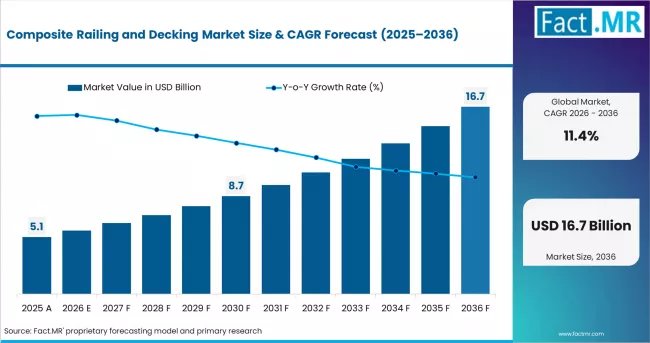
Composite Railing And Decking Market Market Value Analysis | Source: Fact.MR
Composite Railing and Decking Market
| Metric | Details |
|---|---|
| Industry Size (2026E) | USD 5.1 billion |
| Industry Value (2036F) | USD 15.1 billion |
| CAGR (2026 to 2036) | 11.4% |
Source: Fact.MR analysis. Updated May 4, 2026
Summary of Composite Railing and Decking Market
- Market Definition
- The composite railing and decking market comprises engineered construction materials manufactured using wood fibers, thermoplastic resins, and additives designed for exterior structural and architectural applications. Composite decking boards and railing systems provide dimensional stability, moisture resistance, and reduced maintenance requirements compared with conventional timber. These materials are used across residential patios, balconies, terraces, walkways, and commercial outdoor infrastructure where durability and weather resistance remain essential performance parameters.
- Demand Drivers
- Increasing replacement of pressure-treated lumber with composite materials supporting longer service life across exterior flooring applications.
- Expansion of residential renovation activity supporting installation of low-maintenance decking materials requiring minimal surface treatment.
- Growing preference for polymer-wood composite materials demonstrating resistance to moisture absorption, insect degradation, and ultraviolet exposure.
- Increasing use of capped composite materials supporting enhanced color stability and reduced surface wear across outdoor environmental exposure conditions.
- Expansion of residential outdoor living space construction supporting demand for structural decking boards and railing components.
- Development of co-extruded composite technologies supporting improved slip resistance and dimensional stability across exterior construction applications.
- Key Segments Analyzed
- Product Type: Decking accounts for 68.2% share supported by widespread adoption across residential outdoor flooring installations.
- Application: Residential segment holds 64.5% share supported by renovation-driven demand for durable exterior construction materials.
- Type: Capped composites demonstrate increasing adoption supported by enhanced weather resistance and surface protection performance.
- Resin Type: Polyethylene and PVC composites support material flexibility and moisture resistance across exterior structural applications.
- Composition: Solid composite boards demonstrate strong structural stability, while hollow boards support lightweight installation characteristics.
- Geography: China demonstrates fastest growth supported by expansion of composite construction materials manufacturing capacity, while the USA and Germany reflect mature renovation-driven demand environments.
- Analyst Opinion at Fact MR
- Sabyasachi Ghosh, Associate Vice President at Fact MR, states, "Composite railing and decking materials represent a performance-driven substitution category replacing traditional wood construction materials across exterior structural applications. Demand expansion reflects increasing preference for materials demonstrating dimensional stability and reduced maintenance exposure across residential renovation cycles. Manufacturers are focusing on improving polymer encapsulation technologies, surface texture performance, and ultraviolet resistance supporting long-term durability of composite structural materials through 2036."
- Strategic Implications
- Expand capped composite product development supporting improved resistance to ultraviolet exposure and surface degradation.
- Improve polymer formulation consistency supporting stable dimensional performance across varying climatic conditions.
- Strengthen manufacturing capability supporting production of solid and hollow composite structural boards aligned with installation requirements.
- Expand distribution networks supporting renovation-driven demand across residential construction supply chains.
- Improve surface texture engineering supporting slip resistance and structural reliability across exterior flooring installations.
- Strengthen recycled polymer sourcing capability supporting stable raw material supply across composite material production processes.
- Methodology
- Developed using primary interviews with composite material manufacturers, construction contractors, distributors, and architectural specification professionals.
- Supported through analysis of construction material publications, manufacturer technical documentation, and trade statistics covering composite structural materials.
- Market estimation applied hybrid modeling combining bottom-up manufacturer revenue analysis with top-down evaluation of exterior construction material demand.
- Data validated through triangulation using supplier disclosures, technical performance specifications, and expert consultation inputs.
- Periodic updates incorporate changes in polymer pricing, housing construction activity, and developments in composite material processing technologies.
A CAGR of 11.4%, with value increasing from USD 5.1 billion to USD 15.1 billion, indicates moderate peak-to-trough variation within a high-growth building materials segment. Demand is supported by replacement of wood decking and lower maintenance requirements, while fluctuations may arise from housing cycle sensitivity, polymer price volatility, and substitution pressure from treated lumber alternatives.
China records the fastest growth at 12.6%, supported by increasing use of wood plastic composite materials in residential outdoor construction. The USA follows at 12.1%, driven by demand for low-maintenance decking materials in home renovation projects. Germany shows 11.8% growth, linked to adoption of durable railing systems in multi-unit residential developments. The United Kingdom at 11.5% and Canada at 11.3% represent mature markets where demand is largely replacement-driven due to established penetration of composite outdoor construction materials. A structural constraint across mature markets is slower housing turnover rates, which limits rapid incremental installation of new decking systems.
Segmental Analysis of Composite Railing and Decking Market
Composite Railing and Decking Market Analysis by Product Type
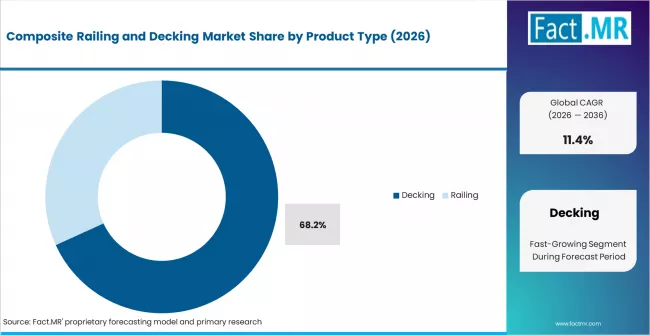
Composite Railing And Decking Market Analysis By Product Type | Source: Fact.MR
- Market Overview: Decking is projected to hold 68.2% share of the composite railing and decking market in 2026. Demand concentration reflects widespread use of wood-plastic composite decking boards in outdoor flooring applications requiring resistance to moisture exposure, dimensional deformation, and biological degradation associated with traditional timber materials. Material adoption patterns indicate preference for composite decking in environments requiring reduced maintenance frequency and extended service life.
- Demand Drivers:
- Moisture Resistance Performance: Composite decking materials demonstrate resistance to water absorption, reducing risks of swelling, cracking, and structural deterioration under outdoor environmental exposure conditions.
- Maintenance Reduction Requirements: End users prefer decking materials requiring minimal surface treatment, eliminating recurring staining, sealing, or repainting processes associated with conventional wood decking structures.
- Material Durability Characteristics: Composite formulations provide resistance to insect activity, ultraviolet exposure, and surface wear across residential outdoor flooring installations.
Composite Railing and Decking Market Analysis by Application
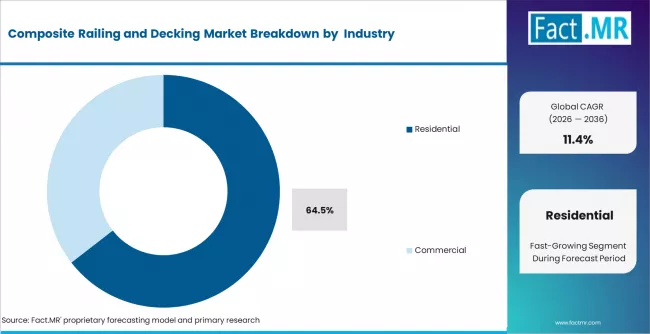
Composite Railing And Decking Market Analysis By Application | Source: Fact.MR
- Market Overview: Residential applications are estimated to account for 64.5% share in 2026, supported by increasing installation of outdoor decking structures across private housing properties requiring long-term performance under variable climatic conditions. Homeowners prioritize construction materials demonstrating stable appearance retention and structural reliability across extended usage periods.
- Demand Drivers:
- Home Improvement Activity: Residential property owners invest in outdoor living space development including patios, terraces, and garden decks constructed using composite decking materials.
- Aesthetic Consistency Requirements: Composite railing and decking materials provide uniform surface finish and color stability, supporting long-term appearance maintenance across exterior residential environments.
- Installation Efficiency: Lightweight composite boards support simplified installation processes across residential construction and renovation projects requiring efficient material handling characteristics.
Key Dynamics
Composite Railing and Decking Market Drivers, Restraints, and Opportunities
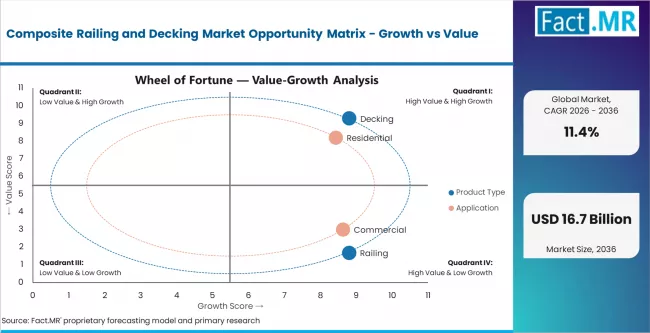
Composite Railing And Decking Market Opportunity Matrix Growth Vs Value | Source: Fact.MR
Fact MR analysis indicates the market reflects a transitioning building materials segment moving from commodity treated wood toward engineered polymer-wood composites designed for durability and lifecycle cost efficiency. Market size exists because traditional timber decking requires periodic sealing, staining, and replacement, creating long-term maintenance cost exposure for residential and commercial property owners. Composite materials combining recycled plastics and wood fiber provide dimensional stability, moisture resistance, and reduced lifecycle maintenance, supporting steady structural demand across renovation and outdoor construction markets. The current valuation reflects strong replacement demand within mature housing markets where homeowners prioritize predictable performance and reduced maintenance cycles.
Current dynamics show declining share for pressure-treated lumber in high-moisture environments such as patios, pool decks, and boardwalks, while capped composites and co-extruded materials command higher per-unit pricing due to enhanced UV resistance and color stability. Higher upfront product costs are offset by longer service life and reduced refinishing requirements, creating net-positive value growth despite moderate installation volume expansion. Market structure is shifting toward engineered surface technologies that improve slip resistance, aesthetics, and durability in residential remodeling and commercial outdoor infrastructure projects.
- Low-Maintenance Substitution: Composite decking replaces pressure-treated wood due to resistance to rot, mold, and insect damage, reducing lifecycle repair costs in residential outdoor construction.
- North America Remodeling Demand: United States home improvement spending and outdoor living upgrades support sustained baseline demand for railing and decking systems across renovation-driven construction cycles.
- Green Building Alignment: LEED certification frameworks and recycled polymer utilization support adoption of composite materials incorporating reclaimed plastics and wood fibers.
Regional Analysis of Composite Railing and Decking Market
The composite railing and decking market is assessed across Asia Pacific, Europe, and North America, segmented by country-level demand for wood plastic composite decking boards, railing systems, structural profiles, and exterior construction materials used in residential renovation and outdoor infrastructure. Geographic variation reflects building renovation activity, outdoor living construction trends, and demand for low maintenance composite materials. The full report offers market attractiveness analysis.
.webp "Top Country Growth Comparison Composite Railing And Decking Market Cagr (2026 2036)")
Top Country Growth Comparison Composite Railing And Decking Market Cagr (2026 2036) | Source: Fact.MR
CAGR Table
| Country | CAGR (2026–2036) |
|---|---|
| China | 12.6% |
| USA | 12.1% |
| Germany | 11.8% |
| UK | 11.5% |
| Canada | 11.3% |
Source: Fact.MR analysis. Updated May 4, 2026
Source: Fact MR analysis, based on proprietary forecasting model and primary research
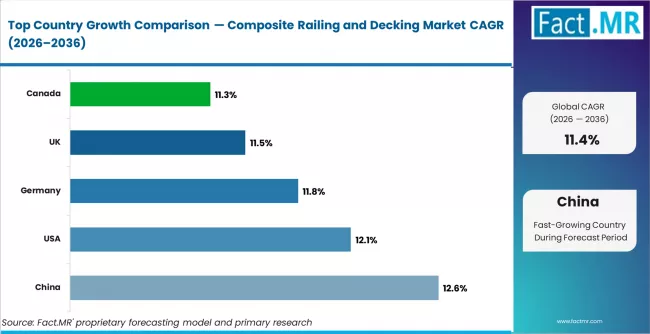
Composite Railing And Decking Market Cagr Analysis By Country | Source: Fact.MR
Asia Pacific
Asia Pacific functions as the composite construction materials production hub supported by increasing adoption of wood plastic composites in residential and commercial outdoor structures. UPM Biocomposites strengthens composite material formulation capability. Jiangsu Kingwood Industrial Co., Ltd. expands composite decking production scale. Anhui Guofeng Wood Plastic Composite Co., Ltd. supports structural profile manufacturing capability.
- China: China is projected to record 12.6% CAGR in composite railing and decking through 2036. Green Building Materials promotion guideline (Ministry of Housing and Urban-Rural Development, March 2023) supports composite construction material adoption. Jiangsu Kingwood Industrial Co., Ltd. expanded decking board production capacity (June 2023).
North America
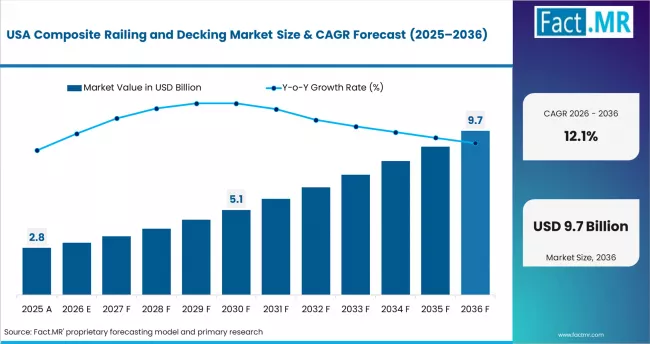
Composite Railing And Decking Market Country Value Analysis | Source: Fact.MR
North America operates as the residential outdoor construction commercialization center supported by strong home renovation activity and increasing preference for low maintenance decking materials. Trex Company, Inc. strengthens composite decking product innovation capability. Fiberon LLC expands railing system portfolio depth. TimberTech supports composite construction material engineering expertise.
- USA: The USA is expected to observe 12.1% CAGR in composite railing and decking through 2036. Residential renovation expenditure trend (U.S. Census Bureau, February 2024) supports demand for exterior composite structures. Trex Company, Inc. expanded composite decking production infrastructure (May 2023).
- Canada: Canada is anticipated to expand at 11.3% CAGR in composite railing and decking through 2036. Sustainable construction material initiative update (Natural Resources Canada, January 2023) supports adoption of recycled composite building materials. TimberTech expanded composite product distribution network (April 2023).
Europe
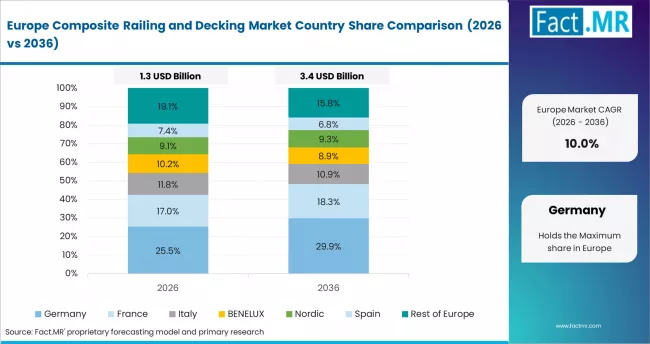
Composite Railing And Decking Market Europe Country Market Share Analysis, 2026 & 2036 | Source: Fact.MR
Europe functions as the exterior composite materials regulatory laboratory supported by demand for durable construction materials and structured building product standards. UPM Biocomposites strengthens wood plastic composite material innovation capability. Fiberon LLC expands structural railing product portfolio. Silvadec supports composite material processing expertise.
- Germany: Germany is forecast to grow at 11.8% CAGR in composite railing and decking through 2036. Energy efficient building material framework (Federal Ministry for Economic Affairs and Climate Action, March 2023) supports adoption of durable exterior materials. UPM Biocomposites expanded composite material production capability (July 2023).
- UK: The UK is projected to register 11.5% CAGR in composite railing and decking through 2036. Future Homes Standard consultation update (Department for Levelling Up, Housing and Communities, December 2023) supports low maintenance building material adoption. Fiberon LLC expanded composite railing product availability (June 2023).
Fact MR's analysis of composite railing and decking market in global regions consists of country-wise assessment that includes China, USA, Germany, UK, and Canada. Readers can find composite construction demand trends, exterior material innovation developments, regulatory positioning frameworks, and competitive product engineering insights.
Competitive Landscape
What is the Competitive Structure of the Composite Railing and Decking Market?
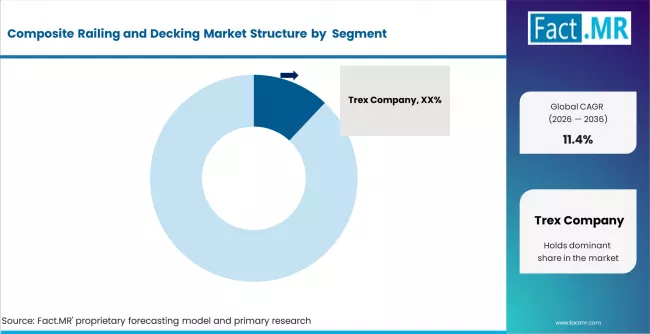
Composite Railing And Decking Market Analysis By Company | Source: Fact.MR
The composite railing and decking market demonstrates a moderately concentrated competitive structure, supported by established manufacturers with expertise in wood plastic composites and engineered outdoor building materials. Leading companies including Trex Company, TimberTech (AZEK Company), Fiberon, UFP Industries, Barrette Outdoor Living, and MoistureShield collectively account for nearly 55–65% of global market share, particularly in residential decking and railing applications requiring weather resistance and dimensional stability. Competitive positioning is primarily determined by material durability, resistance to moisture absorption, ultraviolet stability, surface texture performance, and ease of installation. Manufacturing scale and control over composite formulation influence product consistency and cost efficiency. Regional producers such as Eva-Last, NewTechWood, UPM Biocomposites, and DuxxBak Composite Decking contribute differentiated product designs and niche structural drainage features.
Structural advantages are observed among companies possessing vertically integrated composite processing capabilities and established distribution partnerships with home improvement retailers and contractors. Trex Company and TimberTech benefit from proprietary material formulations that improve scratch resistance and color retention across long-term outdoor exposure conditions. Buyers typically manage supplier dependency through product performance comparison and evaluation of warranty coverage across competing brands. Procurement decisions often consider installation efficiency, lifecycle maintenance cost, and compliance with structural performance requirements for outdoor construction. Pricing power remains relatively balanced, though suppliers retain moderate leverage where branded material performance and extended product warranties create switching constraints for contractors and residential buyers selecting long-term decking solutions.
Key Players of the Composite Railing and Decking Market
- Trex Company
- TimberTech (AZEK Company)
- Fiberon
- UFP Industries
- UPM Biocomposites
- Eva-Last
- MoistureShield
- NewTechWood
- Barrette Outdoor Living
- DuxxBak Composite Decking
Bibliographies
- [1] Ministry of Housing and Urban-Rural Development (China). (2023, March). Green Building Materials promotion guideline.
- [2] U.S. Census Bureau. (2024, February). Residential renovation expenditure trends.
- [3] Federal Ministry for Economic Affairs and Climate Action (Germany). (2023, March). Energy efficient building material framework.
- [4] Department for Levelling Up, Housing and Communities (UK). (2023, December). Future Homes Standard consultation update.
- [5] Natural Resources Canada. (2023, January). Sustainable construction material initiative update.
- [6] Jiangsu Kingwood Industrial Co., Ltd. (2023, June). Decking board production capacity expansion.
- [7] Trex Company, Inc. (2023, May). Composite decking production infrastructure expansion.
- [8] TimberTech (AZEK Company). (2023, April). Composite product distribution network expansion.
- [9] UPM Biocomposites. (2023, July). Composite material production capability expansion.
- [10] Fiberon LLC. (2023, June). Composite railing product availability expansion.
This Report Addresses
- Market size estimation and revenue forecasts from 2026 to 2036, supported by validated residential renovation activity benchmarks and polymer composite production capacity indicators across exterior construction materials.
- Growth opportunity mapping across decking boards, railing systems, capped composites, uncapped composites, and co-extruded surface technologies aligned with durability and weather resistance performance requirements.
- Segment and regional revenue forecasts covering polyethylene, polypropylene, and PVC-based composite formulations used in residential outdoor flooring, balconies, terraces, fencing structures, and commercial exterior installations.
- Competition strategy assessment including benchmarking of moisture resistance performance, ultraviolet stability characteristics, surface durability metrics, and formulation consistency across wood plastic composite manufacturing systems.
- Regulatory impact analysis covering building material performance standards, fire safety compliance frameworks, and environmental certification systems influencing adoption of polymer-wood composite construction materials.
- Market report delivery in PDF, Excel, PPT, and structured data formats designed for construction material manufacturers, distributors, contractors, architects, and building system integrators.
- Supply chain vulnerability assessments identifying concentration risks in recycled polymer sourcing, wood fiber feedstock availability, extrusion processing capacity, and additive formulation supply supporting composite decking and railing production.
Composite Railing and Decking Market Definition
The composite railing and decking market refers to engineered building materials made from combinations of wood fibers, plastics, and additives designed for outdoor structural and decorative applications. These products provide durability, weather resistance, and reduced maintenance compared to traditional timber, and are widely used in residential decks, balconies, fencing, and commercial outdoor infrastructure.
Composite Railing and Decking Market Inclusions
The report covers global and regional market size, historical trends, and forecast outlook across the defined period. It includes segmentation by material type such as polyethylene, polypropylene, and PVC composites, product types including decking boards and railing systems, applications in residential and commercial construction, and pricing, supply chain, and trade flow assessment.
Composite Railing and Decking Market Exclusions
The scope excludes traditional timber decking, metal railings, concrete structures, and alternative outdoor flooring materials not manufactured using composite formulations. Finished construction projects such as complete housing structures or prefabricated outdoor furniture are excluded, focusing strictly on composite boards, profiles, and structural railing components.
Composite Railing and Decking Market Research Methodology
- Primary Research
- Interviews were conducted with composite material manufacturers, construction contractors, distributors, and architects involved in outdoor structural material selection.
- Desk Research
- Public sources including construction material publications, company technical data, trade statistics, and industry reports were reviewed to assess material adoption trends and demand patterns.
- Market-Sizing and Forecasting
- A hybrid model combining bottom-up analysis of manufacturer revenues and top-down evaluation of construction material demand was applied to estimate market size and future growth potential.
- Data Validation and Update Cycle
- Findings were validated using multiple technical references, supplier data, and expert consultations. Periodic updates incorporate changes in construction activity, material pricing, and performance standards for outdoor composite building materials.
Segmentation
Report Scope
| Metric | Value |
|---|---|
| Quantitative Units | USD 5.1 billion (2026) to USD 15.1 billion (2036), at a CAGR of 11.4% |
| Market Definition | The composite railing and decking market includes engineered wood plastic composite and polymer-based materials used for outdoor structural surfaces and barrier systems. These products provide resistance to moisture, ultraviolet exposure, biological degradation, and dimensional instability, enabling long service life in residential and commercial exterior construction applications. |
| Product Type Segmentation | Decking, Railing |
| Type Segmentation | Capped composite, Uncapped composite |
| Resin Type Segmentation | Polyethylene, Polypropylene, PVC |
| Application Segmentation | Residential, Commercial |
| Composition Segmentation | Solid composite boards, Hollow composite boards |
| Regions Covered | North America, Latin America, Europe, East Asia, South Asia, Oceania, Middle East and Africa |
| Countries Covered | United States, Canada, Mexico, Brazil, Argentina, Germany, France, United Kingdom, Italy, Spain, China, India, Japan, South Korea, Indonesia, Australia, and 40+ countries |
| Key Companies Profiled | Trex Company, TimberTech (AZEK Company), Fiberon, UFP Industries, UPM Biocomposites, Eva-Last, MoistureShield, NewTechWood, Barrette Outdoor Living, DuxxBak Composite Decking |
| Forecast Period | 2026 to 2036 |
| Approach | Hybrid top-down and bottom-up market estimation validated through primary interviews with composite material manufacturers, construction material distributors, outdoor structural system producers, and building contractors, supported by construction demand benchmarking, raw material supply assessment, and evaluation of adoption patterns across exterior decking and railing installation projects |
Source: Fact.MR analysis. Updated May 4, 2026
Composite Railing and Decking Market Key Segments
-
Product Type:
- Decking
- Railing
-
Type:
- Capped Composite
- Uncapped Composite
-
Resin Type:
- Polyethylene
- Polypropylene
- PVC
-
Application:
- Residential
- Commercial
- Composition
- Solid Composite Boards
- Hollow Composite Boards
-
Region:
- North America
- USA
- Canada
- Mexico
- Europe
- Germany
- UK
- France
- Italy
- Spain
- Nordic Countries
- BENELUX
- Rest of Europe
- Asia Pacific
- China
- Japan
- South Korea
- India
- Australia
- Rest of Asia Pacific
- Latin America
- Brazil
- Argentina
- Rest of Latin America
- Middle East and Africa
- Kingdom of Saudi Arabia
- United Arab Emirates
- South Africa
- Rest of Middle East and Africa
- Other Regions
- Oceania
- Central Asia
- Other Markets
- North America
Frequently Asked Questions
How large is the demand for Composite Railing and Decking in the global market in 2026?
What will be the market size of Composite Railing and Decking in the global market by 2036?
What is the expected demand growth for Composite Railing and Decking in the global market between 2026 and 2036?
Which Product Type is poised to lead global demand by 2026?
What is Driving Composite Railing and Decking Demand in China?
What is the China Growth Outlook in this Report?
What is Driving Composite Railing and Decking Demand in the United States?
What is the United States Growth Outlook in this Report?
What is Driving Composite Railing and Decking Demand in Germany?
What is the Germany Growth Outlook in this Report?
What is Driving Composite Railing and Decking Demand in the United Kingdom?
What is the United Kingdom Growth Outlook in this Report?
What is Driving Composite Railing and Decking Demand in Canada?
What is the Canada Growth Outlook in this Report?
Which Companies are Identified as Leading Participants in the Composite Railing and Decking Market?
What are Composite Railing and Decking Materials and What are They Mainly Used For?
What does Composite Railing and Decking Market Mean in this Report?
What is Included in the Scope of this Composite Railing and Decking Market Report?
What is Excluded from the Scope of this Report?
What does Market Forecast Mean on this Page?
How is the Composite Railing and Decking Market Forecast Developed in this Report?
What does Data Validation Approach Mean in this Report?
Who worked on this report


Preview the report firsthand - request a free sample
Free SampleGet the brochure for pricing and purchase details
Download PDF