- Market Value (2025): USD 642.3 Mn
- Estimated Value (2026): USD 721.5 Mn
- Forecast Value (2036): USD 2307.8 Mn
- CAGR (2026-2036): 12.3%
What is the High-Temperature Epoxy Resins Market forecast to be worth by 2036?
USD 721.5 million in 2026 to USD 2307.8 million by 2036 at a 12.3% CAGR.
- High-temperature epoxy resin revenue reached a base of USD 642.3 million in 2025, with semiconductor packaging, aerospace composites and electrical insulation accounting for most heat-rated volume.
- Revenue will expand from USD 721.5 million in 2026 to USD 2307.8 million by 2036 as thermal limits tighten in power electronics, electric vehicles and lightweight structures.
- A 12.3% CAGR reflects a small specialty base that grows quickly once a resin system clears qualification and moves into serial production.
| Year | Basis | Market Value (USD million) |
|---|---|---|
| 2025 | Actual | 642.3 |
| 2026 | Estimate | 721.5 |
| 2036 | Forecast | 2307.8 |
| CAGR 2026 to 2036 | Forecast period | 12.3% |
Source: Fact.MR analysis. Updated Nov 12, 2026
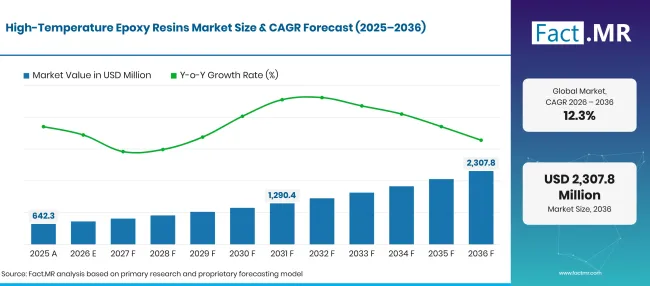
High Temperature Epoxy Resins Forecast Global | Source: Fact.MR
What are the defining numbers behind High-Temperature Epoxy Resins Market growth?
The 2026 to 2036 period adds USD 1586.3 million in new value, led by electronics, composites and electrical equipment.
- Demand Drivers in the Market
- Air travel growth keeps aircraft builders ordering carbon fiber structures that rely on heat-resistant epoxy matrices. The FAA forecasts that U.S. system revenue passenger miles will increase by 2.8% a year between 2025 and 2045.
- Electric vehicles put batteries, motors and inverters under sustained heat, which favors epoxy encapsulants and structural adhesives with elevated glass-transition temperatures. China produced 16.524 million new energy vehicles in 2025, up 25.1% over the previous year, and battery-electric cars took 17.3% of new EU passenger car registrations in 2025.
- Semiconductor packaging needs resins with heat resistance, dimensional stability and low signal loss. DIC will build a new epoxy resins plant at Chiba that lifts its annual capacity for semiconductor-grade epoxy resins by 59%, with operations starting in July 2029.
- Wind blades, transformers and switchgear require insulation and composite matrices that keep their properties at service temperature over long duty cycles, which keeps specialty epoxy in power and grid projects.
- Key Segments Analyzed
- By Epoxy Resin Chemistry: Bisphenol-based resins will hold 25.1% share in 2026 because formulators modify this familiar backbone for heat duty before switching to costlier chemistries.
- By Supply / Product Format: Film / sheet will account for 24.0% of 2026 value, since prepreg and adhesive film users need fixed resin content and clean layup.
- By Manufacturing / Cure Process: Melt processing will capture 26.4% in 2026, as solid and hot-melt resins suit film casting, prepreg impregnation and molding compounds.
- By Industrial End Use: Packaging / infrastructure will represent 27.5% of 2026 demand, given wide use in protective coatings, electronic packaging and civil structures exposed to heat.
- Analyst Opinion at Fact.MR
- Shambhu Nath Jha, Principal Consultant at Fact.MR, states, “Heat rating alone no longer wins business in this category; buyers want proof that a resin keeps its stiffness and adhesion after hundreds of thermal cycles. Suppliers that pair novolac and multifunctional chemistry with cure schedules short enough for volume lines will gain share in electronics and electric vehicles. Asian capacity additions will also shift price leadership toward producers close to semiconductor and battery clusters.”
- Strategic Implications
- Resin manufacturers should publish glass-transition, thermal aging and cure-cycle data together, because qualification teams compare all three before approving a grade.
- Composite fabricators should test film and prepreg resins for out-time and storage life alongside cured properties, since waste from expired material erodes the cost case.
- Electronics buyers should qualify a second resin source early, as packaging capacity in Asia is concentrated in a few plants.
- Investors should watch novolac and multifunctional aromatic capacity near battery and semiconductor clusters, where demand growth and local supply needs overlap.
India leads the country set at 15.9%, helped by new domestic epoxy capacity and fast growth in electronics assembly. China follows at 14.2%, where semiconductor and new energy vehicle output pull in heat-rated grades. The United States and Germany share 11.8%, the first lifted by aerospace engines and chip exports and the second by electrified cars and electrical equipment. Japan closes the range at 11.6%, a mature base where gains depend on advanced packaging materials. The 4.3-point spread between India and Japan shows that younger manufacturing bases will add heat-rated volume faster than markets already rich in qualified suppliers.
How does the High-Temperature Epoxy Resins Market break down by segment?
Bisphenol-based resins will lead Epoxy Resin Chemistry at 25.1%; Film / sheet will head Supply / Product Format at 24.0%; Melt processing will lead Manufacturing / Cure Process at 26.4%; Packaging / infrastructure will hold Industrial End Use at 27.5% in 2026.
Which Epoxy Resin Chemistry leads?
Bisphenol-based resins hold 25.1% of 2026 sales.
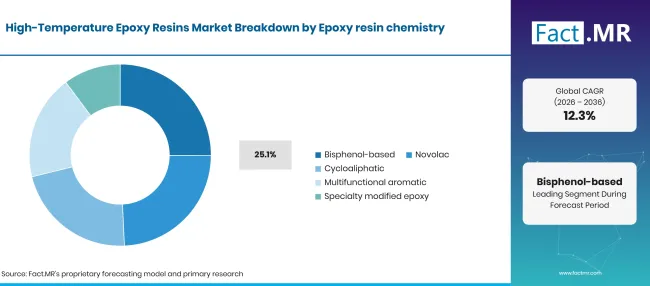
High Temperature Epoxy Resins Breakdown Epoxy Resin Chemistry | Source: Fact.MR
| Epoxy Resin Chemistry | Share (2026) |
|---|---|
| Bisphenol-based resins (Leading segment) | 25.1% |
| Other segments combined | 74.9%* |
| Total | 100.0% |
Source: Fact.MR analysis. Updated Nov 12, 2026
Most formulators start from bisphenol A and bisphenol F backbones, then raise heat resistance with tougheners, fillers and aromatic amine or anhydride hardeners. This route keeps raw material cost and supply risk lower than a full switch to specialty chemistry, and it suits coatings, tooling and many general epoxy resin grades upgraded for heat. Novolac and multifunctional aromatic resins serve the hottest service points, including laminates and encapsulants that must survive lead-free soldering. Cycloaliphatic grades suit outdoor insulators that need tracking resistance, while specialty modified epoxies balance toughness against brittleness at high crosslink density.
What supports Film / sheet within Supply / Product Format?
Film / sheet takes 24.0% of 2026 revenue.
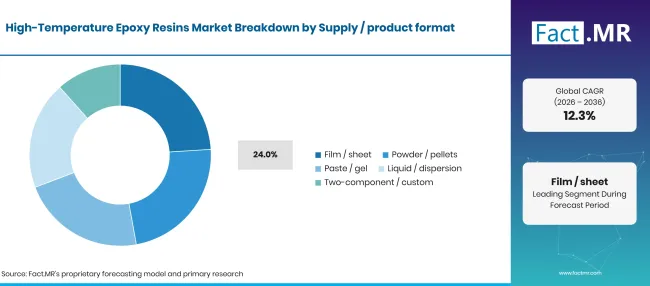
High Temperature Epoxy Resins Breakdown Supply Product Format | Source: Fact.MR
| Supply / Product Format | Share (2026) |
|---|---|
| Film / sheet (Leading segment) | 24.0% |
| Other segments combined | 76.0%* |
| Total | 100.0% |
Source: Fact.MR analysis. Updated Nov 12, 2026
Aircraft and motorsport parts are built from stacked plies, and a resin film gives each ply the same weight and thickness. Producers of carbon prepreg materials use hot-melt film to impregnate fiber without solvent, which also cuts emissions handling. Paste and gel products serve bonding and potting, powder and pellet forms feed molding compounds, and liquid or dispersion grades suit infusion and filament winding. Two-component and custom systems cover repair work and short production runs where users mix resin and hardener on site.
How does Manufacturing / Cure Process shape demand?
Melt processing accounts for 26.4% of 2026 value.
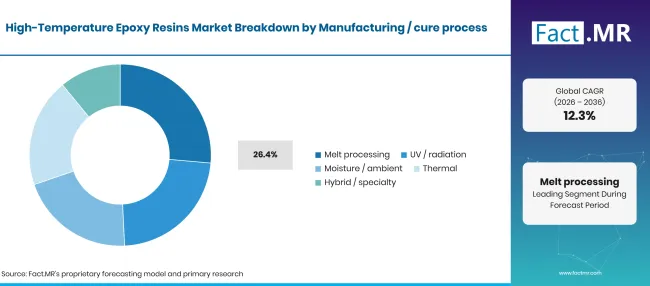
High Temperature Epoxy Resins Breakdown Manufacturing Cure Process | Source: Fact.MR
| Manufacturing / Cure Process | Share (2026) |
|---|---|
| Melt processing (Leading segment) | 26.4% |
| Other segments combined | 73.6%* |
| Total | 100.0% |
Source: Fact.MR analysis. Updated Nov 12, 2026
Solid epoxy and novolac resins are melted to cast films, impregnate fiber and compound molding powders for semiconductor encapsulation. Because the resin arrives without solvent, melt routes fit clean-room packaging lines and the low-outgassing epoxy grades used in optics and space hardware. Thermal oven and autoclave cures remain standard for aerospace laminates. UV and radiation cures serve thin coatings and adhesives, moisture and ambient routes suit field repair, and hybrid schedules help fabricators shorten cycle time without losing glass-transition temperature.
Which Industrial End Use accounts for the leading share?
Packaging / infrastructure represents 27.5% of 2026 demand.
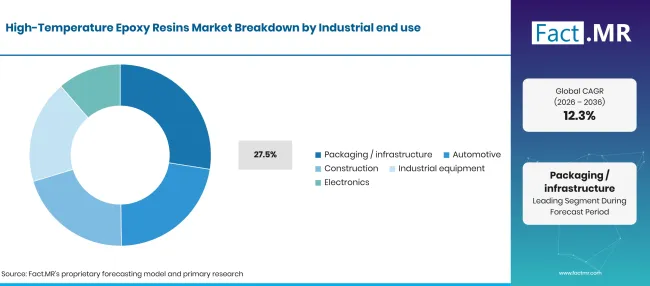
High Temperature Epoxy Resins Breakdown Industrial End Use | Source: Fact.MR
| Industrial End Use | Share (2026) |
|---|---|
| Packaging / infrastructure (Leading segment) | 27.5% |
| Other segments combined | 72.5%* |
| Total | 100.0% |
Source: Fact.MR analysis. Updated Nov 12, 2026
Protective coatings on pipes, tanks and bridges face heat, chemicals and weather, and electronic packaging faces solder reflow and heat from operation. Both rely on electrically insulating epoxies and heat-stable coatings that keep adhesion over long service lives. Construction uses heat-rated grouts and anchoring compounds, automotive uses battery and motor potting, and industrial equipment needs chemical-resistant linings. Electronics remains the most technically demanding outlet because substrate and encapsulant specifications change with each packaging generation.
What is accelerating High-Temperature Epoxy Resins Market adoption, and what is holding it back?
Hotter electronics, electric drivetrains and lighter aircraft structures keep raising the temperature that a resin must survive, and each new platform specifies higher glass-transition values. Specialty resins cost several times more than standard grades, though, and long post-cure schedules, brittleness at high crosslink density and multi-year qualification slow switching in price-sensitive uses.
Drivers Impact Analysis
| DRIVER | (~) % IMPACT ON CAGR | GEOGRAPHIC RELEVANCE | IMPACT TIMELINE |
|---|---|---|---|
| Semiconductor packaging and substrate demand for high-Tg resins | +1.2% | East Asia, North America | Medium term (2-4 years) |
| Electric vehicle battery, motor and power electronics potting | +1.0% | East Asia, Western Europe | Medium term (2-4 years) |
| Carbon fiber composites in aircraft structures and engines | +0.8% | North America, Western Europe | Long term (>=4 years) |
| Electrical insulation for grid and wind equipment | +0.6% | Global | Medium term (2-4 years) |
| Chemical and heat-resistant protective coatings | +0.4% | Global | Short term (<=2 years) |
Source: Fact.MR analysis. Updated Nov 12, 2026
Opportunity Impact Analysis
| OPPORTUNITY | (~) % IMPACT ON CAGR | GEOGRAPHIC RELEVANCE | IMPACT TIMELINE |
|---|---|---|---|
| Low-loss resins for high-speed communication substrates | +0.8% | East Asia | Medium term (2-4 years) |
| Local heat-rated epoxy supply in India | +0.6% | South Asia & Pacific | Long term (>=4 years) |
| Fast-cure prepreg systems for automotive composites | +0.5% | Western Europe, North America | Medium term (2-4 years) |
| Recyclable and lower-hazard epoxy formulations | +0.3% | Western Europe | Long term (>=4 years) |
Source: Fact.MR analysis. Updated Nov 12, 2026
Restraints Impact Analysis
| RESTRAINT | (~) % IMPACT ON CAGR | GEOGRAPHIC RELEVANCE | IMPACT TIMELINE |
|---|---|---|---|
| High cost of novolac and multifunctional resins | -0.8% | Global | Short term (<=2 years) |
| Long cure and post-cure cycles | -0.6% | Global | Medium term (2-4 years) |
| Brittleness at high crosslink density | -0.5% | Global | Medium term (2-4 years) |
| Lengthy aerospace and automotive qualification | -0.4% | North America, Western Europe | Short term (<=2 years) |
Source: Fact.MR analysis. Updated Nov 12, 2026
Which countries are scaling the High-Temperature Epoxy Resins Market through 2036?
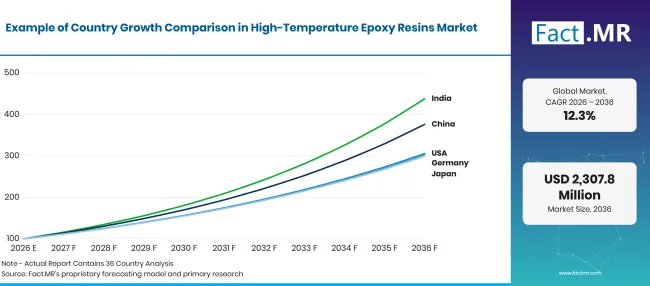
High Temperature Epoxy Resins Growth Index | Source: Fact.MR
| Country | CAGR (2026 to 2036) |
|---|---|
| India | 15.9% |
| China | 14.2% |
| United States | 11.8% |
| Germany | 11.8% |
| Japan | 11.6% |
Source: Fact.MR analysis. Updated Nov 12, 2026
What is driving India’s high-temperature epoxy demand?
15.9% CAGR, driven by domestic resin capacity and a fast-growing electronics base.
India’s chemicals and petrochemicals sector is valued at about USD 220 billion, and the government has set a target of USD 1 trillion by 2040. Electronics production reached about INR 13.11 lakh crore in FY 2025-26, up 15.8% year on year. Board assembly, motor winding and transformer makers are moving toward imported-quality laminates and potting compounds, which opens room for local novolac and heat-rated formulations.
How is China developing demand?
14.2% CAGR, backed by chip, vehicle and wind equipment output.
China produced 484.28 billion integrated circuits in 2025, up 10.9%, and its installed wind power capacity reached 640.01 million kilowatts, up 22.9%. Mold compounds, substrate resins and blade matrices all draw on epoxy systems that tolerate heat. Domestic producers compete hard on price in standard grades, so imported specialty resins keep a place in the most heat-demanding applications.
What is supporting United States adoption?
11.8% CAGR, helped by aerospace engines and semiconductor exports.
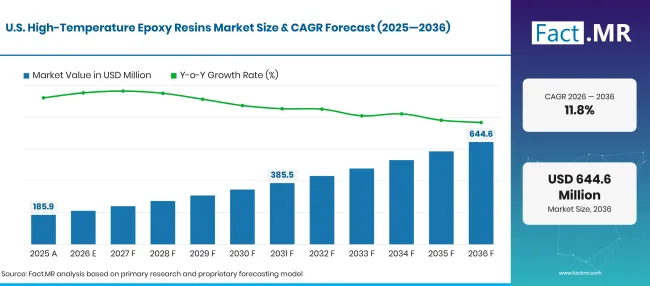
High Temperature Epoxy Resins Forecast Usa | Source: Fact.MR
U.S. exports of civilian aircraft engines reached USD 76.1 billion in 2025, and semiconductor exports reached USD 67.8 billion. Engine nacelles, fan cases and chip packages all use epoxy matrices or encapsulants rated for heat. Defense and space programs add demand for tightly specified grades, though qualification under aerospace standards keeps supplier changes rare.
How is Germany developing demand?
11.8% CAGR, reflecting electrified cars and electrical equipment.
Electric cars took 19.1% of new German registrations in 2025, about 545,100 vehicles. New orders for electrical equipment rose 9.8% in December 2025 from the previous month. Battery housings, e-motor potting and switchgear insulation give German formulators a steady pull for heat-rated grades, while weak overall manufacturing output tempers volume.
What supports Japan’s adoption?
11.6% CAGR, owing to advanced packaging and semiconductor policy.
Japan exported 6.58 trillion yen of semiconductors and related products in 2025, up 8.2% from 2024. The economy ministry plans to invest 100 billion yen in Rapidus, the domestic logic chip venture. These programs support demand for substrate and encapsulant resins used in advanced chip packages.
Who leads the High-Temperature Epoxy Resins Market?
Competition splits into three groups. Broad-line epoxy producers such as Olin Corporation and Westlake Corporation supply bisphenol and novolac resins at scale and win on supply security and price. Westlake Epoxy expanded its distribution relationship with Brenntag to South and West India in February 2026, giving coatings and construction customers local supply and formulation support.
Formulated-system specialists, led by Huntsman Corporation, sell complete ARALDITE and TACTIX systems into aerospace and industrial users who value certified performance over resin cost. Huntsman launched a reformulated ARALDITE adhesive range free of intentionally added BPA in September 2025. Asian electronics-focused producers, including DIC Corporation, Kukdo Chemical Co., Ltd. and Aditya Birla Chemicals, compete on proximity to chip and board makers; DIC approved a new Chiba plant for semiconductor-grade epoxy resins with government subsidy support. Across all three groups, contracts will go to suppliers who can prove heat performance on short cure cycles and hold supply steady near customer plants.
Which companies are the key providers?
Key companies in the High-Temperature Epoxy Resins Market include Huntsman Corporation, Olin Corporation, Westlake Corporation, DIC Corporation, Kukdo Chemical Co., Ltd. and Aditya Birla Chemicals.
- Huntsman Corporation
- Olin Corporation
- Westlake Corporation
- DIC Corporation
- Kukdo Chemical Co., Ltd.
- Aditya Birla Chemicals
Bibliography
- DIC Corporation. (2025, August 1). DIC Resolves to Build New Epoxy Resins Production Facility at its Chiba Plant.
- Federal Aviation Administration. (2025). FAA Aerospace Forecast Fiscal Years 2025-2045: Forecast Highlights.
- Federal Statistical Office of Germany. (2026, February 5). New orders in manufacturing in December 2025: +7.8% on the previous month.
- Huntsman Corporation. (2025, September 17). Huntsman Launches New Range of Safer, More Sustainable ARALDITE Epoxy Adhesives.
- Ministry of Economy, Trade and Industry. (2026, January 1). New Year Greetings 2026: Minister of Economy, Trade and Industry.
- Ministry of Finance Japan. (2026, January 29). Value of Exports and Imports 2025 (Calendar Year).
- National Bureau of Statistics of China. (2026, February 28). Statistical Communiqué of the People’s Republic of China on the 2025 National Economic and Social Development.
- Press Information Bureau, Government of India. (2026, April 23). Union Minister J.P. Nadda Meets with Industry Leaders to Chart Growth Roadmap for Chemicals & Petrochemicals Sector.
- Press Information Bureau, Government of India. (2026, July 29). Production Linked Incentive Schemes Strengthen India’s Electronics Manufacturing Ecosystem, Boosting Domestic Production, Exports and Value Addition.
- Statistisches Bundesamt. (2026, September 22). 17,3 % der Pkw-Neuzulassungen in der EU im Jahr 2025 waren E-Autos.
- U.S. Census Bureau. (2026, June 9). U.S. International Trade in Goods and Services, Annual Revision.
- Westlake Corporation. (2026, February 17). Westlake Epoxy Expands Distribution Relationship with Brenntag to India.
This Report Answers
- How much value will high-temperature epoxy resins add between 2026 and 2036, and which uses will create it?
- Why do bisphenol-based resins still lead chemistry demand when novolac grades offer higher heat resistance?
- Which supply formats and cure routes suit prepreg, encapsulation and coating lines?
- Where will India and China outpace the United States, Germany and Japan, and what explains each gap?
- How do broad-line producers, system formulators and Asian electronics suppliers compete for qualified business?
- What cost, cure and qualification barriers slow adoption in price-sensitive applications?
What does the High-Temperature Epoxy Resins Market cover?
This study measures sales of epoxy resins and formulated epoxy systems designed for service above the limits of standard grades, typically where glass-transition temperature, heat aging and thermal cycling define approval. Bisphenol, novolac, cycloaliphatic, multifunctional aromatic and specialty modified chemistries are tracked across five supply formats and five cure routes.
Values are stated in USD million at manufacturer selling prices, counted once at the point where the resin or system leaves the producer.
What is included in the scope?
Heat-rated liquid, solid and novolac resins sold to formulators, laminators and molders are counted.
Formulated systems sold as film, paste, powder or two-component kits for composites, potting, encapsulation and coatings are counted, including matrices for carbon fiber resin applications.
Heat-stable encapsulants and adhesives with thermal fillers are counted, which overlaps with thermally conductive epoxies only where heat rating is the main specification.
Sales into all five end uses and seven regions are counted, with country detail for India, China, the United States, Germany and Japan.
What is excluded from the scope?
Standard epoxy resins without an elevated temperature rating stay outside the count.
Curing agents and hardeners sold on their own, apart from a defined resin system, are not counted.
Finished composite parts, laminates, molded packages and application equipment are left out of resin revenue.
Bismaleimide, cyanate ester, polyimide and phenolic resins without an epoxy base are not part of this study.
How Was the Analysis Built?
The analysis draws on 120+ sources, 35+ company portfolios, 25+ countries, and more than 20 industry interviews.
- Primary Research: Primary research includes discussions with manufacturers, service providers, technology developers, distributors, end users, and subject-matter experts. These conversations examine purchasing priorities, product adoption, operational challenges, approval requirements, competitive positioning, and the factors that influence wider market acceptance.
- Desk Research: Desk research covers government statistics, regulatory publications, company filings, trade data, technical studies, industry associations, standards, public policy, and other authoritative sources. Every source used in the analysis is documented in the bibliography.
- Market Sizing and Forecasting: Market estimates combine historical performance, demand indicators, pricing and volume trends, segment shares, company participation, country-level growth, adoption patterns, investment activity, and barriers to market expansion.
- Data Validation and Update Cycle: Findings are validated by comparing primary interviews with public data, company activity, regulatory changes, trade patterns, and industry developments. Regular updates review new product launches, capacity changes, partnerships, approvals, and shifts in commercial adoption.
Segmentation
What is the report’s scope and coverage?
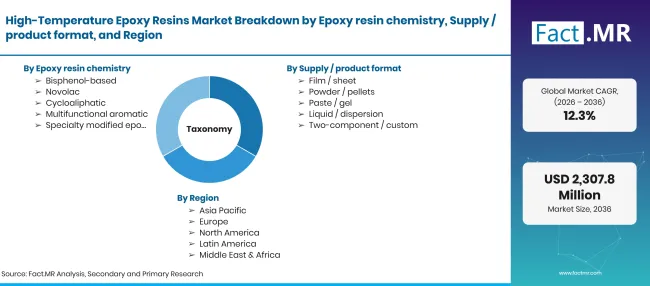
High Temperature Epoxy Resins Taxonomy | Source: Fact.MR
| Attribute | Details |
|---|---|
| Quantitative Units | USD million |
| Market Definition | Epoxy resin systems formulated to keep thermal stability, mechanical strength and adhesion at elevated service temperatures, sold to coatings, composites, electronics and electrical users. |
| Epoxy Resin Chemistry | Bisphenol-based; Novolac; Cycloaliphatic; Multifunctional aromatic; Specialty modified epoxy |
| Supply / Product Format | Film / sheet; Powder / pellets; Paste / gel; Liquid / dispersion; Two-component / custom |
| Manufacturing / Cure Process | Melt processing; UV / radiation; Moisture / ambient; Thermal; Hybrid / specialty |
| Industrial End Use | Packaging / infrastructure; Automotive; Construction; Industrial equipment; Electronics |
| Regions Covered | North America; Latin America; Western Europe; Eastern Europe; East Asia; South Asia & Pacific; Middle East & Africa |
| Countries Covered | India; China; United States; Germany; Japan |
| Companies Profiled | Huntsman Corporation; Olin Corporation; Westlake Corporation; DIC Corporation; Kukdo Chemical Co., Ltd.; Aditya Birla Chemicals |
| Forecast Period | 2026 to 2036 |
| Approach | Resin-level sizing built from chemistry, format and cure-route demand in each end use, checked against producer portfolios and official trade and production data. |
Source: Fact.MR analysis. Updated Nov 12, 2026
How is the market segmented?
-
By Epoxy Resin Chemistry
- Bisphenol-based
- Novolac
- Cycloaliphatic
- Multifunctional aromatic
- Specialty modified epoxy
-
By Supply / Product Format
- Film / sheet
- Powder / pellets
- Paste / gel
- Liquid / dispersion
- Two-component / custom
-
By Manufacturing / Cure Process
- Melt processing
- UV / radiation
- Moisture / ambient
- Thermal
- Hybrid / specialty
-
By Industrial End Use
- Packaging / infrastructure
- Automotive
- Construction
- Industrial equipment
- Electronics
-
By Region
- North America
- Latin America
- Western Europe
- Eastern Europe
- East Asia
- South Asia & Pacific
- Middle East & Africa
Frequently Asked Questions
How large is the high-temperature epoxy resins market in 2026?
What growth rate will the high-temperature epoxy resins market record?
Which epoxy resin chemistry leads?
Which supply / product format leads?
Which manufacturing / cure process leads?
Which industrial end use leads?
Which country will grow quickest?
Who are the main companies?
What holds the market back?
Who worked on this report


Preview the report firsthand - request a free sample
Free SampleGet the brochure for pricing and purchase details
Download PDF