- Market Value (2025): USD 8.9 Bn
- Estimated Value (2026): USD 9.3 Bn
- Forecast Value (2036): USD 14.7 Bn
- CAGR (2026-2036): 4.7%
What is the High-Volume OEM Coatings Market forecast to be worth by 2036?
USD 9.3 billion in 2026 to USD 14.7 billion by 2036 at a 4.7% CAGR.
- The High-Volume OEM Coatings Market crossed a valuation of USD 8.9 billion in 2025.
- Demand is projected to increase from USD 9.3 billion in 2026 to USD 14.7 billion by 2036.
- The market is forecast to record 4.7% CAGR from 2026 to 2036 while vehicle assembly plants prioritize color stability and lower-emission paint-shop operation.
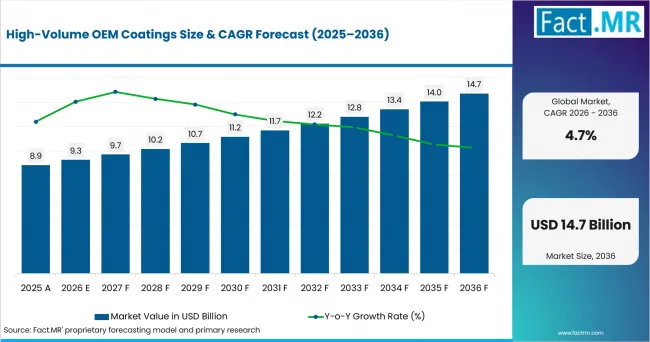
High Volume Oem Coatings Value Analysis | Source: Fact.MR
What are the defining numbers behind High-Volume OEM Coatings Market growth?
An absolute opportunity of USD 5.4 billion is expected between 2026 and 2036.
- Demand Drivers in the Market
- OEM paint shops need stable basecoat transfer since color rework slows high-speed lines and raises launch risk.
- Body engineers need coating stacks that adhere to steel, aluminum and plastic exterior parts used within the same vehicle program.
- Paint-shop managers need lower-bake and wet-on-wet systems that reduce oven exposure while preserving gloss and corrosion protection.
- EV platform teams need coating systems for new exterior panels without forcing long changes to approved production windows.
- The International Energy Agency reported in May 2026 that electric car sales exceeded 20 million units in 2025 and are expected to reach 23 million in 2026. This expanding EV production base increases the importance of aligning automotive coating development and qualification with OEM vehicle-launch schedules.
- Key Segments Analyzed
- By Coating Layer: Basecoat is projected to hold 29.0% share in 2026 owing to the role of color appearance and metallic-effect control in factory finish approval.
- By Vehicle Substrate: Steel body is anticipated to account for 38.0% share in 2026, supported by continuing use in high-volume body-in-white programs.
- By Cure Technology: Conventional bake is estimated to represent 44.0% share in 2026 due to installed oven capacity across existing OEM plants.
- By OEM Segment: Passenger vehicle high-volume is forecast to capture 51.0% share in 2026 owing to larger model runs and tighter color-harmony requirements.
- Analyst Opinion at Fact.MR
- Shambhu Nath Jha, Principal Consultant at Fact.MR, states, “OEM coatings are being judged inside the paint shop before they are judged on the road. Automakers are expected to reward coating systems that reduce rework and keep color stable across several substrates. Coating suppliers should combine color science, line support and cure-window knowledge so plants qualify new models with fewer interruptions.”
- Strategic Implications
- Coating formulators should document color stability across steel, aluminum and plastic parts before platform approval trials.
- Resin suppliers should align binder packages with lower-bake cycles where energy cost and emissions targets influence paint-shop upgrades.
- Automotive OEMs should evaluate primer, basecoat and clearcoat as one process stack before approving a new platform.
- Equipment partners should pair application robotics with coatings that reduce overspray and improve two-tone painting repeatability.
Germany is projected to record 5.8% CAGR through 2036, supported by domestic car output and EV paint-shop modernization. The USA is expected to post 5.4% CAGR supported by large assembly volumes that sustain steel-body and mixed-substrate coating systems. The UK is anticipated to advance at 5.1% CAGR due to new EV models and export-oriented plants. South Korea is estimated to hold 4.7% CAGR owing to export-led vehicle production. Japan is forecast to reach 4.2% CAGR through established OEM production and high finish-quality standards.
How does the High-Volume OEM Coatings Market break down by segment?
Basecoat leads Coating Layer at 29.0%; passenger vehicle high-volume leads OEM Segment at 51.0%.
Which coating layer dominates?
Basecoat holds 29.0% share in 2026.
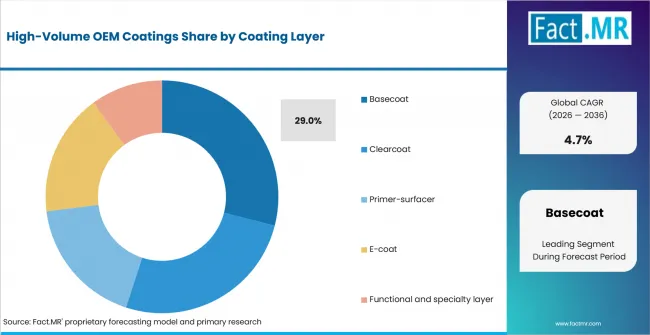
High Volume Oem Coatings Analysis By Coating Layer | Source: Fact.MR
Basecoat leads by carrying the visible color layer and controlling metallic, pearl and solid shade appearance after clearcoat. OEM plants treat basecoat approval as a launch step since color mismatch creates direct rework.
Paint-shop teams also use basecoat behavior to judge transfer efficiency and shade repeatability across daily production. PPG offers automotive OEM primers, basecoats and clearcoats; Surventis GmbH (formerly BASF Coatings) supplies OEM technologies including CathoGuard e-coat.
What leads the vehicle substrate segment?
Steel body holds 38.0% share in 2026.
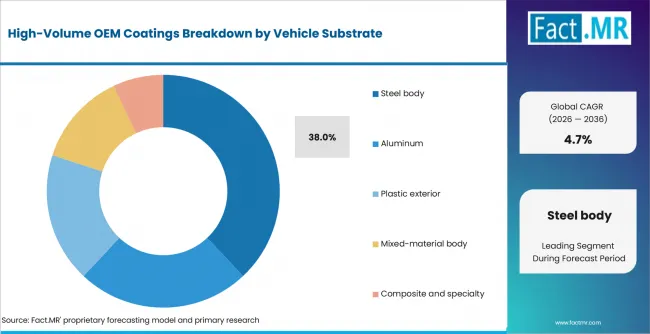
High Volume Oem Coatings Analysis By Vehicle Substrate | Source: Fact.MR
Steel body remains the primary substrate pool due to the continued use of stamped steel panels in high-volume vehicle platforms. Coating suppliers must maintain corrosion protection and appearance over long production runs.
OICA reported in April 2026 that global vehicle production reached 96.4 million units in 2025. This large automotive manufacturing base supports continued demand for e-coat and primer systems compatible with steel and mixed-metal substrates, while growing use of aluminum and plastic body components increases the importance of coatings formulated for multiple substrate types.
How does cure technology shape demand?
Conventional bake leads with 44.0% share in 2026.
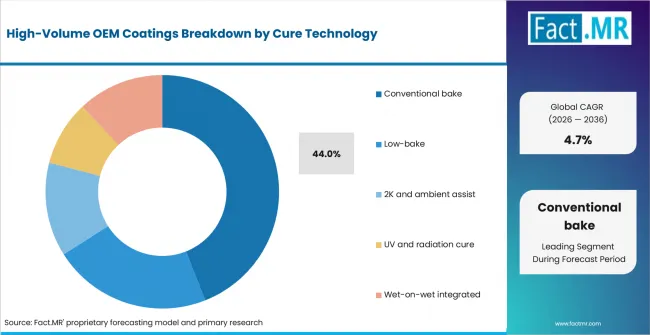
High Volume Oem Coatings Analysis By Cure Technology | Source: Fact.MR
Conventional bake leads due to OEM reliance on oven-based curing and validated process windows. Changing cure conditions affects coating chemistry, energy use and model qualification, so plants move carefully before changing line settings.
Low-bake and wet-on-wet systems are gaining attention where paint shops need shorter heat exposure. Conventional bake still holds the main installed base since legacy ovens and quality approvals remain tied to existing production recipes.
What supports passenger vehicle high-volume within OEM Segment?
Passenger vehicle high-volume holds 51.0% share in 2026.
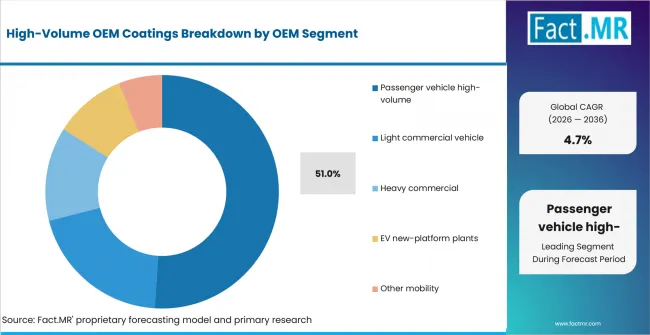
High Volume Oem Coatings Analysis By Oem Segment | Source: Fact.MR
Passenger vehicle high-volume programs create repeat orders owing to larger model runs and tighter finish tolerances. Every approved coating stack must perform across daily output without creating color drift or repair loops.
The International Energy Agency reported that one-quarter of new cars sold globally in 2025 were electric. This growing EV share supports continued demand for passenger-vehicle coating systems designed for EV production, plastic exterior parts and heat-sensitive automotive components.
What is accelerating High-Volume OEM Coatings Market adoption, and what is holding it back?
Demand is expected to rise through OEM production scale, EV platform launches and lower-emission paint-shop needs. Growth is constrained by qualification time, energy cost and trade exposure.
Drivers Impact Analysis
| DRIVER | (~) % IMPACT ON CAGR | GEOGRAPHIC RELEVANCE | IMPACT TIMELINE |
|---|---|---|---|
| Passenger vehicle production scale | +0.8% | Global | Short term (<= 2 years) |
| EV platform coating qualification | +0.6% | North America, Europe, East Asia | Medium term (2-4 years) |
| Lower-VOC and waterborne systems | +0.5% | USA, Europe, Asia Pacific | Medium term (2-4 years) |
| Mixed-material body programs | +0.4% | Global | Long term (>= 4 years) |
- Passenger vehicle production scale: High-volume assembly plants require e-coat, primer, basecoat and clearcoat systems across every model run. Larger output gives coating suppliers recurring demand after approval.
- EV platform coating qualification: Electric vehicle launches require coatings for new exterior panel designs and mixed-material structures. Paint-shop teams are expected to qualify lower-heat and mixed-material coating stacks earlier in model planning.
- Lower-VOC and waterborne systems: Paint shops face continuing pressure to reduce solvent emissions. Waterborne primers and basecoats help OEMs preserve multilayer finishes while lowering plant-level VOC exposure.
Opportunity Impact Analysis
| OPPORTUNITY | (~) % IMPACT ON CAGR | GEOGRAPHIC RELEVANCE | IMPACT TIMELINE |
|---|---|---|---|
| Waterborne basecoat and primer localization | +0.5% | Asia Pacific, North America | Short term (<= 2 years) |
| Overspray-free two-tone application | +0.4% | Europe, Japan, USA | Medium term (2-4 years) |
| Low-bake coating systems | +0.3% | Europe, UK, South Korea | Medium term (2-4 years) |
- Waterborne localization: Regional production of primers and basecoats can shorten supply lines and improve technical support for automotive OEM plants. Local manufacturing and application assistance may become more important as electric-vehicle production expands beyond established assembly clusters.
- Overspray-free two-tone application: Digital paint and jet-based application technologies can reduce masking requirements and improve efficiency in two-tone vehicle programs. These systems create opportunities where OEMs seek more flexible exterior design, lower overspray, and tighter integration between paint application and robotic automation.
- Low-bake systems: Lower-temperature curing systems can reduce oven exposure and support heat-sensitive plastic exterior components. Adoption depends on line trials that confirm gloss, adhesion, corrosion protection, and overall coating durability under actual production conditions.
Restraints Impact Analysis
| RESTRAINT | (~) % IMPACT ON CAGR | GEOGRAPHIC RELEVANCE | IMPACT TIMELINE |
|---|---|---|---|
| Long OEM qualification cycles | -0.4% | Global | Short term (<= 2 years) |
| Energy and oven operating cost | -0.3% | Europe, UK, Japan | Medium term (2-4 years) |
| Trade and production volatility | -0.3% | USA, Germany, UK, South Korea | Medium term (2-4 years) |
- Long OEM qualification cycles: Coatings must pass appearance, corrosion and application tests before line approval. Incumbent systems therefore keep an advantage after a vehicle platform enters production.
- Energy and oven operating cost: Conventional bake systems depend on controlled heating. Plants facing high electricity or gas costs delay coating-line changes until the full process cost is clear.
- Trade and production volatility: Export shifts can alter model allocation and paint demand by plant. Coating suppliers serving global OEMs therefore need regional support plans and flexible batch scheduling.
Which countries are scaling the High-Volume OEM Coatings Market through 2036?
- The country comparison spans 1.59 percentage points and forms a narrow growth band across the forecast period.
- Germany remains 0.35 percentage point above the USA through passenger car output and paint-shop modernization.
- The USA remains 0.34 percentage point above the UK supported by large assembly volumes for steel-body and mixed-substrate coatings.
- The UK remains 0.38 percentage point above South Korea with new EV models supporting factory coating demand.
- South Korea remains 0.52 percentage point above Japan through export-oriented production and small SUV programs.
- Japan closes the displayed range through established OEM production and high finish-quality standards.
Comparable CAGRs create different entry conditions due to plant age, substrate mix, export exposure and air-quality costs. Full report coverage includes North America, Latin America, Western Europe, Eastern Europe, East Asia, South Asia & Pacific, Middle East & Africa.
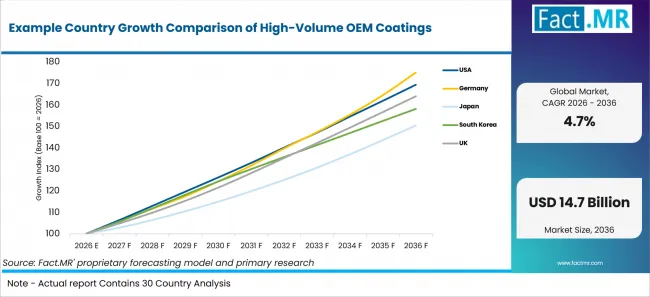
Example Country Growth Comparison Of High Volume Oem Coatings | Source: Fact.MR
| Country | CAGR (2026-2036) |
|---|---|
| Germany | 5.8% |
| USA | 5.4% |
| UK | 5.1% |
| South Korea | 4.7% |
| Japan | 4.2% |
What supports Germany adoption?
5.8% CAGR, supported by passenger car output and EV coating needs.
Germany remains a major coating qualification base due to high-volume domestic platforms with strict appearance and corrosion standards. VDA reported in January 2026 that 4.15 million passenger cars rolled off German assembly lines in 2025. That output supports demand for basecoat, e-coat and primer-surfacer systems that fit approved paint-shop windows.
What supports USA adoption?
5.4% CAGR, led by large assembly scale and emissions-driven paint-shop upgrades.
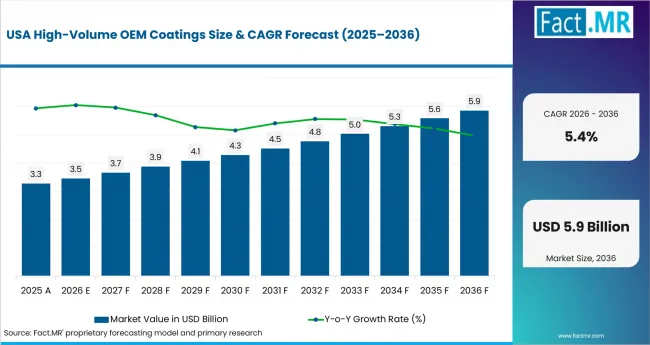
High Volume Oem Coatings Country Value Analysis | Source: Fact.MR
The USA market is shaped by large truck and passenger vehicle programs that need coatings for steel bodies and mixed-material exterior parts. OICA reported in April 2026 that the United States produced 10.24 million vehicles in 2025. That assembly base keeps local technical service and validated multilayer systems central to OEM coating decisions.
What supports UK growth?
5.1% CAGR, backed by EV model programs and export-oriented coating demand.
UK coating demand is tied to export model runs and the launch timing of electrified platforms. SMMT reported in January 2026 that total UK vehicle production reached 764,715 units in 2025. That output supports factory-applied coatings where consistent appearance must travel across more than one overseas sales market.
How is South Korea scaling demand?
4.7% CAGR, shaped by export-led production and small SUV programs.
South Korean OEM plants serve global nameplates and require coatings that hold finish quality across shipping routes and climate conditions. The Ministry of Trade, Industry and Resources announced in May 2026 that Korea produced 362,000 automobiles in April 2026. That production base supports steady demand for basecoat and clearcoat systems qualified for export programs.
How does Japan perform?
4.2% CAGR, led by established production and high finish-quality standards.
Japan’s coating demand is supported by disciplined quality systems and long-running OEM relationships. OICA reported in April 2026 that Japan produced 8.41 million vehicles in 2025. That volume sustains demand for coatings that protect steel and plastic exterior parts while matching strict factory appearance standards.
Who leads the High-Volume OEM Coatings Market?
PPG, Surventis GmbH (formerly BASF Coatings), Axalta, AkzoNobel, Kansai Paint and Nippon Paint are active providers.
Axalta participates through mobility coatings, automotive color technology and digital paint application. Its portfolio serves light-vehicle OEMs with coating systems designed to maintain color consistency across vehicle substrates. Axalta’s NextJet™ digital paint technology enables precise paint placement for two-tone finishes, patterns, graphics and other customized applications.
AkzoNobel supplies automotive specialty coatings for exterior, interior and metal applications. Kansai Paint and Nippon Paint maintain automotive coating and color-development capabilities across Asian markets. In March 2025, Nippon Paint Automotive Coatings and Uchihamakasei jointly announced Japan’s first in-mold coating technology for large thermoplastic automotive exterior applications.
Which companies are the key providers?
Key companies include PPG, Surventis GmbH (formerly BASF Coatings), Axalta, AkzoNobel, Kansai Paint and Nippon Paint.
- PPG
- Surventis GmbH (formerly BASF Coatings)
- Axalta
- AkzoNobel
- Kansai Paint
- Nippon Paint
Bibliography
- Axalta. (2025, January 22). Axalta and Dürr partner on automotive digital paint technology.
- BASF. (2025, March 24). BASF Coatings increases production capacities in Caojing, China to meet growing automotive demand in Asia Pacific.
- International Energy Agency. (2026, May 20). Executive summary. In Global EV Outlook 2026.
- International Organization of Motor Vehicle Manufacturers. (2026, April 23). Auto industry growth shifted east in 2025 amid global repositioning.
- Ministry of Trade, Industry and Resources. (2026, May 20). April 2026 automobile exports total $6.2 billion.
- Nippon Paint Automotive Coatings Co., Ltd. (2025, March 3). Nippon Paint jointly develops next-generation in-mold coating technology: Advancing carbon neutrality in automotive coating processes.
- PPG. (2025, March 26). PPG starts up waterborne automotive coatings plant in Thailand.
- Society of Motor Manufacturers and Traders. (2026, January 29). Tough year for auto but new models and Industrial Strategy can deliver growth.
- U.S. Environmental Protection Agency. (2026, March 30). Surface coating of automobiles and light-duty trucks: National emission standards for hazardous air pollutants (NESHAP).
- Verband der Automobilindustrie. (2026, January 5). Passenger car production in 2025 slightly above previous year’s level.
This Report Addresses
- The report explains where high-volume OEM coatings are used across coating layer, vehicle substrate, cure technology and OEM segment.
- Segment analysis identifies the leading subsegments and the production reasons automotive OEMs prioritize them.
- Country analysis examines the listed markets and the assembly-base or policy factors supporting coating demand.
- Competitive analysis reviews current providers across automotive OEM coatings, digital paint application and plastic exterior coating technologies.
- Application analysis assesses how finish quality, substrate adhesion and paint-shop cycle time influence supplier selection.
What does the High-Volume OEM Coatings Market cover?
The High-Volume OEM Coatings Market covers factory-applied coating systems used in automotive assembly plants. It includes primer-surfacer, basecoat, clearcoat, electrocoat and functional layers applied to vehicle bodies and exterior components. Adjacent areas such as automotive coatings and paint and coating systems are considered where they support vehicle factory production.
The assessment covers coatings for steel body, aluminum, plastic exterior and mixed-material body substrates. Demand is assessed across passenger vehicle, light commercial, heavy commercial, EV platform and other mobility applications.
What is included in the scope?
The scope includes factory-applied coatings sold to automotive OEM plants and component manufacturers. Related technologies such as coating pretreatment, coating additives, coating pigments and coating binders are included only when they are part of an OEM coating formulation.
The scope includes waterborne, solventborne, low-bake, 2K, ambient-assist, UV and radiation-cure systems used in high-volume vehicle production. It also includes in-mold coating when applied to factory-approved exterior parts.
What is excluded from the scope?
Aftermarket refinish coatings are outside the scope when sold only for collision repair. Adjacent areas such as self-healing auto coatings are included only when tied to factory programs.
Architectural coatings, general industrial coatings and raw coating chemicals are outside the scope when they are sold without OEM paint-shop qualification. Standalone powder coatings are covered only where the formulation serves automotive production.
How Was the Analysis Built?
The analysis draws on 120+ sources, 35+ company portfolios, 25+ countries, and more than 20 industry interviews.
- Primary Research: Primary research includes discussions with manufacturers, service providers, technology developers, distributors, end users, and subject-matter experts. These conversations examine purchasing priorities, product adoption, operational challenges, approval requirements, competitive positioning, and the factors that influence wider market acceptance.
- Desk Research: Desk research covers government statistics, regulatory publications, company filings, trade data, technical studies, industry associations, standards, public policy, and other authoritative sources. Every source used in the analysis is documented in the bibliography.
- Market Sizing and Forecasting: Market estimates combine historical performance, demand indicators, pricing and volume trends, segment shares, company participation, country-level growth, adoption patterns, investment activity, and barriers to market expansion.
- Data Validation and Update Cycle: Findings are validated by comparing primary interviews with public data, company activity, regulatory changes, trade patterns, and industry developments. Regular updates review new product launches, capacity changes, partnerships, approvals, and shifts in commercial adoption.
What is the report’s scope and coverage?
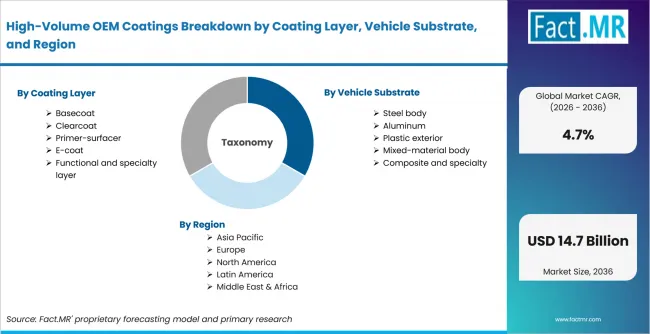
High Volume Oem Coatings Breakdown By Coating Layer, Vehicle Substrate, And Region | Source: Fact.MR
| Attribute | Details |
|---|---|
| Quantitative Units | USD billion in 2026 to USD billion by 2036 at a CAGR |
| Market Definition | Factory-applied coating systems used by automotive OEM plants to deliver corrosion protection, color appearance, surface finish quality and weathering resistance across high-volume vehicle production. |
| Coating Layer | Basecoat; Clearcoat; Primer-surfacer; E-coat; Functional and specialty layer |
| Vehicle Substrate | Steel body; Aluminum; Plastic exterior; Mixed-material body; Composite and specialty |
| Cure Technology | Conventional bake; Low-bake; 2K and ambient assist; UV and radiation cure; Wet-on-wet integrated |
| OEM Segment | Passenger vehicle high-volume; Light commercial vehicle; Heavy commercial; EV new-platform plants; Other mobility |
| Regions Covered | North America; Latin America; Western Europe; Eastern Europe; East Asia; South Asia & Pacific; Middle East & Africa |
| Countries Covered | USA; Germany; Japan; South Korea; UK |
| Key Companies Profiled | PPG; Surventis GmbH (formerly BASF Coatings); Axalta; AkzoNobel; Kansai Paint; Nippon Paint |
| Forecast Period | 2026 to 2036 |
| Approach | Hybrid top-down and bottom-up approach using vehicle production indicators, coating-layer demand, substrate mix, country growth and provider portfolio review. |
How is the market segmented?
-
By Coating Layer
- Basecoat
- Clearcoat
- Primer-surfacer
- E-coat
- Functional and specialty layer
-
By Vehicle Substrate
- Steel body
- Aluminum
- Plastic exterior
- Mixed-material body
- Composite and specialty
-
By Cure Technology
- Conventional bake
- Low-bake
- 2K and ambient assist
- UV and radiation cure
- Wet-on-wet integrated
-
By OEM Segment
- Passenger vehicle high-volume
- Light commercial vehicle
- Heavy commercial
- EV new-platform plants
- Other mobility
-
By Region
- North America
- Latin America
- Western Europe
- Eastern Europe
- East Asia
- South Asia & Pacific
- Middle East & Africa