The Immunosuppressants Kits Market is analyzed across its key product, application and end-use segments, with the study covering market dynamics, regional trends and demand outlook, forecast 2026 to 2036.
By Fact.MR Healthcare DeskFact-checked under the Fact.MR editorial processUpdated
10 min read
Immunosuppressants Kits Market Forecast and Outlook 2026 to 2036
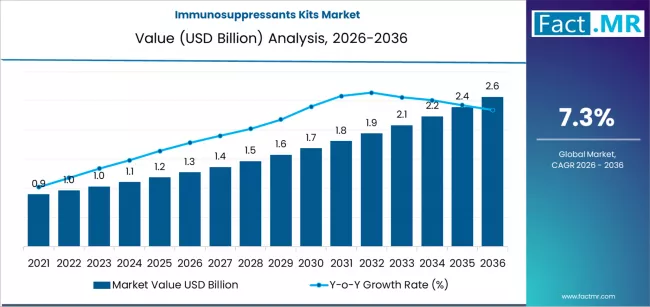
The global immunosuppressants kits market is projected to total USD 1.27 billion in 2026, advancing to USD 2.57 billion by 2036, progressing at a 7.3% CAGR. This growth is sustained by the essential requirement for therapeutic drug monitoring in transplant medicine to balance drug efficacy against toxicity.
Immunosuppressants Kits Market Market Value Analysis | Source: Fact.MR
Summary of ImmunosuppressantsKits Market
Market Snapshot
Globalimmunosuppressantskits market revenue stood at USD 1.27 billion in 2026 and is forecast to reach USD 2.57 billion by 2036.
At a 7.3%CAGRfrom 2026 to 2036, this market is set to expand ~2.0x in value, adding USD 1.30 billion in absolute opportunity.
Growth is driven by the increasing need for therapeutic drug monitoring (TDM) in transplant medicine, where precise dosing is critical to balance efficacy and toxicity.
These kits are evolving into essential diagnostic tools, enabling clinicians tomonitorimmunosuppressive drug levels andoptimizepatient outcomes post-transplant.
Demand and Growth Drivers
Rising number of organ transplant procedures globally is a primary growth driver.
Increasing need for precision dosing and toxicity management in immunosuppressive therapies is accelerating adoption.
Growing focus on personalized medicine and patient-specific treatment protocols is reinforcing demand.
Expansion of clinical diagnostics infrastructure and laboratory testing capabilities is supporting market growth.
Advancements in assay technologies and diagnostic kits are improving accuracy and efficiency of drug monitoring.
Product and Segment View
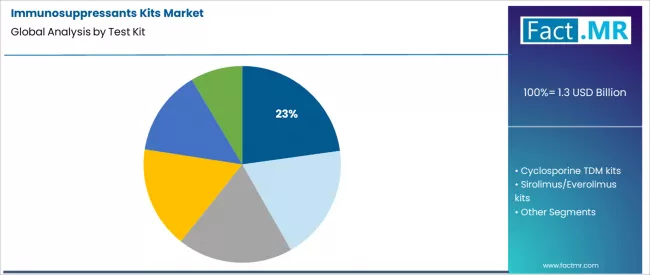
TacrolimusTDMkits command a leading 22.8% share,reflecting its status as the cornerstone immunosuppressant.
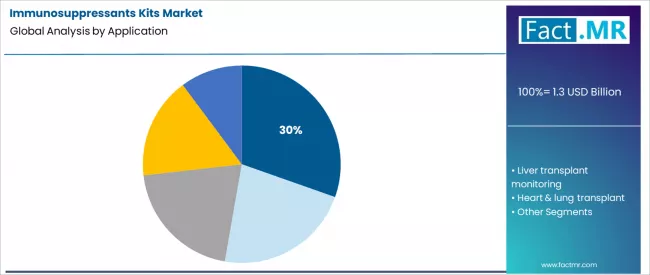
Kidneytransplantationmonitoringaccounts for30.4% of application share in 2026, positioning it as the dominant segment given the high volume of procedures.
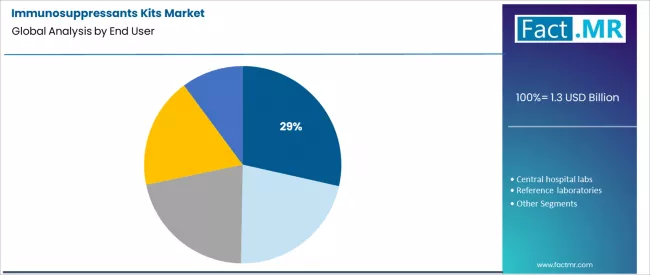
Hospital TransplantCenters28.5% of end-use share in 2026, reflecting thecentral roleof hospital-based transplant programs.
KeyTest Kitcategories include:
TacrolimusTDMKits, CyclosporineTDMKits
Sirolimus/EverolimusKits
Mycophenolic Acid Kits
LC-MS/MS Multi-AnalyteKits
Calibrators & QC Materials
Geography and Competitive Outlook
Growth is supported across North America, Europe, and Asia Pacific, driven by transplant infrastructure and healthcare investments.
Market expansion is closely tied to increasing transplant volumes, diagnostic adoption, and healthcare system development.
Key companies active in this market include Abbott Laboratories,ThermoFisher Scientific, Roche Diagnostics, SiemensHealthineers, andBio-Rad Laboratories.
ImmunosuppressantsKits Market - At a Glance
Attribute
Details
Market Value 2026
USD 1.27 billion
Market Value 2036
USD 2.57 billion
Absolute Dollar Opportunity 2026-2036
USD 1.30 billion
Total Growth 2026-2036
102.4%
CAGR2026-2036
7.3%
Growth Multiple
~2.0x
Key Demand Theme
Increasing adoption of therapeutic drug monitoring kits tooptimizeimmunosuppressive therapy in transplant patients
North America, Latin America, Western Europe, Eastern Europe, East Asia, South Asia & Pacific, MEA
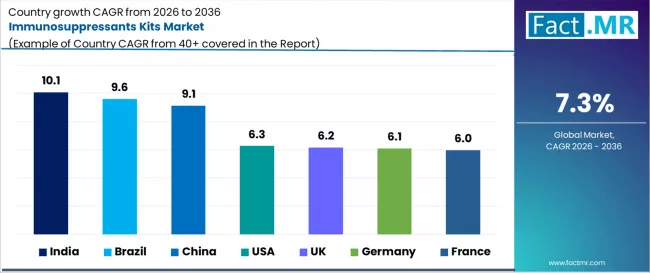
Tacrolimus TDM kits represent the dominant product segment, reflecting its status as the cornerstone immunosuppressant. Kidney transplant monitoring drives the primary application, given the high volume of procedures globally. Hospital transplant centers serve as the leading end-user, centralizing specialized patient care and testing. Accelerated growth in India, Brazil, and China is fueled by expanding access to transplant services and improving laboratory standardization. The market's evolution is further influenced by the shift toward multi-analyte mass spectrometry methods for streamlined testing of combination drug regimens.
Hospital Transplant Centers, Central Hospital Labs, Reference Laboratories, Academic Medical Centers, Private & Specialty Labs
Region
North America, Latin America, Western Europe, Eastern Europe, East Asia, South Asia & Pacific, Middle East & Africa
Which Clinical and Operational Trends are Enhancing Demand for Immunosuppressant Kits?
Trend
Impact
Personalized Dosing Protocols
Moves TDM from routine monitoring to a precision tool, increasing test frequency and reliance on accurate, rapid results for dose adjustment.
Growth of Solid Organ Transplant Volumes
Rising procedure rates, especially in emerging economies, directly expand the core patient population requiring lifelong TDM.
Shift to LC-MS/MS for Multi-Analyte Panels
Drives adoption of sophisticated kits and calibrators that enable simultaneous measurement of multiple immunosuppressants, improving lab efficiency.
Expanding Use in Autoimmune Disorders
Extends the application of TDM for drugs like mycophenolate beyond transplant, creating new testing indications and patient cohorts.
Segmental Analysis
By Test Kit, Which Monoclonal Agent Dominates Routine Monitoring?
Immunosuppressants Kits Market Analysis By Test Kit | Source: Fact.MR
Tacrolimus TDM kits command a leading 22.8% share. This segment’s prominence is directly tied to the near-universal use of tacrolimus as the primary immunosuppressant in most solid organ transplant protocols.
Its narrow therapeutic index and significant inter-patient pharmacokinetic variability necessitate frequent and accurate TDM. The high volume of tests performed throughout a patient’s lifetime establishes a consistent, high-demand market for these specific immunoassays and associated calibrators.
By Application, Which Procedure Generates the Largest Chronic Patient Pool?
Immunosuppressants Kits Market Analysis By Application | Source: Fact.MR
Kidney transplant monitoring constitutes the primary application segment at 30.4%. Kidney transplants are the most frequently performed solid organ transplant globally, creating the largest long-term patient population requiring indefinite immunosuppression therapy.
The chronic nature of post-transplant care, with mandated regular TDM to prevent graft rejection and manage toxicity, ensures this application drives sustained and recurring test volumes above all others.
By End User, Where is Specialized Care and Testing Integrated?
Immunosuppressants Kits Market Analysis By End User | Source: Fact.MR
Hospital transplant centers hold a leading 28.5% share. These specialized units provide integrated care, where transplant surgeons, nephrologists, and clinical pharmacologists work in concert.
The need for rapid TDM results to guide immediate clinical decisions supports the adoption of on-site or closely affiliated testing. This proximity between the clinical team and the laboratory solidifies these centers as critical hubs for test initiation and consumption.
What the Future Awaits- Balancing Precision, Cost, and Access in TDM?
Sustained growth in solid organ and stem cell transplant procedures globally creates an expanding, captive patient population mandated for lifelong therapeutic drug monitoring, ensuring consistent test volume. However, the high cost of proprietary immunoassay reagents and sophisticated LC-MS/MS instrumentation can restrict access in budget-constrained healthcare systems, potentially limiting optimal patient management.
Opportunity exists in developing affordable, standardized multi-analyte mass spectrometry kits that can reduce per-test costs and improve laboratory workflow efficiency. The exploration of pharmacogenetic testing to complement TDM data is gaining traction, aiming to provide a more personalized framework for initial dosing and long-term therapy management.
Analysis of the Immunosuppressants Kits Market by Key Countries
Immunosuppressants Kits Market Cagr Analysis By Country | Source: Fact.MR
Country
CAGR 2026 to 2036
USA
6.3%
Germany
6.1%
China
9.1%
India
10.1%
Brazil
9.6%
France
6.0%
UK
6.2%
How does the USA's Advanced Transplant Network Dictate Market Standards?
A high volume of transplant centers adhering to strict OPTN/UNOS guidelines mandating rigorous TDM supports a 6.3% CAGR. The market is characterized by the use of both high-throughput immunoassays for routine monitoring and definitive LC-MS/MS for complex cases. A large prevalent patient population and the adoption of newer immunosuppressant protocols requiring specific monitoring drive steady demand.
What Drives Demand within Germany's Highly Regulated Healthcare Framework?
Germany's 6.1% CAGR reflects a structured transplant system with centralized labs providing TDM services under stringent quality assurance (RiliBÄK). The focus on assay precision and standardization supports the use of well-validated kits from major diagnostic firms. Demand is consistent, fueled by high procedural standards and comprehensive insurance coverage for necessary therapeutic monitoring.
Which Factors are Central to China's Rapidly Scaling Transplant Capacity?
China's 9.1% CAGR is propelled by significant growth in the number of qualified transplant centers and rising procedure volumes. The expansion of hospital infrastructure includes investments in advanced laboratory equipment, creating corresponding demand for TDM kits. This growth focuses on establishing standardized, reliable testing protocols to support the country's expanding transplant programs.
Why does India's Market Potential Hinge on Healthcare Modernization?
India's leading 10.1% CAGR is linked to the proliferation of private hospitals offering advanced transplant services. The growing volume of procedures creates a new, substantial patient base requiring TDM. Market expansion is closely tied to improving laboratory capabilities and the availability of cost-effective testing solutions suitable for the local economic context.
How is Brazil's Evolving Transplant Landscape Reflected in Testing Needs?
Brazil's 9.6% CAGR is connected to the strengthening of its national transplant system and growing numbers of certified centers. Increased procedure rates, particularly for kidneys and livers, drive core demand. Market growth navigates between the adoption of advanced kits in leading private hospitals and the need for practical solutions within the public healthcare network.
What Characterizes France's Centralized Approach to Specialized Testing?
France's 6.0% CAGR benefits from a network of university hospital centers that centralize transplant care and associated TDM. This model promotes standardized testing protocols and volume-based procurement of kits and calibrators. Demand is stable, driven by well-established clinical pathways and national health insurance coverage for essential drug monitoring.
How does the UK's Commissioned Specialist Services Guide the Market?
The UK’s 6.2% CAGR operates within the NHS framework where specialist transplant services are commissioned regionally. This leads to consolidated testing in designated hub laboratories. National tenders and formularies, favoring suppliers that can provide complete TDM solutions meeting stringent quality and cost-effectiveness criteria, influence procurement.
Competitive Landscape of the Immunosuppressants Kits Market
Large in-vitro diagnostics corporations with established platforms in clinical chemistry and immunoassay dominate the competitive landscape. These companies compete by offering automated, high-throughput immunoassays for major drugs like tacrolimus and cyclosporine on their installed instrument bases.
Competition also exists in the high-complexity testing segment, where mass spectrometry specialists provide multi-analyte kits and method solutions. Success depends on securing a place on hospital and reference lab formularies, providing robust technical support, and ensuring reliable reagent supply for these critical tests.
Portfolio Focus of Leading Players
Key Player
Strategic Portfolio Focus
Abbott Laboratories
Automated immunoassay kits (Tacrolimus, Cyclosporine) for ARCHITECT and Alinity platforms.
F. Hoffmann-La Roche Ltd
Cobas integrated immunoassays for Tacrolimus, Everolimus, and Mycophenolic Acid.
Siemens Healthineers
VISTA and Atellica IM immunosuppressant drug assays for centralized laboratory testing.
Thermo Fisher Scientific Inc.
LC-MS/MS reagents, columns, and calibrators for multi-analyte TDM panels and reference methods.
Waters Corporation
Mass spectrometry instruments, UPLC columns, and dedicated application kits for immunosuppressant analysis.
Key Players in the Immunosuppressants Kits Market
Abbott Laboratories
F. Hoffmann-La Roche Ltd
Siemens Healthineers
Thermo Fisher Scientific Inc.
Waters Corporation
Others
Bibliography
International Association of Therapeutic Drug Monitoring and Clinical Toxicology. (2025). Guidelines for Therapeutic Drug Monitoring of Immunosuppressants.
Kahan, B. D., & Shaw, L. M. (2023). Therapeutic drug monitoring of immunosuppressant drugs: Clinical guide. Transplant International.
Organ Procurement and Transplantation Network. (2024). OPTN/SRTR Annual Data Report.
Shaw, L. M., & Holt, D. W. (2024). Therapeutic Drug Monitoring of Immunosuppressant Drugs: A Focus on Tacrolimus. Clinical Biochemistry.
U.S. Food and Drug Administration. (2024). In Vitro Diagnostics: Immunosuppressant Drug Monitoring Assays.
Wallemacq, P., & Verbeeck, R. K. (2025). Comparative evaluation of immunoassays and chromatographic methods for the therapeutic drug monitoring of immunosuppressive drugs. Journal of Chromatography B.
Comparative analysis of immunoassay vs. LC-MS/MS method performance; cost-per-test modeling across platforms; impact of generic immunosuppressants on TDM needs; review of dosing algorithm integration with TDM results.
Market by Segments
Test Kit :
Tacrolimus TDM Kits
Cyclosporine TDM Kits
Sirolimus/Everolimus Kits
Mycophenolic Acid Kits
LC-MS/MS Multi-Analyte Kits
Calibrators & QC Materials
Application :
Kidney Transplant Monitoring
Liver Transplant Monitoring
Heart & Lung Transplant
HSCT/Bone Marrow Transplant
Autoimmune Therapy Monitoring
End User :
Hospital Transplant Centers
Central Hospital Labs
Reference Laboratories
Academic Medical Centers
Private & Specialty Labs
Region :
North America
USA
Canada
Latin America
Brazil
Mexico
Argentina
Rest of Latin America
Western Europe
Germany
France
UK
Italy
Spain
BENELUX
Rest of Western Europe
Eastern Europe
Poland
Russia
Czech Republic
Rest of Eastern Europe
East Asia
China
Japan
South Korea
Rest of East Asia
South Asia & Pacific
India
ASEAN
Australia & New Zealand
Rest of South Asia & Pacific
MEA
GCC Countries
South Africa
Turkiye
Rest of MEA
Frequently Asked Questions
How big is the immunosuppressants kits market in 2026?
The global immunosuppressants kits market is estimated to be valued at USD 1.3 billion in 2026.
What will be the size of immunosuppressants kits market in 2036?
The market size for the immunosuppressants kits market is projected to reach USD 2.6 billion by 2036.
How much will be the immunosuppressants kits market growth between 2026 and 2036?
The immunosuppressants kits market is expected to grow at a 7.3% CAGR between 2026 and 2036.
What are the key product types in the immunosuppressants kits market?
The key product types in immunosuppressants kits market are tacrolimus tdm kits, cyclosporine tdm kits, sirolimus/everolimus kits, mycophenolic acid kits, lc-ms/ms multi-analyte kits and calibrators & qc materials.
Which application segment to contribute significant share in the immunosuppressants kits market in 2026?
In terms of application, kidney transplant monitoring segment to command 30.4% share in the immunosuppressants kits market in 2026.