Antibody Conjugation Kits Market (2026 - 2036)
Antibody Conjugation Kits Market Size and Share Forecast Outlook 2026 to 2036
Core Findings
Antibody Conjugation Kits Market Forecast and Outlook 2026 to 2036
Antibody conjugation kits market stands at USD 566 million in 2026 and reaches USD 1,315.5 million by 2036, reflecting an 8.80% CAGR.
Antibody Conjugation Kits Market Key Takeaways
- Antibody Conjugation Kits Market Value (2026): USD 566 million
- Antibody Conjugation Kits Market Forecast Value (2036): USD 1,315.5 million
- Antibody Conjugation Kits Market Forecast CAGR: 8.8%
- Leading Downstream Application in Antibody Conjugation Kits Market: Flow cytometry reagents
- Key Growth Regions in Antibody Conjugation Kits Market: North America, Europe, Asia Pacific, Latin America, Middle East & Africa
- Top Players in Antibody Conjugation Kits Market: Thermo Fisher Scientific, Revvity (incl. BioLegend), Danaher (incl. Abcam), Merck KGaA, Maravai LifeSciences (incl. Vector Labs)
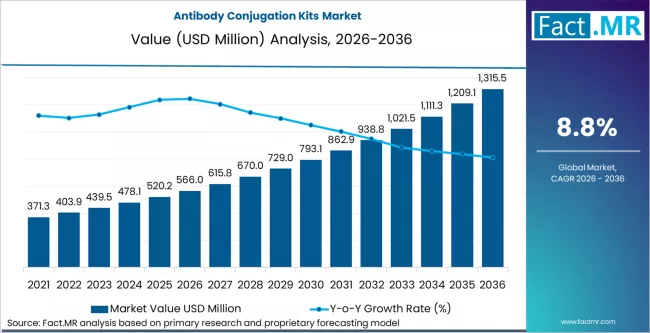
Demand comes from production handoffs rather than from discovery programs. Development teams lock conjugation chemistry early to protect comparability across studies and manufacturing sites. Once a linker and labeling ratio enter regulated workflows, switching costs rise through revalidation and stability work.
Kit suppliers compete on yield consistency, reaction control, and documentation depth. Operations groups plan runs around campaign schedules and release testing queues. Inventory policy tracks component shelf life and cold chain limits. Pricing reflects failed batch avoidance more than list reagent cost. Scale appears through deployment across multiple pipelines inside the same organization. Procurement decisions reference audit history, technical support response, and continuity guarantees. Volume growth follows clinical and commercial manufacturing expansion that requires repeatable, low variance conjugation steps across internal and partner facilities.
Antibody Conjugation Kits Market
| Metric | Value |
|---|---|
| Market Value (2026) | USD 566 million |
| Forecast Value (2036) | USD 1,315.5 million |
| Forecast CAGR (2026-2036) | 8.8% |
Category
| Category | Segments |
|---|---|
| Conjugation Chemistry or Kit Type | NHS-ester dye labeling kits; Click chemistry labeling kits; Site-specific conjugation kits; Biotinylation or streptavidin kits; Enzyme (HRP/AP) conjugation kits; Nanoparticle (gold or latex) conjugation kits |
| Downstream Application | Flow cytometry reagents; Immunofluorescence or imaging; ELISA and plate-based immunoassays; Lateral flow or rapid tests; ADC research (preclinical tools) |
| End User or Channel | Biopharma R&D; Academic and core facilities; Diagnostic developers (IVD); CROs or assay developers; OEM reagent manufacturers |
| Region | North America; Europe; Asia Pacific; Latin America; Middle East & Africa |
Segmental Analysis
By Conjugation Chemistry or Kit Type, Why Do NHS Ester Dye Labeling Kits Lead the Antibody Conjugation Kits Market?
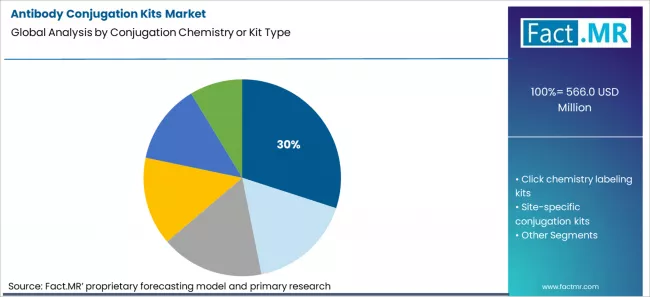
Fact.MR coverage indicates that NHS ester dye labeling kits account for 30.0% share because they offer a direct and predictable way to attach labels without changing laboratory routines. The unmet need is not experimental flexibility but dependable labeling that works across many antibody types. These kits reduce preparation time and avoid specialized handling steps. For most users, the value is operational and tied to keeping projects on schedule. The method becomes part of standard laboratory preparation rather than a separate optimization task. Its position reflects how widely applicable, low friction workflows tend to dominate routine research purchasing decisions.
By Downstream Application, Why Do Flow Cytometry Reagents Represent the Largest Use Case in the Antibody Conjugation Kits Market?
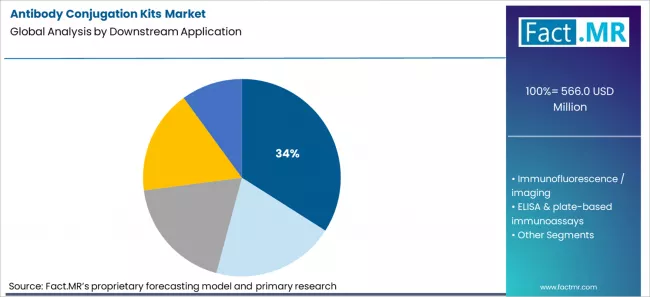
In Fact.MR compiled datasets, flow cytometry reagents represent 34.00% share because this application requires large numbers of labeled antibodies on a continuous basis. The unmet need is not occasional visualization but high volume, repeatable measurement across many samples and experiments. Laboratories consume conjugated antibodies as part of daily operations rather than as project specific tools. The value is functional and throughput driven. For research groups and diagnostic developers, this creates steady demand tied to routine analysis schedules. Its scale reflects how applications that embed conjugation into everyday workflows generate the most stable and predictable purchasing patterns.
Country
| Country | Driver | Restraint | Trend |
|---|---|---|---|
| USA | Strong biotech and diagnostics research demand | High cost of advanced conjugation reagents | Move toward automated conjugation workflows |
| UK | Active academic and translational research base | Budget pressure in public research labs | Shift to standardized ready to use kits |
| Germany | Large biopharma and industrial biotech sector | Strict quality and validation requirements | Integration into GMP compliant processes |
| China | Rapid expansion of biotech manufacturing | Quality consistency and process standardization | Localization of conjugation kit supply |
| India | Growth in biosimilars and contract research | Limited high end laboratory infrastructure | Outsourcing of conjugation and labeling work |
Analysis of the Antibody Conjugation Kits Market by Key Country
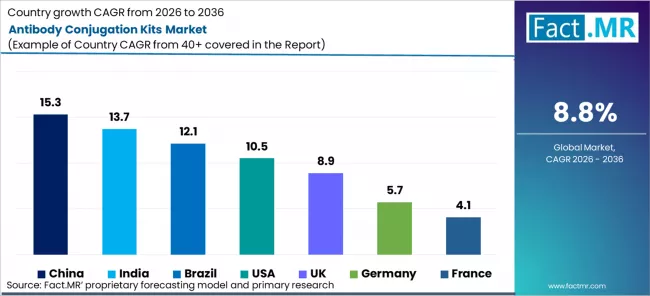
| Country | CAGR (2026-2036) |
|---|---|
| USA | 10.5% |
| Brazil | 12.1% |
| China | 15.3% |
| India | 13.7% |
| Germany | 5.7% |
| France | 4.1% |
| U.K. | 8.9% |
The report covers an in-depth analysis of 30+ countries; top-performing countries are highlighted below.
How is the antibody conjugation kits market developing in the United States?
The antibody conjugation kits market in the United States grows at a 10.5% annual rate through 2036. Large pharmaceutical and biotechnology laboratories use these kits to streamline labeling for assays, flow cytometry, and diagnostic development. Standardized kits reduce manual errors and increase throughput across multi-site operations. Contract research organizations consolidate these assays to manage high sample volumes efficiently. Academic laboratories contribute incremental demand through funded immunology and oncology programs. Growth occurs primarily through adoption inside existing laboratory workflows and automation upgrades rather than through the creation of new research facilities.
Why is the antibody conjugation kits market expanding in Brazil?
The antibody conjugation kits market in Brazil records a 12.1% annual expansion through 2036. Private laboratories and contract research organizations handle most screening and labeling work. Pharmaceutical and biotech companies outsource antibody conjugation to centralized labs, increasing kit utilization. University research adds incremental volumes through immunology and cell biology studies. Upgraded kits replace manual protocols, improving efficiency and reproducibility. Adoption concentrates in urban research hubs where project volume is highest. The market grows due to workflow centralization, service lab consolidation, and rising sample throughput rather than through rapid increases in the number of laboratories or standalone projects.
What explains the rapid growth of the antibody conjugation kits market in China?
China’s antibody conjugation kits market follows a 15.3% growth path through 2036. Pharmaceutical firms, contract research organizations, and state institutes expand high throughput antibody labeling platforms across urban research clusters. Kits provide consistent performance and reduce time spent on assay preparation, enabling large sample throughput. Once a platform laboratory standardizes a kit, replication across regional centers multiplies usage. Provincial science parks and technology zones encourage adoption for drug discovery and diagnostic development. Expansion stems from replication and standardization of workflow across networks rather than project-level fluctuations or small laboratory purchases, sustaining rapid growth.
Why is the antibody conjugation kits market growing steadily in India?
India’s antibody conjugation kits market advances at 13.7% per year through 2036. Centralized contract research laboratories and large academic facilities dominate kit usage. Outsourced antibody labeling for pharmaceutical and biotech pipelines ensures high volume demand. Automation and standardization replace manual preparation, improving efficiency and reproducibility. Academic institutes add incremental uptake through immunology and molecular biology research programs. Kits support multi project workflows, allowing labs to increase sample throughput without expanding headcount. Market expansion comes from deeper utilization inside existing infrastructure rather than the creation of new laboratories, reflecting operational efficiency gains in research networks.
How is the antibody conjugation kits market developing in Germany?
Germany’s antibody conjugation kits market grows at 5.7% per year through 2036. Established laboratories already maintain mature antibody labeling workflows. New kits enter usage primarily through method replacement or minor upgrades. Pharmaceutical and academic research facilities follow documented procedures and validation standards before adopting new products. Volume growth comes from higher utilization per project rather than the creation of new labs. Incremental expansion occurs as existing facilities replace manual or older protocols with standardized kits. The market develops slowly because most laboratories already operate mature systems with long lifecycle timelines for equipment and reagents.
What limits growth of the antibody conjugation kits market in France?
The antibody conjugation kits market in France advances at 4.1% per year through 2036. Laboratory infrastructure is concentrated in public research institutions and hospital linked centers with mature antibody labeling workflows. Purchasing cycles are long and funding is allocated over multiple years. Kit adoption focuses on replacing aging protocols rather than expanding capacity. Incremental demand comes from academic research programs in immunology and molecular biology. Growth is gradual because the number of active laboratories is stable and procedural adoption follows strict internal validation and budget review timelines, limiting the speed of expansion across the country.
Why does the antibody conjugation kits market in the United Kingdom grow moderately?
The antibody conjugation kits market in the United Kingdom grows at 8.9% per year through 2036. University research clusters and contract research organizations account for most usage. Kits improve efficiency and standardization in multi-site workflows for oncology, immunology, and diagnostic projects. Funding cycles create bursts of procurement followed by consolidation. Shared laboratory facilities increase utilization of existing instruments and reagents rather than creating new labs. Startups contribute additional project demand. Market expansion occurs primarily through higher throughput per instrument and optimized workflow integration rather than continuous expansion of laboratory infrastructure.
Who controls antibody modification workflows in research and diagnostics, and why is that control harder to displace than any single conjugation chemistry?
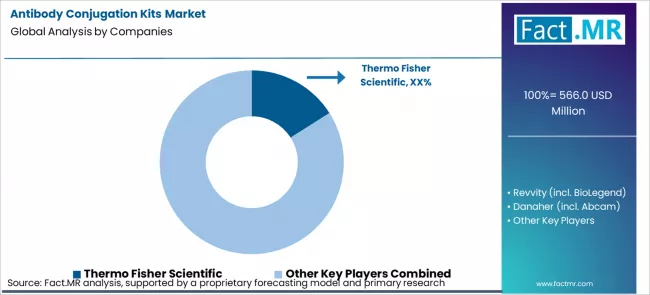
In antibody conjugation kits, purchasing decisions are usually anchored to established laboratory workflows rather than to individual reaction chemistries. Thermo Fisher Scientific and Danaher, including Abcam, benefit from their position inside core antibody sourcing, detection platforms, and downstream assay systems, which allows conjugation steps to be qualified as part of a wider method stack. Revvity, including BioLegend, operates at the interface between high volume research antibodies and labeled formats, where continuity of clone, format, and documentation reduces method change risk. Merck KGaA supplies many of the underlying reagents and buffers that anchor protocol consistency across sites. Maravai LifeSciences, including Vector Labs, holds a focused position in specialized labeling chemistries used where signal control or sensitivity is critical. Once a laboratory standardizes a conjugation workflow, switching requires revalidation and comparability work. Scale supports supply continuity and documentation depth. Process discipline now protects position more reliably than incremental chemistry differences.
Key Players in Antibody Conjugation Kits Market
- Thermo Fisher Scientific
- Revvity (incl. BioLegend)
- Danaher (incl. Abcam)
- Merck KGaA
- Maravai LifeSciences (incl. Vector Labs)
- Others
Scope of the Report
| Items | Values |
|---|---|
| Quantitative Units (2026) | USD million |
| Conjugation Chemistry or Kit Type | NHS-ester dye labeling kits, click chemistry labeling kits, site-specific conjugation kits, biotinylation or streptavidin kits, enzyme (HRP/AP) conjugation kits, nanoparticle (gold/latex) conjugation kits |
| Downstream Application | Flow cytometry reagents, immunofluorescence / imaging, ELISA & plate-based immunoassays, lateral flow or rapid tests, ADC research (preclinical tools) |
| End User or Channel | Biopharma R&D, academic & core facilities, diagnostic developers (IVD), CROs or assay developers, OEM reagent manufacturers |
| Regions Covered | Asia Pacific, Europe, North America, Latin America, Middle East & Africa |
| Countries Covered | United States, Canada, Mexico, Germany, United Kingdom, France, Italy, Spain, China, Japan, South Korea, India, Australia & New Zealand, ASEAN, Brazil, Chile, Saudi Arabia, Turkey, South Africa, and other regional markets |
| Key Companies Profiled | Thermo Fisher Scientific, Revvity (incl. BioLegend), Danaher (incl. Abcam), Merck KGaA, Maravai LifeSciences (incl. Vector Labs) |
| Additional Attributes | Dollar by sales by kit type, downstream application, and end user; focus on method standardization, lot consistency, and audit-ready documentation; demand driven by high throughput labeling, clinical and commercial manufacturing, and contract research networks |
Antibody Conjugation Kits Market Segmentation
-
Conjugation Chemistry or Kit Type :
- NHS-ester dye labeling kits
- Click chemistry labeling kits
- Site-specific conjugation kits
- Biotinylation or streptavidin kits
- Enzyme (HRP/AP) conjugation kits
- Nanoparticle (gold/latex) conjugation kits
-
Downstream Application :
- Flow cytometry reagents
- Immunofluorescence / imaging
- ELISA & plate-based immunoassays
- Lateral flow or rapid tests
- ADC research (preclinical tools)
-
End User or Channel :
- Biopharma R&D
- Academic & core facilities
- Diagnostic developers (IVD)
- CROs or assay developers
- OEM reagent manufacturers
-
Region :
- Asia Pacific
- China
- Japan
- South Korea
- India
- Australia & New Zealand
- ASEAN
- Rest of Asia Pacific
- Europe
- Germany
- United Kingdom
- France
- Italy
- Spain
- Nordic
- BENELUX
- Rest of Europe
- North America
- United States
- Canada
- Mexico
- Latin America
- Brazil
- Chile
- Rest of Latin America
- Middle East & Africa
- Kingdom of Saudi Arabia
- Other GCC Countries
- Turkey
- South Africa
- Other African Union
- Rest of Middle East & Africa
- Asia Pacific
References
- U.S. Department of Health and Human Services, National Institutes of Health, National Center for Advancing Translational Sciences. (2023). Assay guidance manual.
- U.S. Food and Drug Administration. (2024). Bioanalytical method validation: Guidance for industry.U.S. Department of Health and Human Services.
- U.S. Department of Health and Human Services, National Institutes of Health, National Institute of Allergy and Infectious Diseases. (2024). Antibody development.
- Centers for Disease Control and Prevention. (2023). Laboratory quality assurance and quality control.U.S. Department of Health and Human Services.
Table of Content
- Executive Summary
- Global Market Outlook
- Demand to side Trends
- Supply to side Trends
- Technology Roadmap Analysis
- Analysis and Recommendations
- Market Overview
- Market Coverage / Taxonomy
- Market Definition / Scope / Limitations
- Research Methodology
- Chapter Orientation
- Analytical Lens and Working Hypotheses
- Market Structure, Signals, and Trend Drivers
- Benchmarking and Cross-market Comparability
- Market Sizing, Forecasting, and Opportunity Mapping
- Research Design and Evidence Framework
- Desk Research Programme (Secondary Evidence)
- Company Annual and Sustainability Reports
- Peer-reviewed Journals and Academic Literature
- Corporate Websites, Product Literature, and Technical Notes
- Earnings Decks and Investor Briefings
- Statutory Filings and Regulatory Disclosures
- Technical White Papers and Standards Notes
- Trade Journals, Industry Magazines, and Analyst Briefs
- Conference Proceedings, Webinars, and Seminar Materials
- Government Statistics Portals and Public Data Releases
- Press Releases and Reputable Media Coverage
- Specialist Newsletters and Curated Briefings
- Sector Databases and Reference Repositories
- FMR Internal Proprietary Databases and Historical Market Datasets
- Subscription Datasets and Paid Sources
- Social Channels, Communities, and Digital Listening Inputs
- Additional Desk Sources
- Expert Input and Fieldwork (Primary Evidence)
- Primary Modes
- Qualitative Interviews and Expert Elicitation
- Quantitative Surveys and Structured Data Capture
- Blended A8oach
- Why Primary Evidence is Used
- Field Techniques
- Interviews
- Surveys
- Focus Groups
- Observational and In-context Research
- Social and Community Interactions
- Stakeholder Universe Engaged
- C-suite Leaders
- Board Members
- Presidents and Vice Presidents
- R&D and Innovation Heads
- Technical Specialists
- Domain Subject-matter Experts
- Scientists
- Physicians and Other Healthcare Professionals
- Governance, Ethics, and Data Stewardship
- Research Ethics
- Data Integrity and Handling
- Primary Modes
- Tooling, Models, and Reference Databases
- Desk Research Programme (Secondary Evidence)
- Data Engineering and Model Build
- Data Acquisition and Ingestion
- Cleaning, Normalisation, and Verification
- Synthesis, Triangulation, and Analysis
- Quality Assurance and Audit Trail
- Market Background
- Market Dynamics
- Drivers
- Restraints
- Opportunity
- Trends
- Scenario Forecast
- Demand in Optimistic Scenario
- Demand in Likely Scenario
- Demand in Conservative Scenario
- Opportunity Map Analysis
- Product Life Cycle Analysis
- Supply Chain Analysis
- Investment Feasibility Matrix
- Value Chain Analysis
- PESTLE and Porter’s Analysis
- Regulatory Landscape
- Regional Parent Market Outlook
- Production and Consumption Statistics
- Import and Export Statistics
- Market Dynamics
- Global Market Analysis 2021 to 2025 and Forecast, 2026 to 2036
- Historical Market Size Value (USD Million) Analysis, 2021 to 2025
- Current and Future Market Size Value (USD Million) Projections, 2026 to 2036
- Y to o to Y Growth Trend Analysis
- Absolute $ Opportunity Analysis
- Global Market Pricing Analysis 2021 to 2025 and Forecast 2026 to 2036
- Global Market Analysis 2021 to 2025 and Forecast 2026 to 2036, By Conjugation Chemistry or Kit Type
- Introduction / Key Findings
- Historical Market Size Value (USD Million) Analysis By Conjugation Chemistry or Kit Type, 2021 to 2025
- Current and Future Market Size Value (USD Million) Analysis and Forecast By Conjugation Chemistry or Kit Type, 2026 to 2036
- NHS-ester dye labeling kits
- Click chemistry labeling kits
- Site-specific conjugation kits
- Biotinylation or streptavidin kits
- Enzyme (HRP/AP) conjugation kits
- Nanoparticle (gold/latex) conjugation kits
- NHS-ester dye labeling kits
- Y to o to Y Growth Trend Analysis By Conjugation Chemistry or Kit Type, 2021 to 2025
- Absolute $ Opportunity Analysis By Conjugation Chemistry or Kit Type, 2026 to 2036
- Global Market Analysis 2021 to 2025 and Forecast 2026 to 2036, By Downstream Application
- Introduction / Key Findings
- Historical Market Size Value (USD Million) Analysis By Downstream Application, 2021 to 2025
- Current and Future Market Size Value (USD Million) Analysis and Forecast By Downstream Application, 2026 to 2036
- Flow cytometry reagents
- Immunofluorescence / imaging
- ELISA & plate-based immunoassays
- Lateral flow or rapid tests
- ADC research (preclinical tools)
- Flow cytometry reagents
- Y to o to Y Growth Trend Analysis By Downstream Application, 2021 to 2025
- Absolute $ Opportunity Analysis By Downstream Application, 2026 to 2036
- Global Market Analysis 2021 to 2025 and Forecast 2026 to 2036, By End User or Channel
- Introduction / Key Findings
- Historical Market Size Value (USD Million) Analysis By End User or Channel, 2021 to 2025
- Current and Future Market Size Value (USD Million) Analysis and Forecast By End User or Channel, 2026 to 2036
- Biopharma R&D
- Academic & core facilities
- Diagnostic developers (IVD)
- CROs or assay developers
- OEM reagent manufacturers
- Biopharma R&D
- Y to o to Y Growth Trend Analysis By End User or Channel, 2021 to 2025
- Absolute $ Opportunity Analysis By End User or Channel, 2026 to 2036
- Global Market Analysis 2021 to 2025 and Forecast 2026 to 2036, By Region
- Introduction
- Historical Market Size Value (USD Million) Analysis By Region, 2021 to 2025
- Current Market Size Value (USD Million) Analysis and Forecast By Region, 2026 to 2036
- North America
- Latin America
- Western Europe
- Eastern Europe
- East Asia
- South Asia and Pacific
- Middle East & Africa
- Market Attractiveness Analysis By Region
- North America Market Analysis 2021 to 2025 and Forecast 2026 to 2036, By Country
- Historical Market Size Value (USD Million) Trend Analysis By Market Taxonomy, 2021 to 2025
- Market Size Value (USD Million) Forecast By Market Taxonomy, 2026 to 2036
- By Country
- USA
- Canada
- Mexico
- By Conjugation Chemistry or Kit Type
- By Downstream Application
- By End User or Channel
- By Country
- Market Attractiveness Analysis
- By Country
- By Conjugation Chemistry or Kit Type
- By Downstream Application
- By End User or Channel
- Key Takeaways
- Latin America Market Analysis 2021 to 2025 and Forecast 2026 to 2036, By Country
- Historical Market Size Value (USD Million) Trend Analysis By Market Taxonomy, 2021 to 2025
- Market Size Value (USD Million) Forecast By Market Taxonomy, 2026 to 2036
- By Country
- Brazil
- Chile
- Rest of Latin America
- By Conjugation Chemistry or Kit Type
- By Downstream Application
- By End User or Channel
- By Country
- Market Attractiveness Analysis
- By Country
- By Conjugation Chemistry or Kit Type
- By Downstream Application
- By End User or Channel
- Key Takeaways
- Western Europe Market Analysis 2021 to 2025 and Forecast 2026 to 2036, By Country
- Historical Market Size Value (USD Million) Trend Analysis By Market Taxonomy, 2021 to 2025
- Market Size Value (USD Million) Forecast By Market Taxonomy, 2026 to 2036
- By Country
- Germany
- UK
- Italy
- Spain
- France
- Nordic
- BENELUX
- Rest of Western Europe
- By Conjugation Chemistry or Kit Type
- By Downstream Application
- By End User or Channel
- By Country
- Market Attractiveness Analysis
- By Country
- By Conjugation Chemistry or Kit Type
- By Downstream Application
- By End User or Channel
- Key Takeaways
- Eastern Europe Market Analysis 2021 to 2025 and Forecast 2026 to 2036, By Country
- Historical Market Size Value (USD Million) Trend Analysis By Market Taxonomy, 2021 to 2025
- Market Size Value (USD Million) Forecast By Market Taxonomy, 2026 to 2036
- By Country
- Russia
- Poland
- Hungary
- Balkan & Baltic
- Rest of Eastern Europe
- By Conjugation Chemistry or Kit Type
- By Downstream Application
- By End User or Channel
- By Country
- Market Attractiveness Analysis
- By Country
- By Conjugation Chemistry or Kit Type
- By Downstream Application
- By End User or Channel
- Key Takeaways
- East Asia Market Analysis 2021 to 2025 and Forecast 2026 to 2036, By Country
- Historical Market Size Value (USD Million) Trend Analysis By Market Taxonomy, 2021 to 2025
- Market Size Value (USD Million) Forecast By Market Taxonomy, 2026 to 2036
- By Country
- China
- Japan
- South Korea
- By Conjugation Chemistry or Kit Type
- By Downstream Application
- By End User or Channel
- By Country
- Market Attractiveness Analysis
- By Country
- By Conjugation Chemistry or Kit Type
- By Downstream Application
- By End User or Channel
- Key Takeaways
- South Asia and Pacific Market Analysis 2021 to 2025 and Forecast 2026 to 2036, By Country
- Historical Market Size Value (USD Million) Trend Analysis By Market Taxonomy, 2021 to 2025
- Market Size Value (USD Million) Forecast By Market Taxonomy, 2026 to 2036
- By Country
- India
- ASEAN
- Australia & New Zealand
- Rest of South Asia and Pacific
- By Conjugation Chemistry or Kit Type
- By Downstream Application
- By End User or Channel
- By Country
- Market Attractiveness Analysis
- By Country
- By Conjugation Chemistry or Kit Type
- By Downstream Application
- By End User or Channel
- Key Takeaways
- Middle East & Africa Market Analysis 2021 to 2025 and Forecast 2026 to 2036, By Country
- Historical Market Size Value (USD Million) Trend Analysis By Market Taxonomy, 2021 to 2025
- Market Size Value (USD Million) Forecast By Market Taxonomy, 2026 to 2036
- By Country
- Kingdom of Saudi Arabia
- Other GCC Countries
- Turkiye
- South Africa
- Other African Union
- Rest of Middle East & Africa
- By Conjugation Chemistry or Kit Type
- By Downstream Application
- By End User or Channel
- By Country
- Market Attractiveness Analysis
- By Country
- By Conjugation Chemistry or Kit Type
- By Downstream Application
- By End User or Channel
- Key Takeaways
- Key Countries Market Analysis
- USA
- Pricing Analysis
- Market Share Analysis, 2025
- By Conjugation Chemistry or Kit Type
- By Downstream Application
- By End User or Channel
- Canada
- Pricing Analysis
- Market Share Analysis, 2025
- By Conjugation Chemistry or Kit Type
- By Downstream Application
- By End User or Channel
- Mexico
- Pricing Analysis
- Market Share Analysis, 2025
- By Conjugation Chemistry or Kit Type
- By Downstream Application
- By End User or Channel
- Brazil
- Pricing Analysis
- Market Share Analysis, 2025
- By Conjugation Chemistry or Kit Type
- By Downstream Application
- By End User or Channel
- Chile
- Pricing Analysis
- Market Share Analysis, 2025
- By Conjugation Chemistry or Kit Type
- By Downstream Application
- By End User or Channel
- Germany
- Pricing Analysis
- Market Share Analysis, 2025
- By Conjugation Chemistry or Kit Type
- By Downstream Application
- By End User or Channel
- UK
- Pricing Analysis
- Market Share Analysis, 2025
- By Conjugation Chemistry or Kit Type
- By Downstream Application
- By End User or Channel
- Italy
- Pricing Analysis
- Market Share Analysis, 2025
- By Conjugation Chemistry or Kit Type
- By Downstream Application
- By End User or Channel
- Spain
- Pricing Analysis
- Market Share Analysis, 2025
- By Conjugation Chemistry or Kit Type
- By Downstream Application
- By End User or Channel
- France
- Pricing Analysis
- Market Share Analysis, 2025
- By Conjugation Chemistry or Kit Type
- By Downstream Application
- By End User or Channel
- India
- Pricing Analysis
- Market Share Analysis, 2025
- By Conjugation Chemistry or Kit Type
- By Downstream Application
- By End User or Channel
- ASEAN
- Pricing Analysis
- Market Share Analysis, 2025
- By Conjugation Chemistry or Kit Type
- By Downstream Application
- By End User or Channel
- Australia & New Zealand
- Pricing Analysis
- Market Share Analysis, 2025
- By Conjugation Chemistry or Kit Type
- By Downstream Application
- By End User or Channel
- China
- Pricing Analysis
- Market Share Analysis, 2025
- By Conjugation Chemistry or Kit Type
- By Downstream Application
- By End User or Channel
- Japan
- Pricing Analysis
- Market Share Analysis, 2025
- By Conjugation Chemistry or Kit Type
- By Downstream Application
- By End User or Channel
- South Korea
- Pricing Analysis
- Market Share Analysis, 2025
- By Conjugation Chemistry or Kit Type
- By Downstream Application
- By End User or Channel
- Russia
- Pricing Analysis
- Market Share Analysis, 2025
- By Conjugation Chemistry or Kit Type
- By Downstream Application
- By End User or Channel
- Poland
- Pricing Analysis
- Market Share Analysis, 2025
- By Conjugation Chemistry or Kit Type
- By Downstream Application
- By End User or Channel
- Hungary
- Pricing Analysis
- Market Share Analysis, 2025
- By Conjugation Chemistry or Kit Type
- By Downstream Application
- By End User or Channel
- Kingdom of Saudi Arabia
- Pricing Analysis
- Market Share Analysis, 2025
- By Conjugation Chemistry or Kit Type
- By Downstream Application
- By End User or Channel
- Turkiye
- Pricing Analysis
- Market Share Analysis, 2025
- By Conjugation Chemistry or Kit Type
- By Downstream Application
- By End User or Channel
- South Africa
- Pricing Analysis
- Market Share Analysis, 2025
- By Conjugation Chemistry or Kit Type
- By Downstream Application
- By End User or Channel
- USA
- Market Structure Analysis
- Competition Dashboard
- Competition Benchmarking
- Market Share Analysis of Top Players
- By Regional
- By Conjugation Chemistry or Kit Type
- By Downstream Application
- By End User or Channel
- Competition Analysis
- Competition Deep Dive
- Thermo Fisher Scientific
- Overview
- Product Portfolio
- Profitability by Market Segments (Product/Age /Sales Channel/Region)
- Sales Footprint
- Strategy Overview
- Marketing Strategy
- Product Strategy
- Channel Strategy
- Revvity (incl. BioLegend)
- Danaher (incl. Abcam)
- Merck KGaA
- Maravai LifeSciences (incl. Vector Labs)
- Others
- Thermo Fisher Scientific
- Competition Deep Dive
- Assumptions & Acronyms Used
List Of Table
- Table 1: Global Market Value (USD Million) Forecast by Region, 2021 to 2036
- Table 2: Global Market Value (USD Million) Forecast by Conjugation Chemistry or Kit Type, 2021 to 2036
- Table 3: Global Market Value (USD Million) Forecast by Downstream Application, 2021 to 2036
- Table 4: Global Market Value (USD Million) Forecast by End User or Channel, 2021 to 2036
- Table 5: North America Market Value (USD Million) Forecast by Country, 2021 to 2036
- Table 6: North America Market Value (USD Million) Forecast by Conjugation Chemistry or Kit Type, 2021 to 2036
- Table 7: North America Market Value (USD Million) Forecast by Downstream Application, 2021 to 2036
- Table 8: North America Market Value (USD Million) Forecast by End User or Channel, 2021 to 2036
- Table 9: Latin America Market Value (USD Million) Forecast by Country, 2021 to 2036
- Table 10: Latin America Market Value (USD Million) Forecast by Conjugation Chemistry or Kit Type, 2021 to 2036
- Table 11: Latin America Market Value (USD Million) Forecast by Downstream Application, 2021 to 2036
- Table 12: Latin America Market Value (USD Million) Forecast by End User or Channel, 2021 to 2036
- Table 13: Western Europe Market Value (USD Million) Forecast by Country, 2021 to 2036
- Table 14: Western Europe Market Value (USD Million) Forecast by Conjugation Chemistry or Kit Type, 2021 to 2036
- Table 15: Western Europe Market Value (USD Million) Forecast by Downstream Application, 2021 to 2036
- Table 16: Western Europe Market Value (USD Million) Forecast by End User or Channel, 2021 to 2036
- Table 17: Eastern Europe Market Value (USD Million) Forecast by Country, 2021 to 2036
- Table 18: Eastern Europe Market Value (USD Million) Forecast by Conjugation Chemistry or Kit Type, 2021 to 2036
- Table 19: Eastern Europe Market Value (USD Million) Forecast by Downstream Application, 2021 to 2036
- Table 20: Eastern Europe Market Value (USD Million) Forecast by End User or Channel, 2021 to 2036
- Table 21: East Asia Market Value (USD Million) Forecast by Country, 2021 to 2036
- Table 22: East Asia Market Value (USD Million) Forecast by Conjugation Chemistry or Kit Type, 2021 to 2036
- Table 23: East Asia Market Value (USD Million) Forecast by Downstream Application, 2021 to 2036
- Table 24: East Asia Market Value (USD Million) Forecast by End User or Channel, 2021 to 2036
- Table 25: South Asia and Pacific Market Value (USD Million) Forecast by Country, 2021 to 2036
- Table 26: South Asia and Pacific Market Value (USD Million) Forecast by Conjugation Chemistry or Kit Type, 2021 to 2036
- Table 27: South Asia and Pacific Market Value (USD Million) Forecast by Downstream Application, 2021 to 2036
- Table 28: South Asia and Pacific Market Value (USD Million) Forecast by End User or Channel, 2021 to 2036
- Table 29: Middle East & Africa Market Value (USD Million) Forecast by Country, 2021 to 2036
- Table 30: Middle East & Africa Market Value (USD Million) Forecast by Conjugation Chemistry or Kit Type, 2021 to 2036
- Table 31: Middle East & Africa Market Value (USD Million) Forecast by Downstream Application, 2021 to 2036
- Table 32: Middle East & Africa Market Value (USD Million) Forecast by End User or Channel, 2021 to 2036
List Of Figures
- Figure 1: Global Market Pricing Analysis
- Figure 2: Global Market Value (USD Million) Forecast 2021 to 2036
- Figure 3: Global Market Value Share and BPS Analysis by Conjugation Chemistry or Kit Type, 2026 and 2036
- Figure 4: Global Market Y to o to Y Growth Comparison by Conjugation Chemistry or Kit Type, 2026 to 2036
- Figure 5: Global Market Attractiveness Analysis by Conjugation Chemistry or Kit Type
- Figure 6: Global Market Value Share and BPS Analysis by Downstream Application, 2026 and 2036
- Figure 7: Global Market Y to o to Y Growth Comparison by Downstream Application, 2026 to 2036
- Figure 8: Global Market Attractiveness Analysis by Downstream Application
- Figure 9: Global Market Value Share and BPS Analysis by End User or Channel, 2026 and 2036
- Figure 10: Global Market Y to o to Y Growth Comparison by End User or Channel, 2026 to 2036
- Figure 11: Global Market Attractiveness Analysis by End User or Channel
- Figure 12: Global Market Value (USD Million) Share and BPS Analysis by Region, 2026 and 2036
- Figure 13: Global Market Y to o to Y Growth Comparison by Region, 2026 to 2036
- Figure 14: Global Market Attractiveness Analysis by Region
- Figure 15: North America Market Incremental Dollar Opportunity, 2026 to 2036
- Figure 16: Latin America Market Incremental Dollar Opportunity, 2026 to 2036
- Figure 17: Western Europe Market Incremental Dollar Opportunity, 2026 to 2036
- Figure 18: Eastern Europe Market Incremental Dollar Opportunity, 2026 to 2036
- Figure 19: East Asia Market Incremental Dollar Opportunity, 2026 to 2036
- Figure 20: South Asia and Pacific Market Incremental Dollar Opportunity, 2026 to 2036
- Figure 21: Middle East & Africa Market Incremental Dollar Opportunity, 2026 to 2036
- Figure 22: North America Market Value Share and BPS Analysis by Country, 2026 and 2036
- Figure 23: North America Market Value Share and BPS Analysis by Conjugation Chemistry or Kit Type, 2026 and 2036
- Figure 24: North America Market Y to o to Y Growth Comparison by Conjugation Chemistry or Kit Type, 2026 to 2036
- Figure 25: North America Market Attractiveness Analysis by Conjugation Chemistry or Kit Type
- Figure 26: North America Market Value Share and BPS Analysis by Downstream Application, 2026 and 2036
- Figure 27: North America Market Y to o to Y Growth Comparison by Downstream Application, 2026 to 2036
- Figure 28: North America Market Attractiveness Analysis by Downstream Application
- Figure 29: North America Market Value Share and BPS Analysis by End User or Channel, 2026 and 2036
- Figure 30: North America Market Y to o to Y Growth Comparison by End User or Channel, 2026 to 2036
- Figure 31: North America Market Attractiveness Analysis by End User or Channel
- Figure 32: Latin America Market Value Share and BPS Analysis by Country, 2026 and 2036
- Figure 33: Latin America Market Value Share and BPS Analysis by Conjugation Chemistry or Kit Type, 2026 and 2036
- Figure 34: Latin America Market Y to o to Y Growth Comparison by Conjugation Chemistry or Kit Type, 2026 to 2036
- Figure 35: Latin America Market Attractiveness Analysis by Conjugation Chemistry or Kit Type
- Figure 36: Latin America Market Value Share and BPS Analysis by Downstream Application, 2026 and 2036
- Figure 37: Latin America Market Y to o to Y Growth Comparison by Downstream Application, 2026 to 2036
- Figure 38: Latin America Market Attractiveness Analysis by Downstream Application
- Figure 39: Latin America Market Value Share and BPS Analysis by End User or Channel, 2026 and 2036
- Figure 40: Latin America Market Y to o to Y Growth Comparison by End User or Channel, 2026 to 2036
- Figure 41: Latin America Market Attractiveness Analysis by End User or Channel
- Figure 42: Western Europe Market Value Share and BPS Analysis by Country, 2026 and 2036
- Figure 43: Western Europe Market Value Share and BPS Analysis by Conjugation Chemistry or Kit Type, 2026 and 2036
- Figure 44: Western Europe Market Y to o to Y Growth Comparison by Conjugation Chemistry or Kit Type, 2026 to 2036
- Figure 45: Western Europe Market Attractiveness Analysis by Conjugation Chemistry or Kit Type
- Figure 46: Western Europe Market Value Share and BPS Analysis by Downstream Application, 2026 and 2036
- Figure 47: Western Europe Market Y to o to Y Growth Comparison by Downstream Application, 2026 to 2036
- Figure 48: Western Europe Market Attractiveness Analysis by Downstream Application
- Figure 49: Western Europe Market Value Share and BPS Analysis by End User or Channel, 2026 and 2036
- Figure 50: Western Europe Market Y to o to Y Growth Comparison by End User or Channel, 2026 to 2036
- Figure 51: Western Europe Market Attractiveness Analysis by End User or Channel
- Figure 52: Eastern Europe Market Value Share and BPS Analysis by Country, 2026 and 2036
- Figure 53: Eastern Europe Market Value Share and BPS Analysis by Conjugation Chemistry or Kit Type, 2026 and 2036
- Figure 54: Eastern Europe Market Y to o to Y Growth Comparison by Conjugation Chemistry or Kit Type, 2026 to 2036
- Figure 55: Eastern Europe Market Attractiveness Analysis by Conjugation Chemistry or Kit Type
- Figure 56: Eastern Europe Market Value Share and BPS Analysis by Downstream Application, 2026 and 2036
- Figure 57: Eastern Europe Market Y to o to Y Growth Comparison by Downstream Application, 2026 to 2036
- Figure 58: Eastern Europe Market Attractiveness Analysis by Downstream Application
- Figure 59: Eastern Europe Market Value Share and BPS Analysis by End User or Channel, 2026 and 2036
- Figure 60: Eastern Europe Market Y to o to Y Growth Comparison by End User or Channel, 2026 to 2036
- Figure 61: Eastern Europe Market Attractiveness Analysis by End User or Channel
- Figure 62: East Asia Market Value Share and BPS Analysis by Country, 2026 and 2036
- Figure 63: East Asia Market Value Share and BPS Analysis by Conjugation Chemistry or Kit Type, 2026 and 2036
- Figure 64: East Asia Market Y to o to Y Growth Comparison by Conjugation Chemistry or Kit Type, 2026 to 2036
- Figure 65: East Asia Market Attractiveness Analysis by Conjugation Chemistry or Kit Type
- Figure 66: East Asia Market Value Share and BPS Analysis by Downstream Application, 2026 and 2036
- Figure 67: East Asia Market Y to o to Y Growth Comparison by Downstream Application, 2026 to 2036
- Figure 68: East Asia Market Attractiveness Analysis by Downstream Application
- Figure 69: East Asia Market Value Share and BPS Analysis by End User or Channel, 2026 and 2036
- Figure 70: East Asia Market Y to o to Y Growth Comparison by End User or Channel, 2026 to 2036
- Figure 71: East Asia Market Attractiveness Analysis by End User or Channel
- Figure 72: South Asia and Pacific Market Value Share and BPS Analysis by Country, 2026 and 2036
- Figure 73: South Asia and Pacific Market Value Share and BPS Analysis by Conjugation Chemistry or Kit Type, 2026 and 2036
- Figure 74: South Asia and Pacific Market Y to o to Y Growth Comparison by Conjugation Chemistry or Kit Type, 2026 to 2036
- Figure 75: South Asia and Pacific Market Attractiveness Analysis by Conjugation Chemistry or Kit Type
- Figure 76: South Asia and Pacific Market Value Share and BPS Analysis by Downstream Application, 2026 and 2036
- Figure 77: South Asia and Pacific Market Y to o to Y Growth Comparison by Downstream Application, 2026 to 2036
- Figure 78: South Asia and Pacific Market Attractiveness Analysis by Downstream Application
- Figure 79: South Asia and Pacific Market Value Share and BPS Analysis by End User or Channel, 2026 and 2036
- Figure 80: South Asia and Pacific Market Y to o to Y Growth Comparison by End User or Channel, 2026 to 2036
- Figure 81: South Asia and Pacific Market Attractiveness Analysis by End User or Channel
- Figure 82: Middle East & Africa Market Value Share and BPS Analysis by Country, 2026 and 2036
- Figure 83: Middle East & Africa Market Value Share and BPS Analysis by Conjugation Chemistry or Kit Type, 2026 and 2036
- Figure 84: Middle East & Africa Market Y to o to Y Growth Comparison by Conjugation Chemistry or Kit Type, 2026 to 2036
- Figure 85: Middle East & Africa Market Attractiveness Analysis by Conjugation Chemistry or Kit Type
- Figure 86: Middle East & Africa Market Value Share and BPS Analysis by Downstream Application, 2026 and 2036
- Figure 87: Middle East & Africa Market Y to o to Y Growth Comparison by Downstream Application, 2026 to 2036
- Figure 88: Middle East & Africa Market Attractiveness Analysis by Downstream Application
- Figure 89: Middle East & Africa Market Value Share and BPS Analysis by End User or Channel, 2026 and 2036
- Figure 90: Middle East & Africa Market Y to o to Y Growth Comparison by End User or Channel, 2026 to 2036
- Figure 91: Middle East & Africa Market Attractiveness Analysis by End User or Channel
- Figure 92: Global Market - Tier Structure Analysis
- Figure 93: Global Market - Company Share Analysis
- FAQs -
How big is the antibody conjugation kits market in 2026?
The global antibody conjugation kits market is estimated to be valued at USD 566.0 million in 2026.
What will be the size of antibody conjugation kits market in 2036?
The market size for the antibody conjugation kits market is projected to reach USD 1,315.5 million by 2036.
How much will be the antibody conjugation kits market growth between 2026 and 2036?
The antibody conjugation kits market is expected to grow at a 8.8% CAGR between 2026 and 2036.
What are the key product types in the antibody conjugation kits market?
The key product types in antibody conjugation kits market are nhs-ester dye labeling kits, click chemistry labeling kits, site-specific conjugation kits, biotinylation or streptavidin kits, enzyme (hrp/ap) conjugation kits and nanoparticle (gold/latex) conjugation kits.
Which downstream application segment to contribute significant share in the antibody conjugation kits market in 2026?
In terms of downstream application, flow cytometry reagents segment to command 34.0% share in the antibody conjugation kits market in 2026.