- Market size in 2025:USD 265.5 Mn
- Estimated market size in 2026:USD 288.8 Mn
- Projected market size by 2036:USD 1024.6 Mn
- CAGR (2026-2036):13.5%
What is the biomarker supplement kits market forecast to be worth by 2036?
USD 288.8 million in 2026. USD 1,024.6 million by 2036. CAGR of 13.5%.
- The biomarker supplement kits market crossed USD 265.5 million in 2025.
- It is expected to reach USD 288.8 million in 2026.
- The market is projected to reach USD 1,024.6 million by 2036.
- It is forecast to record 13.5% CAGR from 2026 to 2036 as consumers and practitioners seek supplement routines tied to blood biomarkers.
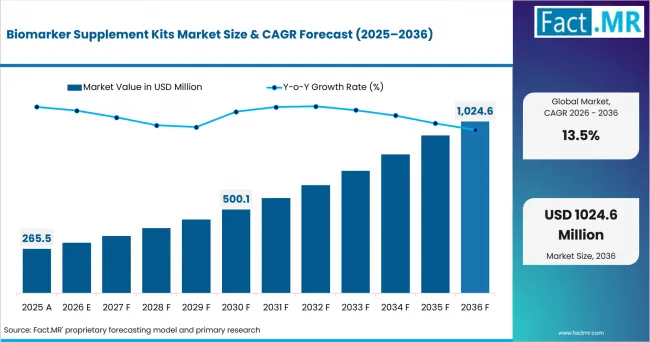
Biomarker Supplement Kits Market Market Value Analysis | Source: Fact.MR
What are the defining numbers behind biomarker supplement kits growth?
USD 735.8 million absolute opportunity by 2036. India and South Korea lead the country view.
- Demand Drivers in the Market
- Consumers need supplement recommendations that explain why a nutrient belongs in the pack.
- Wellness clinics need supplement protocols that connect interpretation with repeat refills.
- Direct-to-consumer brands need subscription bundles that turn one test into recurring refills.
- Employer wellness buyers need simple preventive kits that avoid disease-treatment language.
- Key Segments Analyzed
- By Personalization Input: Blood biomarkers are expected to hold 36.0% share in 2026 because blood values give buyers visible evidence before a supplement routine is chosen.
- By Efficacy Target: Micronutrient gaps lead because deficiency correction is easier to explain than broad wellness claims. The segment is projected to capture 28.0% share in 2026.
- By Personalization Route: Subscription bundles are likely to account for 32.0% share in 2026 as refills turn a test result into recurring revenue.
- By Channel: Direct-to-consumer is projected to hold 46.0% share in 2026 since online onboarding suits quiz-based and app-linked routines.
- By Ingredient Base: Vitamins are expected to hold 31.0% share in 2026 because vitamin D and B-complex recommendations are familiar to consumers and practitioners.
- By Geography: India is projected to record 16.1% CAGR through 2036 as nutraceutical production and wellness retail expansion support faster scaling.
- Analyst Opinion at Fact.MR
- Shambhu Nath Jha, Senior Analyst at Fact.MR, states, “I see the category shifting from selling more pills to explaining why a person should take a narrower routine. Blood panels and DNA inputs make the recommendation easier to defend. The winners are not the brands with the longest ingredient list. They are the brands that turn a test result into a simple monthly action.”
- Strategic Implications
- Supplement brands should separate wellness guidance from diagnostic claims before scaling biomarker-linked offers.
- Clinics need repeat-testing workflows that keep interpretation and refill decisions connected.
- Direct-to-consumer platforms should make consent, data storage and reorder logic visible during onboarding.
- Ingredient suppliers should support narrower formulations for micronutrient gaps, recovery and sleep routines.
Personalized nutrition inputs form the core of this market. The National Center for Health Statistics reported in May 2026 that 60.2% of United States adults used dietary supplements during August 2021 to August 2023. This supports a large base for dietary supplement products that can move into narrower biomarker-linked packs.
India is projected to record 16.1% CAGR through 2036 as nutraceutical production and direct wellness retail expand. South Korea is expected to expand at 15.8% CAGR as app-linked health routines support recurring kits. China is forecast to grow at 14.9% CAGR as aging consumers and e-commerce channels scale personalized nutrition. The United States is expected to advance at 13.9% CAGR as supplement use and home testing are familiar. Japan is projected to rise at 13.4% CAGR as older consumers prefer practitioner-guided routines.
How does the biomarker supplement kits market break down by segment?
Blood biomarkers lead at 36.0%. Direct-to-consumer leads at 46.0%.
Which personalization input dominates?
Blood biomarkers hold 36.0% share in 2026.
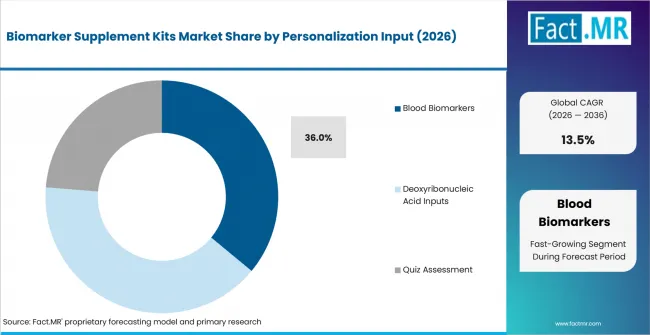
Biomarker Supplement Kits Market Analysis By Personalization Input | Source: Fact.MR
Blood biomarkers lead because they give buyers a measurable reason to change a supplement routine. The category benefits from glucose and micronutrient panels that consumers already understand. Buyers are more likely to accept nutraceutical supplements when the recommendation connects to a visible result. This makes blood values stronger than lifestyle quizzes for premium kits.
Which efficacy target dominates?
Micronutrient gaps account for 28.0% share in 2026.
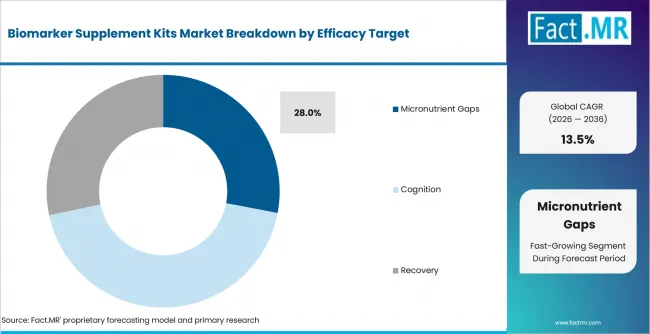
Biomarker Supplement Kits Market Analysis By Efficacy Target | Source: Fact.MR
Micronutrient gaps lead because deficiency correction gives buyers a practical answer. Sleep and stress routines matter but they can be harder to tie to one supplement decision. A measured blood result helps mineral supplement packs justify a narrower routine. Vitamins and minerals therefore remain the easiest base for first-time biomarker kits.
Which personalization route dominates?
Subscription bundles hold 32.0% share in 2026.
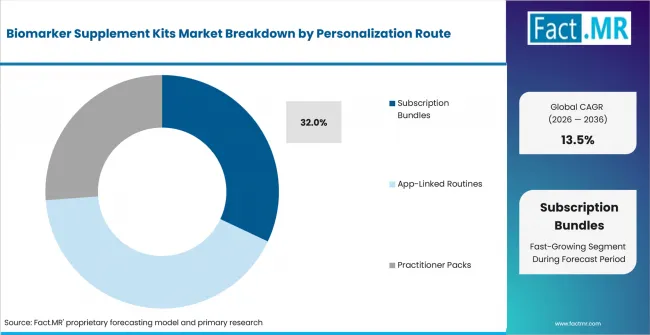
Biomarker Supplement Kits Market Analysis By Personalization Route | Source: Fact.MR
Subscription bundles lead because they connect testing and refill into one commercial path. A one-time result creates interest, but a refill plan creates revenue. Brands selling herbal supplement formats can use the same route when the ingredient reason is explained clearly. The route is strongest when reminders and retesting stay in one account.
Which channel dominates?
Direct-to-consumer leads with 46.0% share in 2026.
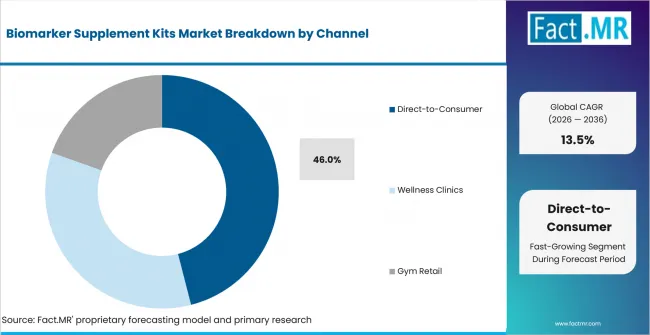
Biomarker Supplement Kits Market Analysis By Channel | Source: Fact.MR
Direct-to-consumer leads because online onboarding suits buyers who compare wellness products through health marketplaces. The channel also lets brands test prices and bundles quickly. A similar pattern is visible in skin care supplements when advice and reorder behavior stay in the same path. Clinics still matter when blood values require explanation.
Which ingredient base dominates?
Vitamins hold 31.0% share in 2026.
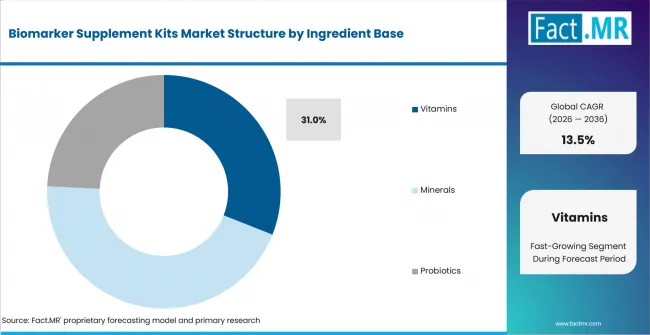
Biomarker Supplement Kits Market Analysis By Ingredient Base | Source: Fact.MR
Vitamins lead because consumers already understand vitamin D and vitamin B correction. Multinutrient routines also fit practitioner protocols. Probiotics and adaptogens are relevant but proof and claim wording are harder to manage. Sports supplement routines offer a crossover path when recovery markers support a narrower formula.
What is accelerating biomarker supplement kit adoption, and what is holding it back?
Blood biomarker inputs and subscription refill models drive it, while disease-claim risk and testing costs restrain it.
Drivers Impact Analysis
| DRIVER | (~) % IMPACT ON CAGR | GEOGRAPHIC RELEVANCE | IMPACT TIMELINE |
|---|---|---|---|
| Blood panels guiding supplement choice | +3.4% | North America, East Asia, Western Europe | Short term (≤ 2 years) |
| Subscription refills raising order frequency | +2.7% | United States, United Kingdom, India | Medium term (2–4 years) |
| Clinics packaging supplement protocols | +2.2% | United States, Germany, Japan | Medium term (2–4 years) |
| Wearable readings shaping routine changes | +1.9% | South Korea, United States, China | Long term (≥ 4 years) |
| Employer wellness buyers bundling kits | +1.4% | United States, United Kingdom, India | Medium term (2–4 years) |
- Blood panels guide routines
- Blood panels give supplement platforms a concrete starting point. The result can show a vitamin or mineral gap before the buyer purchases a pack. The National Institutes of Health Office of Dietary Supplements set its 2025 to 2029 plan around coordinated supplement science. This helps brands explain why a smaller routine is better than a broad supplement basket. Bone and joint supplements can use the same logic when aging users need clearer calcium or vitamin D support.
- Subscriptions convert testing
- A test creates interest only once unless the brand can turn it into a plan. Subscription bundles solve that problem by pairing a recommendation with scheduled refills. This makes retention as important as the first kit sale. The strongest platforms keep the test result, pack logic and reorder decision in one account.
- Clinics package protocols
- Wellness clinics use kits to turn lab interpretation into a paid protocol. The clinic can explain the result, sell the pack and schedule a follow-up test. That makes the product easier to trust than a standalone online recommendation. Clinic-led models also help brands avoid careless disease-treatment wording.
Opportunity Impact Analysis
| OPPORTUNITY | (~) % IMPACT ON CAGR | GEOGRAPHIC RELEVANCE | IMPACT TIMELINE |
|---|---|---|---|
| Practitioner-guided packs for aging users | +2.8% | Japan, Germany, South Korea | Medium term (2–4 years) |
| Recovery kits moving beyond athletes | +2.3% | United States, United Kingdom | Short term (≤ 2 years) |
| Employer wellness kit bundles | +2.0% | United States, India | Medium term (2–4 years) |
| Micronutrient gap tracking in India | +1.8% | India, South Asia | Long term (≥ 4 years) |
| App-linked sleep and energy routines | +1.5% | South Korea, China | Long term (≥ 4 years)= |
- Practitioner packs for aging users
- Aging populations create a need for clearer supplement guidance. Japan counted 36.24 million people aged 65 and over in October 2024. Kits for bone, recovery and energy routines can work better when a practitioner explains the result. This creates room for premium packs that are sold with interpretation, not only capsules.
- Recovery kits move beyond athletes
- Sports recovery buyers already understand protein and electrolytes. Biomarker kits can add iron or vitamin D context. This takes recovery packs into office workers and active consumers who do not buy athlete-only products. Powder dietary supplements can fit this route when the formula is tied to a measured gap.
- Employer bundles reduce friction
- Employers can buy kits as part of preventive wellness benefits. A bundled program reduces the need for each employee to choose products alone. Suppliers that can handle consent, privacy and simple explanations can win broader accounts. The opportunity is strongest when the kit avoids medical claims and stays within wellness support.
Restraints Impact Analysis
| RESTRAINT | (~) % IMPACT ON CAGR | GEOGRAPHIC RELEVANCE | IMPACT TIMELINE |
|---|---|---|---|
| Disease-claim risk limiting wording | -2.6% | United States, Europe | Short term (≤ 2 years) |
| Testing costs narrowing the buyer pool | -2.1% | India, China, Latin America | Medium term (2–4 years) |
| Privacy concerns slowing data sharing | -1.8% | Europe, Japan, South Korea | Medium term (2–4 years) |
| Ingredient evidence varying by target | -1.4% | Global | Long term (≥ 4 years) |
| Inactive brands reducing buyer confidence | -1.0% | North America, Europe | Short term (≤ 2 years) |
- Testing costs narrow access
- Blood-based kits cost more than quiz-based packs. This limits adoption in lower-income user groups and makes clinics important for explaining value. Lower-cost quiz packs can widen reach, but they do not carry the same proof level. Brands must decide whether they want premium credibility or wider entry pricing.
- Privacy slows sharing
- Consumers may hesitate to share deoxyribonucleic acid or blood data with supplement brands. The concern is stronger in countries with strict health data expectations. Liquid dietary supplements can be positioned as easier routines, but personal data still needs consent safeguards. Poor communication can slow conversion before a buyer reaches checkout.
Which countries are scaling biomarker supplement kits fastest?
India leads at 16.1%. South Korea follows at 15.8%. China is forecast at 14.9%. The United States is projected at 13.9%. Japan is expected at 13.4%.
Based on regional analysis, the biomarker supplement kits market is segmented into North America and Latin America. It also covers Europe and East Asia. South Asia and Pacific and Middle East and Africa are included.
| Country | CAGR |
|---|---|
| India | 16.1% |
| South Korea | 15.8% |
| China | 14.9% |
| United States | 13.9% |
| Japan | 13.4% |
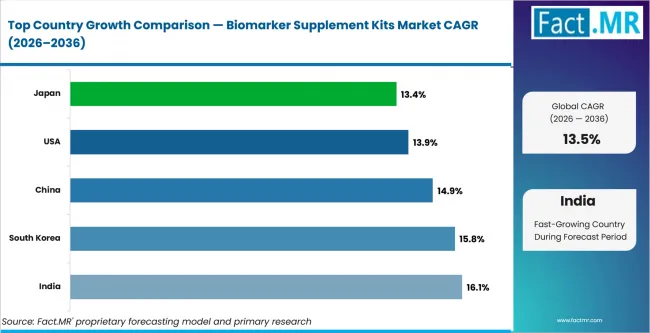
Biomarker Supplement Kits Market Cagr Analysis By Country | Source: Fact.MR
What is powering India’s lead?
16.1% CAGR, supported by nutraceutical production and wellness retail expansion.
India is projected to record 16.1% CAGR through 2036 as nutraceutical manufacturing and direct wellness retail expand. The Ministry of Food Processing Industries reported 4,612 approved micro food processing enterprises for millet processing as of December 2025. That activity supports ingredient processing capability for local supplement formats. Suppliers can pair local nutrient formats with lab-aware subscription packs for urban consumers.
Why is South Korea an important app-linked market?
15.8% CAGR, driven by app-based routines and aging users.
South Korean buyers are comfortable with app-based health services and recurring wellness purchases. The country is expected to expand at 15.8% CAGR through 2036 as connected health behavior supports refill programs. Statistics Korea projected the share of people aged 65 or more at 19.2% in 2024. That aging pressure makes recovery and micronutrient-gap routines easier to explain. Suppliers with Korean-language dashboards can win health-platform partnerships.
How is China scaling kit demand?
14.9% CAGR, backed by aging users and e-commerce reach.
China is forecast to grow at 14.9% CAGR through 2036 as aging consumers and e-commerce channels scale personalized nutrition. The United Nations Development Programme China reported that China had 310.31 million people aged 60 and above at the end of 2024. This makes micronutrient and energy routines commercially relevant for older urban consumers. Local platforms need testing partners and ingredient packs that fit Chinese health-claim review.
What supports the United States outlook?
13.9% CAGR, owing to supplement use and direct-to-consumer testing.
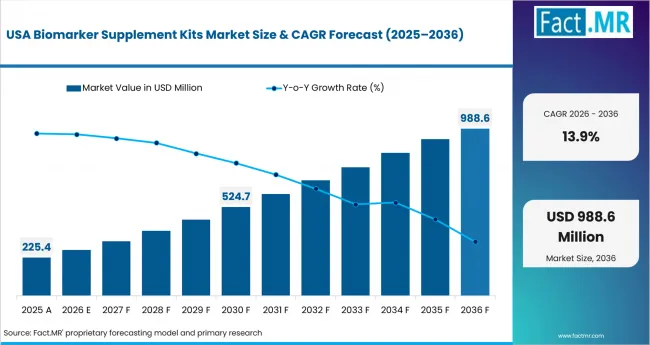
Biomarker Supplement Kits Market Country Value Analysis | Source: Fact.MR
United States consumers already buy supplements and home health tests through online channels. The country is expected to advance at 13.9% CAGR through 2036 as direct-to-consumer brands turn supplement use into personalized refill programs. Buyer acceptance improves when brands separate wellness advice from disease treatment language.
Why does Japan matter for practitioner-led kits?
13.4% CAGR, due to older consumers and clinic-linked wellness routines.
Japan’s older consumers value careful health guidance and clear product claims. Japan is projected to rise at 13.4% CAGR through 2036 as aging households support practitioner-led wellness routines. That share makes bone and recovery packs more relevant than broad lifestyle kits. Buyers in Japan are likely to prefer practitioner-led explanations before ordering repeat biomarker packs.
Who leads the biomarker supplement kits landscape?
InsideTracker and Bioniq lead through testing and supplement quality. Rootine leads through subscription workflows.
Biomarker supplement kits are used by consumers and clinics that need a clearer reason to recommend a supplement pack. InsideTracker competes from a health analytics position because its platform connects blood biomarkers with personalized actions. Bioniq competes through personalized formulas that can use blood test inputs. Rootineand Viomecompete through assessment-led subscription flows.
Thorne, Vessel Healthand Elysium Healthare active in targeted wellness and performance nutrition use cases. Nutrigenomixis relevant because repeat daily routines help show how premium supplement behavior can scale. Competition through 2036 depends on proof quality, refill design and careful claim wording.
Providers that combine simple onboarding, credible ingredients and privacy controls are better placed. Testing-aware platforms can win premium programs through measurable inputs. Supplement brands can win scale if they make the routine easy to understand and safe to describe.
Which companies are the key players?
InsideTracker and Bioniq. Rootine and Viome. Thorne and Nutrigenomix. Elysium Health and Vessel Health.
- InsideTracker
- Bioniq
- Rootine
- Viome
- Thorne
- Nutrigenomix
- Elysium Health
- Vessel Health
Bibliography
- [1] Stierman, B., Mishra, S., & Gahche, J. J. (2026, May). Dietary supplement use: United States, August 2021–August 2023. National Center for Health Statistics.
- [2] U.S. Food and Drug Administration. (2025, September 19). Laboratory developed tests. FDA.
- [3] National Institutes of Health, Office of Dietary Supplements. (2025, January). ODS strategic plan 2025–2029. NIH.
- [4] Cabinet Office, Government of Japan. (2025, June). Annual report on the ageing society FY2025. Government of Japan.
- [5] United Nations Development Programme China. (2025, December). A measurement study on multidimensional vulnerabilities of the elderly population in China. UNDP China.
- [6] Statistics Korea. (2025, December). Population prospects of the world and South Korea. Statistics Korea.
- [7] Press Information Bureau, Government of India. (2026, February 6). Promotion of nutraceuticals and functional foods. Government of India.
- [8] InsideTracker. (2026). Blood biomarker analysis and personalized wellness interventions. Segterra, Inc.
- [9] Bioniq. (2026). Bioniq PRO personalized supplements. Bioniq.
- [10] Persona Nutrition. (2026). Personalized vitamin packs. Persona Nutrition.
- [11] HUM Nutrition. (2026, April 20). HUM Nutrition supplement quiz. HUM Nutrition.
- [12] Thorne HealthTech. (2026, April). Thorne debuts women’s health campaign with Misty Copeland and Lana Condor. Thorne HealthTech.
This Report Addresses
- Strategic intelligence on biomarker supplement kits across personalization input, efficacy target and personalization route.
- Segment analysis covering Blood Biomarkers and Micronutrient Gaps. It also covers Subscription Bundles, Direct-to-Consumer and Vitamins.
- Regional outlook covering India and South Korea. It also covers China, the United States and Japan.
- Competitive analysis of InsideTracker and Bioniq. It also covers Rootineand Viome. Thorne, Nutrigenomixand Elysium Healthare included. Vessel Healthis also included.
- Service assessment covering biomarker-linked packs and app-linked routines. It also covers clinic protocols and subscription bundles.
- Regulatory assessment covering Food and Drug Administration test policy and supplement claim control.
- Primary interviews and company checks support the forecast. Official source review and refill-rate validation also support the forecast.
What does the biomarker supplement kits market cover?
Personalized supplement packs linked to blood biomarkers and genetic inputs. The scope also covers quizzes, wearable data and practitioner protocols.
The biomarker supplement kits market covers packaged supplement programs that connect a health input to a recommended supplement routine. It includes blood biomarker inputs and deoxyribonucleic acid inputs. It also includes quiz-based assessment, wearable data and practitioner protocols. The market differs from standard supplements because the commercial focus is personalization before purchase or refill.
What is included in the scope?
Biomarker-linked packs, app-linked routines and clinic-guided supplement protocols.
The scope includes quiz-based packs and biomarker-input packs. It covers subscription bundles and app-linked routines. It includes vitamins, minerals and probiotics. It also includes adaptogens, nootropics and electrolytes. The channel scope covers direct-to-consumer platforms, wellness clinics and gym retail. Health marketplaces and employer wellness programs are also included.
What is excluded from the scope?
Diagnostic devices sold alone and mass-market supplements without a personalization step.
The scope excludes diagnostic devices sold without a supplement pack. It excludes prescription therapeutics and disease-treatment kits. It also excludes mass-market multivitamins that are not matched to a personalization step.
How was the analysis built?
100+ sources. 40+ company portfolios. 25+ countries. 20+ interviews.
- Primary Research:
- Primary research includes interviews with wellness clinic operators and direct-to-consumer supplement teams. It also includes inputs from supplement formulators, health marketplace buyers and employer wellness program managers.
- Desk Research:
- Desk research reviews dietary supplement use data, laboratory-developed test policy and public nutrition research priorities. It covers official company portfolios and active personalization models across health testing and supplement subscriptions.
- Market-Sizing and Forecasting:
- Forecasting uses the internal market value anchors. The model reconciles those values against supplement use and active nutraceutical products portfolios. Channel reach and biomarker-linked kit intensity shape the forecast.
- Data Validation and Update Cycle:
- Forecasts are validated through company participation checks and regulatory review. The Food and Drug Administration’s laboratory-developed test policy history keeps biomarker-kit compliance planning sensitive to policy changes.
What is the report’s scope and coverage?
| Attribute | Details |
|---|---|
| Quantitative Units | USD Million in 2026 to USD Million by 2036 at CAGR |
| Market Definition | Personalized supplement kits matched to biomarker inputs, genetic inputs, quiz results, wearable data or practitioner protocols |
| Personalization Input | Blood biomarkers, Deoxyribonucleic Acid Inputs, Quiz Assessment, Wearable Data, Practitioner Protocols |
| Efficacy Target | Sleep, Recovery, Cognition, Stress, Micronutrient Gaps |
| Personalization Route | Quiz-Based Packs, Biomarker Inputs, Subscription Bundles, App-Linked Routines, Practitioner Packs |
| Channel | Direct-to-Consumer, Wellness Clinics, Gym Retail, Health Marketplaces, Employer Wellness |
| Ingredient Base | Vitamins, Minerals, Probiotics, Electrolytes, Amino Acids |
| Regions Covered | North America, Latin America, Europe, East Asia, South Asia and Pacific, Middle East and Africa |
| Countries Covered | India, South Korea, China, United States, Japan |
| Key Companies Profiled | InsideTracker, Bioniq, Rootine, Viome, Thorne, Nutrigenomix, Elysium Healthand, Vessel Health |
| Forecast Period | 2026 to 2036 |
| Approach | Hybrid top-down and bottom-up approach using supplement-use indicators, wellness channel checks, company portfolio validation and refill-rate assumptions |
How is the market segmented?
-
By Personalization Input:
- Blood Biomarkers
- Deoxyribonucleic Acid Inputs
- Quiz Assessment
- Wearable Data
- Practitioner Protocols
-
By Efficacy Target:
- Sleep
- Recovery
- Cognition
- Stress
- Micronutrient Gaps
-
By Personalization Route:
- Quiz-Based Packs
- Biomarker Inputs
- Subscription Bundles
- App-Linked Routines
- Practitioner Packs
-
By Channel:
- Direct-to-Consumer
- Wellness Clinics
- Gym Retail
- Health Marketplaces
- Employer Wellness
-
By Ingredient Base:
- Vitamins
- Minerals
- Probiotics
- Electrolytes
- Amino Acids
-
By Region
- North America
- United States
- Canada
- Mexico
- Latin America
- Brazil
- Argentina
- Rest of Latin America
- Europe
- Germany
- United Kingdom
- France
- Italy
- Spain
- Rest of Europe
- Asia Pacific
- China
- India
- Japan
- South Korea
- ASEAN
- Middle East & Africa
- GCC Countries
- South Africa
- UAE
- Rest of Middle East & Africa
- North America