- Base Value(2025): 1.6 Bn
- Estimated Value(2026): 1.7 Bn
- Forecast Value (2036): 3.0 Bn
- CAGR (2026 - 2036): 5.8%
In-circuit Test Market Analysis and Forecast by Fact.MR
- The In-circuit Test Market is expected to grow from USD 1.7 billion in 2026 to USD 3.0 billion by 2036, at a 5.8% CAGR.
- Growth is supported by increasing PCB assembly complexity in automotive and data center applications, rising fault-detection needs in high-reliability electronics, and wider adoption of automated test systems in contract manufacturing.
- Electronics manufacturing testing is expected to account for 72.5% of application share in 2026 as companies prioritize defect reduction, production throughput, and quality assurance compliance.
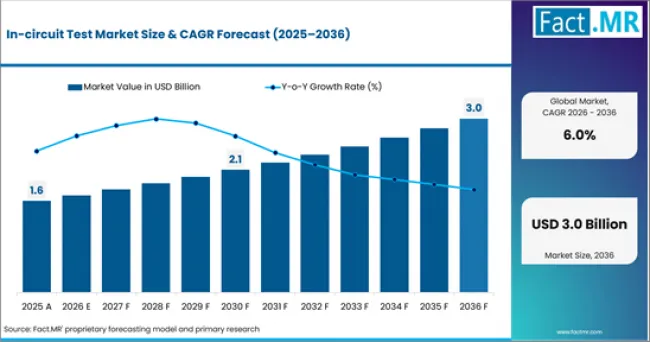
In Circuit Test Market Value Analysis | Source: Fact.MR
Summary of In-circuit Test Market
- Market Snapshot
- In 2025, the global In-circuit Test Market was valued at approximately USD 1.6 billion.
- The market is estimated to reach USD 1.7 billion in 2026 and is projected to attain USD 3.0 billion by 2036.
- The in-circuit test market is likely to expand at a CAGR of 5.8% during the forecast period.
- The market is anticipated to create an absolute dollar opportunity of USD 1.3 billion between 2026 and 2036.
- Automated in-circuit test systems account for 38.6% of the product segment share in 2026.
- China (8.1%) and India (7.5%) are the key growth markets during the forecast period.
- Demand and Growth Drivers
- Rising complexity of printed circuit board assemblies in automotive electronics, 5G infrastructure, and AI-accelerated data center hardware is driving demand for higher fault detection capability in manufacturing test lines.
- Growing adoption of electric vehicles and advanced driver assistance systems is increasing the volume of safety-critical PCBs that require comprehensive in-circuit testing before deployment.
- Expansion of contract electronics manufacturing in Asia Pacific is creating scale-driven procurement of automated in-circuit test platforms to support high-throughput production environments.
- Tightening quality assurance requirements in aerospace, defense, and medical device manufacturing are mandating more rigorous in-circuit test protocols across supply chains.
- Product and Segment View
- Automated in-circuit test systems account for 38.6% of the product segment in 2026, supported by their ability to perform high-speed parametric and structural testing across complex PCB assemblies with minimal operator intervention.
- Electronics manufacturing testing represents 72.5% of the application segment in 2026, with automotive, consumer electronics, telecommunications, and data center PCB production acting as the primary demand channels.
- Modular test platform systems are growing as manufacturers seek flexible test architectures that can be reconfigured for different board designs without full fixture replacement.
- Key segmentation includes:
- Product Type: Automated In-Circuit Test Systems, Bed of Nails Test Systems, Flying Probe Test Systems, Hybrid Test Systems
- Application: Electronics Manufacturing Testing, Automotive PCB Testing, Aerospace and Defense Testing, Medical Device Testing
- End Use: Electronics Manufacturing Companies, Contract Electronics Manufacturers, OEM Quality Assurance Departments
- Technology: Probe Based Testing Technology, Boundary Scan Testing, Combined Structural and Functional Testing
- These systems enable:
- Structural fault detection including opens, shorts, and incorrect component placement across high-density PCB assemblies
- Parametric testing of component values, tolerances, and electrical characteristics at production-line speeds
- Automated defect classification and traceability integration with manufacturing execution systems
- Geography and Competitive Outlook
- North America maintains strong demand supported by automotive electronics reshoring, data center hardware expansion, and defense-grade PCB testing requirements under strict quality standards.
- Europe shows steady growth, with Germany (6.9%) and the UK (5.1%) reflecting demand from automotive tier-1 suppliers, industrial automation manufacturers, and aerospace component producers.
- Asia Pacific is the fastest-growing region, led by China (8.1%) and India (7.5%), where expanding contract electronics manufacturing capacity and growing PCB production volumes are creating scale-driven test equipment demand.
- China (8.1%) and India (7.5%) are the key growth markets, followed by Germany (6.9%), Brazil (6.3%), and the USA (5.7%).
- Key companies active in the market include Teradyne, Inc., Keysight Technologies, Inc., HIOKI E.E. Corporation, SPEA S.p.A., and Test Research, Inc. / TRI.
- Analyst Opinion
- Shambhu Nath Jha, Principal Consultant at Fact.MR, says "The in-circuit test market is being reshaped by the convergence of higher board complexity and stricter reliability requirements across automotive, data center, and aerospace applications. Test platforms are evolving from standalone defect detectors to integrated quality intelligence systems that connect with manufacturing execution platforms and traceability databases. The shift toward chiplet-based semiconductor packaging and multi-layer PCB designs is pushing test coverage requirements beyond traditional structural checks into combined parametric and functional validation. Companies investing in modular, software-defined test architectures are better positioned to address the widening variety of board designs without proportional increases in fixture costs."
Key Growth Drivers, Constraints, and Opportunities
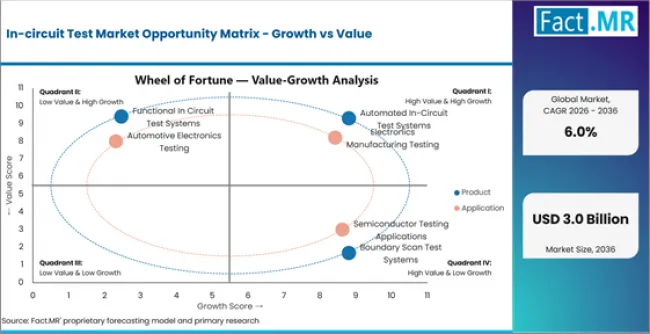
In Circuit Test Market Opportunity Matrix Growth Vs Value | Source: Fact.MR
Key Factors Driving Growth
- Automotive electronics content per vehicle is rising as electric powertrains, ADAS, and connected vehicle systems increase the number of safety-critical PCBs requiring comprehensive structural and parametric testing before assembly into final vehicle systems.
- Data center hardware expansion for AI inference and high-performance computing is generating demand for testing complex multi-layer PCB assemblies used in server motherboards, networking switches, and accelerator cards, where interconnect integrity is essential for system reliability.
- Contract electronics manufacturing growth in Asia Pacific is creating large-scale procurement cycles for automated in-circuit test platforms, as contract manufacturers serving multiple OEMs require flexible, high-throughput test solutions to manage diverse product portfolios.
Key Market Constraints
- Rising PCB miniaturization and higher component density are reducing physical test point accessibility, making traditional bed of nails fixtures more expensive and complex to design for each new board revision.
- Capital expenditure requirements for advanced automated test systems can exceed USD 200,000 per unit, creating procurement barriers for smaller contract manufacturers operating on thin margins in price-competitive markets.
- Growing adoption of alternative testing methods such as automated optical inspection and X-ray inspection is partially displacing in-circuit testing in low-complexity applications, limiting addressable market expansion in some segments.
Key Opportunity Areas
- Integration of in-circuit test data with manufacturing execution systems and Industry 4.0 analytics platforms is creating demand for software-enhanced test solutions that provide real-time defect trending, root cause analysis, and production yield optimization.
- Expansion of defense and aerospace electronics production, driven by global modernization programs and supply chain localization mandates, is generating sustained demand for high-reliability in-circuit test equipment with full traceability capabilities.
- Growing complexity of chiplet-based semiconductor packages that require system-level board testing beyond traditional die-level validation is opening new application areas for advanced in-circuit and combined functional test platforms.
Segment-wise Analysis of the In-circuit Test Market
- Automated in-circuit test systems hold 38.6% of the product type segment in 2026, supported by their high testing throughput, minimal operator intervention requirements, and ability to handle complex multi-point test sequences across dense PCB assemblies.
- Electronics manufacturing testing represents 72.5% of the application segment in 2026, with consumer electronics, automotive, telecommunications, and computing hardware production lines accounting for the bulk of installed test equipment.
- Direct sales to OEMs account for 69.2% of the distribution channel in 2026, reflecting specification-driven test equipment purchases where clients evaluate platforms against board design requirements.
The in-circuit test market is segmented by product, application, end use, technology, platform architecture, distribution channel, and region. By product, the market covers automated in-circuit test systems, boundary scan test systems, and functional in-circuit test systems, with bed-of-nails and flying-probe platforms covered under automated systems. By application, coverage includes electronics manufacturing testing, semiconductor testing applications, and automotive electronics testing. Automated systems lead by value due to their higher throughput and precision, while flying probe systems are gaining share as a fixture-free alternative for lower-volume and prototype testing.
Which Product Type Segment Dominates the In-circuit Test Market?
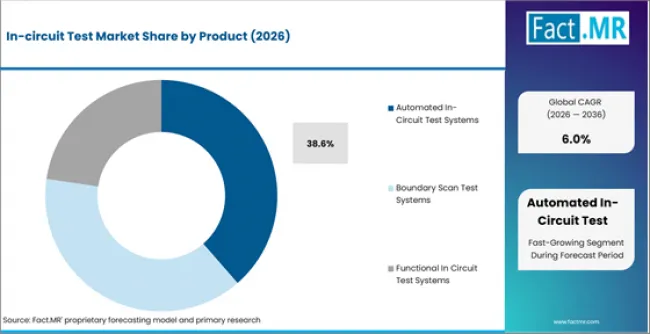
In Circuit Test Market Analysis By Product | Source: Fact.MR
Automated in-circuit test systems account for 38.6% of the product type segment in 2026. Their leadership is built on the ability to perform rapid, repeatable structural and parametric testing across high-volume production lines. These systems use fixed-probe bed of nails fixtures or programmable probe arrays to contact multiple test points simultaneously, enabling comprehensive fault detection in seconds rather than minutes. The combination of speed, accuracy, and low per-unit test cost makes them the preferred choice for high-throughput electronics manufacturing environments.
Flying probe test systems hold a growing but smaller share, valued for their fixture-free design that eliminates the time and cost of building custom fixtures for each board revision. These systems are particularly relevant for prototype testing, engineering validation, and lower-volume production where fixture investment is not justified. Hybrid test systems that combine in-circuit structural testing with functional verification are also gaining traction in automotive and aerospace applications where both fault detection and performance validation are required on the same platform.
Which Application Segment Dominates the In-circuit Test Market?
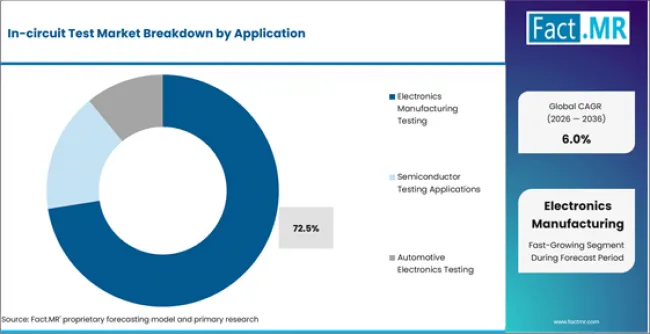
In Circuit Test Market Analysis By Application | Source: Fact.MR
Electronics manufacturing testing is expected to lead the application segment with a 72.5% share in 2026. Demand is driven by the sheer volume of PCB assemblies produced across consumer electronics, computing hardware, telecommunications equipment, and industrial controls. Test coverage requirements are increasing as board designs incorporate finer pitch components, higher layer counts, and more complex interconnect architectures that cannot be reliably verified through visual inspection alone.
Automotive PCB testing holds a significant supporting position, driven by the proliferation of electronic control units, sensor modules, and power electronics in both conventional and electric vehicles. Aerospace and defense testing represents a smaller but high-value segment where zero-defect requirements, full traceability, and compliance with military specifications justify investment in advanced test platforms with comprehensive coverage and data logging capabilities.
Which Product Trend is Shaping the Next Phase of Growth in the In-circuit Test Market?
Software-defined test platforms are emerging as the defining trend in the in-circuit test market. These systems use modular hardware architectures paired with programmable test sequences that can be updated and reconfigured through software rather than physical fixture changes. This flexibility is increasingly important as electronics manufacturers manage growing product variety with shorter design cycles, requiring test equipment that can adapt to new board layouts without proportional increases in fixture tooling costs.
The trend toward software-defined testing also supports deeper integration with manufacturing execution systems and Industry 4.0 data platforms. By treating test results as production intelligence rather than simple pass/fail outputs, manufacturers can use in-circuit test data for real-time process monitoring, defect root cause analysis, and yield optimization. This shift from isolated testing to connected quality management is creating additional value from test equipment investment and strengthening the business case for upgrading from legacy platforms.
Regional Outlook Across Key Markets
- China leads growth at 8.1%, supported by the scale of contract electronics manufacturing, expanding PCB production capacity, and growing quality requirements as domestic manufacturers move into higher-value product categories.
- India follows at 7.5%, driven by electronics manufacturing expansion under PLI scheme incentives, growing automotive electronics production, and establishment of new PCB assembly facilities by both domestic and international companies.
- North America shows steady growth, with the USA at 5.7% supported by automotive electronics reshoring, data center hardware expansion, and defense-grade PCB testing requirements.
- European demand is led by Germany at 6.9%, reflecting automotive tier-1 supplier testing needs, industrial automation electronics, and compliance with EU product safety and reliability standards.
.webp "Top Country Growth Comparison In Circuit Test Market Cagr (2026 2036)")
Top Country Growth Comparison In Circuit Test Market Cagr (2026 2036) | Source: Fact.MR
CAGR Table
| Country | CAGR (%) |
|---|---|
| China | 8.1% |
| India | 7.5% |
| Germany | 6.9% |
| Brazil | 6.3% |
| USA | 5.7% |
| UK | 5.1% |
Source: Fact.MR analysis. Updated Jun 11, 2026
Source: Fact.MR analysis, based on proprietary forecasting model and primary research.
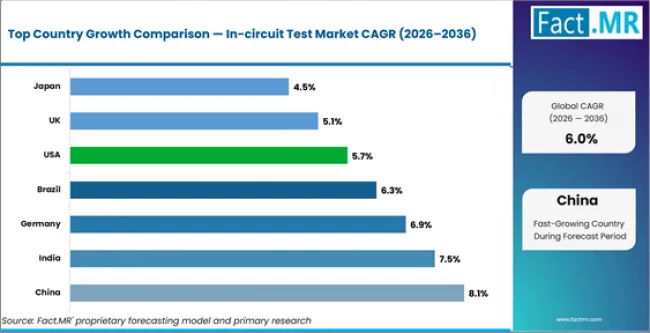
In Circuit Test Market Cagr Analysis By Country | Source: Fact.MR
Market Outlook for In-circuit Testing in the United States
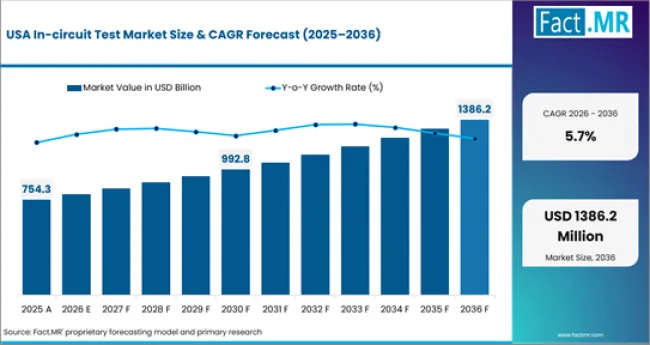
In Circuit Test Market Country Value Analysis | Source: Fact.MR
Reshoring investment under the CHIPS Act and IRA provisions is generating new PCB assembly capacity in the USA, creating procurement cycles for in-circuit test equipment tied to facility buildout timelines. Demand is further supported by defense electronics testing requirements and data center hardware quality assurance for AI server and networking equipment production.
- CHIPS Act facility investments are creating new test equipment procurement tied to domestic assembly expansion.
- Defense-grade PCB testing mandates sustain demand for high-reliability automated test platforms.
China In-circuit Test Market Growth Assessment
Domestic OEM cost advantages and the scale of contract electronics manufacturing make China a major procurement market for in-circuit test equipment. Industrial upgrading policies are pushing manufacturers toward automated test systems as they transition from low-cost assembly to higher-value electronics production requiring stricter quality controls.
- Industrial upgrading policy drives automated test adoption as manufacturers move to higher-value PCB categories.
- Export quality requirements for automotive and telecommunications electronics mandate comprehensive in-circuit testing.
India In-circuit Test Equipment Demand Trends
PLI scheme incentives for electronics manufacturing and growing global OEM investment in Indian PCB assembly facilities are creating sustained demand for in-circuit test platforms. The establishment of new contract manufacturing operations, particularly for smartphones, automotive electronics, and IT hardware, is generating multi-year procurement pipelines for automated test systems.
- PLI scheme-driven electronics manufacturing expansion creates multi-year test equipment procurement cycles.
- Automotive electronics growth in domestic vehicle production supports adoption of reliability-grade testing.
Germany In-circuit Test Market Demand Analysis
DIN standards and EU CE marking requirements shape test coverage needs for German electronics manufacturers, especially in automotive, industrial automation, and medical device sectors. The emphasis on lifecycle cost optimization and Industrie 4.0 integration is driving adoption of software-defined test platforms that connect in-circuit test data with production analytics systems.
- Automotive tier-1 supplier testing needs drive demand for high-throughput automated test systems.
- Industrie 4.0 integration requirements support adoption of connected test platforms with data analytics capabilities.
Competitive Benchmarking and Company Positioning
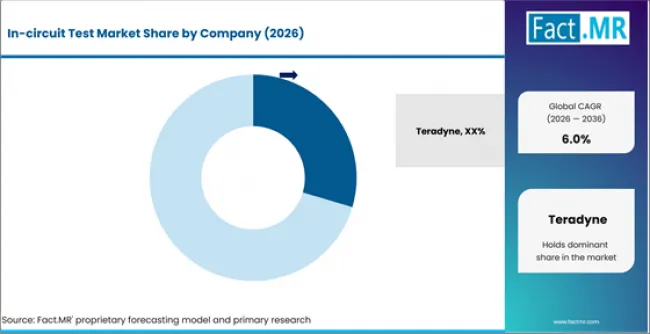
In Circuit Test Market Analysis By Company | Source: Fact.MR
In-circuit Test Market Analysis By Company
- Teradyne, Inc. and Keysight Technologies, Inc. hold strong positions through broad test platform portfolios, established installed bases across major electronics manufacturers, and growing capabilities in software-defined testing and AI data center PCB validation.
- SPEA S.p.A., HIOKI E.E. Corporation, and Test Research, Inc. / TRI participate meaningfully across specific test configurations and regional markets, with competition shaped by fixture design capabilities, testing speed, and price-performance positioning.
- Software integration with manufacturing execution systems creates an important competitive differentiator, as manufacturers increasingly value test platforms that provide production intelligence beyond basic pass/fail defect detection.
The competitive landscape is moderately concentrated, with a small number of established test equipment manufacturers serving a global customer base of electronics manufacturers and contract assemblers. Teradyne, Inc. and Keysight Technologies, Inc. compete through platform breadth, installed base depth, and growing investment in AI-related test capabilities.
Below these leaders, SPEA S.p.A., HIOKI E.E. Corporation, and Test Research, Inc. / TRI maintain positions through specialized test system configurations, competitive pricing, and strong presence in specific regional markets. Competition is also shaped by after-sales support quality, fixture design services, and software platform capabilities.
Key Companies in the In-circuit Test Market
- Teradyne, Inc. and Keysight Technologies, Inc. are the leading players in the in-circuit test market globally, supported by comprehensive test platform portfolios, established relationships with major electronics manufacturers, and growing capabilities in data center and automotive PCB validation.
- SPEA S.p.A., HIOKI E.E. Corporation, and Test Research, Inc. / TRI hold established positions across specific test configurations, regional markets, and application segments, supported by competitive pricing, specialized fixture design capabilities, and strong technical support networks.
Recent Industry Developments
- Teradyne, Omnyx Manufacturing Test Platform Launch (March 2026)
- Teradyne launched Omnyx in March 2026 as a manufacturing test platform for printed circuit board assemblies and sub-assemblies used in AI and data center hardware. The system integrates structural, parametric, high-speed interconnect, and operational testing into a single platform.
- Teradyne, TestInsight Software Acquisition (April 2026)
- Teradyne acquired TestInsight in April 2026 to strengthen semiconductor test development, validation, and conversion software capabilities. The acquisition links TestInsight’s pattern conversion and virtual test tools with Teradyne’s ATE platforms.
- Keysight Technologies, In-Vehicle Network Test Solutions at Automotive Ethernet Congress 2026 (March 2026)
- Keysight Technologies introduced automotive Ethernet receiver compliance test solutions at Automotive Ethernet Congress 2026. The solutions support 10BASE-T1S receiver testing and nGBASE-AU optical automotive Ethernet testing.
Leading Companies Shaping the In-circuit Test Market
- Teradyne, Inc.
- Keysight Technologies, Inc.
- SPEA S.p.A.
- HIOKI E.E. Corporation
- Test Research, Inc. / TRI
Sources and Research References
- Teradyne, Inc. (2026, March 16). Teradyne introduces Omnyx: Redefining board test for the AI era.
- Teradyne, Inc. (2026, April 16). Teradyne acquires TestInsight, accelerating time to market for AI and data center devices.
- Keysight Technologies. (2026, March 25). Keysight unveils next-generation in-vehicle network test solutions at Automotive Ethernet Congress 2026.
Key Questions This Report Addresses
- What is the current and future size of the In-circuit Test Market?
- How fast is the in-circuit test market expected to grow between 2026 and 2036?
- Which product type is likely to lead the market by 2026?
- Which application segment is expected to account for the highest demand by 2026?
- What factors are driving demand for in-circuit test equipment globally?
- How is the shift toward software-defined test platforms influencing the market?
- Why are China and India emerging as the fastest-growing markets?
- How are automotive and data center electronics supporting demand?
- Which countries are projected to show the fastest growth through 2036?
- Who are the key companies active in the In-circuit Test Market?
- How does Fact.MR estimate and validate the market forecast?
In-circuit Test Market Definition
The in-circuit test market covers automated and semi-automated test equipment designed to verify the electrical integrity and component placement accuracy of printed circuit board assemblies during manufacturing. It includes bed of nails fixtures, flying probe systems, boundary scan tools, and hybrid test platforms used across electronics manufacturing, automotive, aerospace, defense, and medical device production.
In-circuit Test Market Inclusions
- The scope covers global and regional market size and forecasts for 2026 to 2036 across product type, application, end use, technology, distribution channel, and region.
- It includes regional demand analysis across major geographies, based on factors such as PCB production volumes, electronics manufacturing capacity, automotive electronics adoption, and quality compliance requirements.
- The report covers technology trends, market drivers and constraints, and the competitive landscape, including product portfolios, testing throughput, geographic reach, and installed base expansion of leading players.
- It includes pricing analysis across entry-level, mid-range, and advanced test platforms, including fixture costs and software licensing models.
In-circuit Test Market Exclusions
- The scope excludes standalone functional test systems that do not perform in-circuit structural or parametric testing of PCB assemblies.
- It excludes semiconductor wafer-level test equipment, chip-level burn-in systems, and probe cards designed for die-level testing rather than assembled board testing.
- The report excludes general-purpose laboratory measurement instruments, oscilloscopes, and signal analyzers not purpose-built for in-circuit testing.
- It also excludes software-only test development tools, simulation platforms, and design-for-test analysis applications sold without hardware integration.
In-circuit Test Market Research Methodology
- The methodology combines secondary research, primary interviews, and forecast modelling.
- It draws on 100+ secondary sources and benchmarks 40+ company product portfolios.
- Market sizing covers 40+ countries through a demand-side model, supported by top-down validation.
- Key inputs include PCB production volumes, electronics manufacturing capacity, automotive electronics adoption rates, and capital equipment spending.
- The model cross-checks demand with equipment shipments, pricing trends, installed base data, and new product launches.
- Primary validation includes 25+ interviews across test equipment manufacturers, contract electronics manufacturers, automotive OEMs, and quality assurance departments.
- Final estimates go through production-volume checks, trade-flow review, and sensitivity testing.
Segmentation
Scope of Analysis
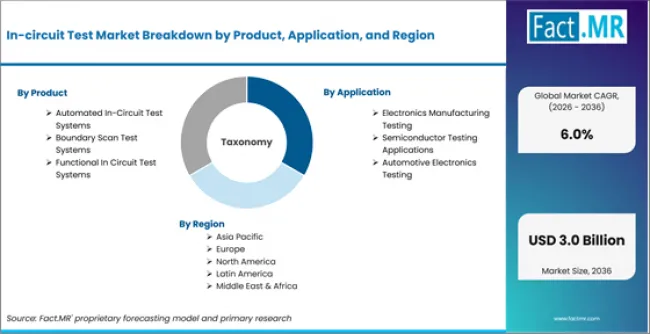
In Circuit Test Market Breakdown By Product, Application, And Region | Source: Fact.MR
| Parameter | Details |
|---|---|
| Quantitative Units | USD billion to USD billion, at a CAGR |
| Market Definition | The In-circuit Test Market covers automated and semi-automated test equipment for verifying electrical integrity and component accuracy of PCB assemblies during electronics manufacturing. |
| Product |
Source: Fact.MR analysis. Updated Jun 11, 2026 Automated In-Circuit Test Systems, Flying Probe Test Systems, Boundary Scan Test Systems, Functional In-Circuit Test Systems |
| Application | Electronics Manufacturing Testing, Semiconductor Testing Applications, Automotive Electronics Testing |
| End Use |
Source: Fact.MR analysis. Updated Jun 11, 2026 Electronics Manufacturing Companies, Automotive Electronics Industry, Semiconductor Industry |
| Technology |
Source: Fact.MR analysis. Updated Jun 11, 2026 Probe-Based Testing Technology, Flying Probe Technology, Boundary Scan Technology, Automated Test Equipment Integration |
| Formulation |
Source: Fact.MR analysis. Updated Jun 11, 2026 Modular Test Platform Systems, Software Defined Test Systems, High Speed Test Architectures, Hybrid Test Formulations, Integrated System Formulations |
| By Distribution Channel |
Source: Fact.MR analysis. Updated Jun 11, 2026 Direct OEM Sales, Industrial Distributors, Online Industrial Platforms |
| Regions Covered | North America, Latin America, Europe, East Asia, South Asia and Pacific, Middle East and Africa |
| Countries Covered | USA, China, India, Germany, Brazil, UK, Japan, 40 plus countries |
| Key Companies | Teradyne, Inc., Keysight Technologies, Inc., SPEA S.p.A., HIOKI E.E. Corporation, Test Research, Inc. / TRI |
| Forecast Period | 2026 to 2036 |
| Approach | Hybrid demand-side and top-down methodology built on country-level PCB production volumes, electronics manufacturing capacity, capital equipment spending, product benchmarking, and primary interviews across test equipment manufacturers, contract electronics manufacturers, and OEM quality departments |
Source: Fact.MR analysis. Updated Jun 11, 2026
In-circuit Test Market Segmentation
-
In-circuit Test Market Segmented by Product:
- Automated In-Circuit Test Systems
- Bed of Nails Test Systems
- Analog Circuit Test Fixtures
- Digital Circuit Test Fixtures
- Flying Probe Test Systems
- Single Probe Test Platforms
- Multi-Probe Test Platforms
- Bed of Nails Test Systems
- Boundary Scan Test Systems
- JTAG-Based Test Systems
- IEEE 1149.1 Compliant Systems
- Advanced Debug Scan Systems
- Non Intrusive Test Systems
- Signal Integrity Test Platforms
- Power Integrity Test Platforms
- JTAG-Based Test Systems
- Functional In Circuit Test Systems
- Hybrid Test Platforms
- Mixed Signal Test Systems
- High-Speed Digital Test Systems
- System-Level Test Integration
- Embedded Board Test Systems
- Module Level Validation Systems
- Hybrid Test Platforms
- Automated In-Circuit Test Systems
-
In-circuit Test Market Segmented by Application:
- Electronics Manufacturing Testing
- PCB Assembly Testing
- SMT Assembly Validation
- Through-Hole Assembly Testing
- Component-Level Testing
- Passive Component Verification
- Active Component Validation
- PCB Assembly Testing
- Semiconductor Testing Applications
- Wafer Level Testing
- Probe Card Testing Operations
- Die Level Validation Systems
- Chip Package Testing
- IC Packaging Verification
- High-Density Interconnect Testing
- Wafer Level Testing
- Automotive Electronics Testing
- ECU Testing Applications
- Engine Control Unit Testing
- Battery Management System Testing
- Infotainment System Testing
- Display Module Validation
- Connectivity System Testing
- ECU Testing Applications
- Electronics Manufacturing Testing
-
In-circuit Test Market Segmented by End Use:
- Electronics Manufacturing Companies
- Contract Electronics Manufacturers
- PCB Assembly Contractors
- System Integration Firms
- OEM Electronics Manufacturers
- Consumer Electronics OEMs
- Industrial Electronics OEMs
- Contract Electronics Manufacturers
- Automotive Electronics Industry
- Tier 1 Automotive Suppliers
- Electronic Module Suppliers
- Vehicle Electronics Integrators
- EV Component Manufacturers
- Battery Electronics Producers
- Charging System Manufacturers
- Tier 1 Automotive Suppliers
- Semiconductor Industry
- Chip Fabrication Companies
- Integrated Circuit Foundries
- Chip Design Houses
- Packaging & Assembly Firms
- IC Packaging Companies
- Testing & Validation Labs
- Chip Fabrication Companies
- Electronics Manufacturing Companies
-
In-circuit Test Market Segmented by Technology:
- Probe-Based Testing Technology
- Mechanical Probe Systems
- Spring Loaded Probe Arrays
- High Density Probe Fixtures
- Flying Probe Technology
- Precision Micro Probe Systems
- Dynamic Movement Probe Systems
- Mechanical Probe Systems
- Boundary Scan Technology
- JTAG Interface Technology
- Digital Signal Access Systems
- Chip Level Debug Interfaces
- IEEE Standard Compliance Systems
- 1149.1 Compliance Engines
- Advanced Scan Chain Systems
- JTAG Interface Technology
- Automated Test Equipment Integration
- Software-Driven Test Systems
- AI Assisted Test Diagnostics
- Predictive Fault Detection Systems
- Hardware Automation Systems
- Robotic Test Handling Systems
- Automated Fixture Control Units
- Software-Driven Test Systems
- Probe-Based Testing Technology
-
In-circuit Test Market Segmented by Formulation:
- Modular Test Platform Systems
- Hardware Modular Architectures
- Plug and Play Test Modules
- Scalable Fixture Systems
- Software Defined Test Systems
- Configurable Test Algorithms
- Cloud Integrated Test Platforms
- Hardware Modular Architectures
- High Speed Test Architectures
- Signal Processing Systems
- High Frequency Test Modules
- Low Latency Measurement Systems
- Data Acquisition Systems
- Multi Channel DAQ Systems
- Real Time Signal Capture Units
- Signal Processing Systems
- Hybrid Test Formulations
- Mixed Signal Architectures
- Analog Digital Hybrid Systems
- Power Signal Testing Systems
- Integrated System Formulations
- End-to-End Test Platforms
- Unified Diagnostic Systems
- Mixed Signal Architectures
- Modular Test Platform Systems
-
In-circuit Test Market Segmented by Distribution Channel:
- Direct OEM Sales
- Enterprise Contract Sales
- Large Scale Manufacturing Contracts
- Long Term Supply Agreements
- Strategic Partnership Sales
- Electronics OEM Partnerships
- Automotive Supplier Agreements
- Enterprise Contract Sales
- Industrial Distributors
- Regional Electronics Distributors
- Test Equipment Resellers
- Automation Solution Distributors
- Global Distribution Networks
- Multi Country Supply Chains
- Authorized Test Equipment Channels
- Regional Electronics Distributors
- Online Industrial Platforms
- B2B Electronics Marketplaces
- Digital Procurement Platforms
- Cloud-Based Equipment Ordering
- Manufacturer Direct Portals
- Online Configuration Systems
- Subscription Based Test Services
- B2B Electronics Marketplaces
- Direct OEM Sales
-
In-circuit Test Market by Region:
- North America
- USA
- Canada
- Latin America
- Brazil
- Chile
- Mexico
- Rest of Latin America
- Western Europe
- Germany
- UK
- Italy
- Spain
- France
- Nordic
- BENELUX
- Rest of Western Europe
- Eastern Europe
- Russia
- Poland
- Hungary
- Balkan & Baltic
- Rest of Eastern Europe
- East Asia
- China
- Japan
- South Korea
- South Asia and Pacific
- India
- ASEAN
- Australia & New Zealand
- Rest of South Asia and Pacific
- Middle East & Africa
- Kingdom of Saudi Arabia
- Other GCC Countries
- Turkiye
- South Africa
- Other African Union
- Rest of Middle East & Africa
- North America
Frequently Asked Questions
What are the key products in the in-circuit test market?
Which application segment is expected to contribute a significant share in the in-circuit test market in 2026?
Which product segment holds the largest share of the In-Circuit Test Market?
Which application segment dominates the In-Circuit Test Market?
What is driving the growth of the In-Circuit Test Market?
Who worked on this report


Preview the report firsthand - request a free sample
Free SampleGet the brochure for pricing and purchase details
Download PDF